



Your clinic’s daily operations depend on efficient patient flow, precise documentation, and smooth billing, not on fighting with your EHR’s quirks or pricing surprises. Yet for many orthopedic practices using WebPT, the software’s rental model and rigid structure can feel like a barrier rather than an enabler. After years of per-user fees, feature gating, and opaque contracts, clinics often find themselves locked in with little to show for their investment besides rising costs and limited control over their own data.
That’s why more orthopedic clinics are actively searching for WebPT alternatives in 2026. Whether your frustration stems from inflexible workflows, unpredictable pricing, or the sense that you’re “renting” your own records, the right alternative can transform operations and cost control. While all-in-one options like Modernizing Medicine, Nextech, and Raintree have their strengths, only a custom Devaims build gives you true ownership, of your platform, your data, and your long-term future. Below, we break down the leading choices, including the only path that lets you stop renting and start owning.
Why orthopedic clinics look for WebPT alternatives
Surprise price hikes: WebPT’s monthly fees can escalate with little notice. As your clinic grows, adding new providers or locations often triggers an automatic increase, and that “growth” doesn’t always bring new features or value. Many practices have reported annual price increases that outpace inflation, with little transparency about what drives the change.
Locked-in workflows: WebPT is designed for the average PT or ortho practice, not your unique processes. If you need custom forms, specialty documentation, or a workflow that reflects your real-world patient journey, you may face hard limits unless you pay for a higher tier or develop awkward workarounds. Over time, these compromises can lead to inefficiency and staff frustration.
Per-user and per-location fees: The common SaaS pricing approach means every new provider, admin, or location is a new line item on your bill. This model penalizes growth and makes budgeting difficult for expanding clinics. Some practices have found their costs doubling simply by opening a second site or hiring a few more therapists.
Feature gating: Essential tools like advanced reporting, telehealth, or granular scheduling are often locked behind premium tiers or billed as add-ons. You may start on a basic plan, only to find that what you really need costs significantly more. This creates a constant trade-off between cost and capability.
Own nothing at the end: After years, even decades, of monthly payments, you don’t own your software, your codebase, or sometimes even your data. Full database exports may be limited, and if you ever decide to switch, you could face a painful, incomplete migration. The risk of vendor lock-in is real.
Given these pain points, it’s no surprise “WebPT alternatives” is a rising search among orthopedic and rehab clinics nationwide.
Quick comparison of the best WebPT alternatives
| Tool | Best for | Starting price | You own it? |
|---|---|---|---|
| Modernizing Medicine (Ortho) | All-in-one ortho practices | Reported $599+/provider/mo | No |
| Nextech | Complex multi-site clinics | Custom quote | No |
| Kareo (Tebra) | Smaller practices | Reported $125+/provider/mo | No |
| AdvancedMD | Integrated billing | Reported $429+/provider/mo | No |
| Athenahealth | Enterprise groups | Custom quote | No |
| ChartLogic | Voice recognition | Reported $350+/provider/mo | No |
| OpNote | Op reporting | Custom quote | No |
| Greenway Health | Ambulatory clinics | Reported $400+/provider/mo | No |
| Raintree | PT/rehab specialists | Custom quote | No |
| Devaims | Clinics wanting to own | One-time build | One-time build, you own it |
Always verify current pricing and demo workflows before making a decision. Published rates often exclude onboarding, training, or integration costs, and add-ons can quickly inflate your actual monthly spend.
The 10 best WebPT alternatives
1. Modernizing Medicine (Ortho) (Best for all-in-one ortho practices)
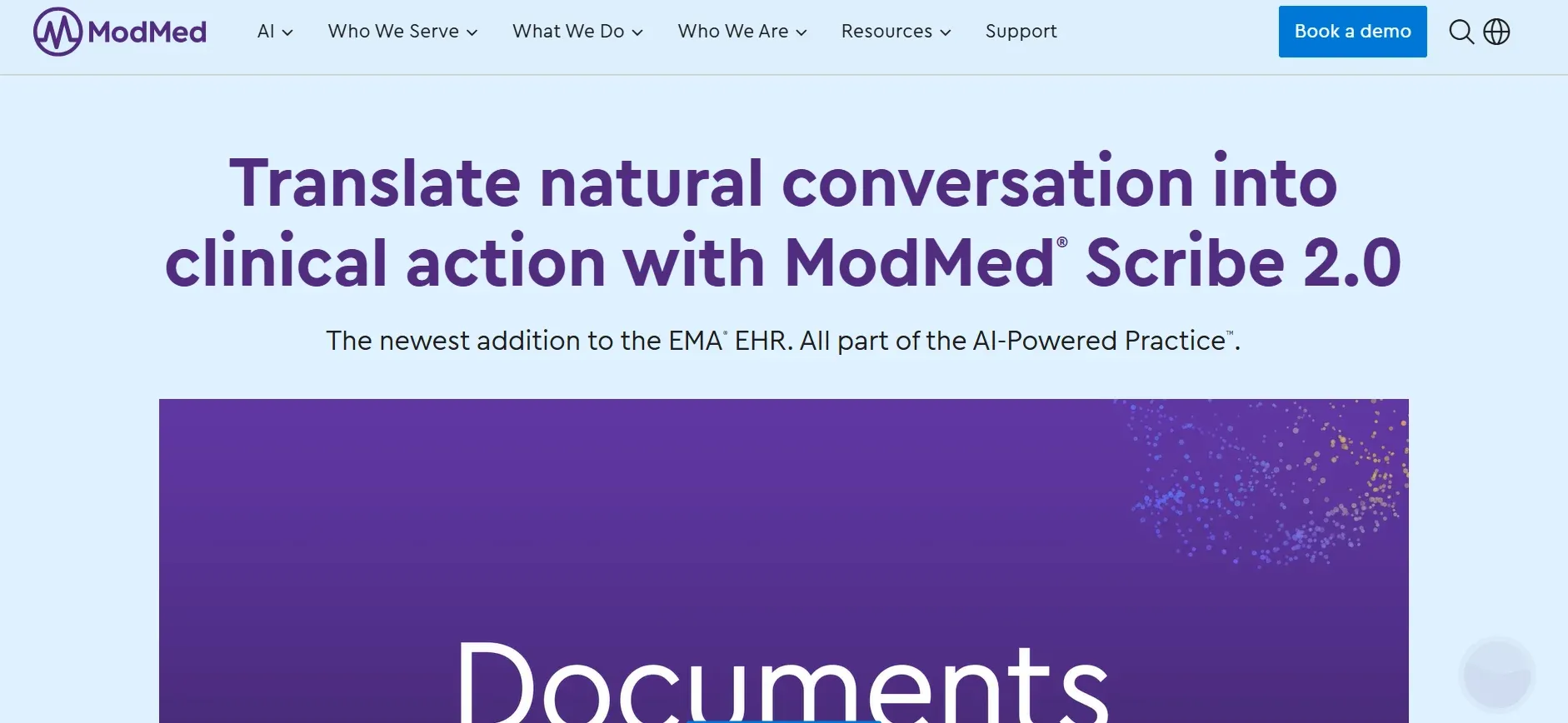
Modernizing Medicine’s Ortho suite stands out for clinics seeking a specialty-tailored EHR, practice management, billing, and patient engagement platform. Its flagship product, EMA Orthopedics, delivers deep orthopedic-specific content, including adaptive templates, built-in orthopedic coding, and electronic prescribing, all designed with input from practicing orthopedists. The system’s adaptive learning tailors forms and suggestions to each provider’s habits, boosting efficiency for high-volume clinics.
Pricing: Reported $599+/provider/month, plus onboarding and add-ons.
- Deep orthopedic content and adaptive templates
- Integrated analytics and compliance tools
- Streamlined onboarding with specialty support
- Per-provider fees add up quickly for larger groups
- Customization beyond standard templates can be costly
- Data export may not include all custom fields or attachments
With a custom Devaims build, your ortho flows and forms are defined by you, with no upcharges or template limitations.
2. Nextech (Best for complex multi-site clinics)
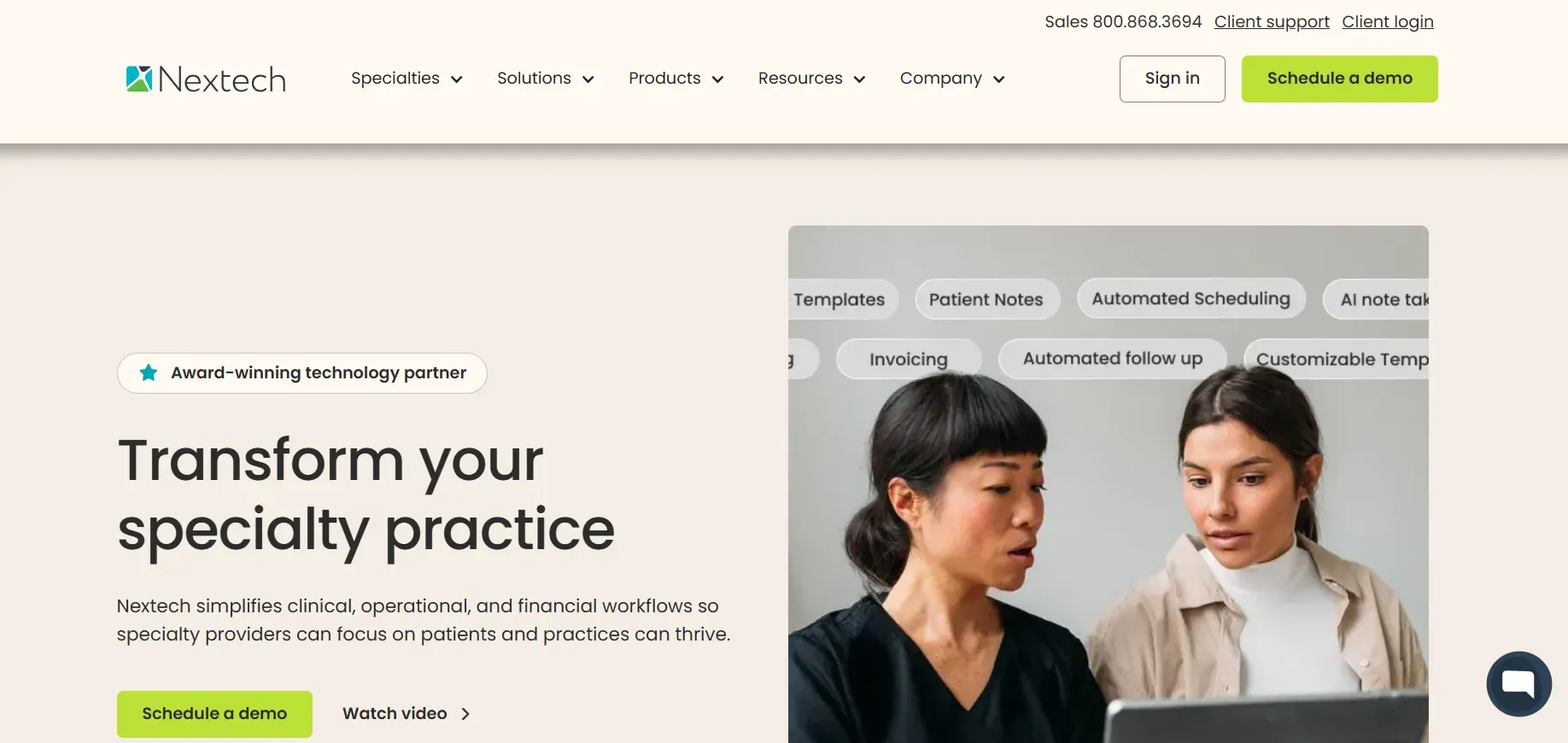
Nextech focuses on large, multi-provider, and multi-site clinics with needs that go beyond basic scheduling and documentation. Its EHR and practice management suite offers advanced multi-location scheduling, role-based access, and customizable workflows. Specialty support covers orthopedics, ophthalmology, and more, allowing for granular permissioning and detailed reporting across locations.
Pricing: Custom quote based on provider count and modules.
- Advanced multi-site scheduling and analytics
- Granular workflow customization
- Strong inventory and billing management
- Opaque pricing and separate add-on costs
- Longer onboarding for large or complex groups
- Ownership and data export limitations
With software you own, adding a new provider or site is no longer a cost event, it’s just your internal process.
3. Kareo (Tebra) (Best for smaller practices)
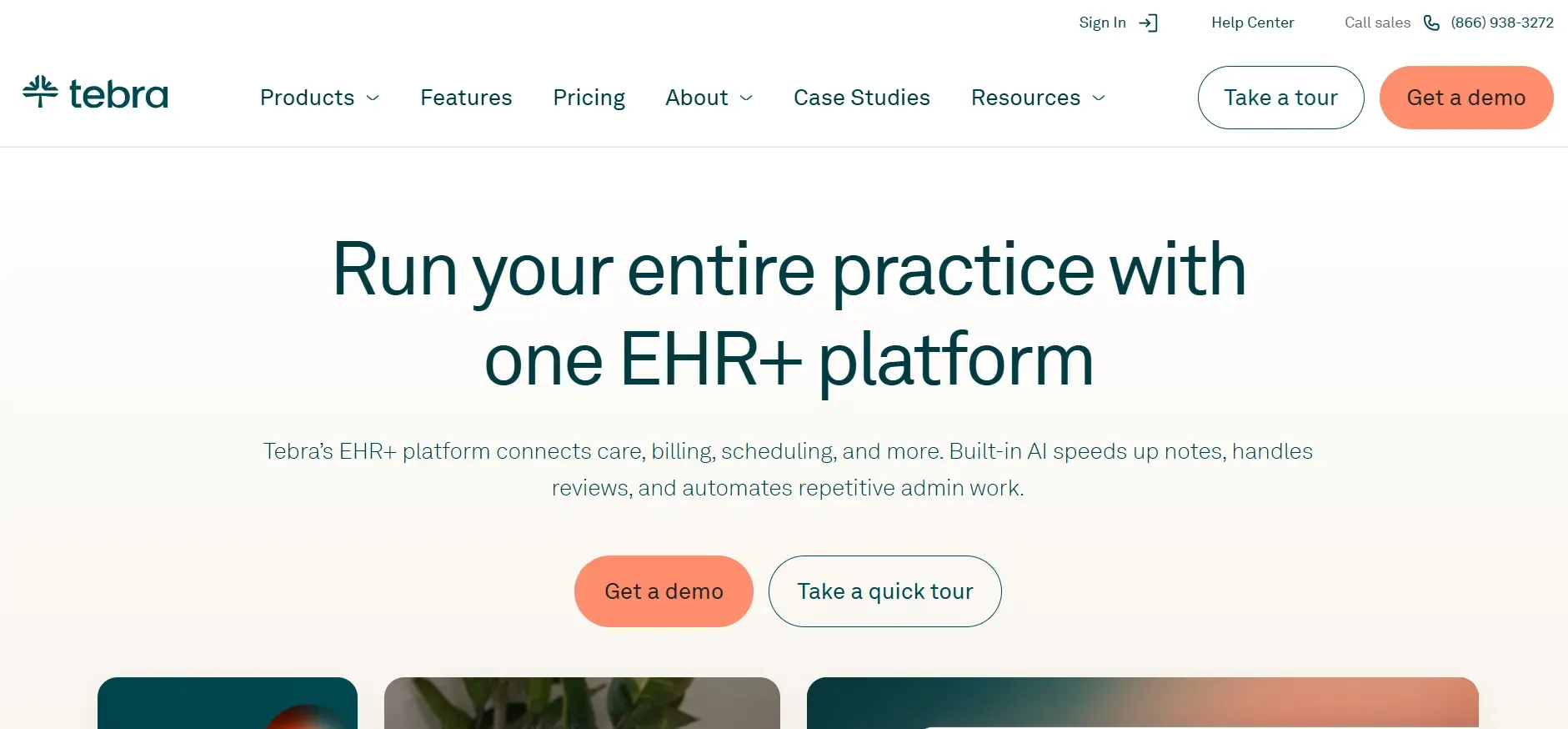
Kareo, now part of the Tebra platform, targets smaller clinics and solo providers with an affordable, easy-to-use EHR and billing solution. The interface is streamlined for speed, with templates suited to primary care and basic ortho/PT workflows.
Pricing: Reported $125+/provider/month, with additional fees for add-ons.
- Affordable for solo and small practices
- Quick onboarding and simple interface
- Integrated billing and patient portal
- Limited customization for advanced reporting
- Scaling up increases per-user costs
- Not designed for multi-location or high-volume groups
4. AdvancedMD (Best for integrated billing)
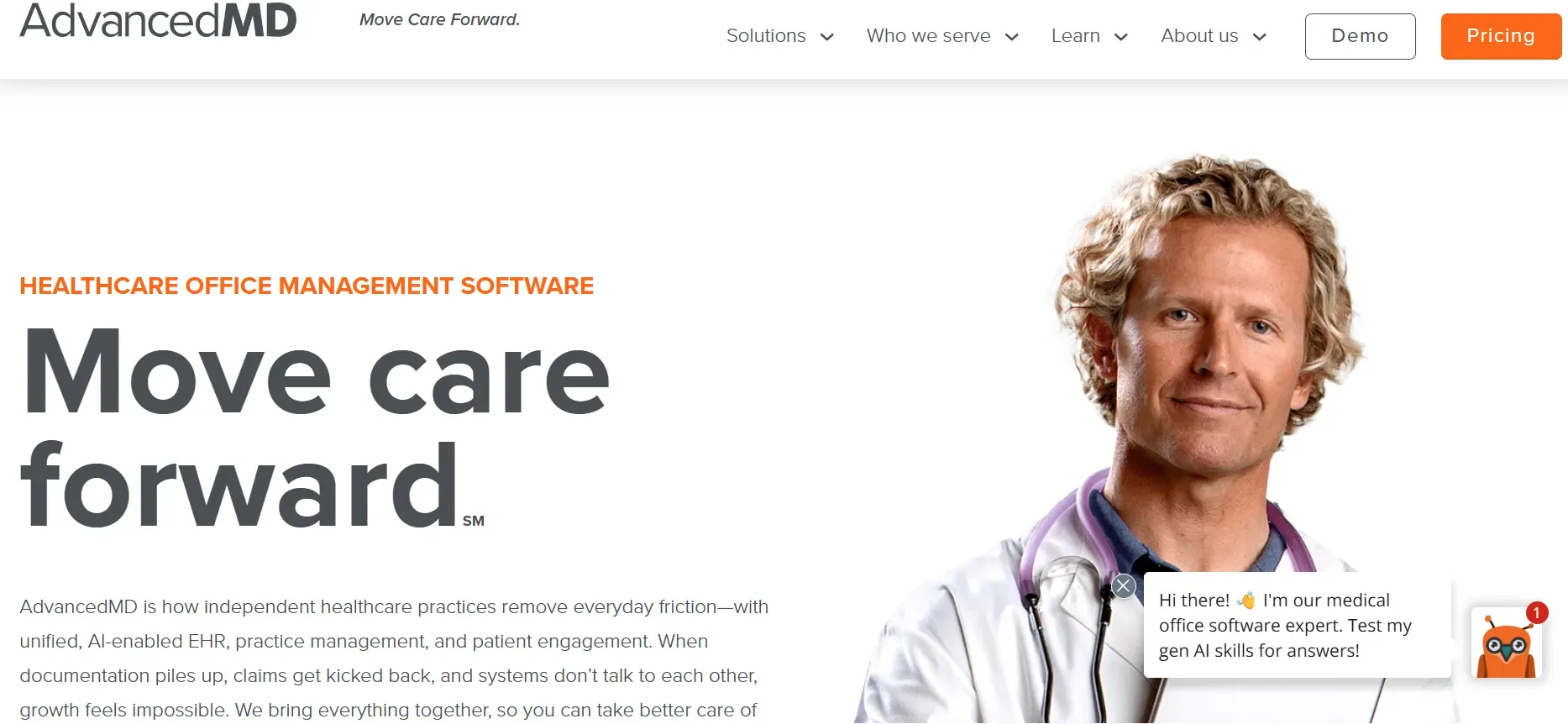
AdvancedMD is designed for clinics that want EHR, scheduling, billing, and telehealth in a modular, cloud-based system. Its strength lies in integrated billing and revenue cycle management, making it a favorite for practices with complex insurance workflows.
Pricing: Reported $429+/provider/month, plus fees for modules and onboarding.
- Powerful billing and revenue cycle tools
- Customizable templates and analytics
- Integrated telehealth and scheduling
- Tiered pricing and separate contracts for modules
- Complex interface may require extra training
- Always rented, never owned
With Devaims, you can select only the modules you need, avoiding feature bloat and forced bundle pricing.
5. Athenahealth (Best for enterprise groups)
Athenahealth is a leader in cloud-based EHR and practice management for enterprise-scale groups. Its platform is built for compliance, scalability, and integration with hospital systems, making it a frequent choice for large orthopedic practices or those affiliated with health systems.
Pricing: Custom quote, often a percentage of collections.
- Enterprise-grade compliance and security
- Integrated telehealth and population health tools
- Strong reporting and analytics
- Expensive for smaller practices
- Feature gating and custom workflows require enterprise contracts
- Data ownership and migration limitations
6. ChartLogic (Best for voice recognition)
ChartLogic is a top choice for orthopedic clinics wanting efficient, accurate voice-to-chart dictation. Its voice recognition engine is tailored for medical vocabularies and allows providers to chart full encounters by dictating, reducing typing and freeing up provider time.
Pricing: Reported $350+/provider/month, plus add-ons for advanced modules.
- Efficient voice recognition and dictation
- Customizable orthopedic templates
- Integrated billing and scheduling
- Advanced modules are add-ons, increasing cost
- Interface is less modern, mobile access limited
- Platform is rented, not owned
7. OpNote (Best for op reporting)
OpNote is a niche tool focused on surgical centers and orthopedic practices needing detailed, structured operative note documentation. Unlike a full EHR, OpNote is designed to complement existing systems by providing rapid op note entry, automation, and standardized reporting.
Pricing: Custom quote, often per-surgeon or per-case.
- Customizable op note templates
- Automated coding and compliance checks
- Integrates with major EHRs and billing systems
- Not a complete EHR or practice management system
- Billing and scheduling features are limited
- Pricing can add up in high-volume environments
8. Greenway Health (Best for ambulatory clinics)
Greenway Health is a longstanding EHR and practice management provider for ambulatory and multi-specialty clinics. Its Intergy platform is known for broad specialty support, customizable templates, and a large network of third-party integrations.
Pricing: Reported $400+/provider/month, plus fees for integrations and onboarding.
- Broad specialty support and integrations
- Customizable templates and analytics
- Patient engagement and telehealth tools
- Per-user pricing can become expensive for larger teams
- Some modules feel dated, interface varies
- Full-fidelity data export not always possible
With a Devaims platform, your data is always accessible, and exporting is as simple as running a query, not filing a support ticket.
9. Raintree (Best for PT/rehab specialists)
Raintree is a favorite among physical therapy and rehab practices. It offers a full suite of scheduling, documentation, and billing tools tailored for PT workflows, including outcome tracking and integrated home exercise programs.
Pricing: Custom quote, varies by modules and provider count.
- Deep PT and rehab specialization
- Automated outcome tracking and analytics
- Multi-location management and patient engagement
- Custom modules and analytics increase costs
- Per-provider and per-location fees penalize scaling
- Implementation is longer than with basic systems
10. Devaims (Best for clinics that want to own their software)
Devaims offers a fundamentally different approach: custom EHR, practice management, and workflow solutions built to your exact specifications, delivered as software you fully own. You define every template, workflow, and integration. After a one-time build fee, the source code and database are yours, with no recurring per-user fees, no contract lock-in, and no forced upgrades.
Pricing: One-time build fee, then optional flat maintenance.
- Full ownership of platform, code, and data
- Unlimited customization and integrations
- No per-user fees or contract lock-in
With Devaims, you gain control and flexibility, and your software investment becomes a capital asset, not a recurring expense.
Other WebPT alternatives worth knowing
- Epic: The industry standard for hospital-owned and large multi-specialty groups. Epic’s comprehensive feature set covers everything from ambulatory documentation to surgical scheduling and analytics. Implementation is complex and costly, and it’s rarely practical for private practices due to licensing and infrastructure requirements. Data ownership is limited, and custom development is tightly controlled by Epic.
- Cerner: Another enterprise EHR with strong compliance and interoperability features. Cerner is frequently used in hospital systems and large outpatient networks. Like Epic, it involves significant implementation costs and long-term contracts. Customization is possible but expensive, and data migration can be challenging.
- SimplePractice: Designed primarily for behavioral health and solo PTs, not for full orthopedic workflow. SimplePractice offers affordable scheduling and documentation, but lacks the specialty templates, reporting, and integration depth needed for most orthopedic clinics.
- Practice Fusion: Known for low cost and easy onboarding, but with limited ortho-specific features. Data export is possible, but customization is minimal. Suitable for micro-practices, but not a full-featured ortho EHR replacement.
How to choose the right WebPT alternative
- Budget: Calculate the true five-year cost, including all users, locations, and required add-ons. Don’t just look at the headline price, real costs often include onboarding, training, integrations, and support. For many clinics, renting ends up costing 2x to 3x more than owning over five years.
- Workflows: Map your critical workflows, forms, and reporting needs. If a platform can’t match your process, you’ll either pay to customize or force your team into inefficient workarounds. Consider how the system handles edge cases, specialty documentation, and compliance requirements.
- Scalability: Will the pricing model and feature set still work as you add providers, locations, or new services? Some platforms penalize growth with per-user or per-location fees, while others allow unlimited scaling for a flat fee, as with Devaims.
- Data ownership: Review the vendor’s export policies and technical documentation. If you ever want to leave, can you get a full, structured export of all your data, including attachments and custom fields? With most SaaS platforms, the answer is “partially.” With Devaims, you own the database and code outright.
- Support and training: Assess the quality of onboarding, ongoing support, and training resources. Will your staff get dedicated help, or just generic videos? Is there a clear escalation path for issues? Custom platforms like Devaims offer tailored training and support designed for your workflows.
If your five-year cost for renting approaches the investment required to build your own, it’s time to consider ownership with Devaims.
Stop paying rent on software you could own
Every alternative above, from WebPT to Greenway and Raintree, keeps you on the rental treadmill: monthly fees, tiered features, and limited data access. Even if you switch vendors, you’re still renting. This model benefits the vendor, not the clinic. Over time, per-user and per-location fees can consume budgets that would be better spent on staff, patient care, or technology you actually own.
Devaims is different. We build your EHR, scheduling, billing, or workflow platform to your exact specification, then hand you the source code and database. You pay once to build, with an optional flat monthly maintenance fee for hosting, updates, or compliance support. There are no contracts, no per-user pricing, and no future lock-in. Your data, your rules, your stack, forever.
Here’s how ownership stacks up against renting for the pain points clinics feel most:
- Per-user pricing? Eliminated. Add as many providers, staff, or locations as you want, no new fees.
- Locked features? You receive every feature you need, not just what a vendor puts on your tier. If you want to add a new workflow or report, it’s yours to define and deploy.
- Export headaches? Gone. With full database and code access, you can export, report, or integrate however you like, no support ticket required.
- Contract anxiety? None. The platform is yours, with no forced renewals or hidden clauses.
| Solution | Monthly cost (10 providers) | Ownership | Feature add-on fees |
|---|---|---|---|
| WebPT | $890+ | Rent | Yes |
| Modernizing Medicine | $5,990+ | Rent | Yes |
| Greenway Health | $4,000+ | Rent | Yes |
| Devaims (owned) | One-time build, then $180/mo maint | You own it | No |
| Year | Rented total (WebPT) | Owned total (Devaims) |
|---|---|---|
| 1 | $10,680 | $29,160 |
| 2 | $21,360 | $31,320 |
| 3 | $32,040 | $33,480 |
| 4 | $42,720 | $35,640 |
| 5 | $53,400 | $37,800 (now ahead) |
Break-even typically comes in year four. After that, every month you own the platform is pure savings. For clinics with stable workflows or growing headcount, the numbers are even more compelling. The larger your team or the more custom your needs, the faster ownership pays off. Want to see a detailed breakdown for your practice? We’ll run the math for you, free of charge.
How to switch from WebPT
- Export your data: Extract all patient, billing, and scheduling data from WebPT, using CSV, HL7, or FHIR formats as available. Request all attachments and historical documents to minimize data loss.
- Choose your new alternative: Select your replacement platform and set up its environment, including user roles, locations, and security settings.
- Import and map data: Import your extracted data, carefully mapping each field to the new system’s structure. Pay special attention to custom forms, attachments, and billing codes to ensure nothing is lost.
- Reconnect integrations: Re-establish connections to payment processors, clearinghouses, labs, imaging, and any other integrated partners. Test each integration to confirm full functionality.
- Train staff: Provide hands-on training for all users, using test patients and dry runs to simulate real workflows. Encourage feedback to refine templates and processes.
- Run in parallel: Operate both systems in parallel for at least one full billing cycle. This allows you to catch and address any discrepancies in claims, documentation, or scheduling before fully cutting over.
- Cancel WebPT: Review your WebPT contract for notice requirements and formally cancel only after you’ve validated the new system and completed the migration.
With a custom Devaims build, the migration is managed as part of your project, including data mapping, validation, and staff training, reducing risk and minimizing downtime.
Frequently asked questions
What is the best WebPT alternative for orthopedic clinics?
For most orthopedic groups, Modernizing Medicine and Nextech provide robust specialty features, while Athenahealth and Greenway offer enterprise scalability. However, only a Devaims build gives you full ownership of your platform, code, and data, allowing for unlimited customization and freedom from recurring fees.
Which WebPT alternative is most affordable?
Kareo (Tebra) is usually the lowest upfront cost for solo providers and small clinics. But as your practice grows, per-user and add-on fees can quickly surpass the cost of building your own platform. Over five years, a custom Devaims build is typically more affordable for mid-sized clinics, especially when you factor in growth and the elimination of recurring fees.
Is there a free WebPT alternative?
Free or very low-cost EHRs like Practice Fusion exist, but they lack the specialty templates, workflow customization, and integration depth required by most orthopedic clinics. They may work for solo PTs or micro-practices, but not for full-scale ortho operations. None of the top alternatives are truly free for comprehensive orthopedic needs.
Can I own my EHR instead of renting?
Yes. With Devaims, you pay a one-time build fee and receive the full source code and database, so you own the entire platform forever. Most WebPT alternatives, even high-end ones, are still SaaS rentals, you never own the code or data structure and can face export limitations if you leave.
How hard is it to switch away from WebPT?
Switching requires careful planning: exporting your data, mapping it to the new platform, retraining staff, and running both systems in parallel for a period. Data migration may be limited by WebPT’s export capabilities. Devaims manages the migration for you and ensures all historical data and attachments transfer, minimizing downtime and errors.
Can I keep my historical data if I leave WebPT?
You can typically export most data from WebPT, but some formats (such as attachments or custom forms) may be limited or require manual intervention. Always request a full export in all available formats. With a Devaims platform, your data is always accessible in full fidelity, and you can export or report on any field at any time.
When does owning beat renting for orthopedic clinics?
Owning your EHR and practice management software pays off for clinics with stable or growing provider counts, complex or custom workflows, or those wanting to avoid per-user fees and contract lock-in. If your five-year rental cost is close to the investment required to build your own, ownership is almost always the better long-term choice.
The bottom line
For orthopedic clinics, renting software like WebPT or its competitors can make sense for small or fast-changing practices, but the math flips for stable or scaling clinics. Here’s the test: add up what your platform will cost over five years, including per-user and add-on fees. If that number could have built you something you own, it’s time to consider ownership.
With Devaims, you gain control: no more contracts, no more surprise hikes, and a system that is yours to shape, keep, and grow. Stop renting your own workflows and start building your clinic’s future.
Explore more insights on the Devaims blog. See related posts: athenahealth alternatives, advancedmd alternatives, greenway health alternatives.