


You know the moment: you run the numbers on BoomTown, find another $3,000 a month in platform fees, and realize you don’t even own the data. Or worse, your team hits a ceiling, features locked behind another tier, integrations that almost work, and a support queue that treats "urgent" as a suggestion. It is the SaaS treadmill every growing real estate agency knows too well.
Even the so-called "alternatives" to BoomTown sound eerily familiar. Different logos, same rental model. But here’s the honest scoop: kvCORE, Chime, Follow Up Boss, Sierra Interactive, LionDesk, Top Producer, Dotloop, Real Geeks, they all rent you access to your own workflows. Over five years, those monthly charges balloon. There is only one way off the SaaS merry-go-round: build something you own, tailored for your agency. That’s where Devaims comes in.
Below, we break down the 9 best BoomTown alternatives, ranked by real agency pain points, cost, lock-in, contracts, and the ownership math. If you’ve ever wondered what it would take to own your CRM, read on.
Why real estate agencies look for BoomTown alternatives
Escalating per-agent and per-lead fees: SaaS pricing models in real estate tech are almost universally built to scale with your headcount or lead volume. What starts as a manageable fee for a small team can easily double or triple as your roster grows, or as you launch new lead generation campaigns. Agencies with rapid hiring cycles or those expanding into new markets often discover that platform costs begin to outpace the value delivered, especially when basic features are only accessible at premium tiers.
Locked-in contracts and minimum commitments: Most leading CRMs and transaction managers require annual or multi-year contracts, sometimes with steep penalties for early exit. These agreements are designed to minimize churn for the vendor, not to offer flexibility for your agency. If your team structure, branding, or workflow shifts, you are often stuck until the renewal window. Some platforms auto-renew with little notice, compounding the headache.
Data portability headaches: Your contacts, notes, deal histories, and communications are the lifeblood of your agency. Yet many platforms restrict bulk exports, or provide only limited data through CSV files or proprietary formats. Custom fields, activity logs, and communication histories are often lost in translation if you try to migrate. Agencies that have built up years of client interactions find themselves trapped, unable to fully extract their data without manual work or additional fees.
Feature gating and forced upgrades: As your agency matures, you'll likely need more sophisticated automations, advanced reporting, or integration with new tools. Many platforms restrict these features to higher-priced tiers or charge extra for access. Essential capabilities like multi-office management, granular permissions, or advanced marketing automations are often held back as upsells, forcing agencies to pay more or make do with less.
Limited customization: Every agency has unique workflows, branding, and compliance needs. Most SaaS platforms offer only surface-level customization, logos, colors, or a handful of custom fields, while the core workflow remains rigid. If your process doesn't fit the platform's assumptions, you're forced to adapt, often at the cost of efficiency and team buy-in. Integrations with other tools (such as accounting, marketing, or analytics) are usually limited to what the vendor supports, and custom development is rarely an option.
If these pain points sound familiar, you’re not alone. It’s why so many agencies search for BoomTown alternatives.
Quick comparison of the best BoomTown alternatives
| Tool | Best for | Starting price | You own it? |
|---|---|---|---|
| kvCORE | All-in-one lead gen, IDX | Reported $499/mo | No |
| Follow Up Boss | Team collaboration | From $69/user/mo | No |
| Chime CRM | Automation-focused shops | Reported $499/mo | No |
| Real Geeks | Simplicity, small teams | Reported $299/mo | No |
| Sierra Interactive | IDX website, CRM | Reported $399/mo | No |
| LionDesk | Budget solo agents | $25/mo | No |
| Top Producer | Old-school CRM loyalists | $99/mo | No |
| Dotloop | Transaction management | $31.99/mo | No |
| Devaims | Owning your full platform | One-time build | One-time build, you own it |
Always confirm current pricing before you decide. SaaS fees and tiers change often. For the most current rates and contract details, check each vendor’s official pricing page or request a quote for your agency’s size.
The 9 best BoomTown alternatives
1. kvCORE (All-in-one lead gen, IDX)
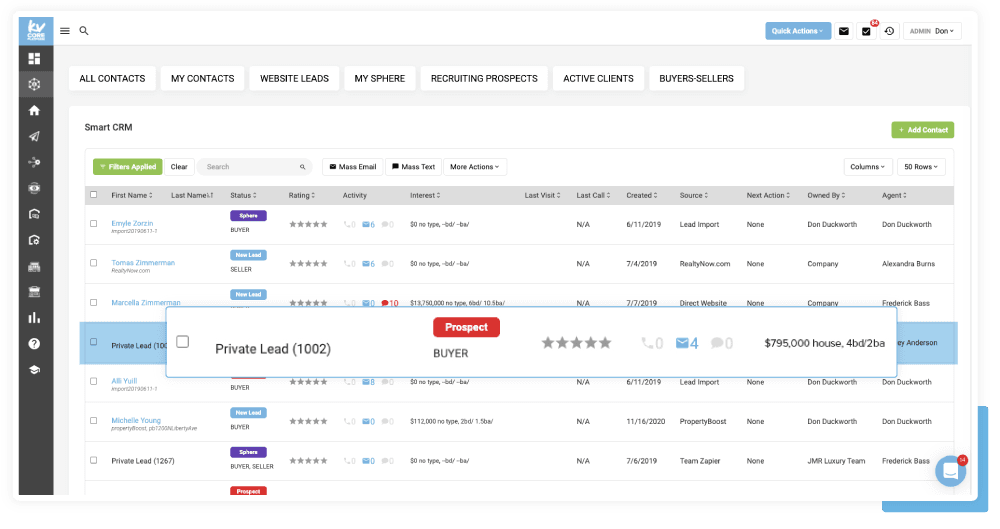
kvCORE is positioned as a comprehensive platform for brokerages seeking to centralize web presence, lead generation, marketing automation, and CRM in a single, unified solution. Designed for scalability, kvCORE is popular with mid-sized and large agencies that want to streamline both agent onboarding and multi-office management.
Pricing: Reported starting at $499/mo, plus per-agent fees. See kvCORE pricing.
- Unified platform for web, CRM, and marketing
- Strong lead routing and automation tools
- Marketplace of integrations and mobile app
- Per-agent pricing and contracts can drive up costs as you scale
- Workflow customization limited by platform design
- Advanced features often require higher-priced plans
If you ever tire of per-agent fees, remember: with a custom Devaims platform, every new user is just another login, not another bill.
2. Follow Up Boss (Team collaboration)
Follow Up Boss is built for agencies that prioritize team collaboration, fast lead response, and integration with lead sources. The platform is known for its clear, agent-friendly interface and rapid onboarding, making it a favorite for fast-growing teams who need to coordinate across roles.
Pricing: Starts at $69 per user per month. See Follow Up Boss pricing.
- Open API and broad lead source integrations
- Unified team inbox and fast onboarding
- Customizable action plans and dashboards
- Per-user pricing increases with team size
- Workflow automation and customization are limited
- Reporting cannot be deeply tailored without workarounds
On software you own, you pick the workflow logic, not the vendor.
3. Chime CRM (Automation-focused shops)
Chime CRM is designed for agencies who want to lean into automation, AI-driven lead scoring, and marketing intelligence. It appeals to tech-forward teams who want to reduce manual work and use smart workflows to nurture leads at scale.
Pricing: Around $499/mo to start, with feature add-ons stacking up. See Chime pricing.
- AI-powered lead scoring and smart plans
- Customizable IDX websites and landing pages
- Marketing automation for email, SMS, and social ads
- AI tools and advanced automations are paid upgrades
- Full customization is not possible
- Costs rise quickly as features are added
4. Real Geeks (Simplicity, small teams)
Real Geeks is built for agencies who want a no-nonsense, easy-to-use platform that covers the basics of lead capture, website presence, and CRM. It is especially favored by smaller teams or independent brokerages who want to avoid complexity.
Pricing: Around $299/mo, plus optional add-ons. See Real Geeks pricing.
- Simple, user-friendly interface
- SEO-friendly IDX websites
- Easy lead capture and follow-up tools
- Limited automation and reporting
- Not ideal for multi-office or large teams
- Integration ecosystem is smaller than larger platforms
That’s the kind of report you would just have if the platform were built for you.
5. Sierra Interactive (IDX website, CRM)
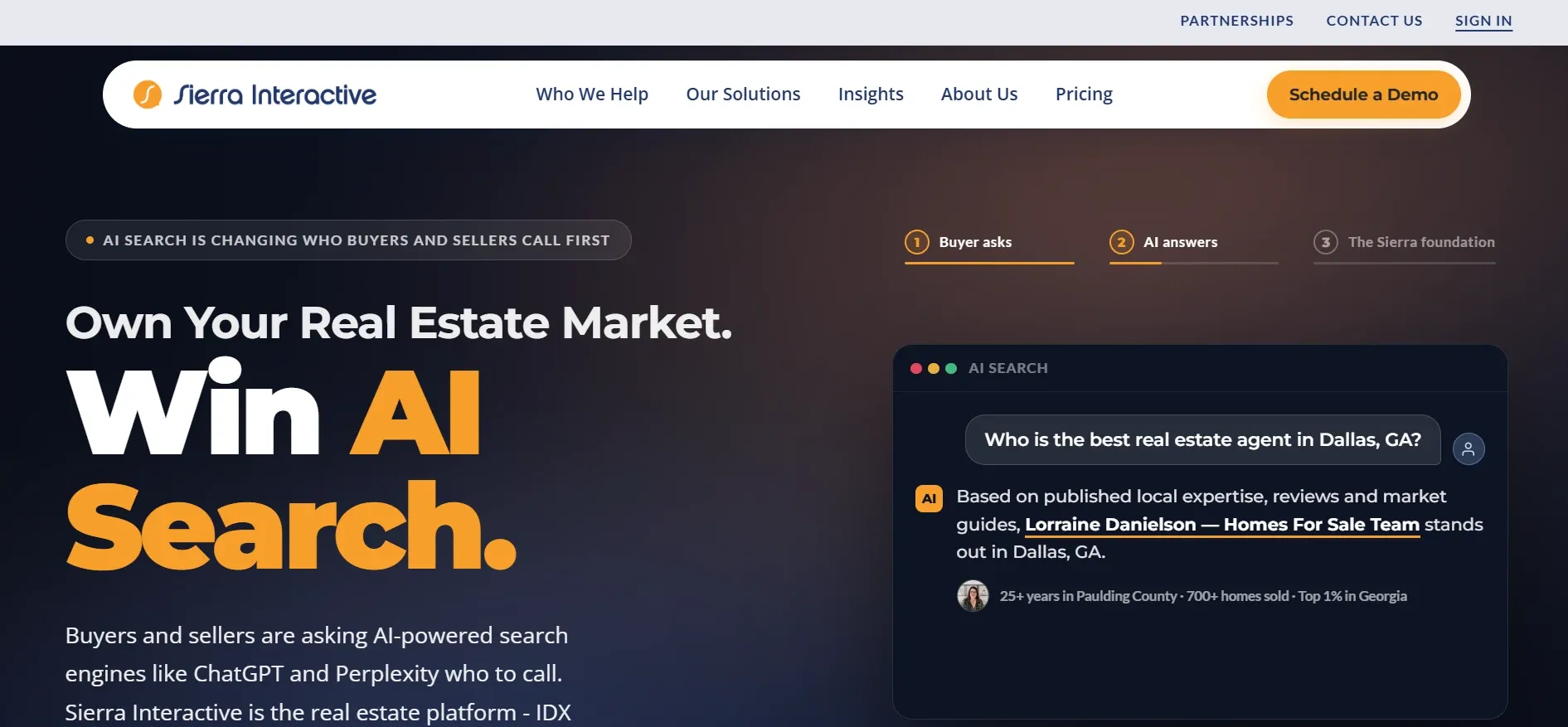
Sierra Interactive is known for its polished, highly customizable IDX websites combined with a robust CRM. Agencies seeking a strong web presence with lead capture and nurture tools often choose Sierra over BoomTown or Real Geeks.
Pricing: Reported at $399/mo, plus setup. See Sierra Interactive pricing.
- Highly customizable IDX websites
- Strong lead attribution and marketing ROI tracking
- Advanced reporting and analytics
- Higher setup fees and ongoing monthly costs
- Advanced features may require premium support or plan upgrades
- Support response times can vary by pricing tier
6. LionDesk (Budget solo agents)
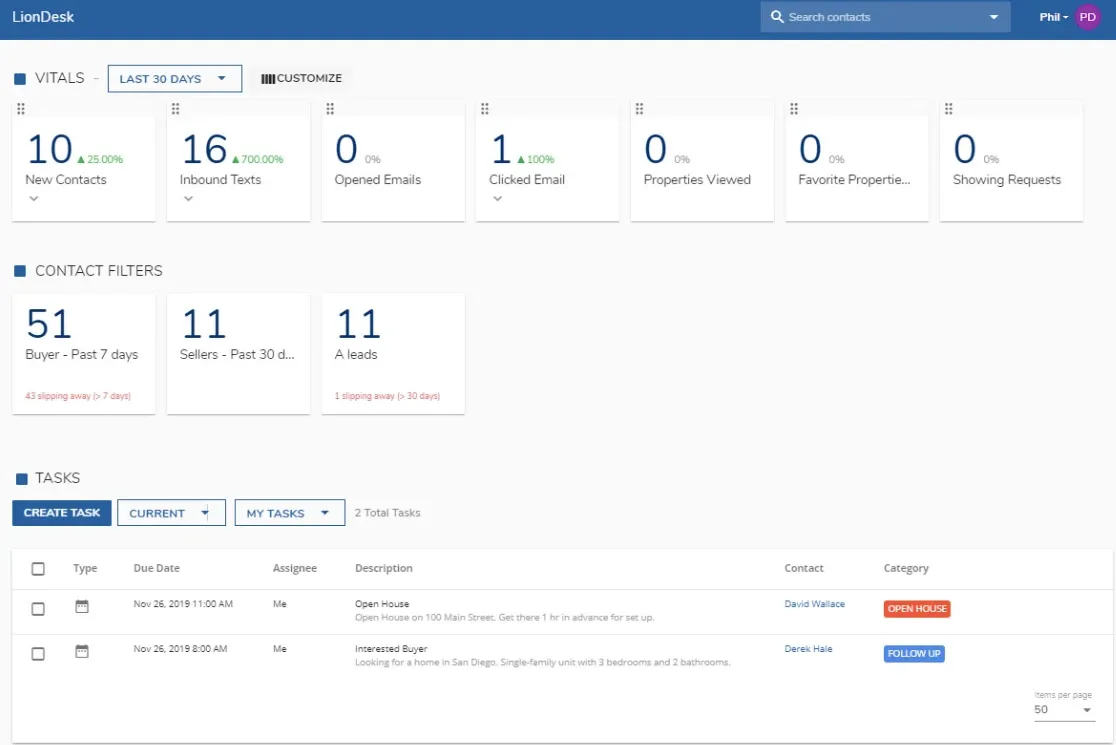
LionDesk is the value pick for solo agents or small teams who want the basics at a low monthly cost. Its core strength is straightforward contact and pipeline management with SMS and email marketing included.
Pricing: Starts at $25/mo. See LionDesk pricing.
- Very affordable for solo agents
- Simple contact and deal management
- Drip campaigns for email and SMS
- Fewer advanced features compared to higher-priced platforms
- Basic interface can feel dated
- Limited automation and workflow customization
7. Top Producer (Old-school CRM loyalists)
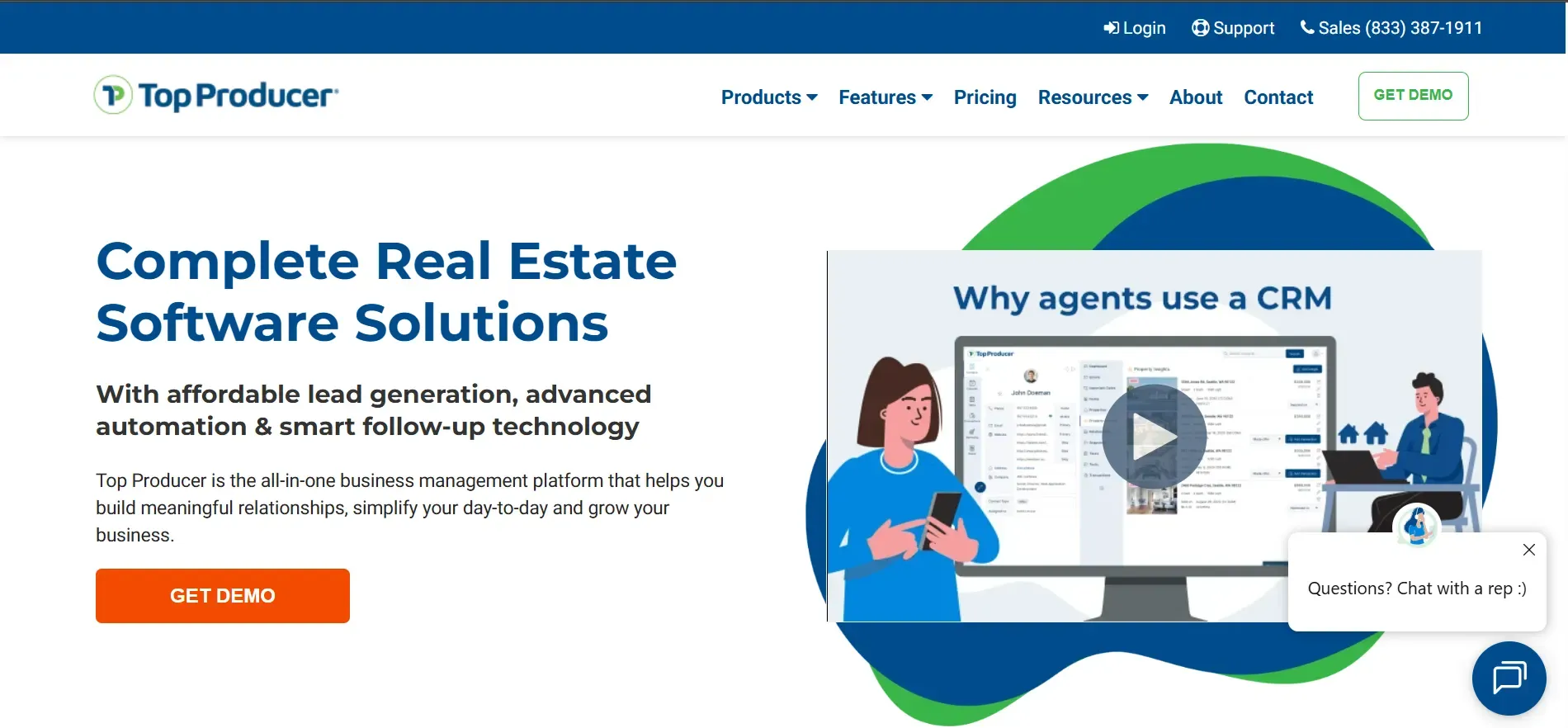
Top Producer is a legacy CRM that has steadily modernized its platform while retaining a focus on contact and transaction management. It appeals to agents and brokerages who value a time-tested solution with a strong support team.
Pricing: $99/mo. See Top Producer pricing.
- Time-tested CRM for real estate
- Strong transaction management and compliance tracking
- Mobile app for on-the-go access
- Interface still feels legacy to some users
- Automation and reporting are less flexible than newer platforms
- Custom integrations and workflow changes are limited
8. Dotloop (Transaction management)
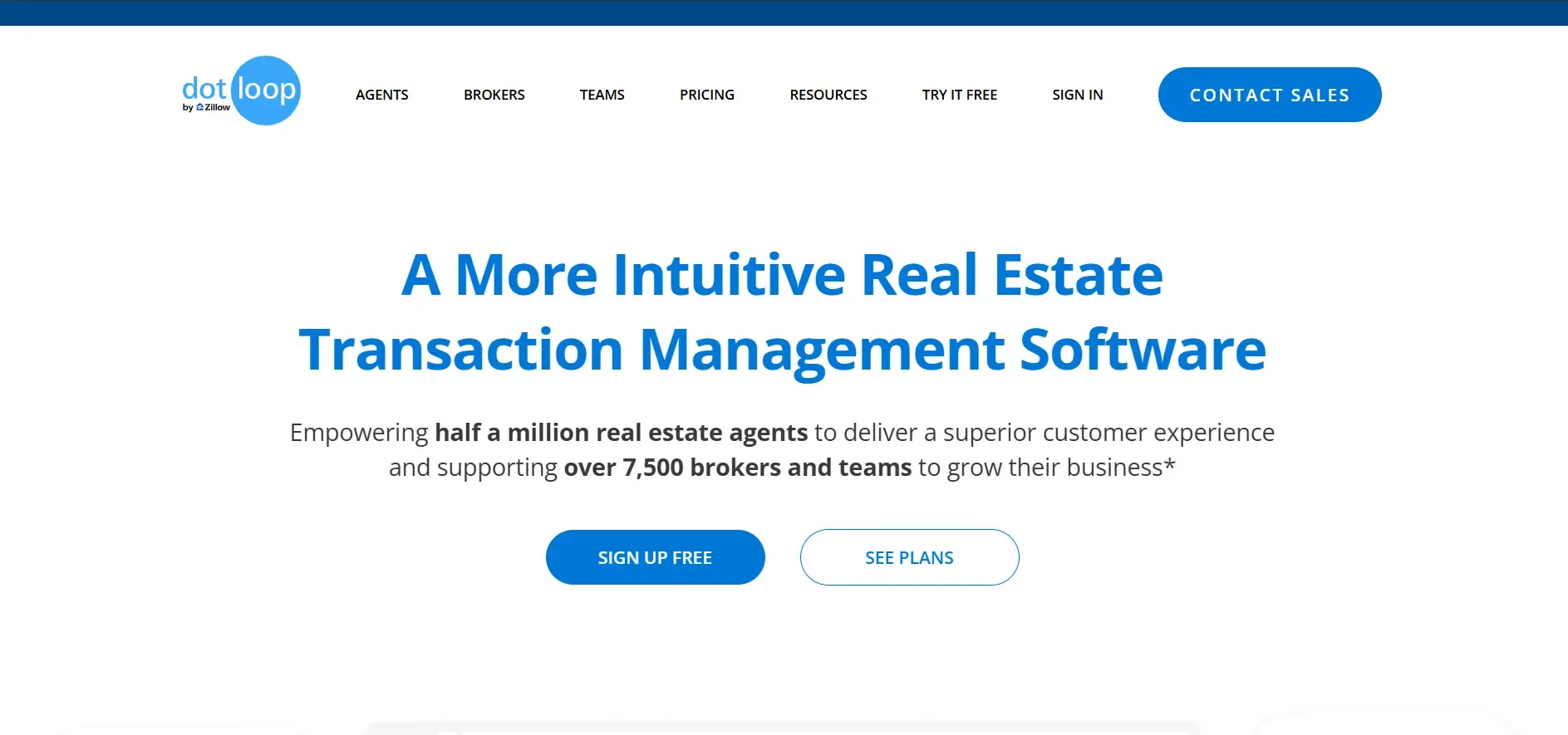
Dotloop is a transaction management platform focused on compliance, e-signatures, and document workflows. It is often used alongside a CRM rather than as a replacement, and is widely adopted by brokerages with strict regulatory requirements.
Pricing: $31.99/mo per user. See Dotloop pricing.
- Strong compliance and audit trails
- Digital e-signature workflow
- Integrates with leading CRMs and back-office tools
- Not a CRM, lacks lead management and marketing tools
- Per-user pricing adds up for larger teams
- Some advanced features are locked to enterprise plans
9. Devaims (Owning your full platform)
Devaims is the only option in this list that puts you in full control. Instead of renting access, you commission a custom platform, CRM, transaction management, agent portal, built to your exact workflow. The result is a system you own, with unlimited users, features, and integrations, and no per-agent or per-feature fees.
- You own the code and the data, forever
- Every feature tailored to your workflow
- No per-user, per-lead, or per-feature fees, flat maintenance only
- No forced upgrades or locked tiers
- Integrates with your existing stack by design
Other BoomTown alternatives worth knowing
- Contactually (now part of Compass): Once a top CRM, now only for Compass brokerages. If you’re in the Compass network, it remains an option with strong relationship tracking, but is unavailable to most independents.
- Lofty: Rebranded from Chime in some regions, offers similar automation and AI features. Pricing and features may vary by market.
- Zurple: Focused on paid lead generation and automated follow-up. Solid for solo agents, but lacks robust team features and deep integrations.
- Propertybase: Enterprise-level CRM and website platform. Powerful, but expensive and often more than most agencies need. Strong Salesforce integration for those already invested in that ecosystem.
Some of these tools are niche or only available as part of larger broker networks, so check if they fit your model before investing time in demos or migrations.
How to choose the right BoomTown alternative
- Budget: Solo agents may favor LionDesk or Top Producer, while large teams need to watch per-user pricing in kvCORE and Chime. As your agency grows, SaaS costs multiply, so factor in your projected headcount over the next 3 to 5 years.
- Feature needs: If you need strong IDX and website tools, Sierra Interactive and Real Geeks shine. For heavy automation and AI-driven lead scoring, Chime is worth a look. Transaction-heavy shops may prioritize Dotloop for compliance.
- Team size: The bigger your team, the more per-user pricing matters. Agencies with 10 or more agents often find custom platforms like Devaims pay off faster due to flat pricing and unlimited users.
- Data ownership: If keeping your data is non-negotiable, rented SaaS will always have limits. True ownership and control are only possible with a custom build or open-source solution.
- Workflow fit: If you’re bending your process to fit the tool, consider if it’s time to switch the other way around. Platforms like Devaims are built to your unique process, no compromises.
If you’re done with rent and want a system that fits your agency cold, owning with Devaims might be the next move. For a deeper dive on choosing real estate CRMs, see this guide from Keeping Current Matters.
Stop paying rent on software you could own
Here’s the cycle: every BoomTown alternative is rented, not owned. You pay per agent, per lead, or per feature, year in and year out. Even if you switch platforms, you’re still paying for access to your own workflows and data. Devaims breaks this cycle by building you a platform that is yours, source code, data, integrations, and all.
Devaims specializes in custom real estate software. We hand over the source code, so you own your tech stack. No contracts, no per-user fees, no SaaS rent. You pay once for the build, then a flat monthly maintenance, forever predictable, forever yours.
- Per-user and per-feature fees: Gone. Every agent and feature is included, no upcharge.
- Locked-in contracts: Gone. You own the code, so your agency is always in control.
- Data portability headaches: Gone. The database is yours, move, export, or integrate as you want.
- Feature gating: Gone. Every workflow and report is built to your specs.
- Support tiers: Gone. Flat maintenance gives you direct access to your builders.
| Platform | Ownership | Pricing model | Contract? | Custom workflows? |
|---|---|---|---|---|
| BoomTown | No | Per month, per agent, add-ons | Yes, annual or multi-year | Limited |
| kvCORE | No | Monthly, per agent | Yes, typical | Some |
| Follow Up Boss | No | Monthly, per user | No | Limited |
| Chime CRM | No | Monthly, feature add-ons | Yes, typical | Some |
| Devaims | Yes | One-time build, flat maintenance | No | Fully custom |
5-year cost math for a 15-agent agency:
| Year | BoomTown (rent) | kvCORE (rent) | Follow Up Boss (rent) | Devaims (own) |
|---|---|---|---|---|
| 1 | $3,000 x 12 = $36,000 | $1,000 x 12 = $12,000 | $69 x 15 x 12 = $12,420 | $30,000 build + ($200 x 12) = $32,400 |
| 2 | $72,000 | $24,000 | $24,840 | $30,000 + ($200 x 24) = $34,800 |
| 3 | $108,000 | $36,000 | $37,260 | $30,000 + ($200 x 36) = $37,200 |
| 4 | $144,000 | $48,000 | $49,680 | $30,000 + ($200 x 48) = $39,600 |
| 5 | $180,000 | $60,000 | $62,100 | $30,000 + ($200 x 60) = $42,000 (now ahead) |
For most agencies, owning with Devaims pulls ahead by year 5, sometimes sooner, depending on scale and feature needs. If you want to run your agency’s numbers, we’ll do the math with you, free.
Agencies with stable teams, clear processes, and a growth mindset see the biggest win from owning. Once you’re done paying rent, your margins grow every year and your platform grows with you, no surprise fees, no forced migrations, and no more adapting your workflow to someone else’s roadmap. Read why some brokerages are building their own CRMs on Inman.
How to switch from BoomTown
- Export all leads, contacts, notes, and deal data from BoomTown (CSV or API export where available). Pay special attention to custom fields, tags, and communication logs, these are often missed in basic exports.
- Choose your new CRM or transaction platform, or scope a custom build with Devaims. Consider how your workflow may change and what data structures you’ll need.
- Import your data into the new system, mapping fields and checking for errors or mismatches. Test the import process with a small data set first, then do a complete migration.
- Reconnect all third-party integrations, lead sources, and payment tools. This may include MLS feeds, marketing automation, accounting, or analytics platforms. Verify that all connections are working as expected.
- Train your agents and admins on the new workflows, focusing on major differences and new features. Provide documentation and schedule Q&A sessions to ensure adoption.
- Run both systems in parallel for a week or two to ensure nothing gets dropped. Monitor lead flow, communication, and transactions in both systems for consistency.
- Review your old contract for termination steps and final data pulls. Make sure you have all required data and meet any contractual obligations before shutting down BoomTown.
With a custom Devaims build, the migration is handled as part of the project, including data mapping, quality checks, and agent onboarding. This reduces the risk of data loss and accelerates adoption.
Frequently asked questions
What is the best BoomTown alternative for large real estate teams?
For large teams, kvCORE and Chime CRM are the most common alternatives due to their scalability, robust lead gen, and automation. They offer multi-office management and advanced routing, but costs can spiral with per-agent pricing and contracts. If you want to break the rent cycle, Devaims is the only alternative where you own the full stack, control all customizations, and pay a flat fee no matter how large your team grows. This is especially impactful for brokerages with 20 or more agents or those planning aggressive expansion.
Which BoomTown alternative is cheapest for solo agents?
LionDesk is the lowest-cost option at $25 per month, but its features are basic, good for managing contacts and running simple drip campaigns. Top Producer is a mid-tier option at $99/month, offering deeper transaction management and better support, but still lacks advanced automation. Free CRMs exist (such as HubSpot’s free tier), but they are not tailored for real estate workflows and lack MLS or IDX integrations.
Is there a free BoomTown alternative?
No major real estate CRM is fully free. While some platforms offer free trials or limited free tiers (such as HubSpot CRM, Zoho CRM, or Bitrix24), these lack real estate-specific features like IDX, transaction management, and compliance tools. For full-featured solutions, expect to pay monthly or per-user fees unless you build your own or use open-source tools (which require significant setup and support).
What’s the best BoomTown alternative for compliance?
Dotloop is the leading transaction and compliance platform. Dotloop is favored for its user-friendly e-signature workflows and audit trails. It is commonly used alongside a CRM for a complete tech stack. If you need custom compliance workflows or integration with specialized back-office tools, a custom build like Devaims is the only way to fully control the process.
Can I migrate my BoomTown data to a new platform?
Yes, but the process can be complex. Most alternatives provide import tools for basic contacts and deals, but custom fields, notes, and communication logs may require manual mapping or vendor support. Some data (such as activity histories or custom workflows) may not transfer at all. Devaims includes full data migration as part of the build, preserving all your historical records and custom fields. Plan for a test migration and data cleanup before going live.
Why do so many agencies look for BoomTown alternatives?
The biggest drivers are escalating SaaS rent, data lock-in, and lack of true ownership. Agencies want more predictable costs, freedom to customize workflows, and the assurance that their client data remains fully under their control. As agencies grow, the per-agent pricing and feature gating of SaaS platforms become more restrictive, and the risk of being trapped in a vendor’s roadmap grows.
How does Devaims compare to other BoomTown alternatives?
Devaims is the only alternative where you own the code, the database, and the integrations. Over five years, the total cost is often lower than renting a SaaS platform, especially for agencies with more than 10 to 15 users. There are no forced upgrades, no feature gating, and no risk of sudden price hikes or contract changes. The long-term savings and control are significant.
The bottom line
Here is how to know when it is time to stop renting: run the five-year math. If your subscription fees for BoomTown or any alternative add up to more than it would cost to build your own, you can own your platform, and the future of your agency. That’s a decision that adds up every year you keep growing.
Ownership is the only way to permanently break free from per-agent fees, feature gating, and contract headaches. If you want to see the numbers for your agency, we’ll run them, no strings attached.
For more in-depth guides, visit the Devaims blog. You might also like kvCORE alternatives, Chime CRM alternatives, and Follow Up Boss alternatives. For a deeper industry perspective, see RISMedia’s guide to choosing a real estate CRM.