


Ever get that sinking feeling when another Meditech invoice lands? The base price is never the end, and every time your urgent care center adds a provider or opens a new location, the fees quietly grow. Worse, you do not even own the system you rely on daily, Meditech just rents it to you, holding your data and processes hostage behind monthly payments. If you have ever wondered what else is out there, you are not alone.
There are a handful of Meditech alternatives for urgent care that promise better usability, more integrations, or friendlier support. Athenahealth, Epic, and Experity are the big names, but even when they solve some Meditech headaches, they introduce their own, different fees, new limitations, and the same old SaaS rental model. At the end, the only way to truly be free of per-user fees and lock-in is to own your platform outright. That is where a custom build from Devaims changes the equation.
Below, we break down the honest pros, cons, and hidden costs of the leading Meditech alternatives. We wrap with the ownership math and what it would look like if your urgent care center finally stopped renting its software.
Why urgent care centers look for Meditech alternatives
Hidden per-seat and per-location fees: Meditech seems affordable until you add providers or locations, then costs balloon with every new user.
Rigid workflows and slow customization: Need a custom report or patient flow tweak? Expect long waits, extra contracts, or a flat "not possible" from Meditech support.
Locked-in integrations: Hooking up labs, imaging, or billing partners means extra fees and red tape, or sometimes a flat "not supported" answer.
Data ownership headaches: Exporting your own data for analytics or migration is slow, manual, and sometimes carries a fee.
Contract lock-in and surprise price hikes: Multi-year agreements and annual price increases are the norm, not the exception, with Meditech and most alternatives. Every Meditech alternatives search starts with these pain points.
Quick comparison of the best Meditech alternatives
| Tool | Best for | Starting price | You own it? |
|---|---|---|---|
| Athenahealth | Cloud EHR, broad integrations | Reported $140-225/mo/provider | No |
| Epic | Enterprise urgent care, hospital-linked | Custom quote, often $200K+ setup | No |
| Experity | Urgent care workflow, scheduling | Custom, reported ~$500+/mo/location | No |
| Kareo (Tebra) | Practice management, small groups | Reported $125+/mo/provider | No |
| AdvancedMD | All-in-one, telemedicine | Custom, reported $250+/mo/provider | No |
| eClinicalWorks | Ambulatory, flexible add-ons | Custom, often $449+/mo/provider | No |
| NextGen | Multi-site, configurable | Custom, reported $299+/mo/provider | No |
| PrognoCIS | Compliance-focused urgent care | Custom, reported $250+/mo/provider | No |
| Devaims | Owning your urgent care platform | One-time build, you own it | Yes |
Always confirm current pricing before you decide, hidden integration or support fees are common in urgent care EHRs.
The 9 best Meditech alternatives
1. Athenahealth (Best for cloud EHR and integrations)
Athenahealth is a cloud-based EHR and practice management suite with strong third-party integrations and a slicker interface than Meditech. Many urgent care centers switch for real-time insurance eligibility checks and smoother e-prescribing, but the pricing model is familiar: pay per provider, forever.
Pricing: Reported $140 to $225 per provider per month, custom quotes for larger groups. See Athenahealth pricing.
- Strong claims and eligibility tools
- Broad third-party integration marketplace
- Cloud-based, no hardware required
- Per-provider pricing adds up as you grow
- Some integrations and analytics cost extra
- Limited workflow customization
On software you owned, extra providers and locations would not raise your cost. With Athenahealth, every new hire is a new recurring fee.
2. Epic (Best for enterprise urgent care or health system links)
Epic is the 800-pound gorilla for large health systems, offering deep hospital and network connectivity. For urgent care centers, Epic brings massive feature depth and interoperability, but it is overkill and over-budget for most independents. Implementation is long, and you still do not own it.
Pricing: Custom quotes only. Implementations often start at $200,000+ with ongoing support fees.
- Unmatched integration with major hospitals
- Deep reporting and analytics
- Industry standard for interoperability
- High upfront and ongoing costs
- Complex, lengthy implementations
- Rigid to customize without developer help
With a custom build, you could pick just the workflows you need, not pay for a hospital's worth of features.
3. Experity (Best for urgent care workflow and scheduling)
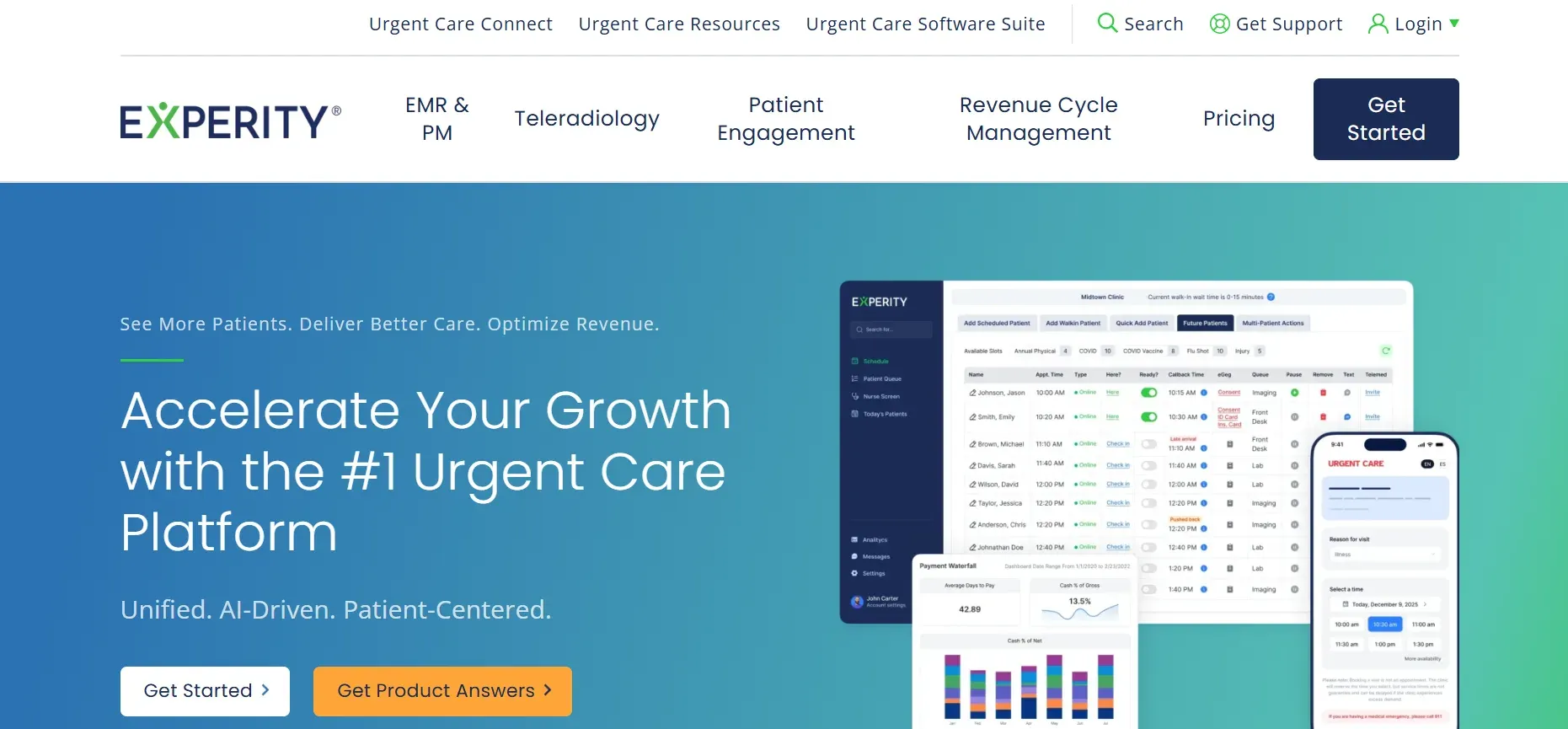
Experity (formerly Clockwise.MD) was purpose-built for urgent care, with patient self-scheduling, queue management, and a solid billing stack. It is quicker to deploy than Meditech or Epic, but you are renting, not owning, and advanced analytics or integrations are upsells.
Pricing: Custom, often around $500+/mo per location, plus onboarding.
- Patient self-scheduling and queue tools
- Good urgent care billing features
- Implementation faster than most
- Per-location and add-on fees
- Some integrations require extra contracts
- Limited long-term customization
That scheduling workflow? If it is core to your process, you would just own it outright in a Devaims build, no extra monthly fee.
4. Kareo (Tebra) (Best for smaller urgent care groups)
Kareo, now part of Tebra, targets small to mid-sized urgent care shops with basic EHR and billing features. It is simpler than Meditech, but reporting is locked behind tiers and customization is limited. If you outgrow the platform, migrating is not painless.
Pricing: Reported $125+/mo per provider. See Kareo pricing.
- Simple onboarding for small teams
- Solid billing and insurance integrations
- Affordable entry price
- Limited advanced reporting unless you upgrade
- Per-provider pricing model
- Fewer urgent care-specific features
That custom report you need? You would just have it if the platform were built for you.
5. AdvancedMD (Best for telemedicine and all-in-one PM)
AdvancedMD gives urgent care centers a single dashboard for scheduling, telemedicine, EHR, and billing. Its interface is more modern than Meditech, but most features are à la carte. Customization and integration come with extra fees or developer hours.
Pricing: Custom, reported $250+/mo per provider depending on features. See AdvancedMD pricing.
- All-in-one interface
- Telemedicine workflows
- Decent patient portal
- Feature bundles drive up cost fast
- Extra fees for telemedicine and integrations
- Customization is limited to what is in the platform
When you own your system, you control which features matter and pay for them exactly once.
6. eClinicalWorks (Best for ambulatory and specialty add-ons)
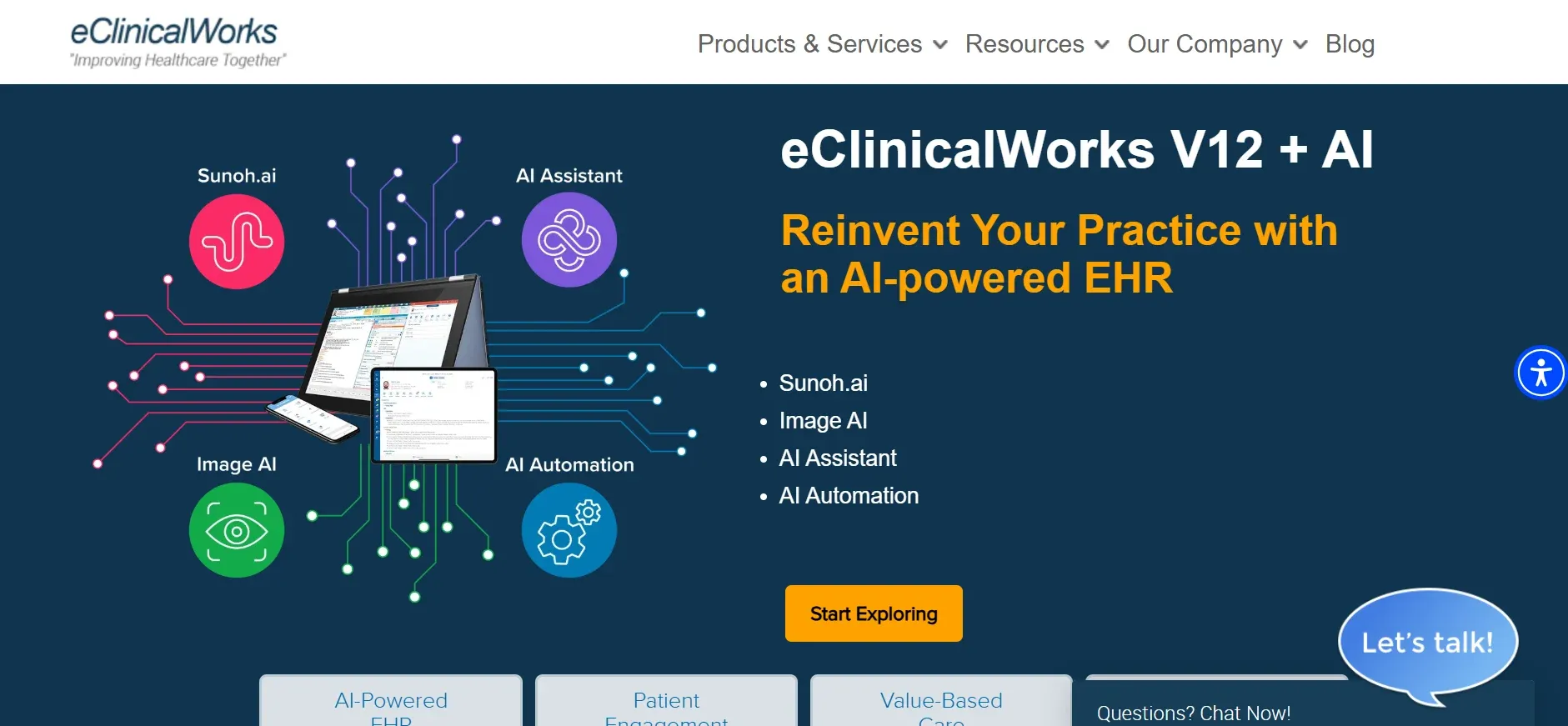
eClinicalWorks is a long-standing EHR with deep ambulatory care options and plenty of add-ons. Urgent care operators often switch for more flexible scheduling and billing, but you pay for every extra, just like Meditech.
Pricing: Custom, often $449+/mo per provider. See eClinicalWorks pricing.
- Flexible for multi-specialty groups
- Decent telehealth and e-prescribe tools
- Strong compliance track record
- Expensive as your provider count climbs
- Many features are paid add-ons
- Interface can feel dated
Hidden per-provider fees are just not a thing when you own the code.
7. NextGen (Best for configurable, multi-site urgent care)
NextGen is known for scalable, configurable EHRs with multi-site support and strong compliance. It is more adaptable than Meditech, but every integration and workflow tweak is a negotiation, plus the usual SaaS rental math.
Pricing: Custom, reported $299+/mo per provider. See NextGen pricing.
- Multi-location and specialty support
- Configurable workflows
- Good compliance, meets urgent care standards
- Customization costs extra
- Per-provider pricing model
- Onboarding can be time-consuming
With a Devaims build, onboarding is staged to your workflow, not a generic playbook.
8. PrognoCIS (Best for compliance-focused urgent care)
PrognoCIS offers EHR and practice management for urgent care centers emphasizing compliance and regulatory reporting. Compared to Meditech, it offers a more modern interface and some urgent care-specific workflows, but customization is still limited by what the platform supports.
Pricing: Custom quotes, often starts around $250+/mo per provider. See PrognoCIS pricing.
- Built-in regulatory and compliance tools
- Modern interface for urgent care
- Telemedicine support
- Compliance features often add-on
- Customization limited to templates
- Support can lag for complex issues
On a Devaims platform, compliance tools are built to match your real process, not what a vendor offers.
9. Devaims (Best for urgent care centers who want to own their platform)
Devaims builds custom EHR and urgent care platforms designed to your workflow, with full source code and data ownership. You pay to build it, then it is yours, no per-user, per-location, or monthly rental fees. Integrate with labs, imaging, billing, and any partner you want, and adapt the platform as your center evolves.
- One-time build, then flat monthly maintenance
- You own the platform and the code
- No per-user, per-location, or feature-upgrade fees
- Fully tailored to your urgent care workflow
Other Meditech alternatives worth knowing
- Healow: Good for patient engagement, but less comprehensive for full urgent care workflows.
- iPatientCare: Flexible EHR, but more focused on small practices than urgent care.
- Nuvolo: Asset management and operations, not a direct EHR replacement.
These are niche options, great for specific use cases, but not a full urgent care EHR alternative like the main list.
How to choose the right Meditech alternative
- Budget reality: Add up what you actually spend after fees, integrations, and per-seat pricing.
- Workflow fit: Demo the actual urgent care workflows, not just the generic demo.
- Integration needs: List every lab, imaging, and billing partner you connect to. Ask about real integration costs and delays.
- Scalability: If you plan to grow, simulate pricing with 2x your current providers and locations.
- Ownership: Decide if you want to keep renting or if it is time to own.
If you are tired of multiplying per-seat fees, take a serious look at what owning your own urgent care platform would cost, and save, over five years.
Stop paying rent on urgent care software you could own
The reality of urgent care EHRs, Meditech, Epic, Athenahealth, and the rest, is that you are always renting. Every provider, every location, every integration, every year. Even if you switch, you are still locked into someone else's roadmap and recurring fees. The only way out is to own your platform outright.
Devaims builds custom urgent care software that matches your workflow, integrates with your partners, and puts your data and code in your hands. You get a platform tailored to your needs, with no per-user or per-location upcharges and no vendor lock-in. You own the source code, the database, and the roadmap.
- No more per-seat or per-location fees: Pay once to build, then flat maintenance. Add users or locations at no extra cost.
- Full data and process ownership: Export, analyze, or migrate whenever you want. No data ransom.
- Integrations on your terms: Labs, billing, imaging, anything you need, not what a vendor offers.
- Custom workflows and reports: Your process, not theirs.
| Tool | Ownership | Per-user/location fees | Custom workflows | Data export |
|---|---|---|---|---|
| Meditech | No | Yes | Limited | Manual/fee |
| Athenahealth | No | Yes | Some | Partial |
| Experity | No | Yes | Some | Manual |
| Devaims | Yes | No | Full | Full control |
| Year | Rent (SaaS, cumulative) | Own (Devaims, cumulative) |
|---|---|---|
| 1 | $36,000 | $35,800 |
| 2 | $72,000 | $38,600 |
| 3 | $108,000 | $41,400 |
| 4 | $144,000 | $44,200 |
| 5 | $180,000 | $47,000 (now ahead) |
For a 5-provider, 2-location urgent care center paying $3,000 per month for a SaaS EHR, the break-even on a Devaims build is just after year one. After five years, you have saved over $130,000 and own the platform outright. If you are spending more, or plan to grow, the savings multiply. We will run your real numbers for you, no pressure.
How to switch from Meditech
- Export all patient records, billing data, and schedules from Meditech (request a complete export format if possible).
- Choose your new platform, whether a SaaS alternative or a custom build.
- Import data into the new system and map workflows to match your real process.
- Reconnect labs, billing, and insurance integrations, and test each integration.
- Train staff on the new workflows and user interface.
- Run both systems in parallel for at least one billing cycle to catch issues.
- Review Meditech contract for exit steps and confirm data retention or deletion.
With a custom Devaims build, the migration is handled as part of the project.
Frequently asked questions
What is the best Meditech alternative for urgent care centers?
Athenahealth and Experity are strong choices for urgent care, with Epic suitable for hospital-linked centers. If you want to own your platform and avoid ongoing fees, a custom Devaims build is the real alternative.
Which Meditech alternative is most affordable for small urgent care clinics?
Kareo (Tebra) and AdvancedMD offer lower entry prices, but watch out for per-provider and add-on fees. Over five years, a custom Devaims build often costs less than renting if you are growing.
Is there a free Meditech alternative?
There are open-source EHRs, but none are tailored for urgent care and all require IT resources to implement. Most alternatives are paid SaaS or custom.
Which Meditech alternative has the best urgent care scheduling features?
Experity leads in patient queue and scheduling tools, but you pay per location. Devaims can build scheduling tailored to your exact urgent care flow, owned by you.
How do Meditech alternatives handle integrations with labs and billing?
Most SaaS platforms charge for integrations or limit you to their partners. When you own your platform with Devaims, you can connect any lab, billing, or imaging partner you want, on your schedule.
When should urgent care centers switch from Meditech?
If per-user fees, integration headaches, or limited customization are slowing you down, it is time to compare Meditech alternatives. Add up your total cost over five years before deciding.
Can I keep my Meditech data if I switch?
You can export your data from Meditech, but the process can be slow and may require support. With Devaims, you own your data and can export it anytime without extra fees.
The bottom line
The right Meditech alternative for your urgent care center depends on what you value most, ease of use, deep integrations, or true ownership. But here is the takeaway: if your five-year SaaS bill could have paid for a system you own, it is time to rethink renting. Ownership means control, savings, and freedom from price hikes. Add up your real numbers, and you might never rent again.
Keep exploring at the Devaims blog or see more alternatives: Epic alternatives, Athenahealth alternatives, Experity alternatives.