


Ever felt the sting of a LexisNexis renewal? Maybe it was a "small" annual increase or a feature locked behind yet another tier. Maybe you watched the bill climb, per user, per case, per month, until it was less your software and more your landlord. You are not alone. Law firms everywhere are looking for LexisNexis alternatives that fit their real needs and don’t hold their data hostage.
Not every alternative is truly different. Most are still rented, just with a different name on the invoice. Your best bets in 2026: Clio for an all-in-one suite, MyCase if you want easy client comms, and PracticePanther for automation. But if you are tired of renting, there is only one way to truly own your platform, building with Devaims. Let’s dig in.
Why law firms look for LexisNexis alternatives
Per-user and per-matter fees add up fast. What starts as an affordable monthly fee becomes a budget headache as your team or caseload grows. Many law firms begin with one or two users, but as you scale, you quickly see the compounding effect: a 10-person team can easily pay over $500/month, not counting premium add-ons. Over five years, that number can become staggering, especially when you realize you never own the product.
Locked-in workflows slow you down. LexisNexis and most rivals don’t flex to your firm’s way of working. You may want to automate a unique intake process, trigger custom reminders, or integrate with your favorite accounting tool. But customization is often limited to surface-level tweaks, with deeper changes requiring costly professional services or not being possible at all. This rigidity can force your staff into inefficient workarounds, reducing productivity and morale.
Data export is limited or painful. Try moving data out of LexisNexis and you’ll hit friction, proprietary formats, partial exports, or extra fees. For example, some platforms export only basic client or case data, but not your full document library, billing history, or communications logs. You might receive data in non-standard formats requiring manual cleanup, or worse, be told that certain data types cannot be exported at all. Your own data shouldn’t be chained up.
Surprise price hikes and add-ons. Many firms get hit with "required" upgrades, forced add-ons, or sudden price jumps. Budgeting feels like a moving target. For example, you might sign up at one price, only to see it increase by 10% or more at renewal. Sometimes, essential features like e-signatures, advanced analytics, or secure messaging are moved to higher tiers, forcing you to upgrade or lose functionality.
Limited integration with the rest of your stack. Whether it’s payments, accounting, or custom client touchpoints, most rented platforms box you in. Integrations might exist, but they’re often shallow (e.g., one-way syncs) or limited to a small set of partners. If your firm relies on specialized tools, such as custom CRM, local court filing portals, or industry-specific billing, you may find yourself stuck with manual data entry or unreliable workarounds. That’s why so many firms search for LexisNexis alternatives.
Quick comparison of the best LexisNexis alternatives
| Tool | Best for | Starting price | You own it? |
|---|---|---|---|
| Clio | Full-suite practice management | Reported $39/user/mo | No, subscription |
| MyCase | Client communication | Reported $49/user/mo | No, subscription |
| PracticePanther | Automations and task flows | Reported $49/user/mo | No, subscription |
| Lawmatics | CRM and intake | Reported $99/user/mo | No, subscription |
| CosmoLex | Accounting integration | Reported $89/user/mo | No, subscription |
| Rocket Matter | Time and billing | Reported $39/user/mo | No, subscription |
| Smokeball | Document automation | Reported, contact for quote | No, subscription |
| Devaims | Owning your law firm platform | One-time build, then $150-230/mo maint | One-time build, you own it |
Always confirm current pricing before you decide, rates and tiers shift constantly. Also, consider implementation and migration costs, which can add thousands to your total investment whether you rent or own.
The 9 best LexisNexis alternatives
1. Clio (full-suite practice management)
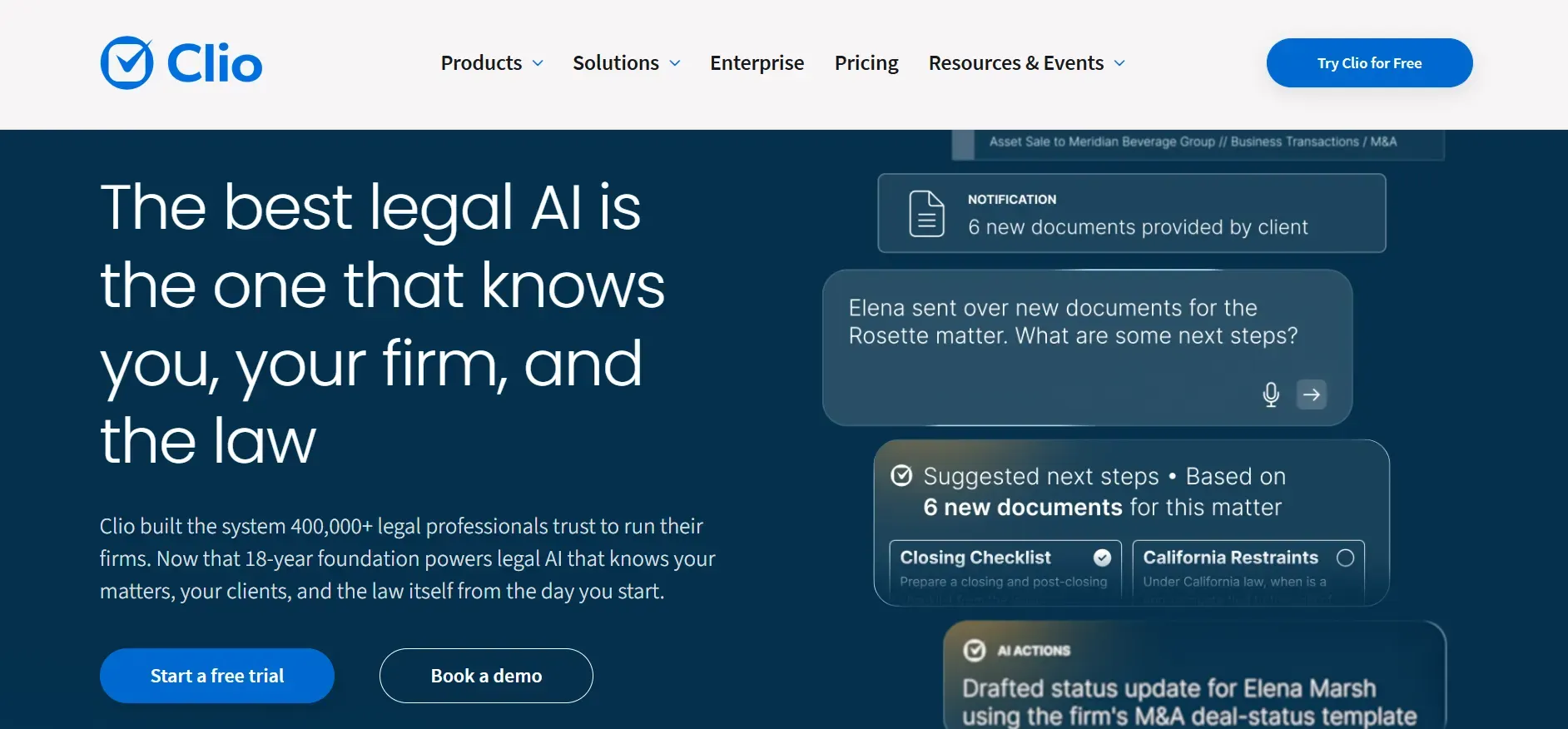
Clio is the household name for law practice management, offering case tracking, billing, document management, and client communications in one rented suite. Its modern web-based interface is a breath of fresh air compared to many legacy solutions. Clio Manage (the core platform) covers case and contact management, calendaring, time tracking, and billing, while Clio Grow adds CRM and client intake features.
Clio’s app marketplace is one of its strongest points, offering over 200 integrations with popular tools like QuickBooks Online, Dropbox, and Microsoft 365. This lets firms connect Clio to their accounting, calendaring, and document workflows with relative ease. Clio’s API is open and well-documented, so tech-savvy firms can build custom integrations if needed.
Pricing: Starts at $39/user/month for Clio Manage. Higher tiers unlock advanced reporting, budgeting, and custom roles.
- Key limitations:
- Per-user pricing adds up as you grow
- Advanced features locked to higher tiers
- No source code or deep workflow customization
- Strengths:
- Polished, intuitive interface and mobile apps for iOS/Android
- Broad integration ecosystem
- Reliable support and extensive self-help resources
On software you owned, those per-user fees disappear after year one.
2. MyCase (client communication)
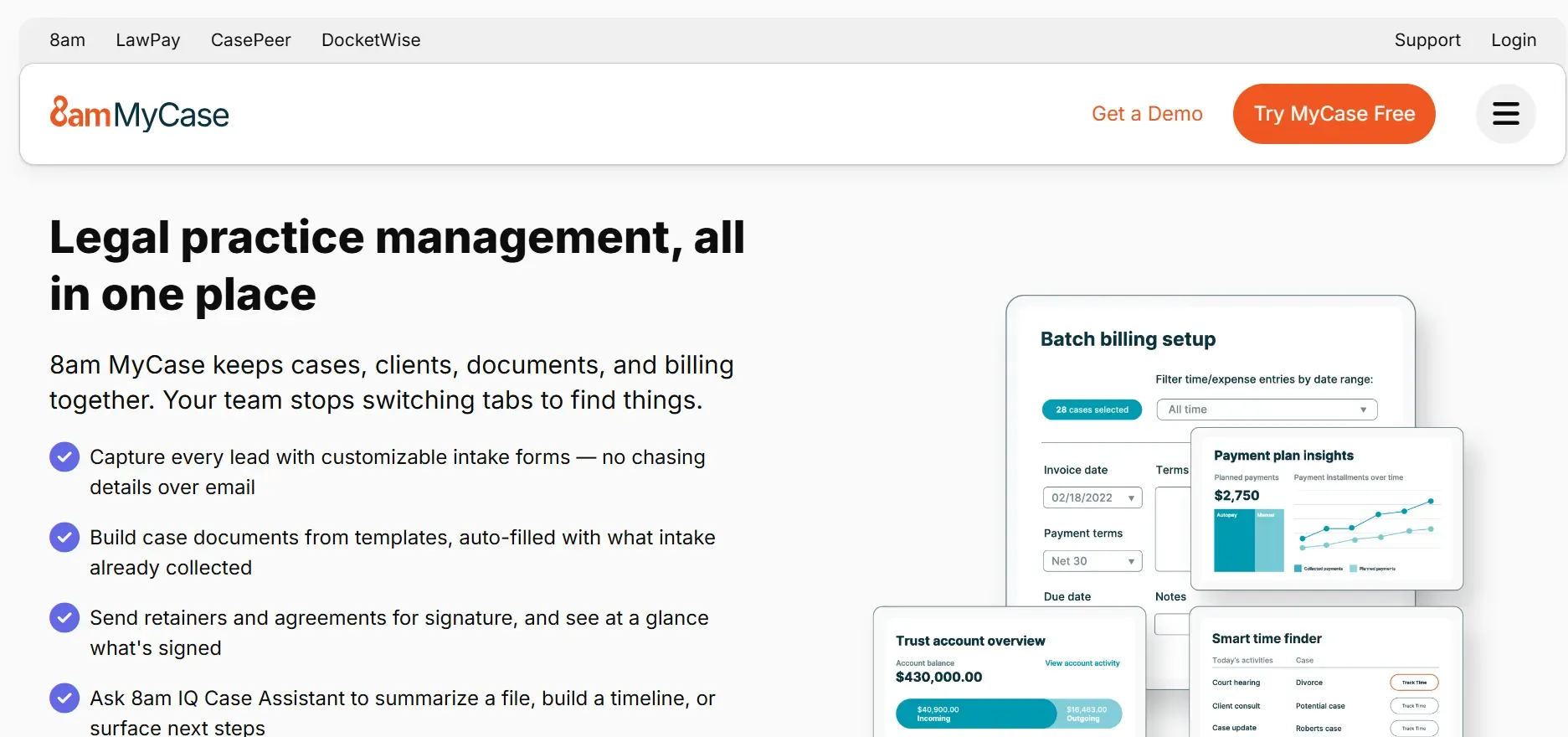
MyCase is built for law firms that value secure client messaging, document sharing, and self-service portals. Its interface is less overwhelming than LexisNexis, making it popular among small and midsize firms that want to improve client experience without a steep learning curve.
Pricing: Starts at $49/user/month. Higher tiers add advanced features like custom workflows and analytics.
- Key limitations:
- Per-user pricing increases costs for larger teams
- Limited advanced analytics and workflow customization
- Full data export is not always possible
- Strengths:
- Excellent client portal and messaging tools
- Integrated payments and basic accounting
- Simple, approachable interface
With Devaims, you can have custom client portals and own the code.
3. PracticePanther (automations and task flows)
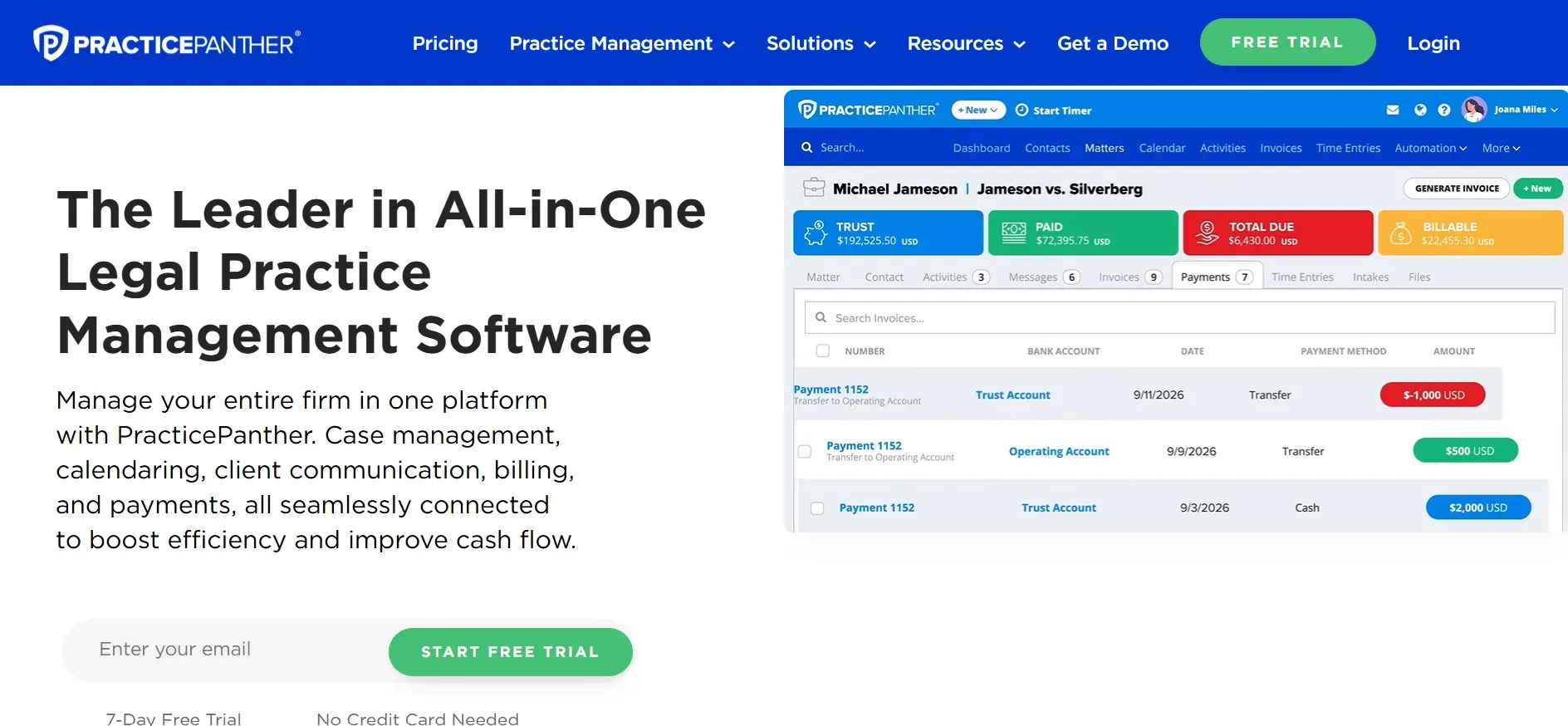
PracticePanther leans into workflow automations. Its automation engine lets you set up triggers for tasks, reminders, and billing events. For firms frustrated by LexisNexis’s rigid processes, PracticePanther’s conditional automations are a major upgrade.
Pricing: Starts at $49/user/month. Higher tiers unlock more automation and reporting features.
- Key limitations:
- Complex automations can be hard to troubleshoot
- Deep customization beyond built-in automations is not possible
- Per-user fees add up with growth
- Strengths:
- Powerful workflow automation tools
- Integrates with major accounting and productivity apps
- Customizable dashboards
If your workflows are unique, owning your own automations with Devaims means no workarounds, just your process.
4. Lawmatics (CRM and intake)
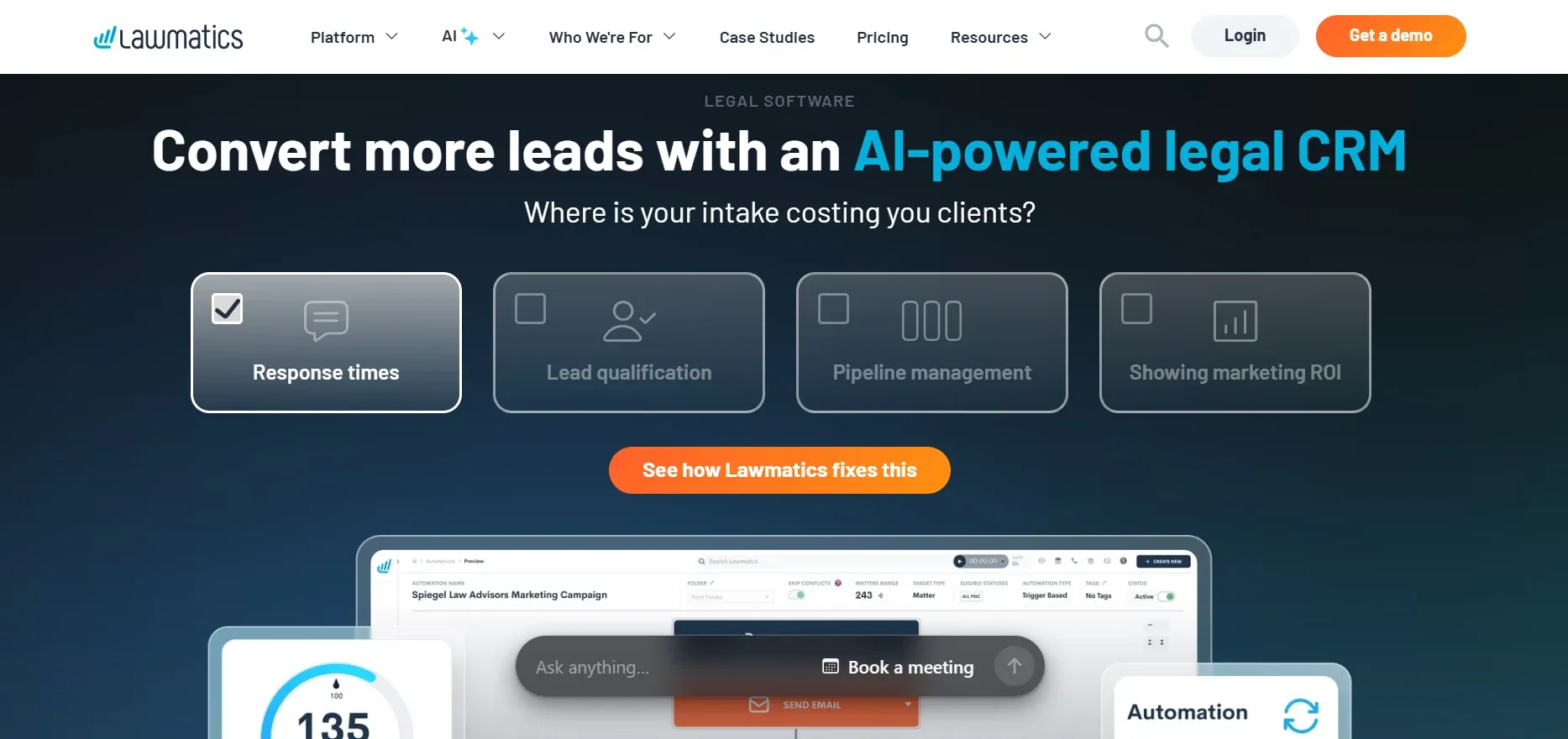
Lawmatics focuses on the CRM and client intake layer that LexisNexis never quite perfected. It centralizes lead capture, follow-ups, intake forms, and marketing automations, giving law firms the ability to nurture prospects and automate initial engagement.
Pricing: Starts at $99/user/month. Used as an add-on to core practice management platforms.
- Key limitations:
- Expensive if used alongside another platform
- Does not replace core case management
- Limited export and ownership of custom workflows
- Strengths:
- Rich intake and CRM automation
- Granular analytics and lead tracking
- Highly customizable forms and drip campaigns
With a custom build, your CRM can be fully integrated and you own every workflow.
5. CosmoLex (accounting integration)
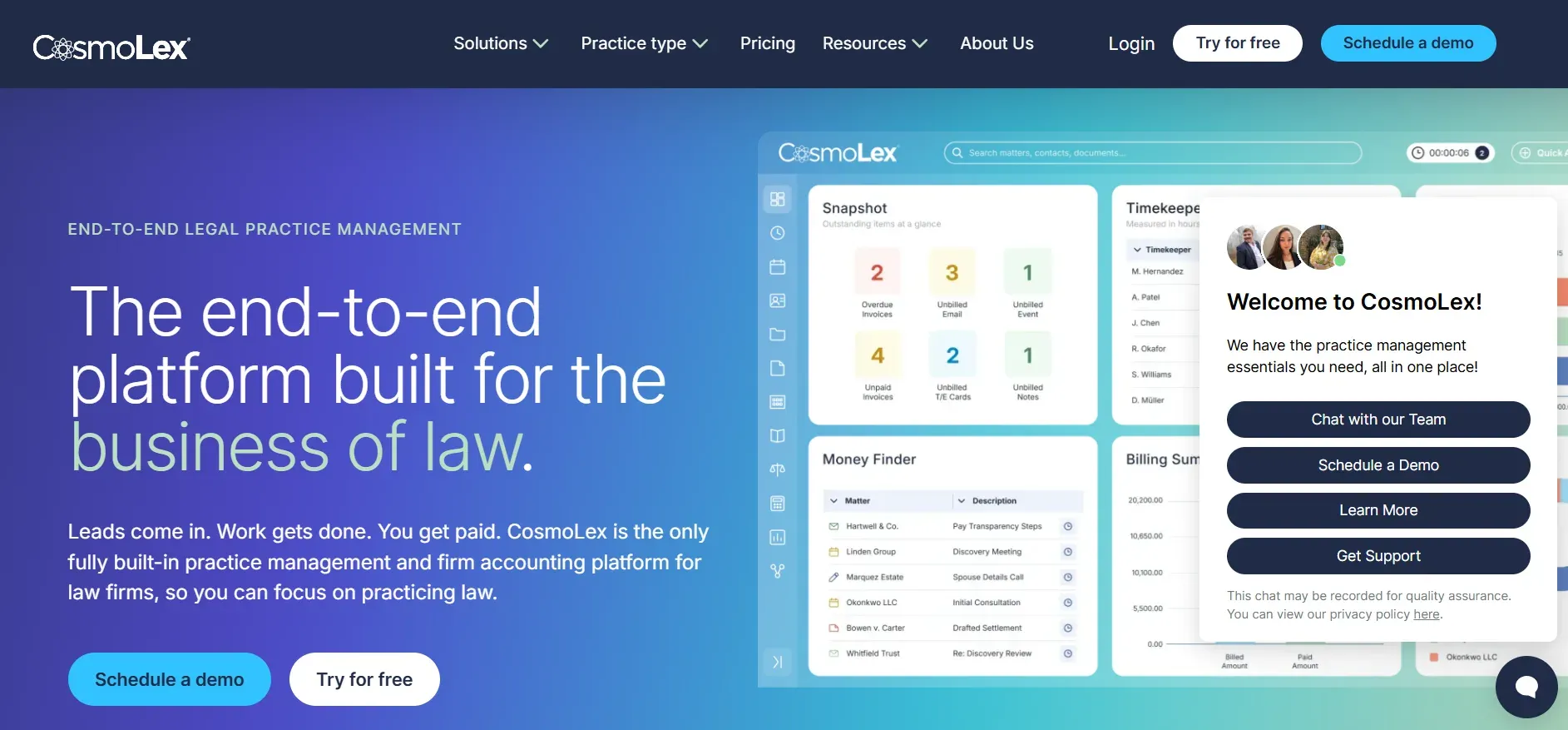
CosmoLex stands out for including full trust accounting and billing in one subscription. If you’re leaving LexisNexis for better accounting, CosmoLex is a logical alternative, especially for firms burdened by compliance requirements.
Pricing: Starts at $89/user/month. Includes both practice management and accounting features.
- Key limitations:
- Higher price point than many rivals
- Custom reporting and integrations are limited
- Exporting full historical accounting data can be challenging
- Strengths:
- Built-in trust accounting and compliance tools
- Unified practice management and accounting
- Audit-ready reporting
That’s the kind of report you would just have if the platform were built for you.
6. Rocket Matter (time and billing)
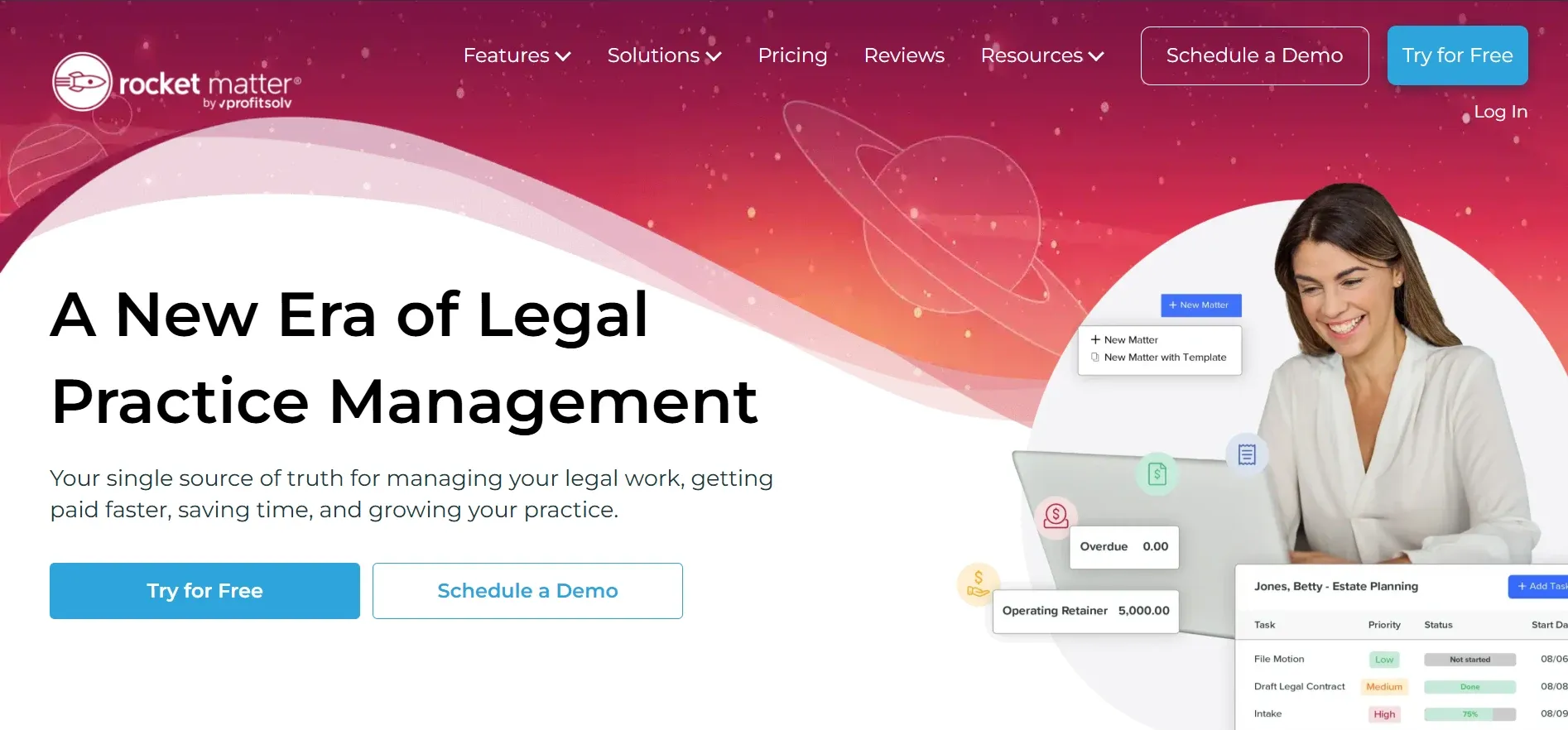
Rocket Matter positions itself as a fast, cloud-based time and billing tool for law firms. Its interface is less cluttered than LexisNexis and easier for new hires to learn, making it popular among small to midsize practices that want to modernize billing without a full practice management overhaul.
Pricing: Starts at $39/user/month. Batch billing and LEDES support included.
- Key limitations:
- Practice management features are basic
- Advanced reporting and workflow automation are limited
- No ownership option, per-user fees apply
- Strengths:
- Simple, fast user experience
- Good for small/midsize firms focused on billing
- Batch billing and LEDES support
7. Smokeball (document automation)
Smokeball is dedicated to automating your firm’s document generation and assembly. If LexisNexis’s document tools frustrate you, Smokeball provides a significant upgrade, especially for firms that rely on high-volume or complex document production.
Pricing: Contact for quote. Pricing is typically higher and scales with users and features.
- Key limitations:
- Opaque and typically high pricing
- Deep document automation requires setup and maintenance
- Exporting custom templates or workflows is not supported
- Strengths:
- Best-in-class document automation
- Integrated time tracking and billing
- Microsoft Office-centric workflow
8. Filevine (case management at scale)
Filevine is designed for high-volume, complex law practices, particularly those with multi-office setups, large teams, or specialized workflows. It moves beyond the limitations of LexisNexis by offering customizable case management, workflow automation, and collaboration tools at scale.
Pricing: Contact for quote. Pricing can be steep for larger teams and is not public.
- Key limitations:
- Customizations require professional services
- Pricing is not transparent and can be high
- Ownership is not possible, always subscription
- Strengths:
- Handles large caseloads and complex workflows
- Advanced automation and analytics
- Strong API and integration options
9. Devaims (own your law firm platform for good)
Devaims builds custom law firm platforms, web, mobile, workflow, document, or billing, with the source code delivered to you. This is the only alternative that puts your firm in full control: no per-user or per-matter fees, no lock-in, and no forced upgrades. You keep your data, your logic, and your stack indefinitely.
Pricing: Custom builds start around $30,000, with ongoing maintenance ($150-230/month). No per-user or per-matter fees.
- You own the source code, no more monthly rent
- Fully custom workflows and integrations
- Export, migrate, and extend at your pace
- Flat, predictable maintenance costs
- Scalable and future-proof, add features as your firm grows
Other LexisNexis alternatives worth knowing
- eLaw, niche in calendaring, but limited as a full PM tool
- Legal Files, better for corporate legal, not law firms
- CASEpeer, personal injury specialists, less flexible for other practices
- Zola Suite, decent all-in-one, but still SaaS rented
- Actionstep, strong workflow automation, but also subscription-based
- CaseRoads, good for small firms, but limited customization
How to choose the right LexisNexis alternative
- Budget: Map your per-user spend over 3 to 5 years, not just monthly. Factor in implementation, training, and migration costs. SaaS platforms often offer discounts for annual contracts, but add-ons and user growth can erode savings quickly.
- Practice size: Growing teams suffer most from per-seat pricing. Solos may care more about ease of use and low upfront cost, while multi-office firms need scalability and workflow automation.
- Features: Do you need baked-in accounting? CRM? Document automation, or just case management? Consider which features are included, which are add-ons, and which are even possible to customize.
- Integration: If your firm runs on a unique stack, custom accounting, proprietary databases, or industry-specific tools, renting may never fit. Owning lets you build around your real workflow and connect to any system you need.
- Ownership: If keeping your data and logic matters long-term, only owning delivers that. This is especially important for firms with unique intellectual property or compliance requirements.
If your firm has hit the ceiling on rented tools, owning your platform is the next move. For more on evaluating SaaS vs. ownership, see this ABA Law Practice article.
Stop paying rent on software you could own
Every LexisNexis alternative in this list has one thing in common: you are still renting. Per-user fees, annual price bumps, forced upgrades, they are all baked into the business model. If you want out, you need to own your platform outright.
Devaims builds law firm software, case tracking, document automation, client portals, billing, you name it, on your terms. You get the source code, not a login. No contract lock. No forced updates. Your data, your workflows, your system.
- Per-user fees? Gone. Pay once to build, then flat maintenance.
- Workflow headaches? Your logic, your process, no more workarounds or clumsy automations.
- Data export? It’s all yours, always. No vendor holds your history hostage.
- Surprise hikes? Never. You set the pace, not a vendor. Maintenance is flat and predictable.
| Platform | Ownership | Pricing Model | Custom Workflows? |
|---|---|---|---|
| LexisNexis | No | Per-user/month + add-ons | Limited, rental only |
| Clio | No | Per-user/month | Some, but locked to tiers |
| MyCase | No | Per-user/month | Some, limited export |
| Devaims (owned) | Yes (you own the code) | One-time build + flat maint | Unlimited |
| Year | Rented (subscription, 10 users) | Owned (Devaims) |
|---|---|---|
| Year 1 | $5,880 | $30,000 (build) + $1,800 (maint) = $31,800 |
| Year 2 | $11,760 | $30,000 + $3,600 = $33,600 |
| Year 3 | $17,640 | $30,000 + $5,400 = $35,400 |
| Year 4 | $23,520 | $30,000 + $7,200 = $37,200 |
| Year 5 | $29,400 | $30,000 + $9,000 = $39,000 |
Why does the math favor ownership as your firm grows? Because every new user, feature, or workflow in a rented platform means higher monthly spend. With Devaims, you pay once for the build, then only for maintenance and support, no matter how many users or matters you add. After five years, you are nearly $10,000 ahead, and you never lose access or control. If you want to run the math on your actual firm, we do it free, no pressure.
How to switch from LexisNexis
- Export your data from LexisNexis: This includes clients, matters, documents, billing, and custom fields. Work with LexisNexis support to get the most complete export possible, ideally in open formats (CSV, PDF, DOCX, etc.).
- Choose your new platform: Compare feature sets, migration support, and ownership options. If you go custom with Devaims, you’ll define your requirements in detail.
- Import cases, clients, and documents into the new system: Most SaaS platforms have import tools, but custom builds can map data exactly as needed, including custom fields and legacy data.
- Reconnect payment processors and third-party integrations: Set up LawPay, QuickBooks, or other tools. With Devaims, this is part of the build.
- Train your team: Conduct hands-on training sessions, provide documentation, and assign point people for questions. For custom builds, training is tailored to your workflows.
- Test everything in parallel for at least two weeks: Run both systems side by side to ensure no data or workflow is missed before you fully switch.
- Review and cancel your LexisNexis contract once you’re live: Double-check that all historical data is accessible and that billing has stopped.
With a custom Devaims build, the migration is handled as part of the project, including data mapping, workflow recreation, and user training.
Frequently asked questions
What is the best LexisNexis alternative for law firms in 2026?
Clio is a leading all-in-one LexisNexis alternative, offering practice management, billing, and integrations. Its interface is modern, and the app ecosystem is extensive, making it a strong choice for many firms. But if you want to own your system and avoid subscriptions, a custom Devaims build is the only way to keep your source code and workflows for good, especially if you have unique requirements or want to build long-term value in your platform.
What is the cheapest LexisNexis alternative for small firms?
Rocket Matter and Clio start at reported $39/user/month, making them among the most affordable for smaller teams. However, as your firm grows or your needs become more complex, per-user costs add up quickly. If you want to avoid long-term rental fees, Devaims can build a lightweight owned platform scaled to your needs, potentially saving money over a 3-5 year horizon, with no lock-in or forced feature upgrades.
Are there any free LexisNexis alternatives?
There are open-source tools like Casebox and Odoo (with legal modules), but they require significant IT overhead, manual setup, and self-support. Most law firms find the lack of support, compliance, and legal-specific features a dealbreaker. For most, paid alternatives like Clio or MyCase are easier to implement, but remain rented. Devaims offers a custom owned path, but it is a paid build. If you have IT resources and a DIY mindset, open source could be an experiment, but beware of the hidden costs and risks.
Which LexisNexis alternative is best for client communication?
MyCase stands out for secure client portals and messaging, with a focus on ease of use and integrated payments. Clio is also strong, but MyCase’s client experience is hard to beat for small and midsize firms. If you need deeper integration, owning your own client portal with Devaims means you can fully control the experience, branding, and data, ideal for firms with unique communication or compliance needs.
Can I keep my historical data when switching from LexisNexis?
Most alternatives offer partial data import, but some formats are tricky or incomplete (especially with documents, custom fields, or billing history). Full migration may require manual work or third-party tools. With a custom Devaims build, your full data, clients, matters, billing, docs, can be mapped and migrated as part of the project, minimizing data loss and ensuring continuity.
When should a law firm consider owning instead of renting?
If your per-user, per-feature, and integration costs keep rising, or you need workflows other platforms can’t deliver, owning makes sense. Firms with unique compliance, integration, or workflow needs often hit a ceiling with SaaS. Devaims is the only LexisNexis alternative that puts you in control for good, especially if you want to future-proof your tech stack and stop the cycle of forced migrations.
How do LexisNexis alternatives handle trust accounting?
CosmoLex offers built-in trust accounting, while most others (Clio, MyCase, PracticePanther) integrate with third-party tools like QuickBooks or Xero. The depth of integration varies; some support full three-way reconciliation, others only basic sync. With Devaims, trust accounting can be built directly into your platform, customized to your compliance needs and reporting requirements, ensuring audit readiness and reducing risk.
The bottom line
Clio, MyCase, PracticePanther, and others are real alternatives, but the logic stays the same: you rent, they own. Here is the one useful test, add up what your rented software will cost you over five years. If that number could have built you a platform you own, it’s time to reconsider. Owning is not for every firm, but for those who value control and long-term savings, it’s the only way to break the rental cycle for good.
See more on the Devaims blog, or check out related deep dives: Clio alternatives, MyCase alternatives, and PracticePanther alternatives.