


Your law firm’s tech stack should save you time, not nickel and dime you with surprise fees. Yet, after a year or two in PracticePanther, most firms realize where the real costs pile up: per-user pricing, feature walls, and data you can’t take with you.
If you’ve ever had to beg support for a report you need, or watched your bill jump as new associates join, you’re not the only one searching for PracticePanther alternatives. The best picks, like Clio, MyCase, and CosmoLex, bring smoother integrations, better mobile apps, and more automation. But here’s the truth: every alternative on this list (except the last) still means renting your software and your data. There is another way: build what you need and own it outright.
Let’s get clear on where PracticePanther alternatives shine, and when it makes sense to stop renting and start owning.
Why law firms look for PracticePanther alternatives
Recurring per-user fees add up fast. Whether your team grows or you just need a few extra seats, costs can double before you blink, especially as matters scale. As your firm expands, so does your software bill. This pricing model means every new attorney, paralegal, or even support staff member who needs access to the system drives up your monthly and annual costs. Many firms find themselves paying for “inactive” users or having to restrict access, which can slow down collaboration and casework.
Locked-in features mean upgrades aren’t optional. Essential tools, like advanced reporting, automated workflows, or even simple custom fields, are often paywalled behind higher tiers, forcing you to upgrade even if you don’t need the extras. This can create a frustrating dynamic where you pay for a bundle of features just to access one critical function, rather than only what you need. Feature gating also means your software may not grow with you as your needs become more sophisticated.
Data portability is limited. Exporting your full case history or client files is rarely as simple as hitting a button. Many platforms offer partial exports (like CSV lists of clients or matters) but leave behind attachments, notes, or billing records. This makes true vendor independence difficult. If you choose to move in the future, you may face costly data migration projects or risk losing historical information that is vital for compliance and client service.
Customization is frustrating. Want a workflow tailored to your firm? Most SaaS platforms only offer surface-level tweaks, like renaming fields or rearranging dashboards, or require pricey custom development contracts. For firms with unique practice areas, specialized intake processes, or complex approval flows, this lack of flexibility can mean you’re always working around the software instead of with it.
Surprise price hikes and long-term contracts. It’s not unusual for SaaS platforms to adjust pricing yearly, often with little warning. Some vendors require annual commitments, and others charge extra for “premium” support or integrations. Even if you start with a low monthly rate, over five years of growth and price increases, your total spend can easily double.
Quick comparison of the best PracticePanther alternatives
| Tool | Best for | Starting price | You own it? |
|---|---|---|---|
| Clio | Broad law firm needs | Reported $39/user/mo | No |
| MyCase | Client portal workflows | Reported $39/user/mo | No |
| CosmoLex | Accounting integration | Reported $89/user/mo | No |
| Rocket Matter | Billing & invoicing | Reported $39/user/mo | No |
| Smokeball | Automation-heavy firms | Reported $99/user/mo | No |
| AbacusLaw | Legacy database needs | Reported $69/user/mo | No |
| Filevine | Case-heavy operations | Custom quote | No |
| LexisNexis PCLaw | Accounting-focused | Reported $39/user/mo | No |
| Devaims | Owning your software | One-time build, you own it | Yes |
Always confirm current pricing before you decide. Vendors update plans and fees often. For the most current and detailed information, check each vendor’s website or Capterra’s legal software listings.
The 9 best PracticePanther alternatives
1. Clio (Broad law firm needs)
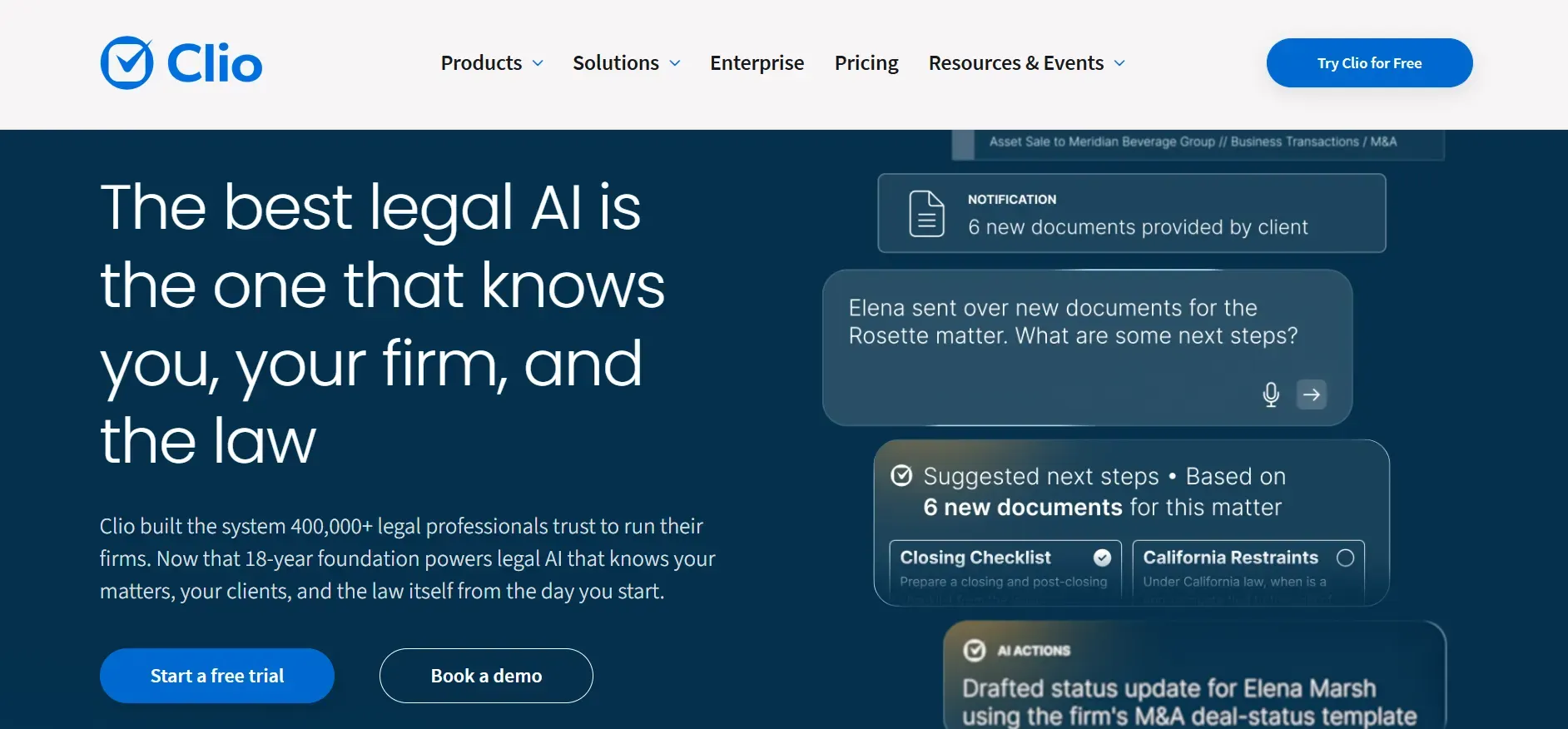
Clio is the market leader in cloud-based law practice management and is often the first stop for firms leaving PracticePanther. Clio’s strength is its mature ecosystem: more than 250 integrations, including Microsoft 365, QuickBooks, Dropbox, DocuSign, LawPay, and Zapier. Its API allows firms to connect Clio with specialized tools or custom workflows for even deeper automation. The user interface is modern and highly intuitive, making onboarding easier for teams of all sizes. Clio’s mobile app is well-regarded, supporting on-the-go time tracking, document access, and secure messaging.
Pricing: Starts at $39/user/month. Advanced features require higher-tier plans.
- Key limitations:
- Advanced analytics and reporting require premium plans
- Per-user pricing increases with firm growth
- Some data exports require manual steps
- Strengths:
- Industry-leading integrations (including Zapier, QuickBooks, and more)
- Sleek, user-friendly UI and mobile apps
- Strong client portal for secure communication and document sharing
That reporting wall is where a custom Devaims build shines. Your data, your reports, no extra fees or feature gating.
2. MyCase (Client portal workflows)
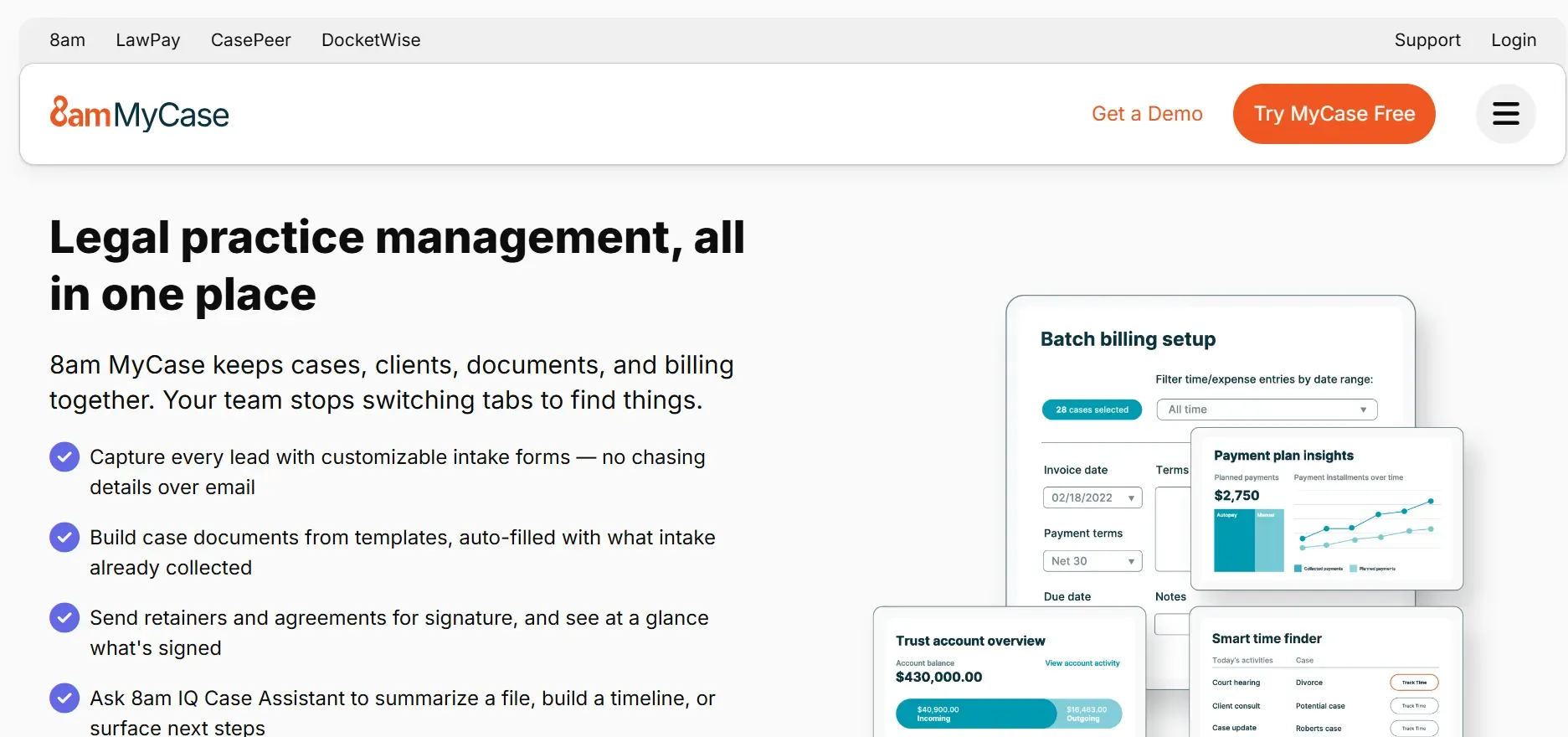
MyCase is designed for simplicity and ease of use, especially for firms that want a smooth client experience. Its client portal is a standout feature, allowing clients to securely message, share documents, and make payments online. MyCase covers the essentials: case tracking, calendaring, billing, and document management through a clean, modern interface. It is often praised for its low learning curve and reliable customer support.
Pricing: Starts at $39/user/month. Some features require higher-tier plans.
- Key limitations:
- Fewer integrations than Clio
- Limited workflow customization
- Advanced features require higher-tier plans
- Strengths:
- Fast, easy onboarding for non-technical staff
- Client portal is simple and effective
- Responsive support team
On a platform you own, those client communications can be customized to your exact process. Branding, intake forms, and notifications are all under your control.
3. CosmoLex (Accounting integration)
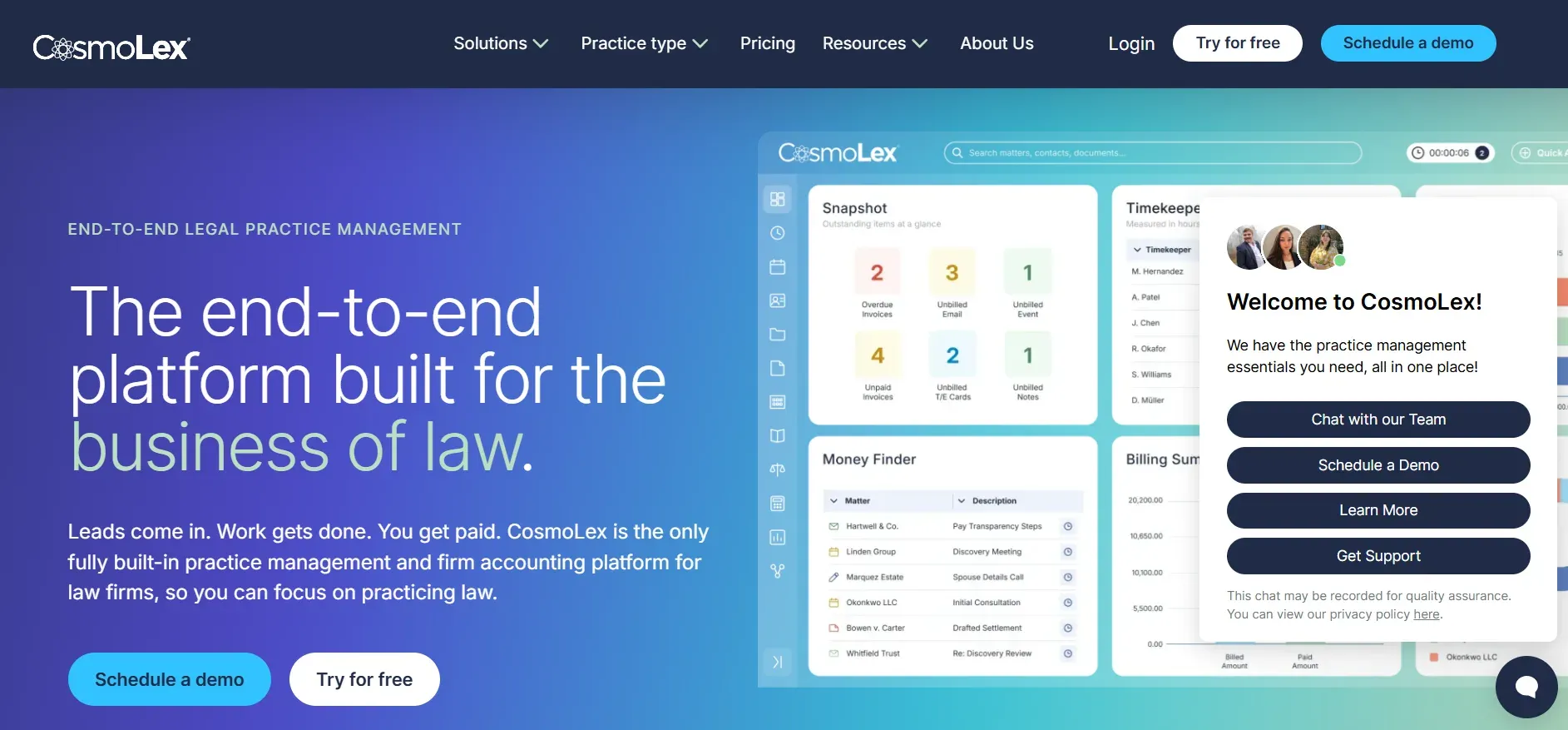
CosmoLex is the leader for firms wanting true all-in-one practice management and legal accounting. It includes built-in general ledger, trust accounting, bill payment, and compliance reporting, eliminating the need for separate QuickBooks or Xero subscriptions. CosmoLex is especially valuable for firms that handle IOLTA accounts and want peace of mind on compliance.
Pricing: Starts at $89/user/month. Includes legal accounting features.
- Key limitations:
- Higher cost as your team grows
- Custom reporting is limited by templates
- Rigid workflows for unique processes
- Strengths:
- All-in-one platform (practice management + legal accounting)
- Compliance tools for trust/IOLTA accounts
- Reduces risk of accounting errors
With custom software, your accounting workflows can be tailored exactly to your jurisdiction’s requirements and firm preferences. No more workarounds or paying for features you do not need.
4. Rocket Matter (Billing & invoicing)
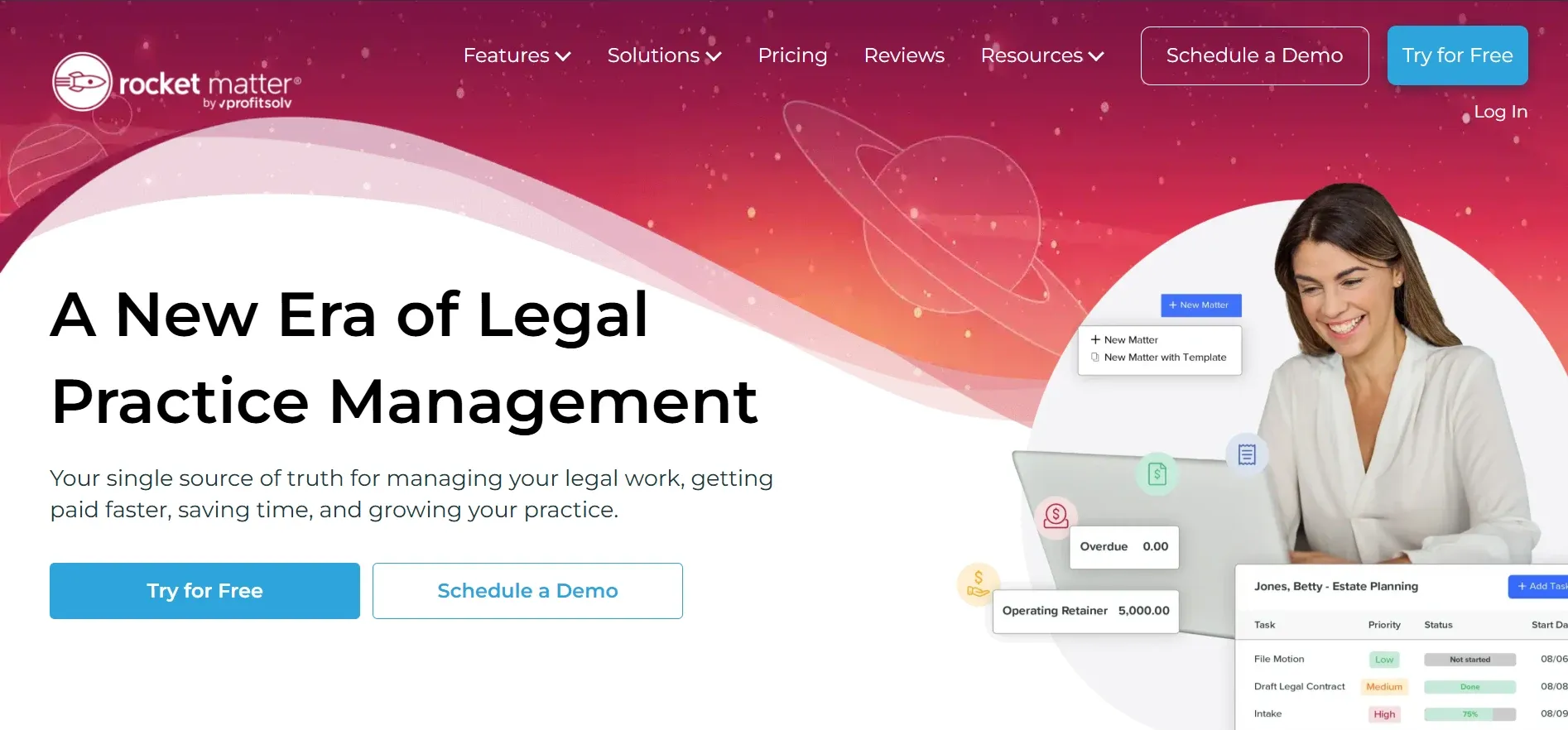
Rocket Matter is purpose-built for time tracking, billing, and invoicing. Its strengths are in accurate time capture, customizable invoice templates, and batch billing. Rocket Matter’s dashboards make it easy to see billable hours, outstanding invoices, and client trust balances at a glance. The platform is popular among firms that bill by the hour or need comprehensive billing compliance.
Pricing: Starts at $39/user/month. Premium features require higher-tier plans.
- Key limitations:
- Case management features less developed than competitors
- Some automation tools require premium plans
- User interface is dated
- Strengths:
- Powerful time tracking and billing modules
- Customizable invoice templates
- Batch billing and trust accounting
When you own your platform, billing, invoicing, and compliance can be matched exactly to your firm’s process. No more force-fitting your workflows to the tool.
5. Smokeball (Automation-heavy firms)
Smokeball is built for firms that want to automate as much as possible: tasks, documents, emails, and even time tracking. Its “Activity Intelligence” feature automatically records work done in Word, Outlook, and other desktop applications, capturing billable time without manual entry. Smokeball’s document automation is strong, supporting custom templates, conditional logic, and batch generation. The platform offers detailed analytics on firm productivity and profitability.
Pricing: Starts at $99/user/month. Advanced automation included in higher plans.
- Key limitations:
- Highest-priced SaaS on this list
- Automation setup can be complex
- Desktop-centric, less ideal for browser-only firms
- Strengths:
- Deep automation of tasks, documents, and time tracking
- Detailed analytics and profitability reports
- Strong onboarding and support
6. AbacusLaw (Legacy database needs)

AbacusLaw is a legacy practice management system that has evolved to offer both on-premise and cloud-hosted options. It is favored by firms with longstanding databases, complex document automation needs, or hybrid IT environments. AbacusLaw’s database tools allow for granular data management and reporting, and the system can handle large volumes of matters and contacts.
Pricing: Starts at $69/user/month. On-premise and cloud options available.
- Key limitations:
- Dated user interface compared to cloud-first tools
- On-premise deployment requires IT resources
- Per-user pricing still applies
- Strengths:
- Hybrid on-premise/cloud deployment options
- Comprehensive database features
- Customizable with IT support
7. Filevine (Case-heavy operations)
Filevine is a modern, cloud-based platform focused on firms with high case volume and complex casework. Its standout feature is a highly customizable workflow builder, allowing firms to create matter templates, automate task assignments, and trigger notifications based on case progress. Filevine’s document management is strong, supporting batch uploads, e-signature, and granular permissions.
Pricing: Custom quote. Pricing varies by firm size and features.
- Key limitations:
- Pricing is opaque and based on custom quotes
- Advanced features may require add-ons
- Per-user fees apply
- Strengths:
- Highly adaptable workflow builder
- Strong automation and document management
- Well-reviewed support for large, growing firms
8. LexisNexis PCLaw (Accounting-focused)
LexisNexis PCLaw is a mature practice management and legal accounting system, often used by firms that require deep financial controls. PCLaw is unique in that it can be deployed on-premise or in the cloud, making it suitable for firms with specific data residency needs. It tracks trust/IOLTA accounts, client ledgers, and firm profitability in detail.
Pricing: Starts at $39/user/month. On-premise and cloud options.
- Key limitations:
- Dated interface compared to modern SaaS
- Per-user licensing adds up quickly
- Limited automation and integrations
- Strengths:
- Integrated legal accounting and practice management
- Trusted brand with long history in legal sector
- Compliance-ready financial reporting
9. Devaims (Owning your software)
Devaims is the only solution on this list that lets your law firm own your software and your data outright. Instead of paying per-user or per-feature fees, Devaims builds custom legal practice management platforms, web, mobile, or desktop, tailored to your firm’s exact workflow. You keep the code, the data, and the power to adapt as you grow. No per-user fees. No contracts. You own it, forever.
- Custom-built for your firm’s unique workflows and brandingOne-time build cost, then flat, predictable maintenanceYou own the code and data, export, integrate, or scale at willNo per-seat or per-feature fees, everDirect access to developers for ongoing improvements and support
- Custom-built for your firm’s unique workflows and branding
- One-time build cost, then flat, predictable maintenance
- You own the code and data, export, integrate, or scale at will
- No per-seat or per-feature fees, ever
- Direct access to developers for ongoing improvements and support
Other PracticePanther alternatives worth knowing
- Lawmatics: Excellent for CRM and client intake, with strong marketing automation. Not a full practice management platform, best paired with another tool.
- Needles: A legacy desktop solution, popular with personal injury (PI) firms needing deep customization. Migration to the cloud is possible but can be costly.
- Legal Files: Geared toward government, corporate, and in-house legal teams. Not ideal for traditional law firm operations, but very strong for matter-centric workflows and reporting.
- CASEpeer: Tailored for personal injury firms, with built-in medical records, lien tracking, and settlement calculators. Niche focus, not general-purpose.
For a broader landscape, see G2’s legal case management category for user reviews and feature breakdowns.
How to choose the right PracticePanther alternative
- By budget: Calculate your total cost of ownership, per-user fees, add-ons, migration, and support, over at least three years. Many SaaS tools start affordable but quickly outpace a custom build as your firm grows.
- By workflow: If your firm has unique automations, needs deep accounting, or relies on custom reporting, check how much you can truly tailor the platform. Ask for demos of your must-have workflows, not just out-of-the-box features.
- By firm size: Solo and small firms may prioritize ease of use and onboarding, while larger firms need scalable permissions, multi-office support, and integrations. Consider staff training and the vendor’s track record with firms your size.
- By ownership: Decide if you want your data and workflows to live in someone else’s system, or if it’s time to own your platform. If you want to future-proof your firm, owning your software is the only way to guarantee control.
Once you know your non-negotiables, budget, features, integrations, data ownership, you’ll have a clear sense of whether renting or owning is right for your next chapter.
Stop paying rent on software you could own
Every PracticePanther alternative above comes with the same core issue: you rent your software and your data. Per-user fees, feature paywalls, and annual price hikes are built into the model, no matter how “customizable” the SaaS. With Devaims, you break the rental cycle for good.
Devaims builds legal practice management platforms tailored to your firm, web, mobile, or hybrid. You get the source code. You keep your data. Change anything, integrate with anything, and never pay a per-user fee again.
- Per-user fees? Gone. Add attorneys or staff at will, your costs stay flat. No more restricting access because of licensing limits.
- Locked-in features? You define every report, workflow, and automation from day one. Need a new approval chain or custom intake? It’s your platform, no upsell required.
- Data stuck in the cloud? You own every record, export at will, integrate with anything, and stay compliant with your jurisdiction’s data requirements.
- Price hikes? Never. Pay once for the build, then flat maintenance, no surprises, no contract renegotiations.
| Tool | Ownership | Pricing model | Customizable? | Data portability? |
|---|---|---|---|---|
| PracticePanther | No | Per-user, per-month, features tiered | Limited | Partial/CSV only |
| Clio | No | Per-user, per-month, features tiered | Moderate | Partial |
| CosmoLex | No | Per-user, high starting price | Limited | Partial |
| Devaims | Yes | One-time build, flat maintenance | Unlimited | Full |
| Year | Rented (SaaS) | Owned (Devaims) |
|---|---|---|
| Year 1 | $14,400 | $27,600 |
| Year 2 | $28,800 | $29,400 |
| Year 3 | $43,200 | $31,200 (now ahead) |
| Year 4 | $57,600 | $33,000 |
| Year 5 | $72,000 | $34,800 |
Example: A 10-attorney firm at $120/mo per user (base plus typical add-ons) pays $14,400/year, never owning the platform. A custom Devaims build at $27,600 upfront and $150/mo maintenance is ahead in year 3 and halves your 5-year spend. We’ll run your numbers for free. For larger firms or those with complex needs, the long-term savings are even greater.
Firms that benefit most from owning are those with 5+ attorneys, complex workflows, or recurring frustrations with feature walls and vendor lock-in. Ownership also means you can adapt to regulatory changes, integrate with new technologies, and control your own roadmap, without waiting for a vendor’s next release.
How to switch from PracticePanther
- Export all client, matter, and billing data from PracticePanther (CSV or via their export tool). Review what is included, attachments, notes, and custom fields may need special handling.
- Choose your new platform and confirm data import options and mapping. Ask vendors or developers for detailed mapping guides and test imports before committing.
- Import clients, matters, and documents to the new system. Validate data integrity, check for missing attachments, mismatched fields, or formatting errors.
- Reconnect payment processors, document storage, and key integrations. Ensure all workflows (like e-signature, court filing, or accounting syncs) are working as expected.
- Train your staff on workflows and new features. Schedule hands-on sessions and provide documentation tailored to your team’s roles.
- Test the new platform in parallel for at least a billing cycle. Run real cases and compare results to your old system to spot discrepancies early.
- Review and close out your PracticePanther contract, confirming full data export and access. Retain backups for compliance, and notify clients of the improved system if needed.
With a custom Devaims build, the migration is handled as part of the project, with a dedicated team managing data mapping, validation, and user onboarding for a smooth transition.
Frequently asked questions
What is the best PracticePanther alternative for midsize law firms?
For midsize law firms (10-50 attorneys), Clio is often the top pick for its deep integrations, scalability, and support resources. CosmoLex is the best fit if integrated accounting and compliance are your highest priorities. Both platforms are cloud-based and support growing teams. However, both charge per-user and may not offer full workflow customization. If you want to own your platform, Devaims is the only full custom alternative, ideal for firms with unique workflows or those seeking to control long-term costs and data.
Which PracticePanther alternative is cheapest?
At first glance, MyCase and LexisNexis PCLaw are among the cheapest, starting at around $39/user/month. Yet, as your firm grows and you add users or features, these costs quickly rise. Over five years, a custom Devaims build is often cheaper for firms with 5+ staff, especially once you factor in add-ons, support, and the value of owning your software outright. For solo practitioners or very small teams, SaaS may still be the most affordable choice, but mid-sized and growing firms should run the long-term math carefully.
Are there free PracticePanther alternatives?
There are a few open-source legal management tools, such as CaseBox and Legal Case, but they require significant IT expertise to deploy, secure, and maintain. They also lack the polish, integrations, and support of commercial SaaS. For most law firms, the time and risk involved outweigh the savings. Devaims offers a fully owned solution, but not a free tier.
Which PracticePanther alternative is best for accounting and compliance?
CosmoLex is the standout for built-in trust accounting and compliance tools. It is designed for firms needing strict IOLTA management, audit trails, and integrated billing. LexisNexis PCLaw is also strong for accounting, though its interface is more traditional. For firms with unique compliance needs, a custom Devaims build can match your jurisdiction’s requirements exactly and adapt as regulations change.
How hard is it to migrate from PracticePanther?
Migration difficulty depends on your data complexity and the platform you choose. Most PracticePanther alternatives offer basic CSV import tools, but attachments, notes, and historical billing data may not transfer automatically. Some vendors provide migration assistance or paid services. With Devaims, migration is handled by the development team, ensuring all data (including custom fields and documents) is mapped, validated, and ready for use in your new system.
Can I keep my historical PracticePanther data?
Partial data exports (clients, matters, billing) are possible via PracticePanther’s export tools, but some attachments, time entries, or notes may not export cleanly. Plan for manual cleanup or validation. With Devaims, you keep all your data, forever, with full export and backup options, no more worrying about vendor lock-in or lost records.
When should a law firm switch from PracticePanther?
If you’re paying for features you never use, hitting workflow walls, or frustrated by rising per-user costs, it’s time to look at PracticePanther alternatives. Other triggers include compliance requirements that the platform cannot meet, the need for deeper integrations, or a desire to control your data. If you want to own your platform and future-proof your firm, Devaims is the only option that ends the rental cycle and puts you in control.
The bottom line
Clio, MyCase, and CosmoLex lead the pack of PracticePanther alternatives, but every SaaS rental means fees and lock-in. Here’s the single most useful decision rule: add up what you’ll pay over five years. If that number would buy you a system you own, you’re ready for the next level.
Owning your law firm’s platform changes the economics and puts your data back in your hands. When you’re ready to stop renting and start building for your team, Devaims is the call to make.
Explore more legal tech insights at the Devaims blog, or check out our deep dives on Clio alternatives, MyCase alternatives, and CosmoLex alternatives.