


The day you realize your law firm's "all-in" practice management suite is quietly eating a five-figure hole in your budget, it's usually Clio. The per-user fees, surprise add-ons, and features locked behind a higher tier, it adds up fast. And no matter how much you pay, you still don't own a thing. You're just renting your workflow, your data, your client relationships.
Clio is polished, but it's not built for your firm, it's built for every firm. If you're here, you're already thinking about jumping off the SaaS treadmill. The good news: there are strong Clio alternatives like MyCase, CosmoLex, and Rocket Matter, each with their own flavor of recurring pain. But if you want to own your tools, not just license them, the only real exit is building your own with Devaims. Let's break it down.
Why law firms look for Clio alternatives
Recurring subscription fees stack up fast. Clio (and every major SaaS competitor) bills per user per month. That means every new attorney, paralegal, or admin you add multiplies your monthly software cost. As your firm grows, a “starter” plan can balloon into one of your largest ongoing expenses. Even small teams can end up with a $10,000+ annual bill, and large firms pay much more. These costs are rarely static: SaaS vendors often raise prices, sometimes with little notice, or introduce new premium features only accessible with higher-tier upgrades.
Key features locked behind premium tiers. Many firms discover that the tools they need, advanced reporting, custom fields, API access, or sophisticated billing, are only available in more expensive plans. This "feature gating" strategy is common across the industry, not just with Clio. For example, bulk document automation or custom intake forms may be exclusive to the highest-priced tiers, forcing you to pay double or triple per user for the system you thought you had already bought.
Renting means lock-in. Your data lives on their platform, the workflows follow their roadmap, and migrating away is a project in itself. With SaaS, you’re always subject to their security standards, their backup policies, and their decisions about what features live or die. If they sunset a feature your firm depends on, or change the UI in ways that slow down your team, your only recourse is to start over somewhere else, often at significant cost and disruption.
Limited customization for unique workflows. Law firms are not all the same. Practice areas, client intake, billing arrangements, and document templates vary widely. Most SaaS solutions are built for the average use case, not your unique mix. Firms often resort to manual workarounds, third-party add-ons, or double-entry data just to make things fit. As you grow, these pain points compound, and true customization is either impossible or prohibitively expensive.
Add-on fees and per-matter pricing. Many platforms charge extra for e-signatures, text messaging, advanced document automation, or custom reporting. Some even have per-matter fees, so the more cases you take on, the more you pay. This makes it difficult to predict costs and eats into margins, especially for high-volume practices. It's why so many firms end up searching for Clio alternatives.
Quick comparison of the best Clio alternatives
| Tool | Best for | Starting price | You own it? |
|---|---|---|---|
| Clio | Most law firm SaaS users | From $39/user/mo | No |
| MyCase | All-in-one simplicity | From $49/user/mo | No |
| PracticePanther | Automation & integrations | From $49/user/mo | No |
| Lawmatics | CRM & intake automation | From $99/user/mo | No |
| CosmoLex | Integrated accounting | From $89/user/mo | No |
| Rocket Matter | Time tracking & billing | From $39/user/mo | No |
| Smokeball | Document automation | From $39/user/mo | No |
| AbacusLaw | On-premise option | Custom quote | Partial (license only) |
| Filevine | Case-heavy firms | Custom quote | No |
| ProLaw | Enterprise legal management | Custom quote | Partial (license only) |
| Devaims | Firms ready to own | One-time build, you own it | Yes |
These prices move, so confirm current pricing before you decide.
The 11 best Clio alternatives
1. MyCase (All-in-one simplicity)
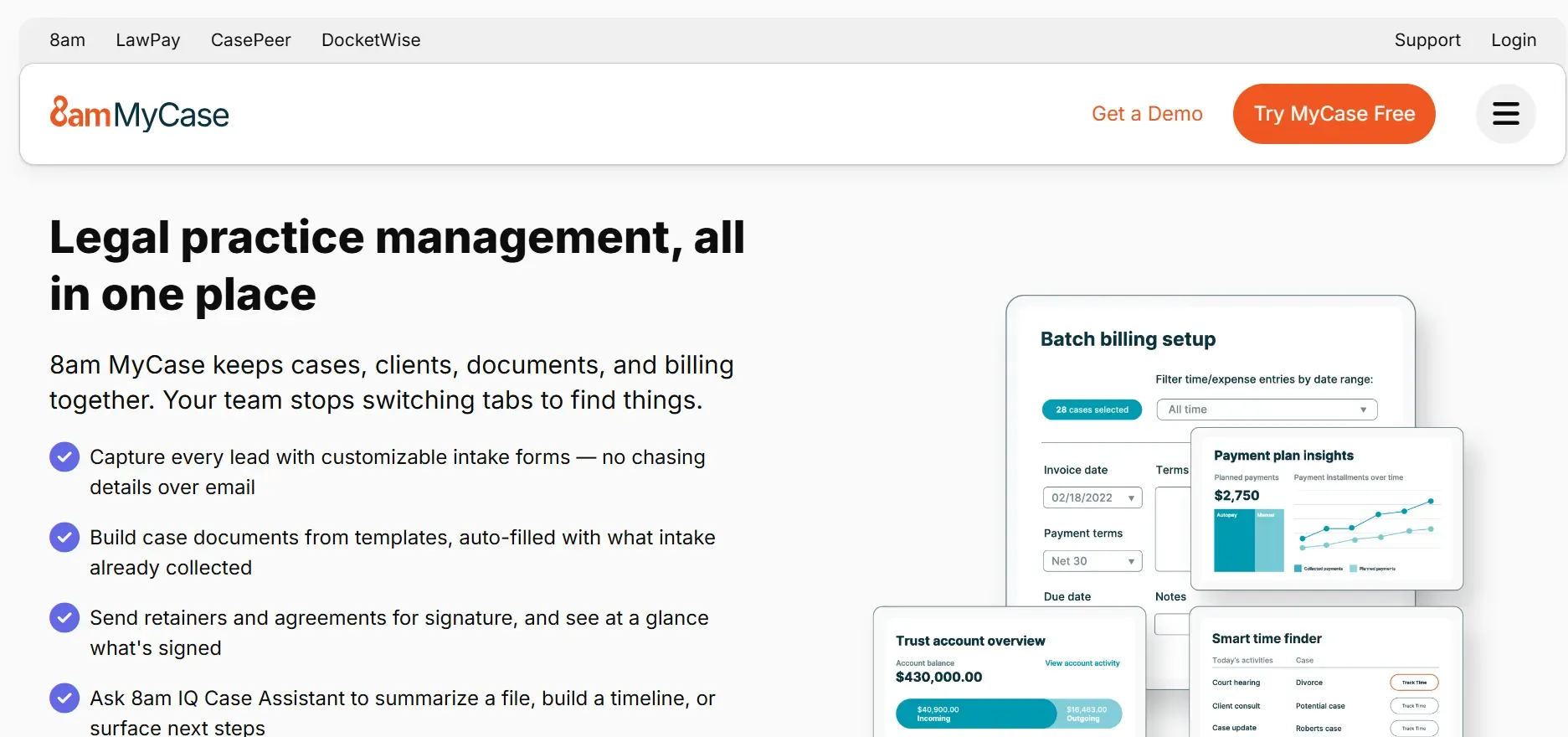
MyCase is widely chosen by small and midsize law firms looking for a straightforward, all-in-one cloud platform. Its clean UI and approachable onboarding process make it a favorite among firms transitioning away from paper or spreadsheets. MyCase provides case management, calendaring, billing, time tracking, document storage, and a client portal, all under a single login. The client portal is a standout, allowing secure messaging, document sharing, and online payments, which can improve client experience and reduce administrative burden.
Features and integrations: MyCase integrates with QuickBooks Online, Dropbox, Google Calendar, and several e-signature providers. Its workflow automations are simple but effective, covering intake, reminders, and task assignments. MyCase recently added a native payments system, which streamlines billing and reduces reconciliation headaches. Migration from Clio is supported through import tools, but some data (such as custom fields or advanced workflows) may need to be rebuilt manually.
Migration friction: MyCase provides migration support, but moving complex workflows or custom data may require manual mapping. Firms with heavy customization in Clio may face some data loss or need to reconfigure certain processes.
Pricing: From $49/user/month.
- Easy onboarding and user-friendly interface
- Integrated client portal for secure communication
- Reliable support and migration tools
- Limited customization for unique workflows
- Advanced features require higher tiers or add-ons
- Per-user pricing increases with firm growth
For firms that need more control, Devaims can build a client portal tailored to your exact needs, with no per-user fees.
2. PracticePanther (Automation & integrations)
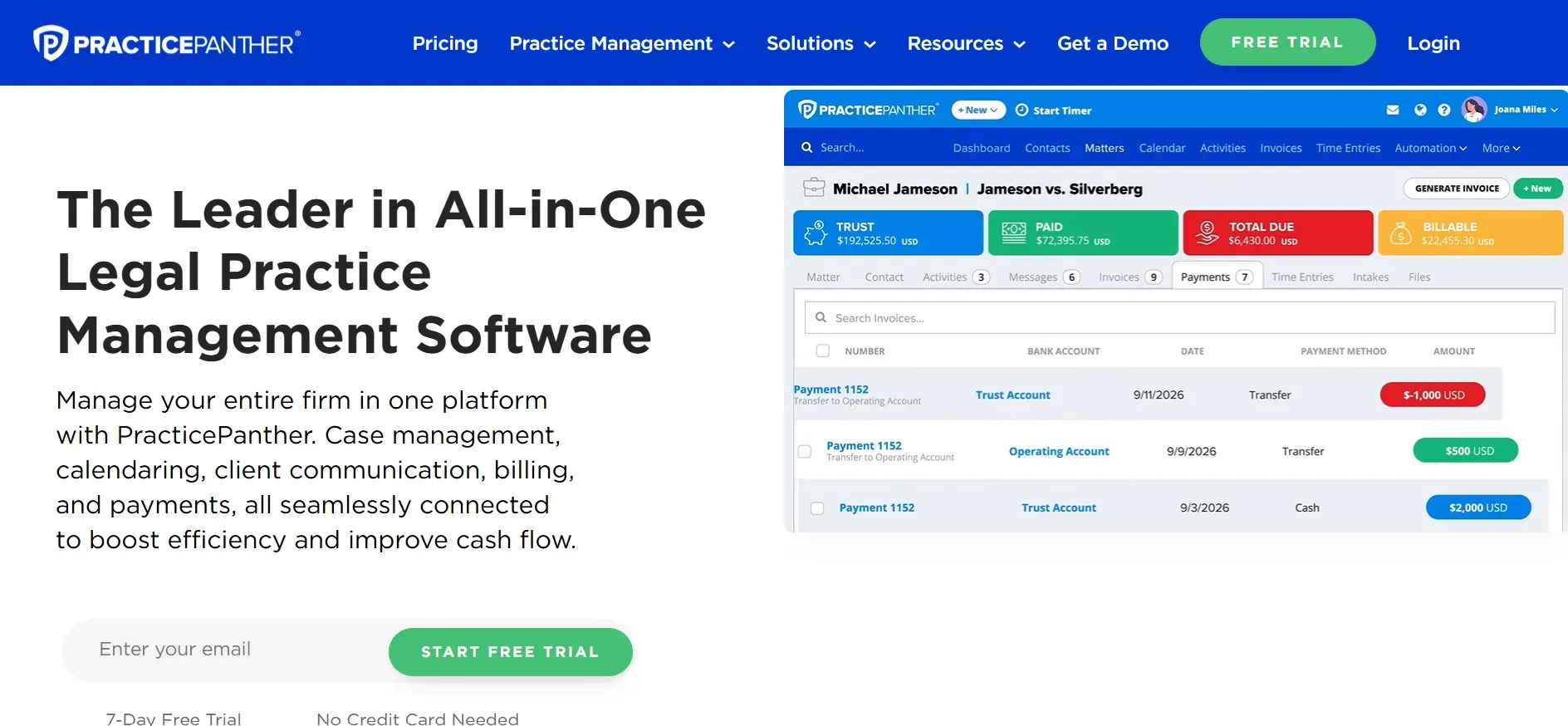
PracticePanther appeals to firms wanting to automate routine work and integrate with a wide software ecosystem. Its workflow builder allows for conditional triggers, automatic reminders, and chained tasks. PracticePanther integrates with Zapier, Xero, QuickBooks, Dropbox, Google Workspace, LawPay, and more, making it a good fit for firms already using these platforms.
Features and integrations: The software includes time tracking, billing, document management, and a client portal. Its automation tools can assign tasks based on matter type, send templated emails, or even trigger e-signature requests. The open API (only available on higher plans) enables firms to build custom integrations. PracticePanther also offers two-way sync with Outlook and Gmail for email management.
Migration friction: Data migration from Clio or other platforms is possible via import tools, but complex automations or custom document templates may require manual recreation. PracticePanther’s support team assists with onboarding and basic migration, but heavy customization increases friction.
Pricing: From $49/user/month.
- Powerful workflow automation tools
- Wide range of integrations
- Flexible for firms with complex processes
- Advanced automation and API access require higher plans
- Per-user pricing can add up for larger teams
- Some features may be overkill for small firms
If you want automation without recurring user fees, Devaims can build custom workflows into your owned platform.
3. Lawmatics (CRM & intake automation)
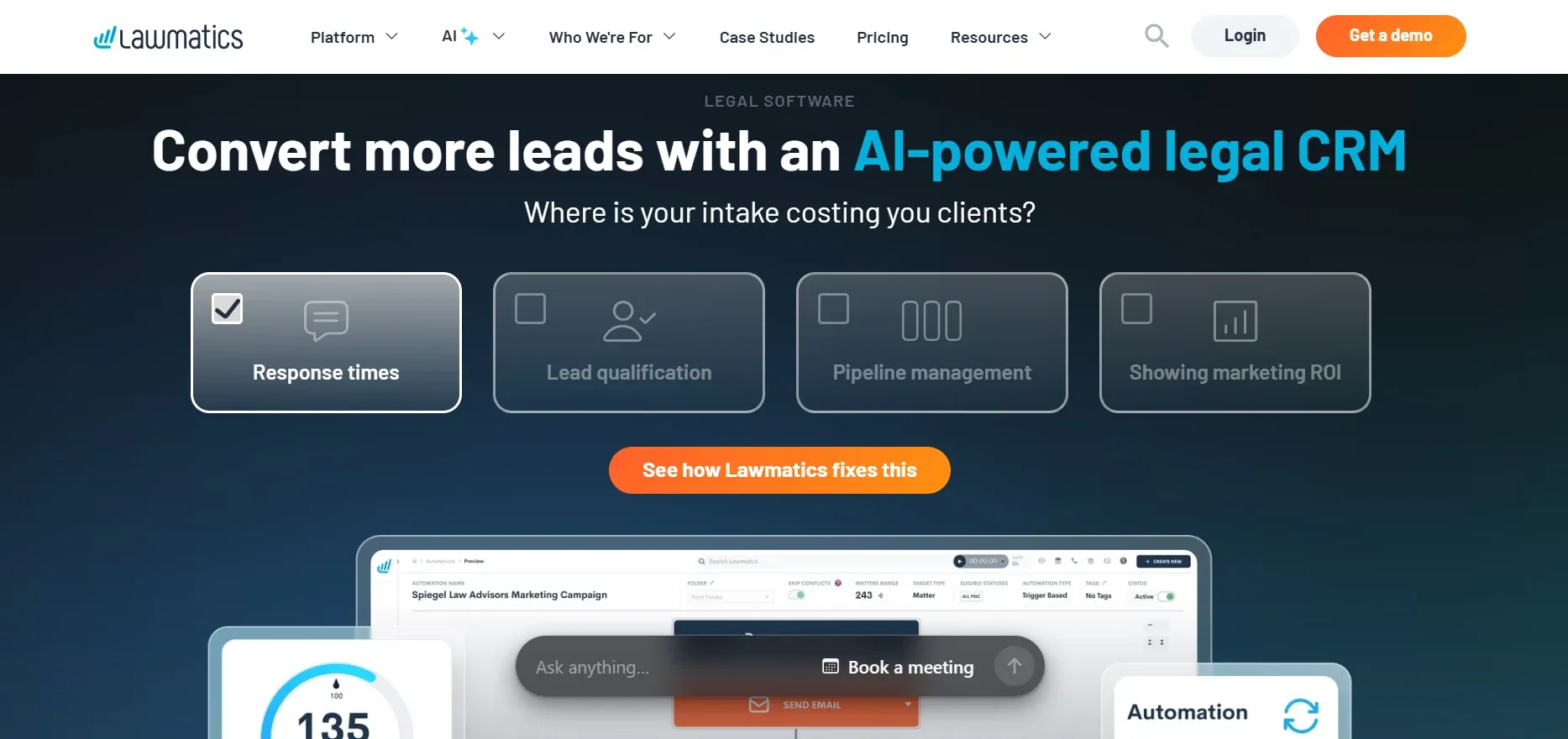
Lawmatics is not a full practice management suite, but it excels at client relationship management (CRM) and intake automation. It is often layered on top of Clio, MyCase, or PracticePanther to boost lead capture and conversion. Lawmatics automates intake forms, email drip campaigns, appointment scheduling, and even post-intake workflows, ensuring no prospect falls through the cracks.
Features and integrations: Lawmatics connects with Clio, PracticePanther, and other practice management tools, passing new leads and intake data directly into your core system. It offers customizable pipelines, robust reporting on lead sources and conversion rates, and built-in e-signature tools. Lawmatics also integrates with Mailchimp, Outlook, Google Calendar, and Zapier for expanded automation.
Migration friction: Since Lawmatics is usually added to your stack rather than replacing your practice management, migration is lighter. However, mapping intake workflows and ensuring clean data handoff to your main system requires planning, especially if you have custom intake steps.
Pricing: From $99/user/month.
- Powerful intake and CRM automation
- Deep reporting on lead sources and conversion
- Integrates with major practice management tools
- Does not replace core practice management functions
- High cost for firms with many users
- Best suited for firms with high lead volume
That's the kind of intake workflow you would just have if your platform were built for you with Devaims.
4. CosmoLex (Integrated accounting)
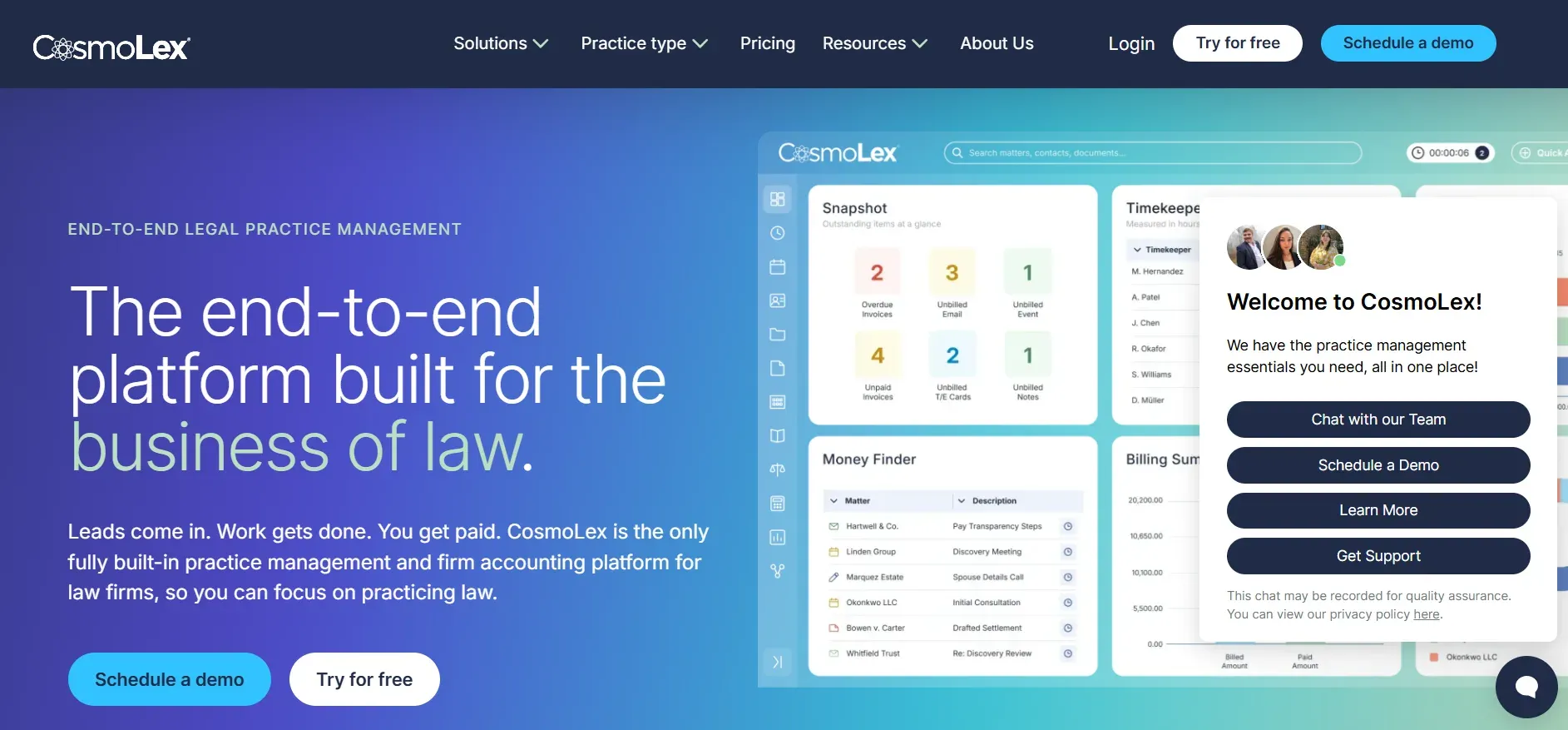
CosmoLex is unique among SaaS legal suites in that it includes full-featured legal accounting and trust accounting natively. This eliminates the need for a separate QuickBooks license, reducing reconciliation errors and simplifying compliance. CosmoLex covers billing, time tracking, matter management, calendaring, and document storage.
Features and integrations: CosmoLex integrates with LawPay, NetDocuments, Office 365, and offers two-way sync with Google Calendar. Its accounting module handles ledger entries, trust accounting, bank reconciliation, and even tracks retainers and settlements. CosmoLex is strong on compliance, with built-in tools for three-way reconciliation and audit trails. Data migration from Clio and other platforms is supported, but accounting data can be complex to transfer cleanly.
Migration friction: Migrating standard matter and contact data is straightforward, but importing historical accounting records, trust balances, or custom billing setups can be complex. Firms switching from a Clio/QuickBooks combo may need the help of CosmoLex’s migration team or an outside consultant.
Pricing: From $89/user/month.
- Integrated legal and trust accounting
- Strong compliance and audit features
- Eliminates need for separate accounting software
- Interface is less modern and has a learning curve
- Higher starting price for small teams
- Advanced document automation still developing
Devaims can build accounting workflows tailored to your firm, with no recurring user fees or forced upgrades.
5. Rocket Matter (Time tracking & billing)
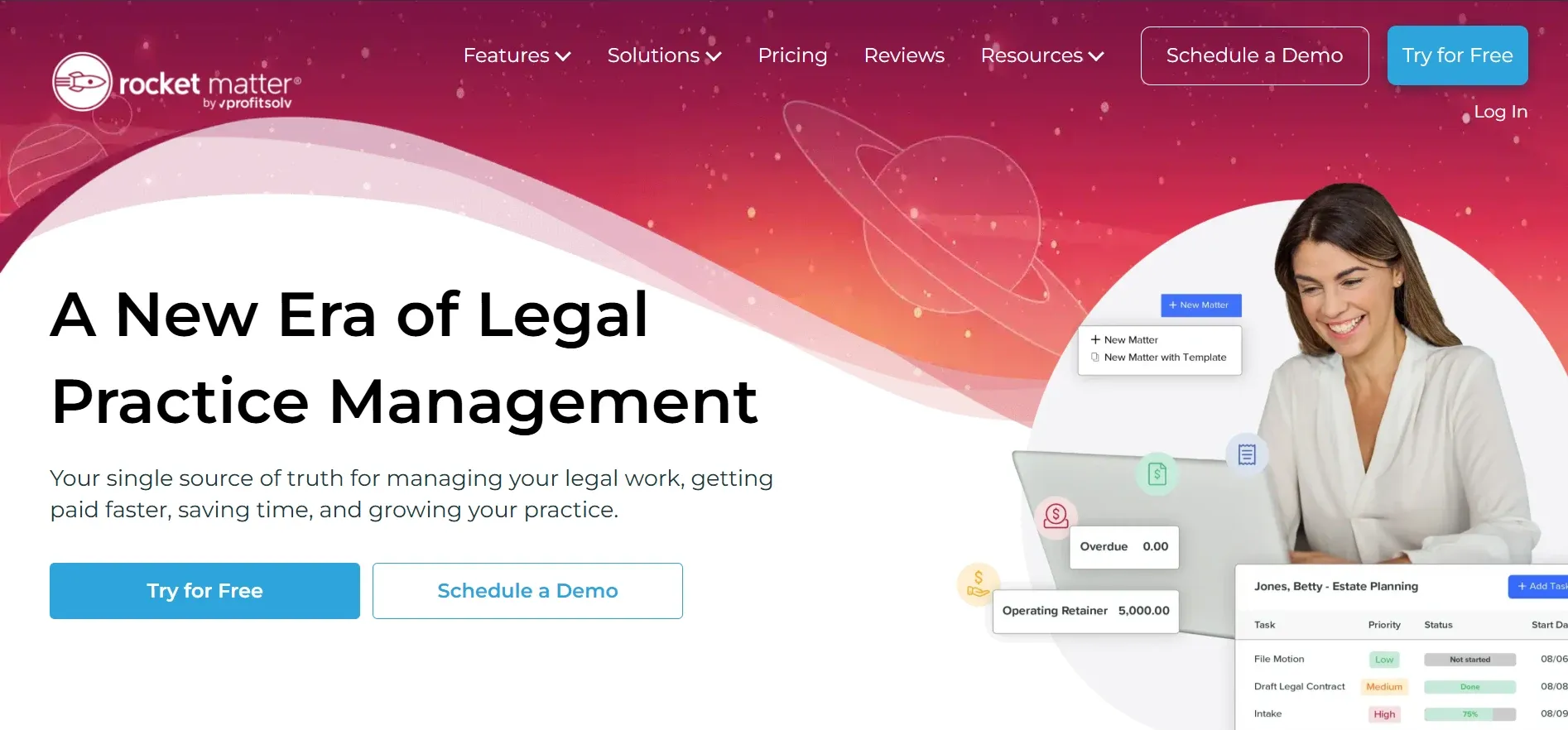
Rocket Matter is one of the earliest cloud-based legal practice management tools, with a clear focus on time tracking and billing. Its interface is approachable, and its mobile app is highly rated for on-the-go time capture. Rocket Matter also supports document management, calendaring, and basic task workflows.
Features and integrations: Rocket Matter integrates with QuickBooks, Dropbox, LawPay, and Office 365. Its billing engine supports batch billing, customizable invoices, and LEDES billing for insurance defense. The platform includes robust reporting, dashboards, and trust accounting tools (though not as extensive as CosmoLex). Migration from Clio is fairly straightforward for standard data, but custom fields and workflows may require manual adjustment.
Migration friction: Rocket Matter provides migration assistance, but complex setups or custom reports from Clio may need to be rebuilt. Firms that rely heavily on custom workflows or document automation may find Rocket Matter’s options somewhat limited.
Pricing: From $39/user/month.
- Strong time tracking and billing tools
- Easy-to-use mobile app
- Reliable support and onboarding
- Advanced features require add-ons or higher plans
- Limited customization for complex workflows
- Per-user pricing can increase costs for larger teams
With Devaims, you can have time tracking and billing built to fit your exact process, with no per-user fees.
6. Smokeball (Document automation)
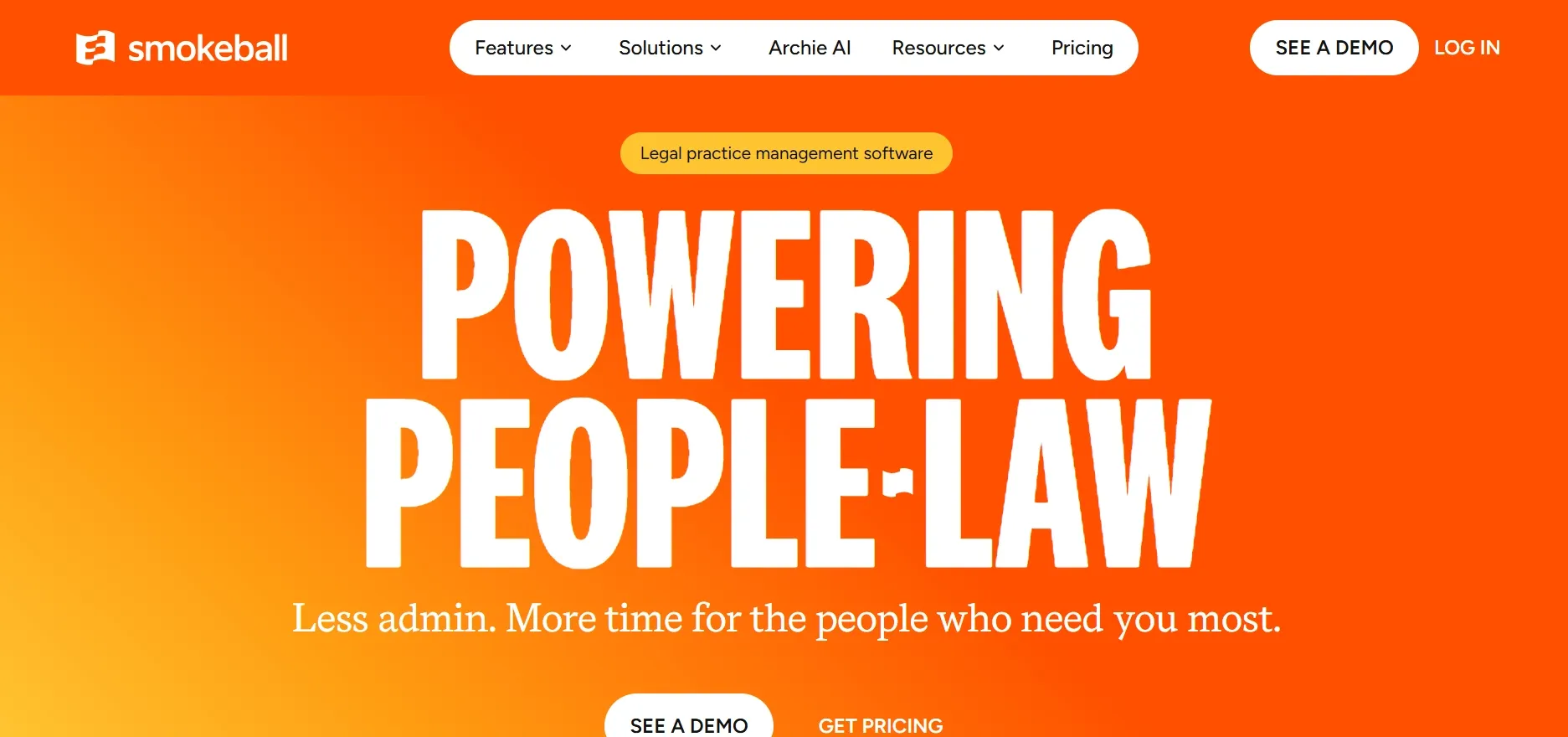
Smokeball is purpose-built for document-intensive law practices, especially in areas like real estate, estate planning, and family law. Its main draw is robust document automation. Smokeball ships with thousands of court forms and templates, which can be customized and auto-filled based on matter data.
Features and integrations: Smokeball integrates with Microsoft Word and Outlook, LawPay, and InfoTrack for e-filing. Its Activity Intelligence tool automatically tracks time spent on documents, emails, and calls, helping firms bill more accurately. Smokeball’s client portal supports secure messaging and document sharing. Data migration is supported, but converting complex document templates from other platforms can be labor-intensive.
Migration friction: Migrating matter data is straightforward, but recreating custom document templates and automations may require significant setup time. Smokeball’s onboarding team can assist, but highly customized practices may need to invest in template development.
Pricing: From $39/user/month.
- Extensive document automation library
- Automatic time tracking for billing
- Secure client portal
- Available only in the US and Australia
- Advanced features require higher plans
- No full accounting module
Devaims can automate your firm's unique documents and workflows, regardless of region or accounting needs.
7. AbacusLaw (On-premise option)

AbacusLaw stands out as one of the few remaining on-premise legal practice management solutions. Firms can install AbacusLaw on their own servers, maintaining physical control over data and security. Alternatively, a managed cloud version is available. AbacusLaw covers case management, calendaring, document assembly, and billing, and offers industry-specific templates (e.g., for personal injury or criminal defense).
Features and integrations: AbacusLaw integrates with Microsoft Office, QuickBooks, and its own suite of legal tools, including Abacus Payment Exchange (APX) for billing and payments. The system is highly configurable, with customizable fields, forms, and workflows. AbacusLaw also offers document automation and a client portal, though both feel less modern than cloud-first competitors.
Migration friction: Moving to AbacusLaw from a cloud platform involves more planning, especially if deploying on-premise. Data import tools are available, but advanced automations or custom integrations may require IT support.
Pricing: Custom quote.
- On-premise deployment for data control
- Highly configurable workflows
- Industry-specific templates
- License only, not true code ownership
- Interface is dated and may require IT support
- Cloud version introduces recurring fees
With Devaims, you keep the code and deploy it anywhere you want, cloud or on-premise, with full ownership.
8. Filevine (Case-heavy firms)
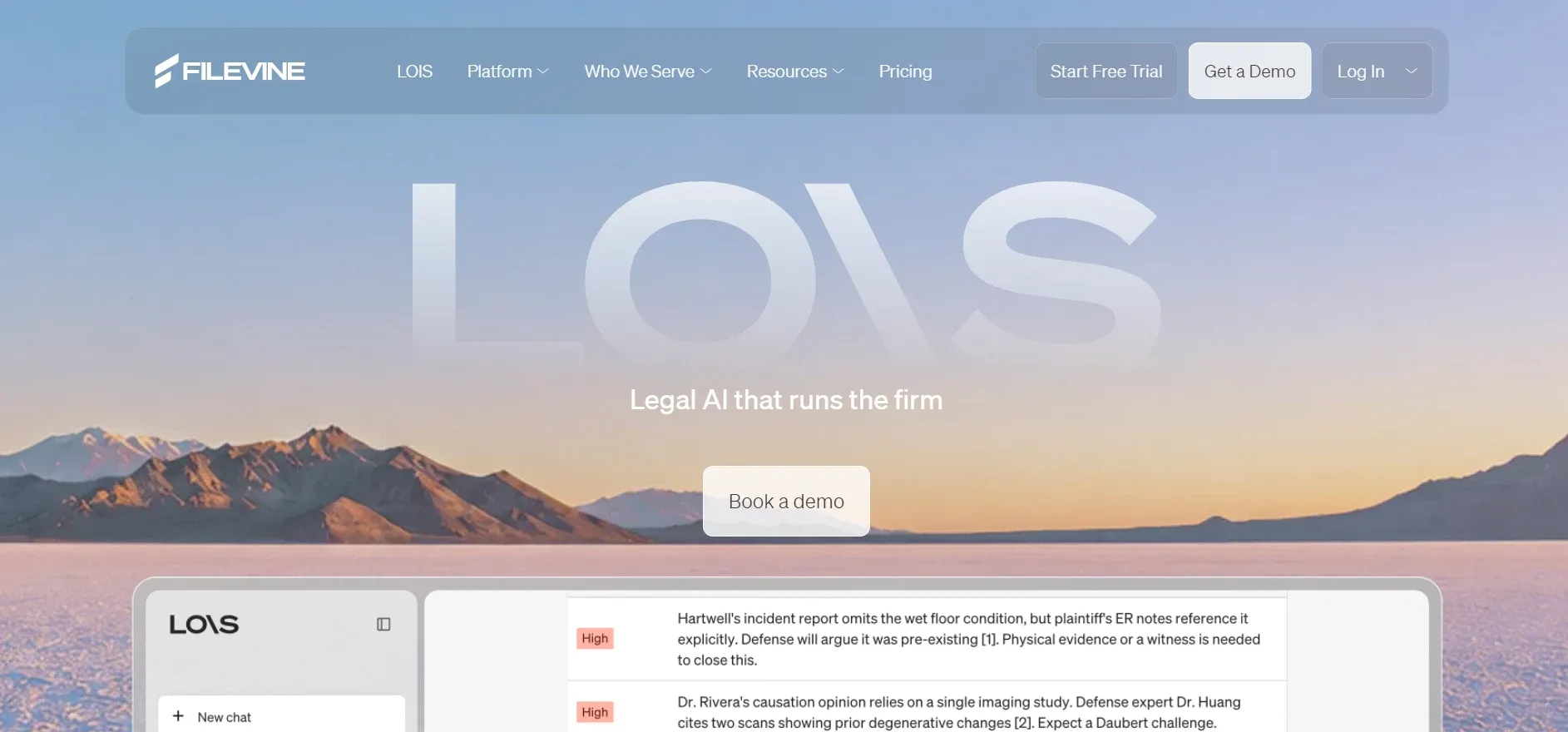
Filevine is a favorite among high-volume, case-driven law firms, especially in personal injury, mass tort, and insurance defense. Its platform excels at complex case management, detailed reporting, and workflow automation. Filevine’s interface is modern, and its project management tools are more advanced than most legal SaaS suites.
Features and integrations: Filevine integrates with DocuSign, QuickBooks, RingCentral, and a growing list of legal tech partners. Its workflow builder supports conditional logic, task assignments, and deadline tracking. The reporting engine is highly customizable, giving firms detailed insights into case progress, staff productivity, and financials. Filevine also offers a client portal and e-signature tools.
Migration friction: Filevine’s team assists with data migration, but custom fields, templates, or advanced automations from Clio may need to be rebuilt. Training is essential, as Filevine’s depth and flexibility require more onboarding than simpler tools.
Pricing: Custom quote.
- Advanced case management and reporting
- Highly customizable workflows
- Strong automation for high-volume firms
- Opaque pricing and multi-year contracts
- Steep learning curve for new users
- Locked into Filevine's ecosystem
Devaims lets you own your platform and reporting, with no contract lock-in or forced upgrades.
9. ProLaw (Enterprise legal management)
ProLaw, developed by Thomson Reuters, is designed for mid-size and large law firms with enterprise-level needs. It combines practice management, document management, and legal accounting in a single suite. ProLaw’s deep integration with Westlaw and other Thomson Reuters products is a major advantage for firms that rely on legal research and advanced document assembly.
Features and integrations: ProLaw offers advanced document management, customizable workflows, billing, accounting, and CRM tools. The platform integrates with Microsoft Office, Outlook, and Westlaw, and supports custom reporting and business intelligence dashboards. ProLaw is available as both on-premise and hosted cloud deployments, and migration is typically a managed, multi-phase project.
Migration friction: Transitioning to ProLaw from Clio or similar SaaS tools is a significant undertaking, often involving consultants and IT staff. Data mapping, workflow recreation, and staff training are essential, and the process can take months for larger firms.
Pricing: Custom quote.
- Enterprise-level features and integrations
- Deep customization for large firms
- Strong document and accounting management
- High upfront and ongoing maintenance fees
- Legacy interface less intuitive than modern SaaS
- License only, not full code ownership
With Devaims, you get enterprise features and true ownership, without legacy constraints.
10. LexisNexis PCLaw (Accounting-focused alternative)
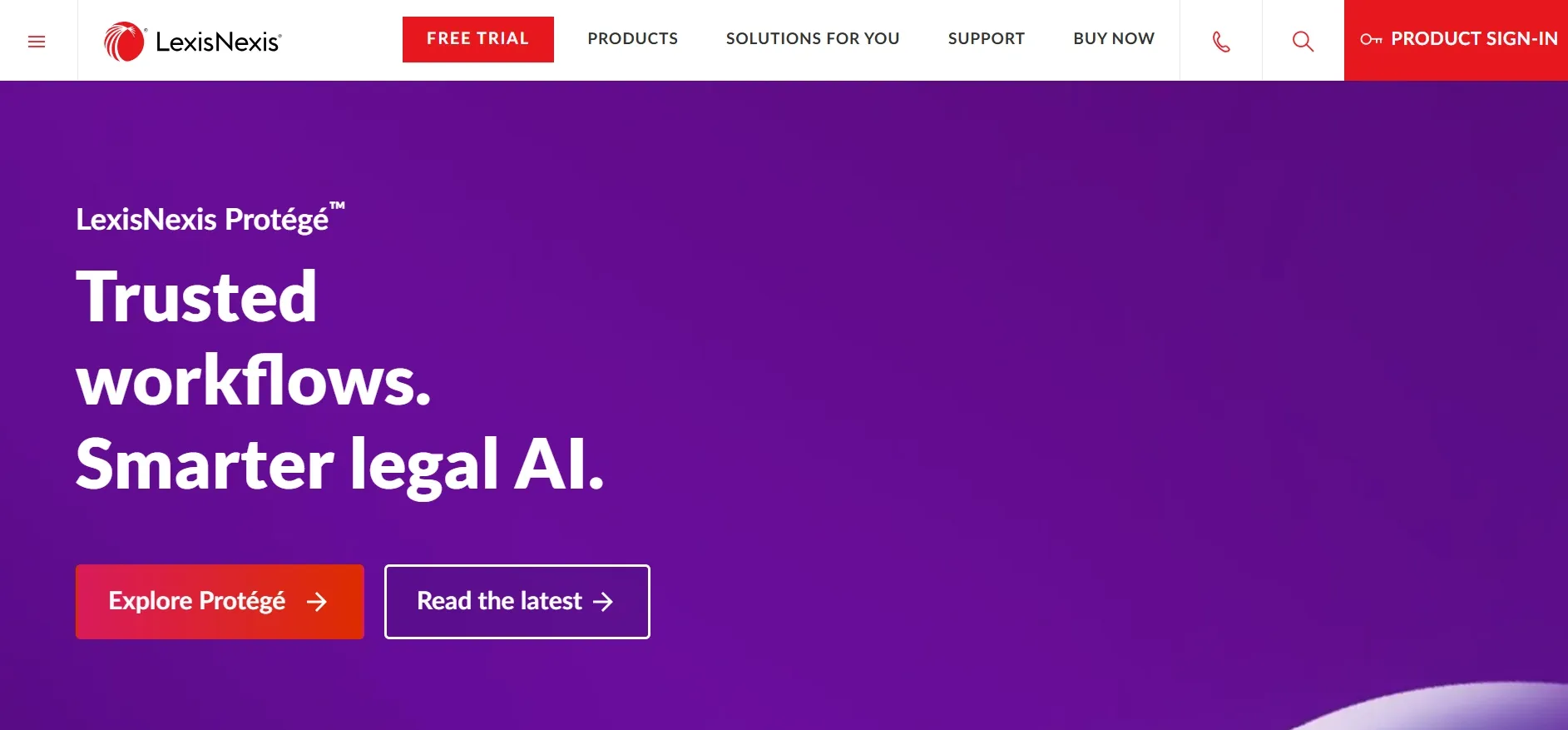
LexisNexis PCLaw is a long-standing legal accounting and practice management solution, best known for its trust accounting and compliance features. It is often chosen by firms that prioritize accounting and financial controls over workflow automation.
Features and integrations: PCLaw offers legal billing, trust accounting, time tracking, and basic matter management. It integrates with Microsoft Office and other LexisNexis products. The platform supports compliance reporting and audit trails, making it suitable for firms with strict accounting requirements.
Migration friction: Migrating from Clio or other SaaS tools may require assistance, especially for complex accounting data. The interface is legacy-style, and training may be needed for new users.
Pricing: License-based, custom quote.
- Strong legal and trust accounting
- Compliance and audit features
- Widely used in accounting-focused firms
- Legacy interface and dated user experience
- Limited workflow automation
- License only, not full code ownership
Devaims can deliver modern accounting features with a user experience tailored to your team, and you own it all.
11. Devaims (True ownership, custom-built for your firm)
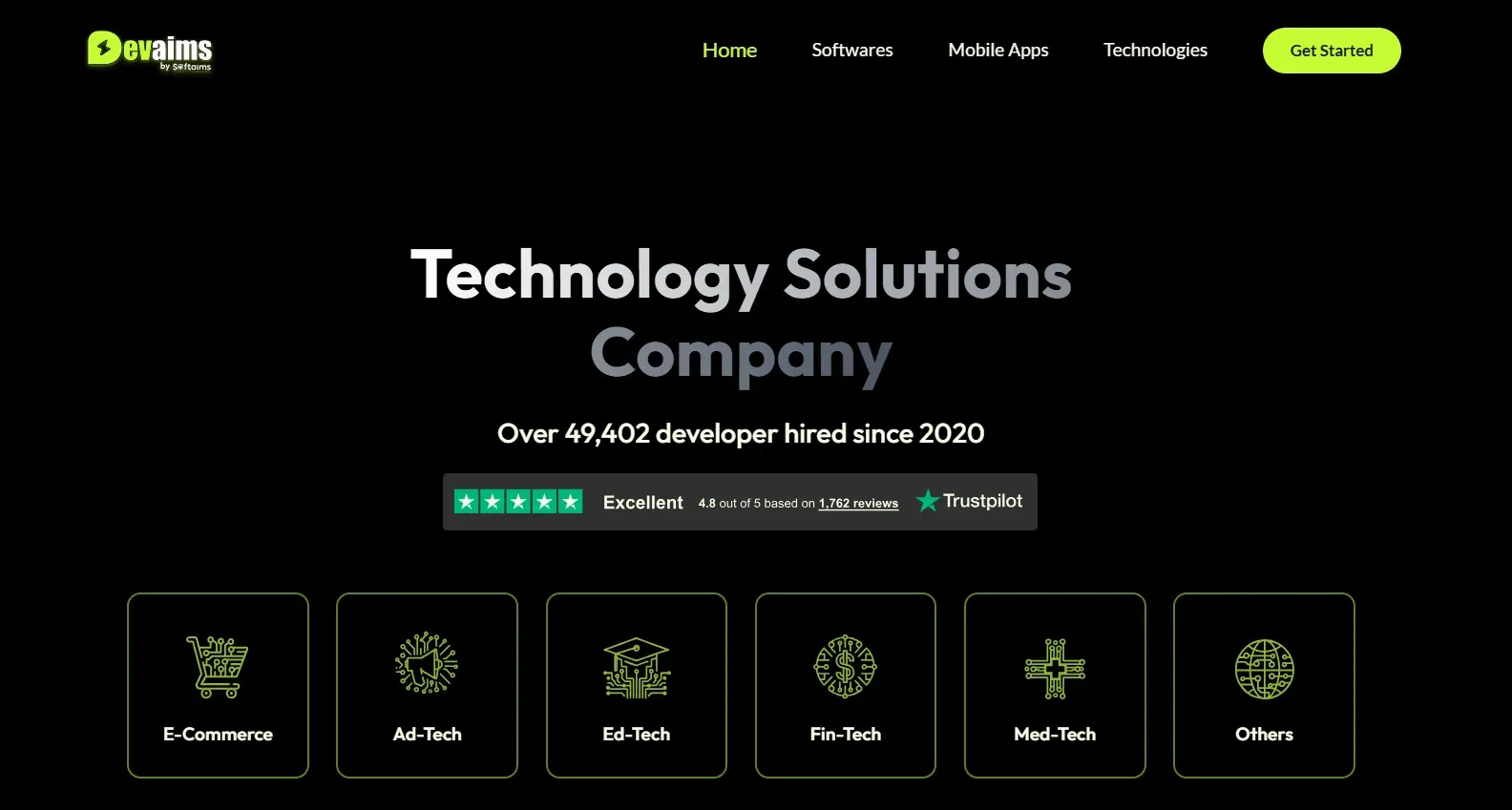
Devaims builds custom legal software you own outright. The code, the data, the rules are yours. Unlike every SaaS on this list, your firm pays once to build your platform, then a flat maintenance fee. No per-user or per-case pricing, no forced updates, and no lock-in ever. You decide what features matter, and the system grows with you.
Features and integrations: Devaims starts with a discovery process to map your workflows, intake, billing, document needs, and unique processes. The resulting platform is tailored to match exactly how your firm operates, from custom matter types to branded client portals, to bespoke reporting and document automation. Devaims can integrate with any third-party tool with an API (e.g., QuickBooks, NetDocuments, DocuSign, LawPay). You get full code ownership, meaning you can host on your own server, in the cloud, or even on-premise. If your needs change, features or integrations can be added at any time, without paying for things you do not use.
- True software ownership, no per-user or per-matter fees
- Custom workflows, features, and integrations
- Full control over data, hosting, and security
With Devaims, you're not just breaking free from SaaS, you're building your firm's competitive edge. Everything is yours, forever.
Other Clio alternatives worth knowing
- Needles: Favored by plaintiff-side personal injury firms. Migration to their cloud-based version (Neos) has been challenging for some, and the interface is less modern than pure cloud competitors.
- Actionstep: Offers a flexible workflow engine and strong automation, but pricing and configuration can be complex. Suited for firms with process expertise and IT support.
Some of these systems are industry-specific or legacy options, solid if you need their niche features, but none offer true ownership like Devaims.
How to choose the right Clio alternative
- By budget: If cost per user is a pain, look at total five-year spend, not just monthly sticker price. SaaS fees add up quickly as you add staff. A one-time build may be cheaper over time, especially for larger firms.
- By firm size: Solo and small shops need simplicity, while large teams demand customization and robust reporting. Some platforms (like MyCase) are best for small teams; others (like Filevine or ProLaw) serve larger firms with IT resources.
- By workflow needs: If your intake, billing, or case types are unique, custom or highly configurable platforms win. SaaS tools can be rigid, while custom software adapts to your process.
- By data control: Firms with sensitive client data or compliance needs may want on-premise or owned solutions. True ownership gives you the ability to set your own security, backup, and retention policies.
- By integration: A platform that plays nicely with your preferred tools saves time and hassle. Some SaaS platforms limit integrations or charge extra for API access; custom platforms can integrate with anything that has an API or export function.
If you're tired of paying rent for the same workflows every month, owning your platform might finally make sense.
Stop paying rent on software you could own
The dirty secret: every alternative to Clio is still rented, just with a different coat of paint or billing model. Whether it's MyCase, CosmoLex, or a legacy license like AbacusLaw, you pay for access, not ownership. Upgrade fees, per-user add-ons, and contract lock-in come standard. Devaims breaks the cycle by building law firm platforms you own outright. You keep the code, you set the rules, and your data never leaves your hands.
Devaims is a custom software agency that builds web, mobile, and business platforms for law firms who want to control their tech, forever. You get the source code, unlimited users, and a system designed for your exact needs. No more outgrowing tiers or paying for features you never use.
- Per-user fees? Gone. You add staff without a new invoice.
- Feature locked behind tiers? Yours by design, you request it, we build it.
- Data ownership? 100 percent yours, from day one.
- Integration limits? If an API exists, we can connect it.
| Platform | Ownership | Per-user fees? | Custom features? | Contract lock-in? |
|---|---|---|---|---|
| Clio | No | Yes | Limited | Yes |
| MyCase | No | Yes | Limited | Yes |
| CosmoLex | No | Yes | Some | Yes |
| Filevine | No | Yes | Some | Yes |
| Devaims | Yes | No | Unlimited | No |
Here's the five-year math for a 15-lawyer firm (typical mid-size):
| Year | Clio (rented) | Devaims (owned) |
|---|---|---|
| 1 | $9,000 | $32,400 |
| 2 | $18,000 | $33,900 |
| 3 | $27,000 | $35,400 |
| 4 | $36,000 | $36,900 |
| 5 | $45,000 | $38,400 (now ahead) |
Here, renting is cheaper for the first three years. But by year five, owning has pulled ahead, and from then on, every year you keep your system, the gap grows. The more users you have, the faster you win. If you want your law firm software to be an asset, not an expense, let's run your numbers.
How to switch from Clio
- Export all client, matter, and billing data from Clio (CSV or API export). Review export options, as some custom fields or attachments may require manual extraction.
- Choose your new platform and plan your migration timeline. Consider downtime, overlap, and training needs.
- Import data into your new system, or work with your provider to automate it. For SaaS, this usually means bulk upload tools; for custom builds, data is mapped and imported as part of the project.
- Reconnect payment processors and key integrations (email, calendar, e-signature, etc.). Test each integration to ensure data flows as expected.
- Train your team on the new workflows and features. Provide cheat sheets and record training sessions for reference.
- Run both systems in parallel for a short period to ensure nothing gets missed. Validate that all active matters, deadlines, and financials are correct.
- Review your Clio contract terms to avoid auto-renewal or penalty fees. Schedule cancellation in advance to prevent surprise charges.
With a custom Devaims build, the migration is handled as part of the project, including mapping, import, and staff training.
Frequently asked questions
What is the best Clio alternative for most law firms?
For small to midsize firms that want a plug-and-play SaaS experience, MyCase and CosmoLex are the most commonly chosen. MyCase offers simplicity and a good client portal, while CosmoLex stands out for integrated accounting. However, both keep you on the subscription treadmill. If you want to break the cycle of monthly fees and get a system tailored to your exact workflows, owning your platform with Devaims is the only way to truly control your costs and features.
Which Clio alternative is the cheapest?
Rocket Matter and Smokeball are among the lowest-priced full-featured SaaS platforms, starting at $39/user/month. However, true cost depends on your required features, add-ons, and total user count. Many firms find that after adding e-signatures, automation, or premium support, costs rise quickly. Over five years, a custom Devaims build may be less expensive for firms with 10+ users, especially when you factor in unlimited users and no add-on fees.
Is there a free Clio alternative?
There are open-source legal management tools (like Casebox), but these require technical expertise to set up, host, and maintain. They often lack the integrations, polish, and support found in commercial SaaS. For law firms that want ownership without the DIY headaches, Devaims delivers a fully supported, custom-built platform tailored to your needs, with ongoing updates and support included.
What is the best Clio alternative for accounting features?
CosmoLex is the leader among SaaS platforms for integrated legal accounting and trust compliance, eliminating the need for QuickBooks. For total control, a custom Devaims build can include any accounting workflow your firm requires, from custom billing models to detailed trust reconciliation and reporting, all owned and managed by you.
How hard is it to switch from Clio to another platform?
Switching takes planning and effort, especially for larger or highly customized firms. Key steps include exporting data (clients, matters, billing, and documents), mapping to the new platform’s structure, importing and verifying data, reconnecting integrations, and retraining staff. Most SaaS vendors offer migration support, but there may be limits on what transfers cleanly (e.g., custom fields, automations). With Devaims, the migration process is fully managed as part of your project, including data mapping, validation, and user training, to minimize disruption.
Can I keep my existing workflows when I move platforms?
Most SaaS alternatives require some compromise, as they are built for the average use case. Custom fields, intake processes, or billing models may need to be adapted or rebuilt. With Devaims, your workflows are mapped and custom-built into your new system, preserving what works and improving where needed. Nothing is lost; everything is tailored to fit your practice.
When should a law firm consider owning vs. renting software?
If your five-year total SaaS spend exceeds the cost to build and maintain a custom platform, or if you need workflows, integrations, or compliance features no SaaS vendor offers, ownership becomes the clear choice. Firms with stable growth, unique needs, or a desire for long-term cost control benefit most. Clio alternatives are all rented; Devaims is yours forever.
The bottom line
Every Clio alternative on this list gives you a new flavor of recurring subscription, but none break the rent cycle. The single most useful test: add up your five-year SaaS cost, then ask if that could have built you something you own. If so, renting stops making sense.
Software you own runs on your terms, at your cost, forever. That's the real alternative most law firms never consider, until the math makes it obvious.
Want more? Visit the Devaims blog or check out our latest alternatives guides: MyCase alternatives, CosmoLex alternatives, and Rocket Matter alternatives.