


Three years into CosmoLex and you realize: it is not just the monthly fee. It is the add-ons, the per-user climb, and the knowledge that your firm will never actually own the data or the process. Every new partner, every paralegal, another bump. By the time you are running a midsize shop, you have spent enough on subscriptions to have bought the software twice over, except you never own it.
The good news: you are not stuck. Clio, MyCase, PracticePanther, and others all pitch their take on law firm management. Each has a strength, but all share the same rental math. If you want out of the rent trap, there is one option the SaaS crowd will not mention: build your own and keep the code. Let’s break down the real CosmoLex alternatives for 2026, who they fit, where they burn, and when it is finally smarter to own.
Why law firms look for CosmoLex alternatives
Per-user pricing climbs fast: CosmoLex charges per user, so as your team grows, so does your bill. Firms that scale feel the pinch. For example, a firm with 15 users might pay over $10,000 annually, not including add-ons or premium support. The cost is predictable, but it quickly becomes significant as your firm expands. This model can hamper hiring decisions and creates a sense of being penalized for growth.
Locked-in features and tiers: Key reports, advanced billing options, or integrations are only available on higher, more expensive tiers, often discovered too late. For many firms, this means that what seemed affordable at first becomes far more expensive once you realize the features you actually need are locked behind another paywall. This can disrupt workflows and force you to either pay more or compromise on efficiency.
Long-term contracts: Year-long commitments are standard, making it hard to exit or pivot if the tool is not a perfect fit for your practice. Early termination fees, auto-renewals, and complex offboarding processes can trap firms in platforms that no longer serve their evolving needs. Even if another platform is a better fit, the hassle and cost of switching can be daunting.
Limited customization: You are boxed in by what CosmoLex offers. Workflow tweaks, unique billing rules, or custom fields? Usually not possible without workarounds, Zapier hacks, or external consultants. This limits your ability to optimize processes for your specific practice area or client base, and can lead to inefficient manual workarounds.
Data ownership and migration headaches: Extracting your data is clunky, and you never truly own your setup. Many look for CosmoLex alternatives to escape this lock-in. Data exports are often incomplete or poorly formatted, and re-importing into a new system can require significant cleanup. There is also the risk of losing crucial historical data or metadata during migration, which can impact compliance and client service.
Quick comparison of the best CosmoLex alternatives
| Tool | Best for | Starting price | You own it? |
|---|---|---|---|
| Clio | All-in-one practice management | Reported $39/user/mo | No |
| MyCase | Client communication | Reported $49/user/mo | No |
| PracticePanther | Automation | Reported $49/user/mo | No |
| Lawmatics | CRM & intake | Reported $99/user/mo | No |
| Rocket Matter | Billing & time tracking | Reported $39/user/mo | No |
| Smokeball | Document automation | Reported $99/user/mo | No |
| AbacusLaw | On-premise legacy | Reported $69/user/mo | No |
| Filevine | Case management flexibility | Custom quote | No |
| Devaims | Custom, ownable platform | One-time build | One-time build, you own it |
Always confirm current pricing before you decide. Fees and tiers can shift year to year.
The 9 best CosmoLex alternatives
1. Clio (All-in-one practice management)
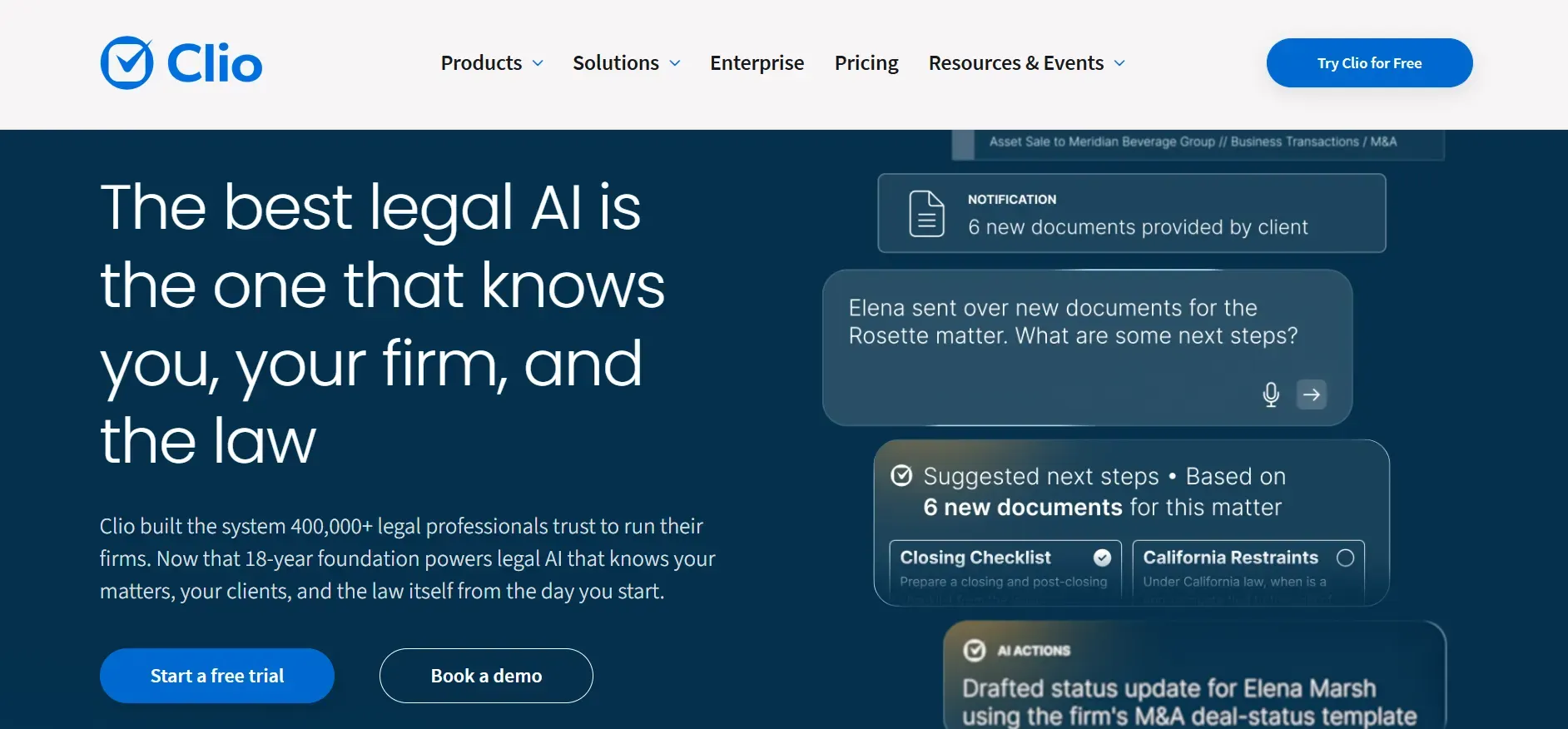
Clio is the most recognized cloud-based legal practice management platform and the most common next step for firms leaving CosmoLex. Clio offers a comprehensive suite: case management, billing, document management, calendaring, time tracking, client portals, and a robust marketplace of over 200 integrations. The platform supports e-signature, two-way email sync, and custom fields, helping firms centralize their workflow.
Pricing: Reported starting at $39/user/month, with premium tiers higher. See Clio pricing.
- Broad feature set and integration marketplace
- Reliable support and onboarding
- Popular with midsize and general practice firms
- Per-user pricing increases as your team grows
- Advanced analytics and reporting require higher tiers
- Customization limited to platform boundaries
If you want to avoid per-user fees, Devaims offers a flat-cost alternative with full ownership.
2. MyCase (Client communication)
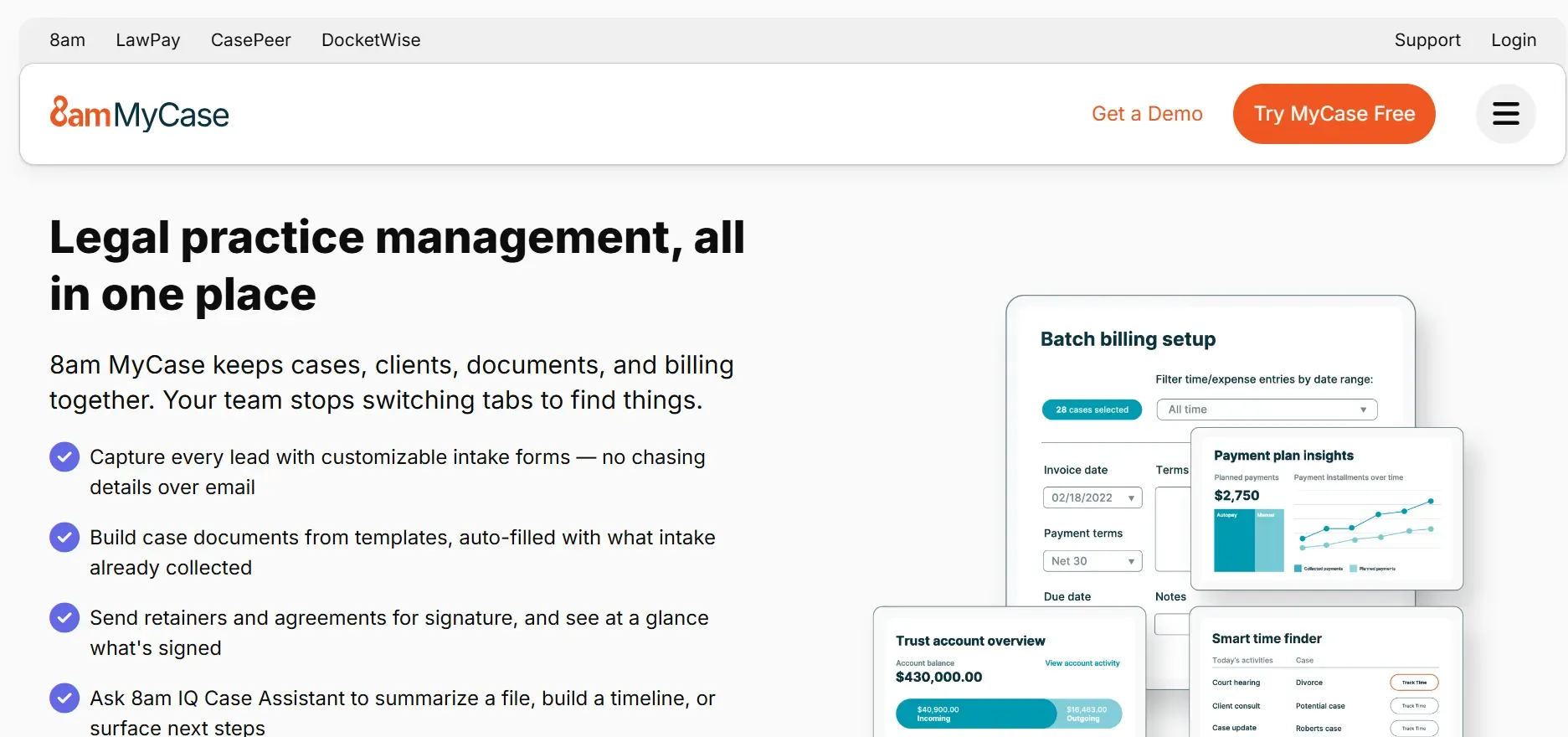
MyCase markets itself as the client-centered practice management platform. Its standout feature is a secure client portal, enabling real-time messaging, document sharing, e-signatures, and online payments. The portal is easy for clients to use, reducing the friction of client communication and document exchange.
Pricing: Reported at $49/user/month. See MyCase pricing.
- Excellent client portal and communication tools
- Easy online payments and reminders
- Streamlined for client-heavy practices
- Limited customization and workflow automation
- Advanced features require higher tiers
- Integration marketplace is smaller than Clio’s
For firms needing more customization, Devaims can build client portals and workflows tailored to your needs.
3. PracticePanther (Automation)
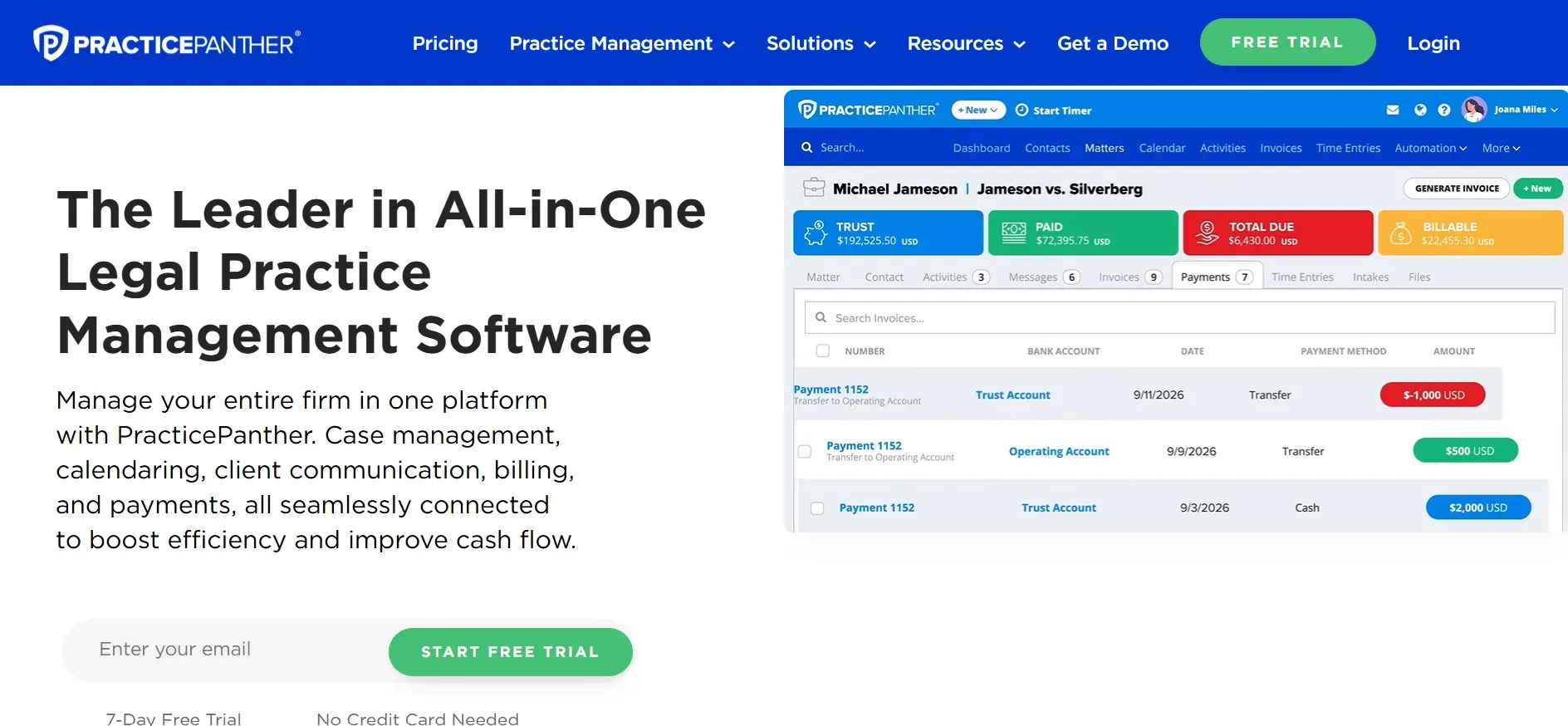
PracticePanther is known for its automation capabilities, offering customizable triggers, reminders, and workflows. It aims to reduce manual data entry and repetitive tasks, freeing staff to focus on billable work. The interface is modern, and the platform is cloud-based with mobile support.
Pricing: Reported at $49/user/month. See PracticePanther pricing.
- Strong automation and workflow tools
- Modern interface and mobile support
- Popular with boutique and high-caseload firms
- Advanced automation features require higher tiers
- Custom workflows limited to platform capabilities
- Per-user pricing increases with team size
If you need automations beyond SaaS limits, Devaims can build exactly what your firm requires, with no extra fees for new features.
4. Lawmatics (CRM & intake)
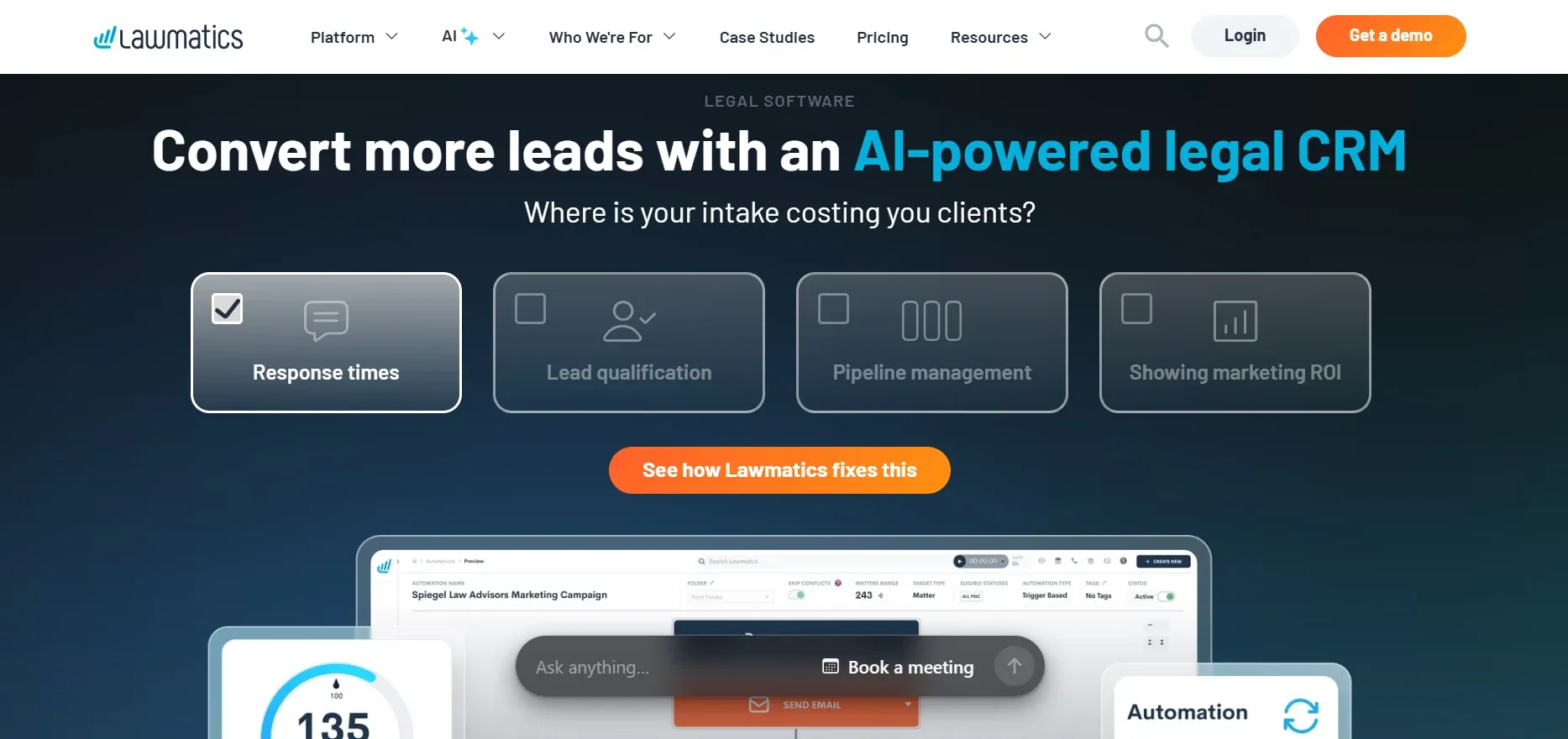
Lawmatics specializes in client relationship management, marketing automation, and intake. Unlike CosmoLex, which focuses on practice management, Lawmatics automates the entire client journey: from lead capture and intake forms, to drip email campaigns and follow-up reminders.
Pricing: Reported at $99/user/month. See Lawmatics pricing.
- Powerful intake and CRM automation
- Strong analytics and lead tracking
- Integrates with major legal SaaS platforms
- Expensive for larger teams
- Learning curve for advanced features
- Does not replace core practice management
For firms wanting CRM and intake tailored to their process, Devaims can build custom solutions that fit your exact workflow.
5. Rocket Matter (Billing & time tracking)
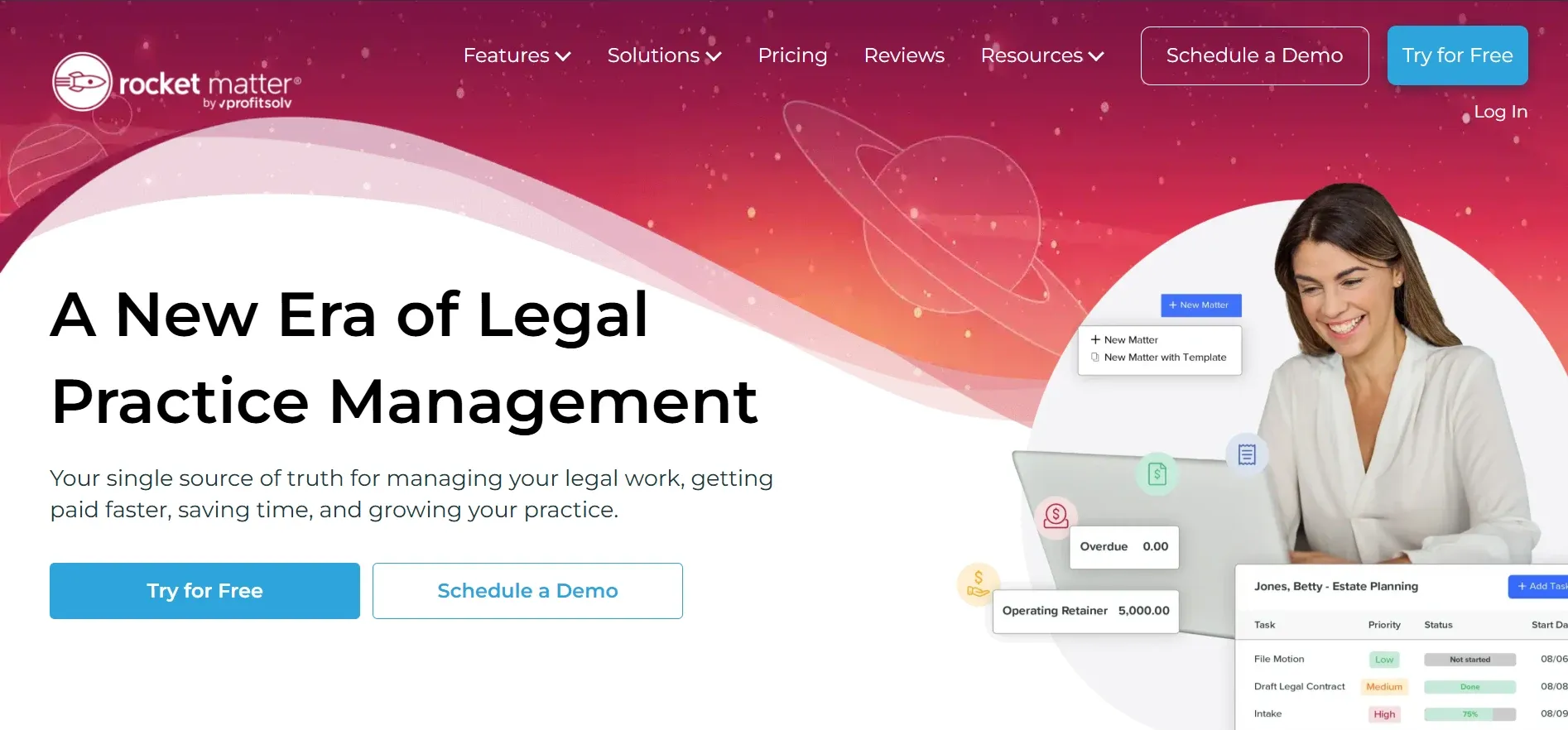
Rocket Matter is trusted for its billing, time tracking, and legal accounting tools. It focuses on simplifying time capture, batch billing, and trust account management, with robust reporting and compliance features.
Pricing: Reported at $39/user/month. See Rocket Matter pricing.
- Strong billing and trust accounting features
- Compliance-focused reporting
- Easy time tracking and batch billing
- Limited document automation and workflow tools
- Customization is basic
- Per-user pricing and annual contracts
Devaims can build billing and accounting tools that match your firm's unique needs, with no per-user fees.
6. Smokeball (Document automation)
Smokeball is designed for document-heavy practices, such as real estate, estate planning, or family law. Its core strength is document automation, with deep Microsoft Office integration and a unique desktop-cloud hybrid model.
Pricing: Reported at $99/user/month. See Smokeball pricing.
- Advanced document automation and templates
- Automatic time tracking via Activity Intelligence
- Strong Microsoft Office integration
- Desktop focus can hinder remote teams
- High cost per user
- Limited workflow customization outside documents
If you want document automation built for your exact process, Devaims can deliver custom tools that work your way.
7. AbacusLaw (On-premise legacy)

AbacusLaw stands out as one of the last on-premise legal practice management systems with a cloud option. It appeals to firms with strict data residency requirements or legacy infrastructure.
Pricing: Reported at $69/user/month for cloud, perpetual license for on-premise; support extra. See AbacusLaw.
- Deep customization for data fields and workflows
- On-premise or hosted options
- Suitable for firms with strict compliance needs
- Interface feels dated compared to modern SaaS
- Server management adds overhead
- Mobile access and user experience lag
For firms wanting true ownership without legacy headaches, Devaims offers a modern, ownable alternative.
8. Filevine (Case management flexibility)
Filevine is a modern, cloud-based platform known for its flexible workflows and powerful automation tools. It is designed for firms that want to tailor case management to their exact processes, with a focus on collaboration and analytics.
Pricing: Custom quote; reported $59 to $79/user/month. See Filevine pricing.
- Highly flexible workflows and automation
- Strong collaboration and reporting tools
- Popular with PI and litigation firms
- Advanced customizations may require Filevine’s team
- Per-user pricing can add up
- Implementation timelines longer for complex needs
For firms wanting full workflow control and ownership, Devaims builds platforms that adapt as you grow.
9. Devaims (Custom, ownable platform)
Devaims is the alternative for law firms that want to stop renting and own their software outright. We build custom web, mobile, and back office tools to match your exact processes. You get the source code, your branding, and full control. No more per-user fees or lock-in.
- One-time build, flat maintenance, you own it
- Custom workflows, intake, billing, and reporting
- No forced upgrades, no feature gatekeeping
Your firm runs on your rules, not a SaaS roadmap. If you want to see what a system built for you (and only you) costs, Devaims will run the numbers and show the break-even.
Other CosmoLex alternatives worth knowing
- LexisNexis PCLaw: Traditional desktop accounting, but aging UI and limited cloud. PCLaw is often used by firms that want robust trust accounting and local data control, but the interface is dated and cloud options are limited. Migration from CosmoLex may require professional support.
- Needles: Case management for PI firms, but dated interface and migration pain. Needles is known for process customization, but transitioning from CosmoLex is complex and the platform is less modern than newer SaaS options.
- Actionstep: Workflow automation, strong for midsize, but per-user pricing. Actionstep offers strong workflow tools and modular features, but migration can be challenging and costs scale with users.
Each fits a niche, but if you want to own your platform, they are all still rental.
How to choose the right CosmoLex alternative
- Budget: Add up your true monthly cost by user count and required add-ons. Remember to factor in support, integrations, and price increases over time.
- Practice area fit: PI, family, corporate, or general, some tools are better tuned. For example, Filevine and Needles are strong for PI, while MyCase is a fit for client-heavy practices.
- Customization: If you need workflows outside the box, SaaS will always be a compromise. Evaluate how much you can tailor intake, billing, and reporting.
- Growth plans: If you plan to expand, watch for per-user pricing cliffs. A firm doubling in headcount will see SaaS costs double, but with owned software, cost is flat.
- Data ownership: Decide if you want true control or are comfortable renting. Consider regulatory needs, client demands, and long-term flexibility.
If your answer to two or more of those is "I want control", it is time to price ownership versus rent.
Stop paying rent on software you could own
The core frustration with CosmoLex, and every SaaS in the legal space, is that no matter how much you pay, you never own the platform. Add a partner, add a bill. Hit a new feature wall, pay more. Five years in and you have spent tens of thousands, but switching is still a headache and your data is still on someone else’s servers.
Devaims builds law firm software you own: web, mobile, billing, reporting, intake, all tailored to your workflow, with the code handed over at launch. There is no forced upgrade, no surprise fee, no contract renewal. You keep the keys and the data, and as your firm grows, your bill does not climb.
- Per-user fees disappear: Add as many users as you want, whenever you want. Growth does not punish your budget.
- No feature gating: Every report, field, or workflow you need is yours from day one. You decide what is built and when.
- Full data control: Your client records, billing, and docs are yours to host and move as you wish. This supports compliance, privacy, and peace of mind.
- Custom everything: Your intake, your billing rules, your reporting. No more SaaS workarounds. If your practice evolves, your software evolves with you.
| Tool | Ownership | Per-user fees | Custom workflows | Contract lock-in? |
|---|---|---|---|---|
| Clio | Rent | Yes | Limited | Yes |
| MyCase | Rent | Yes | Limited | Yes |
| Filevine | Rent | Yes | Some | Yes |
| Devaims (custom build) | You own it | No | Full | No |
Here’s how the five-year math plays out for a 12-person firm:
| Year | Rented (12 users x $59/mo = $708/mo) | Owned (Devaims: $32,000 build, $200/mo maint) |
|---|---|---|
| 1 | $8,496 | $34,400 |
| 2 | $16,992 | $36,800 |
| 3 | $25,488 | $39,200 |
| 4 | $33,984 | $41,600 |
| 5 | $42,480 | $44,000 |
At year six, you have paid off the build and begin to pull ahead. Every year after, you are saving thousands, plus you own the code and the process. For firms with ten or more staff, owning makes sense faster. For smaller teams or shops planning to stay small, renting can make sense a bit longer. We run the numbers for every client to find the break-even.
How to switch from CosmoLex
- Export your client, billing, and document data from CosmoLex. This typically includes contacts, matters, time entries, invoices, trust account balances, and all related documents. CosmoLex provides export tools, but review for completeness.
- Choose your new platform and plan the migration timeline. Schedule downtime or parallel testing, and communicate with your team about the transition to avoid surprises.
- Import data into the new tool, verifying all records. Most platforms have import utilities, but custom fields or legacy data may need manual mapping.
- Reconnect payment processors, calendars, and integrations. Test each integration to ensure payments, scheduling, and document sharing work as expected.
- Train your staff on the new workflows and systems. Provide documentation and support to minimize productivity loss during the transition.
- Test in parallel for a week to catch issues. Run both systems side by side and compare outputs, especially invoices, trust balances, and key reports.
- Review your old CosmoLex contract and cancel when ready. Watch for auto-renewal clauses and confirm that all data has been exported before shutting down access.
With a custom Devaims build, the migration is handled as part of the project, including data mapping, import, and user training.
Frequently asked questions
What is the best CosmoLex alternative for midsize law firms?
Clio is a popular choice for midsize firms, offering broad features, reliable support, and a wide integration marketplace. It is a strong option for general practice and firms that want an all-in-one SaaS with ongoing updates. However, you are still subject to per-user fees and feature gating. For firms that want to invest in their own long-term infrastructure, a custom Devaims build is the only true ownership option, giving you full control, flat costs, and the ability to evolve your platform as your practice grows.
Which CosmoLex alternative is cheapest?
Rocket Matter and Clio tend to have the lowest entry-level fees, starting at $39 per user per month. However, this only covers basic features, and most firms find themselves upgrading to higher tiers or paying for add-ons (such as advanced reporting, premium support, or additional integrations). Over five years, a ten-user firm will spend $23,400 or more, and that number increases with growth or feature needs. By comparison, a custom Devaims build may have a higher upfront cost, but after three to four years, the total cost of ownership is lower and you are no longer paying per user.
Is there a free alternative to CosmoLex?
There are free tools for isolated needs, like Toggl for time tracking, Dropbox for document storage, or Google Calendar for scheduling, but there is no free, full-featured law firm management platform that covers billing, intake, document automation, and compliance. Open-source options like SuiteCRM exist, but require significant IT investment and customization. All major CosmoLex alternatives have per-user fees or usage limits. With Devaims, you pay once to build and own your system, with no ongoing per-user fees.
Which CosmoLex alternative is best for automation?
PracticePanther is strong for automation among SaaS options, offering robust workflow triggers and reminders. Filevine and Actionstep also provide advanced automation, especially for firms willing to invest in configuration. However, if your firm needs truly bespoke automations, such as custom intake logic, billing approvals, or process-specific triggers, owning the code with a Devaims build is the only way to get exactly what you want, with no extra fees for new features or limits on workflow complexity.
When should a firm switch from CosmoLex?
Consider switching if your CosmoLex fees are scaling with staff, you are hitting feature walls, or you have complex workflow or compliance needs that CosmoLex cannot address. If annual costs approach what a custom build would run over three to four years, it is time to run the numbers. Also consider switching if you want full data control, plan significant growth, or need integrations that CosmoLex cannot support.
Can I keep my billing and client records when switching?
Most CosmoLex alternatives allow data import, but the process can be manual and some fields (such as custom notes, historical invoices, or matter metadata) may not map perfectly. Expect to spend time on data cleanup and validation. With a Devaims build, migration is scoped and handled as part of the project. Our team works to ensure that all client, billing, and document records are preserved and mapped to your new system, minimizing data loss and disruption.
The bottom line
You have real alternatives to CosmoLex, but every SaaS on this list is still a rental: you pay, you use, you never own. If you want to break the cycle, owning your own law firm software is no longer out of reach, and for firms with ten or more staff, it pays off faster than most think.
Here is the decision rule: add up what you will spend over five years on any platform. If that number gets close to a custom build, you are already past the break-even. The freedom to own your workflows, your data, and your growth is the real alternative.
For more ownership-first thinking, see the Devaims blog. Explore more alternatives: Clio alternatives, MyCase alternatives, PracticePanther alternatives.