


The monthly bills never stop. You signed the contract, moved your records, and now every family you serve is another line item on a SaaS invoice. Aurora Funeral Solutions is solid, but what happens when you want a feature that is locked behind the next tier, or when your annual renewal jumps by 20 percent? You start looking for Aurora Funeral Solutions alternatives, but every "solution" feels a lot like the last: another rental, another dashboard, another way to be locked in.
So what actually changes if you switch? Below, we break down the 10 best Aurora Funeral Solutions alternatives, from the big names to the niche players, and the one option that lets you stop renting and start owning: a custom build from Devaims. If you have ever wondered whether you could just keep your own system and stop paying per case, here is the honest math.
Why funeral homes look for Aurora Funeral Solutions alternatives
Never-ending subscription fees: Every month, you pay, whether you have five cases or fifty. Over five years, those "affordable" fees add up fast. Many funeral home owners find that what started as a manageable $150 or $250 monthly fee quietly climbs as they add cases, users, or features. The cumulative effect is often overlooked until you run the long-term numbers.
Locked-in contracts and limited export: Once your records live in one platform, migrating out is a multi-week headache, and some data is sticky by design. Many SaaS vendors make it easy to import your information but not so simple to extract it. Attachments, digital signatures, and obituary media are commonly left behind or require manual effort to recover. Some contracts include auto-renewal clauses or notice periods that can trap you for another year if you miss a deadline.
Essential features cost extra: Obituary hosting, e-signatures, or reporting may be stuck behind higher tiers or add-ons, not included in your base fee. Want a custom report? That is an upgrade. Need to integrate with your website or a local cemetery database? That could be an extra line item. Over time, the nickel-and-diming of essential features can make a basic plan balloon in price.
Support that can be slow or generic: The bigger the vendor, the more you wait for answers or fixes, especially if you're not a top-paying client. Some providers outsource support or prioritize larger clients, resulting in slower ticket resolution and less personalized help. For funeral homes handling sensitive cases, even brief downtime or miscommunication can be costly.
No code ownership: You rent the tools, but you never own the system or your workflows. That limits what you can automate or customize long-term. When a vendor sunsets a feature or changes a workflow, you adapt, or pay more for a workaround. For many funeral homes, this lack of true ownership is the biggest frustration, especially as technology becomes a long-term asset for operations and branding.
If you are here, you are probably already searching for Aurora Funeral Solutions alternatives that avoid these headaches, or at least give you more leverage and flexibility.
Quick comparison of the best Aurora Funeral Solutions alternatives
| Tool | Best for | Starting price | You own it? |
|---|---|---|---|
| FrontRunner Professional | Full-service funeral homes | Not disclosed | No |
| Tribute Management | Obituary & tribute management | Not disclosed | No |
| Osiris | Legacy records | Not disclosed | No |
| FuneralTech | Multi-location providers | Not disclosed | No |
| FDMS | Mid-size funeral homes | Not disclosed | No |
| FuneralHQ | Small operators on a budget | $99/mo | No |
| MiMS | Case management | Not disclosed | No |
| CIMS | Cemetery records | Not disclosed | No |
| Epitaphe | European funeral homes | Not disclosed | No |
| Devaims | Full code ownership, custom fit | One-time build, you own it | Yes |
Always confirm current pricing and contract terms with vendors before you decide. Many providers update pricing and bundle features differently from year to year. Ask for a full feature list and sample contract before you sign.
The 10 best Aurora Funeral Solutions alternatives
1. FrontRunner Professional (full-service funeral homes)
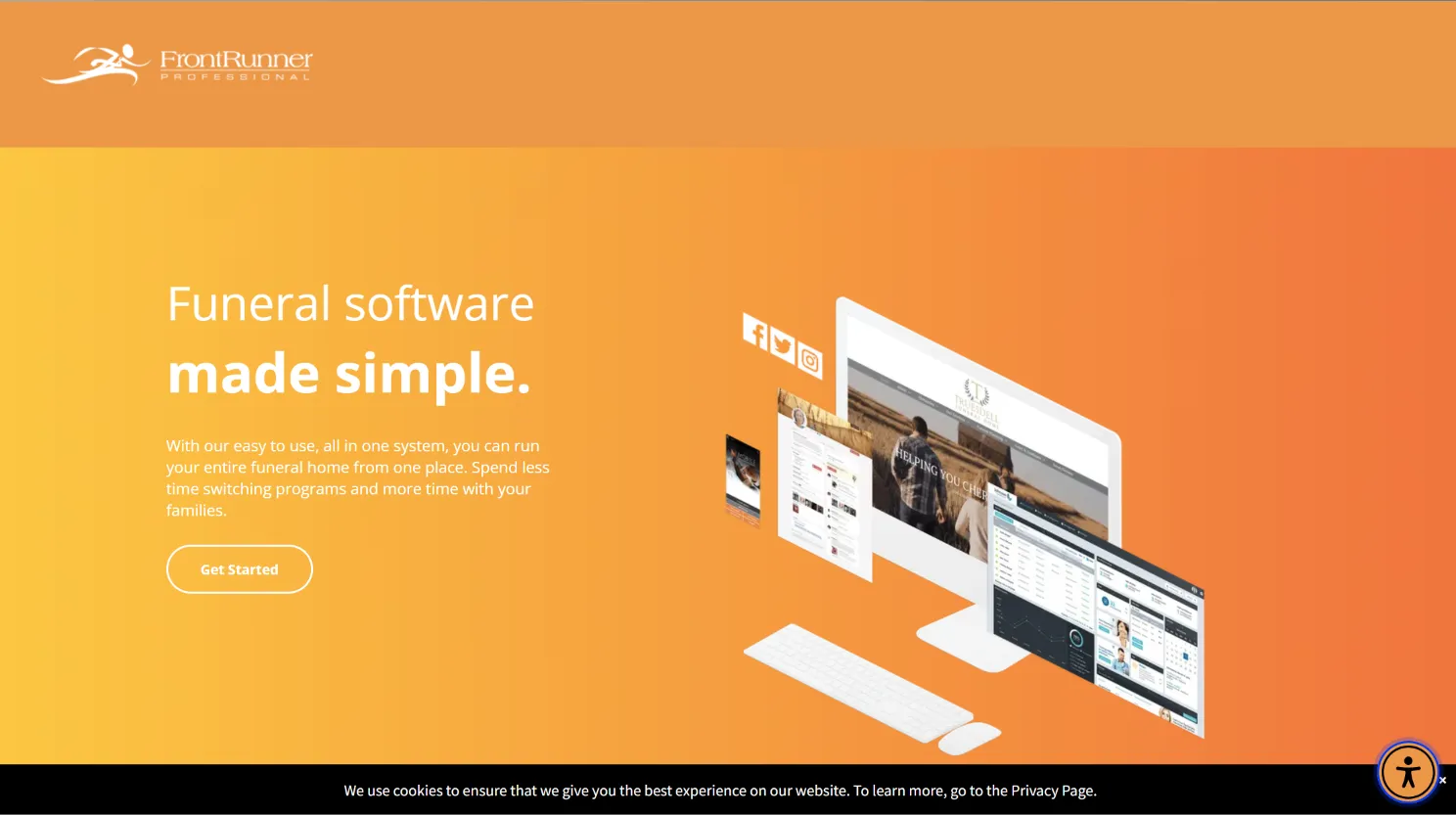
FrontRunner Professional is a comprehensive platform, now part of Tribute Technology, and is widely recognized across North America. Its suite includes case management, website design/hosting, tribute pages, aftercare tools, and digital arrangement solutions. FrontRunner is often praised for its all-in-one approach, allowing funeral homes to handle almost every digital workflow through a single login.
Key features:
- Comprehensive case management (from first call to final disposition)
- Integrated website and online memorials
- Arrangement forms, e-signatures, and contract management
- Reporting and compliance tools
- Pre-need management and aftercare automation
- Integration with obituary syndication and local media partners
Integrations: FrontRunner offers integrations with popular obituary syndication networks, payment processors, and some cemetery management tools. However, many advanced integrations require additional fees or setup.
Migration friction: Moving to FrontRunner typically involves a dedicated onboarding team, but the process can take several weeks. Data import is possible from many common providers, but some record types (like attached PDFs, photos, or digital signatures) may need manual handling. Exiting the platform can be more challenging, especially if you have used their website builder, as your site and data are often tightly coupled with their infrastructure.
Concrete use cases: Multi-location funeral homes needing standardized workflows across branches; firms wanting a unified website, tribute, and arrangement experience; operators with heavy obituary publishing needs.
Trade-offs: While FrontRunner delivers a robust set of features, you remain on the subscription treadmill. Customization is limited to their platform. Feature requests or workflow changes are subject to the vendor’s roadmap. Public pricing is not available, which can make budgeting harder. Some users report that the platform can feel complex for smaller operations.
If you want an owned solution where your workflows are truly yours, a custom build from Devaims means you never pay to access your own data or website.
2. Tribute Management Software (obituary & tribute management)
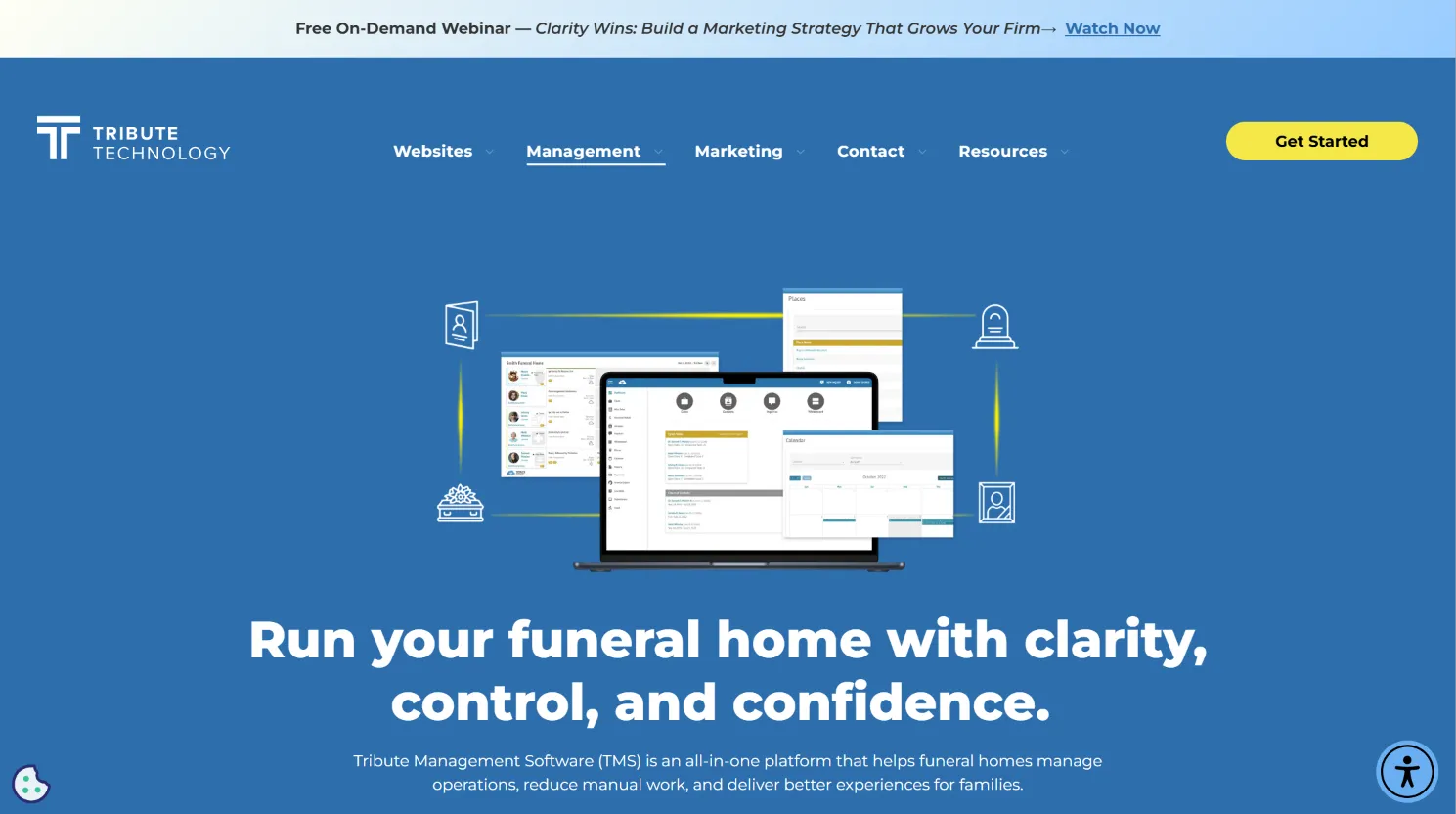
Tribute Management Software (by Tribute Technology) is focused on streamlining the creation and management of obituaries, tribute pages, and guest books. It is popular with funeral homes that process high volumes of memorials and want to monetize tribute features (such as flower ordering, donation links, or video tributes).
Key features:
- Obituary and tribute page creation with templates
- Integrated flower, donation, and e-commerce options
- Guest book moderation and memory sharing tools
- Integration with funeral home websites (especially those on Tribute’s ecosystem)
- Automated obituary syndication to local and national media
Integrations: Tribute Management integrates seamlessly with other Tribute Tech products (such as Frazer Consultants and SRS Computing), and offers API connections for obituary syndication and local payment partners.
Migration friction: Onboarding is generally smooth if you are already using Tribute’s website or other software. However, migrating from a different ecosystem can present challenges, as not all tribute data is portable. Exporting data out of Tribute Management may require custom support or manual downloads, especially for media files.
Concrete use cases: Funeral homes with a strong focus on digital tributes and revenue from online memorials; firms wanting to automate obituary publishing and guest book moderation; operators seeking to increase family engagement and upsell tribute products.
Trade-offs: Pricing is not public and is based on volume/features. While the platform is user-friendly, true customization is limited. You cannot fundamentally change workflows or integrate with outside systems unless Tribute offers it. Data portability is a concern if you ever want to leave.
When you own your platform, like with Devaims, every tribute workflow can be tailored to your process and integrated with your own website without extra monthly fees.
3. Osiris (legacy records and case management)
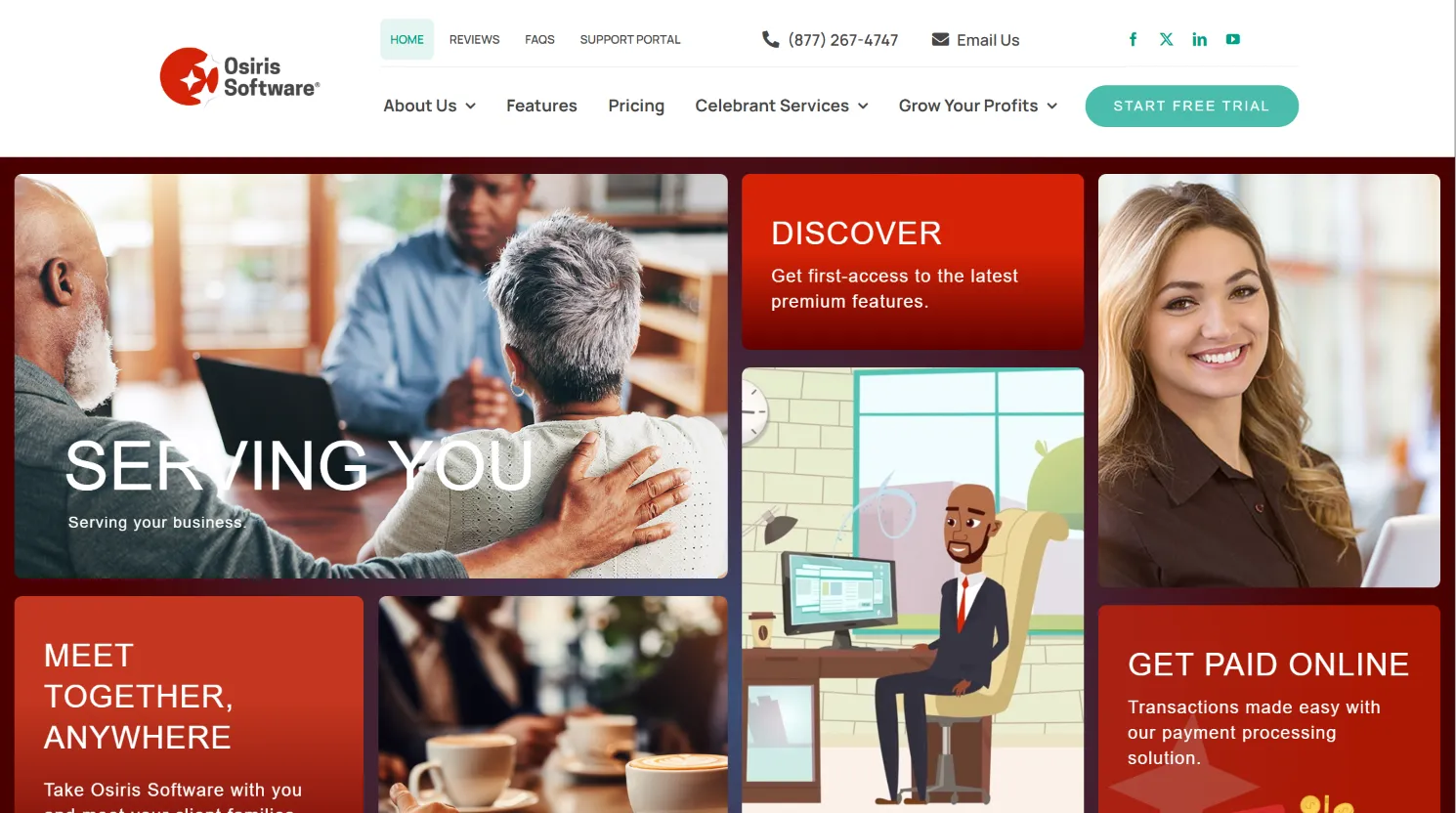
Osiris is a legacy funeral home management solution that has been around for decades. It is often chosen by firms that have a long history with the software or need to preserve old records. Osiris is known for its stability and deep case record management, but the interface and feature set can feel dated by modern standards.
Key features:
- Comprehensive case management with detailed historical records
- Compliance and vital statistics reporting
- Billing and contract management
- Limited digital document storage and printing
Integrations: Osiris has limited modern integrations. Some funeral homes use third-party tools or manual processes to connect Osiris data with newer platforms (such as website obituary pages or accounting packages).
Migration friction: Migrating into Osiris is straightforward for older data formats, but getting data out (especially attachments and non-standard fields) can be labor-intensive. There is no official web presence, which can make support and upgrades harder to access.
Concrete use cases: Funeral homes with decades of legacy records; firms needing a stable, no-frills back office system; shops where digital workflows are less important than record-keeping.
Trade-offs: Osiris is a rental platform. The outdated interface can slow training for new staff. There is little support for modern integrations or features like e-signatures and online arrangements. Upgrades and support depend on the vendor’s pace.
4. FuneralTech (multi-location providers)
FuneralTech specializes in solutions for both single-location and multi-location funeral homes. Their suite covers case management, arrangement tools, digital forms, and website hosting. FuneralTech is often chosen by growing firms that need to standardize processes across branches and want scalable document management.
Key features:
- Case and contract management
- Template-driven forms and documents
- Integrated website builder with tribute pages
- Compliance and reporting tools
- Automated obituary publishing and social media sharing
Integrations: FuneralTech offers integrations with cemetery and crematory management systems, as well as some third-party accounting tools. They provide API access for select partners but not for full custom integrations.
Migration friction: FuneralTech provides onboarding support, but the complexity of migration depends on your existing data structure. Importing from other platforms is possible, but not all data types (such as custom forms or notes) may transfer cleanly. Exiting the platform can be time-consuming, particularly if you use their website builder and want to migrate your site as well.
Concrete use cases: Multi-location funeral home chains needing unified workflows; operators wanting to standardize documentation and compliance; firms looking for a balance between flexibility and vendor support.
Trade-offs: Subscription costs scale with usage, locations, and user counts. Customization is limited to what the platform allows. Feature development is controlled by FuneralTech, and their roadmap may not match your needs.
With a Devaims custom build, as you add locations or volume, your costs stay flat, no per-location or per-user fees.
5. FDMS (mid-size funeral homes)
FDMS (Funeral Director's Management System) is a well-established platform for small and mid-sized funeral homes. It offers a blend of digital and traditional features, focusing on arrangement, billing, compliance, and reporting. FDMS is known for its reliability and industry-specific compliance tools.
Key features:
- Arrangement and case management with contract workflows
- Billing and accounts receivable
- Vital statistics and compliance reporting (including state and federal forms)
- Document generation and storage
- Support for standard industry forms and contracts
Integrations: FDMS can integrate with some accounting software, but integrations with modern web tools and e-signature platforms are less common. Some users employ manual processes to bridge gaps (such as exporting data for obituary publishing).
Migration friction: FDMS onboarding is supported by the vendor, but importing data from other platforms may require mapping and manual review. Exporting your data on exit is possible, but not always in formats that work with other systems.
Concrete use cases: Independently owned funeral homes with a focus on compliance and billing; operators who need a reliable, traditional back-office platform; firms with modest digital needs.
Trade-offs: FDMS is not as modern or customizable as newer SaaS tools. You remain dependent on the vendor for upgrades and support. Adding new features or integrations often means waiting for the vendor’s development cycle.
6. FuneralHQ (small operators on a budget)
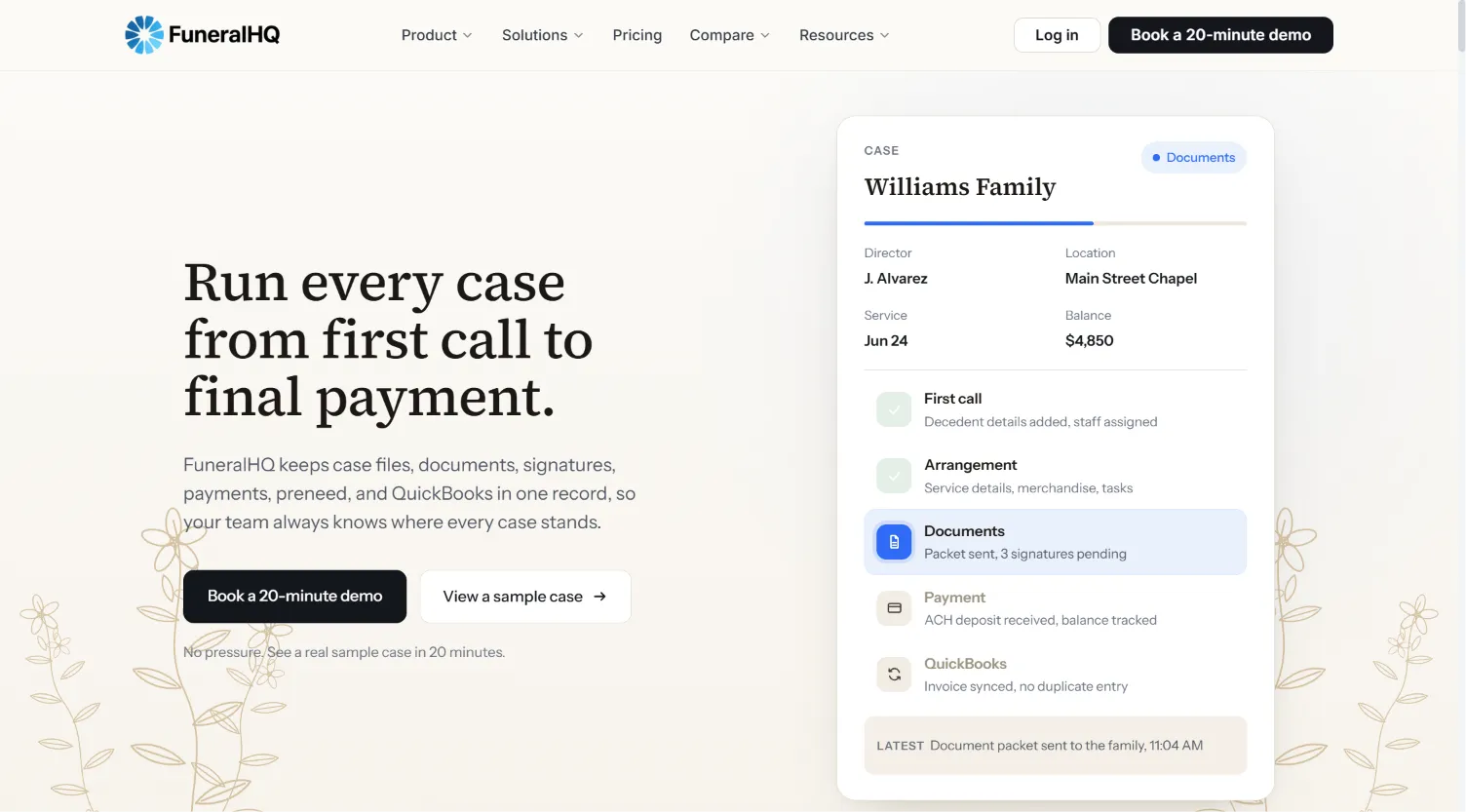
FuneralHQ is a newer SaaS platform built for smaller funeral homes or those new to digital management. Its clear, transparent pricing is a rare advantage in this space. FuneralHQ emphasizes ease of use, streamlined onboarding, and cloud-based access for small teams.
Key features:
- Case and arrangement management
- Digital forms and e-signatures
- Obituary publishing and tribute pages
- Basic billing and reporting
- Cloud-based access for remote work
Integrations: FuneralHQ offers native integrations with some obituary syndication partners and payment processors. However, more advanced integrations (such as website or CRM tools) may require custom work or are not supported at lower tiers.
Migration friction: FuneralHQ is designed for easy onboarding, with guided data import and support. However, if you are migrating from a complex system or have large amounts of legacy data, manual adjustment may be needed. Exporting data out is possible but may not include all attachments or custom fields.
Concrete use cases: New funeral homes, small operators digitizing for the first time, or firms on a tight budget that need basic management tools without the complexity of larger platforms.
Trade-offs: Lower-tier plans come with feature limitations (such as user counts, reporting, or integrations). As you grow, costs rise quickly with add-ons and extra users. Customization is minimal, and you remain on a subscription model.
On software you own, additional users are just staff, not another line on your bill.
7. MiMS (case management)
MiMS (Management Information Management System) is a general-purpose case management tool that is sometimes adapted for funeral home use. It is not designed specifically for the funeral industry but can be customized for basic workflows such as record keeping, client communication, and billing.
Key features:
- General case management and record storage
- Custom form creation
- Role-based permissions for teams
- Cloud access for distributed staff
Integrations: MiMS offers integrations with some accounting and CRM platforms. However, industry-specific integrations (such as obituary publishing or compliance forms) are not included by default and require custom configuration.
Migration friction: Because MiMS is not tailored for funeral homes, migration involves significant manual setup. Importing data from funeral-specific platforms is possible but may require mapping fields and custom scripting.
Concrete use cases: Very small funeral homes with simple needs; firms that already use MiMS for other business functions and want to avoid learning new software.
Trade-offs: Lacks funeral-specific features like vital statistics, tribute management, or industry compliance. You pay recurring fees for a generic tool that may not fully meet your needs and may require extra work to adapt.
8. CIMS (cemetery records)
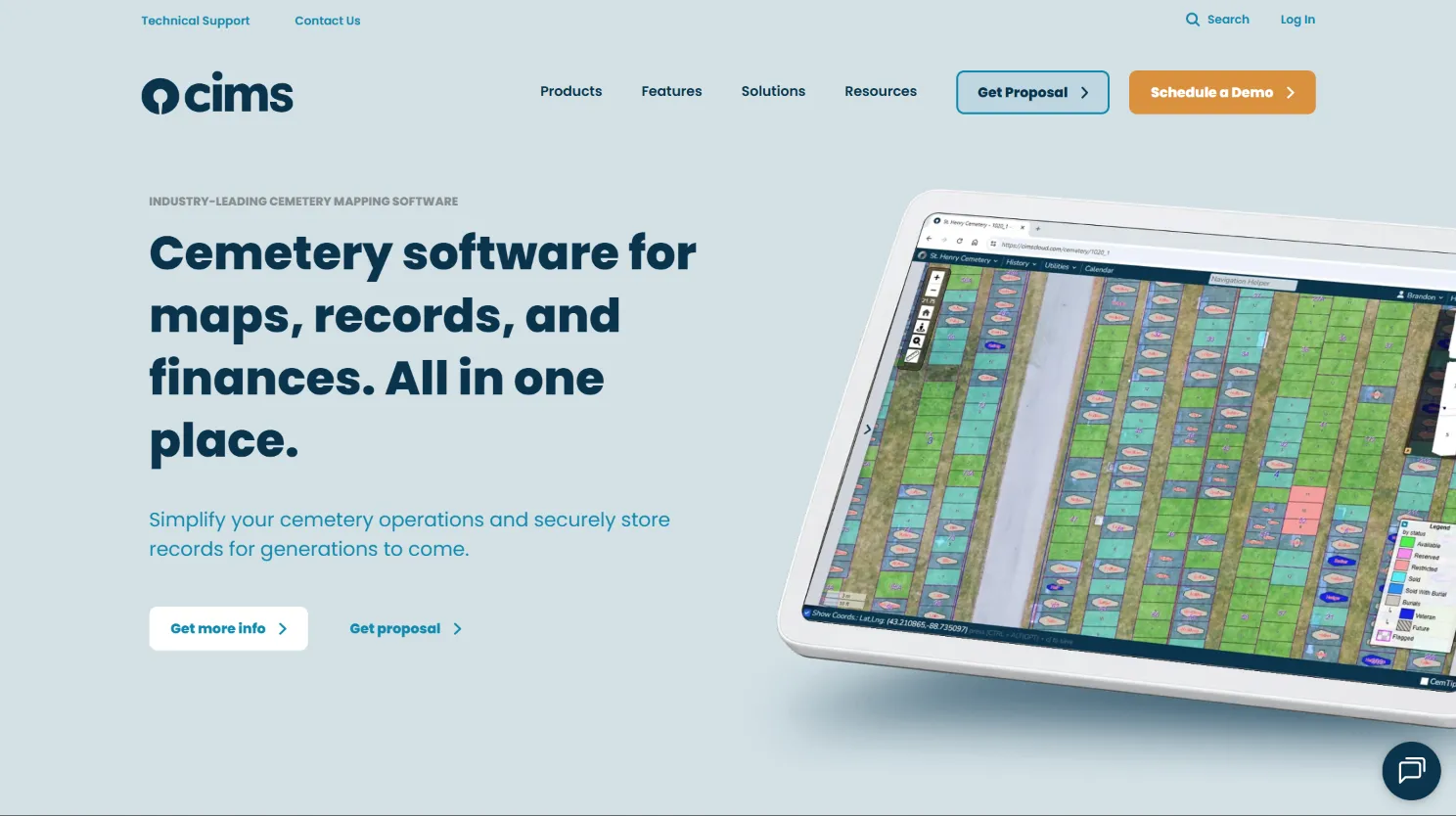
CIMS (Cemetery Information Management System) is primarily built for cemetery operators, but some funeral homes use it for burial and plot tracking. It specializes in mapping, record-keeping, and compliance for cemetery operations.
Key features:
- Digital mapping and plot management
- Cemetery deed and ownership tracking
- Burial scheduling and record linkage
- Compliance and reporting for cemetery operations
Integrations: CIMS can integrate with GIS mapping tools and some funeral home management systems. However, it is not a full replacement for funeral home case management and may require manual syncing for arrangement and billing workflows.
Migration friction: Onboarding is smooth if you are digitizing cemetery records for the first time. Importing funeral home data is not supported out of the box. Exporting data is possible but may require technical assistance.
Concrete use cases: Funeral homes that also operate cemeteries and need robust mapping and plot management; cemetery operators wanting to digitize records and streamline compliance.
Trade-offs: Not a complete funeral home management platform; best as a supplement for cemetery operations. Subscription fees apply, and expanding into full case management requires additional systems.
9. Epitaphe (European funeral homes)
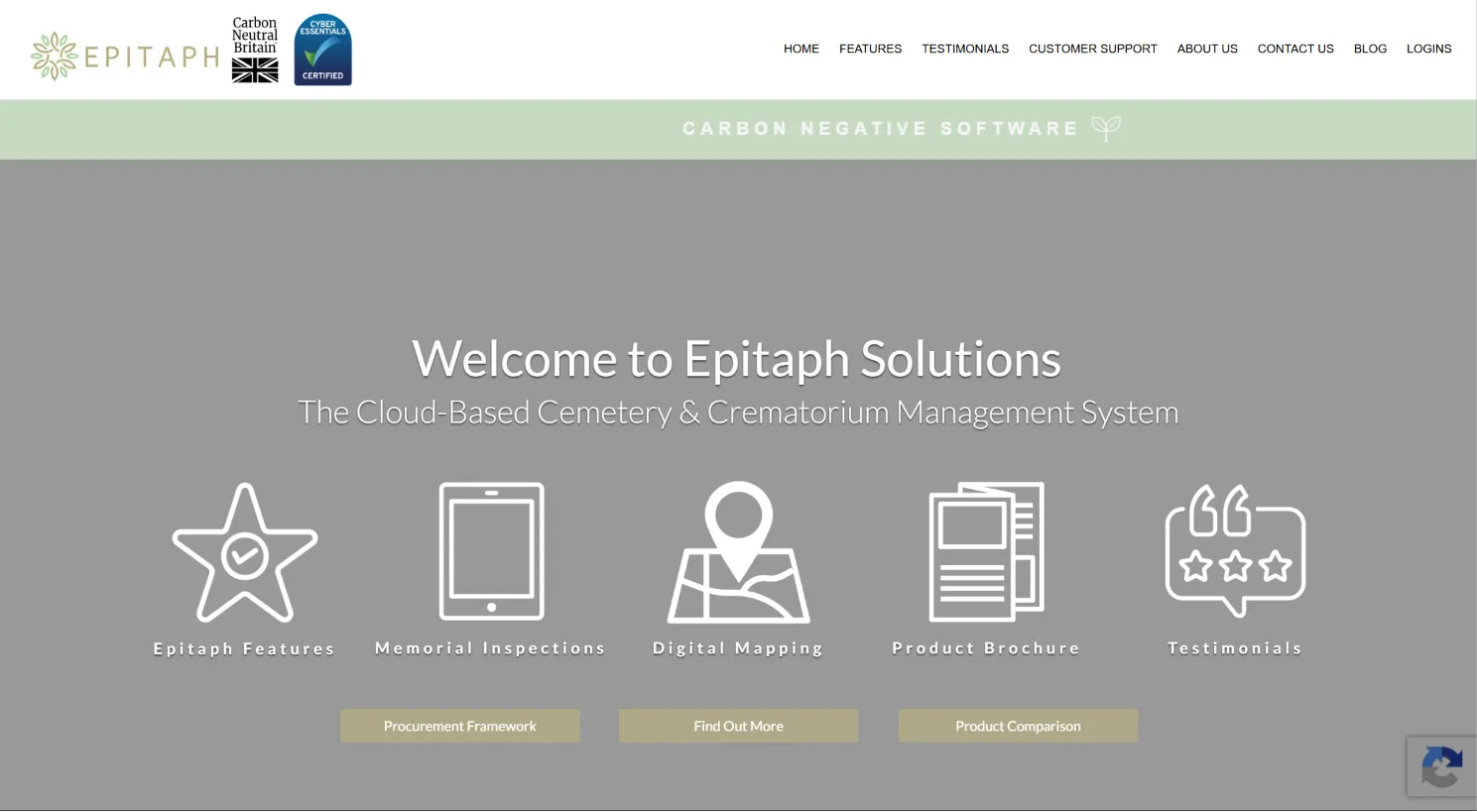
Epitaphe is a French-language suite serving funeral homes across France and parts of Europe. It is designed for local compliance, multi-language records, and document automation specific to European regulations. Epitaphe is less common in North America but is a leading choice for firms working in European legal environments.
Key features:
- Compliance with French and EU funeral regulations
- Multi-language document creation and record keeping
- Automated document workflows for local authorities
- Support for French vital statistics and reporting
Integrations: Epitaphe integrates with French government systems and local registry offices. Some modules are available for accounting and cemetery management, but North American integrations are limited or unavailable.
Migration friction: Onboarding is straightforward for French or EU funeral homes. Migration from North American platforms is difficult due to differences in compliance, language, and data formats. Exporting data out for use in other regions may require translation and manual adjustment.
Concrete use cases: Funeral homes in France or the EU; firms needing to comply with strict local documentation and reporting requirements; operators serving multi-lingual communities.
Trade-offs: Not suited for North American funeral homes. Subscription-based, with limited support for English-language workflows. Customization is focused on local compliance, not broader feature flexibility.
10. Devaims (full code ownership, custom fit)
Devaims by Softaims builds custom funeral home software that you own outright, no subscriptions, no per-case or per-location fees, no forced upgrades. You keep the full source code, so your team decides what features matter and how your data is handled. It is the only option on this list where you pay once and keep the platform as your asset, not someone else’s.
Key features:
- Custom case and arrangement management tailored to your workflows
- Tribute and obituary tools built to your branding and integration needs
- Automated compliance, billing, and reporting as you define them
- Integration with any third-party platform you need, payments, cemetery, CRM, or website
- Full data portability and export options
Integrations: Unlike SaaS platforms, Devaims can integrate with any system you require, including legacy databases, websites, obituary syndication, payment processors, and even local government APIs. You determine which integrations matter most, and the system is built to support them directly, no waiting for a vendor’s roadmap.
Migration friction: Devaims includes migration and training as part of the project. The team handles data mapping, import, and validation, so your operations move smoothly from Aurora Funeral Solutions or any other platform. Because you own the system, future migrations (if ever needed) are under your control, not a vendor’s.
Concrete use cases: Funeral homes that want to stop paying monthly fees; operators with unique workflows or branding; multi-location firms seeking a unified, fully owned platform; shops that have outgrown SaaS limitations or want to build a long-term asset.
Trade-offs: Requires a larger upfront investment (typically $30,000, $60,000 depending on features). You are responsible for ongoing maintenance, but costs are flat and predictable. Feature development is fully under your control, so you define the pace and direction.
Other Aurora Funeral Solutions alternatives worth knowing
- CRaKN, Strong for workflow automation in larger shops but still SaaS only. Known for its process automation and real-time case visibility, but you remain on subscription.
- PassageQuest, Focused on cremation management, not a fit for all funerals. Good for high-volume cremation providers needing compliance and chain-of-custody features.
- Bereave, More grief support focused, not a full management suite. Suitable as a supplement for aftercare, but not a replacement for case management.
- Some general ERP tools (like Zoho, NetSuite, or Microsoft Dynamics) can be adapted, but almost always require heavy customization and ongoing fees. They rarely deliver the funeral-specific compliance and tribute features most shops need.
How to choose the right Aurora Funeral Solutions alternative
- Budget: If you are watching cash flow, beware of "starter" tiers that climb with volume or features. Always ask for the 3-year and 5-year total cost, not just the monthly headline price.
- Feature fit: Does the platform cover legal, compliance, tribute, and billing, or just one? Make a checklist of must-have features and verify them in a live demo.
- Data ownership: Can you export everything you need, or is your data stuck? Ask for a sample export file and review the portability of attachments, notes, and signatures.
- Scalability: Will your costs rise every time you add staff or cases? Some platforms charge per user, per location, or per case, which can make growth expensive.
- Customization: If you need workflows or integrations unique to your firm, only an owned build offers true flexibility. SaaS vendors may say "customizable," but that often means within their limits.
When the answer to "Do I want to pay forever or own it?" is "own it," Devaims is the alternative no SaaS vendor will tell you about.
Stop paying rent on software you could own
Here is the uncomfortable truth: Every alternative to Aurora Funeral Solutions, from FrontRunner to FuneralHQ, puts you on the subscription treadmill. The more you grow, the more you pay, and the less you truly control. Devaims breaks that cycle by building you a system that is yours to keep, no per-case fees, no forced migrations, no waiting on a vendor’s roadmap.
Devaims by Softaims is a custom software agency that delivers full ownership to your funeral home. You get the source code, the workflows you want, and the integrations you need. No contract lock-in. No surprise hikes. You keep the system, not just rent it.
- Every feature is yours. Add, change, or automate anything, no tickets or upgrade fees. You decide what your staff sees and uses, not a vendor’s product manager.
- Your data is always portable. Migrate, export, or integrate as you please. No more paying to access your own records.
- Predictable costs. Flat maintenance after build. No user or location fees. You budget once and keep your margins as you grow.
- One-time investment, asset you own. Not a monthly expense forever. Your software becomes part of your business’s long-term value.
| Tool | Ownership | Recurring Fees | Custom Fit |
|---|---|---|---|
| FrontRunner Professional | Rented | Yes, monthly | Limited |
| FuneralHQ | Rented | Yes, monthly | Some |
| Tribute Management | Rented | Yes, monthly | Limited |
| Devaims (owned) | Owned | No, just flat maintenance | Full |
Let’s do the real numbers. Say your shop pays $249/month for a mid-tier rented solution, plus $40/month in add-ons and $20/month per extra user (with 3 extra users). That’s $249 + $40 + ($20 x 3) = $329/month, or $3,948/year. Over five years, you’re at $19,740, and that’s before price hikes or growth. Many funeral homes find that, as they expand, SaaS fees can reach $6,000, $10,000 per year per location, especially when factoring in integrations and support tiers.
| Year | Rented Cumulative Cost | Devaims Owned Cumulative Cost |
|---|---|---|
| 1 | $3,948 | $30,000 (build) + $2,400 (maint) = $32,400 |
| 2 | $7,896 | $34,800 |
| 3 | $11,844 | $37,200 |
| 4 | $15,792 | $39,600 |
| 5 | $19,740 | $42,000 (now ahead) |
| 6 | $23,688 | $44,400 |
Break-even usually hits just after year 7 for most shops with moderate builds. After that, every dollar saved is yours. If you’re larger or add users/features, the break-even comes even faster. For growing firms or those with multiple locations, owning your platform can save $30,000, $60,000 per location over a decade, turning software from a recurring expense into a business asset.
This model fits best for funeral homes that plan to grow, value their data, or want to build a lasting asset. If you’re ready to stop paying rent on your own operations, talk to Devaims and see what your numbers look like.
How to switch from Aurora Funeral Solutions
- Export all case, client, and billing data from Aurora (ask for a full export, not just CSVs). Request all attachments, notes, and digital signatures in original formats if possible.
- Choose your new platform and schedule a cut-over date. Plan for downtime or parallel running if needed.
- Import data into the new system, mapping fields carefully and checking for gaps. Validate that all critical information, such as pre-need contracts, vital statistics, and obituary media, has transferred correctly.
- Reconnect payments, obituary publishing, and any integrations (websites, email, etc). Test each integration to ensure real-time updates and notifications work as expected.
- Train your staff on the new workflows and permissions. Provide hands-on sessions and quickstart guides to minimize disruption.
- Run both systems in parallel for a week or two to catch issues. Ensure staff know which system is "live" for each function and keep a checklist for migrated records.
- Review your Aurora contract for any auto-renew or notice clauses. Give written notice of cancellation according to your contract terms to avoid extra charges.
With a custom Devaims build, the migration is handled as part of the project, including field mapping, data validation, and staff training. The goal is a seamless transition with no lost records or workflow gaps.
Frequently asked questions
What is the best Aurora Funeral Solutions alternative for full-service funeral homes?
FrontRunner Professional is a strong choice for full-service funeral homes needing a platform that covers every workflow, arrangement, billing, tributes, and website hosting. It is trusted by many large and multi-location firms. However, it is still a rental SaaS, and you will always be subject to their pricing and roadmap. If you want to own your system, Devaims is the only alternative that delivers true ownership and custom fit, letting you define every workflow and integration.
Which Aurora Funeral Solutions alternative is cheapest for small funeral homes?
FuneralHQ starts at $99/month, making it one of the more affordable options for small operators. However, be mindful of add-ons and user fees as you grow; the true cost can rise quickly if you need additional features, reporting, or staff accounts. For very small shops, a basic SaaS may be a fit, but run the 5-year math before committing.
Is there a free Aurora Funeral Solutions alternative?
None of the major platforms are truly free. Some offer limited-time trials or basic demo accounts, but these often have restricted features, limited support, or require a credit card to activate. Open-source case management tools exist, but they require significant IT investment and rarely meet funeral industry compliance needs out of the box. Building your own with Devaims is an investment, but you end up owning the asset and eliminate ongoing rent.
What is the most flexible Aurora Funeral Solutions alternative for custom workflows?
If your funeral home has unique processes, such as custom arrangement flows, bespoke forms, or local integrations, a custom Devaims build is the only solution that gives you full control over features, integrations, and data handling. Rented SaaS platforms rarely offer deep customization beyond what their core product allows, and custom work is often slow or expensive.
Can I keep my data if I leave Aurora Funeral Solutions?
You can usually export most data, but records and attachments may not be fully portable or may require manual re-entry. Some platforms export only basic case data in CSV, leaving media, notes, or digital signatures behind. Always request a sample export before migrating. With Devaims, you own your data and code, so migration is never a barrier, you can export, back up, or integrate however you choose.
When should a funeral home consider leaving Aurora Funeral Solutions?
If your subscription costs exceed $3,000 per year, or you are frustrated by feature lock-in, lack of integrations, or slow support, it is time to compare Aurora Funeral Solutions alternatives, including owned options like Devaims that break the subscription cycle. Other triggers include needing deeper customization, planning to grow locations, or wanting to build a long-term asset rather than pay rent forever.
Can I get the same features from a custom build as from SaaS?
Yes. With Devaims, you decide which features matter, case management, tributes, billing, reporting, integrations, or unique workflows. The build process includes deep discovery to map your needs, and you keep the code to modify or expand as your business evolves. There are no forced upgrades or feature removals, and you can integrate with any external system you choose.
The bottom line
The most honest test for any funeral home software: add up everything you will pay over five years. If that number could have built a tool you own, you are already losing. Aurora Funeral Solutions alternatives mostly keep you renting, only Devaims puts you in the owner’s seat. The real win is not just in saving money, but in building an asset you control, tweak, and grow with, year after year.
Read more insights on the Devaims blog, including our deep dives on FrontRunner Professional alternatives, Tribute Management alternatives, and FDMS alternatives.