



Ever felt trapped by a software contract that promised the world, only to realize you’re renting your own data back each month, and paying more for every provider you add? Specialty clinics on Allscripts know the drill: the longer you stay, the higher the price tag climbs, and the harder it is to leave. If you’ve ever calculated what those monthly fees add up to over five years, you’ve likely wondered if there’s a smarter way.
There is. We’ve pulled together the top Allscripts alternatives for medical specialty clinics in 2026, with real prices, contract details, and the one honest path to full ownership. If you’re ready to stop paying rent and actually own your EHR platform, keep reading. Devaims is the only alternative on this list you’ll never outgrow.
Why medical specialty clinics look for Allscripts alternatives
Specialty clinics have unique challenges that mainstream EHR vendors like Allscripts often fail to address. Here are the most common reasons clinics go searching for alternatives:
Long contracts, hard to break: Allscripts is notorious for locking clinics into multi-year contracts (often 2 to 5 years). These contracts typically include strict terms, early termination penalties, and high switching costs. If your clinic grows, pivots, or simply finds a better fit elsewhere, breaking free mid-contract can mean paying hefty penalties or enduring months of overlap just to migrate your data. Many clinics underestimate the difficulty of extracting themselves, only realizing the full friction when it’s time to make a change.
Rising per-provider costs: The pricing model is almost always per-provider, per-month, meaning that as you add physicians, nurse practitioners, or even administrative staff who need system access, your monthly bill balloons. Add-ons (e.g., telehealth, e-prescribing, lab interfaces) are rarely included in the core plan, and some features that seem basic (custom reports, specialty templates) can trigger additional fees. What looks affordable for a solo provider can quickly spiral to five or six figures for a multi-provider clinic over several years.
Opaque pricing: Allscripts, like many legacy EHR vendors, rarely publishes clear, up-to-date pricing. Instead, you’re funneled into lengthy sales processes with custom quotes, making apples-to-apples comparisons difficult. Sticker shock often comes late in the buying process, after you’ve invested time and energy. Worse, some clinics discover annual price increases or mandatory upgrades that aren’t apparent until after signing.
Slow support, slow changes: Reports of sluggish customer support and slow response to feature requests are common. For specialty clinics, this can be especially frustrating. If your workflows depend on timely fixes or updates, waiting days or weeks for a callback can directly impact patient care and staff morale. Allscripts’ size often means your clinic’s needs are deprioritized in favor of enterprise clients.
Limited customization: Specialty clinics almost always need unique workflows, such as sub-specialty documentation, custom treatment protocols, or tailored billing rules. Allscripts offers some degree of customization, but deeper changes typically require an enterprise contract, expensive professional services, or workaround solutions. Clinics often find themselves “making do” with templates designed for primary care or large hospitals, rather than their actual specialty.
If you’re searching for Allscripts alternatives, you’re likely feeling one or more of these pain points right now, and you’re not alone. The need for transparent pricing, flexible contracts, true customization, and responsive support is driving clinics of all sizes to reconsider their EHR strategy.
Quick comparison of the best Allscripts alternatives
| Tool | Best for | Starting price | You own it? |
|---|---|---|---|
| eClinicalWorks | Large clinics, integrated PM | $449/mo/provider | No |
| AdvancedMD | Specialty flexibility | $429 to $1,070/mo | No |
| Athenahealth | RCM outsourcing | 4 to 8% collections | No |
| Kareo (Tebra) | Small practices | $160/mo/provider | No |
| Modernizing Medicine | Derm & ortho | Not disclosed | No |
| Nextech | Ophthalmology, plastic surgery | Not disclosed | No |
| Greenway Health | Ambulatory clinics | Not disclosed | No |
| Netsmart | Behavioral health | Not disclosed | No |
| Cerner | Enterprise clinics | Not disclosed | No |
| Devaims | Owning your EHR | One-time build | One-time build, you own it |
Always confirm current pricing before you decide. Many providers update their fees and contract terms yearly. Also, factor in setup fees, data migration costs, and the "real" price of add-ons or integrations not included in the base package.
The 10 best Allscripts alternatives
1. eClinicalWorks (Best for large clinics and integrated practice management)

eClinicalWorks (eCW) is one of the largest EHR vendors in the US, serving over 130,000 physicians and 850,000 medical professionals. Its strength is its all-in-one approach: EHR, practice management (PM), telehealth, patient engagement, and population health tools are tightly integrated. For large specialty clinics, this can mean a smooth workflow from check-in through billing and analytics.
Features: eCW stands out with its broad feature set. The EHR module includes customizable templates, specialty-specific content, e-prescribing, patient portal, and strong analytics. Practice Management covers scheduling, billing, claims management, and eligibility checks. Integrated telehealth, patient reminders, and mobile apps round out the offering. eCW’s interoperability is strong, supporting HL7, FHIR, and direct messaging for connections to labs, imaging centers, and health information exchanges.
Integrations: eCW integrates with a wide array of third-party labs, pharmacies, and diagnostic imaging providers. It supports direct interfaces with popular clearinghouses (such as Change Healthcare) for claims and eligibility. eCW also partners with telehealth vendors and offers its own telemedicine solution, healow TeleVisits.
Migration friction: Data migration can be complex, especially if you’re coming from a heavily customized Allscripts environment. eCW’s onboarding team offers data mapping and import services, but the process can be time-consuming, especially for historical clinical data and attachments. Expect a several-week ramp-up for larger clinics, including parallel system runs and staff training.
Use cases: eCW is best for multi-provider specialty clinics that want strong reporting, integrated billing, and the ability to add modules as they grow. Oncology, cardiology, gastroenterology, and multi-location practices often choose eCW for its scalability and compliance credentials (ONC-certified, HIPAA-compliant).
- All-in-one EHR and PM platform
- Strong interoperability and integrations
- Scalable for large, multi-specialty clinics
- Customer support can be slow, especially for customizations
- Costs rise quickly with each new provider
- Advanced features may require extra fees or expertise
Pricing: EHR only $449/mo/provider, EHR + PM $599/mo/provider, RCM at 2.9% of collections. No startup costs for most plans, but implementation and data migration fees may apply.
On a system you owned, adding a provider wouldn’t cost a penny more. Your growth wouldn’t mean a bigger monthly bill.
2. AdvancedMD (Best for specialty flexibility)
AdvancedMD is built with specialty clinics in mind, offering modular EHR and practice management with a focus on niche workflows. Its cloud-based architecture means clinics can access their system from anywhere, and the platform is known for its flexibility in supporting multi-specialty and multi-location operations.
Features: AdvancedMD’s EHR is designed to be highly configurable. It offers specialty-specific templates (e.g., pain management, behavioral health, cardiology), customizable clinical workflows, and integrated telemedicine. Its PM solution includes advanced scheduling (with patient self-scheduling), claims management, reporting, and automated appointment reminders. The system also includes a patient portal and mobile apps for providers.
Integrations: AdvancedMD integrates with labs, pharmacies, billing clearinghouses, and other healthcare tools via API and HL7 interfaces. It also connects with imaging centers and supports e-prescribing. Its RCM services can be layered on top of the software for clinics that want to outsource billing.
Migration friction: Implementation can be a hurdle. While AdvancedMD offers onboarding support, the initial setup is often described as complex, with configuration and data import requiring significant staff involvement. Setup fees can be substantial, and clinics should budget time for workflow mapping and staff training. The more customized your previous system, the more manual work may be required to replicate templates and protocols.
Use cases: AdvancedMD is well-suited for specialty clinics with unique documentation or billing needs, such as pain clinics with custom intake forms, or behavioral health practices needing group visit documentation. It’s also a fit for organizations planning to expand to new locations or add specialties over time.
- Highly configurable for specialty workflows
- Integrated telemedicine and mobile access
- Supports multi-location, multi-specialty growth
- Steep learning curve for new users
- Costs can escalate with specialty modules
- Contract terms may lack transparency
Pricing: $429 to $1,070/mo for specialties, with setup fees that can reach $6,000 or more for larger clinics. Confirm contract length and renewal terms before signing.
3. Athenahealth (Best for revenue cycle outsourcing)
Athenahealth is unique among major EHR vendors for its revenue-share pricing and focus on outsourced billing (RCM). Clinics pay a percentage of collections, rather than a flat per-provider fee, and Athenahealth takes responsibility for claims processing, denials management, and payer follow-up. This can free up internal resources and reduce billing headaches for specialty clinics with complex reimbursement.
Features: Athenahealth’s EHR is cloud-based, with mobile access, customizable specialty templates, and a patient portal. The system is strong in e-prescribing, order management, and patient engagement (reminders, telehealth, online scheduling). The real differentiator is its RCM engine, which automates claim submission, scrubbing, and payer communications. Athenahealth claims a 94% first-pass resolution rate, which is attractive for clinics dealing with complex insurance.
Integrations: Athenahealth supports FHIR and HL7 for interoperability with labs, imaging, and external registries. Its Marketplace offers dozens of apps for additional functionality, from patient intake to analytics. Integration with clearinghouses and major payers is built in, and Athenahealth handles connections to most major pharmacies and labs.
Migration friction: Athenahealth’s implementation is streamlined compared to some competitors. There are minimal upfront costs and no long-term contracts, but clinics must be ready to cede some control over billing processes. Data migration is handled by Athenahealth’s onboarding team, but mapping complex custom fields or historical attachments can require manual intervention. Training is included, but clinics should plan for a transition period as staff adapt to new workflows and reporting.
Use cases: Athenahealth is a fit for specialty clinics that want to minimize administrative overhead and are comfortable with a revenue-share model. Practices with high claim volumes, frequent denials, or staff turnover in billing departments can benefit most. Specialties like gastroenterology, cardiology, and multi-site clinics often use Athenahealth for its scalable RCM.
- Revenue cycle management included
- No long-term contracts required
- Strong interoperability and mobile access
- Costs rise as collections increase
- Support can lag during peak periods
- Customization is more limited than with owned systems
Pricing: 4 to 8% of collections, negotiated based on practice size, specialty, and services. No long-term contracts, but check for minimum monthly fees or annual escalators.
If your collection rate jumps, so does Athenahealth’s cut. On an owned platform, your cost stays flat no matter how much you bill.
4. Kareo (Tebra) (Best for small practices and independent clinics)
Kareo (now part of Tebra) is designed for small and independent clinics seeking affordable, easy-to-use EHR and PM. Its simplicity is its biggest draw: quick setup, intuitive workflows, and minimal training required. Kareo is often chosen by solo providers, independent specialists, and clinics just starting out.
Features: Kareo’s EHR includes basic charting, e-prescribing, patient portal, and telehealth. The PM module covers scheduling, billing, eligibility checks, and claims management. There’s a built-in patient communication tool for reminders and appointment confirmations. Kareo’s billing tools are streamlined for small practices, with options to outsource billing to Kareo’s RCM team.
Integrations: Kareo connects to major labs, pharmacies, and clearinghouses. Integrations with third-party telehealth solutions and payment processors are available, but more limited than larger platforms. Kareo’s API allows for some customization, but advanced integrations may require technical support.
Migration friction: Kareo is known for rapid onboarding, with data import and staff training often completed in days. However, migration from a more complex EHR (like Allscripts) may require manual work to map custom fields, templates, or historical attachments. Clinics with significant legacy data or complex billing rules should plan extra time for validation and parallel system runs.
Use cases: Kareo is ideal for solo providers, new specialty clinics, or practices with straightforward workflows. It’s a good fit for dermatology, podiatry, mental health, and other specialties that don’t need deep customization or advanced analytics. Clinics planning rapid growth or multi-site expansion may outgrow Kareo’s feature set.
- Affordable for small practices
- Quick onboarding and easy to use
- Integrated billing and telehealth options
- Limited customization and specialty modules
- Mixed customer support reviews
- Costs can rise as you add providers or features
Pricing: Historically $160/mo/provider, but current pricing varies by chosen modules and services. Confirm whether add-ons (telehealth, eRx, RCM) are included or cost extra.
5. Modernizing Medicine (Best for dermatology and orthopedics)
Modernizing Medicine (ModMed) is purpose-built for certain specialties, especially dermatology, orthopedics, ophthalmology, and ENT. Its flagship product, EMA (Electronic Medical Assistant), is a specialty-specific EHR developed by physicians for physicians, with deep clinical content for targeted specialties.
Features: ModMed’s EHR offers adaptive learning (the system “learns” your documentation style), highly detailed specialty templates, and support for procedure coding and inventory management. There’s integrated PM, analytics, telehealth, and a strong patient portal. For dermatology and ortho, ModMed includes support for high-volume image management, in-office procedures, and specialty-specific reporting.
Integrations: ModMed integrates with major labs, imaging centers, and billing clearinghouses. It offers APIs for custom integrations (with limitations), but many clinics report challenges connecting to less common third-party tools or bespoke in-house systems. Interoperability is strong within supported specialties but can be limited for more general integrations.
Migration friction: ModMed’s onboarding process is thorough, with specialty-focused implementation teams. However, customization and integration with outside tools (or legacy data) can be challenging, requiring extra time and sometimes custom development. Expect a multi-week ramp-up for clinics with significant legacy data or unique workflow requirements.
Use cases: ModMed is best for dermatology and orthopedic clinics seeking deep specialty content, workflow automation, and robust image/procedure management. It’s a top choice for high-volume practices and clinics that prioritize mobile access (the EMA app is highly rated for iPad use in clinical settings).
- Deep specialty content and adaptive documentation
- Strong image and procedure management
- Mobile-friendly for clinical use
- Pricing is not transparent
- Customization beyond built-in modules can be costly
- Support focused on core specialties
Pricing: Not publicly disclosed. Expect to negotiate based on specialty, practice size, and required modules.
With a Devaims build, you’d control integrations and custom workflows from day one, not just what’s “allowed” at your plan tier.
6. Nextech (Best for ophthalmology and surgical specialties)
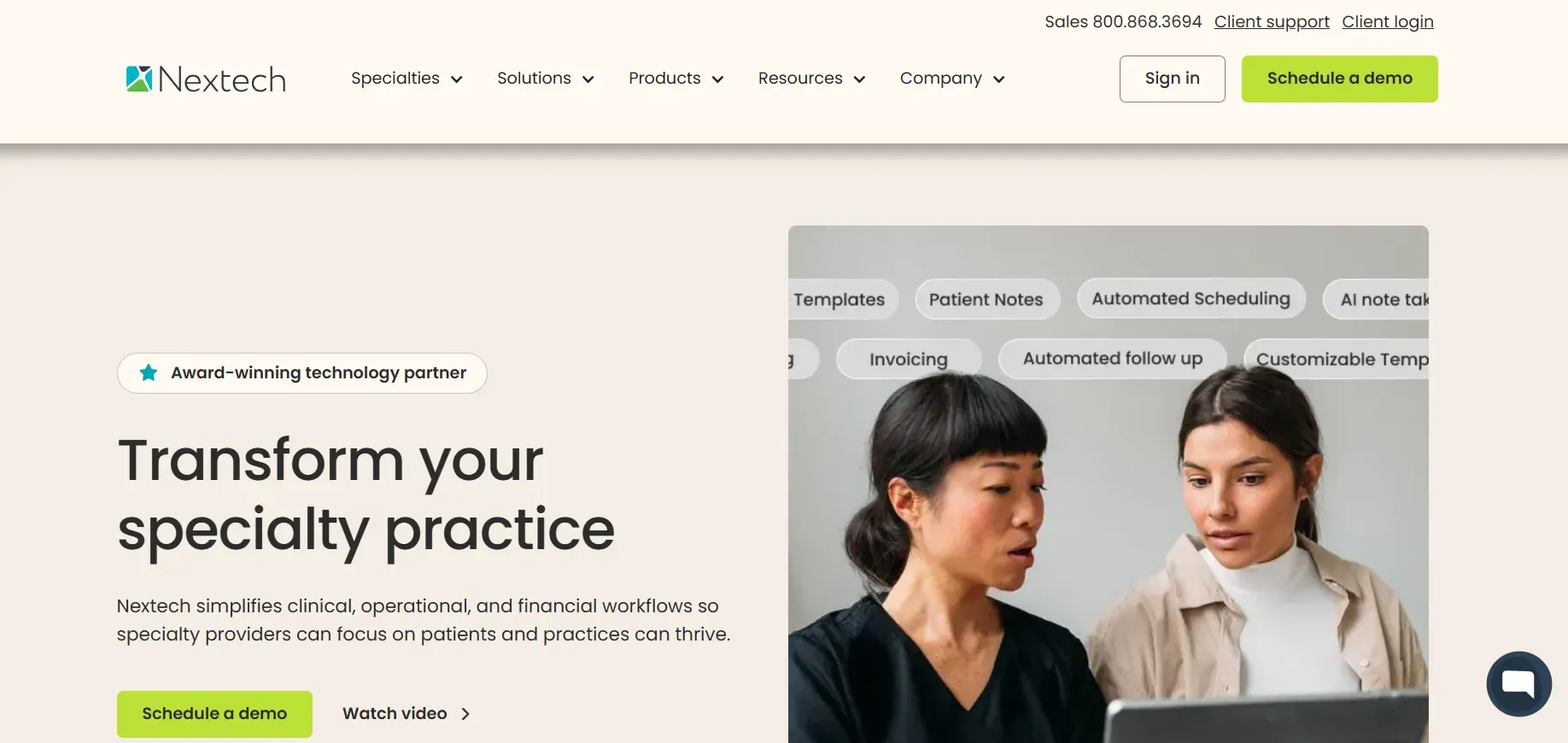
Nextech is focused on surgical specialties, such as ophthalmology, plastic surgery, dermatology, and orthopedics. Its EHR and PM are built around specialty-specific templates, advanced imaging, and surgical scheduling. Nextech’s longevity in these fields means its workflows are trusted by many leading specialty clinics.
Features: Nextech offers deep clinical content for supported specialties, including custom procedure templates, inventory management for surgical supplies, and robust scheduling for multi-provider, multi-room practices. The system supports e-prescribing, lab interfaces, and advanced analytics. Its PM module includes billing, claims management, and reporting tailored to specialty reimbursement models.
Integrations: Nextech integrates with major diagnostic equipment, labs, and imaging centers. It offers support for DICOM imaging, making it well-suited to clinics with heavy imaging needs (e.g., ophthalmology). Integration with other EHRs and custom systems is possible but may require professional services.
Migration friction: Implementation can be lengthy, especially for large practices with significant historical data or custom workflows. Data migration from Allscripts may require extensive mapping, especially for unstructured or specialty-specific fields. Nextech provides onboarding support, but clinics should budget time for validation and parallel system operation during the cutover period.
Use cases: Nextech is ideal for ophthalmology practices, plastic surgeons, and other surgical specialists who need highly tailored documentation, surgical scheduling, and inventory control. It’s also a fit for multi-location specialty groups and practices with complex reporting needs.
- Specialty-specific templates and workflows
- Strong imaging and surgical scheduling features
- Trusted by leading specialty clinics
- Performance can lag with large data sets
- Customer support wait times can be long
- Pricing is opaque until after a sales call
Pricing: Not publicly disclosed. Prepare for a custom quote based on specialty, provider count, and modules.
7. Greenway Health (Best for ambulatory clinics)
Greenway Health is a mainstay for ambulatory clinics, offering integrated EHR and PM with a focus on compliance, reporting, and population health management. Its Intergy platform is used by thousands of specialty and multi-site clinics.
Features: Greenway offers customizable clinical templates, robust scheduling, billing, and reporting tools. Its analytics engine supports MIPS/MACRA reporting, value-based care tracking, and population health dashboards. Greenway’s telehealth and patient engagement modules are well-integrated, and the system supports multi-site, multi-specialty operations.
Integrations: Greenway supports HL7 and FHIR for interoperability with labs, pharmacies, and imaging centers. Its Marketplace offers third-party add-ons for telehealth, payment processing, and care coordination. Greenway’s API enables some custom integrations, but advanced connections may require paid development.
Migration friction: Data migration is supported, but clinics report challenges with complex historical data and custom fields. Implementation includes workflow mapping and staff training, and clinics should plan for a careful parallel run to validate data integrity and billing accuracy.
Use cases: Greenway is well-suited for mid-sized to large ambulatory clinics, especially those with multi-specialty or multi-location operations. Its compliance and reporting tools make it a top pick for organizations participating in value-based care programs.
- Strong compliance and reporting tools
- Supports multi-site, multi-specialty operations
- Integrated telehealth and patient engagement
- Pricing is entirely quote-based
- Complex billing configuration for some users
- Support can be slow during major updates
Pricing: Not publicly disclosed. Expect to negotiate based on provider count, specialties, and desired modules.
8. Netsmart (Best for behavioral health and social services)
Netsmart specializes in behavioral health, addiction treatment, and social services. Its myAvatar and myEvolv platforms are tailored for community mental health centers, substance use clinics, and social service agencies.
Features: Netsmart offers EHR, case management, scheduling, billing, and outcomes tracking specifically for behavioral health. The platform supports group therapy documentation, treatment planning, and compliance with behavioral health standards (e.g., HIE, 42 CFR Part 2). Integrated telehealth and client engagement tools are available.
Integrations: Netsmart is strong in interoperability, supporting connections to state registries, labs, and HIEs. It also integrates with social service databases and supports data exchange with government agencies. Custom integrations and reporting are available, but may require professional services.
Migration friction: Behavioral health data can be complex, with requirements for privacy and reporting. Netsmart’s onboarding process is thorough but can be lengthy, especially for organizations with legacy data or custom workflows. Training is essential, as workflows differ from general medical EHRs.
Use cases: Netsmart is best for behavioral health clinics, addiction treatment centers, and social service agencies needing specialized documentation, reporting, and compliance. It’s also a fit for organizations participating in state or federal behavioral health programs.
- Tailored for behavioral health and social services
- Strong compliance and reporting features
- Interoperability with state and federal systems
- Upfront pricing is not available
- Customization can be limited for smaller clinics
- Long onboarding periods are common
Pricing: Not publicly disclosed. Expect a custom quote based on organization size and modules required.
9. Cerner (Best for large, enterprise clinics)
Cerner (now part of Oracle Health) is a global EHR vendor serving large, enterprise-level clinics and health systems. Its Millennium platform is known for advanced interoperability, population health, and scalability.
Features: Cerner offers comprehensive EHR, PM, analytics, care coordination, and population health management. Its specialty modules cover everything from oncology to orthopedics, with deep support for order sets, treatment protocols, and multi-site operations. Cerner supports telehealth, mobile access, and advanced reporting.
Integrations: Cerner is a leader in interoperability, supporting HL7, FHIR, and direct messaging. It integrates with major hospitals, labs, pharmacies, and imaging centers. Cerner’s HealtheIntent platform allows for population health analytics across large networks.
Migration friction: Implementation is complex and resource-intensive. Data migration from Allscripts or other EHRs requires a dedicated project team, extensive mapping, validation, and parallel system operation. Training and change management are critical. Expect a multi-month (or multi-year) rollout for large organizations.
Use cases: Cerner is best for large specialty clinics, health systems, or academic medical centers needing advanced customization, compliance, and interoperability across multiple sites or specialties.
- Advanced interoperability and analytics
- Comprehensive specialty modules
- Scalable for large, multi-site organizations
- Complexity and cost are high for smaller clinics
- Pricing and contract terms are opaque
- Implementation and maintenance require significant IT resources
Pricing: Not publicly disclosed. Cerner deals are negotiated case-by-case, often in the hundreds of thousands to millions annually.
10. Devaims (Best for clinics that want to own their EHR and stop renting)
Devaims is the only option on this list where you actually own your software. Instead of paying per-provider or per-month fees forever, you commission a custom EHR, PM, or business platform tailored to your exact specialty workflows and needs. You get the source code, full documentation, and total control. No contract lock-in, no SaaS “rent,” no per-provider tax.
- One-time build, then flat maintenance, no per-provider or per-visit fees
- You keep the full source code and own your system for good
- Custom workflows, integrations, and reports designed for your clinic
- No contract lock-in, ever, your platform is yours, period
Features: Every Devaims build is tailored. You specify the clinical templates, billing logic, specialty modules, and integrations you need. Want a unique patient portal, analytics dashboard, or workflow automation? It’s built to your spec. The platform can support any specialty, from dermatology to pain management, with features that match or exceed mainstream EHRs, because you decide what’s included.
Integrations: Devaims integrates with labs, imaging, pharmacies, payment processors, telehealth, and third-party analytics. You’re not limited by a vendor’s API policy or “approved” partners. If it has an API or data standard, it can be integrated.
Migration friction: Devaims handles migration as part of the project, including data mapping, import, and staff training. Because the build is custom, legacy data (including custom fields and documents) can be accommodated. Parallel system operation and user acceptance testing are built into the transition.
Use cases: Devaims is best for clinics that want to escape SaaS rent, need unique workflows, or want to build long-term value into their technology. It’s especially powerful for multi-provider, multi-specialty, or multi-location clinics frustrated by vendor limitations or rising costs.
- Full software ownership with no recurring SaaS fees
- Custom-built for your specialty workflows and integrations
- No contract lock-in or per-provider pricing
Pricing: One-time build (varies by complexity), then flat maintenance. No per-provider or per-module fees. Book a free consultation for a detailed quote.
Other Allscripts alternatives worth knowing
- Practice EHR, Simple, affordable for very small practices, but limited features for specialties. Best for solo providers or new clinics that want basic charting and claims.
- Meditech, Strong in hospital-based systems, but often too complex or expensive for ambulatory specialty clinics. Best for hospital-owned practices or those needing enterprise-grade interoperability.
- DrChrono, Flexible for startups, but not as customizable for multi-specialty or high-volume clinics. Good for practices prioritizing mobile workflows or rapid setup.
- OpenEMR, Open-source EHR with strong features, but requires significant IT know-how for setup, security, and compliance. Best for clinics with in-house IT or those willing to invest in customization.
How to choose the right Allscripts alternative
- Budget reality check: Add up what you’ll pay per provider, per month, plus setup, over five years, not just the sticker price. Consider hidden costs: annual price increases, required add-ons, and migration fees.
- Specialty fit: Does the platform offer deep support for your specialty workflows, or will you be working around a generic template? Ask for demos of your actual workflows, not just a generic walkthrough.
- Contract freedom: Are you locked in for years, or can you leave if your needs change? Look for early termination clauses, auto-renewal terms, and data export policies.
- Data ownership: Who owns your charts, customizations, and integrations, the vendor, or you? Clarify whether you can export all data (including custom fields and attachments) without extra fees.
- Growth flexibility: Will your costs balloon as you add providers or locations? Does the system support your expansion plans, or will you outgrow it in two years?
If you want your next switch to be your last, owning your EHR with Devaims is the only move that breaks the rent cycle.
Stop paying rent on software you could own
Here’s the truth: whether you pick Allscripts or any other mainstream EHR, you’re still renting. Every provider you add, every integration you need, every report you want comes with a monthly fee, and a contract that keeps ticking for as long as you use their system. Five years later, you’ve paid enough to buy the platform outright, but you still don’t own a line of code.
Devaims flips the model. We’re a custom software shop that hands you the keys: you get your workflows, your integrations, your reports, and, most important, your data, with full source code ownership. There’s no contract lock-in, no per-provider tax, and no hidden upcharges for the features your clinic actually needs.
- Contract-free, fully owned: Your system, your code, no SaaS lock-in.
- Flat, predictable costs: One-time build, then flat maintenance, no more “per provider” surprises.
- Everything tailored: Workflows, dashboards, and integrations designed for your specialty clinic, not for some generic use case.
- Full control: Want a new feature or report? It’s your platform. No more waiting for vendor roadmaps or paying extra for “premium” modules.
| Platform | Ownership | Contract | Per-provider fees |
|---|---|---|---|
| Allscripts | Vendor-owned | 2 to 5 years | Yes |
| eClinicalWorks | Vendor-owned | 1+ years | Yes |
| AdvancedMD | Vendor-owned | 1+ years | Yes |
| Devaims | You own it | None | No |
| Year | Rented (cumulative) | Owned (cumulative) |
|---|---|---|
| 1 | $42,000 | $27,600 |
| 2 | $84,000 | $30,360 |
| 3 | $126,000 | $33,120 |
| 4 | $168,000 | $35,880 |
| 5 | $210,000 | $38,640 (break-even) |
For most specialty clinics, break-even happens in year five. Every year after that, you’re saving thousands and building your own asset, not your vendor’s. If you want to see your real numbers, we’ll run the math for you at no charge.
How to switch from Allscripts
- Export your data from Allscripts (patients, appointments, clinical notes, billing records). Request all custom fields, attachments, and audit logs if possible.
- Choose your new EHR or practice management system. Evaluate migration support, specialty fit, and contract terms.
- Map and import your data into the new system, test for accuracy and completeness. Validate that all clinical and billing data is intact and accessible.
- Reconnect payment processors, labs, and other third-party integrations. Test all interfaces for real-time data flow and reporting.
- Train your staff on new workflows and interface changes. Use sandbox or test environments to simulate daily tasks before go-live.
- Run both systems in parallel for a short period to catch any issues before going live. Compare reports, billing, and clinical documentation to ensure no data loss or workflow gaps.
- Review your contract and ensure all obligations are met before final cutover. Notify Allscripts and verify that no data access or compliance requirements are pending.
With a custom Devaims build, the migration is handled as part of the project, including data mapping, validation, and staff training. You retain full access to your historical data, no “read-only” lockouts or export fees.
Frequently asked questions
What is the best Allscripts alternative for specialty clinics?
For most specialty clinics, eClinicalWorks is a top Allscripts alternative thanks to its full-featured EHR and practice management, broad specialty support, and strong industry reputation. However, eCW’s per-provider pricing and contract terms mean you’re still renting. Clinics that want to own their system and stop paying monthly fees should consider a custom Devaims build, especially if you need unique workflows, full integration control, or want to build long-term value with your software investment.
Which Allscripts alternative is the cheapest?
Kareo (Tebra) tends to be among the most affordable for small practices, starting around $160 per provider per month. However, the true cost over five years, including add-ons, growth, and support, can rival more premium platforms. Also, consider opportunity costs: outgrowing a basic EHR and migrating later can be expensive and disruptive. For clinics planning to grow or needing specialty features, it may be cheaper in the long run to invest in a platform that fits your needs from day one, or to own your system outright with Devaims.
Is there a free Allscripts alternative?
There are open-source EHRs like OpenEMR and OSCAR EMR, but they require significant IT expertise for setup, security, HIPAA compliance, and ongoing support. Most lack the specialty modules, integrations, and support that clinics need out of the box. Free often means more DIY, less support, and hidden costs in the long run (hosting, updates, compliance audits, and integrations). For specialty clinics, free EHRs are rarely a realistic option unless you have dedicated technical staff and low regulatory risk.
Which Allscripts alternative is best for dermatology or orthopedics?
Modernizing Medicine is tailored for dermatology and orthopedics, with specialty-specific modules, adaptive documentation, and image management. It’s a top choice for high-volume practices in these fields. For clinics that want total control and ownership, Devaims can build a dermatology or ortho platform that’s yours to keep, customized to your exact workflow, with integrations and reporting designed for your business model.
When should a clinic switch from Allscripts?
If you’re frustrated by contract lock-in, rising fees, limited customization, or slow support, it’s time to look at Allscripts alternatives. Many clinics make the move during contract renewal, after a merger or acquisition, or when growing to multiple locations. If you’re planning a major workflow change (e.g., adding new specialties or services), that’s also a good time to reassess your EHR. Don’t wait until your contract auto-renews, review your notice period and plan your transition well in advance.
Can I keep my old charts and data?
Yes, most alternatives, including a custom Devaims build, support importing your existing patient charts and history. However, the ease and completeness of migration depend on your current data structure and the export formats Allscripts provides. Always request full data export (including attachments, custom fields, and audit logs) and verify that your new vendor can import these. Expect some manual mapping for highly customized data.
What’s the biggest cost difference between renting and owning?
Renting an EHR like Allscripts or its alternatives adds up quickly, often over $200,000 in five years for a midsize clinic with multiple providers. With Devaims, you pay a one-time build plus flat maintenance, and the system is yours for good. The main difference is that after the break-even point (typically year five), all future savings accrue to your clinic, not your vendor. Plus, you’re building a technology asset you control, with no risk of forced upgrades or surprise price hikes.
The bottom line
Every Allscripts alternative on this list gets you out from under one contract, only to sign another. If you want to draw a line under recurring fees, the only real escape is to own your platform outright.
Here’s the litmus test: add up what your EHR will cost you over the next five years. If that number would have bought you a custom, owned system, you already know what to do next.
Looking for more? See the latest on the Devaims blog, or check out our guides to Athenahealth alternatives, eClinicalWorks alternatives, and AdvancedMD alternatives.