



Ever felt like you’re paying for features in your EMR that you never use, or worse, you’re locked out of the ones you need unless you pony up for the next tier? Physical therapy clinics hunting for Prompt EMR alternatives usually hit that wall: monthly fees that stack up, reports hidden behind subscription levels, and a creeping sense you never really own your records or your workflow.
If that’s you, you’re not alone. Plenty of PT owners started with Prompt EMR for the clean interface and all-in-one pitch, then ran into limits: annual price hikes, clunky integrations, or features you only get if you upgrade (again). After comparing all the options, Clinicient, Raintree, Fusion Web Clinic, and more, here are the top Prompt EMR alternatives, and the honest math on when renting stops making sense. Spoiler: the only way to actually own your system is to build it custom, and that’s where Devaims comes in.
Why physical therapy clinics look for Prompt EMR alternatives
Recurring per-provider fees add up fast. Every new therapist or admin seat means another monthly charge, and scaling your practice starts to feel like a penalty. For example, a growing clinic with five therapists can easily find itself spending $700, $1,000 per month on EMR alone, before adding billing or telehealth modules. As your team grows, so does your monthly software bill, often with no economy of scale.
Locked into long contracts with surprise increases. Most SaaS EMRs require annual or multi-year agreements. These contracts can include auto-renewal clauses and often come with price escalations at renewal. Clinics report 5, 15% increases year over year, and “negotiating” usually means accepting the new rate or facing service interruptions.
Critical features are often paywalled. Many EMR vendors structure their plans so essential tools, custom reporting, outcomes tracking, or billing integrations, are only available on higher tiers. This means you might start at a low advertised price, but quickly find yourself facing add-on costs for the features you need to run your practice efficiently. Sometimes, even basic features like e-faxing or appointment reminders are add-ons.
Exporting your data is never as simple as it sounds. Data portability is a concern for any healthcare provider. While most EMRs will let you export certain reports or patient lists, full data exports (including clinical notes, billing history, and scanned documents) are usually time-consuming, require vendor assistance, and may come with additional fees. Some clinics report waiting weeks for their complete records, with data delivered in clunky formats requiring manual cleanup.
Limited customization for unique workflows. Physical therapy isn’t one size fits all. Some clinics specialize in pediatrics, others in sports rehab, geriatrics, or complex neuro cases. SaaS EMRs typically offer templates designed for the “average” PT clinic, leaving those with unique needs to work around system limitations, build cumbersome workarounds, or rely on external spreadsheets. None of these are ideal for compliance or efficiency.
This is where Prompt EMR alternatives come in, hoping for more flexibility, lower long-term cost, and true ownership of your PT practice data.
Quick comparison of the best Prompt EMR alternatives
| Tool | Best for | Starting price | You own it? |
|---|---|---|---|
| Clinicient | Multi-site practices | Reported $125+/provider/mo | No, subscription |
| Raintree | Enterprise PT clinics | Custom quote | No, subscription |
| Therabill | Small PT practices | $149/mo | No, subscription |
| Net Health | Integrated documentation | Custom quote | No, subscription |
| Fusion Web Clinic | Pediatric therapy | $39/provider/mo | No, subscription |
| DrChrono PT | Integrated billing | Reported $200+/provider/mo | No, subscription |
| Practice Perfect | Solo and small clinics | $70+/user/mo | No, subscription |
| Devaims (custom build) | Clinics that want to own | One-time build, then $150-230/mo maint | One-time build, you own it |
Always confirm current pricing before you decide. Many vendors adjust rates annually or by contract. For deeper cost breakdowns and user reviews, see resources like Capterra or Software Advice.
The 9 best Prompt EMR alternatives
1. Clinicient (Best for multi-location practices)
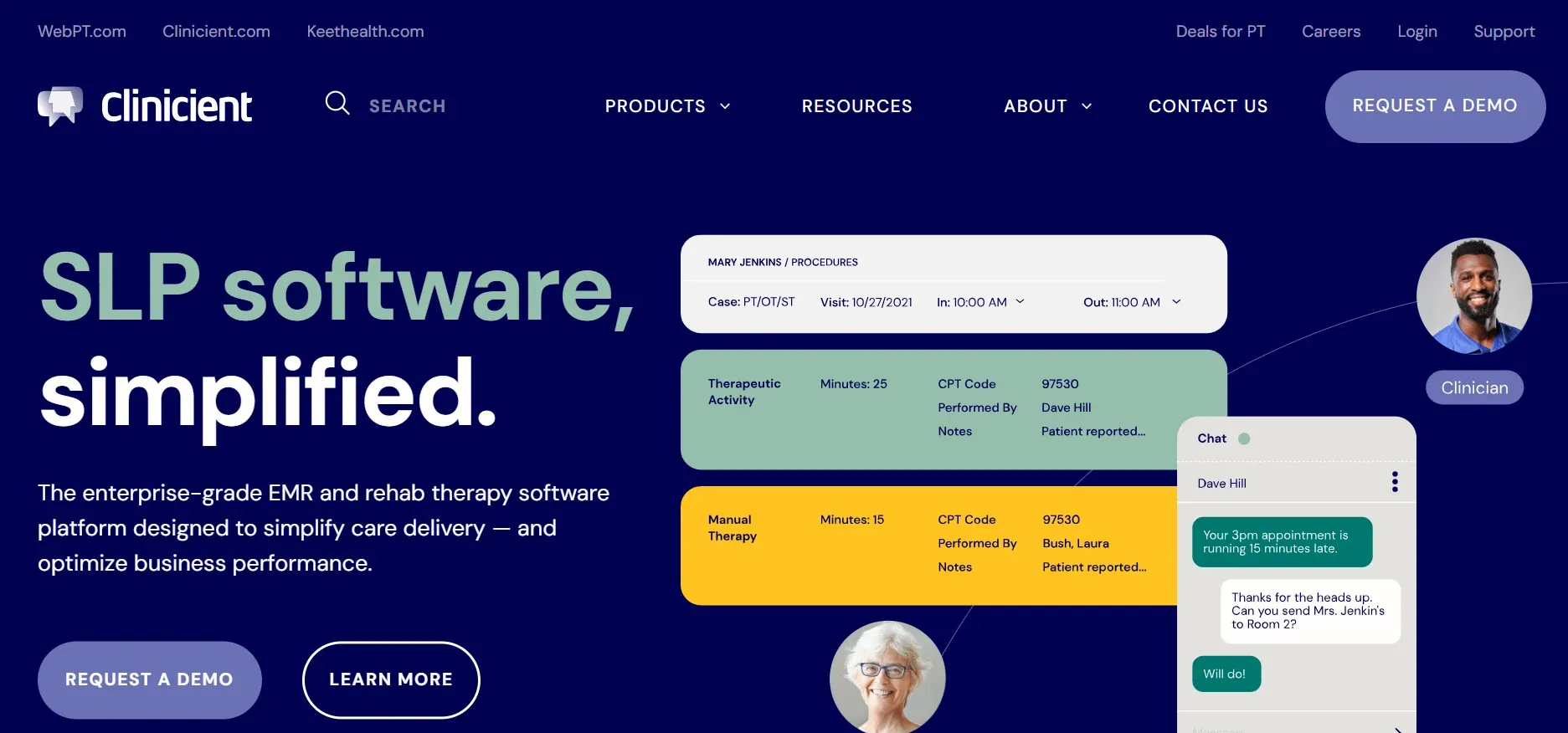
Clinicient is a powerhouse for practices with several locations or high patient volumes. It offers integrated scheduling, clinical documentation, billing, and outcomes tracking, all with a focus on compliance and revenue cycle management. Unlike Prompt EMR, which appeals for its simplicity, Clinicient is built for scale and complexity. Think multi-site groups, outpatient rehab networks, and practices managing dozens of therapists.
Features: Robust scheduling with waitlists and recurring appointments, built-in payer rules engine, customizable documentation templates, outcomes measurement tools, integrated billing and claims management, and advanced analytics dashboards. There is also support for telehealth, though this may require an add-on.
Integrations: Clinicient connects with several clearinghouses, billing partners, and some third-party telehealth tools. Integration with external EHRs or custom reporting tools is possible, but usually requires vendor involvement and may incur extra charges.
Migration friction: Onboarding is guided by Clinicient’s implementation team, and data migration from Prompt EMR or other systems is available, but full chart migration can take weeks and may not include every historical document or template. Custom workflows are limited to what Clinicient supports internally.
Use cases: Ideal for established practices expanding to multiple locations, or those with complex insurance mixes and a need for detailed payer analytics. If you need granular control over billing workflows and prioritize compliance, Clinicient is a strong fit.
Trade-offs: The feature set is vast, but comes with a steeper learning curve. Monthly per-provider fees add up, especially for larger teams. Customization is largely limited to built-in templates, and any new feature requests go through their product pipeline. You never own the system or code, and are subject to annual contract renewals and price escalations.
Pricing: Reported $125+ per provider per month. See pricing.
- Key limitations:
- Steep learning curve for new users
- Customization limited to built-in templates
- Recurring per-provider fees
- Strengths:
- Enterprise-grade analytics and compliance
- Robust multi-location support
- Integrated billing and outcomes tracking
If you ever hit a paywall for custom reporting, remember, with a custom Devaims build, you’d have the exact reports you need from day one.
2. Raintree (Best for enterprise PT clinics)
Raintree is engineered for the largest and most complex outpatient rehab organizations. It’s a modular platform, offering a suite of tools for scheduling, documentation, billing, patient engagement, and even patient relationship management (PRM). Raintree’s strength is its configurability and ability to handle enterprise workflows, including multi-specialty and multi-location setups.
Features: Deep automation for authorizations and eligibility checks, custom workflow scripting, advanced analytics, and support for remote patient monitoring. Raintree includes patient portals, telehealth, and mobile documentation options. Its reporting engine is customizable, but modifying templates often requires working with their technical team.
Integrations: Extensive, including clearinghouses, financial systems (like QuickBooks), external EHRs, and custom APIs. Many integrations are only available on higher pricing tiers or require custom development fees.
Migration friction: Implementation can take several months for large organizations. Data migration is possible but can be complex, especially if you have legacy data formats. Training is essential, given the system’s breadth.
Use cases: Best for hospital-affiliated rehab networks, large private equity-backed PT groups, or clinics with complex payer mixes and high compliance demands. If you need workflow automation at scale, Raintree is a contender.
Trade-offs: Opaque pricing (always custom quoted), lengthy onboarding, and reliance on Raintree’s team for customizations. Smaller clinics may find it overwhelming and expensive. Like all SaaS, you don’t own the code, and integrations beyond the basics are never truly in your control.
Pricing: Custom quote only.
- Key limitations:
- Complex onboarding and training
- Customizations require vendor involvement
- Pricing is not transparent
- Strengths:
- Highly configurable for enterprise needs
- Advanced workflow automation
- Comprehensive integration options
When you own the platform, integration is just an API away, not a vendor ticket.
3. Therabill (Best for small PT practices)
Therabill is designed for solo practitioners and small group clinics that want a simple, affordable, and easy-to-use EMR. It covers the basics: scheduling, documentation, and billing, with a focus on outpatient rehab. Compared to Prompt EMR, Therabill is less feature-rich but much easier to onboard for small teams.
Features: Drag-and-drop scheduling, basic documentation templates, insurance eligibility checking, electronic claims submission, and client invoicing. There’s a built-in patient portal and telehealth support, but these are more limited than in enterprise systems.
Integrations: Integrates with Office Ally for claims and some clearinghouses. Some clinics connect Therabill with practice management tools like SimplePractice, but deep integrations require manual setup or middleware tools like Zapier.
Migration friction: Data migration is straightforward for patient demographics and schedules, but clinical notes and historical billing data often require manual entry or CSV imports. Therabill’s support team can assist, but expect some manual work.
Use cases: Solo clinicians or small teams who want to get up and running quickly with minimal IT overhead and don’t need complex analytics or custom workflows.
Trade-offs: Feature set is limited; as your practice grows, you may quickly outgrow Therabill. Reporting is basic, and customization is minimal. There’s no true ownership, your data and workflows are tied to the vendor.
Pricing: $149 per month. See pricing.
- Key limitations:
- Limited reporting and analytics
- Minimal customization options
- Manual data migration for notes
- Strengths:
- Simple onboarding for small teams
- Affordable for solo practices
- Basic telehealth and portal included
4. Net Health (Best for integrated documentation)
Net Health is a major player in the hospital and multi-specialty clinic space, often selected for its robust compliance, documentation, and audit tools. Net Health’s EMR is modular, so you can add or remove features based on your organization’s needs.
Features: Advanced clinical documentation with compliance checks, ICD-10 coding assistance, outcomes tracking, scheduling, and integrated billing. There’s a strong focus on audit readiness and regulatory compliance (HIPAA, MIPS, PQRS). Patient engagement features include secure messaging and patient portals.
Integrations: Integrates with hospital information systems (HIS), billing software, and some third-party analytics tools. HL7 and FHIR compatibility is available, but often requires IT support and additional fees.
Migration friction: Implementation is typically project-managed, with data migration supported for demographics and recent clinical data. Legacy chart notes and scanned documents may need manual migration.
Use cases: Hospital-affiliated outpatient clinics, large therapy groups, or practices with high compliance requirements. Net Health is well-suited for organizations that undergo frequent audits or need to report on quality measures.
Trade-offs: Multi-year contracts and slow customization cycles. The system can be overkill for smaller clinics, and any changes to workflows or templates require vendor involvement. Subscription-only; you never own the code or the platform.
Pricing: Custom quote.
- Key limitations:
- Slow customization cycles
- Overkill for small practices
- Subscription only, no ownership
- Strengths:
- Strong compliance and audit tools
- Modular features for large clinics
- Integrated patient engagement
5. Fusion Web Clinic (Best for pediatric therapy)
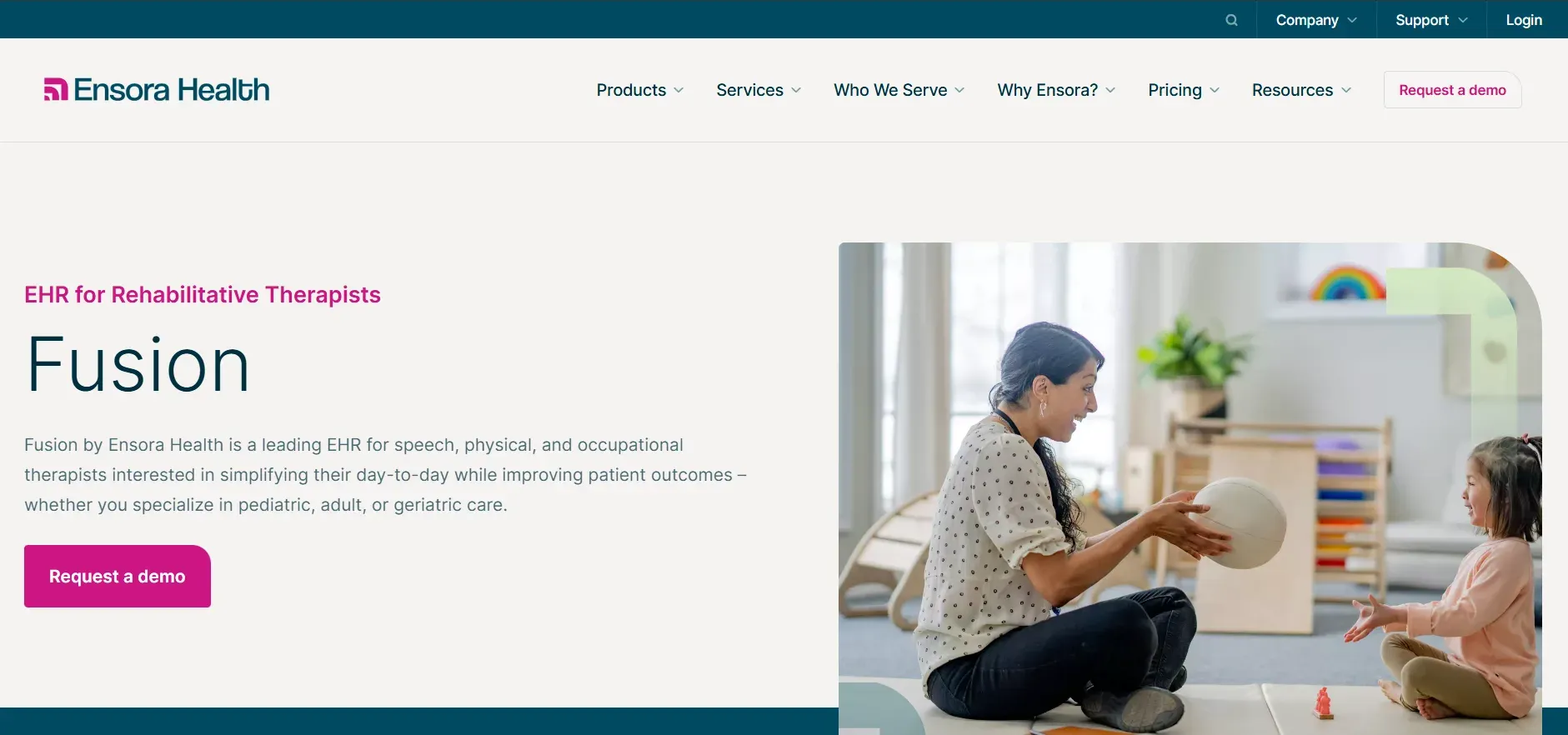
Fusion Web Clinic is designed from the ground up for pediatric therapy practices, including PT, OT, and speech therapy. Its templates, reports, and workflows are tailored for the unique needs of pediatric care, including family engagement and school-based services.
Features: Pediatric-specific documentation templates, progress tracking, goal setting, and family engagement tools (like parent portals and activity logs). Fusion includes basic scheduling, billing, and telehealth modules, plus visual progress charts for communicating with parents and schools.
Integrations: Integrates with clearinghouses for billing, SimplePractice, and some third-party outcome tools. Family engagement features (like the parent portal) may be paid add-ons.
Migration friction: Data import is streamlined for patient demographics and schedules, but more complex for historical clinical notes. Fusion’s team assists with onboarding, but expect some manual data entry for older records or custom forms.
Use cases: Pediatric therapy clinics, early intervention providers, and school-based therapists who need age-appropriate documentation and family involvement tools.
Trade-offs: Limited usefulness outside the pediatric space. Some reporting and engagement features are locked to higher plans. As with all SaaS, you pay per provider and never own the system.
Pricing: $39 per provider per month. See pricing.
- Key limitations:
- Limited to pediatric therapy
- Advanced features require higher plans
- No ownership, per-provider fees
- Strengths:
- Pediatric-focused templates and tools
- Family engagement features
- Affordable entry price
On an owned platform, adding a new report or portal is a one-time build, not an upsell.
6. DrChrono PT (Best for integrated billing)
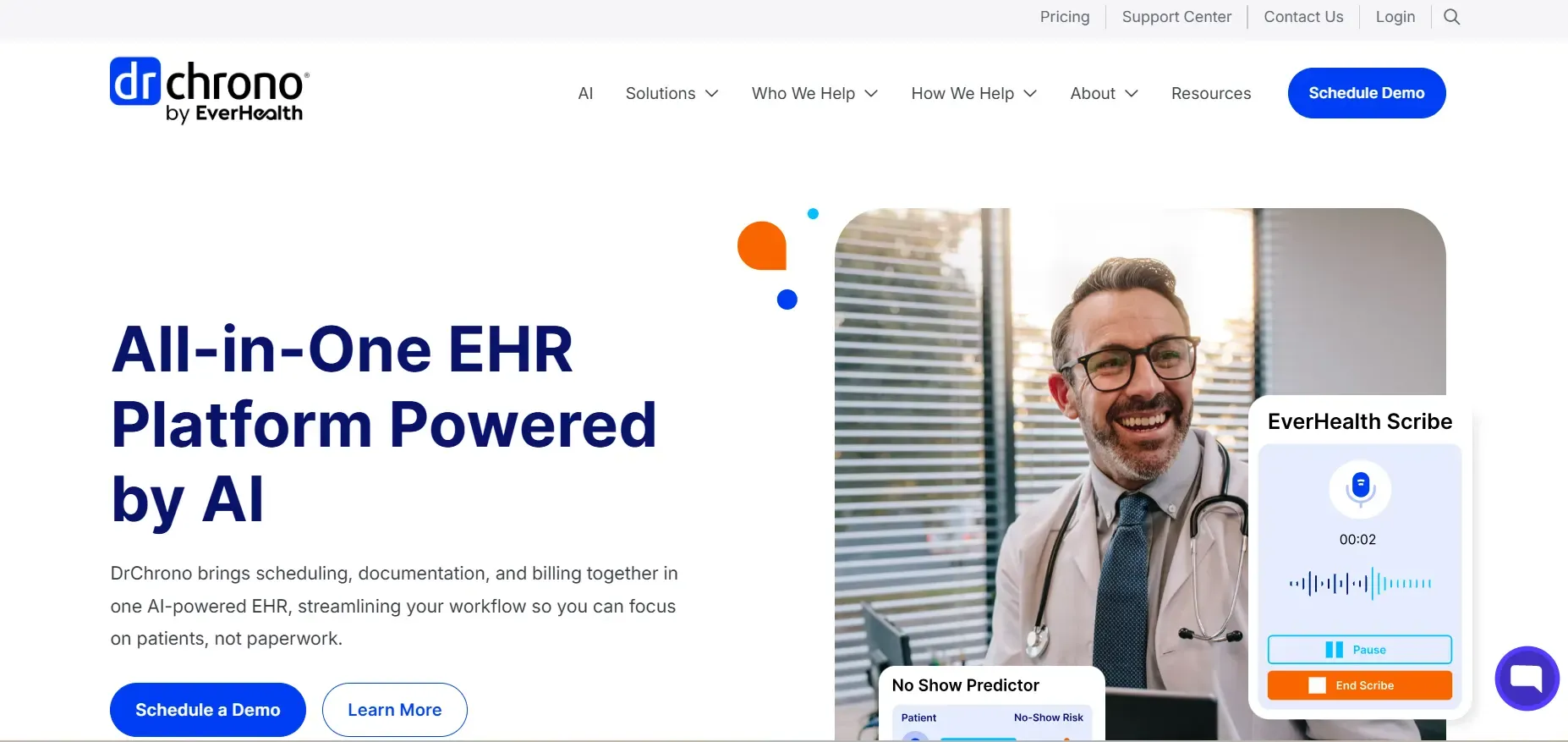
DrChrono PT is an established name in EHR, with a PT-specific module layered on top of its core platform. Its strength is its all-in-one approach, combining scheduling, documentation, billing, e-prescribing, and even telehealth in a mobile-friendly format.
Features: Customizable templates for PT, integrated billing and claims management, e-prescribing (for multi-specialty practices), patient check-in kiosks, telehealth, and robust mobile apps for iPad and iPhone. DrChrono’s reporting is flexible, but many advanced analytics require higher-tier plans or custom configuration.
Integrations: Integrates with labs, imaging centers, and clearinghouses, plus third-party apps via its API. Some integrations (like business analytics or advanced patient engagement) are only available on premium plans or require additional fees.
Migration friction: Data migration from Prompt EMR or other PT-specific systems can be complex, as DrChrono’s data model is multi-specialty. Expect guided onboarding but some manual work for clinical note templates.
Use cases: PT clinics that are part of broader medical practices, or those wanting seamless medical billing and telehealth integration in a mobile-first environment.
Trade-offs: High per-provider cost, especially as you scale. PT workflows are less customizable than in PT-only systems, and some features require add-ons. As with all SaaS, you’re renting, not owning.
Pricing: Reported $200+ per provider per month. See pricing.
- Key limitations:
- High per-provider cost
- PT workflows less customizable
- Advanced features require upgrades
- Strengths:
- Integrated billing and claims
- Mobile-friendly interface
- All-in-one platform
7. MediLinks (Best for hospital-affiliated rehab)
MediLinks (now part of Allscripts/Meditouch) is used primarily by hospital-based outpatient rehab and large therapy groups. It’s designed to handle high complexity and regulatory requirements, making it a go-to for enterprise organizations.
Features: Enterprise-grade documentation, advanced compliance tools, support for multi-specialty workflows, and integration with hospital billing systems. MediLinks is highly configurable for reporting and workflow automation, but changes require vendor assistance.
Integrations: Deep integration with hospital information systems, billing platforms, and compliance monitoring tools. HL7 and FHIR support is available but managed by the vendor.
Migration friction: Implementation projects can take months, with dedicated project managers and IT involvement. Data migration from Prompt EMR or other outpatient systems is complex, especially for custom templates and legacy data.
Use cases: Hospital outpatient rehab departments, large therapy groups, organizations needing to meet strict compliance and reporting standards.
Trade-offs: Not suited for small or mid-size private PT clinics. Feature development can lag, and the system is expensive and complex to maintain. Like all SaaS, you never own the platform.
Pricing: Custom quote required.
- Key limitations:
- Complex and lengthy implementation
- Not suited for small clinics
- Expensive and requires IT support
- Strengths:
- Enterprise-level compliance tools
- Deep hospital system integration
- Highly configurable workflows
8. Devaims (Best for clinics ready to own their EMR)
Devaims builds fully custom EMR and practice management platforms for PT clinics that want to own, not rent, their technology. The process starts with a deep dive into your clinic’s workflows, specialty needs, and reporting requirements. The result is a platform that matches your exact documentation, scheduling, billing, outcomes, and integration needs, with no per-user or per-visit fees, no lock-in, and no forced upgrades.
Features: 100% custom scheduling, documentation, billing, patient engagement, and analytics, built for your practice, not for the lowest common denominator. Integrate with any billing, telehealth, or outcome registry tool you use. Reports and dashboards are tailored to your clinical and business KPIs. Mobile and tablet support is included if needed.
Integrations: Devaims connects with any external system via API, HL7, FHIR, or custom data interfaces. Whether you need to sync with a hospital system, link to a billing partner, or push data to a custom outcomes registry, it’s all possible and under your control.
Migration friction: Devaims handles the full migration process, including extracting, cleaning, and importing all patient records, schedules, billing data, and documents from Prompt EMR or any other system. You get a dedicated project manager and support team, and the transition is planned to minimize downtime.
Use cases: Clinics that want to future-proof their tech stack, need unique workflows, or want to eliminate recurring software rental fees. Especially valuable for multi-provider practices, specialty clinics, and those with complex reporting or integration needs.
- You own the code and all your data, forever
- No per-seat or per-visit fees, ever
- Fully custom workflows and integrations
- Flat, predictable maintenance cost
Other Prompt EMR alternatives worth knowing
- TherAssist: Still used by some small clinics, but updates are sparse and support is limited. It’s not a modern cloud solution, and migration to or from TherAssist can be challenging.
- ReDoc: A legacy platform, best for large hospital groups but rarely chosen by new PT clinics today. Features are robust but interface and support lag behind newer options.
- WebPT: Widely used, but not covered above due to similar rent-and-lock-in model as Prompt EMR; worth a look if you want a large user community and a broad set of third-party integrations. For a deep dive, see our WebPT alternatives guide.
How to choose the right Prompt EMR alternative
- Budget: Add up the real total over five years, including every "required" add-on and per-user fee. Remember to factor in training, data migration, and potential price hikes. Most SaaS platforms cost more than the sticker price.
- Practice size: Some EMRs are built for solos, others for enterprise. Overpaying or underbuying is common. Solo and small practices do best with simple solutions, but if you plan to grow, ensure your EMR can scale without massive cost jumps or workflow disruptions.
- Customization needs: If you need more than checkboxes and templates, renting will always hit limits. Specialty clinics (pediatrics, neuro, sports, etc.) and those with nonstandard workflows should look for platforms that are truly customizable or consider a custom build.
- Data control: How easy is it to export everything if you switch, or do you want to own it from the start? Ask for a sample export and test it. Remember, true ownership means controlling both your data and the software itself.
- Integration: Will the EMR connect to your billing, telehealth, or outcome tools natively or at all? If you rely on third-party systems or want to automate workflows, ensure those integrations are supported, ideally without expensive custom projects.
If you’re tired of per-seat fees and want a practice management system designed for your exact workflow, owning may be the smarter long-term play. For a comparison of EMRs by feature and fit, see resources like Verywell Health or Capterra.
Stop paying rent on software you could own
Every Prompt EMR alternative in this post is a SaaS rental, meaning the vendor holds your data, charges per seat, and can raise rates at any time. Even the best-designed platform leaves you on the hook for monthly fees and limited by what’s already built. When you finally want your own workflow, you’re starting over again.
Devaims flips that equation. We build custom web, mobile, and business software for PT clinics, and you get the source code. No lock-in, no recurring per-user bills, no contract renewal surprises. Your data stays your data, and your team gets the exact features, integrations, and reports you want.
- No more per-seat or per-visit charges: One price, however many therapists or admins you have. As your team grows or your practice expands, your costs remain predictable.
- Fully custom workflow: Get the documentation, reminders, and outcome tracking you actually need, not just what fits in a template. This means your EMR works the way your clinic does, not the other way around.
- Integration on your terms: Billing, telehealth, outcome registries, whatever your practice uses, we can connect. No more waiting for a vendor’s next development cycle or paying for custom integrations that should be standard.
- Your data, your rules: Export, analyze, and control your records without asking a vendor’s permission. You decide how your data is stored, backed up, and accessed.
| Tool | Ownership | Recurring fees | Custom workflows |
|---|---|---|---|
| Prompt EMR | No | Yes, per user/mo | Limited to templates |
| Clinicient | No | Yes, per provider/mo | Partial |
| Fusion Web Clinic | No | Yes, per provider/mo | Pediatrics focused |
| Devaims | Yes, you own it | Flat maint only | Fully custom |
Here’s the honest 5-year math for a 6-provider PT clinic:
| Year | Rented (Prompt/Clinicient: $150/provider/mo) | Owned (Devaims: $30,000 build, $180/mo maint) |
|---|---|---|
| 1 | $10,800 | $32,160 |
| 2 | $21,600 | $34,320 |
| 3 | $32,400 | $36,480 |
| 4 | $43,200 | $38,640 (break-even) |
| 5 | $54,000 | $40,800 |
For clinics with 5 or more providers, you break even around year 4. Every year after that, owning your EMR saves more and more, plus you’re never stuck with a vendor’s roadmap or rate hikes. Want to run your real numbers? We’ll walk you through it, no obligation.
How to switch from Prompt EMR
- Export all patient records, schedules, and billing data from Prompt EMR. Request a complete export, including clinical notes, scanned documents, and appointment history. Test the export to ensure data integrity and completeness.
- Choose the alternative EMR or custom platform that fits your clinic’s needs. Consider not just current features, but your growth plans, specialty needs, and any integration requirements.
- Work with your new vendor to import records and set up user roles. Review how clinical notes and historical data will be imported. Some systems only support demographic and schedule imports, so plan for manual entry if needed.
- Reconnect payment processors and third-party integrations (telehealth, outcome tools). Map out each integration and verify compatibility before going live.
- Train your staff on the new workflows and documentation standards. Schedule time for hands-on training and build a knowledge base or reference guide for common tasks.
- Run both systems in parallel for a billing cycle to catch errors. This parallel run helps you identify gaps in data, workflow mismatches, or billing issues before fully switching over.
- Review your Prompt EMR contract for cancellation terms and complete the switch. Some contracts require 30, 90 days’ notice or charge early termination fees, so plan accordingly.
With a custom Devaims build, the migration is handled as part of the project. We manage the data extraction, transformation, and import, and provide full staff training and go-live support for a seamless transition.
Frequently asked questions
What is the best Prompt EMR alternative for pediatric therapy?
Fusion Web Clinic is purpose-built for pediatric PT, OT, and speech practices. Its templates and family engagement tools are tuned for peds, and it’s lighter to set up than most "all-in-one" EMRs. However, if your pediatric clinic has highly specialized workflows, outgrows Fusion’s capabilities, or wants to avoid per-user fees, a custom Devaims build will offer more flexibility and ownership.
Which Prompt EMR alternative is cheapest for solo PTs?
For solo clinicians, Practice Perfect and Therabill are among the most affordable, with starter plans around $70 to $150 per month. Both are simpler than enterprise EMRs but limited if you grow. If you plan to add providers or need custom features, be aware that per-user costs can rise quickly and you may face migration work later.
Can I get a free Prompt EMR alternative?
There isn’t a truly free, HIPAA-compliant EMR for physical therapy that matches Prompt EMR’s features. Some clinics experiment with open-source solutions like OpenEMR, but these lack dedicated PT templates, require manual IT setup, and offer no real support. Free trials are available from some vendors, but ongoing use always carries a monthly fee. If you want to fully own your software and avoid recurring costs, a custom build from Devaims is the only way to combine ownership, support, and compliance.
How hard is it to switch from Prompt EMR to another system?
Switching from Prompt EMR takes planning: you’ll need to export your data, set up the new EMR, train staff, and run both systems in parallel for a short period. Most PT clinics complete the process in 30 to 60 days, though some vendors offer migration support. The most challenging part is often cleaning and mapping clinical notes and scanned documents to the new system’s format. With Devaims, the transition is included in your custom project and managed start-to-finish.
What’s the main benefit of owning my PT software?
Owning your EMR (versus renting Prompt EMR or any SaaS) means no more per-user fees, no lock-in, and the freedom to add any workflow, integration, or report you want. Custom builds from Devaims give you the code and full control, forever. You also avoid the risk of vendor shutdowns, forced upgrades, or sudden price hikes, and can adapt your platform as regulations or your clinic’s needs evolve.
Are there Prompt EMR alternatives that let me own my data?
Most SaaS EMRs let you export your data, but you never own the platform itself. Even with “full export,” you’re limited by the formats and tools the vendor provides. Only a custom Devaims build puts you in full control of both the data and the code, with no ongoing rental required. This means you can run analytics, connect new integrations, or even license your system to others if you choose.
When should a PT clinic switch away from Prompt EMR?
If you’re frustrated by recurring costs, can’t get the features you need, or want to scale without per-seat fees, it’s time to look at Prompt EMR alternatives. For clinics with 5 or more providers, owning can make financial sense within four years. Other signals: reliance on external spreadsheets, constant workarounds for missing features, or a desire to integrate with systems your vendor doesn’t support.
The bottom line
The right Prompt EMR alternative depends on your size, workflow, and appetite for recurring fees. Most SaaS options get you started fast, but after three to four years, the math often favors owning your platform, especially if you want control and flexibility.
Here’s the test: add up what your current EMR will cost you over the next five years. If that number could have built you something you own outright, you have your answer. Let Devaims show you what owning can look like for your practice, and what you’ll save when you stop renting.
Read more on the Devaims blog, or see our deep dives on WebPT alternatives, DrChrono alternatives, and Clinicient alternatives.