



Your Procentive bill never gets smaller. Maybe it's the rising per-provider fees, or the morning you realize you're locked into workflows that don't quite fit your practice. You try to export your data and find yourself staring at a CSV that's missing half the fields you need. Or you discover the "must-have" reporting feature is only in a higher tier, another $80 a month, per user.
If you run a mental health clinic, you know the pain of outgrowing your EHR. SimplePractice and TherapyNotes lure you with clean dashboards, but every SaaS locks you into their way of working, and their forever meter. The real decision: keep renting, or start owning. Below, you'll find the 9 strongest Procentive alternatives, why clinics switch, and the only option that puts you in charge of your software (and your data): a custom build from Devaims.
Why mental health practices look for Procentive alternatives
Per-provider fees add up fast. Practices scaling from five to twenty providers see their costs balloon, often outpacing the value they get. When each new therapist or staff member brings a new monthly charge, budgeting becomes unpredictable. This is especially true if your clinic experiences seasonal fluctuations or rapid growth, as you may end up paying for seats you do not consistently use.
Locked-in workflows frustrate your team. You end up working around the system, not with it. Even basic changes like new intake forms require support tickets or paid add-ons. For clinics with unique processes, such as specialized group therapy, integrated telepsychiatry, or custom progress notes, these rigid systems slow you down, introduce errors, and frustrate staff who have to double-document or maintain paper records on the side.
Feature upgrades mean paying for tiers you do not need. The "Pro" reporting or telehealth module is gated behind expensive monthly tiers. This forces you to pay for bundles of features you may never use, just to unlock one critical function. Over time, the cost gap between what you need and what you pay for widens. Many clinics report having to upgrade their entire plan just to access a single analytics dashboard or telehealth integration.
Data export is never as easy as promised. When you try to leave, you learn reports are incomplete or formats don't import cleanly elsewhere. Some EHRs export only minimal data (such as basic demographics and appointment history), leaving out clinical notes, billing records, or custom forms. This can cause major headaches in audits, insurance reviews, or when migrating to a new system. You may also find that exported files require significant manual cleaning or transformation before they can be imported elsewhere, which can be a hidden cost in time and technical expertise.
Surprise price hikes and contract lock-ins. Yearly renewals come with sticker shock, and short cancellation windows tie your hands. Some SaaS providers increase prices with little notice, add new fees for compliance or integrations, or require long-term contracts with auto-renew clauses. For many clinics, this means you are not only paying more over time, but also have little leverage or flexibility to adapt as your needs change. These are the pain points driving clinics to research Procentive alternatives.
Quick comparison of the best Procentive alternatives
| Tool | Best for | Starting price | You own it? |
|---|---|---|---|
| SimplePractice | Small practices, solo clinicians | Reported $39/mo | No |
| TherapyNotes | Clinical documentation | Reported $49/mo | No |
| TheraNest | Group practices, telehealth | Reported $39/mo | No |
| Luminare Health | Compliance-focused clinics | Reported $50/mo | No |
| Valant | Larger, integrated clinics | Custom quote | No |
| Kareo Behavioral (Tebra) | Insurance billing | Reported $80/mo | No |
| Greenspace | Outcomes tracking | Reported $30/mo | No |
| ICANotes | Psychiatry practices | Reported $75/mo | No |
| Devaims | Owning your system | One-time build, you own it | Yes |
Always confirm current pricing before you decide. SaaS rates change and often depend on your provider count or add-ons. Some platforms also charge for onboarding, data migration, or essential integrations, so be sure to request a detailed quote for your clinic’s real-world needs.
The 9 best Procentive alternatives
1. SimplePractice (Best for solo and small practices)
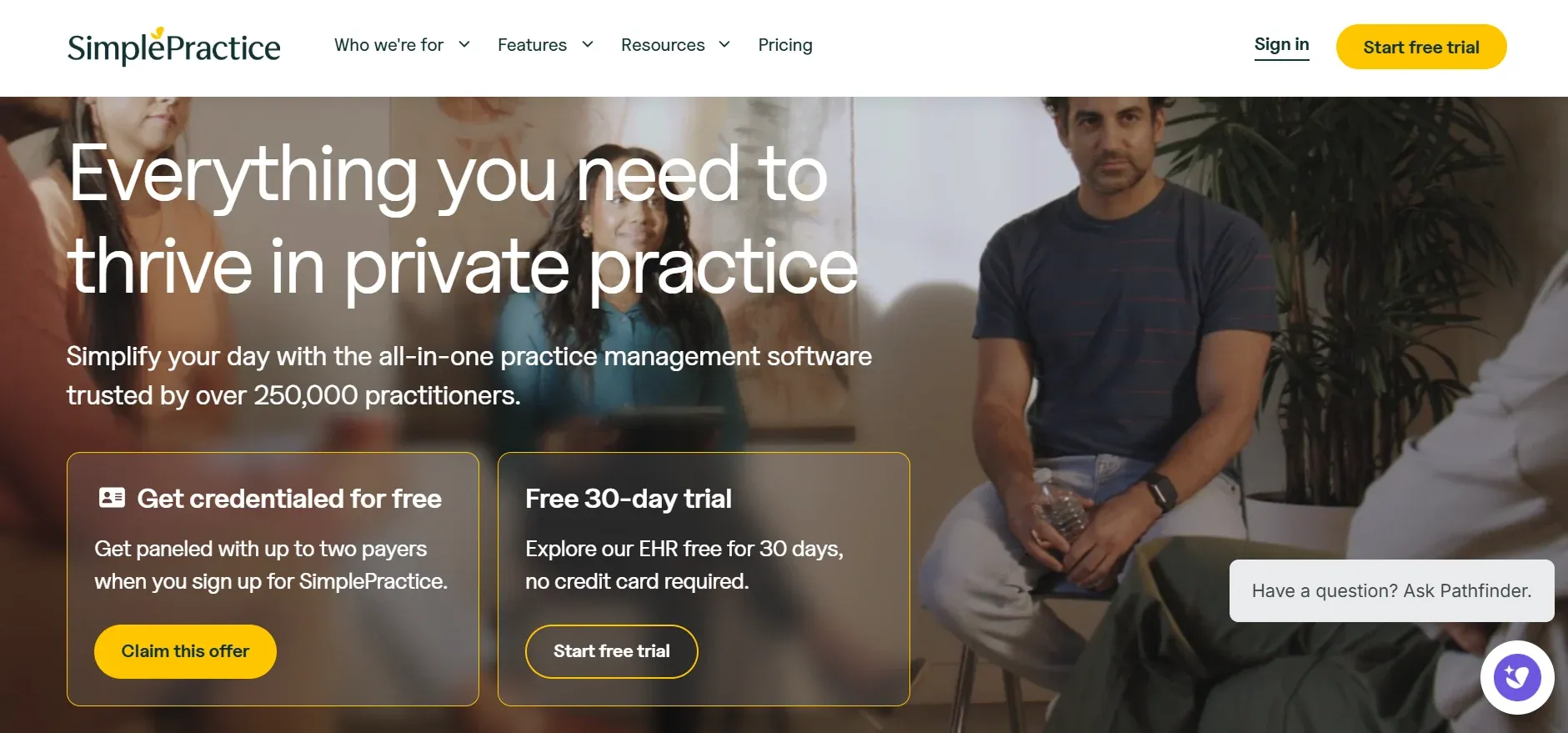
SimplePractice is widely considered the entry point for private practice therapists and small group clinics. Its modern, mobile-friendly interface is easy to learn and offers streamlined appointment scheduling, video telehealth, and customizable notes templates. Integrated payment processing makes it a favorite for clinicians who want to handle private pay clients and basic insurance billing in one place.
Pricing: $39/mo solo, $390, $590/mo for 10 providers.
- Easy onboarding and intuitive interface
- Integrated telehealth and payment processing
- Mobile app and client self-scheduling
- Advanced features require higher tiers or add-ons
- Customization is limited for unique workflows
- Performance can lag with large client panels
Devaims can build you a platform with all the simplicity of SimplePractice, but tailored to your exact workflow and owned outright.
2. TherapyNotes (Best for clinical documentation and compliance)

TherapyNotes is built for detailed, compliant record-keeping. It is a go-to for practices that prioritize clinical documentation, insurance claim management, and audit readiness. The platform supports psychology, psychiatry, and group practice workflows with built-in assessment templates and automated billing.
Pricing: $49/mo per clinician, $490/mo for 10 providers.
- Comprehensive documentation and compliance tools
- Integrated insurance billing and e-prescribing
- Strong audit and reporting features
- Interface is less modern than some competitors
- Custom note templates are limited
- Advanced features require add-ons or higher tiers
With Devaims, you can have documentation workflows built for your specialty, with no feature gating or forced upgrades.
3. TheraNest (Best for group practices and telehealth)
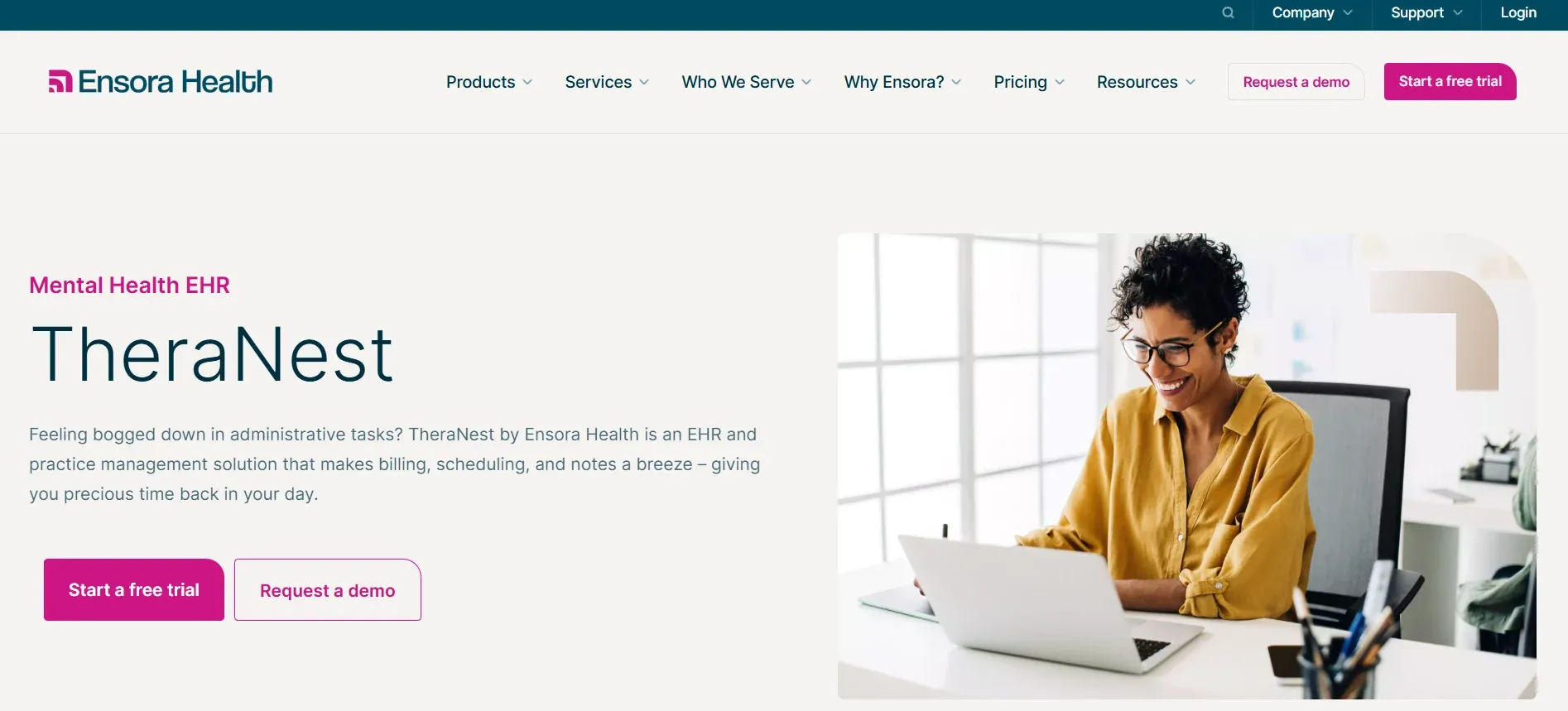
TheraNest is designed for collaborative group practices, nonprofit agencies, and clinics juggling multiple providers and locations. Its strengths lie in flexible scheduling, built-in telehealth, and support for both private pay and insurance workflows.
Pricing: $39/mo solo, $390, $500/mo for 10 providers.
- Flexible scheduling and group appointment support
- Integrated telehealth and outcome measurement
- Mobile app for on-the-go charting
- Analytics and reporting are basic without add-ons
- Support response times can vary
- Workflow customization is limited
Devaims can build group scheduling and telehealth features that fit your exact processes, with no per-user fees.
4. Luminare Health (Best for compliance-driven clinics)

Luminare Health is purpose-built for organizations with strict regulatory, privacy, and security requirements. Its modular EHR and practice management tools focus on audit trails, granular permissions, and role-based access, making it a strong fit for clinics under frequent review or serving high-risk populations.
Pricing: $50/mo per user, $500, $700/mo for 10 providers.
- Advanced HIPAA compliance and audit features
- Granular permissions and security controls
- Custom workflow automations
- Complex interface and steep learning curve
- Higher costs for smaller teams
- Customization limited to platform framework
5. Valant (Best for mid-sized and enterprise clinics)
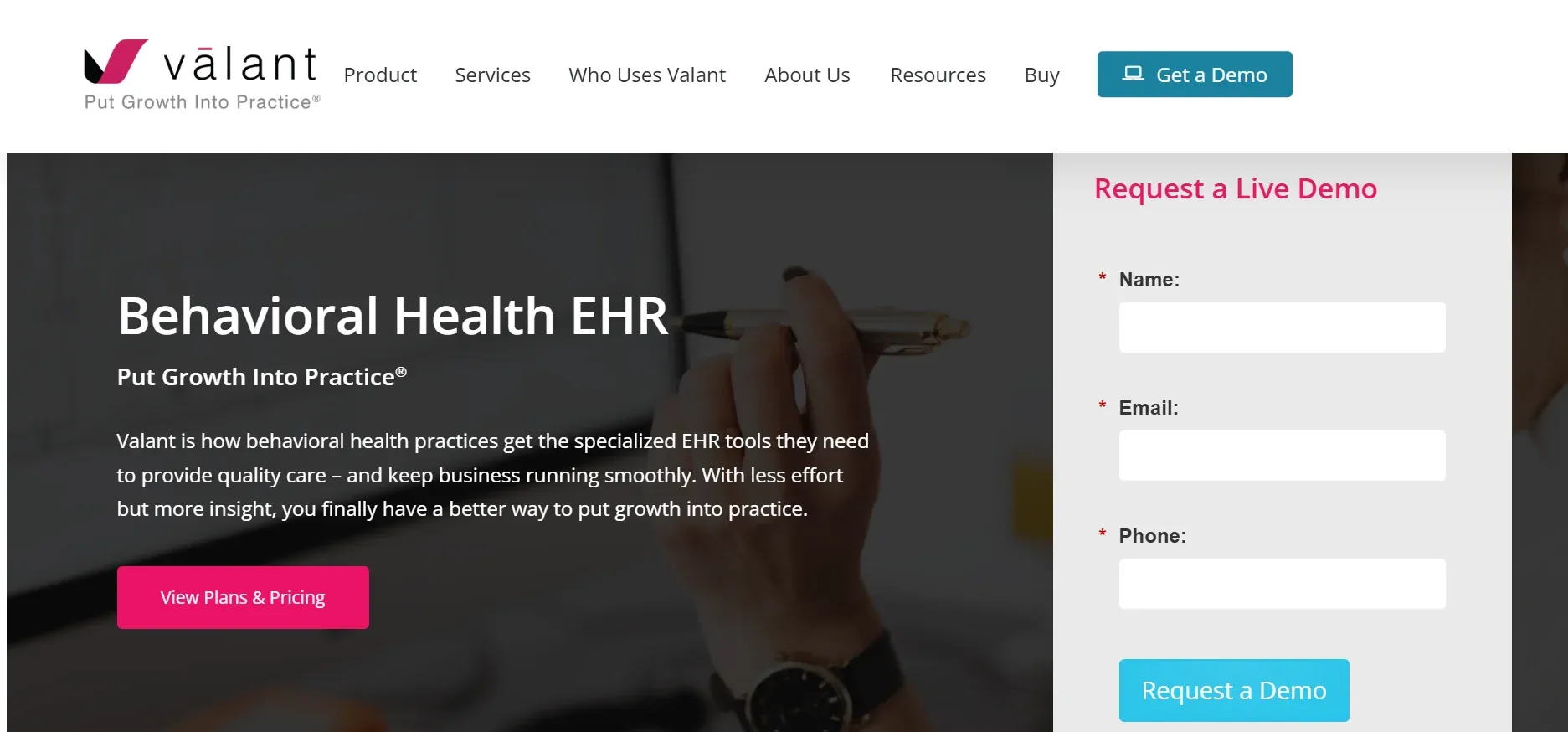
Valant is an enterprise-grade platform designed for growing mental health organizations, integrated care networks, and clinics needing strong analytics, billing, and patient engagement in a single ecosystem. Its modular architecture allows for adding features as you grow, but pricing is not public and can be significant for full-feature access.
Pricing: Custom quotes, often $1000+/mo for mid-sized clinics.
- Comprehensive EHR and analytics tools
- Enterprise-level integrations and scalability
- Strong insurance billing and reporting
- Opaque pricing and potential for high costs
- Customization is limited by platform constraints
- Support and feature requests can be slow
6. Kareo Behavioral (Tebra) (Best for insurance billing)
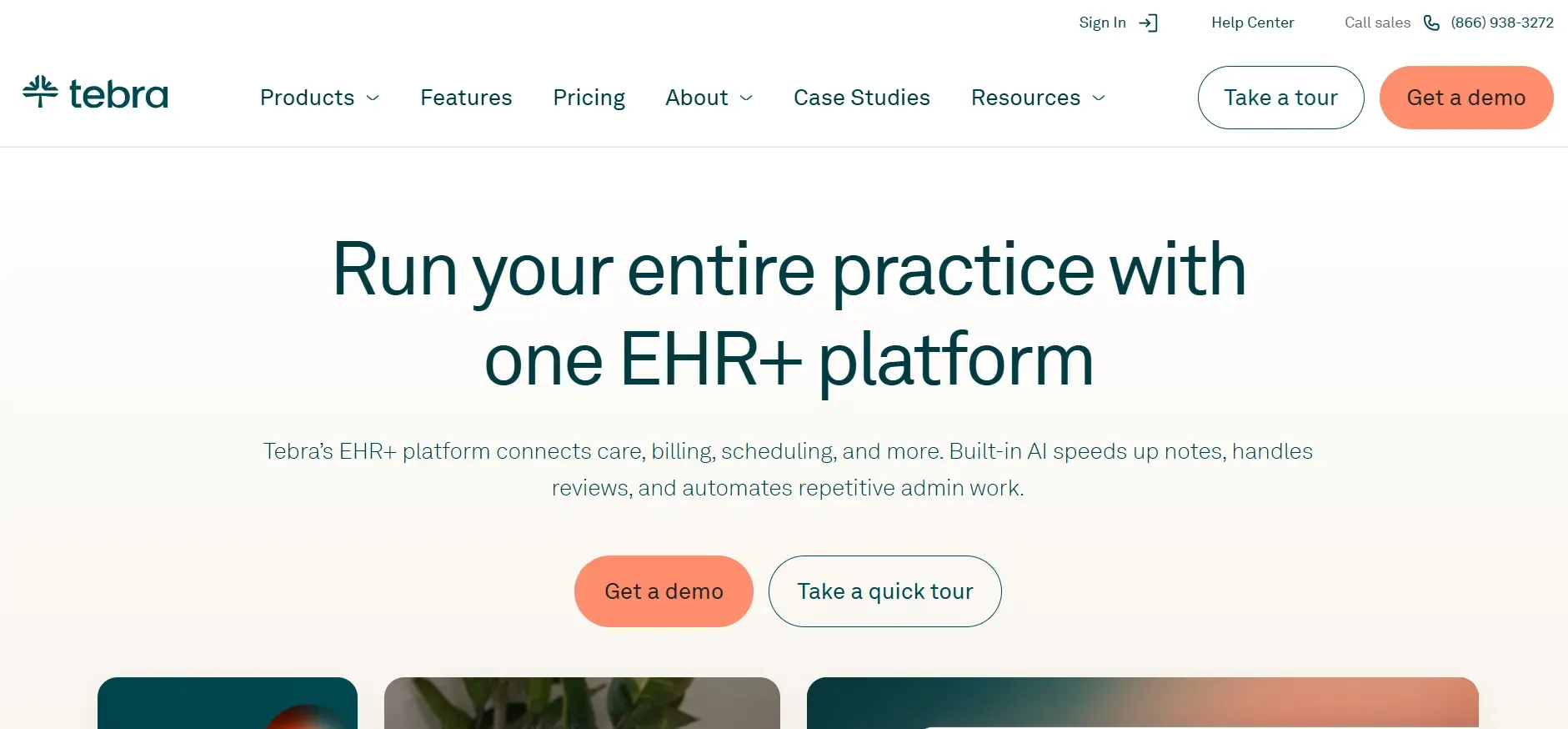
Kareo Behavioral (now Tebra) is engineered for mental health practices that process high volumes of insurance claims, manage complex billing, and want to reduce denials. Its claim scrubbing, eligibility checks, and revenue cycle management are best-in-class, but it is less suited for clinics seeking deep clinical customization.
Pricing: $80/mo per provider, $800/mo for 10 providers.
- Excellent insurance billing and claim management
- Automated eligibility and payment collection
- Streamlined revenue cycle tools
- Clinical documentation is less robust than competitors
- High cost for small clinics
- Add-ons increase total price
7. Greenspace (Best for outcomes tracking)

Greenspace is an outcomes measurement platform, not a full EHR, but it is increasingly used by clinics committed to evidence-based care and value-based reimbursement. It tracks client progress using validated measures (PHQ-9, GAD-7, etc.), generates automated reports, and helps demonstrate clinical effectiveness to payers or grant funders.
Pricing: $30/mo per provider, $300/mo for 10 users.
- Automated outcomes tracking and reporting
- Integrates with popular EHRs
- Supports value-based care contracts
- Does not handle billing or core EHR tasks
- Requires a separate EHR for full practice management
8. ICANotes (Best for psychiatry practices)
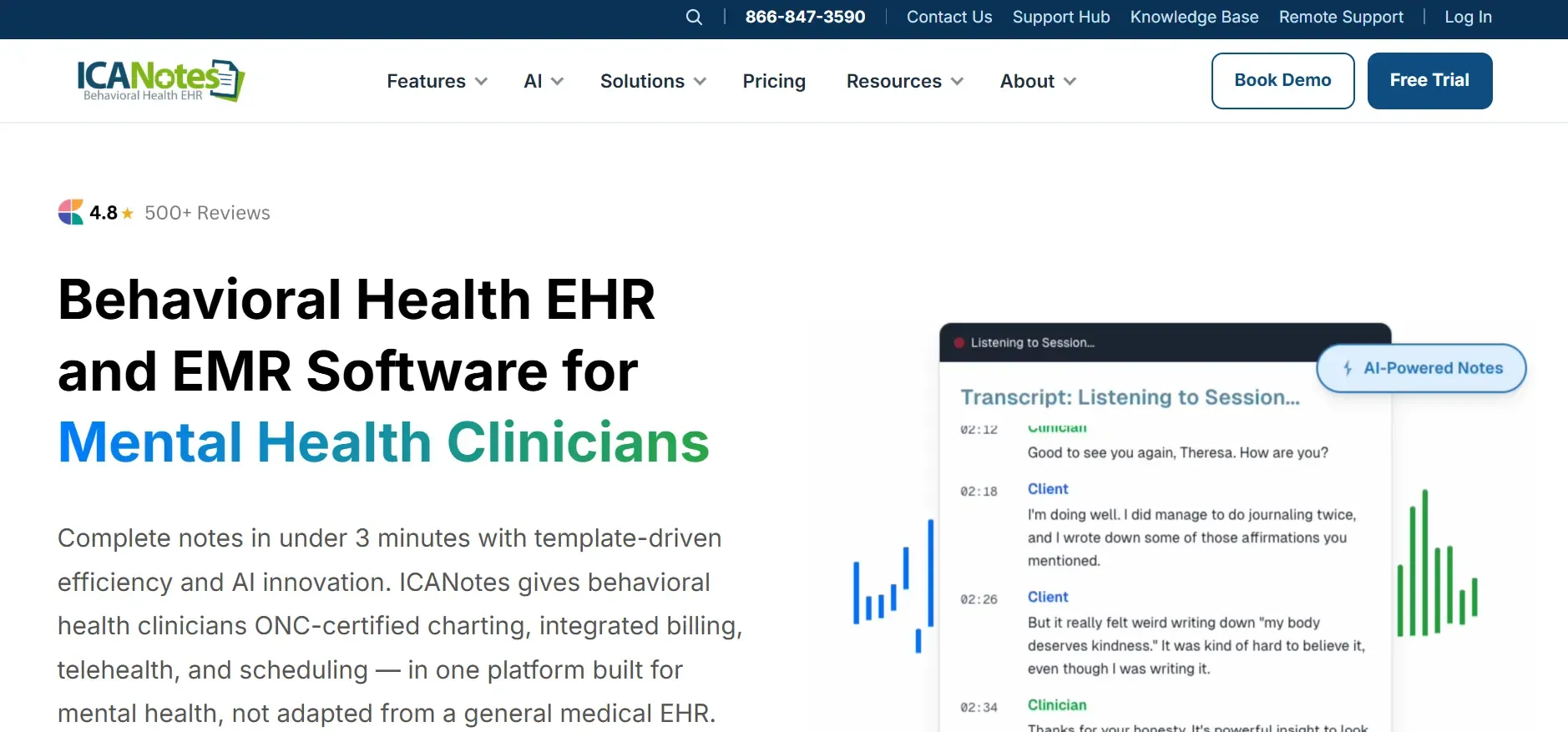
ICANotes is a clinical documentation powerhouse for psychiatry and behavioral health. Its structured, point-and-click note builder is designed to speed up psychiatric evaluations, medication management, and diagnostic coding. It is a favorite among psychiatrists and psychiatric nurse practitioners who need to manage complex medications and regulatory requirements.
Pricing: $75/mo per provider, $750/mo for 10 providers.
- Powerful psychiatric note templates
- Integrated e-prescribing and medication management
- Automated billing code generation
- Interface is dated and learning curve is steep
- Advanced analytics require add-ons
- Higher per-provider cost
9. Devaims (The only owned alternative)
Devaims builds custom web, mobile, and business software for mental health clinics, and hands you the source code. You own your EHR, workflow, and data outright. No forced upgrades, no per-provider or per-feature fees, and nothing is locked behind a paywall.
- 100% tailored to your clinic: intake forms, scheduling, progress notes, e-prescribing, telehealth, billing workflows, reporting, and any custom automation you need
- Full data migration and custom integrations, built to your requirements
- You own the code, data, and future roadmap, no lock-in or per-user fees
Devaims can build you a platform that adapts as your clinic grows, with no recurring per-user fees and no forced upgrades.
Other Procentive alternatives worth knowing
- Netsmart for large enterprise behavioral health networks. Netsmart is highly customizable and integrates with hospital systems, but is costly and complex for smaller clinics. It is best for organizations needing state reporting, integrated care, or multi-agency coordination. HealthIT.gov includes Netsmart on its certified EHR list.
- Qualifacts with strong compliance features, especially for multi-location or public sector providers. Qualifacts supports value-based care contracts and has strong reporting, but its cost and complexity are best justified at scale.
- Some mental health clinics use general EHRs like Athenahealth, Cerner, or Epic, but these are rarely optimized for therapy or psychiatry workflows and often come with significant customization costs.
How to choose the right Procentive alternative
- Budget: Solo and small teams get value from SimplePractice or BreezyNotes, but per-provider pricing adds up as you grow. If you expect to expand, calculate your five-year cost at your target size, not just your current headcount.
- Features: If insurance billing is your pain, Kareo Behavioral or Valant shine, but analytics or telehealth may mean TheraNest or TherapyNotes. Be sure to request demos and test the workflows that matter most to your staff, one missing feature can create hours of manual work each week.
- Customization: If you need forms or workflows unique to your clinic, only a custom build (like Devaims) truly delivers. Most SaaS tools allow limited template editing, but cannot accommodate deep process changes or unique reporting needs.
- Scale: Enterprise clinics need audit trails and compliance, so consider Luminare Health or Valant, or owning your own system. If you expect to add locations, providers, or service lines, consider how easily your EHR will adapt.
- Data ownership: If your data and workflow are central to your value, renting will always be a compromise. Owning your software ensures you are never held hostage by a vendor’s export limitations or pricing changes.
If you want to break free from rent-forever EHRs, owning your software is the next step.
Stop paying rent on software you could own
The single biggest problem with Procentive is the rent: monthly per-provider fees, annual "compliance" add-ons, and workflows you can't bend. Every SaaS alternative above is just another rental, with new wrappers, but the same meter running. If you want out, you have to own your software. That's where Devaims comes in.
Devaims builds custom EHR, PM, and client engagement platforms for mental health clinics. You get the source code, full control, and a system built for your workflows, not someone else's. No per-user fees, no forced upgrades, no data held hostage.
- No per-provider tax: Add as many staff as you want, no fee. This is especially valuable for clinics with high turnover, growing teams, or part-time providers who would otherwise trigger extra SaaS charges.
- Every form and workflow is yours: Intake, billing, reporting, and telehealth built for your practice, not for the average use case. You can adapt as clinical best practices or regulations evolve, without waiting for a vendor update.
- Data is yours forever: Export, migrate, and integrate as you wish. Need to connect to a state registry, research database, or analytics dashboard? You control the access and format.
- No contract lock-in: You own the code, period. If you want to switch IT vendors or bring maintenance in-house, you can.
| Tool | Ownership | Pricing model | Custom features? |
|---|---|---|---|
| Procentive | Vendor-owned | Per-user/month + add-ons | Limited |
| SimplePractice | Vendor-owned | Per-user/month | Some |
| Valant | Vendor-owned | Custom quote/month | Some |
| Devaims (owned) | You own it | One-time build, then flat maintenance | Full |
Here's how the 5-year math breaks down for a 10-provider clinic:
| Year | Rented (SaaS) | Owned (Devaims) |
|---|---|---|
| 1 | $7,800 | $32,000 |
| 2 | $15,600 | $33,800 |
| 3 | $23,400 | $35,600 |
| 4 | $31,200 | $37,400 |
| 5 | $39,000 | $39,200 (now ahead) |
For a typical clinic, owning pulls ahead near year five, and the gap only widens after. If you expect to be in business for the long haul, why keep renting? Consider that every year after year five, the owned system’s only costs are flat-rate maintenance and upgrades you choose, while SaaS fees keep rising.
How to switch from Procentive
- Export your data from Procentive: client records, billing, forms, and notes. Request a full export in multiple formats if possible, and verify the completeness of each data set.
- Choose your alternative platform and confirm feature parity. Make sure your new EHR or custom build supports all workflows and compliance needs, and that any missing features have a planned workaround.
- Import data into your new system, mapping fields as needed. This may require data cleaning or transformation to match new field types, especially for custom forms and notes.
- Reconnect payment processing, insurance, and third-party integrations. Test each connection (such as clearinghouses, labs, and telehealth) before going live.
- Train your staff on new workflows and features. Provide hands-on training sessions and create quick reference guides to reduce friction and errors during the transition.
- Run both systems in parallel for a transition period, testing for accuracy. This allows you to catch missing data, mismatched fields, or process gaps before fully switching.
- Review any remaining contract obligations with Procentive before fully switching. Ensure you are not exposed to penalties or data access restrictions after cancellation.
With a custom Devaims build, the migration is handled as part of the project, including custom scripts to import data and train your staff.
Frequently asked questions
What is the best Procentive alternative for solo therapists?
SimplePractice is the most popular for solo clinicians thanks to its low entry cost, intuitive scheduling, and easy onboarding. TherapyNotes is also strong for those who value strong documentation and need built-in insurance billing. Both are rented SaaS, so you pay monthly for as long as you use them. If you plan to grow into a group, consider how the per-user pricing will scale, and check if the platform can handle your future workflows.
Which Procentive alternative has the lowest starting price?
BreezyNotes and Greenspace both start around $30 per provider per month. BreezyNotes covers the basics for solo or small clinics, but lacks advanced billing or analytics. Greenspace is for outcomes tracking only, not a full EHR. For clinics on a tight budget and basic needs, BreezyNotes is a common pick, but be aware you may need to migrate again as you grow.
Can I get a free Procentive alternative?
There are no truly free, HIPAA-compliant EHRs for mental health. Some tools offer limited free trials or demo accounts, but ongoing use requires a subscription. Open-source EHRs (like OpenEMR) exist but demand significant technical lift for setup, security, and compliance. These are not plug-and-play solutions, and you are responsible for hosting, updates, and regulatory requirements.
Which Procentive alternative is best for insurance billing?
Kareo Behavioral (Tebra) is built around insurance billing workflows and claims management, with features like real-time eligibility and automated claim scrubbing. Valant also handles complex insurance, but costs more and is less customizable for small clinics. If you need strong clinical documentation alongside billing, TherapyNotes is a solid compromise.
How hard is it to migrate from Procentive to another platform?
Migration can be tricky due to differences in data formats, field mapping, and support for custom forms or notes. Most major EHRs offer migration support, but you may need to clean or reformat exported data. Some systems (including Devaims custom builds) offer full-service migration, including custom scripts to import all data and recreate your workflows. Expect some downtime or parallel operations during the transition, and plan for extra training and QA.
Can I own my mental health EHR platform?
Yes. With a custom build from Devaims, you own the software and source code outright. This is the only option among Procentive alternatives that gives you full control and eliminates per-user or per-feature fees. You can host it in the cloud or on-premises, integrate with any tool you choose, and adapt the platform as your clinic evolves.
When should a practice switch from Procentive?
If your costs are rising, workflows are frustrating staff, or you want true data ownership, it's time to research Procentive alternatives. The earlier you switch, the sooner you stop paying rent on your software. Consider switching if you have upcoming contract renewals, a major workflow change, or are planning to scale your practice in the next 12 to 24 months.
The bottom line
Every Procentive alternative for mental health clinics is a rental, except one. If you're tired of paying per-provider forever, owning your EHR is the only real escape. Here is the test: add up what your current tool will cost over five years. If that number could have built you something you own, it's time to talk to Devaims.
Find more insights on the Devaims blog. For more alternatives, see SimplePractice alternatives, TherapyNotes alternatives, and Valant alternatives.