



Your clinicians spend more time fighting with their EHR than treating patients. TheraNest’s monthly bills keep going up, but you’re still missing the features you need most, unless you upgrade, again. Sound familiar?
For mental health practices, “renting” a SaaS like TheraNest can feel like a never-ending meter running on every seat, every note, every billing add-on. If you’re looking for TheraNest alternatives, you’re probably ready to break the cycle. In this guide, I’ll walk you through the top options: SimplePractice, TherapyNotes, Kareo Behavioral, Valant, and more, plus one way to stop paying rent for someone else’s platform: owning your own custom system from Devaims.
Let’s cut through the noise and find the TheraNest alternative that actually fits your practice and your bottom line.
Why mental health practices look for TheraNest alternatives
TheraNest has served thousands of mental health clinics, but as your practice evolves, so do your needs. Here’s why many clinics and group practices start searching for alternatives:
- Recurring per-provider fees: TheraNest charges a monthly fee for each clinician. As you grow, your costs can spiral, especially if you have part-time providers or interns who don’t generate full-time revenue but still require system access.
- Features paywalled into higher tiers: Many must-have tools, such as e-prescribing, advanced reporting, or custom forms, are locked behind higher pricing tiers or require separate add-ons. This means you’re often forced to pay for features you don’t need just to unlock the one you do.
- Limited customizability: SaaS EHRs like TheraNest are designed for the masses. Your workflow, documentation templates, and reporting requirements may not fit neatly into their one-size-fits-all model, leading to inefficient workarounds and frustrated staff.
- Surprise price hikes: SaaS vendors can, and do, increase subscription fees with little warning, often citing “platform improvements.” You’re left with the choice to pay more or endure a disruptive migration.
- Your data, but not your system: Even if you can export your data, you never own the technology itself. This means you’re always at the mercy of your vendor’s roadmap, business priorities, and business continuity, an uncomfortable position for any practice prioritizing stability and control.
For many clinics, these pain points are not just theoretical, they’re daily realities. That’s why so many search for TheraNest alternatives that can actually grow with them, not against them.
Quick comparison of the best TheraNest alternatives
| Tool | Best for | Starting price | You own it? |
|---|---|---|---|
| SimplePractice | Solo & small group clinics | Reported $39/mo | No |
| TherapyNotes | Insurance billing | Reported $49/mo | No |
| Luminare Health | Practice analytics | Custom | No |
| Valant | Large mental health orgs | Custom | No |
| Procentive | Multi-location practices | Custom | No |
| Kareo Behavioral (Tebra) | Integrated billing | Reported $125/mo | No |
| Greenspace | Outcome tracking | Custom | No |
| BreezyNotes | Simplest interface | Reported $39/mo | No |
| ICANotes | Behavioral health note templates | Reported $59/mo | No |
| Netsmart | Enterprise-grade agencies | Custom | No |
| Devaims | Full ownership, custom fit | One-time build | One-time build, you own it |
Always confirm current pricing before you decide. SaaS rates change often, and some vendors charge onboarding, training, or data migration fees that don’t show up in headline prices.
The 11 best TheraNest alternatives
1. SimplePractice (Best for solo & small group clinics)
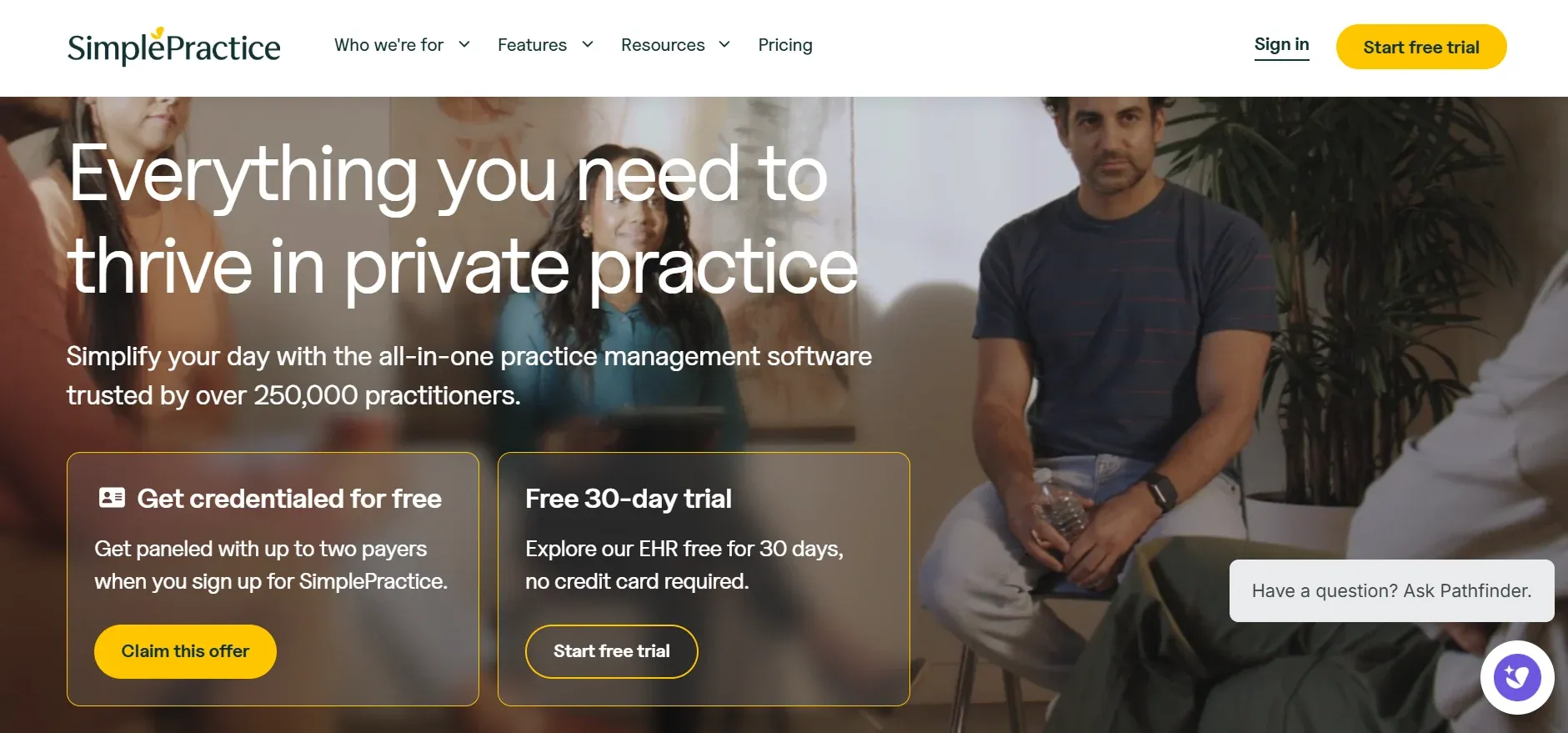
SimplePractice has become the go-to EHR for solo therapists and small mental health groups. Its user experience is one of its biggest selling points: clean dashboards, easy navigation, and minimal setup. SimplePractice supports core features like scheduling, secure client messaging, telehealth, and basic billing. For providers just starting out or running a lean operation, it’s often the fastest way to get up and running.
Pricing: Starts at $39/month per provider, with higher tiers for insurance billing and advanced features.
- Intuitive interface and fast onboarding
- Solid telehealth and client portal
- Widely used, strong support community
- Per-user pricing increases costs as you grow
- Advanced features require higher-tier plans
- Limited customization for workflows and branding
Devaims lets you own your platform, so you never pay per-user fees as you grow.
2. TherapyNotes (Best for insurance billing)

TherapyNotes is a leader in insurance-focused EHRs, with deep experience in automating claim workflows and supporting regulatory compliance. The platform is built around robust documentation templates, claim scrubbing, and insurance eligibility checks. If your clinic bills primarily through insurance, TherapyNotes often saves time and reduces rejections.
Pricing: Starts at $49/month per user, with add-ons for e-prescribing and telehealth.
- Excellent insurance billing and claim management
- Comprehensive documentation templates
- Strong compliance and audit support
- Per-user fees add up for larger teams
- Limited customization for forms and workflows
- Advanced analytics require third-party tools
With Devaims, you can have insurance workflows built to your exact needs, not just what’s on a vendor’s roadmap.
3. Luminare Health (Best for practice analytics)
Luminare Health stands out for practices wanting deep insight into operational and clinical performance. Its platform emphasizes real-time analytics, outcome measurement, and population health dashboards. This is ideal for organizations that want to manage care quality, track client progress across cohorts, or report to funders and payers with detailed metrics.
Pricing: Custom pricing based on analytics modules and user count.
- Powerful analytics and outcome measurement
- Customizable dashboards for different roles
- Supports benchmarking and grant reporting
- Opaque pricing, can escalate quickly
- Complex onboarding and data mapping
- Still vendor-controlled, not owned
4. Valant (Best for large mental health orgs)
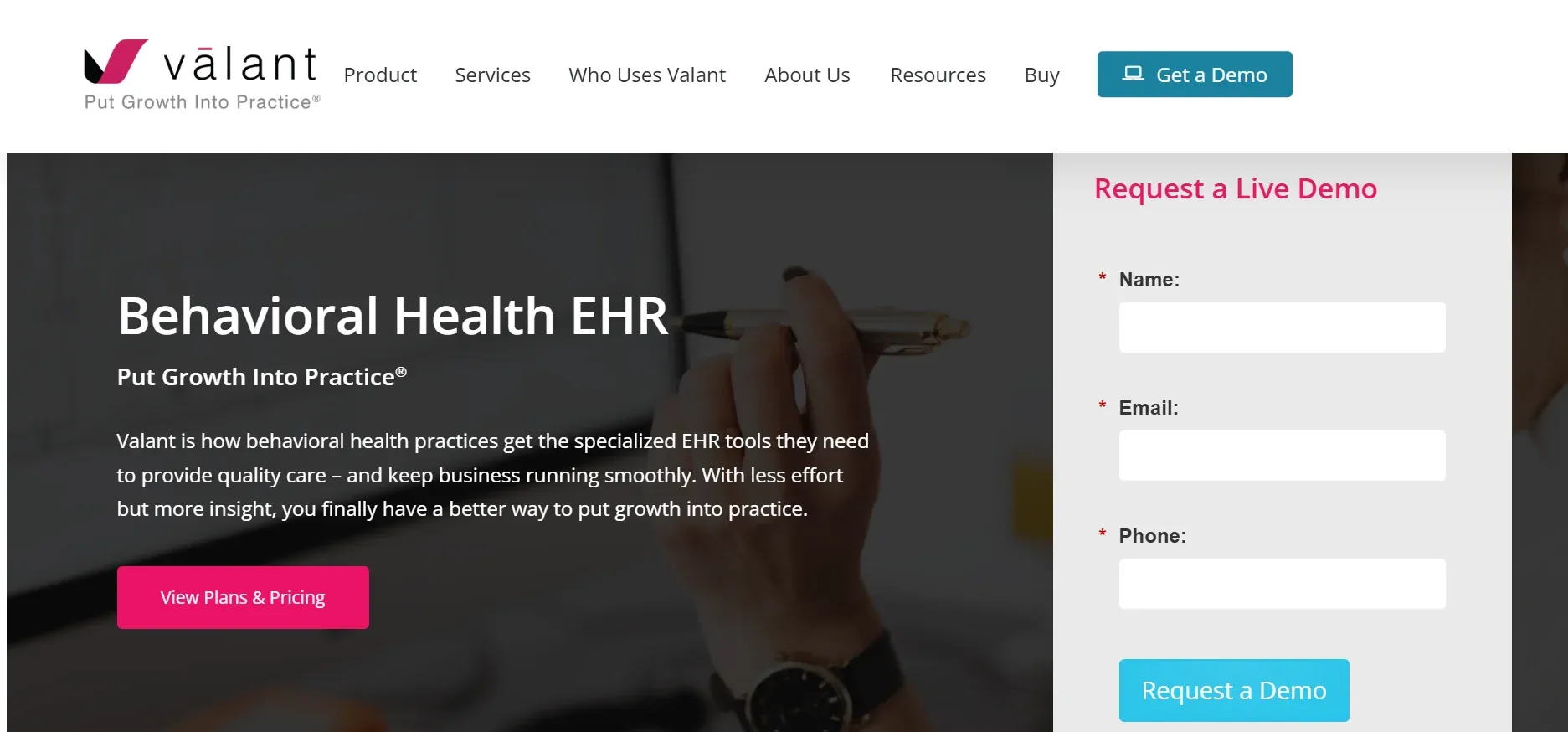
Valant is a cloud-based EHR and practice management suite designed for behavioral health organizations with complex needs. It excels at supporting multi-location, multi-specialty clinics and provides advanced scheduling, compliance, and billing tools.
Pricing: Custom pricing, typically higher for larger organizations and advanced modules.
- Advanced scheduling and compliance tools
- Supports large, multi-site organizations
- Robust billing and claims management
- Steep learning curve for new users
- Costs can escalate with advanced features
- Dependent on vendor for major changes
5. Procentive (Best for multi-location practices)
Procentive targets organizations with multiple locations or high visit volumes. Its strengths lie in centralized management, batch billing, and compliance monitoring, valuable for agencies managing distributed teams or satellite offices.
Pricing: Custom pricing based on organization size and modules.
- Centralized management for multi-site practices
- Batch billing and compliance tools
- Supports credentialing management
- Less modern interface
- Customization limited to vendor options
- Add-ons can drive up costs
6. Kareo Behavioral (Tebra) (Best for integrated billing)
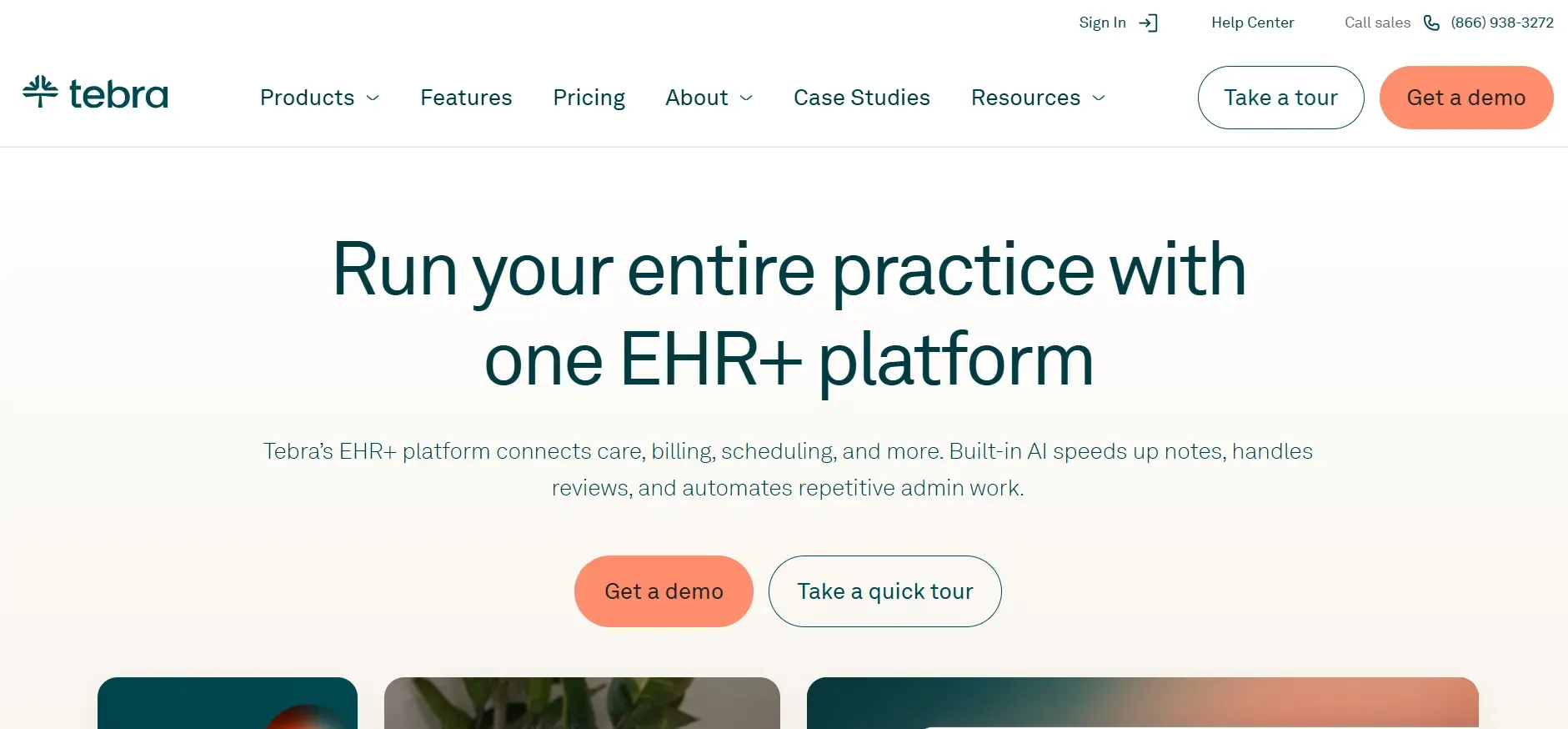
Kareo Behavioral, now under the Tebra brand, targets practices seeking integrated clinical documentation and billing. Its workflow is designed to reduce claim denials and automate much of the insurance process.
Pricing: Starts at $125/month per provider, with add-ons for e-prescribing and marketing tools.
- Deep billing and claims automation
- Integrated marketing and analytics tools
- Solid telehealth and client portal
- High per-user cost for growing practices
- Customization limited to vendor’s roadmap
- Advanced features may require extra fees
Devaims lets you avoid per-user pricing and build exactly the billing workflows you need.
7. Greenspace (Best for outcome tracking)

Greenspace is unique in its focus on digital outcome measurement and client progress tracking. It’s designed to help clinicians and practices demonstrate the impact of care, often required for value-based contracts, grants, or clinical research.
Pricing: Custom pricing based on organization size and reporting needs.
- Automated outcome measurement tools
- Real-time progress dashboards
- Supports collaborative care and research
- Not a full EHR, must be used alongside another system
- Costs rise with advanced reporting or user count
- Dependent on vendor for new measures
8. BreezyNotes (Best for the simplest interface)

BreezyNotes delivers on its name, a lightweight, easy-to-use EHR built for mental health providers who value simplicity. The interface is clean, onboarding is quick, and there’s little clutter to distract from daily tasks. It’s ideal for solo practitioners or small groups who need essential features without the learning curve of more robust systems.
Pricing: Starts at $39/month per provider.
- Very simple, clean interface
- Quick onboarding for new users
- Affordable entry price
- Few advanced features or analytics
- Limited integrations with third-party tools
- Per-provider fees apply at all tiers
9. ICANotes (Best for behavioral health note templates)
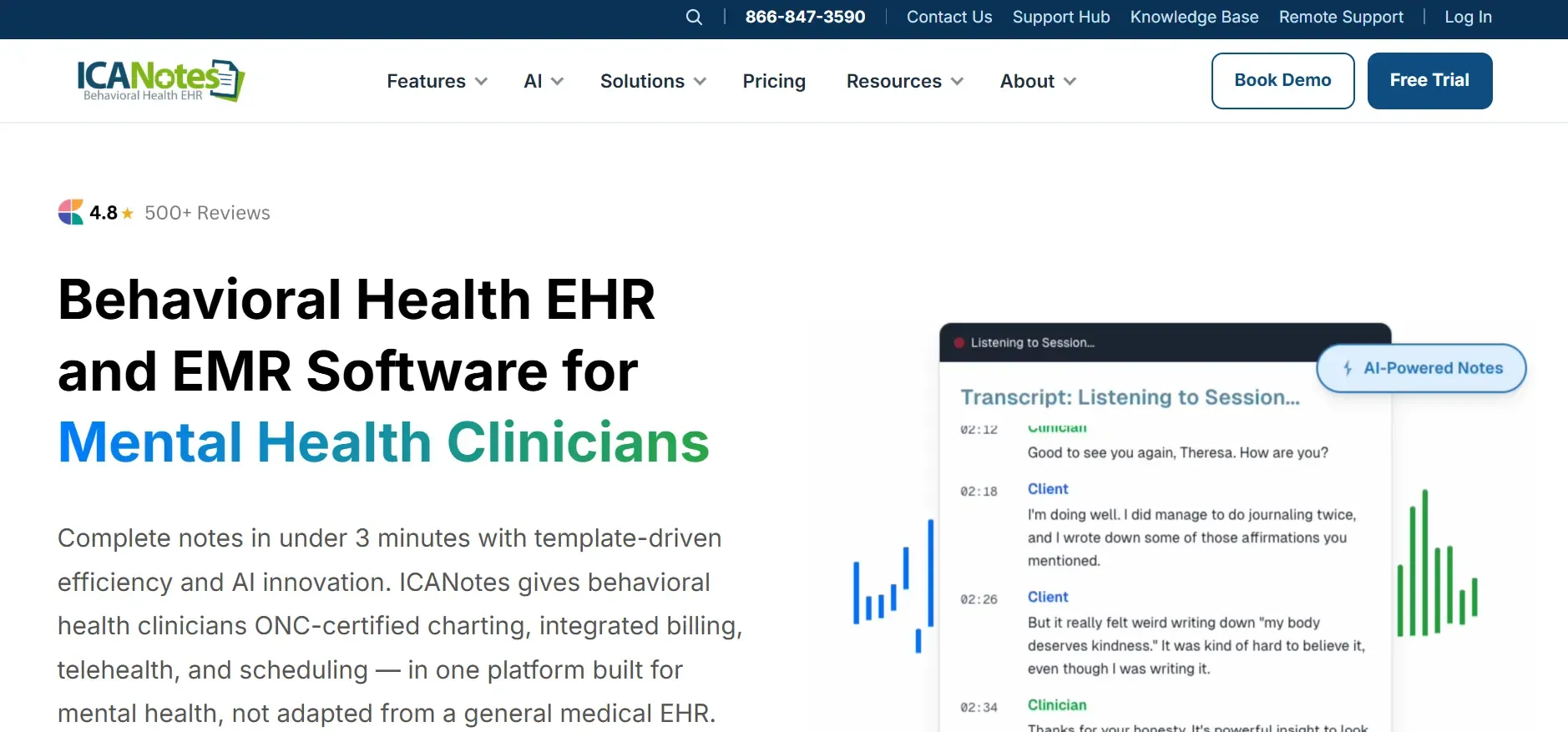
ICANotes has long been a favorite among psychiatric and behavioral health practices for its extensive library of clinical note templates. It’s built to support detailed, compliant documentation with minimal typing, ideal for psychiatrists, psychologists, and therapists who want to standardize records and reduce administrative time.
Pricing: Starts at $59/month per user, with add-ons for e-prescribing and telehealth.
- Extensive, compliant note templates
- Supports psychiatry and behavioral health
- Regular template updates for compliance
- Template-driven approach can feel rigid
- Interface is functional but dated
- Advanced analytics require external tools
10. Netsmart (Best for enterprise-grade agencies)
Netsmart is built for large agencies and public health systems that need extensive integrations and enterprise-level controls. It supports complex workflows, population health, and regulatory compliance at scale.
Pricing: Custom, typically high for enterprise deployments.
- Extensive integrations (Epic, Cerner, etc.)
- Enterprise-grade compliance and security
- Supports large, distributed organizations
- High cost and complexity
- Long implementation timelines
- Overkill for small or midsize practices
11. Devaims (Best for owning your system)
Devaims is the only option on this list that builds a truly custom EHR or practice management system and hands you the source code. You pay once for the build (with optional ongoing support), and then the system is yours. No more per-seat fees, feature gates, or vendor lock-in.
Pricing: One-time build (average $25,000), plus optional maintenance ($150/month).
- Full ownership of your system and data
- Custom workflows, reports, and integrations
- No recurring per-user or feature fees
With Devaims, you control your technology, eliminate SaaS rent, and can scale without penalty.
Other TheraNest alternatives worth knowing
- Qualifacts: Built for behavioral health agencies, supports CCBHC and value-based care models. Rich compliance, but overkill for small practices.
Some tools offer specialized features, such as grant reporting, population health, or research data management, but may not fit every clinic’s needs or budget. Always assess real-world workflow fit, not just the feature list or vendor promises. Talk to peers, read independent reviews (see Capterra or G2), and ask vendors to demo your actual workflows.
How to choose the right TheraNest alternative
- Budget: Calculate your per-provider, per-month cost over five years, not just year one. Remember to include onboarding, data migration, and the cost of add-ons or integrations. For SaaS, expect annual price increases; for custom builds, factor in support and hosting.
- Workflows: Map your intake, documentation, billing, and reporting needs to each tool’s strengths and limits. Request live demos using your actual workflows, not just generic presentations.
- Growth plans: Will your cost balloon as you add providers or sites? Per-user pricing can crush margins as you expand. If you plan to double in size, model those costs now.
- Data ownership: Can you truly own your system, or are you just exporting records? If you need to switch again, how easy is it to migrate?
- Support & integrations: What happens if you want to connect your EHR to something new next year? Are you reliant on the vendor’s roadmap, or can you build your own connections?
When your workflows or costs outgrow any SaaS, owning your own platform starts to make sense. The right choice depends on your practice’s size, complexity, and appetite for control versus convenience.
Stop paying rent on software you could own
Here’s the hard truth: every TheraNest alternative in this list (except Devaims) keeps you renting. Per-user fees, feature gates, and vendor lock-in are built into the SaaS model, not just TheraNest. If you’re tired of recalculating your budget every time you add a clinician or need a new report, it’s time to consider owning your system outright.
Devaims builds custom mental health EHRs and client management tools. You get the code, full rights, and a platform built for your exact workflows. No monthly rent, no forced migrations, no surprises.
- Per-user costs: With Devaims, every clinician you add is just a login, not another fee. This means your cost per provider drops as you grow, instead of rising.
- Features you own: If you want a new workflow or report, it’s built for you, no waiting for a roadmap or paying for “premium” tiers. Your feedback is the only roadmap.
- Lock-in gone: Your data, your system, your rules. No more scrambling if a vendor changes terms or sunsets a product. If you ever want to move, you already own the code and full database.
| Tool | Ownership | Per-user fees | Custom fit | Contract |
|---|---|---|---|---|
| TheraNest | Rent | Yes | Limited | Yes |
| SimplePractice | Rent | Yes | No | Yes |
| Kareo Behavioral | Rent | Yes | Partial | Yes |
| Devaims | Own | No | Full | No |
Compare the real five-year math:
| Year | Rented (SaaS, e.g. TheraNest) | Owned (Devaims) |
|---|---|---|
| 1 | $12,000 | $26,800 |
| 2 | $24,000 | $28,600 |
| 3 | $36,000 | $30,400 |
| 4 | $48,000 | $32,200 |
| 5 | $60,000 | $34,000 (now ahead) |
For a 10-provider clinic at $100 per seat per month (typical all-in with add-ons), you pay $12,000 per year to rent. A custom Devaims build averages $25,000 up front and $150/month in maintenance. By year 3, you’ve paid off the build; by year 5, you’re more than $25,000 ahead, and your system is yours, forever. Let us run your real numbers and show you the break-even.
How to switch from TheraNest
- Export all client data, notes, and billing records from TheraNest. Use the built-in export tools for clients, appointments, notes, and billing. If you have custom forms or attachments, export those separately. Review for completeness, some fields may export as PDFs or CSVs only.
- Choose your new platform (SaaS or custom build). Make sure your team is involved in the selection and that demo workflows match your real processes.
- Import data into the new system, mapping fields and formats. Most EHRs provide import templates. Review field mappings carefully, mismatches here cause downstream headaches. For custom builds, your vendor should handle this with you.
- Reconnect payment processing, billing, and third-party integrations. Re-link your clearinghouse, payment gateway, telehealth provider, and any analytics or HR tools. Test each connection with sample data before going live.
- Train staff on the new workflows and documentation tools. Schedule training sessions, create quick-reference guides, and assign a superuser to answer questions during the transition.
- Test your new system in parallel with TheraNest for at least one billing cycle. Run both systems side by side to catch errors, ensure billing accuracy, and confirm all workflows function as expected. Address issues before shutting down TheraNest.
- Review your contract and cancel TheraNest once confident in the new setup. Double-check that all data has been migrated and that you’ve met any contractual notice requirements.
With a custom Devaims build, the migration is handled as part of the project. This includes data mapping, validation, and staff training, so your transition is as smooth as possible.
Frequently asked questions
What is the best TheraNest alternative for mental health?
SimplePractice and TherapyNotes are strong choices for most clinics needing a SaaS solution, both are widely used, offer good customer support, and have proven insurance and documentation workflows. However, if you want to own your platform outright, including code, integrations, and unlimited customization, Devaims is the only option that lets you stop renting. For clinics with unique workflows, complex compliance, or plans to scale, ownership pays off quickly.
Which TheraNest alternative is the cheapest?
BreezyNotes and SimplePractice offer low entry prices (around $39/month per provider), but costs rise as you add users, sites, or advanced features. Over five years, owning with Devaims can be the lowest total cost for growing practices, especially if you have more than 6-8 providers or need custom workflows. Always run a five-year total cost calculation, including migration and support.
Is there a free TheraNest alternative?
There are no truly free tools that match TheraNest’s full feature set. Some clinics cobble together Google Workspace, spreadsheets, or free project management tools, but this approach lacks HIPAA compliance, audit trails, and the ability to scale. Free trials are available for most SaaS EHRs, but for lasting practice management, plan on paying or building. Open-source EHRs exist (like OpenEMR), but require significant IT investment and are rarely tailored for behavioral health.
Which TheraNest alternative has the best telehealth?
SimplePractice and Kareo Behavioral both have strong built-in telehealth modules that support HIPAA-compliant video, screen sharing, and client document sharing. Valant and TherapyNotes also offer integrated telehealth, but may require add-ons for advanced features. If telehealth is your primary workflow, check for session limits, group support, and whether there are extra fees per session. With Devaims, you can have telehealth built directly into your owned system, designed for your workflows, group sessions, or hybrid care models.
Can I keep my client data if I leave TheraNest?
You can export your data from TheraNest (clients, appointments, notes, billing), but you won’t own the system itself, just the exported records, usually as CSVs or PDFs. Some data (like custom forms or attachments) may not export cleanly. With Devaims, both your data and your software are yours to keep, forever, in whatever format you choose.
When should a practice switch from TheraNest?
If your costs are rising with every provider, you’re blocked by missing features, or staff are frustrated with workarounds, it’s time to explore TheraNest alternatives. The break-even on owning your own system is often just three years for clinics with 6 or more providers. If you’re planning to grow, need custom workflows, or want to future-proof your tech, switching sooner can save money and headaches.
Can I get custom reports or workflows with TheraNest alternatives?
Most SaaS platforms offer some customization, like custom forms, limited template edits, or basic report builders, but real workflow changes are limited or cost extra. True custom workflows, automated reporting, or deep integration with other systems usually require a custom build. On a Devaims build, every workflow and report is designed for your team’s real needs, with no recurring upcharges.
The bottom line
If you’re tired of renting your practice management software, there’s finally an escape hatch. SimplePractice, TherapyNotes, and Kareo Behavioral make sense for clinics that want fast setup and can live with SaaS guardrails, but for practices ready to grow on their own terms, owning makes more sense every year you use it.
Here’s the test: add up what your system will cost you over the next five years. If that number would have built you something you own, you already have your answer. The future belongs to clinics that control their own tech.
For more ownership-first thinking, visit the Devaims blog, or check out our guides to SimplePractice alternatives, TherapyNotes alternatives, and Kareo alternatives.