

Every year, optometry practices using Nextech face the same frustrations: another price increase, features stuck behind a paywall, slow support, and the realization that no matter how long you pay, you never truly own your software or data. If you’re reading this, you’re likely weighing your options and wondering if switching will actually give you more control, or just swap one subscription for another.
We’ll dig deep into the 9 best Nextech alternatives for optometry in 2026, exploring not just features and pricing, but also the hidden trade-offs, real-world migration challenges, and what it actually means to “own” your platform. We’ll also show you the math on subscription costs versus building your own with Devaims, so you can make a fully informed decision for your practice’s future.
Why optometry practices look for Nextech alternatives
Most optometry clinics start searching for Nextech alternatives for these key reasons:
- Recurring subscription costs add up fast. Nextech and its competitors typically charge $400 to $800 per provider per month, plus location fees and sometimes even additional per-feature or per-user charges. Over a few years, your EMR bill can rival your rent or payroll.
- Locked-in contracts restrict your options. Multi-year agreements with auto-renew clauses and steep early exit fees are common. If your needs change or you’re unhappy, switching can be costly or delayed.
- Data portability is rarely simple. Exporting your full patient database, imaging, and custom fields often involves lengthy processes or extra fees. Sometimes, only partial data is exportable, and you may lose customizations or history.
- Features are tiered and gated. Want advanced reporting, patient engagement, or e-prescribing? Be prepared for upsells, premium modules, and new charges for the features you need most.
- Integration headaches are common. Connecting to labs, optical inventory, insurance clearinghouses, or third-party billing systems often requires additional modules or custom development (and more recurring fees).
- Support and responsiveness can lag. Many clinics report slow ticket turnaround, limited support hours, or high-level support being reserved for top-tier customers.
If these pain points sound familiar, you’re not alone. The move toward ownership and control is a growing trend among established optometry clinics, especially as SaaS pricing and complexity continue to rise.
Quick comparison of the best Nextech alternatives
| Tool | Best for | Starting price | You own it? |
|---|---|---|---|
| Eyefinity | VSP members, integrated insurance | Reported $500+/mo | No |
| RevolutionEHR | Cloud-first, multi-location | Reported $399+/mo/provider | No |
| Crystal PM | Custom workflows, budget-minded | Reported $349+/mo | No |
| Compulink | Large practices, speed | Reported $399+/mo | No |
| MaximEyes | Cloud or server-based, EHR/PM | Reported $350+/mo | No |
| OfficeMate (Eyefinity) | Legacy users, in-house servers | Reported $400+/mo | No |
| Modernizing Medicine (Eyes) | Large-scale, subspecialties | Reported $600+/mo | No |
| MDVista | Ophthalmology, advanced imaging | Reported $400+/mo | No |
| Devaims | Owning your own platform | One-time build + flat maintenance | One-time build, you own it |
Always confirm current pricing and contract terms before you decide. Fees and terms can change quickly, and the fine print often matters more than the headline number.
The 9 best Nextech alternatives
1. Eyefinity (Best for VSP integration)
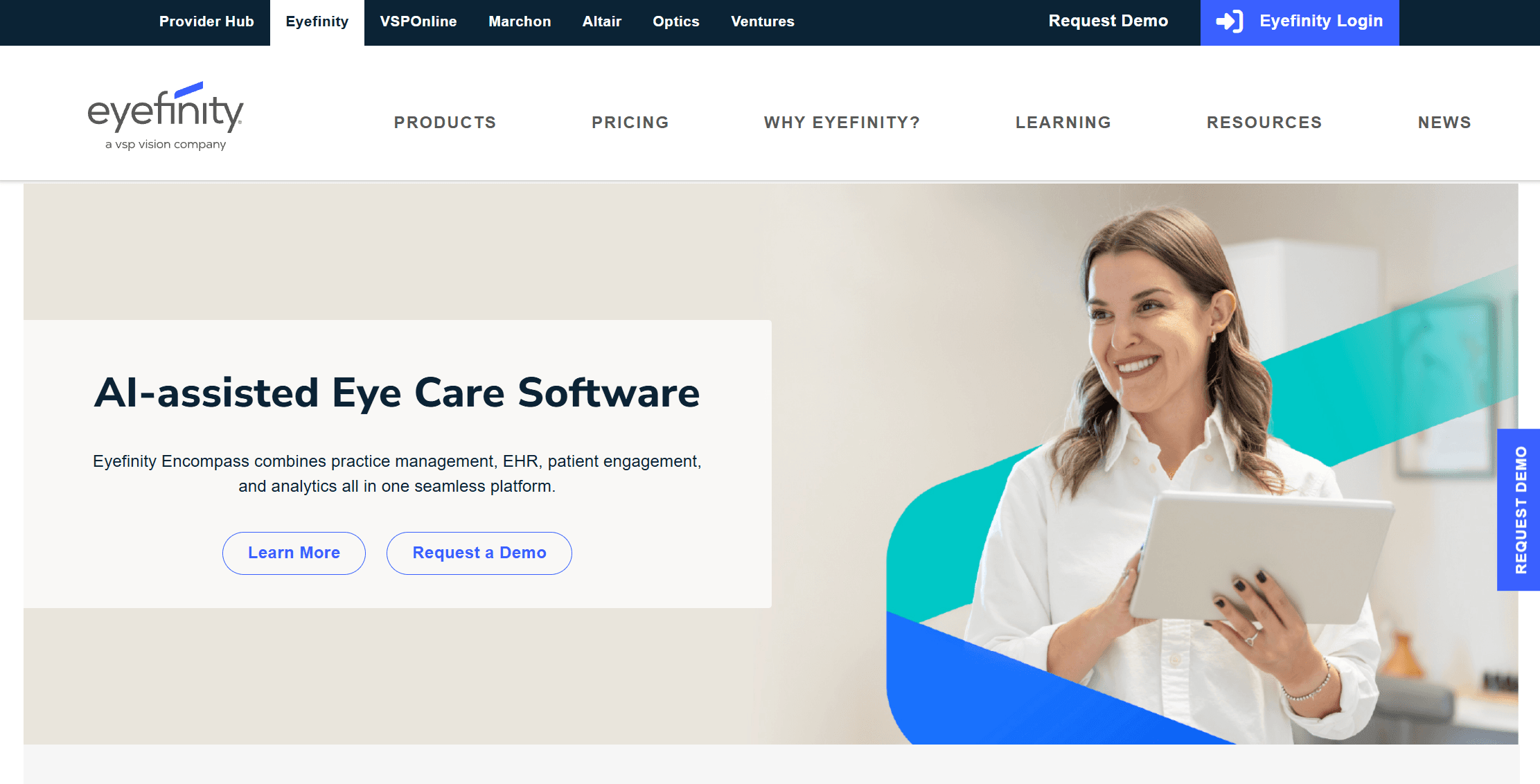
Eyefinity is a market leader for practices with a heavy VSP panel and a need for streamlined insurance billing. The platform combines EHR, practice management, appointment scheduling, optical inventory, and insurance claim management in one cloud-based suite. Its tight integration with VSP makes it especially attractive for clinics where a large percentage of patients use VSP benefits.
Pricing: Reported $500+/month per provider, with additional fees for locations and premium modules.
- Best-in-class VSP integration and insurance workflows
- Comprehensive optical inventory and point-of-sale tools
- Cloud access and patient portal features
- Recurring subscription costs increase with providers and locations
- Custom integrations and advanced features often require paid add-ons
- Full data export and migration can be complex and time-consuming
When you own your platform, adding a new insurance integration is a one-time project, not a recurring fee.
2. RevolutionEHR (Best for cloud-first practices)
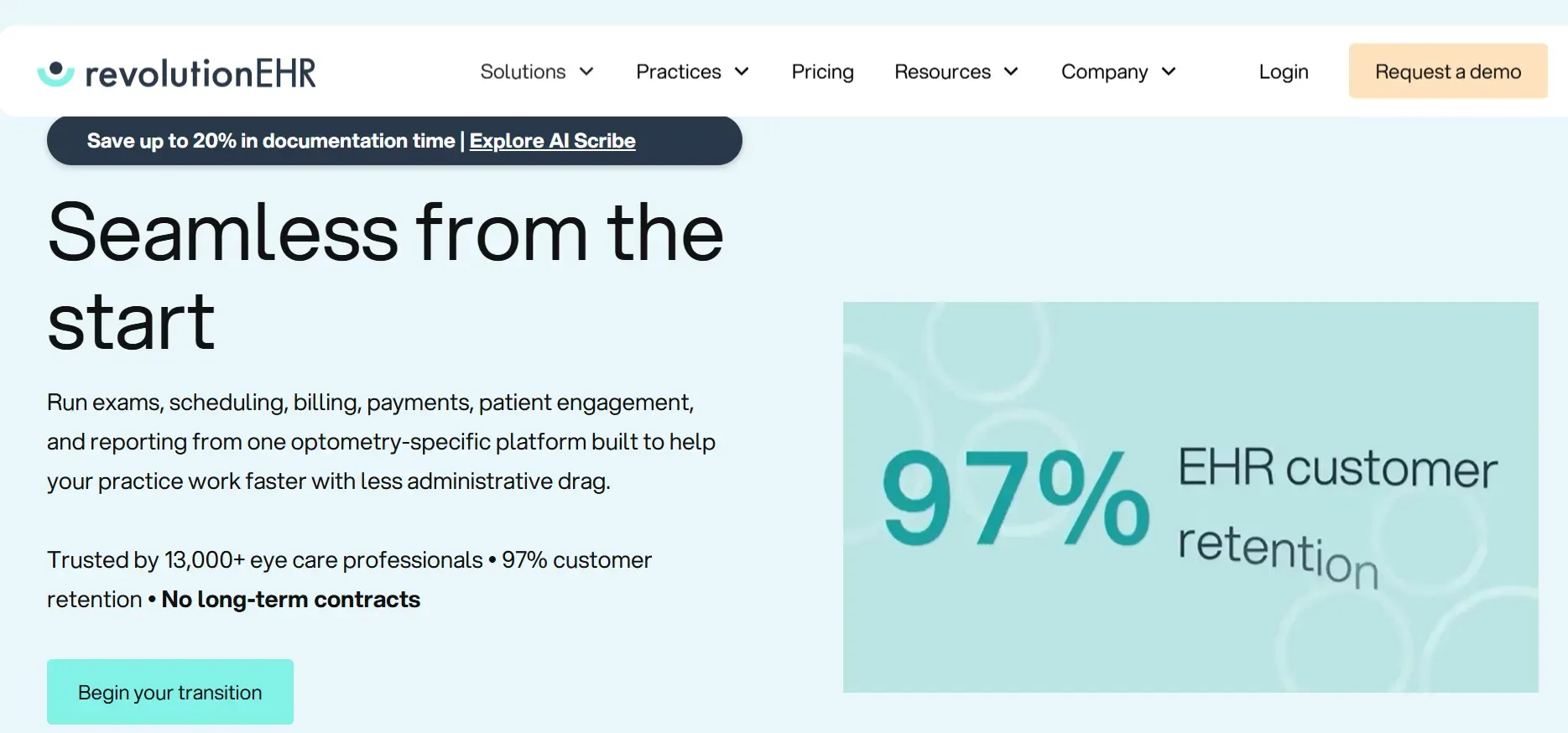
RevolutionEHR is a cloud-native EMR and practice management system designed for optometry practices of all sizes. Its modern UI, solid telehealth features, and strong e-prescribing make it a favorite for multi-location groups and practices embracing remote care.
Pricing: Reported $399+/month per provider, plus fees for advanced modules and integrations.
- Cloud-first access and modern interface
- Integrated telehealth and patient engagement tools
- Scalable for multi-location practices
- Per-provider pricing can add up for growing teams
- Advanced analytics and reporting require premium tiers
- Custom integrations may be limited or require extra fees
With a custom platform, advanced analytics are built-in and can be changed on your terms.
3. Crystal PM (Best for custom workflows)
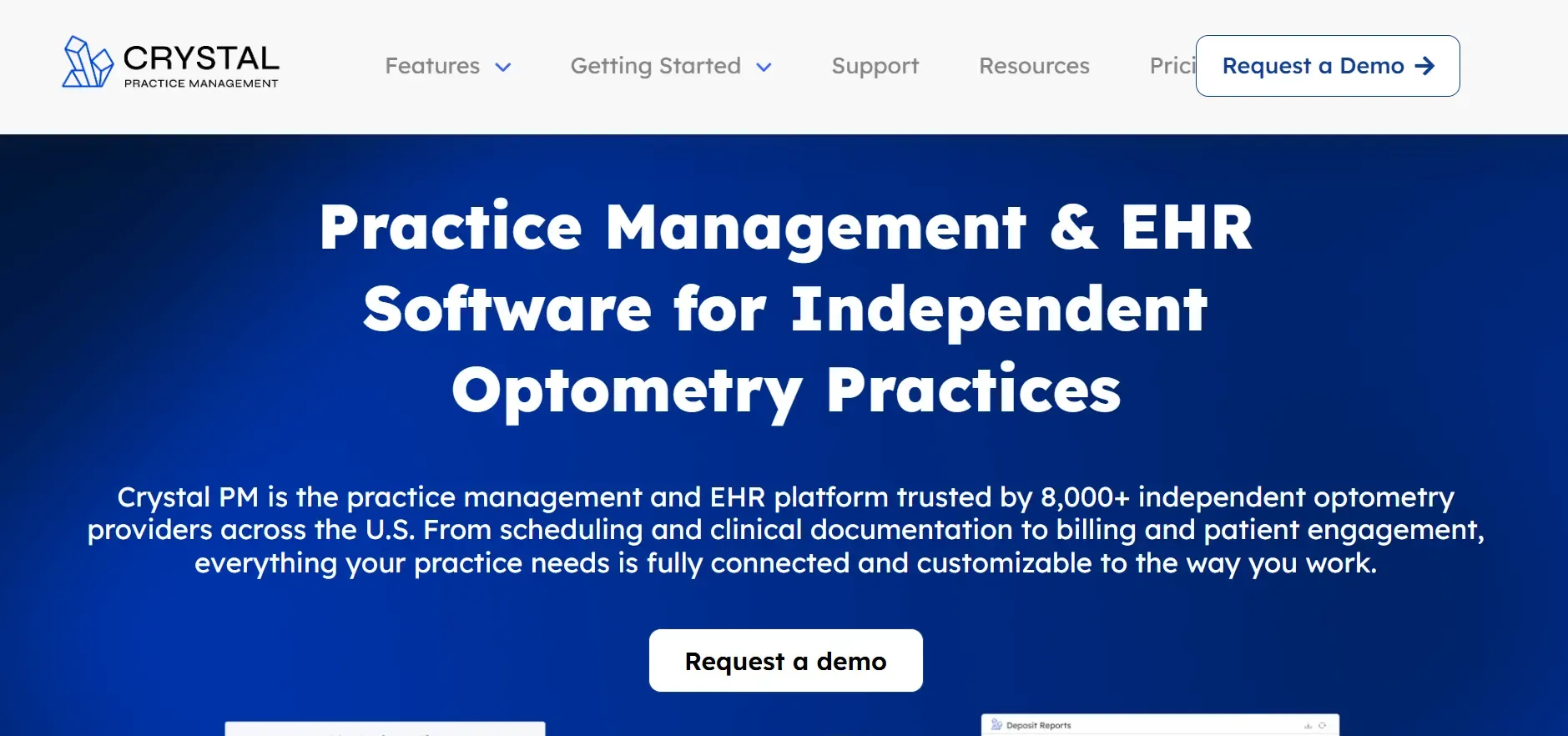
Crystal PM stands out for practices that want to design their own forms, templates, and workflows without learning to code. The system is known for its flexibility and affordability, making it popular with budget-conscious clinics and those with unique documentation needs.
Pricing: Reported $349+/month, with additional charges for integrations and advanced features.
- Highly customizable templates and forms
- Affordable entry point for small practices
- Patient portal and secure messaging included
- Interface can feel dated and may slow onboarding
- Advanced integrations may require vendor involvement
- Subscription model means ongoing costs
When you own your platform, every workflow and template is yours to change or automate, without waiting on a vendor.
4. Compulink (Best for high-volume clinics)

Compulink targets high-volume optometry and ophthalmology clinics, offering a feature-rich platform designed for speed and scale. The system is highly configurable, but its complexity can be a double-edged sword.
Pricing: Reported $399+/month per provider, with additional fees for specialty modules and training.
- Rapid charting and scheduling for busy clinics
- Comprehensive analytics and specialty modules
- Open API for integrations
- Steep learning curve for new users
- Feature bloat may overwhelm smaller teams
- Customizations beyond standard offerings can be costly
On your own system, you choose which features matter and never pay for modules you don’t use.
5. MaximEyes (Best for hybrid setups)
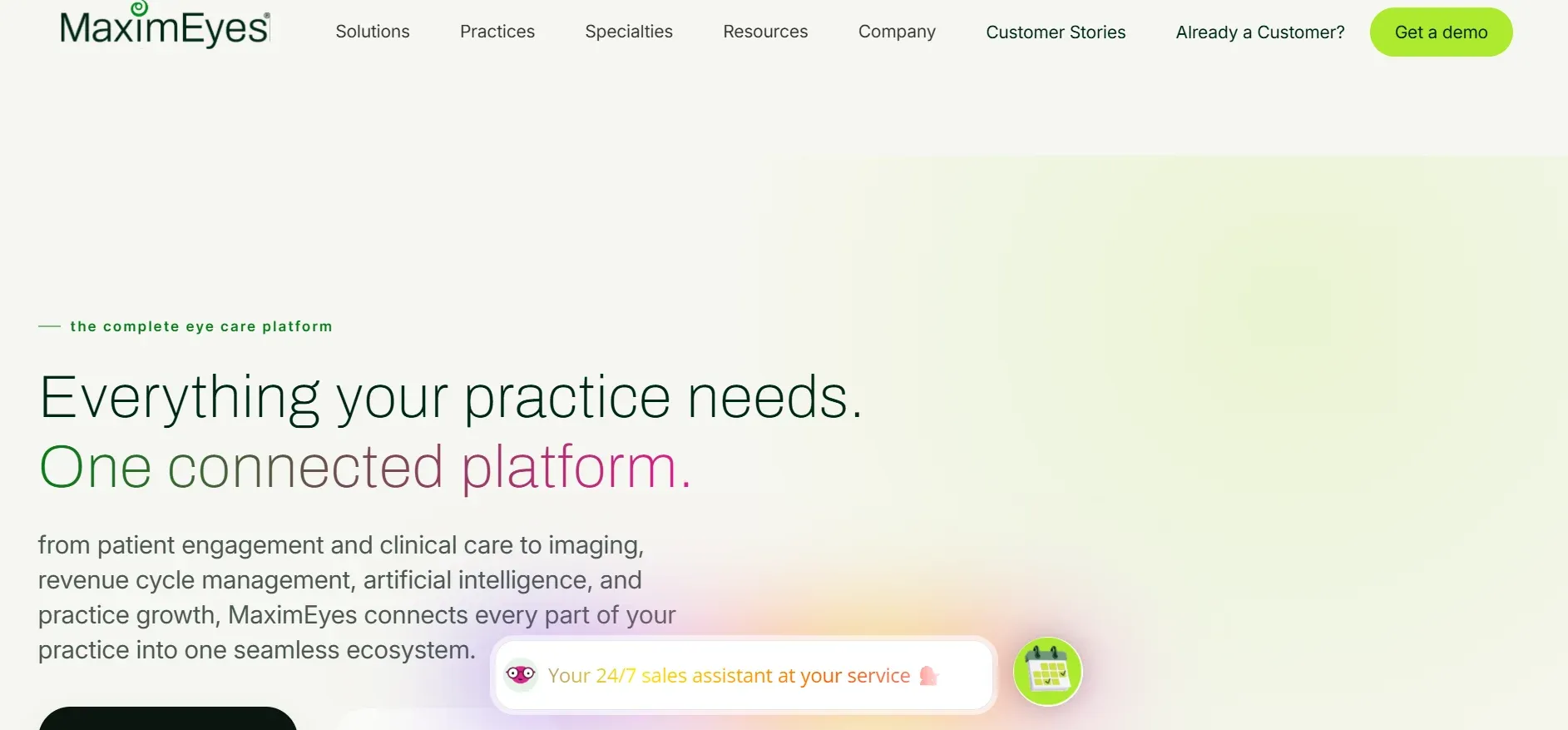
MaximEyes offers both cloud and on-premise deployment, making it unique among optometry EMRs. It’s a common pick for clinics transitioning from legacy systems to modern workflows or those with concerns about cloud-only solutions.
Pricing: Reported $350+/month per provider, with additional support and integration fees.
- Flexible deployment: cloud or local server
- Comprehensive EHR and PM suite
- Integrated imaging and document management
- Hybrid model can increase IT complexity
- Cloud features may lag behind competitors
- Subscription fees continue regardless of deployment
6. OfficeMate (Eyefinity) (Best for legacy users)
OfficeMate is one of the longest-standing optometry EMRs in North America. Many established practices still run OfficeMate on in-house servers, valuing its stability and familiar workflows. However, the platform is less cloud-forward, and Eyefinity is actively encouraging migration to its cloud-based solution.
Pricing: Reported $400+/month per provider, with additional IT and support costs.
- Stable, familiar workflows for legacy users
- Customizable reporting and inventory management
- Migration path to Eyefinity cloud
- Innovation is slower than with cloud-native competitors
- Integrations and support for new devices may lag
- On-premise maintenance requires IT resources
7. Modernizing Medicine (Eyes) (Best for subspecialties)
Modernizing Medicine (Eyes) is a specialty-focused EMR with deep support for both optometry and ophthalmology. It is built with advanced imaging, analytics, and mobile charting in mind. The platform is especially popular with large practices and those offering subspecialties such as retina, cornea, or oculoplastics.
Pricing: Reported $600+/month per provider, with premium modules for advanced analytics.
- Specialty-specific templates and analytics
- Integrated imaging and diagnostic device support
- Mobile charting via iPad app
- High starting and ongoing costs
- Complexity can slow down smaller teams
- Some modules only available as premium add-ons
8. MDVista (Best for ophthalmology practices)
MDVista is tailored for ophthalmology and advanced optometry clinics, especially those with surgical or imaging-heavy workflows. It is positioned as a high-end, niche solution for practices that need sophisticated tracking of surgical outcomes, imaging, and referrals.
Pricing: Reported $400+/month per provider, with additional fees for advanced modules.
- Advanced imaging and surgical workflow management
- Referral management and outcome analytics
- Customizable reporting tools
- Learning curve and higher ongoing costs
- Niche focus means fewer third-party integrations
- May be overkill for basic optometry practices
9. Devaims (Best for practices that want to own their software)
Devaims is not another SaaS EMR, it is a software partner that builds you a custom optometry platform you own outright. Instead of paying monthly rent, you invest in a one-time build tailored to your exact workflows, integrations, and reporting needs, with flat maintenance for updates and support. The code, the data, and the roadmap are entirely yours.
Pricing: One-time build (custom quote) plus flat annual maintenance.
- Custom EHR and practice management modules built to your specs
- Full data ownership and exportability
- Integrations with any third-party system you use
With Devaims, you never pay for features you don’t use, and your platform grows as your practice does.
Other Nextech alternatives worth knowing
- Practice Fusion: A general-purpose, cloud-based EMR with a low cost of entry. Not optometry-specific, so it lacks optical inventory, VSP integration, and eye care templates, but can work for basic charting in micro-practices.
- CureMD: A flexible EMR with custom templates. Some optometry practices use it, but eye care support is limited compared to dedicated platforms. Consider only for clinics with very simple needs.
- Practice Mate: Free scheduling and practice management with basic charting. Best for part-time or one-provider clinics with minimal documentation requirements. Not suitable for insurance-heavy or multi-location practices.
- Kareo: Strong billing and PM features, but optometry-specific EHR features are lacking. Useful as a billing add-on for clinics using a separate charting system.
Before switching to a generic EMR, check whether it supports the depth of optometry features, especially optical inventory, imaging, and vision plan integration, you need.
How to choose the right Nextech alternative
- By budget: If low monthly cost is your priority, Crystal PM and Practice Mate are the most affordable, but feature sets are limited. For clinics wanting to stop paying rent, a Devaims custom build puts you in control of long-term cost after year two or three.
- By workflow: Need bulletproof VSP and insurance integration? Eyefinity is the leader. Want to design custom templates and forms without coding? Crystal PM or Devaims. Need advanced telehealth, multi-location, and imaging? RevolutionEHR, Compulink, or Modernizing Medicine are strong choices.
- By practice size: High-volume, multi-specialty clinics benefit from Compulink, Modernizing Medicine, or Devaims. Small or solo practices may lean toward Crystal PM or Practice Mate for simplicity and cost. Clinics with legacy systems or on-premise requirements may prefer OfficeMate or MaximEyes.
- By long-term control: If owning your data, controlling upgrades, and avoiding future price hikes matter, Devaims is the only alternative that puts you in control of your roadmap, cost, and integrations.
Once you know your priorities, the rent-or-own question becomes much clearer.
Stop renting your software: Own your optometry platform
Every SaaS alternative to Nextech, no matter how modern or well-reviewed, still rents you access to your own workflows, data, and reports. Subscription costs rise, features get gated, and your ability to innovate is always subject to a contract. The only way to break the cycle is to own your software outright.
Who is Devaims? We’re a team of custom software builders who turn your optometry workflows into a platform you own. Every feature, report, and integration is designed for your team, not as a generic template, but as a lasting asset. You control the data, the roadmap, and the cost, with no lock-in or recurring surprises.
How does owning your platform change your daily reality?
- No more surprise price hikes: Your cost is flat and predictable. Maintenance and support are transparent, and you decide when and how to invest in upgrades or new features.
- Build exactly what you need: Your workflows, reports, and dashboards match your practice’s daily reality. No more workarounds, waiting on vendor updates, or being told “that’s not possible.”
- Own your data and stack: You can export, back up, and extend your system however you like. No more support tickets for a simple data export, and no risk of your data being held hostage.
- Flat, transparent maintenance: Upgrades, new integrations, and support are on your schedule, not dictated by a vendor’s roadmap or pricing strategy.
| Platform | Ownership | Annual cost (est.) | Contract? |
|---|---|---|---|
| Nextech | Vendor-owned | $10,800+ | Yes, 1 to 3 years |
| Eyefinity | Vendor-owned | $12,000+ | Yes, 1 to 3 years |
| RevolutionEHR | Vendor-owned | $9,600+ | Yes |
| Devaims | You own it | One-time build, flat maint. | No |
| Year | Rented (annual, cumulative) | Owned (annual, cumulative) |
|---|---|---|
| 1 | $12,000 | $27,600 (build + maint.) |
| 2 | $24,000 | $30,360 |
| 3 | $36,000 | $33,120 |
| 4 | $48,000 | $35,880 (now ahead) |
| 5 | $60,000 | $38,640 |
For most clinics, the break-even for owning your platform is between years 3 and 4. After that, every year you keep renting, you’re paying for software you’ll never own. For a three-provider clinic at $400/month each, that’s $1,200/month, $14,400/year, or $72,000 over five years, without any equity or control. With Devaims, you pay once, own the asset, and can expand it as your practice grows.
How to switch from Nextech
- Request a complete data export from Nextech, including patient records, schedules, imaging, and custom fields, in a standard format (such as CSV, XML, or HL7). Be prepared to follow up for imaging and custom data.
- Choose your new platform, whether it’s another SaaS solution or a custom Devaims build. Make sure it supports all your required integrations and workflows.
- Import your data into the new system, carefully mapping each field and testing for accuracy. This step is critical to preserve clinical history and workflow continuity.
- Reconnect all integrations, billing, e-prescribing, labs, optical inventory, and any specialty devices. With Devaims, these integrations are built as part of the project.
- Train your staff on new workflows, documentation, and features. Custom builds can be tailored to your team, reducing the learning curve.
- Test in parallel for at least two weeks, running both systems side by side to catch any migration gaps or workflow issues before you fully cut over.
- Review and terminate your Nextech contract, ensuring all data is transferred and there are no hidden penalties or post-termination data retention issues.
With a Devaims build, migration and staff training are handled as part of your project, with dedicated support every step of the way.
Frequently asked questions
What is the best Nextech alternative for optometry clinics?
For most clinics, Eyefinity and RevolutionEHR are the most widely adopted SaaS alternatives, with strong insurance integration, compliance, and EHR features. However, they remain vendor-owned and subscription-based. If you want to control your cost, data, and upgrades, and truly own your solution, Devaims is the only alternative that gives you full ownership and flexibility.
Which Nextech alternative is the cheapest?
Practice Mate and Crystal PM have the lowest monthly starting prices, but their features are basic compared to full-featured EMRs. Over five years, even these "cheap" subscriptions add up. Devaims’ one-time build model is often the lowest total cost of ownership for established clinics ready to invest in their own asset.
Are there any free Nextech alternatives?
Practice Mate offers free scheduling and basic charting, but lacks in-depth optometry features, insurance integration, and customization. No full-featured optometry EMR is truly free, expect to pay either in monthly fees, limited features, or both. Always verify what is included in "free" packages and what is locked behind paid upgrades.
When does it make sense to switch from Nextech?
It’s time to switch when you face rising costs, need deeper customization, or want to own your data and workflows. Calculate your five-year total cost of ownership, including hidden fees, integration costs, and migration friction, and compare it to the cost of building your own platform with Devaims. If you’re planning to grow, add locations, or want to innovate, owning your platform provides long-term stability and flexibility.
Can I keep my patient data if I leave Nextech?
Nextech allows data export, but the process can be complex and may require multiple support tickets. Some exports may not include custom fields, historical imaging, or non-standard data. Always request a full data dump, and clarify the format, before your contract ends. With Devaims, you own your data outright and can export, migrate, or extend your platform at any time.
What if my clinic needs features none of these alternatives offer?
If your practice has unique workflows, custom reporting needs, or requires niche integrations, a Devaims custom build ensures you get every feature you want. The source code is yours, so you can expand, integrate, or change as your clinic evolves, without waiting on a vendor roadmap.
Do Nextech alternatives support telehealth and imaging?
Most major alternatives now offer telehealth and imaging integrations, but the depth, quality, and cost can vary widely. Some features are included in base subscriptions, others are locked behind premium tiers or require additional modules. Always confirm that your chosen platform supports your specific devices, imaging formats, and telehealth workflows before signing a contract.
The bottom line
Every Nextech alternative rents you software, not control. The real test is this: add up what you’ll pay in monthly fees over five years. If that number could have built you a custom platform you own, you already know the right move.
Owning your optometry platform means no more surprises, no more lock-in, and a system that works the way you do. You decide when to upgrade, what to automate, and how much you’ll pay, forever.
Want more real-world alternatives and optometry insights? See the Devaims blog or check out these posts: Eyefinity alternatives, RevolutionEHR alternatives, and Compulink alternatives. For broader EMR comparisons, see resources from Software Advice and HealthIT.gov.