

You probably did the math on Kareo’s monthly fees and felt that pinch. The base rate looked fair, until you added seats, e-prescribing, clearinghouse, or a second location. Suddenly, you’re on the hook for thousands a year and every tool in the stack feels like another meter running.
Optometry practices need tech that works and lets them run their business, not the other way around. If you’re looking for Kareo alternatives because you’re tired of recurring costs, feature lock-in, or feeling like a renter in your own practice, you are not alone. Here’s the honest look at the top 9 Kareo alternatives for optometry in 2026, including the only option that hands you the keys and the source code: a Devaims custom build.
Let’s get you out of rent-forever mode and into something you actually own.
Why optometry practices look for Kareo alternatives
Recurring subscription creep: Kareo’s monthly fee stacks up with each user, add-on, and location, turning what looked affordable into a major recurring cost. Over five years, even a modest practice can end up spending tens of thousands of dollars, money that could have been invested in staff, equipment, or growth. As your team grows or you open a new location, the cost multiplies, and it is rarely easy to predict the true five-year spend up front.
Data lock-in and exports: Getting your patient data out is a hassle, with limited export formats and extra fees for full access. For practices that have invested years in building their records, this can feel like ransom, especially if you want to switch to a competitor or need a complete data dump for legal compliance. Often, only partial exports (such as CSV for patient lists but not clinical notes or attachments) are available without extra cost, and converting to a new system can be time-consuming and risky.
Contract rigidity: Most plans require you to sign annual contracts with stiff penalties for leaving early or downgrading. If your needs change mid-year, or a global event impacts patient volume, you might still be locked into paying for unused seats. Cancellation fees, auto-renewal clauses, and complex notice requirements are common complaints from Kareo users and those on similar platforms.
Feature gating: Core features like reporting, e-prescribing, or integrations are often locked behind higher tiers or extra modules. What starts as a "complete" solution quickly reveals hidden costs: advanced analytics, automated reminders, or even basic patient communication might require a premium plan or additional subscription. This can lead to a patchwork workflow or an ever-growing monthly bill.
Support bottlenecks: When something breaks, you wait in the same ticket queue as every other practice, unless you pay for premium support. Standard support often means long wait times, limited troubleshooting, and little say in when or how issues are resolved. For busy clinics, downtime can mean lost revenue and frustrated staff.
If these pain points sound familiar, you’re in the right place to compare Kareo alternatives.
Quick comparison of the best Kareo alternatives
| Tool | Best for | Starting price | You own it? |
|---|---|---|---|
| Eyefinity | VSP-connected EHR | Reported $399/mo | No |
| RevolutionEHR | All-in-one, cloud | Reported $385/mo | No |
| Crystal PM | Customizable EHR | Reported $250/mo | No |
| Compulink | Enterprise optometry | Reported $399/mo | No |
| MaximEyes | Cloud or on-prem | Reported $325/mo | No |
| OfficeMate | Legacy practices | Reported $350/mo | No |
| Modernizing Medicine (Eyes) | Specialty eye care | Reported $729/mo | No |
| MDVista | Multi-specialty | Custom quote | No |
| Devaims | Owning your EHR | One-time build, you own it | Yes |
Always confirm current pricing before you decide. Rates change and add-ons add up. Price is just the surface; the real issue is ownership, flexibility, and whether the system will grow with you, not against you.
The 9 best Kareo alternatives
1. Eyefinity (Best for VSP-connected EHR)
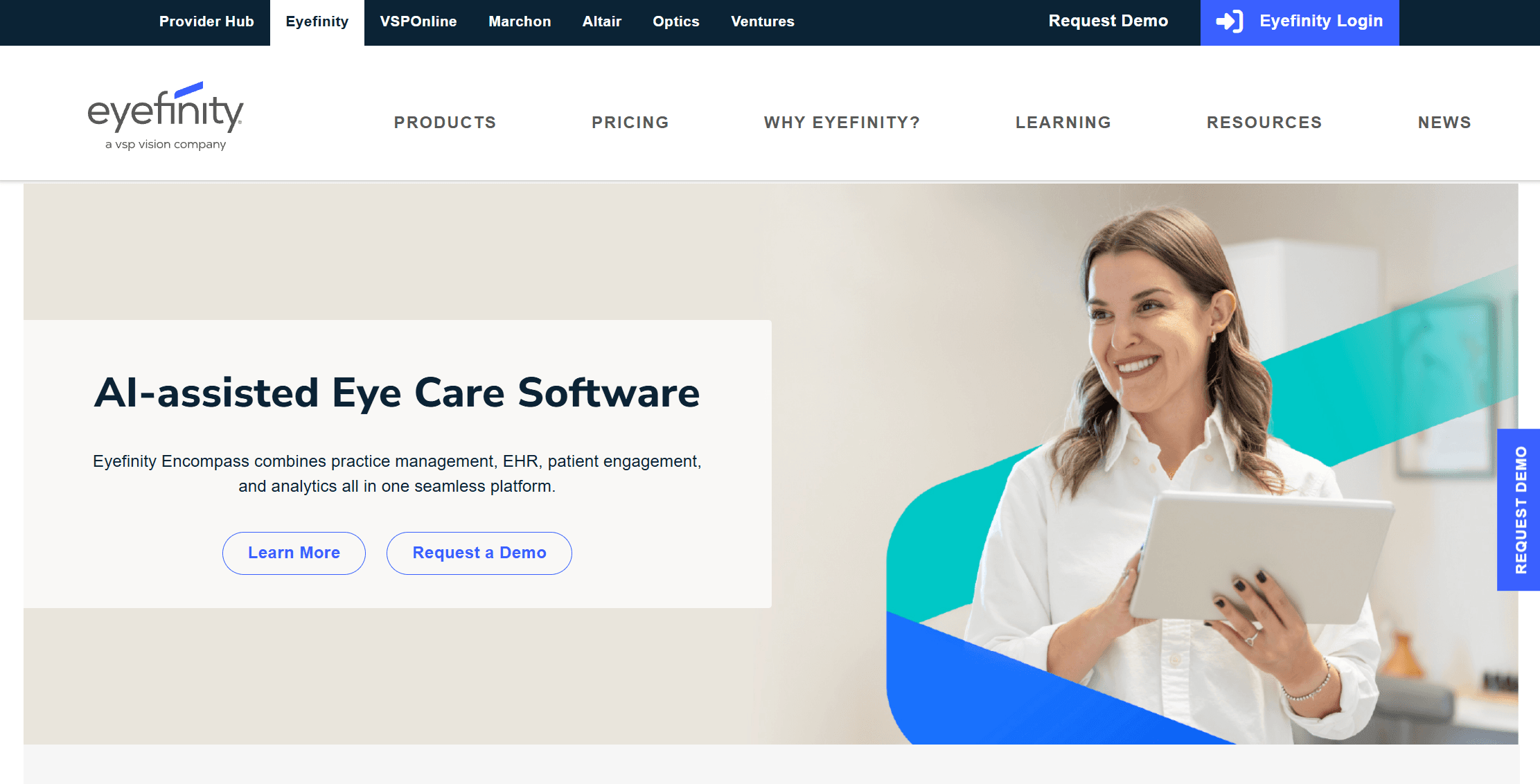
Eyefinity is the flagship optometry EHR and practice management solution from VSP Global. Designed to serve practices participating in the VSP network, Eyefinity offers a smooth integration with VSP claims, eligibility verification, and patient benefits. The platform provides a complete suite of features: online scheduling, digital patient intake, billing and claims management, e-prescribing, inventory management, and a modern patient portal.
Pricing: Reported $399/month per provider, plus add-ons.
- Deep VSP integration for insurance and benefits
- Unified EHR, billing, and scheduling
- Strong device and diagnostic integrations
- Per-provider pricing can escalate as you grow
- Limited customization outside the VSP ecosystem
- Data exports are available but not fully open
If you want to avoid VSP lock-in and own your data, Devaims gives you full control and exportability.
2. RevolutionEHR (Best for all-in-one, cloud-first)
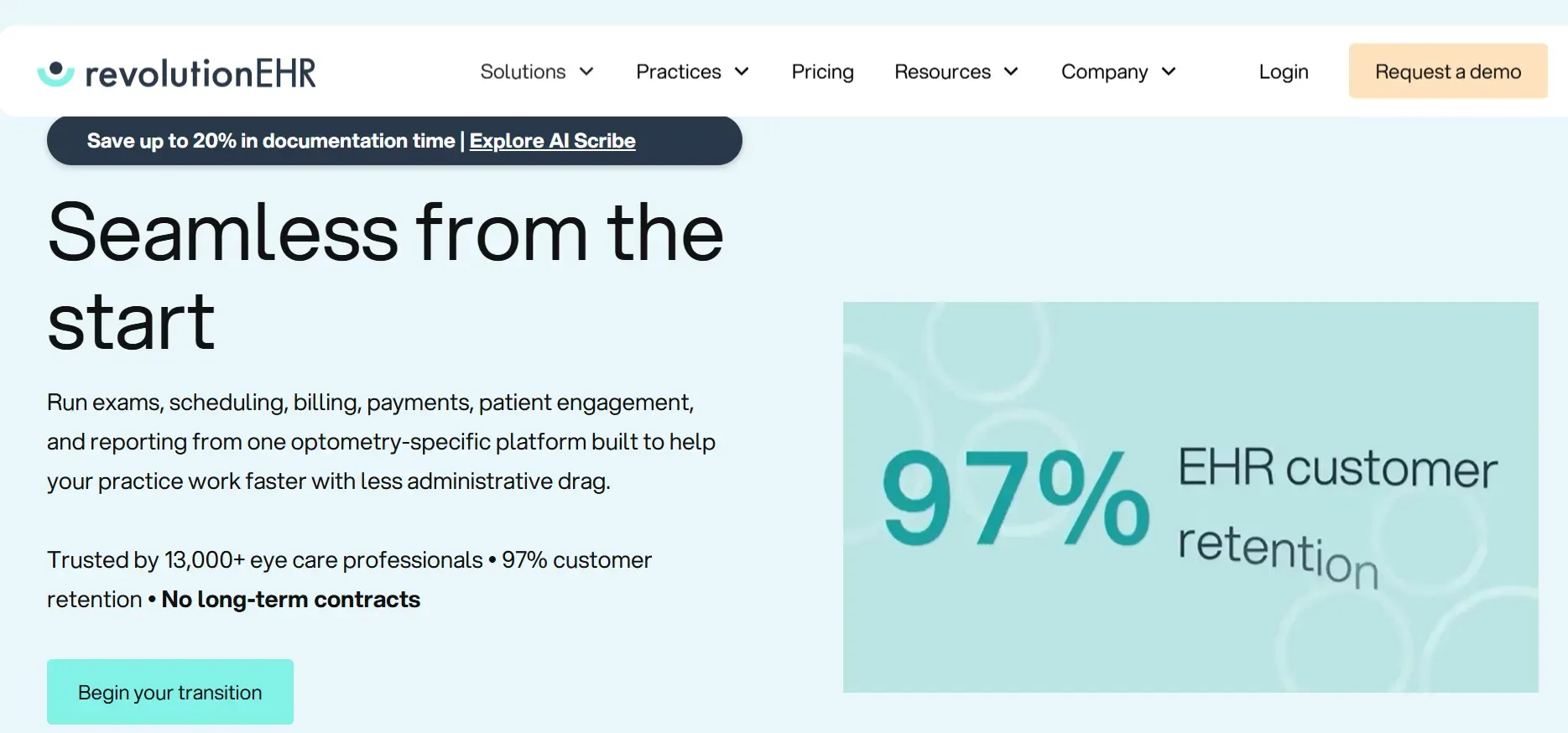
RevolutionEHR is a leading cloud-based EHR and practice management platform built exclusively for optometry. It has a strong reputation for usability, with optometry-specific exam templates, patient scheduling, billing, reporting, and inventory management all under one roof. Revolution’s SaaS-only model means no on-premise headaches, and updates are automatic.
Pricing: Reported $385/month per provider, plus add-ons.
- All-in-one optometry workflow
- Easy onboarding and cloud access
- Integrates with major labs and devices
- Subscription-only, no path to ownership
- Custom features limited to what’s supported
- Advanced reporting may require higher tiers
Want to stop paying per user? Devaims lets you add unlimited users and locations for a flat fee.
3. Crystal PM (Best for customizable EHR workflows)
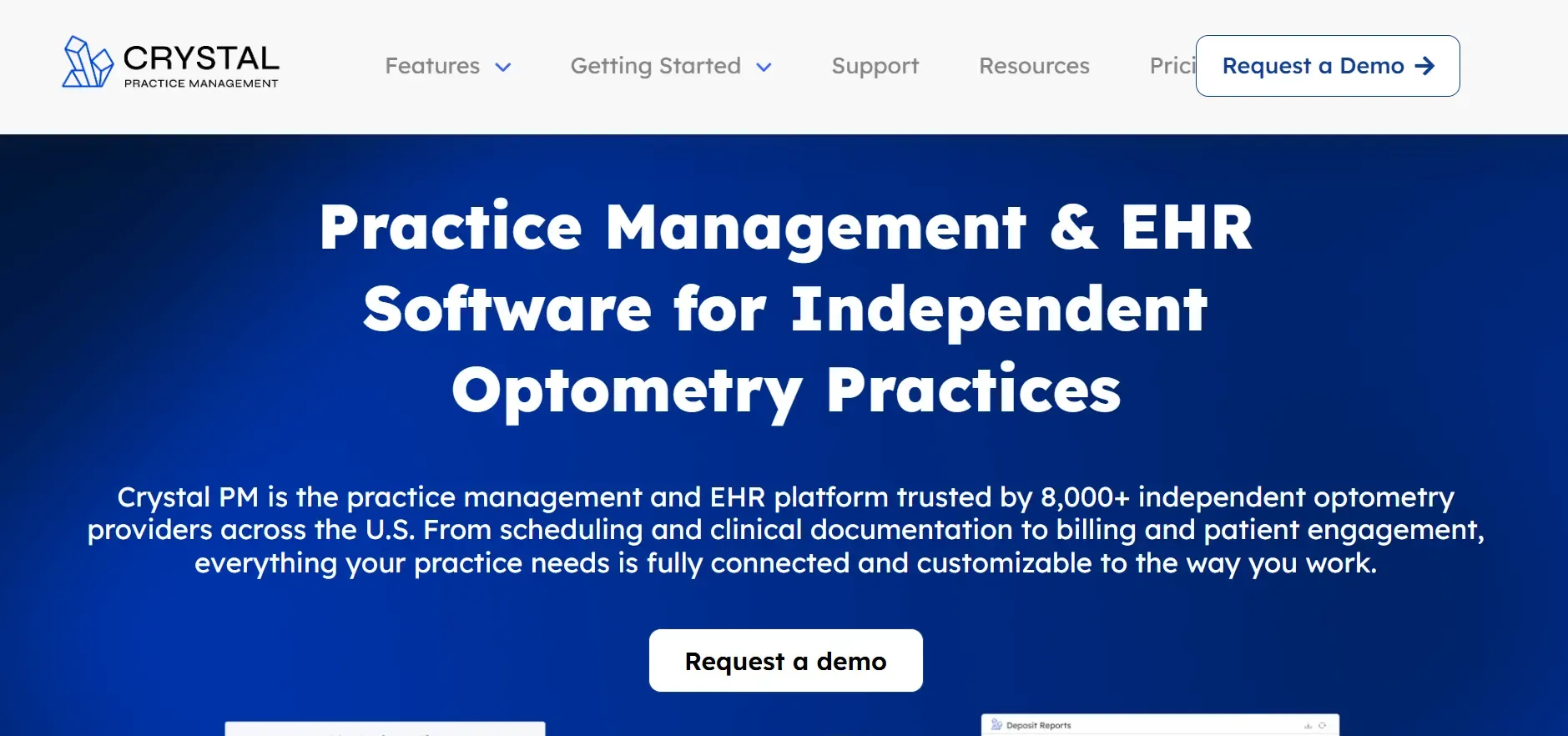
Crystal PM stands out for its high degree of EHR customization. Practices can build their own exam templates, custom forms, and workflow automations, which is a big draw for optometrists with unique documentation or specialty requirements. The platform includes scheduling, billing, e-claims, and inventory management. Its interface is less flashy than some competitors, but it is functional and proven.
Pricing: Reported $250/month per provider, plus add-ons.
- Highly customizable workflows and templates
- Strong device and lab integrations
- Lower starting price than most SaaS EHRs
- Steeper learning curve for custom setups
- Interface is dated compared to newer tools
- Ongoing subscription, no ownership
With Devaims, you get custom workflows and full ownership, no subscription required.
4. Compulink (Best for enterprise and multi-location)
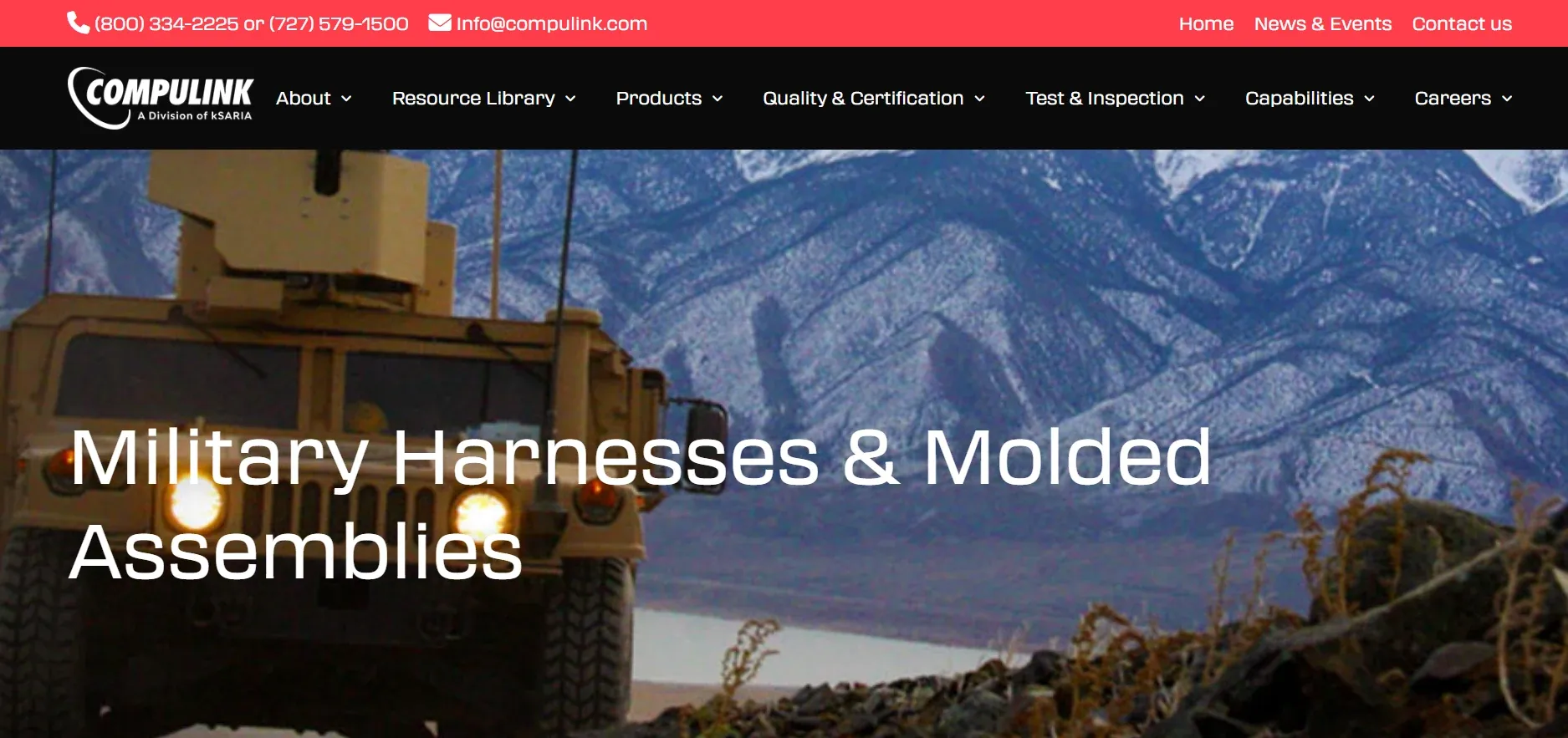
Compulink is an enterprise-grade EHR and practice management system for optometry, ophthalmology, and multi-location groups. It offers a wide range of features, from advanced scheduling and billing to imaging, telehealth, and patient engagement. Compulink is known for its customization options, extensive device integrations, and scalability for large practices.
Pricing: Reported $399/month per provider, plus setup and training fees.
- Enterprise-grade scalability
- Deep device and imaging integration
- Custom reporting and analytics
- High setup and training costs
- Multi-year contracts and ongoing fees
- Complex for small practices
Devaims offers enterprise customization without locking you into vendor contracts.
5. MaximEyes (Best for cloud or on-prem flexibility)
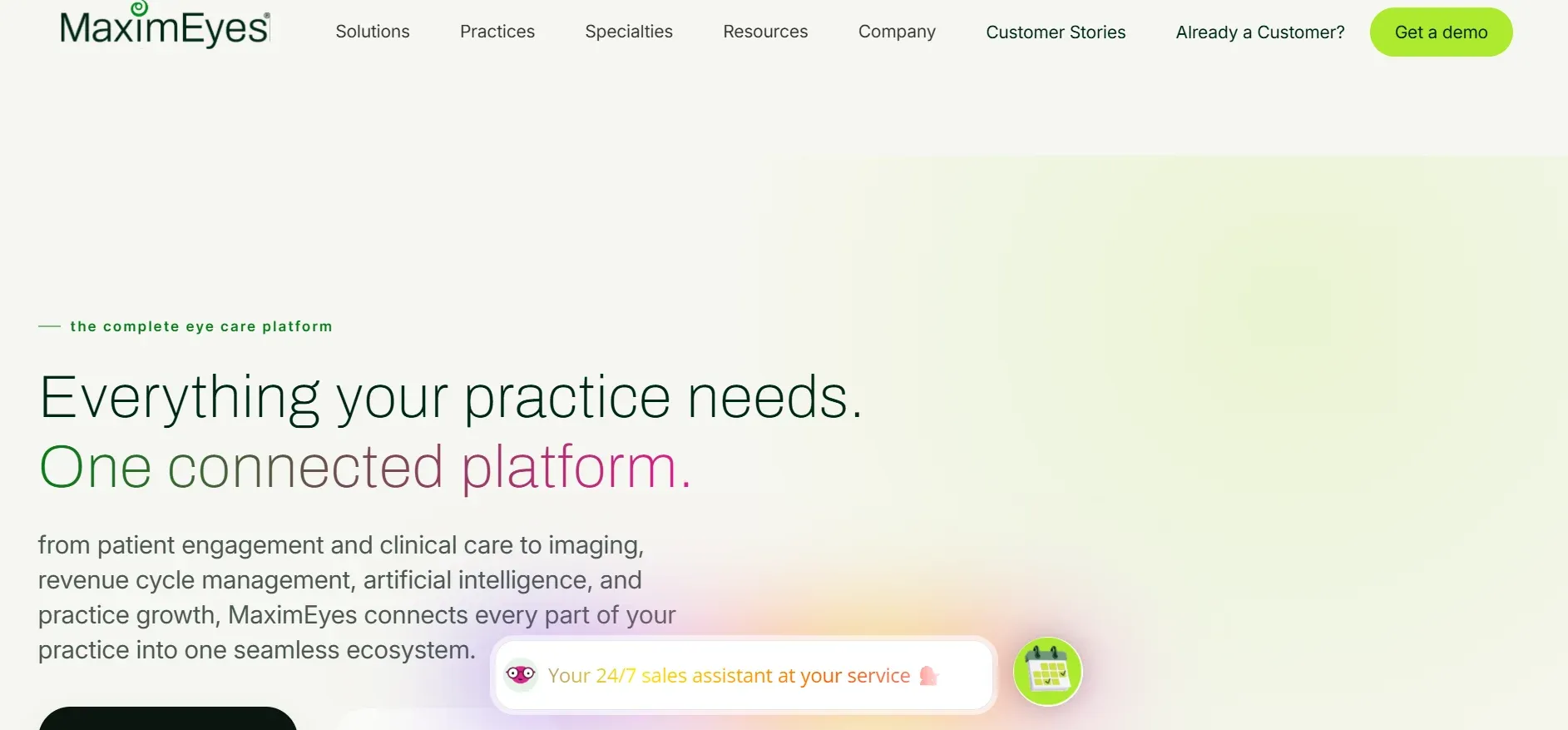
MaximEyes offers a rare degree of deployment flexibility: practices can choose between a cloud-based SaaS model or an on-premises installation. This is attractive for clinics with strict data residency or security requirements, or those seeking more control than pure SaaS options like Kareo provide. MaximEyes covers EHR, practice management, optical billing, and imaging, with a focus on optometry workflows.
Pricing: Reported $325/month per provider, plus add-ons and setup.
- Flexible deployment (cloud or on-prem)
- Optometry-specific workflows
- Strong device integration
- Monthly fees apply to both cloud and on-prem
- Upgrades for on-prem are not automatic
- No source code or true ownership
6. OfficeMate (Best for legacy VSP practices)
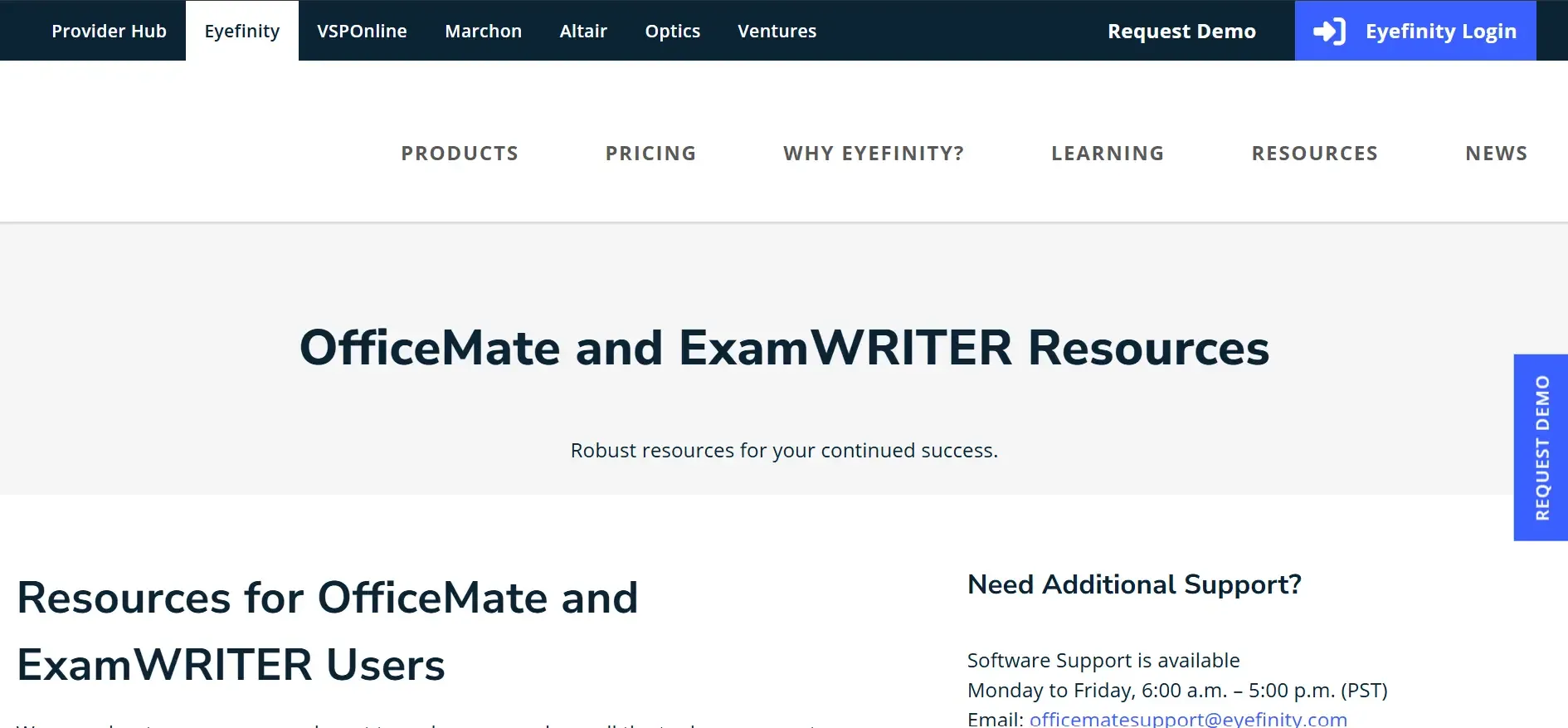
OfficeMate is the classic on-premises optometry EHR, still widely used by clinics that prefer to keep data in-house. As the predecessor to Eyefinity PM, it is especially common among long-standing VSP-aligned practices. OfficeMate offers full-featured scheduling, billing, inventory, and patient management, but lacks the modern cloud features and mobile access of newer systems.
Pricing: Reported $350/month per provider, plus support contracts.
- Proven reliability for legacy practices
- Direct VSP integration
- Local data storage and control
- No cloud access or mobile features
- Requires in-house IT for backups and updates
- Annual support contracts required
7. Modernizing Medicine (Eyes) (Best for specialty eye care)
Modernizing Medicine (Eyes) offers a specialty-focused EHR designed for high-volume ophthalmology and optometry practices. The platform is known for its adaptive, specialty-specific charting, deep device integration, and powerful analytics. It supports a wide range of subspecialties, including retina, cornea, glaucoma, and refractive surgery, making it a favorite among multi-specialty eye care clinics.
Pricing: Reported $729/month per provider, plus add-ons.
- Adaptive charting for specialties
- Deep device and imaging integration
- Powerful analytics and compliance tools
- Premium pricing and onboarding fees
- Add-on fees for advanced modules
- No ownership, strictly SaaS
8. MDVista (Best for multi-specialty and clinics)
MDVista provides a flexible, multi-specialty EHR and practice management solution that can be tailored for optometry as well as general medicine, ophthalmology, and other specialties. It is positioned as a customizable alternative to Kareo for clinics with complex or multi-disciplinary requirements.
Pricing: Custom quote, varies by practice size and needs.
- Multi-specialty support
- Customizable workflows
- Integrated billing and scheduling
- No ownership, always vendor-controlled
- Pricing is not transparent
- Complex for single-specialty clinics
9. Devaims (Best for owning your optometry platform)
Devaims is the only Kareo alternative that truly lets you own your system. Instead of paying monthly per user forever, you get a custom-built EHR and practice management platform designed for your workflow, your devices, and your billing structure. The system is built to your requirements, and, unlike every other option on this list, you get the source code and full data ownership. This means you decide how and when to upgrade, what features to add, and how to integrate with third-party systems. The only ongoing cost is a flat-rate maintenance agreement, not a perpetual subscription.
- Custom EHR and practice management, built for your needs
- Full device and third-party integrations
- Unlimited users and locations, no extra fees
- Full data and source code ownership
- Flat monthly maintenance, no per-user rent
Devaims handles migration, integration, and support as part of your build, so you never have to compromise on workflow or reporting.
Other Kareo alternatives worth knowing
- Practice Mate, Free practice management, but lacks EHR depth for optometry. It is best for very small clinics or those just starting out who do not need clinical documentation, imaging, or specialty workflows.
- Nextech, Strong in ophthalmology, but overkill and expensive for most optometry clinics. Best for surgical or multi-specialty practices with complex compliance needs.
- OpenEMR, Open source, but requires heavy IT investment and optometry customization. For tech-savvy clinics with IT resources, it is possible to build a tailored system, but most practices find the cost and effort prohibitive compared to commercial options.
Some tools are close fits but don’t truly cover optometry-specific needs or hand you ownership.
How to choose the right Kareo alternative
- Budget: Calculate total cost of ownership, not just the monthly fee, but add-ons, per-provider rates, and contract minimums over five years. Consider implementation, training, and migration costs as well, as these can be significant.
- Practice size: Solo, small group, or multi-location? Many platforms price by seat or location, and what works for a solo provider may not scale affordably as you grow.
- Specialty needs: Do you need advanced imaging, optical billing, or custom exam templates? Specialty and subspecialty practices should prioritize platforms that support their full workflow, not just basic EHR features.
- Integration: Will it talk to your devices, labs, and clearinghouse, or will you pay extra for each? Deep integration can save hours of manual work and reduce errors, but may require custom interfaces or additional setup.
- Ownership: Do you want to own your data and system, or are you comfortable renting? If you plan to operate for more than 4 or 5 years, ownership can dramatically reduce lifetime costs and risk of vendor lock-in.
If you want to break the cycle of rent-forever and control your own system, owning with Devaims is the next step.
Stop paying rent on software you could own
Kareo and nearly every alternative in this space keep you on the hook: per-user, per-month, forever. Even when you switch, you’re still renting. The only way out is to own your platform outright.
Devaims builds custom EHR and practice management systems for optometry clinics that want control. You get a system tailored for your workflow, with the integrations and reports you actually need, and the source code belongs to you, not a vendor.
- No more recurring per-user fees: Pay once to build, then a flat monthly for maintenance. Add as many users and locations as you want.
- Data belongs to you: Export, integrate, and report however you want, no more vendor lock-in or export fees.
- Upgrades and features on your terms: Add features when your practice needs them, not when a vendor releases them.
| Tool | Ownership | Recurring fees | Custom workflows? |
|---|---|---|---|
| Kareo | No | Yes, per user per month | Limited |
| Eyefinity | No | Yes, per provider per month | Some |
| RevolutionEHR | No | Yes, per provider per month | Some |
| Devaims | Yes | One-time build, flat maintenance | Full, built for you |
| Year | Rent (Kareo, $500/mo) | Own (Devaims, $32,000 build + $200/mo) |
|---|---|---|
| Year 1 | $6,000 | $34,400 |
| Year 2 | $12,000 | $36,800 |
| Year 3 | $18,000 | $39,200 |
| Year 4 | $24,000 | $41,600 |
| Year 5 | $30,000 | $44,000 |
For a typical optometry practice (4 providers, modest add-ons), Kareo and most alternatives will cost you over $30,000 in rent over five years, with nothing to show for it if you leave. Devaims breaks even around year 4. After that, you’re ahead and fully in control, with no risk of sudden price hikes, forced upgrades, or data ransom. You gain the ability to reinvest savings into your clinic, staff, or patient experience, instead of perpetual software rent.
How to switch from Kareo
- Export all patient, billing, and schedule data from Kareo: Use available export tools (CSV, HL7, CCD, or other formats). Confirm that you are getting not only demographics, but also clinical notes, attachments, and billing history. Ask Kareo support for a full data export if needed.
- Choose your new EHR/practice management solution: Confirm that the new system supports your required import formats. Some vendors provide migration tools or services, while others expect manual data entry for certain fields.
- Import your data: Work with your new vendor to map and import information. Pay special attention to preserving relationships between patients, encounters, and billing records. For custom systems like Devaims, this step includes data cleaning and transformation for a seamless transition.
- Reconnect payment processing, insurance clearinghouse, and device integrations: Ensure all third-party integrations are set up and tested in advance. Device and clearinghouse integration can be the most complex part of migration, especially for practices with diverse equipment.
- Train your staff: Schedule in-depth training sessions, ideally using your own data, so staff can learn in a familiar context. Create documentation and provide ongoing support during the transition period.
- Test the system in parallel: Run the new and old systems side by side for at least a week. Validate that scheduling, billing, and EHR workflows function as expected, and that all data has migrated correctly.
- Review your Kareo contract and formally cancel: Provide written notice according to your contract terms, and confirm the cancellation with Kareo support to avoid extra charges or auto-renewals. Retain all export documentation for compliance and legal records.
With a custom Devaims build, the migration is handled as part of the project, with dedicated support for mapping, importing, and validating your data, plus staff training and go-live assistance.
Frequently asked questions
What is the best Kareo alternative for independent optometry practices?
For independent optometry clinics, RevolutionEHR and Crystal PM are popular for their optometry-specific features and cloud convenience. RevolutionEHR is praised for its all-in-one usability and strong support, while Crystal PM is preferred by those needing deep customization. However, both remain subscription-based and limit true ownership. If you want to fully own your platform, Devaims is the only option that delivers a custom, ownable solution, with workflows and data control tailored to your practice.
Which Kareo alternative is cheapest over five years?
At first glance, Crystal PM and Practice Mate offer among the lowest monthly fees. However, over five years, recurring subscriptions, especially when you account for add-ons and extra providers, can surpass the cost of building your own system. Devaims overtakes most SaaS options in value by year 4, since you stop paying per user and own your system outright. For practices with more than two providers, the long-term savings and control quickly become clear.
Is there a free Kareo alternative for optometry?
Practice Mate is a free practice management tool, but it lacks optometry-specific EHR features, imaging, and deep reporting. OpenEMR is open source and free to use, but requires significant technical expertise and customization to meet optometry requirements, including device integration and specialty workflows. For most clinics, the cost in IT time and lost productivity outweighs the benefit. Devaims is not free, but for those who want a fully-featured, ownable system, the investment pays for itself over time.
Which Kareo alternatives work best for multi-location practices?
Compulink and Net Health Optometry scale well for large or multi-site groups, offering centralized scheduling, data, and analytics. Both are strong but come with enterprise pricing and still require ongoing SaaS contracts. Devaims offers unlimited users and locations for a flat maintenance fee, making it a cost-effective and flexible solution for growing practices that want to avoid per-seat or per-location upcharges.
Can I keep my historical data when switching from Kareo?
Most Kareo alternatives support data import, but the completeness and cost vary. Some charge extra for migration or limit what you can bring over (e.g., only demographics, not clinical notes or attachments). With Devaims, the migration process is custom-fit to your needs, including full patient histories, billing records, and attachments. You retain full access to your data, and the source code ensures you are never locked out in the future.
When should I switch from Kareo to another system?
If your monthly costs are climbing, features you need are locked behind higher tiers, or your workflow is boxed in by the system’s limitations, it is time to explore Kareo alternatives. Practices planning for growth, additional locations, or specialty expansion should consider switching before the next contract renewal. If you want full control, over your data, features, and costs, owning with Devaims is a clean break from the rent-forever cycle.
The bottom line
Switching from Kareo is about more than finding another subscription, it’s about deciding if you want to rent forever or finally own the system that runs your optometry practice. Here’s the test: add up what every tool will cost you over the next five years. If that figure could have bought you a platform you control, you already have your answer. Owning with Devaims means you’re never stuck paying for the same software twice. You gain flexibility, security, and the ability to innovate as your practice grows, all without vendor-imposed limits or surprise price hikes.
Looking for more? See the Devaims blog, or compare more options at RevolutionEHR alternatives, Eyefinity alternatives, and Compulink alternatives.