



Spend more on your clinic's software than on your MRI machine lately? Epic's sticker shock, $50,000 to $500,000 for even a small clinic's setup, plus a contract you need a lawyer to decode, has specialty clinics hunting for Epic alternatives. The day you realize that every "cloud EHR" is just another rental, the question changes: how do you get out of the rent cycle?
AdvancedMD, Kareo, and eClinicalWorks all promise smoother onboarding and fewer headaches than Epic, but you're still paying per provider, every month, forever. The hidden math? Over five years, your SaaS bill can easily top what it would have cost to build something you own. That's where a custom Devaims platform flips the script, one-time build, your code, your rules. Here are the Epic alternatives worth your time in 2026, and the honest reason to stop renting for good.
Why medical specialty clinics look for Epic alternatives
Epic has long been the gold standard for large hospital systems, but for specialty clinics, its enterprise focus often brings more pain than value. Here’s what’s driving the search for alternatives:
- High sticker price: Epic's initial setup can run $50,000 to $500,000, even for a small clinic. This does not include annual maintenance fees, which can be 20% or more of the original price. For most specialty practices, that up-front cost is a barrier to entry.
- Per-provider pricing piles up: Most Epic alternatives charge $400 to $600 per provider per month. As your clinic grows, these costs scale up rapidly, making it tough to predict your true five-year spend.
- Long contracts, short flexibility: Epic and many rivals require multi-year contracts. These commitments make it difficult to renegotiate pricing or pivot to new features as your clinic’s needs evolve. Early termination can mean steep penalties or complex data extraction processes.
- Complexity outpaces value: Many clinics pay for expansive feature sets they never use, just to get the handful of specialty workflows they need. The result? Overpaying for complexity while still feeling boxed in by limited customization.
- It's always rented: No matter which Epic alternative you pick, you rarely own the software or the database. Switch vendors and you start from scratch, often losing years of workflow customizations and facing data migration headaches. That makes "Epic alternatives" a keyphrase on every specialty clinic's shortlist.
Quick comparison of the best Epic alternatives
| Tool | Best for | Starting price | You own it? |
|---|---|---|---|
| AdvancedMD | Customizable, robust features | $429/mo/provider | No, monthly SaaS |
| Kareo (Tebra) | Smaller practices, easy billing | $160/mo/provider | No, monthly SaaS |
| Modernizing Medicine | Dermatology, ortho specialties | Custom quote | No, monthly SaaS |
| Nextech | Ophthalmology, plastic surgery | Custom quote | No, monthly SaaS |
| Allscripts | Enterprise, large clinics | Custom quote | No, monthly SaaS |
| Greenway Health | Ambulatory, multi-specialty | Custom quote | No, monthly SaaS |
| Athenahealth | Integrated RCM, minimal contracts | % of collections | No, monthly SaaS |
| eClinicalWorks | Full-featured, mobile support | $599/mo/provider | No, monthly SaaS |
| Devaims (Custom Build) | Full ownership, tailored features | One-time build | One-time build, you own it |
Always confirm current pricing before you decide, SaaS rates and contract terms can change quickly. Also, be sure to ask about hidden fees: setup, data migration, and integration with labs or imaging systems may not be included in the sticker price.
The 9 best Epic alternatives
1. AdvancedMD (Customizable, robust features)
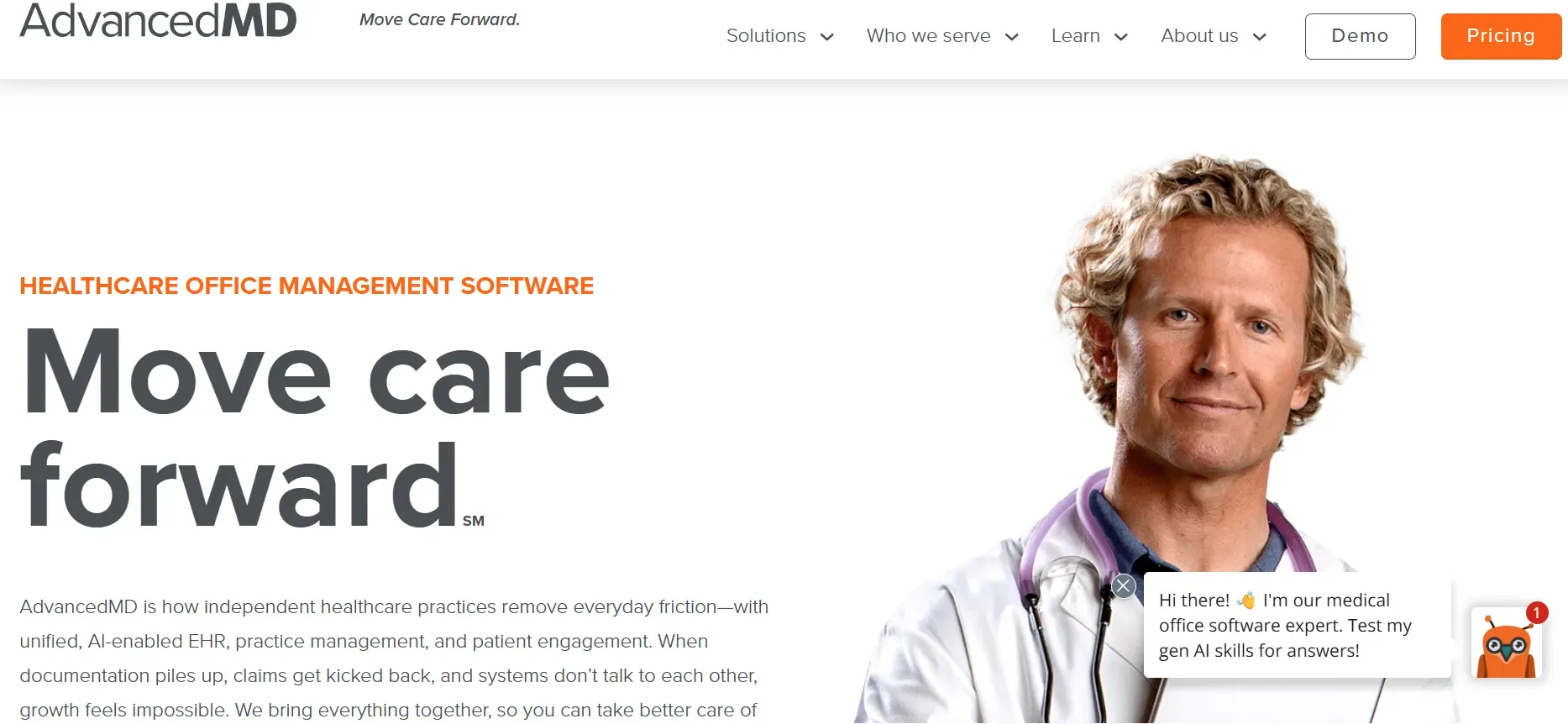
AdvancedMD serves specialty clinics seeking robust, customizable EHR and practice management without hospital-sized costs. The platform covers EHR, scheduling, telehealth, billing, and revenue cycle management (RCM), all modular, so you can start small and add features as you grow. Specialty-specific templates are available for cardiology, orthopedics, behavioral health, and more.
Pricing: $429 to $1,070 per provider per month (varies by modules and contract length).
-
Key limitations:
- Per-provider pricing adds up quickly for growing clinics
- Customization beyond templates requires vendor involvement
- Long-term contracts required for best pricing
-
Strengths:
- Highly customizable templates and specialty workflows
- Integrated telemedicine and analytics
- Mobile access for providers on the go
On a Devaims build, per-provider fees disappear, your 11th user costs you nothing extra.
2. Kareo (Tebra) (Smaller practices, easy billing)
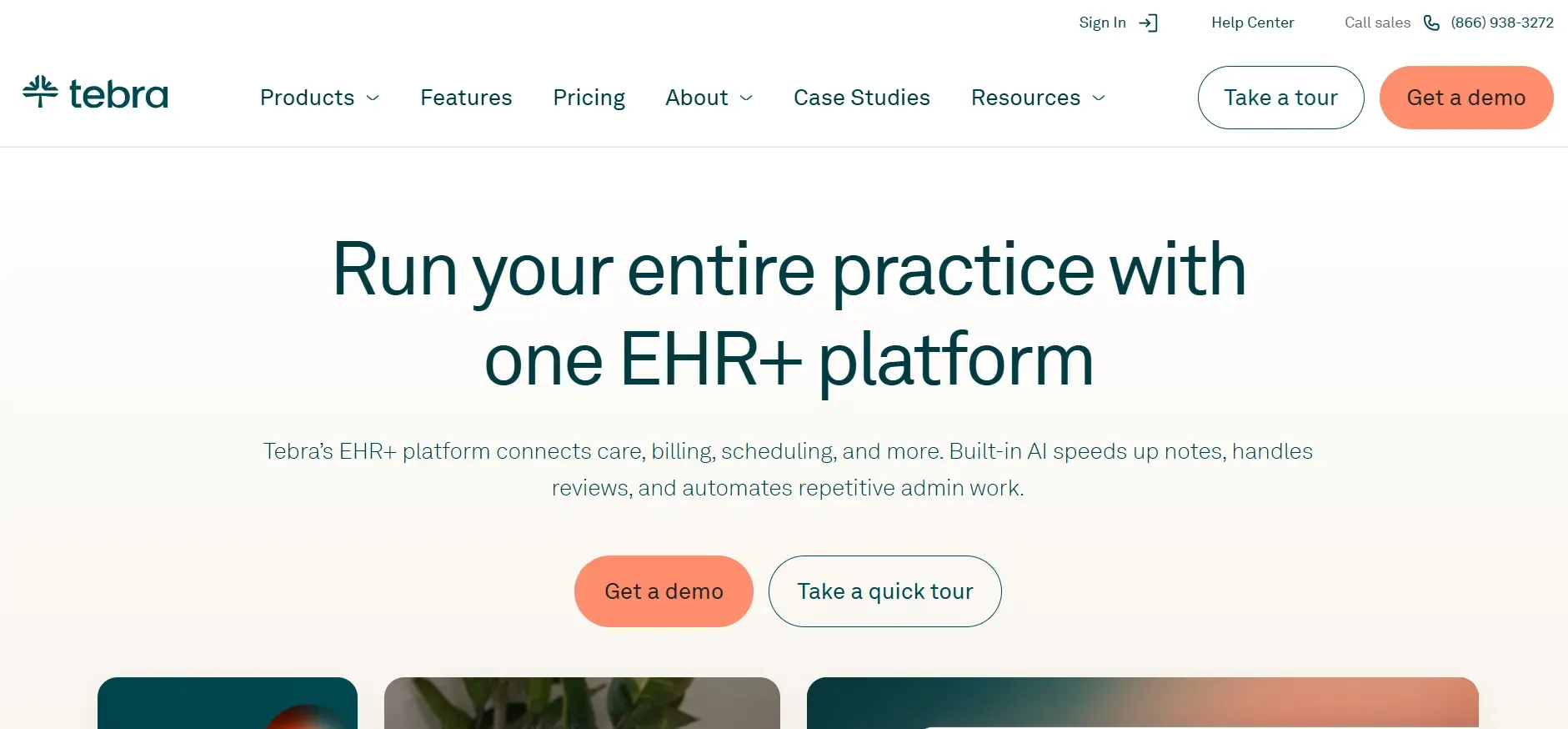
Kareo (now part of Tebra) is designed for small and midsize clinics that want simple, affordable EHR and practice management. Its clean interface and quick onboarding make it a top choice for solo or two-provider practices. Kareo’s billing and claims tools are central to its value, and it integrates with most clearinghouses and labs.
Pricing: $160 per provider per month (EHR + billing); add-ons extra.
-
Key limitations:
- Limited billing tools for complex specialties
- Customization options are basic
- Support can lag during peak times
-
Strengths:
- Affordable entry point for small clinics
- Quick onboarding and easy-to-use interface
- Solid claims and insurance verification tools
3. Modernizing Medicine (Derm, ortho specialties)
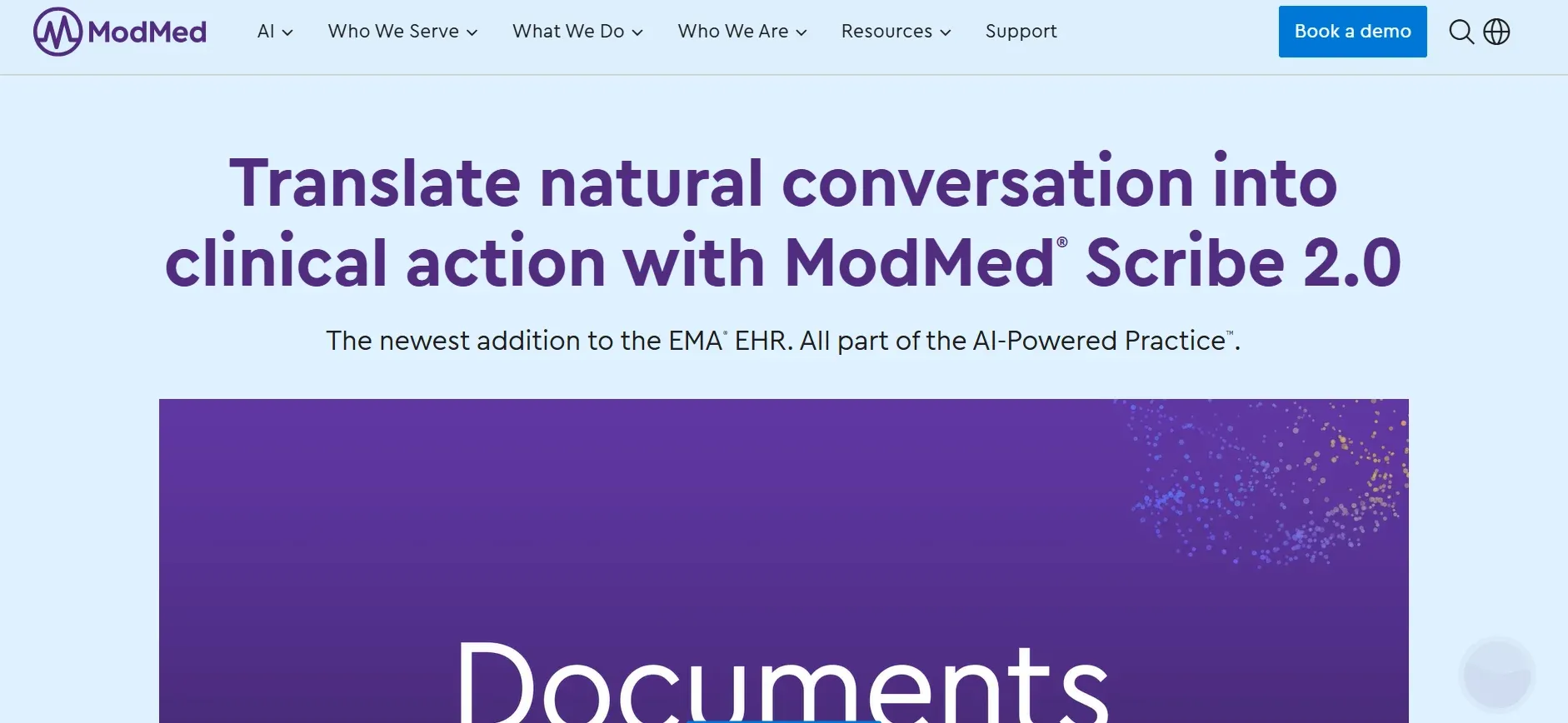
Modernizing Medicine (ModMed) targets dermatology, orthopedics, ophthalmology, and ENT clinics. It stands out for specialty-specific workflows, prebuilt templates, and its "EMA" (Electronic Medical Assistant) system, which uses voice commands and touch navigation for faster documentation.
Pricing: Custom quote required (typically higher than average).
-
Key limitations:
- Opaque pricing, must contact sales
- Customization outside core specialties is limited
- Performance lags reported by some users
-
Strengths:
- Specialty-specific templates and content libraries
- Voice and touch-based charting (iPad-first)
- Integrated telehealth and analytics
With a Devaims build, every field, workflow, and template is designed for your staff, not a generic vertical.
4. Nextech (Ophthalmology, plastic surgery)
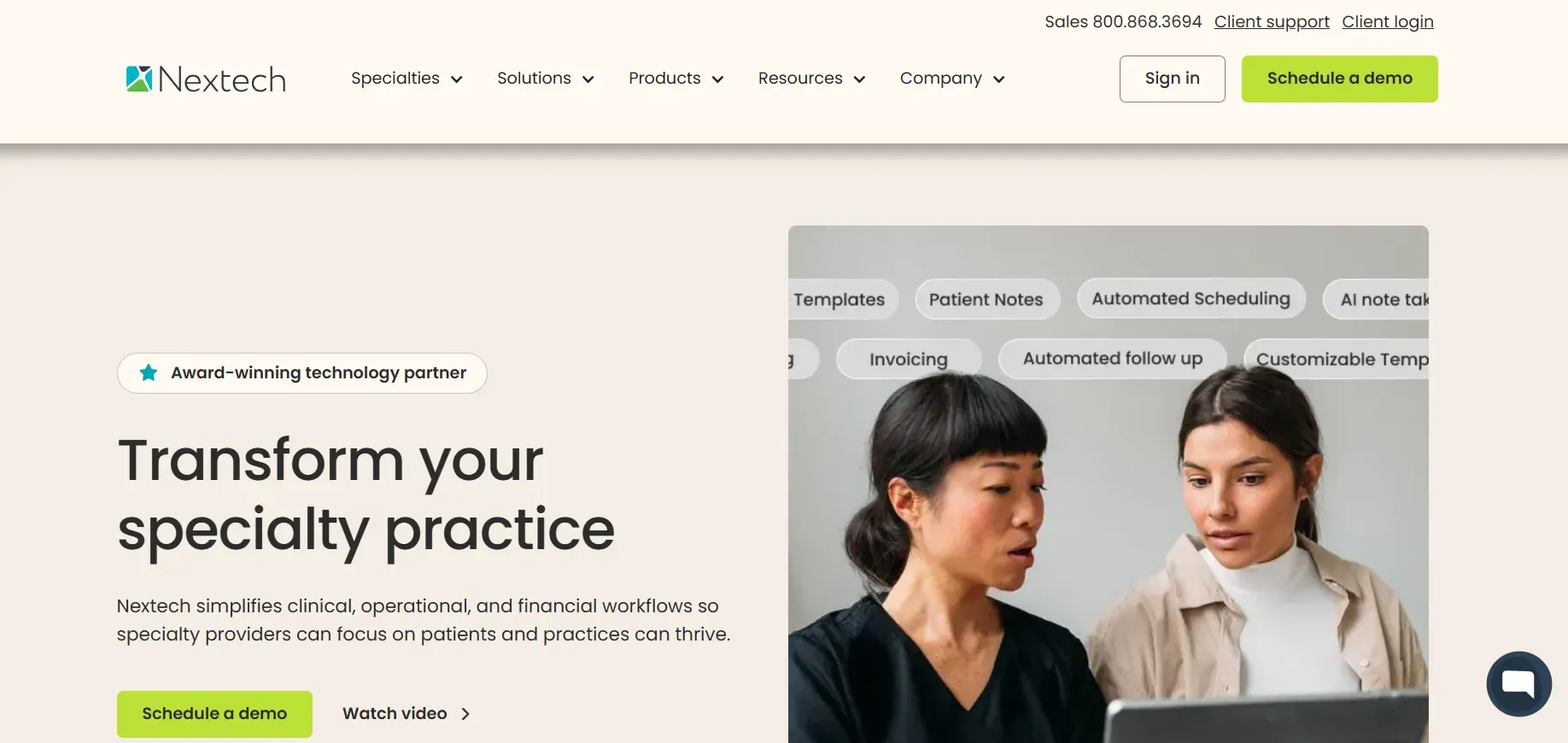
Nextech specializes in ophthalmology, plastic surgery, and dermatology, delivering deep clinical documentation, drawing tools, and imaging integrations. It supports unique specialty workflows like pre/post imaging and surgical planning, making it a favorite among procedure-driven clinics.
Pricing: Custom quote required.
-
Key limitations:
- Steep learning curve for new users
- Customization is expensive and slow
- Longer onboarding for complex clinics
-
Strengths:
- Graphical charting and robust imaging support
- Customizable templates for procedures
- Integrated practice management and analytics
5. Allscripts (Enterprise, large clinics)
Allscripts (now part of Altera Digital Health) is designed for large, multi-site clinics and health systems needing deep integration across departments. The platform offers robust analytics, population health management, and interoperability with hospital systems.
Pricing: Custom quote required (enterprise pricing).
-
Key limitations:
- System crashes and downtime in highly customized setups
- Long-term contracts and slow support
- Not cost-effective for small clinics
-
Strengths:
- Comprehensive EHR and practice management suite
- Strong interoperability and open API
- Advanced analytics and reporting
6. Greenway Health (Ambulatory, multi-specialty)
Greenway Health targets ambulatory clinics and multi-specialty practices with flexible templates, patient engagement, and compliance tools. It is popular among clinics looking for a balance between customization and out-of-the-box usability.
Pricing: Custom quote required.
-
Key limitations:
- System speed can lag with large patient volumes
- Support quality varies
- Customization is not limitless
-
Strengths:
- Flexible templates and customizable workflows
- Integrated practice management and billing
- Strong patient engagement tools
With Devaims, owning your platform means no "support window", you can hire anyone to help with your code.
7. Athenahealth (Integrated RCM, minimal contracts)
Athenahealth stands out for its no-long-term-contract approach and revenue-based pricing. Instead of fixed monthly fees, Athenahealth takes a percentage of your collections, aligning its incentives with your revenue. This can help reduce upfront costs, but as your clinic grows, so does your bill.
Pricing: Percentage of collections (typically 4% to 8%).
-
Key limitations:
- Costs rise with clinic revenue
- Confusing billing for some users
- Limited customization and platform ownership
-
Strengths:
- No long-term contract required
- Integrated EHR, practice management, and RCM
- Strong analytics and benchmarking tools
8. eClinicalWorks (Full-featured, mobile support)
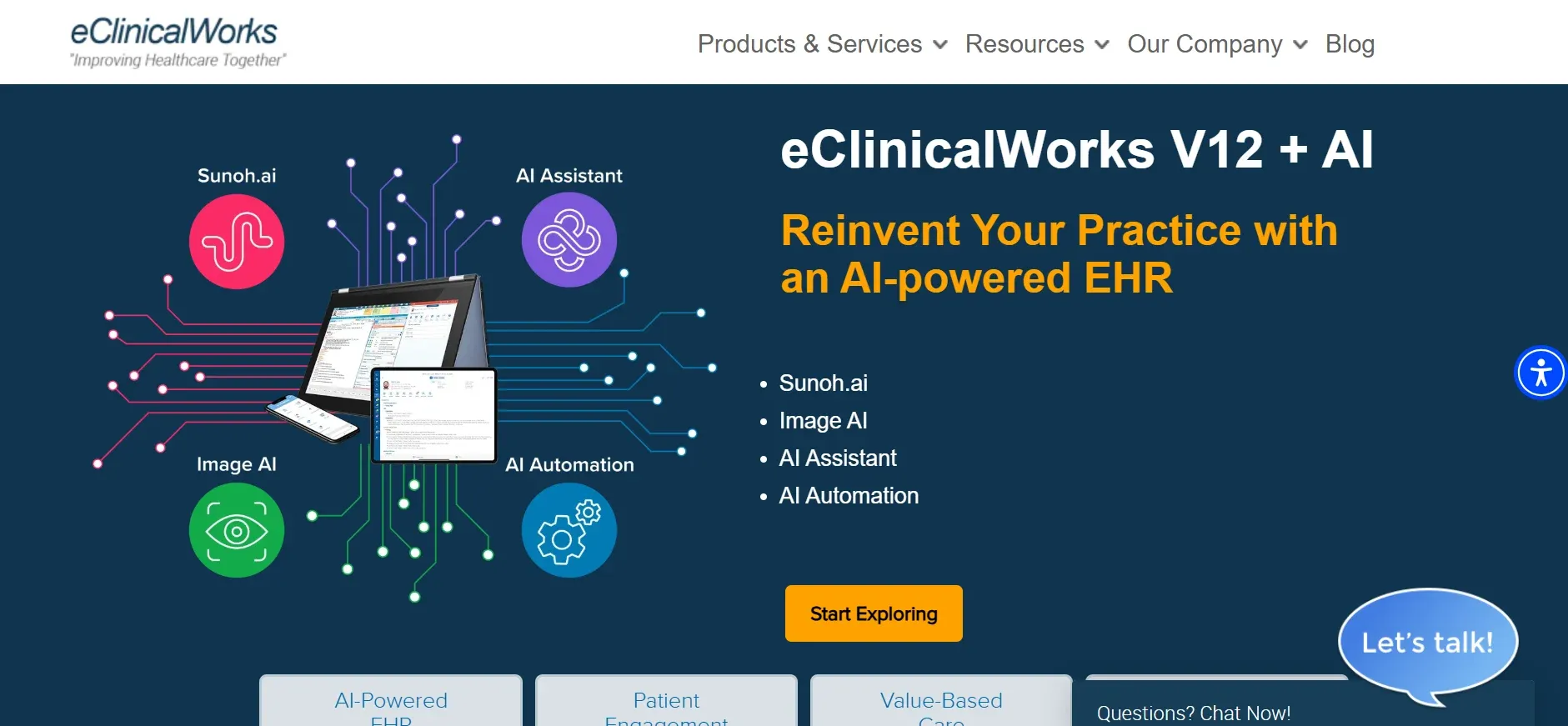
eClinicalWorks is a highly comprehensive EHR and practice management system, popular for its mobile support and all-in-one suite. It is used by a broad range of clinics, from solo practices to large specialty groups.
Pricing: $449 to $599 per provider per month.
-
Key limitations:
- Costs escalate with each new provider
- Customization limited to platform options
- Glitches and inconsistent support reported
-
Strengths:
- Comprehensive feature set and mobile apps
- Strong interoperability and device support
- No setup fees and 24/7 support
On an owned Devaims system, your mobile features and integrations stay with you, no matter which device or vendor you use next year.
9. Devaims (Full ownership, tailored features)
Devaims builds custom EHR and practice management software for specialty clinics that want to own their platform, source code, and data, no monthly rent, no lock-in, just a system built for your workflows. Every feature, report, and integration is designed around your clinic, not a generic template. Your staff keeps using the tools that make sense to them, and you never pay per-user or per-provider again.
Pricing: One-time build (typical range: $33,000 to $44,000 for 10 providers, plus optional flat maintenance).
- Custom EHR and practice management modules built to your workflowIntegration with any lab, imaging, or billing systemFull data ownership and exportability, no vendor lock-inMobile-ready interfaces and modern device supportHIPAA compliance and customizable securityFlat, transparent maintenance (or bring your own developer)
- Custom EHR and practice management modules built to your workflow
- Integration with any lab, imaging, or billing system
- Full data ownership and exportability, no vendor lock-in
- Mobile-ready interfaces and modern device support
- HIPAA compliance and customizable security
- Flat, transparent maintenance (or bring your own developer)
On software you own, you set the pace, add features, keep your data, and never ask permission.
Other Epic alternatives worth knowing
- Practice EHR: Simple, budget-friendly, but basic for most specialties. Good for solo providers who need a compliant charting and billing system without bells and whistles.
- Netsmart: Focuses on behavioral health and post-acute care; limited for many specialties but strong for substance abuse and mental health clinics.
- Practice Fusion: Popular for solo practices, but sunsetting features and ownership concerns make it risky for scaling clinics. Recent changes have limited its appeal for specialty workflows.
- DrChrono: Strong for iPad-first workflows, but per-provider fees and basic specialty support hold it back for complex clinics. Good for mobile charting in small practices.
How to choose the right Epic alternative
- By budget: Calculate total 5-year cost, not just monthly fees, Epic and most alternatives get expensive fast as you add providers. Include hidden costs: migration, integrations, and training.
- By specialty needs: If you need deep derm, ortho, or ophthalmology features, test templates in a real workflow before you buy. Request a demo tailored to your most complex patient scenarios.
- By data ownership: If you want to keep your data and code, only a custom build like Devaims hands it over, most SaaS tools never do. Ask vendors about true data export, not just PDFs or limited CSVs.
- By support and flexibility: Ask what happens if you want to add a new workflow or integration in year two. On rented platforms, expect a ticket and a wait. On owned platforms, you control the roadmap and support model.
When you want out of the rent cycle, building your own with Devaims is the only way to truly own your clinical platform.
Stop paying rent on software you could own
Epic alternatives promise to solve Epic's pain points: cost, speed, contract. But every one of them is a rental, and over five years, you can pay more in SaaS fees than it would have cost to build the system you actually want. Owning your clinic's platform means no per-provider pricing, no surprise hikes, and no "support window", just your system, your way.
Who is Devaims? Devaims builds custom EHR and practice management software for specialty clinics. You get the code, the database, and the workflows, no contracts, no recurring per-user fees, and no vendor lock-in. When you own the platform, you call the shots: add features, connect integrations, and keep your data forever.
- Per-provider fees? Gone. Add users or providers with no extra cost. If you double your staff, your bill does not double.
- Locked features? Every workflow is designed for your specialty, not a generic tier. You can add custom reports, interfaces, or patient engagement modules as your clinic evolves.
- Data migration headaches? You own your database, so you never lose access when you change systems. Future transitions are smooth, since you control the data model and exports.
- Contract gotchas? No contract. You keep everything. We support or you hire anyone you like. Support and upgrades are transparent and not tied to a vendor’s business model.
| Feature | Epic | eClinicalWorks | Athenahealth | Devaims (Owned) |
|---|---|---|---|---|
| Pricing model | Setup + annual, per-user | Monthly per-user | % of collections | One-time build, flat maintenance |
| Data ownership | Vendor | Vendor | Vendor (can export) | You, always |
| Feature set | Enterprise, broad | All-in-one, mobile | Integrated RCM | Custom, specialty-specific |
| Support model | Vendor only | Vendor only | Vendor only | Any developer |
| Contract | Multi-year required | Monthly/annual | Month-to-month | None |
| Year | Rented SaaS (10 providers) | Owned (Devaims) |
|---|---|---|
| 1 | $71,880 | $33,000 |
| 2 | $143,760 | $35,760 |
| 3 | $215,640 | $38,520 |
| 4 | $287,520 | $41,280 |
| 5 | $359,400 | $44,040 (now ahead) |
Break-even comes early in year 2. After that, every month you rent is money lost. Clinics with more than 5 providers, complex workflows, or a desire to keep their own data gain the most from ownership. Want to see your real numbers?
How to switch from Epic
- Export all patient, billing, and schedule data from Epic (request a full data dump, not just CSVs). This should include clinical notes, scanned documents, images, and audit logs for compliance.
- Choose your new platform, whether SaaS or a custom Devaims build. Evaluate migration support and data mapping capabilities before committing.
- Import data, map fields, and validate for accuracy in the new system. Pay special attention to custom fields, attachments, and historical billing data.
- Reconnect billing, payments, labs, and any third-party integrations. Test all interfaces before going live to avoid disruption.
- Train staff on the new workflows and user interface. Use hands-on sessions and test scenarios to ensure adoption.
- Run both systems in parallel for a month, checking reports and compliance. This dual-run period is crucial for identifying gaps or errors before fully switching.
- Review contract terms to ensure all obligations are closed with Epic, including data retention and access for audits.
With a custom Devaims build, the migration is handled as part of the project, with dedicated support for mapping, validation, and user training.
Frequently asked questions
What is the best Epic alternative for specialty clinics?
For most specialty clinics, eClinicalWorks and AdvancedMD offer the broadest out-of-the-box features with lower setup costs than Epic. They are widely adopted, have strong mobile and specialty modules, and offer solid interoperability. However, if you want to own your software and data, Devaims is the only option that delivers full ownership, total customization, and the ability to control your platform’s future without ongoing rent or vendor lock-in.
Which Epic alternative is cheapest for small clinics?
Kareo (Tebra) is often the lowest-cost entry point for solo or 2-3 provider clinics, starting around $160 per provider per month. It is a solid choice for basic charting and billing, but costs rise quickly as you add providers or need specialty modules. Remember, you never own the platform, and feature limitations can become a barrier as you grow.
Are there any free Epic alternatives?
Practice Fusion was once the leading free EHR, but since its acquisition and feature changes, there are no fully free, robust Epic alternatives suitable for specialty clinics in 2026. Every reliable system, especially those supporting compliance and specialty needs, now charges monthly or per provider. Free options may exist for basic charting, but they lack the integrations, compliance, and support required for real-world clinics.
Can I really own my EHR platform?
Yes, with a custom build from Devaims. Unlike Epic or its alternatives, which all rent you access, Devaims hands over the code and database. You keep it, modify it, and use it forever, no ongoing rent or contract required. Full ownership means you can hire any developer for support, add features on your timeline, and future-proof your workflow and data strategy.
What is the biggest Epic pain point for specialty clinics?
Cost and complexity. High setup fees, long contracts, and paying for features you never use are the most common complaints. Many clinics also struggle with rigid workflows, slow support, and the inability to fully export or own their data. That is why so many clinics search for Epic alternatives in the first place.
When should I switch from Epic to an alternative?
If your practice is outgrowing Epic's pricing, needs more control over workflows, or wants to own its data and platform, now is the time to consider switching. The sooner you move, the sooner you stop paying rent on your own patient records, and the easier migration will be before your data and workflows become even more entrenched.
Can I keep my data if I switch from Epic?
You can export data from Epic, but reimporting into another SaaS is not always straightforward. Many platforms limit what formats or fields they will accept. With Devaims, your data is always yours, no migration headaches down the line, and you have unrestricted access for audits, research, or future transitions.
The bottom line
Epic alternatives promise smaller bills and simpler setup, but if you are tired of renting your own workflows, only a custom Devaims build lets you own the system, the data, and the future upgrades outright. The single most practical rule? Add up what your rented platform will cost you over five years. If that number is higher than the build cost, you are already paying for something you will never own. That is the moment to call the question and keep your investment in-house.
See more on the Devaims blog, or get honest comparisons at AdvancedMD alternatives, Kareo alternatives, and eClinicalWorks alternatives. For a deeper dive on interoperability and EHR standards, see HealthIT.gov Interoperability.