


Every optometry practice hits the same wall with OfficeMate (Eyefinity): you start for the features, but over time, the monthly fees, nickel and dime add-ons, and forced upgrades start eating into your margins. You get roped into "integrations" that cost extra, and every year, your bill creeps up, sometimes for features you never use, or for adding a new staff member, or just because your practice grew. If you have ever seen your software line item balloon out of nowhere, you are not alone.
Here is the truth: most OfficeMate (Eyefinity) alternatives still rent you access rather than letting you own your platform. So the question is not just "Which software?" but "Should I keep renting, or is it time to own?" In this post, we break down the top alternatives, like RevolutionEHR, Crystal PM, and Compulink, plus a custom Devaims build, the only option you own outright. If you are ready to stop renting your own data, keep reading.
Why eye care practices look for OfficeMate (Eyefinity) alternatives
Recurring subscription creep: Monthly fees with OfficeMate and its close competitors often start at a manageable level, especially for solo providers. But as you add staff, bring on new providers, or open additional locations, the recurring costs can snowball. Many practices report starting at $350 to $400 per month but seeing bills rise to $1,000 or more as they scale. Add-on modules, like e-prescribing, telehealth, or advanced reporting, are rarely included in the base price. Over time, these "optional" extras become essential, and you find yourself paying significantly more than you budgeted.
Feature gating and forced upgrades: Many optometry EHRs lock must-have features, like online scheduling, patient portals, or custom form builders, behind higher pricing tiers. Some vendors require multi-year contracts to unlock these capabilities, or they might roll them out as paid upgrades. This model creates constant upsell pressure. Even if your workflow does not change, the vendor’s roadmap may force you to upgrade or pay more for features that were previously included.
Data lock-in: The ability to access and fully export your records is often limited. Data is typically stored in proprietary formats, making migration to another vendor a technical and financial challenge. Some providers charge hefty fees for data exports or limit what you can retrieve (for example, omitting attachments, scanned documents, or imaging records). This lock-in effect discourages switching and can leave you feeling hostage to your current vendor.
Integration headaches: Labs, billing clearinghouses, diagnostic devices, and other third-party tools are essential for modern optometry. But connecting these systems often requires costly integration modules, and not all vendors support the devices or external software you rely on. Sometimes, you must work with a third-party integrator, which adds cost and complexity. Keeping integrations up to date can be a moving target, especially when vendors update their APIs or change terms.
Support gaps and ticket limbo: Large EHR vendors often rely on ticketing systems and call centers. Customization requests, workflow questions, or technical issues can languish in support queues for weeks. Many practices report frustration with slow or impersonal service, especially when they need a quick answer to keep clinics running smoothly. If your practice has unique needs, you may be told to “adapt your workflow” rather than expect the software to fit you.
If these pain points sound familiar, it is time to look at OfficeMate (Eyefinity) alternatives. Finding the right fit can dramatically reduce stress, save money, and give you back control of your operations.
Quick comparison of the best OfficeMate (Eyefinity) alternatives
| Tool | Best for | Starting price | You own it? |
|---|---|---|---|
| RevolutionEHR | All-in-one cloud EHR | Reported $399/mo | No, subscription |
| Crystal PM | Customizable EHR | Reported $250/mo | No, subscription |
| Compulink | Enterprise practices | Custom quote | No, subscription |
| MaximEyes | Cloud or on-premise | Reported $300/mo | No, subscription |
| Modernizing Medicine (Eyes) | Ophthalmology/Eye MDs | Custom quote | No, subscription |
| MDVista | Specialty clinics | Custom quote | No, subscription |
| Net Health Optometry | Multi-location | Custom quote | No, subscription |
| Practice Fusion | Budget EHR | Reported $149/mo | No, subscription |
| Devaims | Owning your EHR | One-time build | One-time build, you own it |
Confirm current pricing before you decide, as vendors change their tiers and fees often.
The 9 best OfficeMate (Eyefinity) alternatives
1. RevolutionEHR (All-in-one cloud EHR)
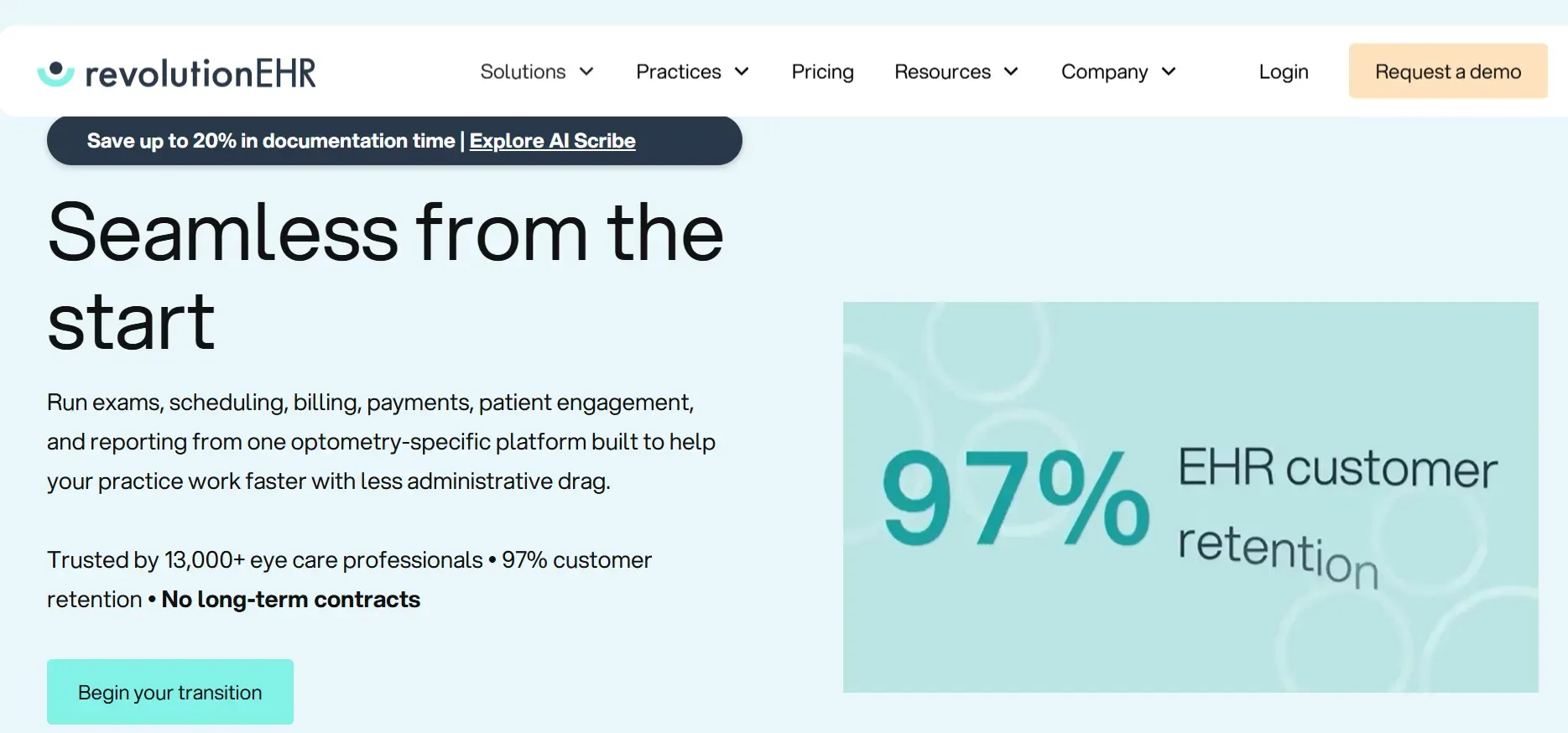
RevolutionEHR is the market leader in cloud-based optometry EHRs. Its all-in-one design covers scheduling, charting, billing, inventory, and reporting in a single interface. RevolutionEHR is popular for practices that want a turnkey solution and do not want to worry about hardware or on-premise maintenance.
Pricing: Reported around $399/month for standard plans, plus onboarding and setup fees. See pricing.
- All-in-one platform with robust reporting
- Cloud access for remote and multi-site practices
- Strong insurance and billing integrations
- Per-provider fees escalate as you grow
- Customization beyond templates is limited
- Full data export can be time-consuming and costly
Devaims note: If you want to avoid per-provider fees and own your data, Devaims offers a flat-cost, owned alternative.
2. Crystal PM (Customizable EHR)
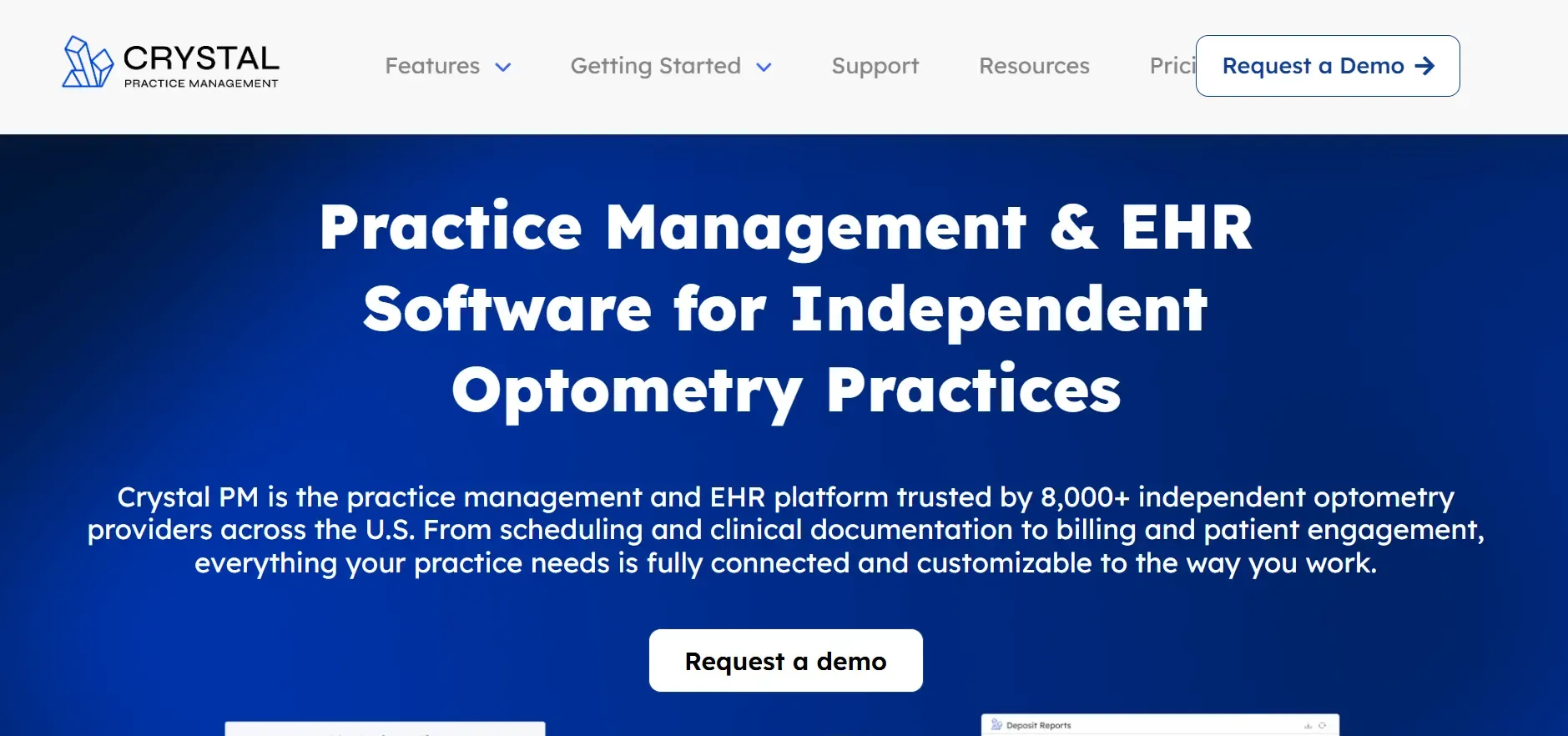
Crystal PM is known for its flexibility and customization. Unlike many EHRs that restrict the user to set templates, Crystal PM lets you build custom forms, tweak exam layouts, and adapt the workflow to fit your practice. This appeals to clinics with unique documentation needs or those who want to replicate a paper charting process digitally.
Pricing: Reported from $250/month, with extra fees for e-prescribing and integrations. See pricing.
- Highly customizable forms and reports
- Device integration for many optometry instruments
- Popular among independent and specialty clinics
- Steeper learning curve for new users
- Interface is less modern than newer cloud platforms
- Add-on modules increase total cost
Devaims note: If you want full customization without ongoing rent, Devaims builds to your exact workflow and you own the system.
3. Compulink (Enterprise practices)
Compulink is an enterprise-grade EHR and practice management suite designed for large, multi-location optometry and ophthalmology groups. It is known for its breadth of features and ability to serve complex organizations, including those with multi-specialty needs.
Pricing: Custom quote only, usually for multi-site practices; expect high setup fees and ongoing per-user costs. See contact.
- Comprehensive feature set for large groups
- Advanced analytics and compliance tools
- Strong device and lab integrations
- Steep learning curve and complex implementation
- High ongoing subscription and support fees
- Scaling up increases recurring costs
Devaims note: For multi-location groups, Devaims offers predictable costs with no per-site fees.
4. MaximEyes (Cloud or on-premise)
MaximEyes is one of the few optometry EHRs that offers both cloud-based and on-premise deployments. This flexibility appeals to practices with specific compliance needs, legacy hardware, or unreliable internet connectivity. MaximEyes covers core EHR, scheduling, billing, and inventory management.
Pricing: Reported from $300/month, plus fees for e-prescribing and labs. See pricing.
- Cloud or on-premise deployment options
- Strong inventory management for optical shops
- Good for practices with compliance or connectivity needs
- Interface is less modern than cloud-first competitors
- Add-ons for basic features increase cost
- Monthly fees persist, no ownership
5. Modernizing Medicine (Eyes) (Ophthalmology/Eye MDs)
Modernizing Medicine (Eyes) is designed for ophthalmology clinics and surgical centers, with a focus on subspecialties like retina, cornea, and oculoplastics. The platform is known for its specialty-specific content and intelligent automation, including adaptive exam templates and benchmarking tools.
Pricing: Custom quote only; usually a premium tier. See contact.
- Deep specialty content and analytics
- Integrated imaging and ASC modules
- Value-based care and quality reporting tools
- Premium pricing, especially for small practices
- Learning curve for non-ophthalmologists
- Limited customization beyond specialty templates
6. MDVista (Specialty clinics)
MDVista is a flexible EHR and practice management platform designed for specialty and boutique clinics, including those in optometry, ophthalmology, and related fields. Its modular design allows practices to add or remove features as needed.
Pricing: Custom quote; often higher for custom modules.
- Customizable workflows for specialty clinics
- Direct vendor attention and support
- API and HL7 interfaces for integration
- Smaller market footprint, less third-party integration
- Custom modules can increase cost
- Migration process may require manual mapping
7. Net Health Optometry (Multi-location)
Net Health Optometry specializes in solutions for multi-location eye care groups. Its focus is on workflow automation, centralized reporting, and revenue cycle optimization for organizations with complex scheduling and billing needs.
Pricing: Custom quote required; pricing increases with locations and users.
- Centralized scheduling and reporting
- Performance analytics across locations
- Strong insurance and compliance management
- Subscription and per-location fees add up as you grow
- Full-feature access may require premium pricing
- Data migration can be labor-intensive
8. Practice Fusion (Budget EHR)
Practice Fusion is a general-purpose, cloud-based EHR that is sometimes used by optometrists seeking a low-cost entry point. It is not built specifically for eye care, but covers basic scheduling, charting, and e-prescribing needs.
Pricing: Reported $149/month, with limited optometry add-ons. See pricing.
- Low upfront cost for small practices
- Cloud-based with basic features
- Patient portal and e-prescribing included
- Minimal device integration for optometry
- Generic reporting and templates
- Support response times can be slow
9. Devaims (Owning your EHR)
Devaims builds custom optometry and eye care platforms that you own outright. Instead of paying monthly for a generic system, Devaims delivers a solution tailored to your workflows, devices, compliance needs, and branding. You keep the source code and all data, with no contracts, no rent, and no forced upgrades. Every feature, integration, and report is designed to match your practice, today and as you grow.
- You own the source code and all data
- No per-user or per-location fees
- Fully tailored to your practice’s workflow
- Flat maintenance cost after the build
- No forced updates, lock-ins, or hidden fees
Other OfficeMate (Eyefinity) alternatives worth knowing
- Practice Mate: A general EHR platform with basic scheduling and billing. Optometry features are limited and often require creative workarounds or manual documentation. Best for very small clinics or those with minimal optometric workflow needs.
- Nextech: Well-regarded for medical specialties and plastic surgery, Nextech is feature-rich but more expensive and not focused on optometry. Some larger ophthalmology practices use it for its analytics and ASC modules.
- Eyefinity (VSP): The parent company of OfficeMate. Remains a major player for VSP-connected practices, but shares most of the same subscription and feature gating limitations as OfficeMate itself.
These can work in niche cases, but most eye care clinics will find better fits in the main list above. For a comprehensive look at more alternatives, see resources like Software Advice and Capterra.
How to choose the right OfficeMate (Eyefinity) alternative
- Budget: If you want to minimize upfront cost, subscription tools win, but add up fast as you scale. Calculate your total cost of ownership over five years, not just the first year’s fee.
- Workflow fit: Niche practices or those with unique device integrations may need more than templates. Devaims can build exactly for you, while most subscriptions will require you to adapt to their workflow.
- Data ownership: If long-term control matters, only an owned platform like Devaims puts you in the driver’s seat. This is especially important for practices concerned about compliance audits, mergers, or building long-term value.
- Growth plans: Multi-location or multi-specialty shops will pay more on per-user or per-site pricing. Owning can flatten this cost curve, letting you add providers and locations without a new bill every time.
- Compliance: All listed solutions support HIPAA, but only some make it easy to audit and export full records. If you need to guarantee data access for legal or regulatory reasons, ownership is a major advantage.
If you are ready to stop renting your own data, owning may finally make sense.
Stop paying rent on software you could own
The reality is every OfficeMate (Eyefinity) alternative, from RevolutionEHR to Modernizing Medicine, is a subscription you rent. The more you grow, the higher your bill goes. You never own the tools or the data, and switching costs keep you stuck. That’s the rent trap. You are paying for access, not for ownership, and your practice’s digital future is always at the mercy of vendor pricing and product roadmaps.
Devaims builds custom optometry software you own. You get exactly the features, reports, and integrations your practice needs, and every line of code, every record, is yours. No contracts. No per-user fees. No surprises. When you own your EHR, you are free to modify workflows, add new features, and integrate with any device or third-party service, without waiting for a vendor to prioritize your requests.
- Per-user and per-location fees disappear: Your costs do not rise when you hire or expand. Whether you have two providers or twenty, your software cost stays flat after the initial build.
- All features included: No more paying extra for e-prescribing, custom forms, or integrations. Everything you need is built in, with no feature gating.
- Switching costs are gone: You own your records, so migration and compliance are simple. If you ever want to change platforms again, you have full access to your data in standard, interoperable formats.
- Flat, predictable maintenance: No forced upgrades or surprise price hikes. You control when and how updates happen, and your maintenance costs are transparent.
| Tool | Ownership | Contract | Per-user/location fees? |
|---|---|---|---|
| OfficeMate (Eyefinity) | Rented | Often multi-year | Yes |
| RevolutionEHR | Rented | Monthly/annual | Yes |
| Crystal PM | Rented | Monthly/annual | Yes |
| Devaims | You own it outright | No contract | No |
| Year | Rented (cumulative) | Owned (Devaims, cumulative) |
|---|---|---|
| 1 | $6,000 | $32,400 |
| 2 | $12,000 | $34,200 |
| 3 | $18,000 | $36,000 |
| 4 | $24,000 | $37,800 |
| 5 | $30,000 | $39,600 (break-even) |
For most practices, break-even comes around year 5. After that, owning saves you thousands every year. If you have 6 providers and pay $500/month per provider, that is $3,000/month, or $36,000/year, over five years, $180,000, gone. With Devaims, you pay once, then low flat maintenance, and you keep your system, your data, and your control over future costs.
How to switch from OfficeMate (Eyefinity)
- Export all patient, billing, and scheduling data from OfficeMate (Eyefinity): Request a full data export from your current vendor, including clinical notes, imaging, scanned documents, billing history, and appointments. Review the export format and completeness before proceeding.
- Choose your new platform, cloud EHR, hybrid, or a custom Devaims build: Evaluate your workflow needs, integration requirements, and long-term cost. Ensure the new system supports all devices and third-party connections critical to your operations.
- Import data into the new system, resolving format or field differences: Work with your new vendor or IT partner to map and validate data fields. For custom builds like Devaims, this step includes data cleaning and normalization to ensure every record is accessible and searchable.
- Reconnect external integrations: Labs, e-prescribing, billing, and devices must be reconnected. Validate that all data flows correctly between systems, and test for compatibility with each integration.
- Train your team on new workflows, forms, and compliance steps: Conduct hands-on training for providers and staff. Focus on new documentation workflows, billing processes, and compliance features. Custom builds can match your old workflow to minimize retraining time.
- Run both systems in parallel for a trial period to spot issues: Operate both EHRs concurrently for a week or two. Compare results, ensure no data is lost, and resolve any unexpected workflow gaps before fully switching over.
- Review your old contract to confirm you have met all termination requirements: Avoid penalties by confirming your contract terms, notice periods, and data retention obligations. Notify your old vendor in writing and retain confirmation of account closure.
With a custom Devaims build, the migration is handled as part of the project, including vendor negotiation, data mapping, and staff onboarding.
Frequently asked questions
What is the best OfficeMate (Eyefinity) alternative for optometry?
For most optometry practices, RevolutionEHR and Crystal PM are top rented platforms, offering robust features and industry-standard integrations. However, if you want to own your system, eliminate ongoing fees, and gain full control over data and features, Devaims is the only solution that lets you keep your code and data. The best choice depends on your clinic size, workflow complexity, and appetite for upfront investment versus long-term savings.
Which alternative is most affordable long term?
Subscription software like Practice Fusion is cheapest upfront, but over five years, costs add up, especially as you add providers or locations. Most rented EHRs increase in cost each year, especially if you grow. A Devaims build costs more at the start, but after break-even (typically within five years), ongoing maintenance is flat and predictable, saving you thousands as you expand.
Is there a free OfficeMate (Eyefinity) alternative?
There are no truly free optometry EHRs with the features most clinics need. Some general EHRs offer trial periods or "freemium" versions, but these lack essential optometry workflows, device integrations, and compliance features. For eye care, you will pay ongoing fees or opt for a one-time build you own with Devaims. Open-source EHRs exist (like OpenEMR), but require significant IT investment and lack optometry-specific support.
Which tool is best for multi-location or large practices?
Compulink and Net Health Optometry are robust for large or multi-location groups, offering centralized reporting, compliance, and scalable infrastructure. However, both charge per site or user, so costs rise as you grow. With Devaims, you pay once and keep your system as you scale, with no new fees for adding providers or locations, and your data remains consolidated and fully owned.
How hard is it to switch from OfficeMate (Eyefinity)?
Switching can be tricky due to data format differences, integration dependencies, and contract lock-in. The right vendor, or a custom build with Devaims, handles data migration, workflow mapping, and integration setup for you. Expect to invest time in planning and staff training, but with expert support, most practices can switch with minimal disruption.
Can I keep my old OfficeMate data when I switch?
You can export your core records, but some data (like attachments, images, or custom fields) may be tricky to convert, depending on the export format and your new system's import capabilities. Devaims manages full data migration as part of the handoff, so you own everything from day one, including all patient histories, images, and billing records in accessible formats.
Do OfficeMate (Eyefinity) alternatives support device integration?
Most do, but some charge extra for device modules or limit the supported hardware. Always confirm your diagnostic and imaging equipment is supported before switching. With Devaims, all required integrations are built in from the start, and you can add new devices in the future without extra vendor fees.
The bottom line
OfficeMate (Eyefinity) alternatives like RevolutionEHR, Crystal PM, and Compulink solve some headaches but still keep you renting. The real move is to ask: what will renting cost you over five years, and what would you rather own instead?
Here is the test: add up what this tool will cost you over the next five years. If that number would have built you something you own, you already know your answer. When you own your software, your costs flatten, your data is yours, and you break the upgrade and fee cycle for good.
For more practical software ownership insights, visit the Devaims blog. You may also like our alternative guides: RevolutionEHR alternatives, Compulink alternatives, and Crystal PM alternatives.