

If you’ve ever caught yourself staring at a MaximEyes renewal invoice, wondering why your EHR costs ratchet up year after year, you’re not alone. Maybe you’ve hit a wall with limited integrations. Or maybe it’s the nickel and dime add-ons: e-prescribe here, imaging module there, and yet another fee for sending reminders. It’s not just expense, it’s the feeling you never really own the platform you rely on every day.
By 2026, optometry practices face more choice than ever, but most MaximEyes alternatives are built on the same rental model: monthly or annual fees, per-provider or per-location pricing, and contract terms that make switching a challenge. The real question isn’t just which vendor is best, it’s whether you want to rent or own your clinical workflow and data. Eyefinity, RevolutionEHR, and Compulink are powerful, but only Devaims puts you in the owner’s seat. Here’s a deep dive on your options, including honest trade-offs, migration friction, and the real cost math behind every decision.
Why optometry practices look for MaximEyes alternatives
MaximEyes has served thousands of practices, but the reasons for seeking alternatives are increasingly universal:
- Recurring per-provider fees: Every new OD, tech, or location means a bigger monthly bill, even if your usage is flat. Many practices start with a manageable fee but find costs spiral as they grow or add part-time staff.
- Locked-in integrations: Want to connect imaging or specialty modules? You’re often stuck with MaximEyes’ preferred vendors or forced into premium tiers. For example, integrating with a non-standard OCT device or a third-party patient engagement tool may require custom development, additional costs, or may not be supported at all.
- Data portability headaches: Exporting your patient data or switching EHRs can be painful, with custom exports and fees for access. This often includes proprietary formats, incomplete data sets, or extra charges if you want a full HL7 or FHIR export.
- Feature creep and surprise costs: Core features like e-prescribing, recall reminders, or telehealth often require costly add-ons, turning budgeting into a moving target. A system that starts at $400/month per provider can easily balloon to $600 or more once you add all the modules you need to keep up with modern expectations.
- Limited workflow customization: It’s their way or the highway, custom reports or unique workflows usually require enterprise contracts or aren’t possible at all. Many practices end up with workarounds, manual exports, or double entry because the system cannot fit their unique patient flow or billing needs.
If these pain points sound familiar, you’re not alone. The search for MaximEyes alternatives is often driven as much by a desire for control and flexibility as by cost.
Quick comparison of the best MaximEyes alternatives
| Tool | Best for | Starting price | You own it? |
|---|---|---|---|
| Eyefinity | Integrated EHR + PM | Reported ~$449/mo per provider | No |
| RevolutionEHR | Cloud, all-in-one | Reported ~$399/mo per provider | No |
| Crystal PM | Customizable EHR | Reported ~$449/mo per provider | No |
| Compulink | Enterprise practices | Reported ~$399/mo per provider | No |
| OfficeMate | Legacy on-prem | Reported ~$249/mo per provider | No |
| Modernizing Medicine (Eyes) | Specialist EHR | Reported ~$499/mo per provider | No |
| Net Health Optometry | Multi-location | Reported ~$399/mo per provider | No |
| MDVista | Independent ODs | Reported ~$299/mo per provider | No |
| Devaims | Fully owned, custom | One-time build, you own it | Yes |
Always confirm current pricing before you decide. Fees and terms can change. Actual cost will depend on the number of users, selected modules, and contract length. Integration and support fees are often additional.
The 9 best MaximEyes alternatives
1. Eyefinity (Best for VSP and insurance integration)
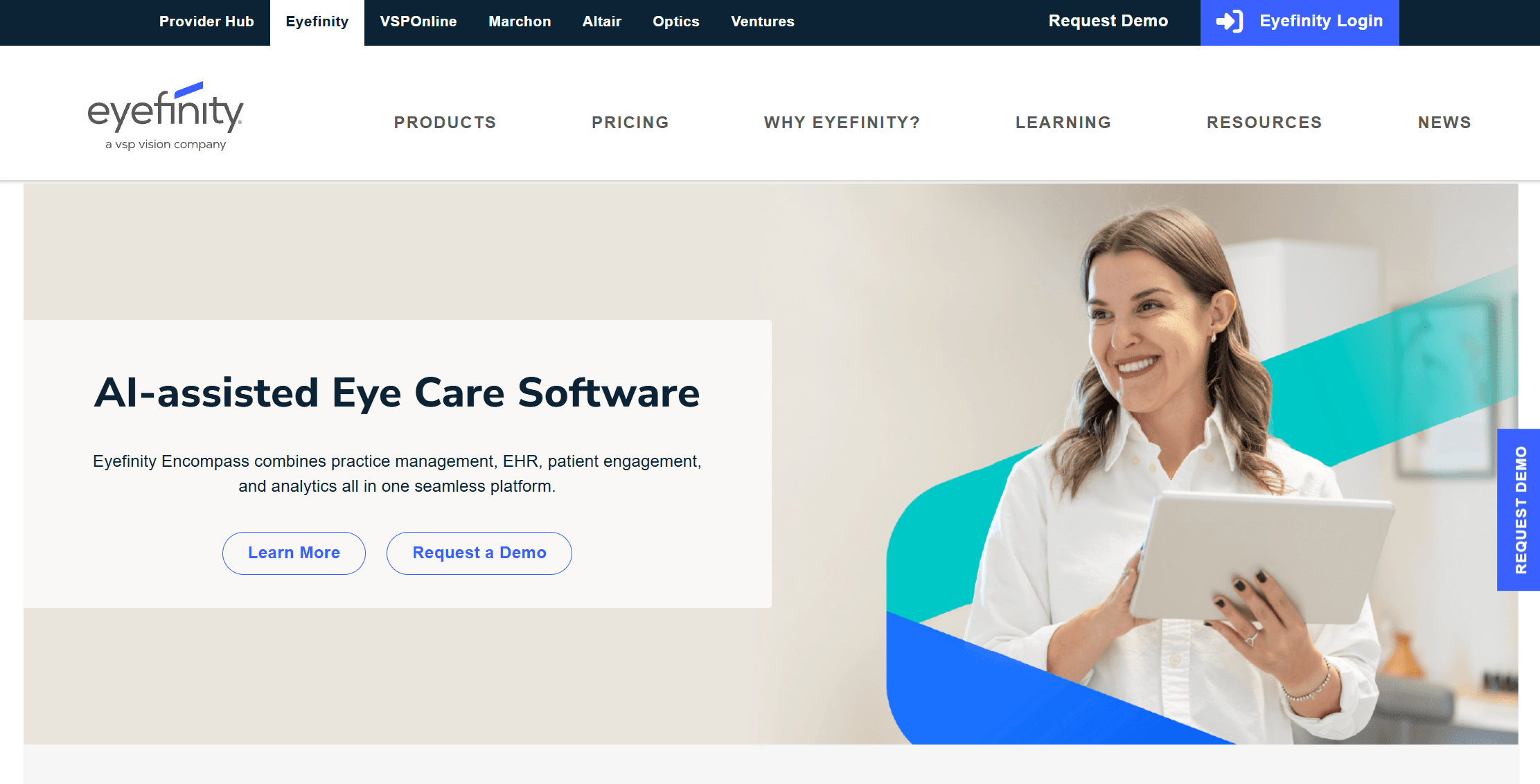
Eyefinity is a dominant player for practices billing VSP daily, offering deep insurance integrations, automated claims, and strong practice management. Its platform combines EHR and PM (practice management) with a focus on insurance automation, especially for VSP, which owns Eyefinity. This gives it privileged access to eligibility checks, real-time benefits, and streamlined claims workflows that can cut down on front desk time and billing errors.
Pricing: Starts around $449/month per provider. Add-ons and integrations may increase costs.
-
Key limitations:
- Recurring per-provider fees make scaling expensive.
- Integration flexibility is limited, especially for non-VSP payers or custom devices.
- Reporting customization requires enterprise tiers.
-
Strengths:
- Deep VSP and insurance integration.
- Unified EHR and PM platform.
- Strong vendor support and user community.
Eyefinity is a safe choice for VSP-heavy offices, but it’s still a rental model. If you want to own your system or deeply customize, it’s not a fit. With Devaims, you can integrate any insurer or device you need, without vendor restrictions.
2. RevolutionEHR (Best for cloud-based, all-in-one simplicity)
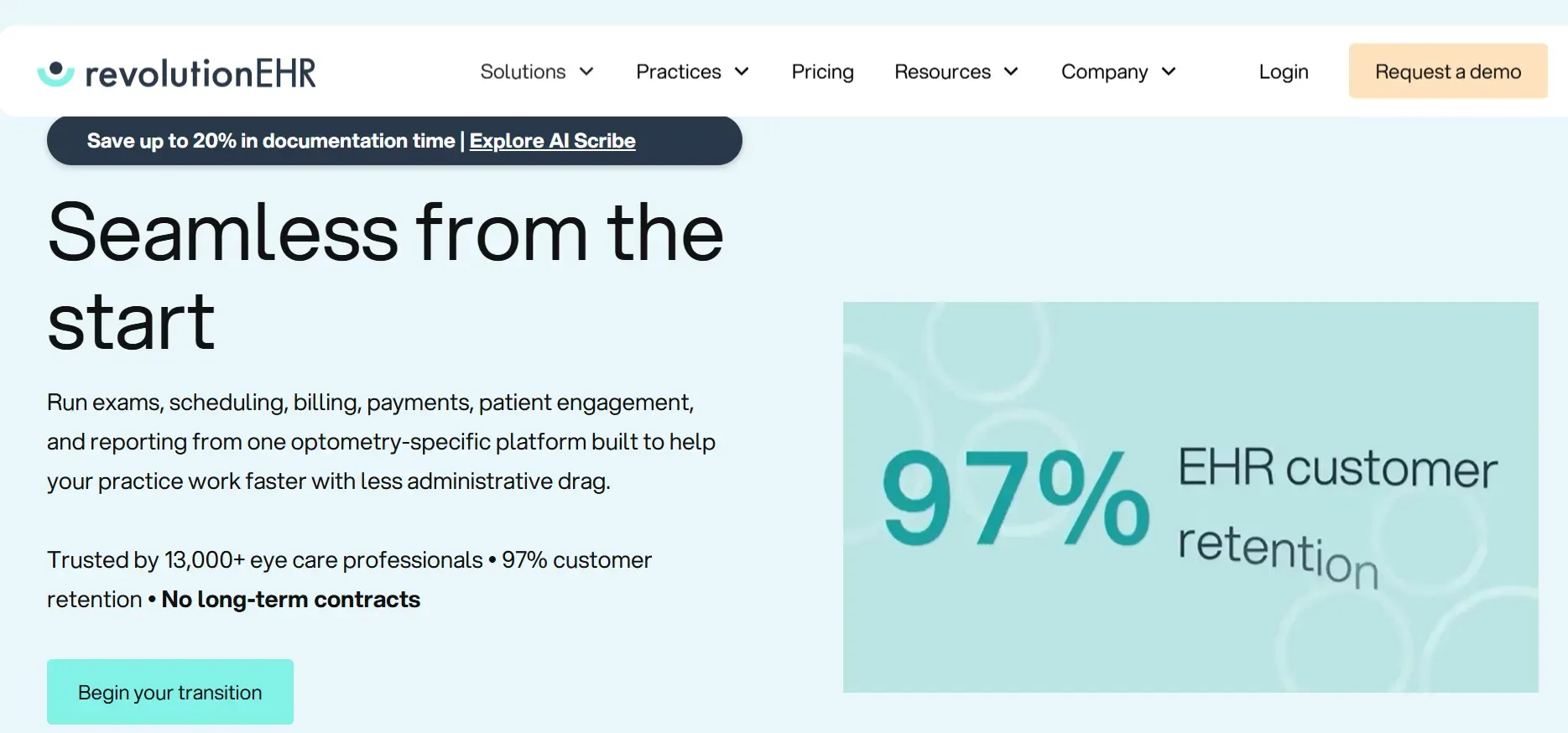
RevolutionEHR was one of the first optometry EHRs built native for the cloud, making it popular with practices wanting to ditch servers and access records from anywhere. Its focus is usability and speed, with standardized workflows that make onboarding faster for new staff and reduce IT headaches.
Pricing: Starts around $399/month per provider. Telehealth and patient messaging are extra.
-
Key limitations:
- Per-provider subscription fees add up as you grow.
- Customization is limited; custom reports may require paid support.
- Full data control is not possible; you cannot self-host or modify the code.
-
Strengths:
- Cloud-based access from anywhere.
- Fast onboarding and standardized workflows.
- Comprehensive EHR and PM in one platform.
RevolutionEHR offers ease and reliability, but if you want total control, you’ll need to look elsewhere. Devaims lets you own your cloud or on-premise system, with no per-user fees.
3. Crystal PM (Best for practices wanting EHR customization)
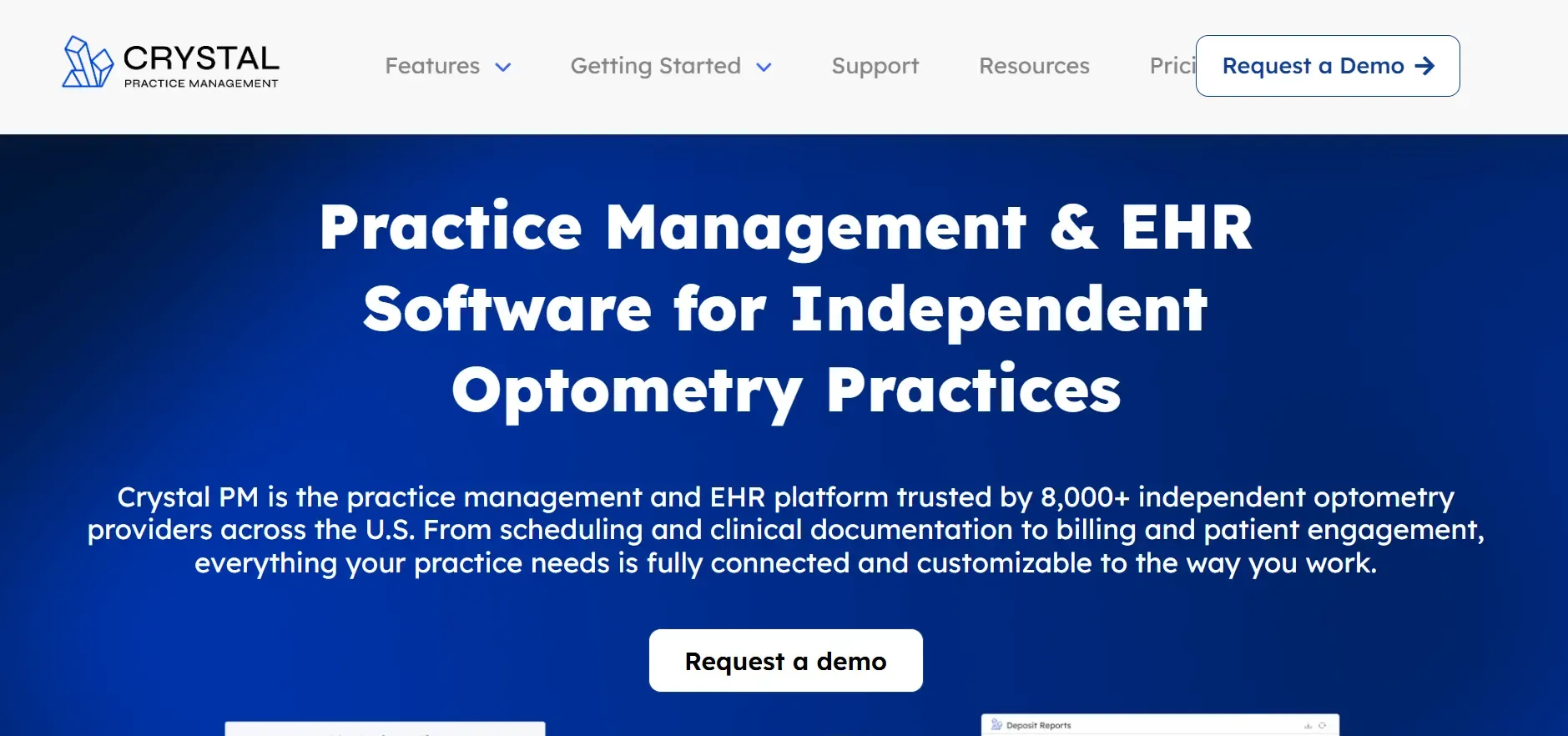
Crystal PM is a favorite among optometrists who want to tailor their EHR experience. The platform allows significant customization of intake forms, chart layouts, and some workflow logic. Crystal PM’s community forums are active, and many users share custom templates or workflows.
Pricing: Starts around $449/month per provider. Advanced integrations may cost extra.
-
Key limitations:
- Advanced customization requires technical skill or developer support.
- Subscription fees still apply per provider.
- Integrations outside the standard ecosystem may be costly or unsupported.
-
Strengths:
- Highly customizable forms and templates.
- Active user community for sharing workflows.
- Robust reporting and export tools.
Crystal PM is flexible, but you’re still renting and limited by what the vendor allows. With Devaims, you control every aspect of customization and integration.
4. Compulink (Best for large and multi-specialty practices)
Compulink is designed for scale: multi-location, multi-specialty, and enterprise clinics. Its feature set is deep, with modules for optometry, ophthalmology, and surgery centers. Compulink is known for supporting complex billing, analytics, and customizable workflows for large organizations.
Pricing: Starts around $399/month per provider. Enterprise features and support cost extra.
-
Key limitations:
- Enterprise learning curve; onboarding can be time-consuming.
- Premium features and support cost extra; contracts are often multi-year.
- Customization is possible, but only at higher tiers or with paid services.
-
Strengths:
- Comprehensive EHR and PM for large practices.
- Advanced analytics and reporting.
- Multi-specialty and surgical modules.
Compulink is powerful, but the trade-off is complexity, cost, and ongoing rent. Devaims gives you enterprise features with full ownership and no recurring per-provider fees.
5. OfficeMate (Best for legacy on-premise needs)
OfficeMate is the legacy solution from Eyefinity, still popular with practices that want to keep data local or avoid the cloud. OfficeMate is installed on local servers, giving practices direct control over data storage and backups. It’s a proven, stable system, used for decades by optometrists who value reliability and local IT management.
Pricing: Starts around $249/month per provider. Annual support and upgrades are extra.
-
Key limitations:
- Server maintenance and backups are your responsibility.
- Annual support fees continue indefinitely.
- Remote access and mobile workflows are limited.
-
Strengths:
- Local data control and on-premise storage.
- Proven reliability for traditional practices.
- Integrated optical and billing modules.
OfficeMate offers control, but at the cost of IT complexity and ongoing support contracts. Devaims lets you choose cloud or on-premise, with no forced upgrades or annual fees.
6. Modernizing Medicine (Eyes) (Best for specialist EHR features)
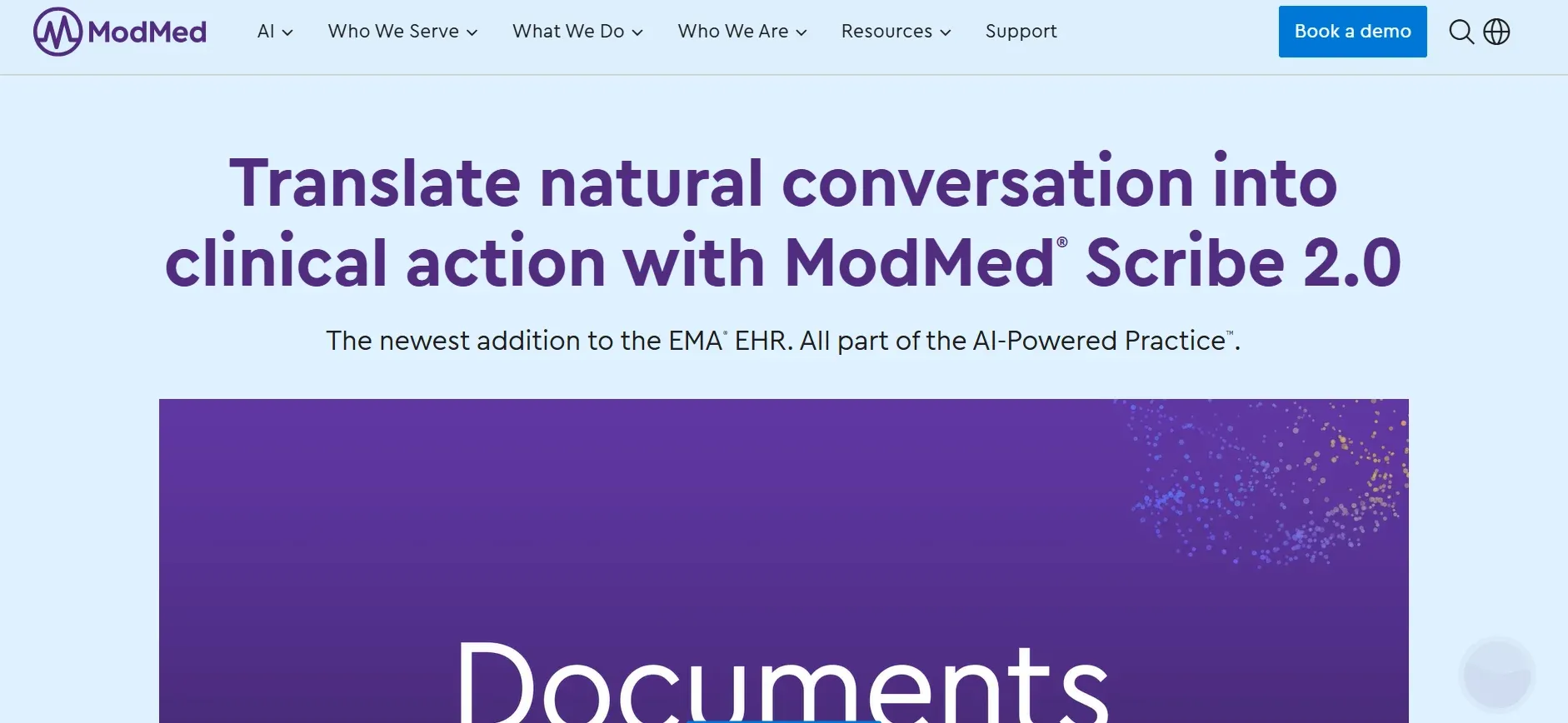
Modernizing Medicine (Eyes) is designed for ophthalmology and subspecialties, offering advanced clinical features, visual workflows, and deep imaging integration. Its specialty focus means retina, glaucoma, and surgical workflows are first-class citizens, with charting and diagnostic layouts tailored for each subspecialty.
Pricing: Starts around $499/month per provider. Enterprise contracts may be required for advanced features.
-
Key limitations:
- Premium pricing; core features often locked behind enterprise contracts.
- Customization outside supported workflows is limited.
- Migration for imaging and specialty data can be complex.
-
Strengths:
- Specialty-specific charting and imaging.
- Integrated patient engagement tools.
- Mobile app for point-of-care access.
Modernizing Medicine (Eyes) is a leader for specialists, but it’s a high-end rental with little ownership flexibility. Devaims can build specialty workflows to your exact needs, with no recurring rent.
7. Net Health Optometry (Best for multi-location groups)
Net Health Optometry targets regional or DSO-affiliated practices needing scalable, cloud-based management. Its design supports high-volume, multi-location scheduling and reporting, making it attractive for growing practices or those planning to add locations.
Pricing: Starts around $399/month per provider. API access and advanced integrations may cost extra.
-
Key limitations:
- Annual contracts with auto-renewal and strict termination clauses.
- Recurring per-provider or per-location fees can escalate as you scale.
- Customization is possible, but often at extra cost and with vendor involvement.
-
Strengths:
- Centralized scheduling for multi-location practices.
- Integrated analytics and reporting.
- Cloud-based EHR and PM platform.
Net Health Optometry is scalable, but you’re still paying rent and contract terms often favor the vendor. With Devaims, you scale locations and users with no extra fees.
8. MDVista (Best for independent ODs and small groups)
MDVista is a smaller EHR vendor with an optometry module, marketed to independent practices and small groups. It focuses on simplicity, straightforward charting, and basic billing, making it attractive for clinics wanting to avoid enterprise complexity.
Pricing: Starts around $299/month per provider. Limited advanced features.
-
Key limitations:
- Limited advanced features, no deep imaging, optical inventory, or specialty modules.
- Smaller vendor means fewer updates and less community knowledge.
- Subscription model persists, no path to ownership.
-
Strengths:
- Simple, affordable EHR for small practices.
- Quick onboarding and basic charting.
- Role-based access control for staff and providers.
MDVista is simple and affordable, but not expandable for complex or growing practices. Devaims lets you start simple and expand as your needs grow, with no vendor lock-in.
9. Devaims (Best for owning your EHR and workflow)
Devaims is a fundamentally different approach: your practice owns the code, database, and every workflow. Devaims builds your EHR to your exact specifications, integrating the devices, payers, and custom features you need. There are no per-provider or per-location fees, no contract lock-in, and no limits on data access or customization.
Pricing: One-time build cost (e.g., $32,000 for a typical 4-provider practice), plus a flat maintenance/support fee (e.g., $200/month). You own the system.
- Full ownership of code, database, and workflows.Custom integrations with any device, insurer, or lab.No recurring per-user or per-location fees.Unlimited customization and branding.Predictable costs and no contract lock-in.
- Full ownership of code, database, and workflows.
- Custom integrations with any device, insurer, or lab.
- No recurring per-user or per-location fees.
- Unlimited customization and branding.
- Predictable costs and no contract lock-in.
Devaims is the path to true ownership, no more rent, no more lock-in, and no more vendor-imposed limits.
Other MaximEyes alternatives worth knowing
- Kareo (not optometry-specific, but used by some clinics for billing and EHR; limited device integration).
- Nextech (ophthalmology and multi-specialty focus, higher enterprise pricing, strong for large surgical centers).
- AdvancedMD (generalist EHR with some eye care users, less tailored for optometry, but strong billing).
- Practice Mate (budget-friendly but lacks eye care depth; few integrations and limited reporting).
These options may work for niche cases or hybrid practices, but most lack the depth or optometry focus of the primary alternatives above. Always assess integration requirements and support for vision insurance before considering a generalist EHR.
How to choose the right MaximEyes alternative
- Budget vs. customization: Set your true cost tolerance. Per-provider fees add up quickly if you’re growing. Calculate five-year costs, including add-ons and support.
- Practice size and specialties: Some tools scale to DSOs or multi-specialty, others are better for solo ODs. Enterprise features often cost more but may be needed for surgical or multi-site practices.
- Integration needs: Check device, imaging, and insurance integrations, do you need VSP, Zeiss, OCT, or custom reporting? List your must-haves before you shop.
- Ownership and portability: If owning your platform matters, only a custom build like Devaims delivers that. Otherwise, plan for future migration costs and data export headaches.
- Contract flexibility: Watch for annual auto-renewals and data export restrictions. Ask vendors for sample contracts and export policies before you sign.
If rent fatigue is real and you’re ready to own your workflow, it’s time to compare the alternatives that let you keep what you pay for.
Stop paying rent on software you could own
The dirty secret: every MaximEyes alternative on this list is another rental. You might get a better interface, deeper VSP integration, or a more flexible charting tool, but the meter keeps running. Switch vendors and your monthly bill changes hands, not structure. Only a custom build puts you in the owner’s seat.
Devaims is the developer behind custom optometry platforms that you hold the keys to. You get the source code, the database, and integrations you choose, built around your actual workflow, not what fits a subscription template. No contract lock-ins, no hidden per-user upcharges, and no surprise “feature unlock” fees. You decide when to upgrade, and your data never leaves your hands.
- Recurring per-provider fees? Gone. Add users, locations, or modules at will, without a bigger bill.
- Locked integrations? Every device or insurer you need, integrated by design, not by vendor preference.
- Data portability? It’s your database, always exportable and modifiable, with no proprietary barriers.
- Custom workflows? Built for you from day one, no workarounds, no forced templates.
| Tool | Ownership | Per-provider fees? | Custom workflows? | Contract lock-in? |
|---|---|---|---|---|
| Devaims (owned) | You own the code | No | Yes, built for you | No |
| Eyefinity | Subscription | Yes | Limited | Annual |
| RevolutionEHR | Subscription | Yes | Limited | Annual |
| Compulink | Subscription | Yes | Enterprise tier | Annual |
Let’s do the 5-year rent to own math. Assume a practice with 4 providers paying $449/month each for a rented system (typical for MaximEyes, Eyefinity, or RevolutionEHR):
| Year | Rented (4x$449/mo) | Owned (Devaims $32,000 build, $200/mo maint) |
|---|---|---|
| 1 | $21,552 | $34,400 |
| 2 | $43,104 | $36,800 |
| 3 | $64,656 | $39,200 |
| 4 | $86,208 | $41,600 |
| 5 | $107,760 | $44,000 (now ahead) |
By year 2, your subscription outpaces the build. By year 5, you’re over $63,000 ahead and you own the system outright. For growing practices, the savings multiply as you scale. If you want to see your own numbers, Devaims will run the math for you on a real quote.
Keep in mind: this math doesn’t even include the hidden costs of upgrades, add-ons, or migration fees you’ll face with most subscriptions. With Devaims, your investment builds equity in your own technology, not a never-ending lease.
How to switch from MaximEyes
- Request and export all patient, billing, and clinical data from MaximEyes in a standard format (CSV, HL7, or as provided). Confirm that you have access to all historical imaging, scanned documents, and custom fields.
- Choose your new EHR or custom platform. Before signing, verify that the new system supports importing your data formats and can handle all devices and integrations you rely on.
- Work with your new vendor (or developer) to import patient records, appointment schedules, and clinical data. Plan for a validation phase to check data integrity and completeness.
- Reconnect payment processors, e-prescribe, and insurance integrations. If you use in-house billing or a third-party service, ensure they are looped in early to avoid disruption.
- Train your staff on new workflows, charting, documentation, and any new features or compliance requirements. Consider parallel running both systems for a short period to catch issues.
- Test the new platform in parallel, verify all integrations and data, and run test claims and reports to ensure everything works as expected.
- Review and officially terminate your MaximEyes contract when live. Be sure to keep a final data backup and confirm that all regulatory requirements for data retention are met.
With a custom Devaims build, the migration process is managed for you, data mapping, validation, and staff training are all part of the project. This reduces risk and ensures continuity.
Frequently asked questions
What is the best MaximEyes alternative for optometry practices?
For cloud-based EHR, RevolutionEHR and Eyefinity are leading choices, each with strong support, VSP integration, and solid practice management. However, both are subscription-based. If owning your system, data, and workflows is a priority, a custom build with Devaims is the only alternative that gives you complete control. This is especially important for practices with unique workflows, advanced integration needs, or long-term growth plans.
What’s the cheapest MaximEyes alternative?
Some smaller vendors offer lower monthly rates, but they often lack optometry-specific features, device integrations, and vision insurance workflows. Over time, recurring fees, even low ones, add up, and you may face migration costs if you outgrow their capabilities. If you want to control long-term cost and avoid future migrations, owning your EHR with Devaims is the most cost-effective path after 2-3 years for most practices.
Is there a free MaximEyes alternative?
There isn’t a truly free, optometry-focused EHR with the depth of MaximEyes. Some general medical EHRs (such as Practice Fusion in its earliest days) offered free tiers, but these typically relied on advertising or data monetization and lacked essential eye care workflows. Free open-source EHRs (like OpenEMR) exist but require significant technical expertise to customize for optometry and often lack device integration or vision billing support. Owning your system upfront with Devaims requires investment but pays off in cost, control, and compliance over time.
Which MaximEyes alternatives offer the most customization?
Crystal PM and Devaims are the leading options for customization. Crystal PM allows form tweaks, template customization, and some workflow logic, good for practices with technical staff or a willingness to learn. Only Devaims, however, gives you full control over the code, database, and integrations, allowing unlimited customization, branding, and feature extensions. If you need a system tailored exactly to your process, Devaims is the only true "blank slate" option.
When should I switch from MaximEyes?
If your costs are rising, integration needs outpace what MaximEyes offers, or you’re tired of being locked into a contract, it’s time to consider MaximEyes alternatives. Other signals: frequent staff complaints about workflow, inability to integrate new devices, or slow vendor support. Owning the platform with Devaims is the only way to break the rent cycle and future-proof your technology investment.
Can I keep my MaximEyes data if I switch?
You can export most of your data, but the process is rarely smooth. Expect to lose some custom fields, imaging metadata, or historical notes unless you plan migration carefully. It’s important to request a full export in the most universal format possible (HL7, CSV, or XML). Devaims handles migration as part of a custom build, ensuring your records are preserved and mapped correctly into your new system.
What should I look for in MaximEyes alternatives?
Assess total cost of ownership over at least five years, not just upfront or monthly fees. Prioritize integration flexibility, can you connect all devices, labs, and payers you need? Ensure you have full access to your data for future exports or analytics. Consider workflow customization: does the system fit your practice, or do you have to adapt to it? Finally, review contract terms for lock-ins, auto-renewals, and exit clauses. The keyphrase "MaximEyes alternatives" should turn up both rental and owned paths, know which you want before switching.
The bottom line
Your next EHR decision will shape your costs and control for years. If you’re done paying rent for tools you rely on, run the five-year math and see if owning makes sense for your practice. In nearly every scenario, Devaims puts you ahead after the initial build and you’re never locked out of your own data or workflow again.
Here is the test: add up what this tool will cost you over the next five years. If that number would have built you something you own, you already have your answer.
Explore more at the Devaims blog. Related reads: Eyefinity alternatives, RevolutionEHR alternatives, Compulink alternatives.