



Ever get hit with a "surprise" upgrade fee just to keep your PT clinic running? Or spend 40 minutes on hold trying to fix a reporting bug that matters only to you? If you use MediLinks, you know exactly what I'm talking about, with locked features, per-user fees, and a support queue that treats your business like an ID number. The truth: most PT EMR and practice management platforms are rented, not owned. And over five years, that rent can outpace what it costs to build your own system entirely.
If you’re on the hunt for MediLinks alternatives, you’re not alone. The best options, like Clinicient, Raintree, Prompt EMR, Therabill, and more, each fix some pain points, but introduce a few of their own. Most options are SaaS, so you trade one set of fees for another. There is a way out: a custom Devaims build you own outright. Here’s how the leading alternatives stack up, and why owning your software may finally make sense.
Why physical therapy clinics look for MediLinks alternatives
Physical therapy clinics often start with MediLinks because it is a known name, but the platform’s limitations become clear as clinics grow or workflows get more complex. Here’s why more clinics are searching for alternatives in 2026:
- Surprise costs and upgrade traps: Most clinics enter with an affordable monthly plan, only to find that must-have features, such as advanced documentation templates, outcome tracking, telehealth, or analytics, are locked behind expensive premium tiers. As you try to scale, you’re cornered into upgrades that can double or triple your original spend. Some clinics report annual fee hikes or "mandatory" updates that are difficult to refuse.
- Per-user or per-visit fees: Nearly all mainstream EMRs for PT use a per-user or per-provider pricing model. That means every new therapist, biller, or scheduler you add increases your monthly costs. Some platforms even charge for "inactive" or part-time users. If your clinic grows, the price can quickly outpace your margins, especially in high-volume or multi-location settings.
- Limited customization: Out-of-the-box workflows seldom match the realities of your clinic. Therapists often resort to workarounds, manual spreadsheets, or double-entry just to get through daily tasks. Customization is usually restricted to templates or a handful of settings. If you want new integrations (like a unique clearinghouse or analytics tool), you may find your vendor unwilling or slow to help.
- Data lock-in: Getting your data out of MediLinks can be a challenge. Exports may be incomplete, in proprietary formats, or require expensive professional services. This creates a high switching cost and makes clinics hesitant to move, even when their needs outgrow the platform.
- Long contracts and slow support: Many EMR vendors require multi-year contracts with steep penalties for early exit. Support is typically ticket-based, with response times that can stretch from hours to days. When your clinic is down or facing compliance deadlines, this lag can be costly.
In short, clinics are seeking alternatives that offer predictable costs, flexible workflows, better integration, and ownership or at least meaningful control over their technology stack.
Quick comparison of the best MediLinks alternatives
| Tool | Best for | Starting price | You own it? |
|---|---|---|---|
| Clinicient | Mature multi-site clinics | Reported $135+/user/mo | No |
| Raintree | Enterprise or integration-heavy clinics | Custom quote | No |
| Prompt EMR | Modern interface, small to mid clinics | Reported $149+/user/mo | No |
| Therabill | Insurance-heavy practices | From $149/mo | No |
| Casamba | Large group or SNF | Custom quote | No |
| Net Health | Hospitals and networks | Custom quote | No |
| Fusion Web Clinic | Pediatrics and speech/OT/PT | From $99/mo | No |
| DrChrono PT | Multi-specialty clinics | Reported $249/mo | No |
| Devaims | Clinics that want to own their stack | One-time build, you own it | Yes |
Always confirm current pricing before you decide. Rates and contract terms change quickly in this industry. If you negotiate, get all terms in writing, especially for data exports and cancellation.
The 9 best MediLinks alternatives
1. Clinicient (Best for multi-site PT clinics)
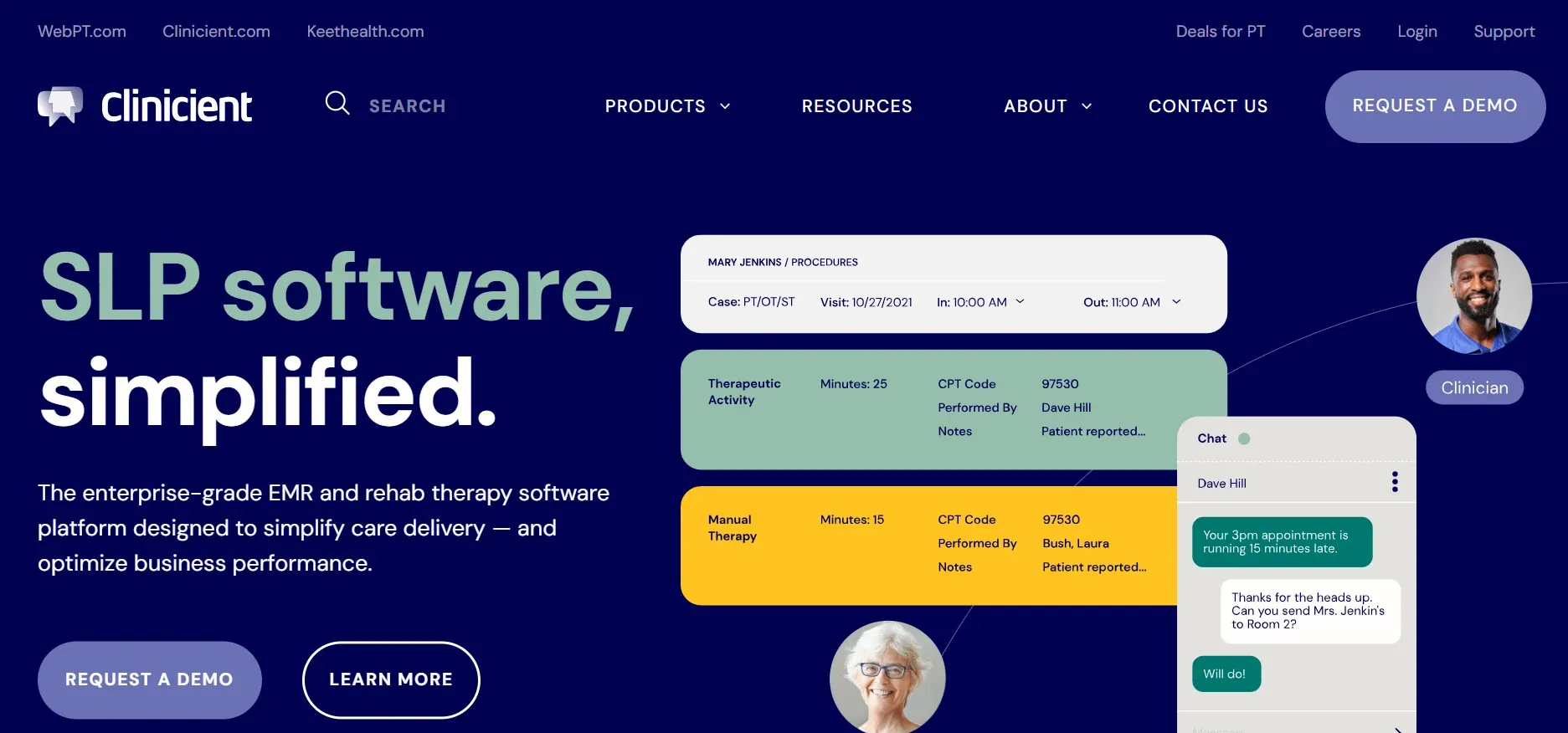
Clinicient is a mature, cloud-based EMR and revenue cycle management (RCM) platform built specifically for outpatient rehab. It is widely used by mid-sized and large PT, OT, and speech therapy groups looking for strong insurance integrations, compliance tools, and advanced analytics.
Pricing: Reported $135+/user/month, custom quotes for larger groups.
-
Key limitations:
- Pricing increases with each user added
- Custom workflow changes limited to templates
- Full data export may require support and extra fees
-
Strengths:
- Comprehensive scheduling, documentation, and billing
- Advanced analytics and outcome tracking
- Integrates with clearinghouses and billing partners
When you need more control over integrations, Devaims lets you connect to any system you choose, not just those supported by the vendor.
2. Raintree (Best for enterprise and complex integration)
Raintree is a highly configurable EMR and patient engagement platform targeting large, enterprise, or integration-heavy clinics. Raintree is often the choice when clinics require custom modules, extensive automations, or must mesh with hospital systems and legacy databases.
Pricing: Custom quote, typically higher for enterprise features.
-
Key limitations:
- Steep learning curve for new users
- Implementation and support often billable
- Complex setups require significant time and cost
-
Strengths:
- Highly customizable workflows and forms
- Robust API and integration options
- Granular permissions and compliance features
If you want to avoid ongoing support fees, Devaims gives you a flat maintenance model with no per-user surprises.
3. Prompt EMR (Best for modern, intuitive workflow)
Prompt EMR is a cloud-based EMR and practice management platform with a focus on speed and usability. Designed for small and mid-sized clinics, Prompt offers a visually appealing, intuitive interface that helps therapists document faster and engage patients more easily.
Pricing: Reported $149+/user/month.
-
Key limitations:
- Per-user pricing increases with staff size
- Custom integrations limited and require vendor
- Some insurance integrations less robust
-
Strengths:
- Fast, user-friendly interface
- Integrated telehealth and patient engagement
- Built-in analytics dashboards
With Devaims, you never pay per user or per visit, so your costs stay predictable as you grow.
4. Therabill (Best for insurance-heavy PT practices)
Therabill is a web-based billing and EMR tool focused on clinics with high insurance volume. It is especially popular among solo providers and small practices that value streamlined claims management and automated billing.
Pricing: From $149/month.
-
Key limitations:
- Limited documentation customization
- Extra cost for additional clearinghouse connections
- Reporting less customizable than enterprise tools
-
Strengths:
- Automated insurance eligibility and claims
- Simple charting and scheduling
- Native integration with WebPT
5. Net Health (Best for hospital-integrated PT)
Net Health is a leading provider of EMR and analytics solutions for hospitals and enterprise outpatient therapy clinics. It is built for scale, compliance, and integration with hospital IT systems.
Pricing: Custom quote.
-
Key limitations:
- Overkill for small or mid-sized clinics
- Interface less modern than newer SaaS tools
- Long-term contracts and limited customization
-
Strengths:
- Deep compliance and security features
- Enterprise-level analytics and reporting
- Integration with hospital EHRs
6. Fusion Web Clinic (Best for pediatric PT, OT, SLP clinics)
Fusion Web Clinic focuses on pediatric therapy clinics, with workflows and documentation designed for physical, occupational, and speech therapists working with children. Its clean interface and specialized templates make it a favorite for solo providers and small groups in the pediatric space.
Pricing: From $99/month.
-
Key limitations:
- Not designed for adult PT or multi-location scalability
- Customization outside pediatric focus is limited
- Larger practices may outgrow capabilities
-
Strengths:
- Pediatric-specific templates and goal tracking
- Parent/caregiver portal and telehealth
- Simple scheduling and billing
7. DrChrono PT (Best for multi-specialty practices)
DrChrono PT is the physical therapy module within the larger DrChrono EHR ecosystem. It is designed for clinics offering multiple specialties under one roof and looking for unified scheduling, billing, and patient management.
Pricing: Reported $249/month.
-
Key limitations:
- PT module less robust than standalone PT EMRs
- Costs rise quickly with add-ons and per-provider fees
- Support may prioritize larger customers
-
Strengths:
- All-in-one platform for multiple specialties
- iPad-native app for mobile charting
- Integrated billing and scheduling
8. Devaims (The only option you actually own)
Devaims builds fully custom physical therapy EMR and practice management systems that you own outright. No per-user or per-visit fees, no locked features, no contract renewals. You get the code, your data, and total control. With Devaims, you stop renting and start owning your digital clinic.
Pricing: One-time build cost, plus flat maintenance (no per-user fees).
- Custom workflows, forms, and documentation tailored to your clinicIntegration with any clearinghouse, billing partner, or third-party toolReporting and analytics built to your KPIsRole-based permissions and compliance featuresFull ownership of code and database, modify or extend as you grow
- Custom workflows, forms, and documentation tailored to your clinic
- Integration with any clearinghouse, billing partner, or third-party tool
- Reporting and analytics built to your KPIs
- Role-based permissions and compliance features
- Full ownership of code and database, modify or extend as you grow
With Devaims, you never pay to add a user, location, or feature unless you want to build something new. Your data and code are always yours.
Other MediLinks alternatives worth knowing
- TherAssist: A legacy PT EMR with basic charting. Feels dated but works for small clinics comfortable with older interfaces. Limited ongoing development and integrations.
- WebPT: Very popular but omitted above due to overlap with Therabill. Worth looking at for its ecosystem, but still rented. WebPT offers a marketplace of add-ons and a large community, but pricing escalates for advanced features.
- SimplePractice: Often used by solo therapists and counselors, but lacks PT-specific depth. SimplePractice is easy to set up, but documentation and billing may not meet the needs of PT clinics with insurance-heavy workflows.
How to choose the right MediLinks alternative
- By clinic size: Large groups may need enterprise features (Raintree, Net Health), while smaller clinics can do more with Fusion or DrChrono PT. Consider future growth, and whether your platform will scale with you.
- By workflow fit: If your needs are highly specialized, rented tools can only go so far, as customization is limited. Evaluate how much you can tailor documentation, scheduling, and reporting to your clinic’s processes.
- By integration needs: Some platforms play nicely with clearinghouses and billing, others do not. Ask for integration documentation and references before you sign.
- By cost structure: Add up per-user, per-visit, and add-on costs over five years. Factor in hidden fees, such as data exports or support. This is where ownership can win, especially for established clinics.
If none of the rented MediLinks alternatives fit, or if you’re tired of paying for features you should just own, it’s time to consider a custom build.
Stop paying rent on software you could own
The core problem: every alternative to MediLinks is still rented. Whether you go with Clinicient, Prompt, or another SaaS, you’re paying monthly, per user, and for features you might eventually outgrow. The "upgrade trap" is real. Owning your software is the only way off the treadmill.
Devaims builds custom web, mobile, and business software for physical therapy clinics, then hands you the source code. You own it, outright. No more vendor lock-in, no more per-user fees, no more waiting for a feature that fits your workflow. You get a platform built for your exact needs, and you keep it for good.
- If you’re battling per-user fees, those disappear. Your staff count is your business, not your vendor’s.
- Need a report nobody else does? It’s yours, because your system is built for you.
- Integrations stalled on a vendor’s roadmap? When you own the code, you control the timeline.
- Above all: your data is always yours, and switching vendors becomes a thing of the past.
| Platform | Ownership | Per-user fees | Customization |
|---|---|---|---|
| MediLinks | No | Yes | Limited |
| Clinicient | No | Yes | Moderate |
| Prompt EMR | No | Yes | Moderate |
| Devaims | Yes, you own it | No | Unlimited |
| Year | Rented (ex: $800/mo) | Owned (Devaims) |
|---|---|---|
| 1 | $9,600 | $27,000 (build) |
| 2 | $19,200 | $28,800 |
| 3 | $28,800 | $30,600 |
| 4 | $38,400 | $32,400 (now ahead) |
| 5 | $48,000 | $34,200 |
For a typical five-provider clinic on $800/month SaaS, you cross the break-even point in year four. Every year after, owning widens the gap. If you want to see your own numbers, Devaims will run the math for you, with no strings attached.
Who benefits most from owning? Clinics with stable staff counts, custom workflows, or long-term visions. If you want to control your tech, not just rent it, ownership is the only real alternative.
How to switch from MediLinks
- Export all data: Extract patient records, treatment notes, schedules, billing history, and any custom forms or attachments from MediLinks. Confirm the export format (often CSV or XML) and check for completeness, as some fields or attachments may need separate requests.
- Choose your new platform: Whether SaaS or custom, verify the new system’s data import capabilities. Ask for references about their migration process and support.
- Map and import data: Work with your new vendor to map fields, import historical data, and verify integrity. Run test imports to check for data loss or corruption. For custom builds (like Devaims), this is included in the project and tailored to your needs.
- Re-establish integrations: Reconnect payment gateways, clearinghouses, analytics, and any third-party tools. For custom solutions, you can expand integrations as needed.
- Train your staff: Schedule orientation and workflow training. Run both systems in parallel for 2 to 4 weeks to catch issues and ensure a smooth transition.
- Review contracts and policies: Check your MediLinks contract for notice periods, cancellation fees, and data retention policies. Plan your go-live date accordingly.
With a custom Devaims build, the migration is handled as part of the project, including data mapping, validation, and user training.
Frequently asked questions
What is the best MediLinks alternative for large PT clinics?
For large or multi-site PT clinics, Clinicient and Raintree are strong choices due to their robust billing, scheduling, and reporting. Both offer enterprise features and integrations. However, if you want to own your workflow, data, and platform, avoiding per-user fees and vendor lock-in, a custom Devaims build is the only real alternative that puts you fully in control. This is especially true if your clinic has custom workflows, unique compliance needs, or plans for significant growth.
Which MediLinks alternative is most affordable for small practices?
Fusion Web Clinic and DrChrono PT offer the lowest entry pricing for solo or small group practices. These platforms have straightforward pricing, minimal onboarding costs, and simple interfaces. However, as your practice grows, monthly rental costs and upgrade fees can add up. Over five years, these costs can exceed the price of a custom-built solution, especially if you plan to add users or require advanced integrations.
Are there any free MediLinks alternatives?
Very few truly free EMR tools are designed for physical therapy. Most free platforms lack insurance billing, compliance features, or PT-specific templates. Some open-source EMRs exist (like OpenEMR), but they require significant technical setup and customization, and often do not meet the needs of insurance-billing PT clinics. For most practices, budgeting for a basic paid plan or investing in a custom solution is necessary for compliance and workflow efficiency.
When does it make sense to build your own PT software?
It makes sense to build and own your platform when:
- Your rental costs exceed $700 to $1,000 per month (typical for 4 or more providers on SaaS)
- You have specialized workflows, reporting, or integrations that off-the-shelf EMRs cannot support
- Data security, compliance, and ownership are priorities
- You want to avoid recurring fees and long-term contracts
Devaims specializes in building platforms for clinics that want to control their tech future. Ownership means you decide on features, integrations, and updates, without waiting for a vendor’s roadmap or paying per user.
Can I keep my historical patient data when switching from MediLinks?
Yes, but the process can be complex. Most clinics can export patient records, billing, and schedules, but custom fields, attachments, and forms may require additional steps. Some EMRs charge for full data exports or provide data in formats that need conversion. Devaims includes comprehensive data migration as part of the project, ensuring you retain all critical information and maintain compliance records.
Do all MediLinks alternatives charge per user?
Almost all SaaS EMRs charge per user or per provider, and some also charge for billers, schedulers, or administrative staff. These costs can escalate quickly as your clinic grows. Only a custom Devaims build lets you pay once (plus flat maintenance) and own your software outright, so you can add as many users, locations, or features as you want, with no extra fees.
Is Devaims right for every PT clinic?
Devaims is ideal for clinics that want to control their software, scale without per-user costs, and keep their data and code. Clinics with stable staff counts, complex workflows, or a long-term growth plan benefit most. For very small or new practices with minimal needs and limited budgets, a basic SaaS may suffice in the short term. But the rent versus own math changes quickly as you add users or require custom features.
The bottom line
The top MediLinks alternatives each offer modern workflows, but none break the rental cycle. Here’s your test: add up what a rented EMR will cost you over five years. If that number could have bought you a system you actually own, you already have your answer. For clinics that want to control their tech stack, Devaims is the only alternative that hands you the keys to your own platform.
Want more honest takes? See the Devaims blog, or check out our guides to WebPT alternatives and SimplePractice alternatives.