



Ever feel like your EMR is running your clinic, not the other way around? You tweak your workflow to fit the system, chase down features locked behind a paywall, and wince every time a new per-provider fee hits your bill. Fusion Web Clinic is everywhere in physical therapy and rehab, but the rent-never-own model gets expensive, fast. Five years in, you’ve written checks that could have paid for your own custom platform, but you still don’t own a line of code.
If you’re searching for Fusion Web Clinic alternatives, you’re not alone. Clinicians get tired of rigid templates, nickel-and-dime add-ons, or the constant sense that their data isn’t truly theirs. This guide walks you through the best alternatives: Clinicient, Raintree, Prompt EMR, Therabill, Casamba, Net Health, DrChrono PT, TherAssist, and, for those who want to own instead of rent, a custom Devaims build. If you’re done with rent-forever SaaS, there’s a new way to do it.
Why physical therapy clinics look for Fusion Web Clinic alternatives
Per-provider fees add up fast: Most SaaS EMRs charge a flat fee per provider, which can seem manageable with a small team but quickly balloons as you grow. For each new therapist, admin, or even front-desk scheduler, you’re often paying full price. This model punishes growth and can create budgeting headaches, especially when you expand to new locations or bring on part-timers.
Rigid templates slow your workflow: Many clinics find themselves forced to adapt their processes to fit the software, not the other way around. Pre-set documentation templates, limited ability to create custom forms, or lack of flexibility in scheduling can cost your staff valuable time. Even when customization is available, it often requires expensive professional services or time-consuming workarounds.
Locked-in contracts: Most mainstream EMR vendors require annual or multi-year agreements. Early termination can trigger penalty fees or even data access restrictions. This means you may be stuck with a system that no longer fits your needs, with little leverage to negotiate improvements or cost reductions.
Add-ons and nickel-and-diming: Core features like outcomes tracking, telehealth, e-prescribing, or advanced reporting are frequently sold as paid add-ons. This a la carte pricing model can make it difficult to forecast your total cost, and every new feature you need is another negotiation or invoice.
No true data ownership: Your clinic’s clinical and business data lives on someone else’s server. While most reputable vendors allow data export, the process can be cumbersome, incomplete, or expensive. In some cases, you may only get PDFs or limited CSV exports, making true migration or analytics difficult. If you ever want to switch, you’ll need to invest significant time and resources to ensure a smooth transition and data integrity.
If any of these hit home, you’re in the right place to explore Fusion Web Clinic alternatives.
Quick comparison of the best Fusion Web Clinic alternatives
| Tool | Best for | Starting price | You own it? |
|---|---|---|---|
| Clinicient | Integrated billing, EMR | Reported $100+/provider/mo | No |
| Raintree | Enterprise clinics | Custom quote | No |
| Prompt EMR | Modern EMR, scheduling | Reported $120+/provider/mo | No |
| Therabill | Small practices | Reported $149/mo/therapist | No |
| Net Health | Hospital-affiliated clinics | Custom quote | No |
| DrChrono PT | Cloud EMR for PT | Reported $200+/user/mo | No |
| TherAssist | Solo/small clinics | Reported $80+/mo | No |
| Devaims | Owning your platform | One-time build, you own it | Yes |
Always confirm current pricing before you decide. Rates and included modules change often. Many tools require custom quotes for larger clinics, so real-world pricing may be higher than what’s listed on their websites.
The 9 best Fusion Web Clinic alternatives
1. Clinicient (Integrated billing, EMR)
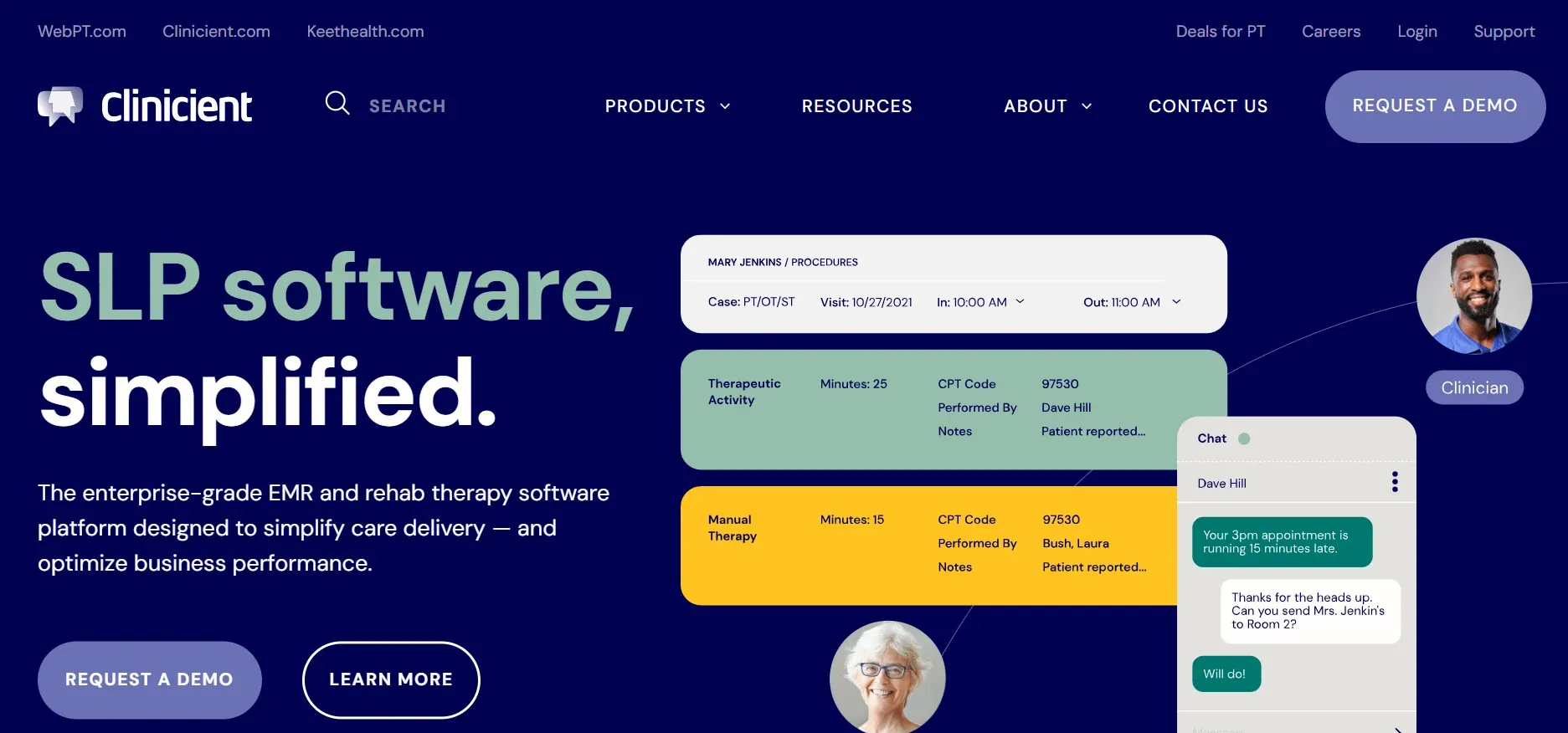
Clinicient stands out for its all-in-one approach to EMR, practice management, and especially integrated billing. It’s a cloud-based system tailored to outpatient rehab clinics, aiming to centralize scheduling, clinical documentation, and revenue cycle management (RCM) in one platform. Clinicient’s billing suite is particularly deep: automated eligibility checks, claim scrubbing, denial management, and analytics are native, not bolted on. This makes it attractive for clinics with complex insurance mixes or high claim volumes.
Clinicient’s documentation tools cover PT, OT, and SLP, and include customizable templates, flowsheets, and outcome measures. Their analytics module gives access to real-time dashboards for KPIs like productivity, collections, and compliance. On the integrations front, Clinicient connects to clearinghouses, payers, and common accounting tools, reducing manual re-entry of data.
Migration friction: Moving to Clinicient can require significant onboarding, including data migration, workflow mapping, and staff training. Customization is possible but typically involves setup fees and time with their implementation consultants.
Best use cases: Midsize to large practices seeking to streamline billing and clinical operations, especially those struggling with denied claims or complex multi-payer environments.
Trade-offs: You get industry-leading RCM, but you’re still locked into per-provider fees that grow with your clinic. Customization is better than some, but still within the boundaries of their platform.
Pricing: Reported at $100+/provider/month. See their pricing page for details.
- Deep, automated billing and insurance tools
- Unified login for EMR and billing
- Strong customer support and onboarding
- Per-provider fees scale up as you grow
- Custom work and deeper integrations may carry extra cost
- Long-term contracts are common
With Devaims, that per-provider fee disappears entirely after the build. You own the system.
2. Raintree (Enterprise clinics)
Raintree is built for large, multi-site therapy and rehab organizations that need scale and deep configuration. Its platform covers scheduling, documentation, billing, outcomes, and patient engagement. Raintree’s architecture is modular, so you can add features like telehealth, patient portals, and business intelligence as needed.
One of Raintree’s standout features is its workflow engine, which allows clinics to automate tasks, reminders, and approvals. Its analytics suite provides custom dashboards for executives, providers, and billing teams, making it a good fit for organizations with multiple departments or locations. Raintree integrates well with hospital information systems (HIS) via HL7 and other standards, supporting both standalone clinics and hospital-affiliated networks.
Migration friction: Raintree’s implementation process is thorough but can be lengthy. Expect several weeks to months for onboarding, data migration, and staff training. Customization is possible but may require additional consulting fees.
Best use cases: Large, multi-site PT groups, enterprise rehab networks, and hospital-affiliated clinics that need strong audit trails, custom reporting, and regulatory compliance.
Trade-offs: Raintree’s power comes at the cost of complexity. Smaller clinics may find the system overwhelming, and the price tag reflects its enterprise focus. You’ll still be paying ongoing per-user or per-location fees, and true source code ownership is not possible.
Pricing: Custom quote. Typically tiered by user count and features.
- Highly scalable for large networks
- Powerful analytics, business intelligence, and workflow automation
- Deep integrations with hospital and enterprise systems
- Setup and training require significant time investment
- Minimum contract periods are standard
- Customization and integrations can add to cost
3. Prompt EMR (Modern EMR, scheduling)
Prompt EMR is a cloud-based EMR built for modern, intuitive workflows. It’s designed to eliminate much of the friction found in legacy systems, focusing on a clean user interface, rapid onboarding, and automation. Prompt EMR covers scheduling, documentation, billing, outcomes, patient engagement, and even marketing tools like referral tracking and automated reminders.
Its documentation engine lets you create custom templates with drag-and-drop fields, and includes e-signatures, progress note automation, and real-time compliance alerts. Prompt’s scheduling system is praised for its ease of use, with color-coded calendars, recurring appointments, and waitlist tools. The billing and claims module supports electronic claims, ERA posting, and patient payments via integrated processors.
Prompt integrates with clearinghouses, telehealth platforms, and common accounting tools. Its patient portal supports intake forms, appointment requests, and online bill pay. For clinics looking to modernize quickly, Prompt offers fast implementation and responsive support.
Migration friction: Prompt’s onboarding is relatively fast, but you’ll still need to plan for data export/import, user training, and configuration of custom forms and workflows. Some advanced features are only available in higher pricing tiers.
Best use cases: Growing clinics and startups seeking a modern, all-in-one platform with strong patient engagement tools and flexible documentation.
Trade-offs: While Prompt is aesthetically modern and user-friendly, you’re still renting. Per-user fees persist, and deeper customization is limited to what the platform allows. Integrations with niche tools may require extra work.
Pricing: Reported at $120+/provider/month. See Prompt EMR pricing.
- Modern, intuitive interface
- Fast setup and onboarding
- Strong patient engagement and automation options
- Monthly per-user fees add up as you scale
- No true ownership of platform or data
- Some advanced features require higher tiers
With a custom Devaims build, you get a workflow crafted around your clinic. No extra tier needed for the features you want.
4. Therabill (Small practices)
Therabill is a cloud-based practice management and billing solution designed specifically for solo and small-group therapy practices. Its strength lies in its simplicity and affordability for smaller teams. Therabill supports scheduling, documentation, electronic claims, ERA posting, and patient invoicing. It integrates with WebPT, so clinics can use Therabill for billing while maintaining clinical documentation in WebPT’s system.
The documentation module is basic, sufficient for standard SOAP notes and progress reports, but less flexible than enterprise options. Therabill’s billing engine is strong for its price, supporting insurance, patient, and secondary billing, and includes automated reminders for outstanding balances. Reporting features are limited compared to larger systems, but adequate for small practices tracking revenue and appointment trends.
Migration friction: Therabill’s onboarding is straightforward for small clinics, but migrating from a more complex system may require manual data entry or limited imports. Exporting data for future migration is possible, but not always comprehensive.
Best use cases: Solo providers or very small clinics looking for a budget-friendly, web-based system that simplifies billing and scheduling.
Trade-offs: Therabill’s simplicity can be a double-edged sword. Great for ease of use, but limiting as you grow or if you need advanced analytics or custom workflows.
Pricing: Reported $149/month/therapist. See the Therabill pricing page.
- Easy to use for solo providers
- Good billing and insurance integration
- Simple web-based access from any device
- Limited reporting and analytics
- Not designed for large or fast-growing clinics
- Monthly fee per therapist
5. Net Health (Hospital-affiliated clinics)
Net Health is purpose-built for hospital-affiliated rehab and therapy clinics. Its suite includes EMR, scheduling, compliance tracking, and analytics, with a strong focus on integrating into hospital IT environments. Net Health is recognized for its rigorous audit trails, security, and compliance with HIPAA, HITECH, and other healthcare regulations.
The documentation module supports customizable templates, electronic signatures, and built-in compliance alerts. Scheduling is integrated with hospital calendars, and billing modules support both professional and facility claims. Net Health offers deep integration with hospital systems via HL7 and API, and its analytics tools provide real-time insight into productivity, compliance, and outcomes.
Migration friction: Implementation is complex due to the need to interface with hospital IT and compliance systems. Net Health provides dedicated onboarding teams but expects a multi-phase rollout and extensive staff training.
Best use cases: Hospital-based rehab departments, large outpatient clinics affiliated with health systems, and organizations needing enterprise-level compliance and reporting.
Trade-offs: Net Health’s depth and compliance focus mean higher costs and complexity. Smaller clinics may find the system overwhelming, and ongoing costs escalate with user and location growth.
Pricing: Custom quote. Pricing typically scales with users and modules.
- Strong compliance, audit trails, and security
- Deep hospital and enterprise integrations
- Trusted by major health systems
- Complex onboarding and IT integration
- Enterprise contract required
- Per-user or per-location pricing
6. DrChrono PT (Cloud EMR for PT)
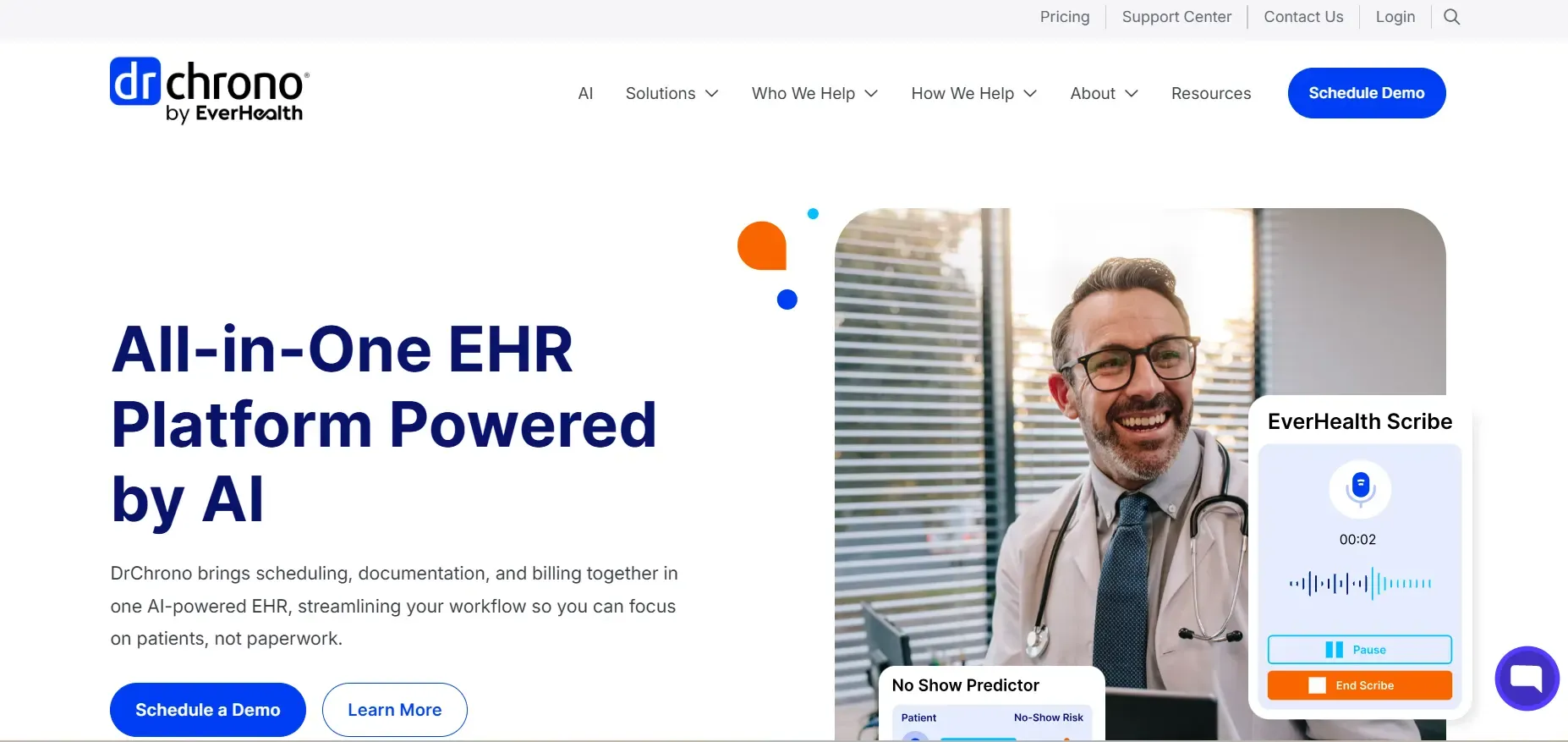
DrChrono PT extends the popular DrChrono EMR ecosystem to physical therapy and rehab clinics. It offers a cloud-based EMR with telehealth, e-prescribing, appointment reminders, and patient engagement tools. DrChrono’s mobile-first design allows providers to document and manage schedules from tablets or smartphones, appealing to clinics on the go.
DrChrono PT provides customizable clinical templates, SOAP notes, and outcome measures, though some PT-specific features may feel less mature than in platforms built exclusively for rehab. The platform’s billing system supports electronic claims, ERA, and patient billing. DrChrono integrates with labs, imaging, and pharmacy networks, and offers an open API for third-party connections.
Migration friction: Onboarding is relatively quick if you’re already using DrChrono in other specialties; otherwise, data migration and template customization may require support from their onboarding team. PT-specific workflows may need additional configuration.
Best use cases: Clinics already using DrChrono for other specialties, or those seeking strong telehealth and mobile documentation.
Trade-offs: DrChrono’s PT features are improving but may lag behind niche PT EMRs for advanced rehab workflows. Pricing is premium, and support quality can vary based on your subscription tier.
Pricing: Reported $200+/user/month. See DrChrono pricing.
- Strong telehealth, mobile, and e-prescribing features
- Cloud access from anywhere
- HIPAA compliant and scalable
- Premium pricing per user
- Some PT features feel less integrated
- Support responsiveness varies
7. TherAssist (Solo/small clinics)

TherAssist caters to solo practitioners and small clinics seeking affordable, straightforward scheduling and documentation. Its core features include appointment calendars, basic documentation templates, and simple reporting. TherAssist’s interface is functional but dated, focusing on reliability over aesthetics.
The platform allows for simple customizations, such as adding clinic-specific fields to notes, but lacks the deep workflow automation or analytics seen in larger systems. Billing capabilities are present but basic, supporting superbill generation and manual claims management. Data export is possible, though advanced integrations are limited.
Migration friction: Onboarding is easy for new clinics, but importing historical records from other systems may require manual entry or limited data mapping.
Best use cases: Solo providers or clinics with 1-3 therapists who want a low-cost, no-frills solution for scheduling and documentation.
Trade-offs: TherAssist is not built for scale. Growing clinics will quickly outgrow its capabilities. The user interface may feel dated, and customization options are limited.
Pricing: Reported $80+/month. See TherAssist pricing.
- Budget-friendly for solo providers
- Simple learning curve and fast onboarding
- Supports core PT workflow needs
- Limited features for growing clinics
- Older user interface and limited integrations
- Few customization options
8. Devaims (Owning your platform)
Devaims builds custom clinic software that you own outright. Unlike every other option on this list, Devaims hands over the source code, giving you full control over your software, your data, and your future. You define your workflows, documentation templates, and integrations, tailored exactly to your team’s needs and your clinic’s branding. The system can include EMR, scheduling, billing, reporting, patient portals, telehealth, or any other feature you require.
With Devaims, you pay a one-time build fee and a flat, predictable maintenance cost. There are no per-user, per-location, or per-feature fees. You can host your system anywhere, on your servers or in the cloud, and integrate with any third-party system you choose. Data export, custom analytics, and workflow changes are under your control, not a vendor’s roadmap.
- One-time build, then flat maintenance, no rent, no per-user fees
- Unlimited customization, your branding and workflow
- Full data and source code ownership, forever
- Hosting and integrations on your terms
Other Fusion Web Clinic alternatives worth knowing
- Practice Perfect: Good for small clinics needing basic scheduling and billing, but limited analytics and custom workflow options.
- WebPT: Widely used in PT, with extensive integrations and a large user community, but has similar rent-and-upgrade pricing to Fusion Web Clinic.
- ReDoc: Designed for hospital-based therapy, strong for compliance and documentation, but onboarding is resource-intensive.
- SimplePractice: Great for mental health and solo providers, but lacks the PT-specific workflows and outcomes tracking needed for many rehab clinics.
How to choose the right Fusion Web Clinic alternative
- Budget: Add up your current per-provider, per-location, and add-on fees, then compare to custom build costs. Remember to factor in onboarding, migration, and potential termination fees from your current vendor.
- Customization: If you’re frustrated by rigid templates or workflows, look for platforms that allow real configuration, or consider owning with Devaims, where anything is possible.
- Clinic size: Small practices may do fine with TherAssist or Therabill, but as you grow or add locations, the cost and rigidity of these systems become limiting. Multi-site or enterprise groups should prioritize scalability and integration options.
- Compliance: Hospital-affiliated clinics and those in regulated markets need strong audit, security, and reporting tools. Ensure your chosen platform supports HIPAA, HITECH, and local regulations.
- Ownership: If source code and data ownership matter, only a custom build truly delivers. This also future-proofs your investment against vendor shutdowns or price hikes.
If you want out of the rent-forever model for good, keep reading for the true ownership option.
Stop paying rent on software you could own
Every Fusion Web Clinic alternative on this list, except Devaims, still keeps you on the hook for monthly fees, per-provider charges, and contracts that never really end. The moment you want to leave or add new features, you’re back to the negotiation table. What if, instead, you owned your EMR system outright, built for your workflow, your branding, and with your data saved where you want it?
Devaims builds custom software for physical therapy, rehab, and multi-site clinics. You get every feature you need, none you don’t, and the source code is delivered for you to own. No more licensing drama, no more wondering if your data will be held hostage if you switch.
- No more per-user or per-location fees. Add as many therapists or clinics as you want, your cost doesn’t change.
- No more locked features. If you need a report, billing rule, or integration, you just have it, no upsell required.
- Full data control. Host on your terms. Export anytime. No more “request a CSV” hoops.
Here’s how Devaims compares to the usual suspects:
| Tool | Ongoing cost | Data ownership | Contract required? |
|---|---|---|---|
| Fusion Web Clinic | $100+/user/mo | Vendor holds code | Yes |
| Prompt EMR | $120+/provider/mo | Vendor holds code | Yes |
| Casamba | Enterprise quote | Vendor holds code | Yes |
| Devaims | One-time build + flat maintenance | You own the code | No |
Here’s what rent vs. own looks like over five years for a 10-provider clinic:
| Year | Rented (at $120/provider/mo) | Owned (Devaims: $32,000 build + $200/mo maint) |
|---|---|---|
| 1 | $14,400 | $34,400 |
| 2 | $28,800 | $36,800 |
| 3 | $43,200 | $39,200 |
| 4 | $57,600 | $41,600 |
| 5 | $72,000 | $44,000 (now ahead) |
Renting is cheaper for about two years. After that, owning pulls ahead and keeps widening the gap. If you have 10 therapists at $120 each per month, that’s $1,200 per month, $14,400 per year, roughly $72,000 over five years, and you still don’t own your platform. With Devaims, you build once, pay a flat maintenance fee, and the code is yours. If you want an exact break-even for your situation, we’ll run the numbers for you.
Clinics scaling up, sick of paying for every new hire, or with unique workflow needs gain the most from owning. If you want true control, real customization, and to keep what you’ve built, Devaims is the only real alternative.
How to switch from Fusion Web Clinic
- Export your data: Start by exporting patient demographics, clinical documentation, appointment histories, billing records, and outcomes from Fusion Web Clinic. Use CSV or PDF exports if available, and request assistance from Fusion’s support team to ensure completeness.
- Choose your new platform: Select the alternative that best matches your needs and budget. For SaaS tools, set up your account and configure core settings (users, scheduling, billing rules). For Devaims, requirements gathering and workflow design are part of the build process.
- Import historical records: Most platforms provide import tools or support for bringing in legacy data. Test the import with a sample set to ensure accuracy and completeness.
- Reconnect integrations: Set up payment processors, clearinghouses, e-fax, and any third-party integrations (like telehealth or patient portals). For custom builds, integrations are scoped and delivered as part of the project.
- Train your team: Provide hands-on training for clinicians, schedulers, and billing staff on the new workflows, documentation, and reporting tools. Most vendors offer onboarding resources, while Devaims includes personalized training.
- Run in parallel: For a transition period, operate both systems side by side to ensure all data and processes are working as expected. Use this time to resolve any gaps or issues.
- Review contract obligations: Check your old Fusion Web Clinic contract for cancellation requirements or fees, and formally terminate service once the transition is complete.
With a custom Devaims build, the migration is handled as part of the project, including mapping, data cleansing, and user training.
Frequently asked questions
What is the best Fusion Web Clinic alternative for midsize PT clinics?
For midsize clinics, Clinicient and Prompt EMR are popular choices due to their balance of integrated workflows, billing, and support. They offer more flexibility and analytics than entry-level tools but without the overhead of enterprise platforms. However, if you want to escape per-user fees and long-term contracts, only Devaims gives you true ownership, unlimited users, and full customization, ideal if you’re in growth mode or have unique workflow needs.
Which alternative is the cheapest for a solo provider?
TherAssist and Therabill offer the lowest pricing for solo or very small clinics, with rates starting around $80 to $149 per month. They provide the basics, scheduling, documentation, and billing, without the complexity of larger systems. Just remember, these are still rented platforms, so costs will rise if you add users or need more features. If you want to invest in ownership even as a solo provider, Devaims can scope a lightweight build for your needs.
Is there a free alternative to Fusion Web Clinic?
There is no truly free, HIPAA-compliant EMR for physical therapy that covers all core needs. Some platforms offer limited free trials or basic free plans (such as SimplePractice’s trial), but these lack the documentation, billing, and compliance features needed for a real clinic. Open-source EMRs exist but are rarely tailored for PT workflows and require significant technical expertise. Owning your system with Devaims means no ongoing license fees, but there is an upfront build cost, often recouped within a few years compared to renting.
What’s the best alternative for large, multi-site PT organizations?
Raintree and Casamba are the go-to systems for enterprise-scale, multi-site, or post-acute networks. Both offer deep configuration, compliance, and analytics, but require significant onboarding and custom contracts. If you want to avoid endless per-user fees and have full control over features, a Devaims custom build is the only alternative that lets you scale without licensing headaches.
When should I switch from Fusion Web Clinic?
Switch when your current system is holding back growth, frustrating your team, or becoming too costly. The best time is often when your contract is ending, during a planned workflow change, or before a major clinic expansion. Budget for migration and training, and allow time for parallel operation to ensure a smooth transition. If you’re considering Devaims, the sooner you switch, the faster you start building equity in your own platform.
Can I keep my historical clinical data when switching?
You can usually export patient and billing records from Fusion Web Clinic, but the process takes planning. Some vendors charge for full data exports or provide data in hard-to-use formats. Always request a complete export in advance. If you build with Devaims, you control your data from day one and can migrate everything as part of the project, including custom mapping and validation for accuracy.
What’s the true 5-year cost difference between renting and owning?
For a 10-provider clinic, renting at $120/provider/month adds up to $72,000 over five years, and you never own the system. A typical Devaims custom build (around $32,000 + $200/month maintenance) is paid off by year three or four, after which your costs are flat and predictable. Ownership means you can scale, customize, and keep the value you’ve built, instead of paying for the privilege to rent someone else’s platform.
The bottom line
If you’re tired of your software bill growing every year, or want to finally stop renting your clinic’s most important system, the best Fusion Web Clinic alternatives are worth a close look. Here’s the real test: add up what your EMR will cost over the next five years. If that number could have built you something you truly own, you already know what to do.
Owning your platform isn’t just about saving money, it’s about keeping control over your workflow, your data, and your future growth. If you’re ready to make that leap, talk to Devaims about what a custom build could look like for your clinic.
Want more insights? See the Devaims blog for deep dives on clinic technology. Compare more options with WebPT alternatives, SimplePractice alternatives, and Clinicient alternatives.