



Your mental health practice is growing, but your software bill is growing faster. Kareo Behavioral (Tebra) promises all-in-one simplicity, but the reality is a pile of monthly fees, locked features, and the sinking feeling that you are just renting your own data. If you have ever wondered why your EHR costs more as you add clinicians, or why you still need workarounds for basic tasks, you are not alone.
Most mental health clinics start with off-the-shelf software. It works, until you need a workflow tweak, a real integration, or just want to stop paying per user forever. That is when practices look for Kareo Behavioral (Tebra) alternatives like SimplePractice, TherapyNotes, or TheraNest. But here is the truth: every SaaS in this space rents you the same model. Only a custom build from Devaims hands you the source code and cuts the cord for good. Let us compare the options, from big-name EHRs to the only platform you truly own.
Why mental health practices look for Kareo Behavioral (Tebra) alternatives
Per-provider pricing turns growth into a penalty. Adding a new therapist, counselor, or psychiatrist should be a sign of healthy growth. Instead, with Kareo Behavioral (Tebra) and most SaaS EHRs, each new provider means your monthly bill jumps, often by $30 to $60 per person. Even if your practice’s revenue or patient load stays flat, your software cost rises with each hire. This makes scaling feel like a punishment, not a reward.
Locked features and tier creep. Most EHRs now segment their features into tiers or modules. Need e-prescribing for a new psychiatric NP? That’s often a premium add-on. Want integrated telehealth, advanced analytics, or custom forms? Prepare to move up to a higher-priced plan. Over time, you may find yourself paying double or triple your original subscription just to access tools that feel essential for modern care.
Data ownership is out of your hands. Your EHR contains your clients’ most sensitive information, and your clinic’s true value. Yet with Kareo Behavioral (Tebra) and most alternatives, exporting your data is slow, incomplete, or only possible in a vendor-controlled format. If you ever want to switch platforms, you risk losing years of notes, billing history, or appointment data. You are always at the mercy of their roadmap, their outage schedule, and their business priorities.
Integration headaches. Very few mental health EHRs offer open integrations. Connecting your EHR to insurance clearinghouses, billing software, labs, or a patient portal often requires third-party connectors, manual CSV uploads, or additional fees. If you want to automate reminders, sync with accounting, or enable patient self-scheduling, you will likely need to patch together multiple systems, each with its own support and costs.
Long-term costs snowball. The SaaS model is designed for recurring revenue. Five years of subscriptions for a growing practice can easily cost more than building your own system from scratch. Yet after all that spending, you still do not own a thing. If you want to move or customize your workflows, you are back to square one. That is why so many search for Kareo Behavioral (Tebra) alternatives that offer real control and predictability.
Quick comparison of the best Kareo Behavioral (Tebra) alternatives
| Tool | Best for | Starting price | You own it? |
|---|---|---|---|
| SimplePractice | Solo or small group practices | Reported $29/user/mo | No |
| TherapyNotes | Insurance-heavy clinics | Reported $49/mo (1st clinician) | No |
| TheraNest | Medium to large practices | Reported $39/mo (1st user) | No |
| Luminare Health | Integrated care | Contact for pricing | No |
| Valant | Psychiatry groups | Contact for pricing | No |
| Procentive | Complex organizations | Contact for pricing | No |
| Greenspace | Outcomes measurement | Contact for pricing | No |
| Devaims | Practices wanting to own their EHR | One-time build, you own it | Yes |
Always confirm current pricing before you decide. Hidden add-ons can double the monthly cost. For the most accurate, up-to-date info, check the vendor’s official pricing page or request a quote tailored to your practice’s needs.
The 9 best Kareo Behavioral (Tebra) alternatives
1. SimplePractice (Best for solo and small group practices)
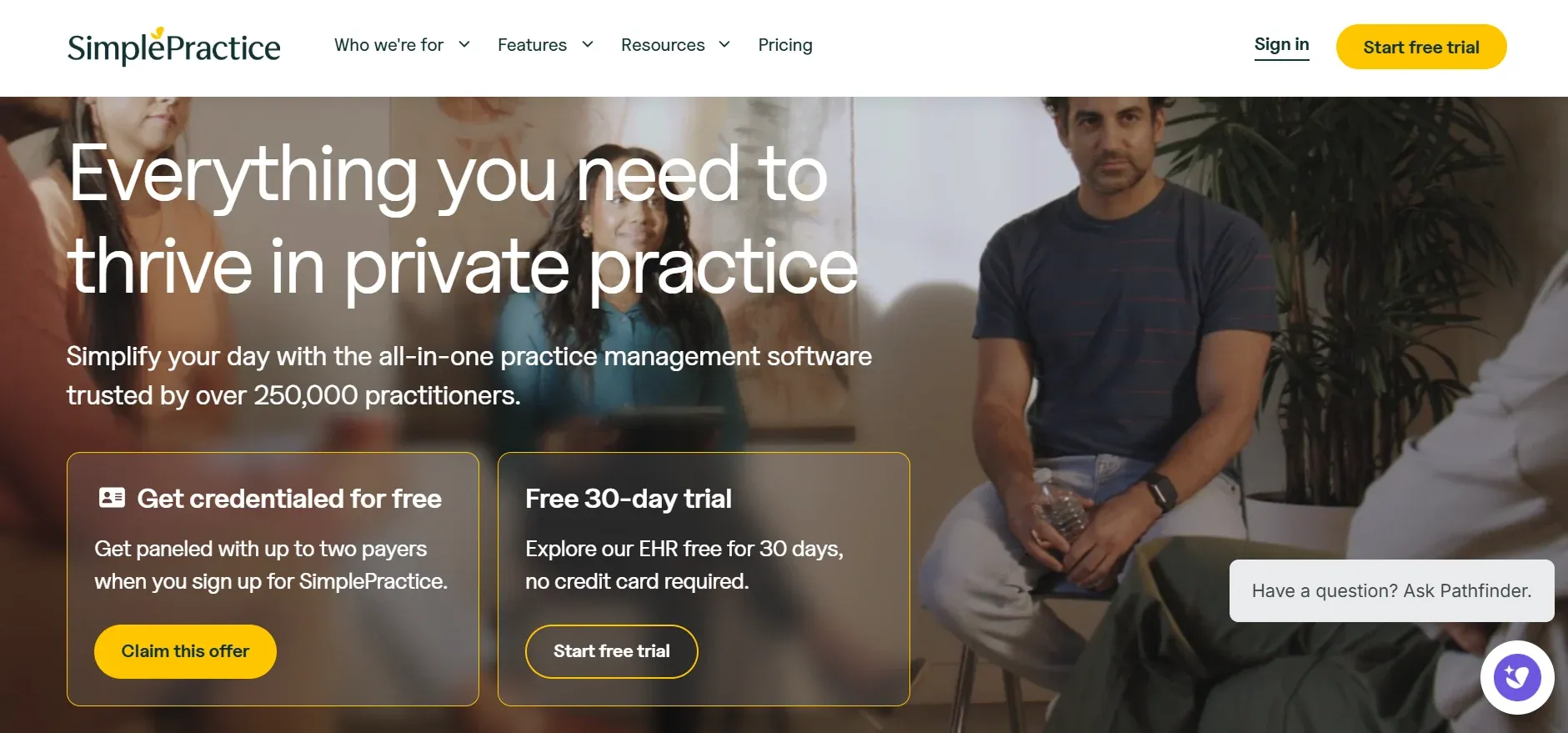
SimplePractice is the market leader for solo practitioners and small groups in mental health, counseling, and allied fields. Its focus is on ease of use, streamlined onboarding, and a clean, modern interface that makes scheduling, documentation, and telehealth accessible even for clinicians with little technical background.
Pricing: Starts at $29 per user per month. Add-ons for telehealth and e-prescribing increase costs.
- Key limitations:
- Per-user pricing increases costs as your team grows
- Limited open integrations and no open API
- Data export is not always complete or seamless
- Strengths:
- Intuitive interface and fast onboarding
- Strong client portal and telehealth features
- Good for solo and small group practices
2. TherapyNotes (Best for insurance-heavy practices)
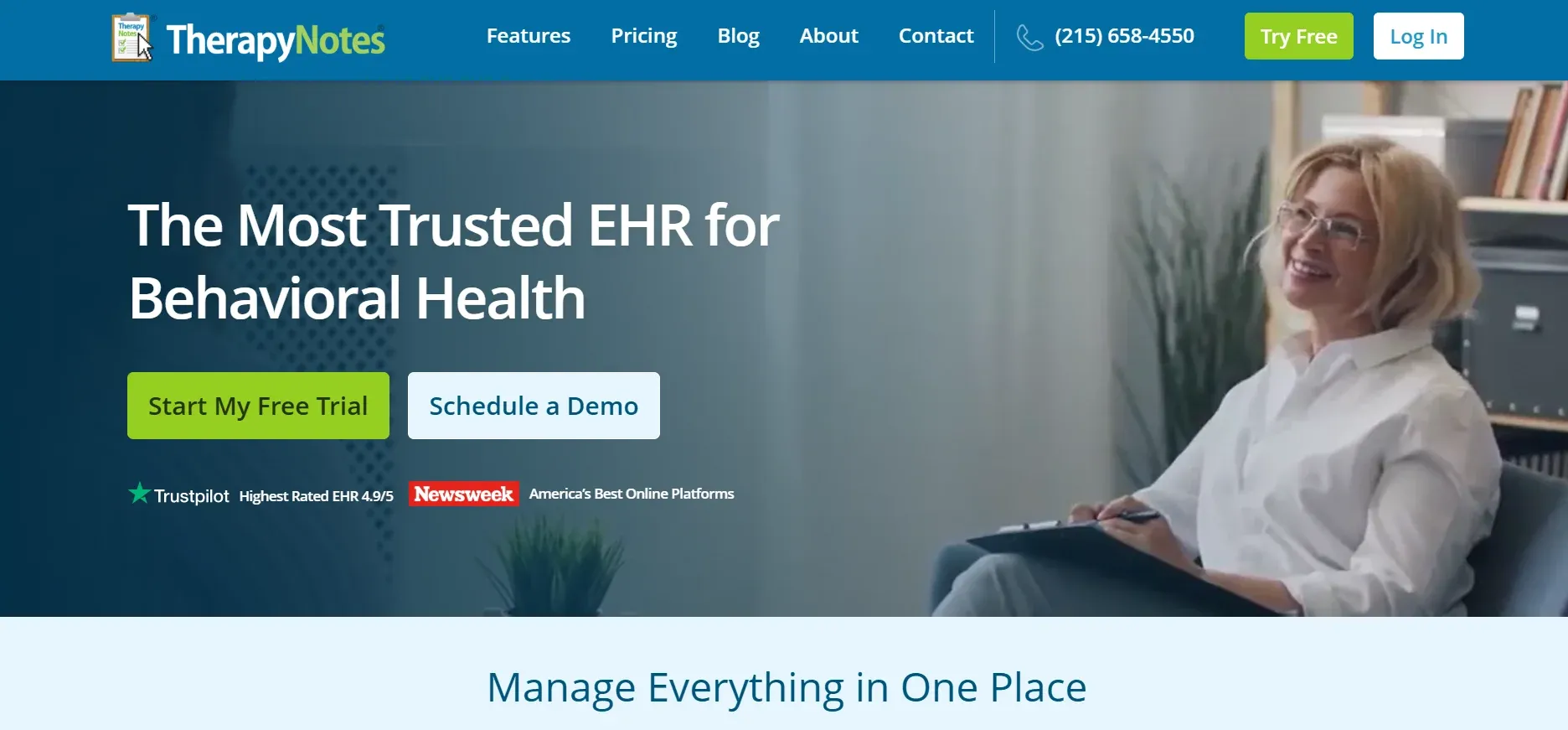
TherapyNotes is a favorite for practices that bill insurance heavily or require compliant documentation. It offers a more medicalized feature set than SimplePractice and is praised for its reliability and responsive support.
Pricing: Starts at $49 per month for the first clinician. Telehealth and e-prescribing are paid add-ons.
- Key limitations:
- Telehealth is a paid add-on
- No open API for deep customization
- Annual contracts common for larger practices
- Strengths:
- Comprehensive insurance billing tools
- Customizable note templates
- Responsive customer support
3. TheraNest (Best for medium to large clinics)
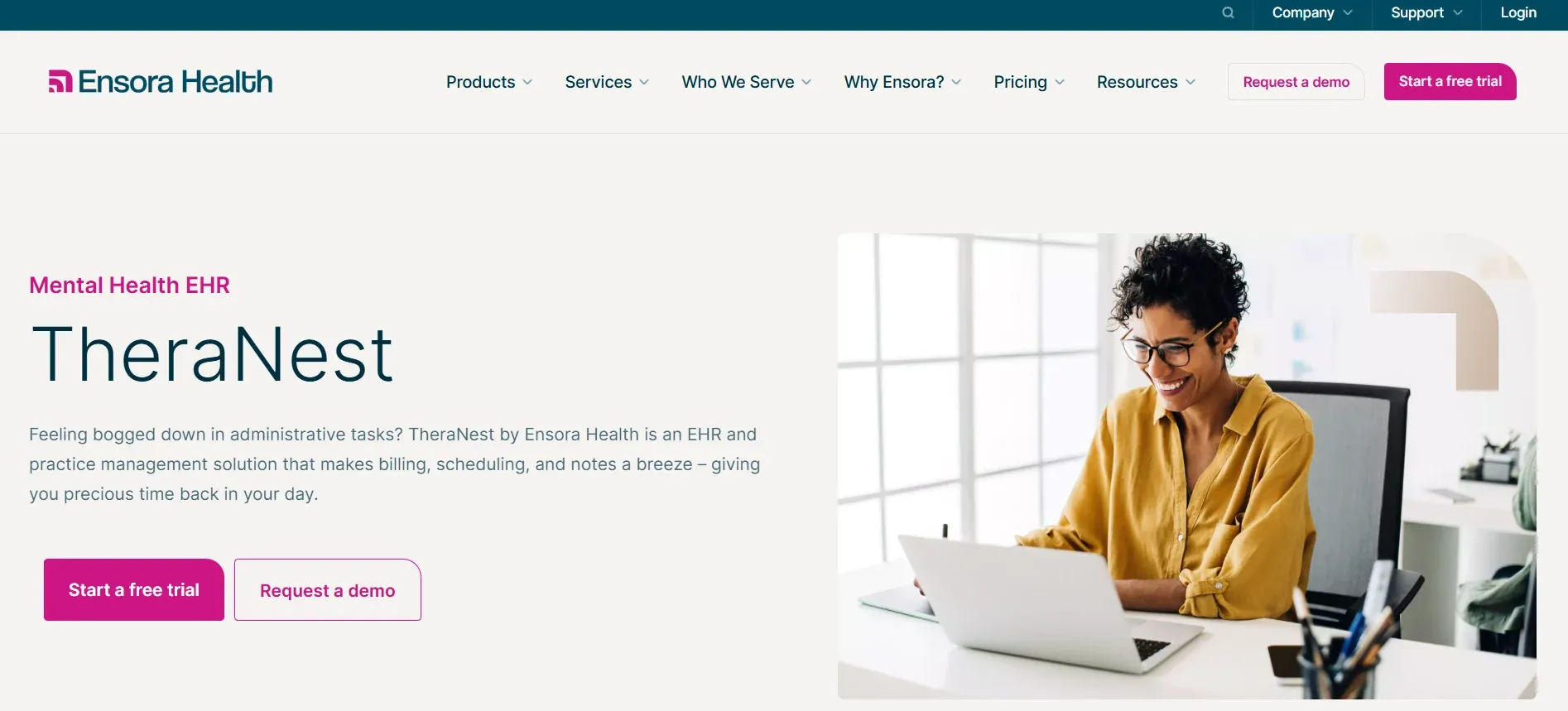
TheraNest targets practices with growing teams, group therapy needs, and more complex billing. It blends scheduling, documentation, telehealth, and billing in a single interface, with some flexibility for larger teams.
Pricing: Starts at $39 per month for the first user. Add-ons for telehealth and e-prescribing.
- Key limitations:
- Per-user pricing increases costs as you grow
- Customization limited to preset options
- Data export may not be complete
- Strengths:
- Group therapy and attendance tracking
- Flexible billing for insurance and self-pay
- Task assignment and team collaboration
On a custom Devaims build, group note workflows are just part of your system, not a premium add-on.
4. Luminare Health (Best for integrated and holistic care)

Luminare Health is designed for practices that blend mental and physical health, such as collaborative care organizations or clinics with primary care and behavioral health under one roof. Its strength is in care coordination, population health, and integrated treatment planning.
Pricing: Contact for pricing. Typically higher than focused EHRs.
- Key limitations:
- Pricing is opaque and often higher
- Customization limited to available modules
- Complexity may be overwhelming for smaller clinics
- Strengths:
- Integrated care plans for behavioral and physical health
- Population health dashboards
- Regulatory compliance tracking
5. Valant (Best for psychiatry and prescribing practices)
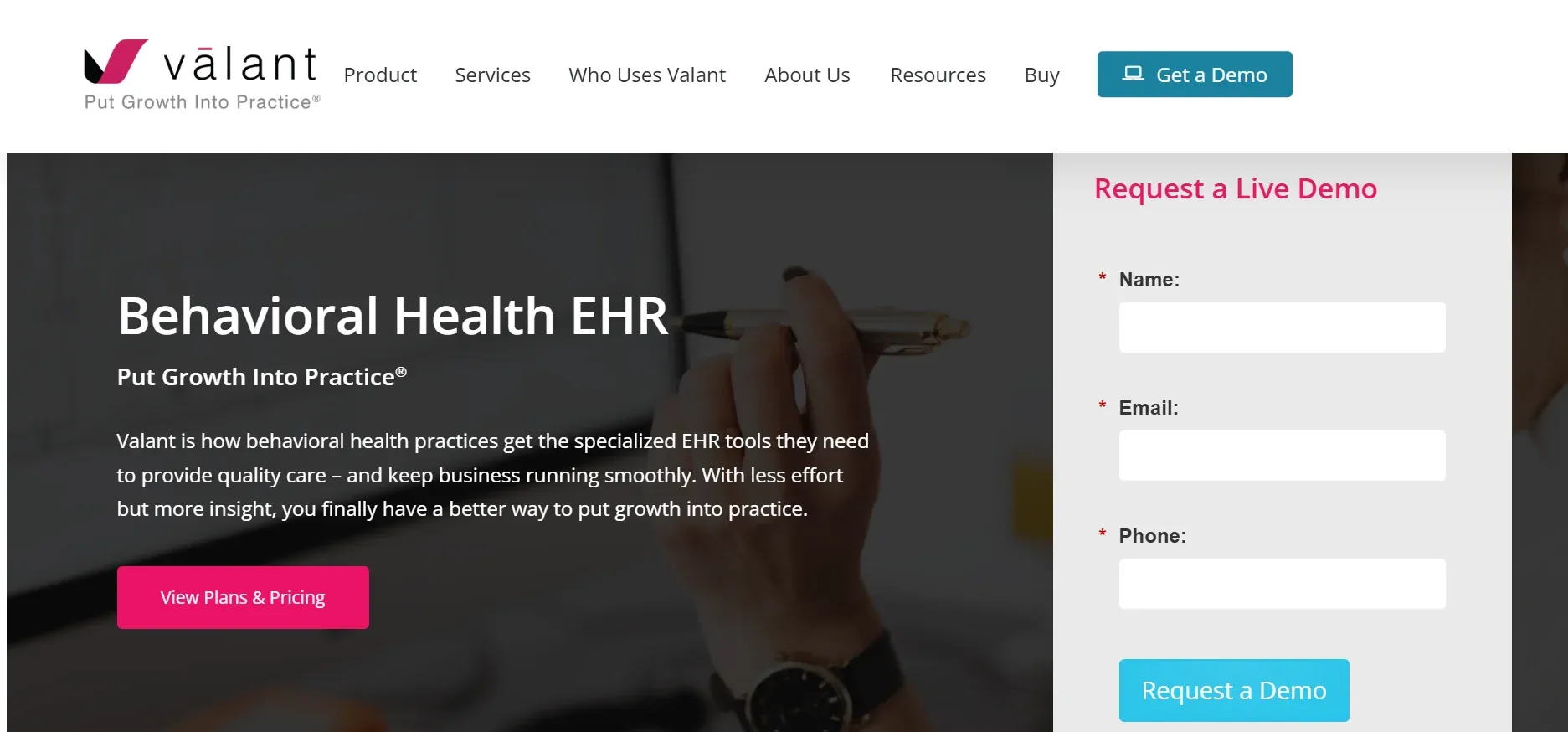
Valant is purpose-built for psychiatry practices, especially those with medication management, complex prescribing, and high documentation standards. It is more comprehensive than Kareo Behavioral (Tebra) for psychiatric workflows.
Pricing: Contact for pricing. Annual contracts are common.
- Key limitations:
- Full-feature access is expensive
- Data export can be cumbersome
- Customization is limited
- Strengths:
- Advanced e-prescribing and medication management
- Custom psychiatric assessment forms
- Outcomes measurement tools
With a Devaims build, your prescribing workflow is designed around your real process, no contract required.
6. Procentive (Best for complex, multi-site organizations)
Procentive is built for large agencies, multi-site organizations, and clinics with complex billing or compliance needs. Its modular architecture allows for customization, but also means costs can rise rapidly as you add features.
Pricing: Contact for pricing. Costs scale with users and modules.
- Key limitations:
- Costs scale quickly with users and modules
- User interface can feel dated
- Custom workflows come at a premium
- Strengths:
- Multi-site and multi-program support
- Configurable billing engine
- Customizable reporting and analytics
7. Greenspace (Best for outcomes tracking)

Greenspace is unique among these alternatives: it does not replace your EHR, but overlays measurement-based care (MBC) and outcomes tracking on top of your existing systems. Its focus is on helping clinicians and organizations measure client progress and clinical effectiveness in real time.
Pricing: Contact for pricing. Per-client or per-provider fees.
- Key limitations:
- Per-client or per-provider fees add up
- Not a full EHR, requires a core practice management system
- Customization focused on outcomes workflows only
- Strengths:
- Automated client assessments and surveys
- Real-time dashboards for clinicians
- Integrates with major EHRs
8. ICANotes (Best for behavioral health documentation)
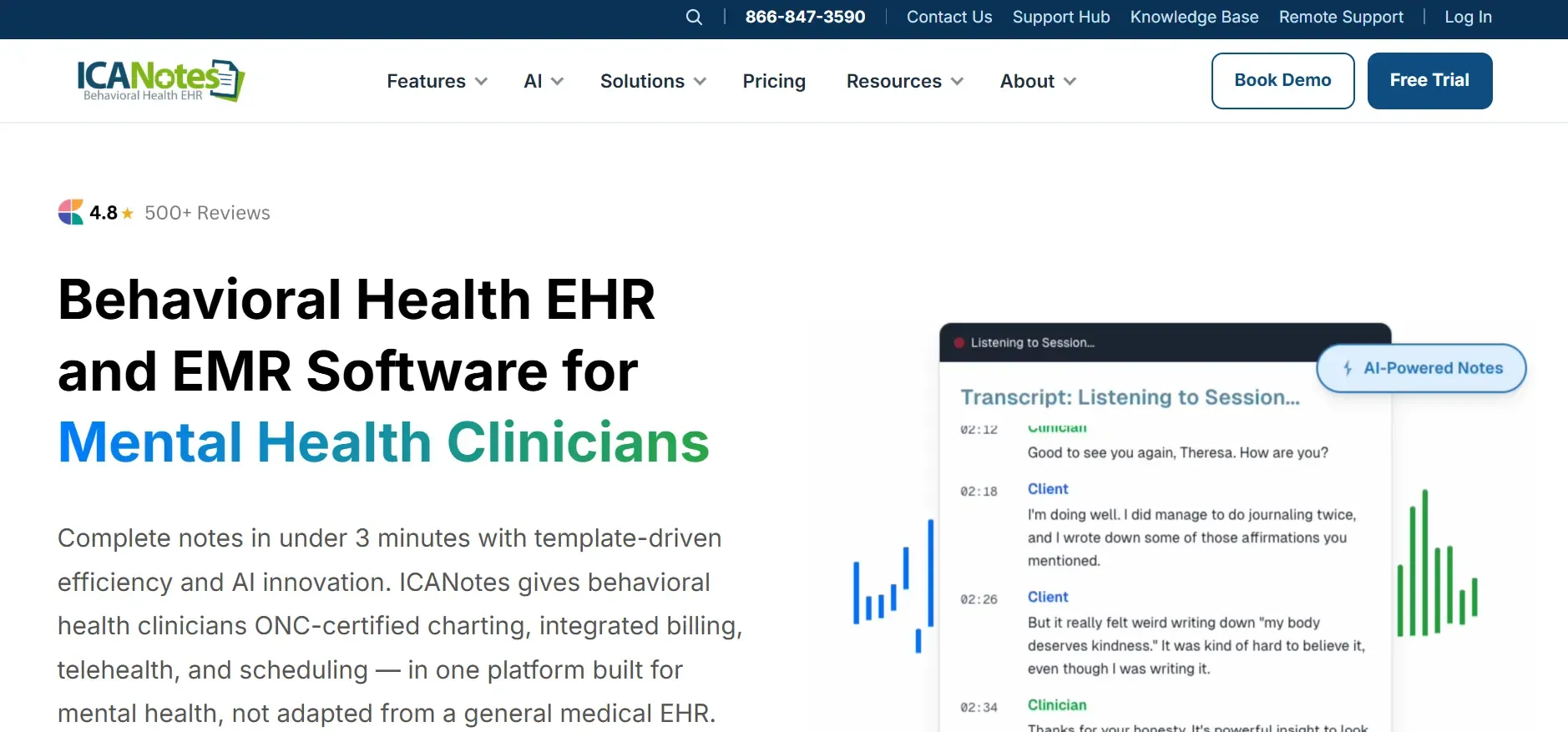
ICANotes is designed for clinicians who want fast, compliant note-taking. Its unique selling point is a click-through interface for building structured, DSM-compliant notes, which reduces documentation time and supports audit-readiness.
Pricing: Starts at $59 per user per month. Add-ons for e-prescribing and billing.
- Key limitations:
- Per-user pricing rises quickly for groups
- Interface is functional but dated
- Limited customization of templates
- Strengths:
- Quick, point-and-click note templates
- DSM-5/ICD-10 coding and billing support
- Integrated e-prescribing (add-on)
9. Devaims (Best for owning your EHR and cutting subscription costs)

Devaims builds custom web, mobile, and business platforms for mental health practices and hands you the source code. Unlike every SaaS on this list, you get exactly the workflows, forms, reports, and integrations you need. The platform is yours: no per-user fees, no feature lock, no vendor contracts. You own your data and code, can self-host or choose managed maintenance, and never risk losing access due to a vendor pivot or shutdown.
Pricing: One-time build, you own it. Optional transparent maintenance.
- 100% custom, your workflows, forms, and integrationsFull data and code ownership, no lock-inFlat cost, no per-user or per-feature fees
- 100% custom, your workflows, forms, and integrations
- Full data and code ownership, no lock-in
- Flat cost, no per-user or per-feature fees
Other Kareo Behavioral (Tebra) alternatives worth knowing
- BreezyNotes: Good for very small practices, but limited features and little scalability. Great for those just starting out, but you may outgrow it quickly if you add clinicians or require insurance billing.
- Qualifacts: Strong for large agencies, but expensive and often overkill for private clinics. Deep reporting and compliance, but expect enterprise-level costs and contracts.
- CarePaths: Niche EHR with basic telehealth, but less robust than bigger names. Useful for simple solo practices, but limited customization and few advanced features.
How to choose the right Kareo Behavioral (Tebra) alternative
- By team size: Solo and small group practices do best with SimplePractice or TherapyNotes. Larger clinics may need TheraNest or Valant. Multi-site agencies may require Procentive or Luminare Health.
- By billing complexity: If you process a lot of insurance, TherapyNotes and Valant lead. For cash-pay, SimplePractice or CarePaths can be enough. Medicaid/Medicare billing? Consider Procentive or Luminare Health.
- By need for customization: If you want your own workflows, only Devaims (custom build) delivers true flexibility. SaaS platforms offer some preset templates, but cannot match the freedom of full ownership.
- By ownership mindset: If recurring SaaS fees and feature lock-ins are a dealbreaker, owning with Devaims makes the math work after just a couple of years. If you want to future-proof your practice and keep your data safe, ownership is the only way.
If you are tired of renting software, it is time to ask what owning could do for your practice's bottom line.
Stop paying rent on software you could own
Every Kareo Behavioral (Tebra) alternative, from SimplePractice to Valant, rents you access to their platform. As your team grows, so does your bill. Features you need, such as telehealth, e-prescribing, or analytics, are always a tier or add-on away. Change vendors, and you start from scratch. With Devaims, you pay once to build, then run your system on flat, predictable maintenance. The code is yours. The data is yours. No more surprises.
Devaims specializes in building custom EHR, scheduling, billing, and telehealth platforms for mental health clinics. You keep the source code, own your data, and can add features or users whenever you want, no contracts, no hidden fees, no lock-in.
- Per-user fees vanish: Add as many clinicians as you like, without paying more. Your cost is flat, no matter how large your team grows.
- Custom reports and workflows: Get the analytics and forms you want, not just the templates your vendor provides. Track outcomes, custom billing metrics, or clinical trends unique to your practice.
- Integration freedom: Connect your EHR to billing, labs, or a custom patient portal without waiting for a vendor to care. Build automation that saves your staff hours each week.
- Data ownership for life: You have the code. You decide where it lives and who can access it. No vendor can hold your records hostage or shut you out.
| Platform | Ownership | Per-user fees | Contract required |
|---|---|---|---|
| SimplePractice | No | Yes | Monthly |
| TherapyNotes | No | Yes | Monthly/Annual |
| Valant | No | Yes | Annual |
| Devaims (custom build) | Yes | No | No |
Here is how the five-year cost breaks down for a 10-clinician practice:
| Year | Rented (Kareo/SaaS) | Owned (Devaims) |
|---|---|---|
| 1 | $6,000 | $32,000 |
| 2 | $12,000 | $34,400 |
| 3 | $18,000 | $36,800 (now ahead) |
| 4 | $24,000 | $39,200 |
| 5 | $30,000 | $41,600 |
Renting is cheaper for the first two years, but by year three, owning your platform pulls ahead, and you never have a surprise fee again. If you have 10 clinicians and pay $50 per user per month, that is $500 per month, or $6,000 per year, or $30,000 over five years, and you still do not own it. We can run your real numbers for free. For larger teams or organizations with multiple service lines, the ownership math becomes even more compelling.
How to switch from Kareo Behavioral (Tebra)
- Export your client and billing data. Start by requesting or generating exports of all patient records, appointment history, notes, and financial data from Kareo Behavioral (Tebra). This step can take time, especially if you have years of records. Review what formats are available (CSV, PDF, XML) and ensure you get all the fields you need.
- Choose your new platform. Evaluate SaaS options or decide on a custom Devaims build. Consider your team size, billing complexity, and need for custom workflows. For custom builds, create a requirements list of the features, forms, and integrations you want.
- Import data into the new system. For SaaS platforms, use their import tools, often limited to demographics and basic notes. For Devaims, migration includes custom mapping of your data, ensuring notes, appointments, billing, and forms come across fully and accurately.
- Re-establish integrations. Set up connections to your payment processors, telehealth providers, insurance clearinghouses, and other critical tools. For custom builds, Devaims can automate these connections to fit your workflow.
- Train your staff. Provide hands-on training for clinicians and admin staff on the new workflows, documentation tools, and any new features. With Devaims, training is included and tailored to your team’s actual use cases.
- Run both systems in parallel. For at least a few weeks, keep Kareo Behavioral (Tebra) running alongside your new platform. This allows you to spot data mismatches, workflow hiccups, or missing information before fully switching over.
- Review your contract and cancel Kareo Behavioral (Tebra). Once you have verified all data is present and workflows are stable, formally end your Kareo Behavioral (Tebra) subscription. Ensure you retain a final backup for compliance.
With a custom Devaims build, the migration is handled as part of the project, including data mapping, validation, and staff training, so you can focus on care, not IT.
Frequently asked questions
What is the best Kareo Behavioral (Tebra) alternative for small practices?
For solo and small group mental health practices, SimplePractice is the easiest to use and offers strong scheduling, telehealth, and documentation at a relatively low per-user cost. Its interface is intuitive and onboarding is quick. For practices that want to fully own their platform and avoid recurring fees, Devaims is the only route that gives you the code and freedom to scale. Devaims is especially appealing if you anticipate growth, need custom workflows, or want to ensure data ownership from day one.
Which Kareo Behavioral (Tebra) alternative is the cheapest?
SimplePractice and TherapyNotes are usually the lowest-cost SaaS options for small clinics, with entry plans around $29 to $49 per user per month. However, costs rise quickly as you add users or need premium features like e-prescribing or telehealth. Many clinics are surprised by hidden fees or the need to upgrade tiers for essential tools. Over five years, a custom Devaims build can be cheaper for teams of 8 to 10 or more, especially since you avoid per-user and per-feature fees entirely. For larger agencies, the cost advantage of ownership becomes even clearer.
Are there any free alternatives to Kareo Behavioral (Tebra)?
There are very few truly free EHRs for mental health, and most lack HIPAA compliance, support, or the features clinics need (such as e-prescribing or secure telehealth). Some practices start with open-source platforms like OpenEMR, but often outgrow them due to limited mental health features and the need for technical expertise. Devaims can build on an open-source foundation, combining the flexibility of open source with a custom interface and full HIPAA compliance, giving you the best of both worlds without sacrificing support or security.
Which Kareo Behavioral (Tebra) alternative is best for psychiatry?
Valant is well known for e-prescribing, medication management, and psychiatric templates, making it a strong choice for psychiatry groups. It offers deep features for medication tracking, controlled substances, and outcomes measurement. However, it comes with high costs and limited customization. For clinics that need custom forms, unique workflows, or want to own their code and data, Devaims is the only alternative that puts you in control, allowing you to design your ideal psychiatric workflow and integrate with any system you choose.
When should I switch from Kareo Behavioral (Tebra) to an alternative?
If your monthly bill keeps rising, you need features locked in higher tiers, or you want more control over your data, it is time to look at Kareo Behavioral (Tebra) alternatives. The switch is also wise if you are experiencing integration frustrations, vendor support issues, or planning to scale your practice. Owning with Devaims makes sense if you have more than 8 clinicians, want to future-proof your tech stack, or simply want to stop paying rent forever. Consider your five-year software spend and whether that investment could deliver permanent ownership and flexibility.
Can I keep my data if I leave Kareo Behavioral (Tebra)?
You can export your data from Kareo Behavioral (Tebra), but the process may be manual, time-consuming, and does not always include every detail, especially custom forms, historical notes, or billing records. Data may be delivered in fragmented formats, requiring extra work for a new platform to ingest. A Devaims migration includes full data transfer, format matching, and validation as part of the project, ensuring you do not lose critical information and your new system is ready to use from day one.
Which Kareo Behavioral (Tebra) alternative is best for outcomes tracking?
Greenspace specializes in measurement-based care, making it ideal for clinics that prioritize outcomes tracking and client progress dashboards. It can overlay on your existing EHR or integrate with many leading platforms. For practices that want custom outcomes tracking built into their core EHR, tailored to their unique measures, reporting needs, or grant requirements, Devaims can develop exactly what you need, fully owned and integrated with your other workflows.
The bottom line
If you are tired of rising SaaS fees or fighting your EHR to do what your team needs, it is time to rethink the rent-vs-own equation. Most Kareo Behavioral (Tebra) alternatives just shuffle the same costs and limits to new places. Owning your platform is the only way to break the cycle.
Here is the test: add up what your EHR will cost your practice over the next five years. If that number could have built you something you own forever, you already have your answer. Ownership gives you control, predictability, and the freedom to scale without penalty, while SaaS keeps you on the hook for every clinician, every feature, and every year you practice.
Explore more on the Devaims blog: SimplePractice alternatives, TherapyNotes alternatives, Valant alternatives.