



Ever feel like you’re paying rent on your own records? ICANotes may have gotten you started fast, but as your mental health practice grows, so do the headaches: per-user fees, clunky workflows, features locked behind bigger monthly bills. You’re not alone. Most clinics hit the same wall, wondering if anyone ever really owns their EHR.
If you’re weighing ICANotes alternatives, you already know the pain points. Maybe it’s the surprise price hikes, the rigid templates, or just the endless subscription cycle. Whatever the trigger, you’re looking for a platform that actually fits how you work, not the other way around. The good news: you have options. From TherapyNotes to SimplePractice to Devaims’ build-you-own approach, here’s how they stack up. More clinics are choosing to own, not rent, their core system.
Let’s break down the top ICANotes alternatives for 2026, including the only one built for keeps.
Why mental health practices look for ICANotes alternatives
Many mental health clinics start with ICANotes because of its behavioral health focus and quick onboarding. But over time, recurring frustrations drive practices to seek alternatives. Here are the main reasons clinics consider switching:
- Recurring per-user and per-client fees: As your practice adds clinicians or grows its client base, monthly costs can balloon quickly, eating into margins. Unlike fixed-cost solutions, ICANotes’ pricing means every new hire or surge in clients increases your monthly bill. For group practices, this can mean thousands extra per year, with no cap.
- Locked-in workflows: ICANotes’ templated designs save time at first, but try customizing a workflow or adding a new intake form, and you’ll hit limits fast. Many clinics find themselves forced to adapt their processes to fit the software, instead of the other way around.
- Feature gating: Need telehealth, e-prescribing, or robust reporting? Many features are tiered, meaning you pay more or go without. Even basic functions like outcome tracking or custom analytics may require an upgrade, making it hard to predict your real costs.
- Data portability and ownership: Exporting your full records isn’t always straightforward, and you never own the platform, just your data, if you’re lucky. Some clinics discover that even getting a usable export for migration can be challenging or require support intervention.
- Surprise contract renewals and price hikes: Annual contracts often auto-renew, and price increases can hit with little warning, leaving you scrambling or forced to accept the new rate. The lack of transparency in renewal terms and upgrade costs is a persistent issue for many practices.
If these sound familiar, you’re not alone. Many clinics search for ICANotes alternatives to avoid these traps and to find a platform that truly scales with them, on their terms.
Quick comparison of the best ICANotes alternatives
| Tool | Best for | Starting price | You own it? |
|---|---|---|---|
| TherapyNotes | Insurance billing | Reported $49/mo per user | No |
| SimplePractice | Small private practices | Reported $29/mo per clinician | No |
| TheraNest | Growing clinics | Reported $39/mo per user | No |
| Luminare Health | Integrated care | Reported, quote-based | No |
| Valant | Psychiatry groups | Reported, $135/mo minimum | No |
| Procentive | Large organizations | Reported, quote-based | No |
| Kareo Behavioral (Tebra) | Integrated billing | Reported $125/mo per provider | No |
| Greenspace | Outcome tracking | Reported, quote-based | No |
| Devaims | Owning your EHR | One-time build, flat maintenance | One-time build, you own it |
Always confirm current pricing before you decide. Many vendors change rates or bundle features between tiers, and published prices often do not reflect real-world costs after required add-ons.
The 9 best ICANotes alternatives
1. TherapyNotes (Insurance billing)

TherapyNotes is a leading EHR for mental health, highly regarded for its insurance billing and claims management capabilities. The platform is used by a wide range of behavioral health professionals, including psychologists, counselors, and social workers. Its interface is more modern than ICANotes, and its documentation and scheduling tools are reliable and widely adopted.
Pricing: Starts at $49/month per user, with add-ons for telehealth and e-prescribing.
- Robust insurance billing and claims management
- Integrated scheduling and documentation tools
- Highly rated customer support
- Customization is limited to built-in templates and settings
- Per-user and per-feature pricing can escalate costs as you grow
- Data export requires support and may not be fully automated
With a custom Devaims build, you’d avoid per-user fees entirely: once it’s yours, onboarding a new therapist is just an internal process, and any workflow can be designed for your exact needs.
2. SimplePractice (Small private practices)
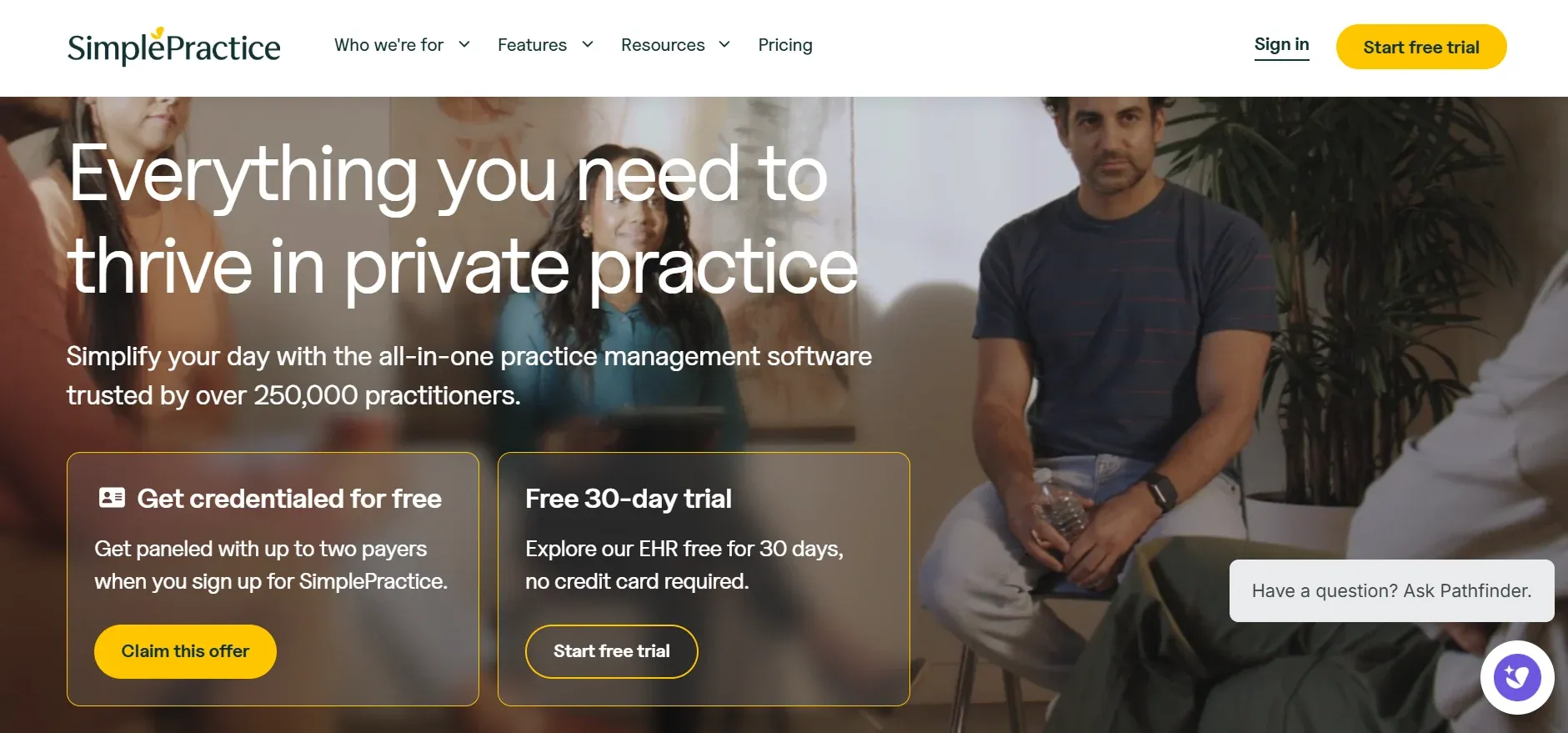
SimplePractice is widely adopted by solo practitioners and small groups for its intuitive interface and all-in-one approach. It offers client scheduling, billing, note-taking, telehealth, and a client portal, all in a clean, mobile-friendly package. SimplePractice is known for its ease of use and quick onboarding, making it a favorite among therapists who want to spend less time on admin and more on care.
Pricing: Starts at $29/month per clinician, with additional fees for telehealth and insurance billing.
- User-friendly interface and mobile app
- Quick onboarding and setup for solo and small group practices
- Integrated client portal and online scheduling
- Telehealth and insurance billing require higher-tier plans
- Customization is limited, especially for advanced workflows
- Data migration for notes and documents is manual
That’s the kind of custom report or workflow you’d have built-in if you owned your own software.
3. TheraNest (Growing clinics)
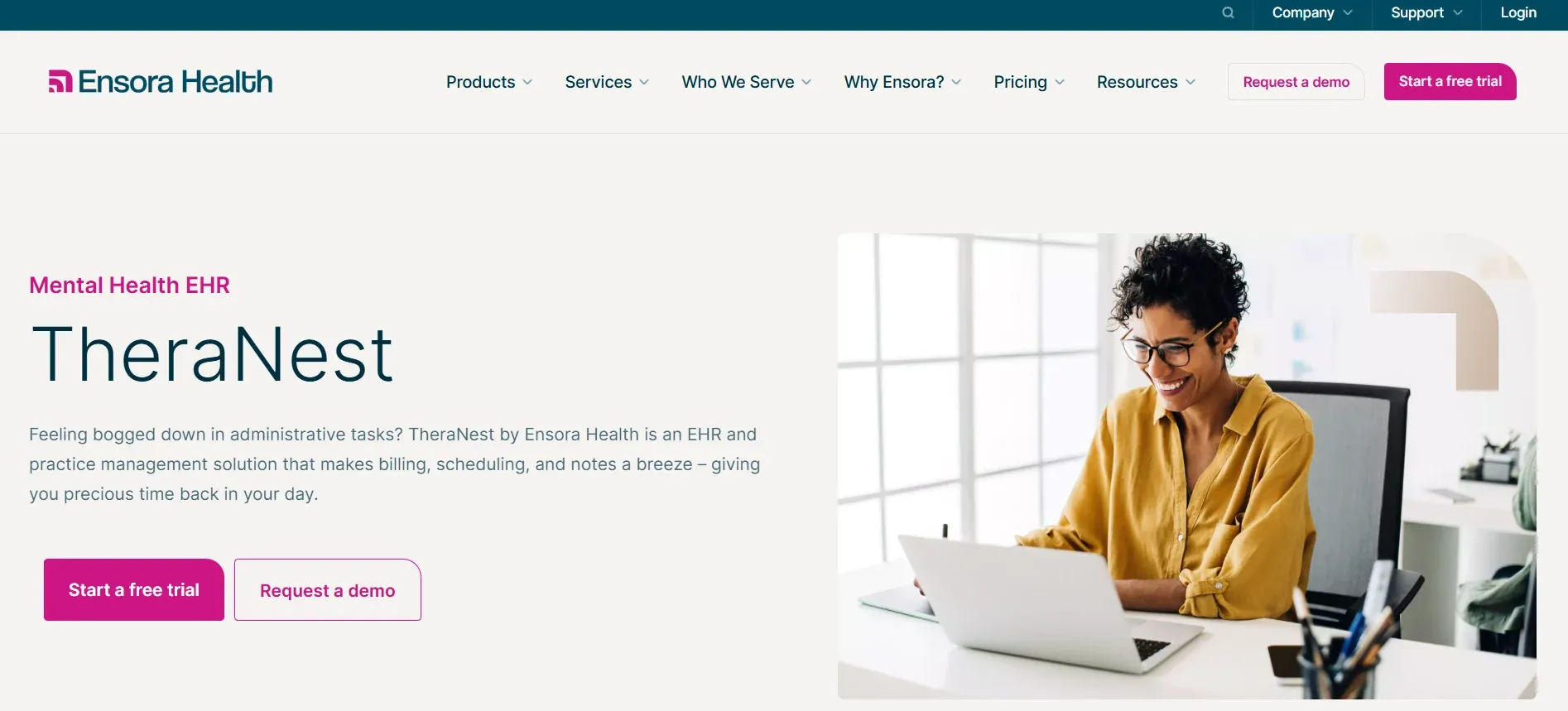
TheraNest is designed for practices that are expanding, offering tools for group therapy, team collaboration, and integrated telehealth. Its client portal allows for document sharing, appointment reminders, and secure messaging. TheraNest also provides outcome measurement tools, invoicing, and insurance claim management.
Pricing: Starts at $39/month per user, with additional fees for e-prescribing and advanced analytics.
- Group scheduling and group note functionality
- Integrated telehealth and outcome measurement tools
- Custom forms builder for intake and documentation
- Pricing scales per user and per client
- Advanced features require additional fees
- Learning curve for custom forms and group notes
On software you owned, every new group or feature would be a one-time build, not an upsell.
4. Luminare Health (Integrated care)

Luminare Health is tailored for clinics that offer both behavioral and physical health services, focusing on care coordination across disciplines. It provides modules for behavioral health, primary care, and case management on a unified platform. Luminare Health is designed for practices that need to share data across medical and mental health teams, track outcomes, and manage population health.
Pricing: Quote-based, typically higher than single-discipline EHRs.
- Integrated behavioral and primary care modules
- Advanced analytics and population health tools
- HL7 and FHIR-based integrations
- Pricing is opaque and setup is resource-intensive
- Customization requires vendor involvement and fees
- May be overkill for small practices
5. Valant (Psychiatry groups)
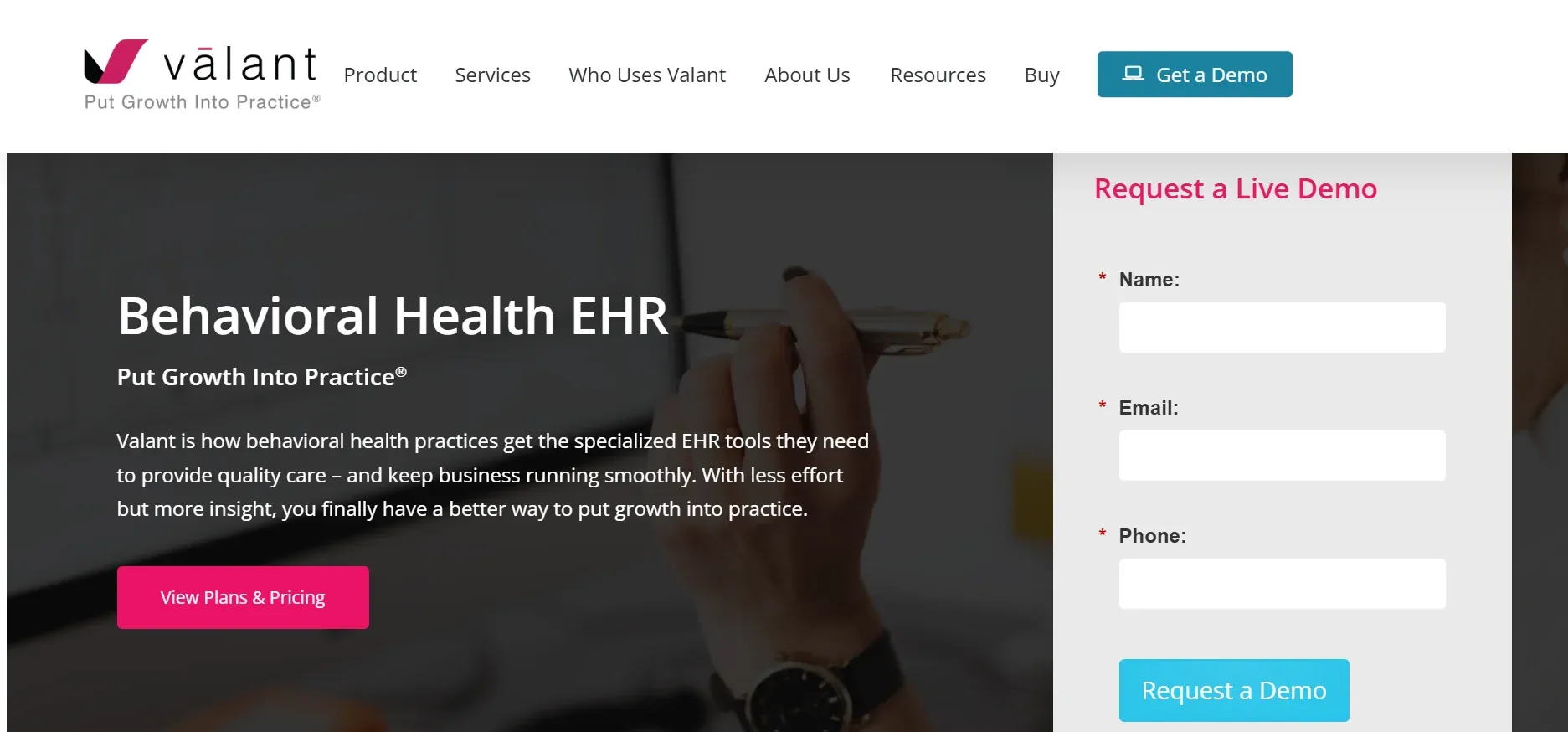
Valant is purpose-built for psychiatry and large behavioral health organizations, offering advanced medication management, e-prescribing, and clinical decision support. It is frequently chosen by practices that need robust tools for psychiatric care, including controlled substance management and complex medication regimens.
Pricing: Minimum $135/month, with long-term contracts and paid add-ons.
- Advanced medication management and e-prescribing
- Psychiatry-specific templates and analytics
- API access for enterprise clients
- High minimum monthly commitments and contracts
- Customization limited to built-in modules
- Migration can be complex and time-consuming
When you own your platform, there’s no minimum, just the features you need, built for your workflows.
6. Procentive (Large organizations)
Procentive is designed for large behavioral health organizations and agencies with complex compliance and reporting requirements. It offers deep configuration options for state and federal compliance, including 42 CFR Part 2, and supports multi-location, multi-program operations.
Pricing: Quote-based, with setup and training fees.
- Advanced compliance and audit features
- Customizable forms and workflow automation
- Multi-location and multi-program support
- Steep learning curve for staff
- Customizations are slow and expensive
- Support can be inconsistent
7. Kareo Behavioral (Tebra) (Integrated billing)
Kareo Behavioral (Tebra) provides a unified EHR and billing platform for behavioral health. Its strength lies in revenue cycle management and claims processing, making it a go-to for billing-heavy practices.
Pricing: Starts at $125/month per provider, with add-ons for telehealth and e-prescribing.
- Integrated billing and revenue cycle management
- Patient portal and mobile app
- API access for select partners
- Per-provider pricing increases costs as you grow
- Workflow customization is limited
- Clinical analytics are basic
8. Greenspace (Outcome tracking)

Greenspace is designed to enhance measurement-based care by providing robust outcome tracking and client engagement tools. It is not a full EHR, but instead integrates with existing systems to add outcome measurement, client self-reporting, and analytics.
Pricing: Quote-based, varies by practice size and features.
- Automated outcome measure delivery
- Real-time analytics and client dashboards
- Integrates with leading EHRs
- Not a complete EHR replacement
- Integration may require IT support
- Pricing can be significant for large practices
9. Devaims (Owning your EHR)

Devaims builds custom web, mobile, and business software for mental health practices. You get exactly the features your clinic needs, nothing more, nothing less. The big difference: you own the source code, the platform, and your data. No subscriptions, no per-user fees, and no feature gating. Your EHR works the way you do, adapts as you grow, and you never have to migrate again.
Pricing: One-time build (typically $29,000 for a mid-sized clinic), flat annual maintenance (around $2,400/year), no per-user or per-feature fees.
- You own the software and source code outright
- No per-user, per-client, or per-feature fees
- Fully customized workflows and reports
- Flat, predictable maintenance costs
- One-time build, never rent your core system again
Other ICANotes alternatives worth knowing
- Netsmart: Aimed at large behavioral health organizations, with deep integration and compliance features, but typically more than solo or small group practices need. Netsmart requires significant setup and long-term contracts, making it best for enterprise-scale providers.
- Qualifacts: Specialized for enterprise behavioral health, with advanced analytics and compliance tools. Like Netsmart, it is suited to agencies with complex reporting and integration needs and typically requires multi-year contracts.
Some clinics also look at AdvancedMD and CarePaths, but both are heavier platforms with complex onboarding and are not ideal for smaller mental health teams. AdvancedMD, for example, offers a wide range of features including practice management and RCM, but comes with a steep learning curve and premium pricing. CarePaths is more affordable but less customizable and is not as widely adopted as other options on this list.
How to choose the right ICANotes alternative
- By practice size: Solo clinicians and small groups often choose SimplePractice or BreezyNotes for quick setup and low overhead. Larger clinics or agencies may need the advanced features and compliance tools found in Procentive or Valant.
- By billing needs: Insurance-heavy practices favor TherapyNotes or Kareo Behavioral (Tebra) due to robust claims management and payer integrations. Private-pay or hybrid clinics may prefer platforms with built-in payment processing and client portals.
- By customization: If you need custom workflows, integrations with unique third-party systems, or specialized reporting, renting may never fit, consider building your own with Devaims to get exactly what you need.
- By cost structure: Add up per-user, per-feature, and annual contract costs to see your real five-year total. Many clinics are surprised to find that after five years, they have spent enough on SaaS fees to have bought a custom platform outright.
- By data ownership: If you want to truly own your system and your data, only a custom build gives you that control. Otherwise, you are always subject to vendor terms, price hikes, and migration headaches in the future.
Once you know what matters most, you’ll see why more practices are asking what it would cost to own the platform instead of renting it forever.
Stop paying rent on software you could own
Here’s the catch nobody tells you: every ICANotes alternative is still rented, not owned. Per-user pricing, locked features, and endless contracts are built into the business model. The more your clinic grows, the more you pay. Devaims is different: you pay once to build, keep the source code, and own your platform outright.
Devaims works directly with mental health practices to design and build web, mobile, and business software you own. You keep your workflows, your data, and your intellectual property. No one can hike your fees, lock you out, or force a migration down the line.
- If you’re tired of per-user fees, you’ll never pay another one: add providers, locations, or features without extra cost.
- If you hate feature gating, every report or integration you need can be built in, no upgrade required.
- If data ownership matters, your records stay in your hands, not locked in a vendor’s cloud.
| Platform | Ownership | Pricing Model | Custom Workflows |
|---|---|---|---|
| ICANotes | No | Per-user, per-feature monthly | Limited |
| TherapyNotes | No | Per-user monthly + add-ons | Limited |
| SimplePractice | No | Per-clinician monthly + add-ons | Limited |
| Valant | No | High minimum + contract | Limited |
| Devaims | Yes | One-time build, flat maint. | Full customization |
Let’s run the five-year math for a practice of 8 clinicians. Most SaaS EHRs charge $49 per user per month (with add-ons, often higher): that’s $392/month, or $4,704/year, plus add-ons and annual hikes. Over five years, that’s well over $23,000, and you still own nothing.
| Year | Rented (cumulative) | Owned (cumulative) |
|---|---|---|
| 1 | $4,704 | $29,000 (build) + $2,400 (maint) = $31,400 |
| 2 | $9,408 | $29,000 + $4,800 = $33,800 |
| 3 | $14,112 | $29,000 + $7,200 = $36,200 |
| 4 | $18,816 | $29,000 + $9,600 = $38,600 |
| 5 | $23,520 | $29,000 + $12,000 = $41,000 |
Break-even is close by year 6 or 7, especially as most SaaS costs climb annually. With Devaims, you never face a forced migration again. Want to see your own numbers? We’ll run the math for your team, free.
How to switch from ICANotes
Switching EHRs is a major project, but with careful planning, you can minimize disruption. Here’s how most practices move from ICANotes to a new platform:
- Export your client records, notes, and billing data from ICANotes: Request a full export in a usable format (often CSV or XML). Confirm you receive all historical notes, billing records, and attachments. Some vendors may charge for this service or require support tickets.
- Choose your new platform and confirm migration support: Ask your new vendor what data formats they accept and whether they provide migration services. Some platforms, like Devaims, handle full data mapping and import; others only support basic demographic imports.
- Import your data into the new system, mapping fields where needed: This step may require cleaning up your data or mapping custom fields (like custom forms or progress notes). Expect some manual work, especially for detailed clinical records.
- Reconnect payment processing and third-party integrations: Set up Stripe, insurance clearinghouses, telehealth providers, and any other integrations your clinic relies on. Test all connections before going live.
- Train your staff on the new interface and workflows: Schedule hands-on training sessions and create quick-reference guides for common tasks. Allow extra time for staff to adjust to new workflows and shortcuts.
- Run both systems in parallel for a week and resolve any issues: Maintain access to ICANotes while validating your data and workflows in the new system. Address any gaps or errors before fully switching over.
- Review your ICANotes contract and formally cancel before auto-renewal: Double-check termination clauses and required notice periods. Get written confirmation of cancellation and retain all exported data for your records.
With a custom Devaims build, the migration is handled as part of the project, with support for mapping, validation, and staff training included in the process.
Frequently asked questions
What is the best ICANotes alternative for small private practices?
For solo and small-group clinics, SimplePractice is a favorite due to its user-friendly interface, quick onboarding, and affordable starting price. SimplePractice offers robust features and add-ons, but follows the SaaS model, meaning you rent, not own. For clinics ready to invest in long-term control and customization, Devaims can build a bespoke platform tailored to your exact workflows, with no recurring user fees. This is especially valuable if you anticipate growth, need special integrations, or want to build lasting value in your intellectual property.
Which ICANotes alternative is best for insurance billing?
TherapyNotes is widely used for its robust insurance billing features, including electronic claims, ERA processing, and payer management. Kareo Behavioral (Tebra) is another strong choice, especially for practices with complex billing workflows or multiple payers. Both platforms offer documentation, scheduling, and claims management in one, but require monthly per-user fees and add-ons for telehealth and eRx. If you have unique billing needs or want to avoid recurring fees, a custom Devaims build can integrate with any clearinghouse or RCM system you use, with workflows designed specifically for your payers and processes.
Is there a free ICANotes alternative?
Most EHRs for mental health are paid, with very limited free plans (if any). Some open-source projects, like OpenEMR, exist but typically lack support, require self-hosting, and are not tailored for behavioral health. They may also need costly IT investment to configure and maintain securely. Devaims does not offer a free tier, but provides a fixed-cost, custom build model, meaning you pay once and never face user or feature fees. For the lowest upfront cost, SaaS options like SimplePractice offer entry-level pricing, but you trade long-term ownership for ongoing rent.
How do ICANotes alternatives compare on data ownership?
Nearly all ICANotes alternatives (including TherapyNotes, SimplePractice, TheraNest, Valant, etc.) are rented platforms: you own your data, but not the system. This means you can export your records (with varying degrees of friction), but you are always at risk of price hikes, feature removals, or forced migrations. Only Devaims delivers both, the software and the source code, so you control your workflows, records, integrations, and future upgrades. This is especially important for practices planning to scale, add locations, or build custom client engagement tools.
When should a mental health clinic switch from ICANotes?
If you’re frustrated with recurring fees, feature gating, or rigid workflows, it’s time to review alternatives. Common triggers include expanding staff (and seeing costs spike), needing custom reporting or integrations, or preparing for value-based care programs that require new documentation. Add up your five-year costs, factor in the hassle of future migrations, and weigh the benefits of ownership. If your clinic is growing or your SaaS costs are climbing, it’s worth exploring a switch to regain control and predictability.
Can I keep my old ICANotes records?
Yes, you can export your records from ICANotes for migration to a new system, but the process can be more complex than vendors suggest. Export all client data, clinical notes, billing records, and attachments in a structured format (CSV, XML, or PDF). Some platforms only support importing basic demographics automatically; detailed notes and billing data may require manual mapping or vendor assistance. Devaims handles full data migration as part of every custom build, ensuring your historical records and compliance needs are met.
What’s the real five-year cost difference between renting and owning?
For a clinic of 8, renting a mid-tier EHR is about $23,520 over five years (not counting add-ons, annual price hikes, or migration fees). This number can easily exceed $30,000 with telehealth, eRx, and compliance features. A Devaims build is around $29,000 upfront plus flat annual maintenance. By year 6 or 7, you’re ahead, and you own the system for life. For larger practices or those with complex needs, the savings and value of ownership are even greater. Plus, you gain the ability to adapt and extend your platform as your clinic evolves, with no vendor lock-in.
The bottom line
ICANotes alternatives offer more choices than ever, but most keep you locked into the rent cycle. Here’s the value add: before you pick another subscription, ask yourself if what you’re paying in five years could have bought you the platform you actually want, built for you and owned outright.
That’s the test: add up your real five-year SaaS cost. If it could have built you something you own, you already have your answer.
Want more insights? Visit the Devaims blog or explore other alternatives like SimplePractice alternatives and TheraNest alternatives.