



Your urgent care center is likely spending far more on software than you realize. Athenahealth’s monthly fees, per-provider pricing, and a patchwork of extra charges for integrations can quietly balloon until you find yourself paying more to rent your EHR than for your clinic’s physical space. Every new provider, every attempt at customization, every time you need a report or a new integration, it’s another invoice, or another delay. If you’re frustrated, you’re not alone. Many urgent care operators hit the same wall, then start searching for Athenahealth alternatives that fit their actual workflow, not a vendor’s template.
The reality? Most alternatives just change the logo on the same rental model. If you want to break the cycle for good, only a custom system you own, like what Devaims builds, gets you there. This guide will break down the 10 best Athenahealth alternatives for urgent care, what you’ll actually pay (and when), and the one way to finally own your software instead of renting it forever.
Why urgent care centers look for Athenahealth alternatives
Per-provider fees add up fast: SaaS models charge for each new provider, often including part-time or temporary staff at the same full rate. For urgent care, where flexible staffing is common, these fees can escalate rapidly. You pay for every seat, regardless of how much it’s used. Adding a provider for weekend shifts? That’s a full monthly fee. Over five years, these costs compound into six figures for even modestly sized clinics.
Feature lock-in and nickel-and-diming: Many core features, like telehealth, e-prescribing, advanced analytics, or custom patient reminders, are locked behind higher subscription tiers or require separate contracts. Upgrading for one feature often means paying for a bundle you don’t need. Need a custom integration? That could mean a long queue and a hefty quote, or worse, “not supported.”
Long contracts and migration headaches: Multi-year terms and hidden offboarding fees keep you trapped. Exporting your data can be complex and expensive, with vendors sometimes charging thousands for your own records. Even if you’re dissatisfied, the friction to switch is substantial. Many urgent care centers feel stuck, even when the software no longer fits.
Workflow friction and customization limits: Athenahealth’s workflows are designed for broad compatibility, not urgent care’s unique pace and needs. Customization is either limited, slow, or requires paid consulting. Forms, check-in flows, and documentation often feel generic or inefficient. If your team needs a unique workflow, you’re forced to adapt, or pay extra to have it built.
Hidden integration fees: Connecting labs, billing, imaging, or third-party apps isn’t always included. Each connection can mean setup fees, monthly charges, or both. For urgent care, which often relies on a mix of local labs and specialized billing, these costs add up quickly.
These pain points push many operators to research Athenahealth alternatives, hoping for more control, lower costs, and workflows that actually serve urgent care realities.
Quick comparison of the best Athenahealth alternatives
| Tool | Best for | Starting price | Ownership |
|---|---|---|---|
| Experity (Clockwise.MD) | Urgent care chains | Reported $500+/provider/mo | Subscription, rented |
| Kareo (Tebra) | Smaller clinics | Reported $125+/provider/mo | Subscription, rented |
| AdvancedMD | Integrated EHR + PM | Reported $429+/provider/mo | Subscription, rented |
| Healow | Patient engagement | Reported $100+/provider/mo | Subscription, rented |
| iPatientCare | Customizable EHR | Reported $150+/provider/mo | Subscription, rented |
| Meditech | Enterprise health systems | Custom quote | Subscription, rented |
| eClinicalWorks | All-in-one practice | Reported $449+/provider/mo | Subscription, rented |
| NextGen | Multi-location clinics | Reported $299+/provider/mo | Subscription, rented |
| Epic | Large health orgs | Custom quote | Subscription, rented |
| Devaims (Custom build) | Ownership + full control | $28,000 one-time, then $180/mo maint | One-time build, you own it |
Confirm current pricing before you decide: published rates can change, and add-ons or integrations can drive up your real costs quickly. Always ask vendors for a detailed price breakdown including onboarding, support, integrations, and upgrade fees.
The 10 best Athenahealth alternatives
1. Experity (Clockwise.MD) (Best for urgent care chains)
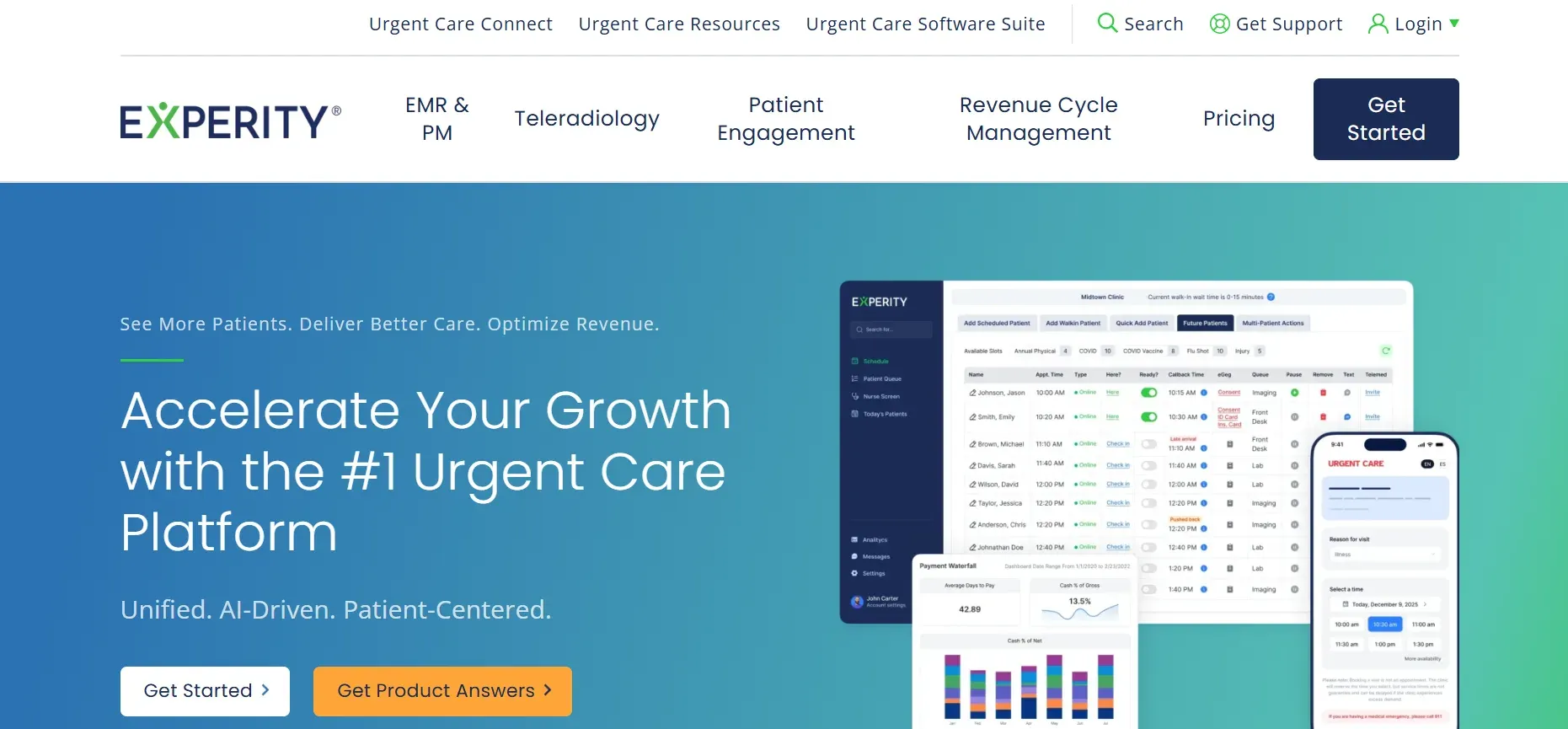
Experity is purpose-built for high-volume urgent care. Its platform combines EHR, practice management, billing, and patient engagement, plus the well-known Clockwise.MD queue management system. Experity stands out for its real-time waitlist, walk-in check-in, and analytics, making it a favorite among urgent care chains and multi-location operators.
Pricing: Reported $500+/provider/month (confirm with vendor).
- Purpose-built urgent care workflows and queue management
- Robust analytics and operational reporting
- Integrated telehealth and patient engagement tools
- Per-provider pricing rises quickly as you add staff
- Custom integrations and advanced features often require paid consulting
- Annual contracts limit flexibility for fast-changing clinics
Devaims can build queue management and analytics tailored to your exact urgent care workflow, with no per-provider fees or contract lock-in.
2. Kareo (Tebra) (Best for small urgent care clinics)
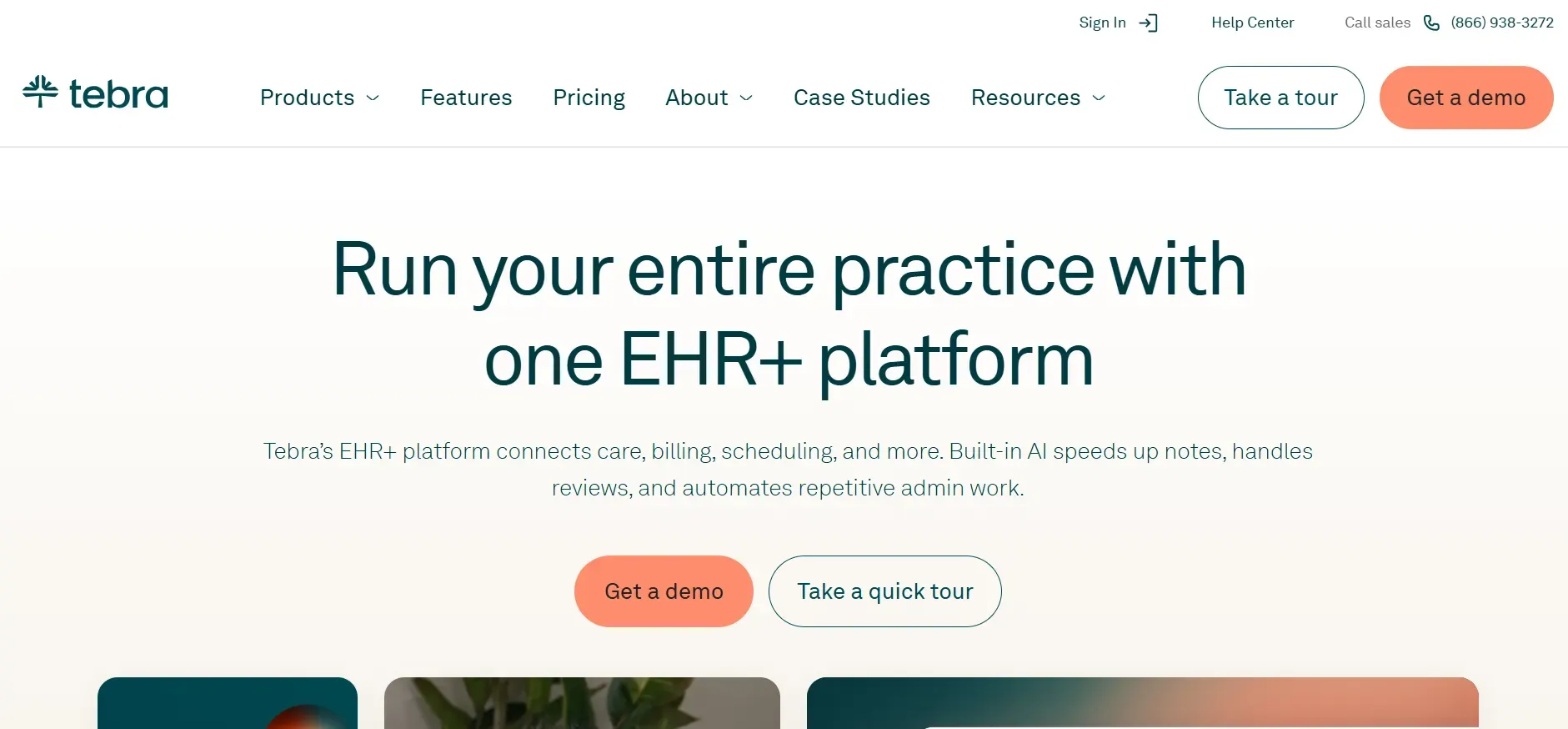
Kareo (now part of Tebra) is designed for smaller clinics and startups. It offers a cloud-based EHR, practice management, and billing system, all in a lightweight package. Its simple interface and quick onboarding make it a popular choice for clinics that want to get up and running fast.
Pricing: Reported $125+/provider/month (confirm with vendor).
- Low upfront cost and fast onboarding
- Simple interface for small teams
- Integrated billing and e-prescribing
- Limited custom reporting and workflow flexibility
- Integration marketplace is smaller than larger competitors
- Data portability is basic, making future migrations harder
Devaims gives you full data portability and custom reporting from day one, so you never feel stuck or limited as you grow.
3. AdvancedMD (Best for integrated EHR and practice management)
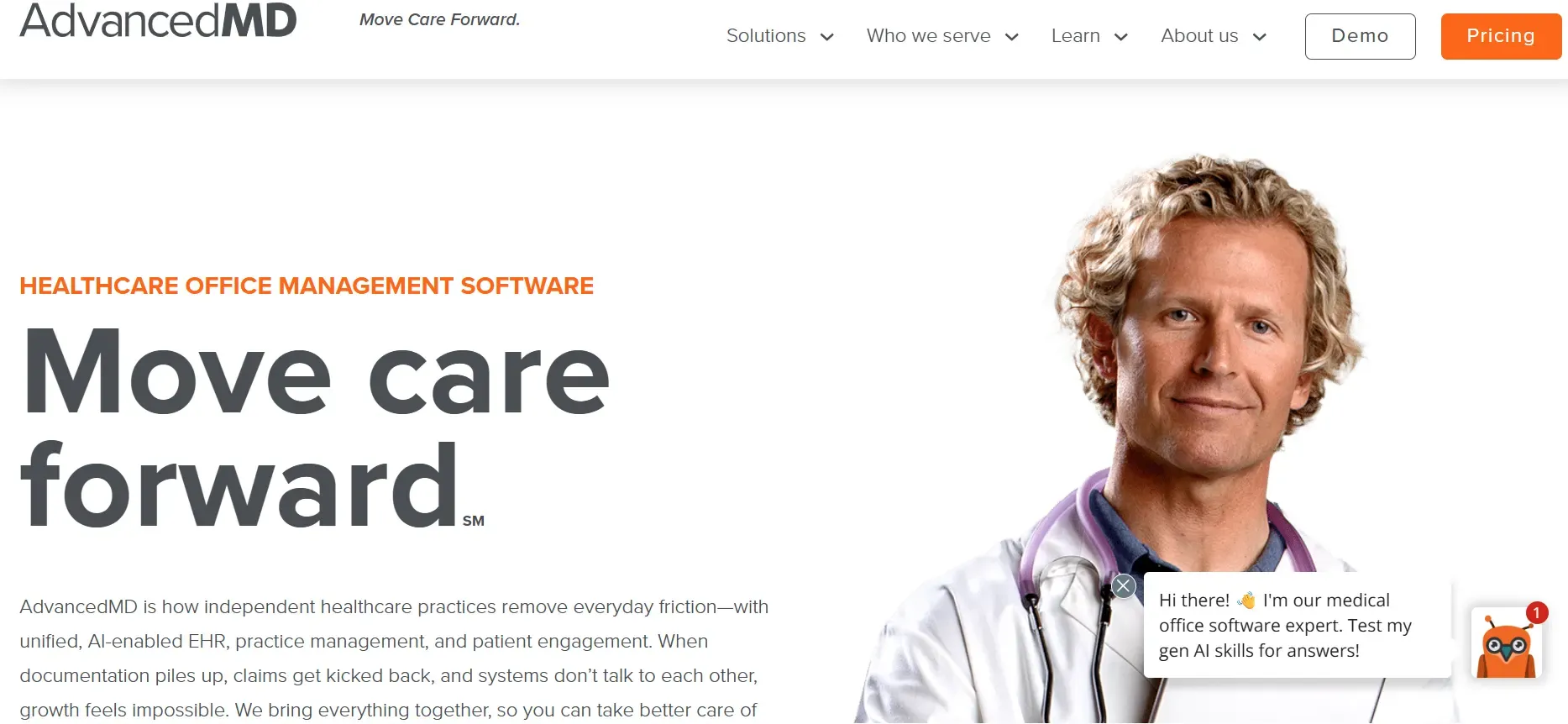
AdvancedMD provides a deep suite of features, including EHR, practice management, telemedicine, and revenue cycle management. It’s more flexible than Athenahealth and offers modular configuration, letting you choose only what you need.
Pricing: Reported $429+/provider/month (confirm with vendor).
- Modular platform with broad feature set
- Advanced analytics and reporting
- API access for integrations
- Costs rise quickly as you add modules and users
- Interface can feel cluttered or dated
- Customizations often require paid development
With Devaims, you get a modern interface and only the features you need, with customizations included in your build, not as extra charges.
4. Healow (Best for patient engagement and telehealth)
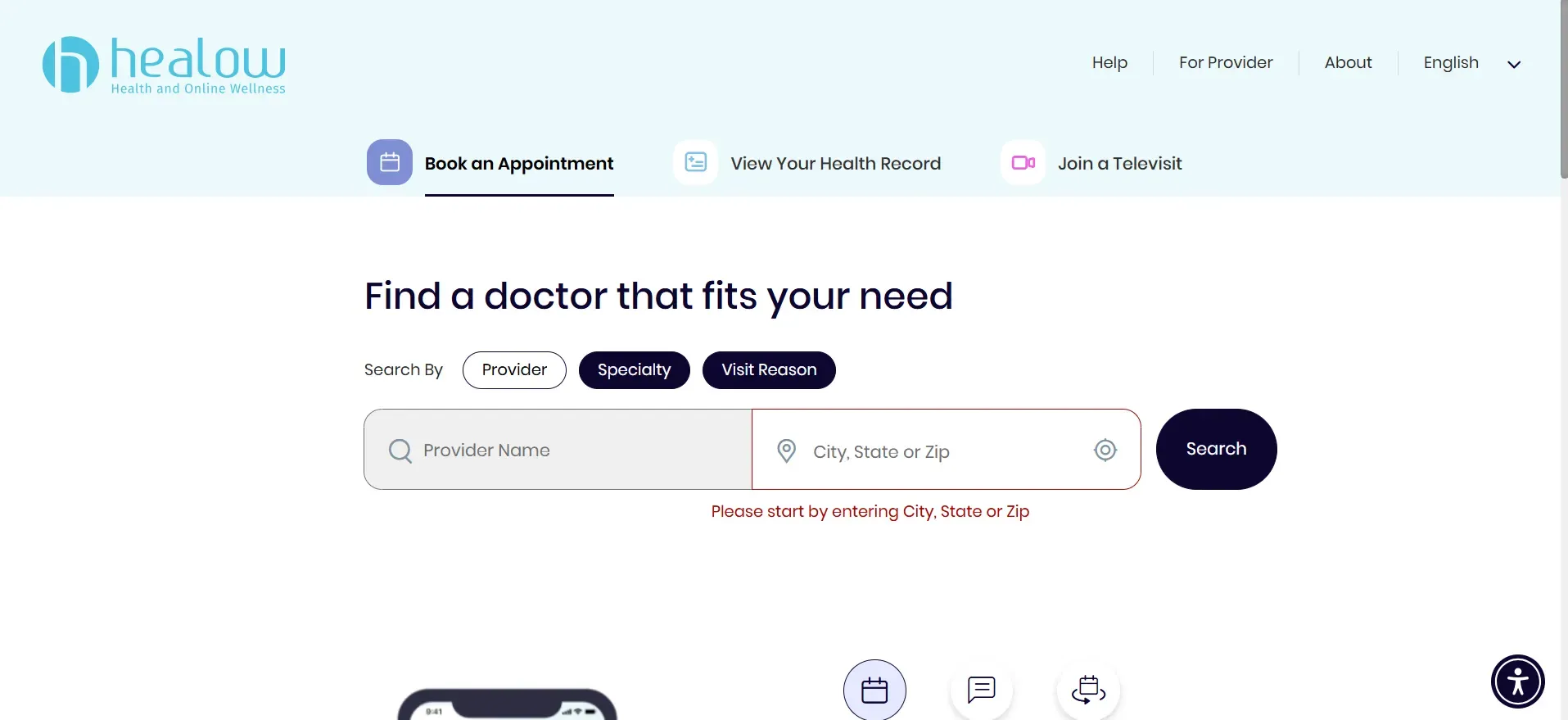
Healow focuses on enhancing patient engagement, appointment management, and telehealth, layered on top of your existing EHR (often eClinicalWorks, but also others). It provides mobile apps and web portals that make it easy for patients to book, check in, and attend virtual visits.
Pricing: Reported $100+/provider/month (confirm with vendor).
- Mobile-first patient engagement tools
- Easy telehealth integration
- Automated reminders and follow-ups
- Dependent on your underlying EHR for core data
- Customization options are limited to Healow’s feature set
- Monthly fees for telehealth and reminders can add up
Devaims can build patient engagement and telehealth features directly into your platform, fully customized and without recurring add-on fees.
5. iPatientCare (Best for customization within a SaaS model)
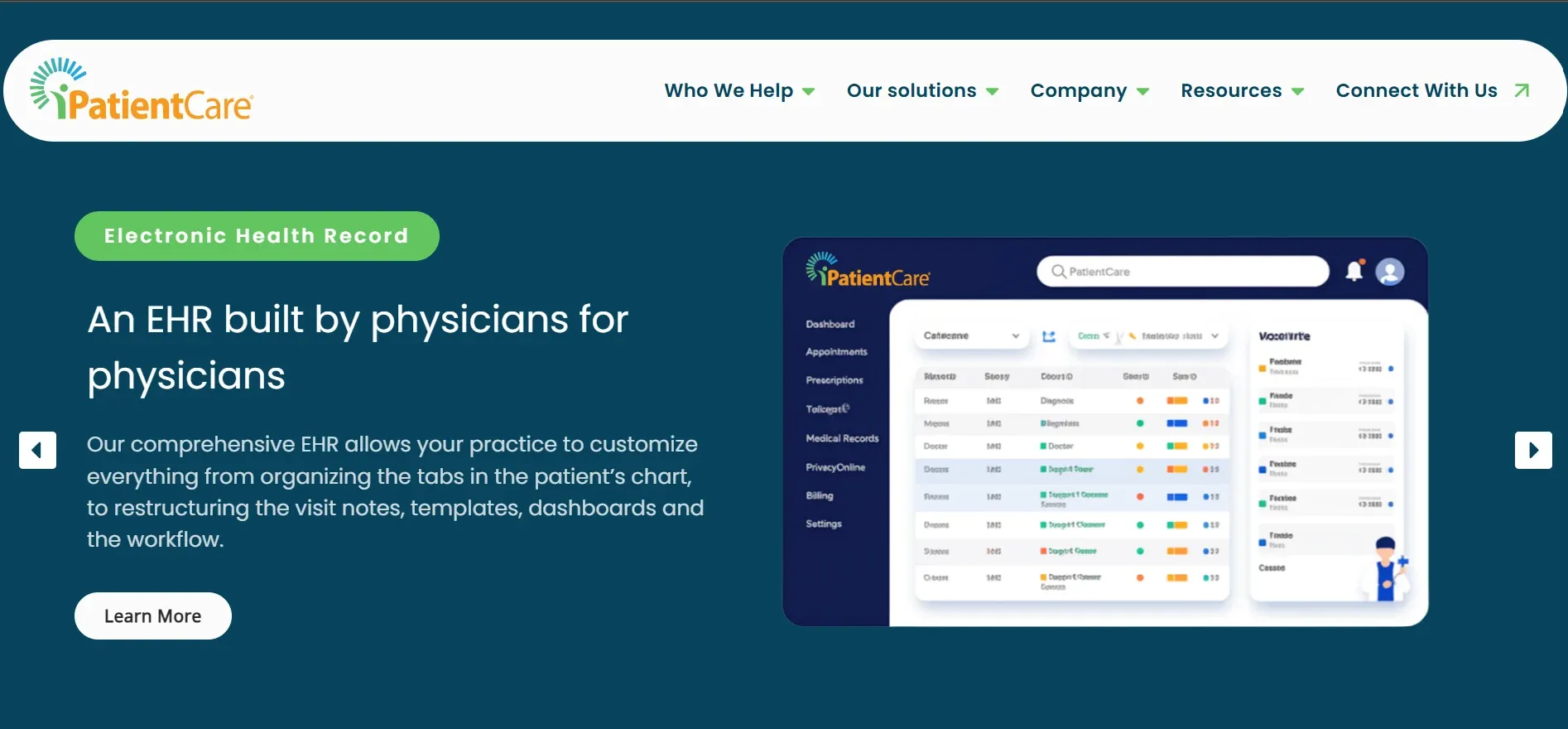
iPatientCare is a modular EHR and practice management platform offering more configurability than most SaaS tools. It supports specialty templates, custom forms, and a variety of billing workflows.
Pricing: Reported $150+/provider/month (confirm with vendor).
- Customizable templates and forms
- Developer API for integrations
- Population health modules available
- Still pay per provider and annual contracts apply
- Custom modules and integrations can be costly
- Setup can be complex for unique workflows
Devaims lets you own your platform and customize every workflow, with no per-provider or annual contract fees.
6. Meditech (Best for enterprise health systems)
Meditech is an industry leader among large hospitals and health systems. Its EHR powers multi-hospital networks, with compliance, population health, and analytics capabilities.
Pricing: Custom quote (enterprise scale).
- Comprehensive EHR for large organizations
- Advanced analytics and compliance features
- Enterprise resource management tools
- High cost and complexity for independent clinics
- Implementation can take 6 to 18 months
- Customization and support require significant IT investment
7. eClinicalWorks (Best for all-in-one practice management)
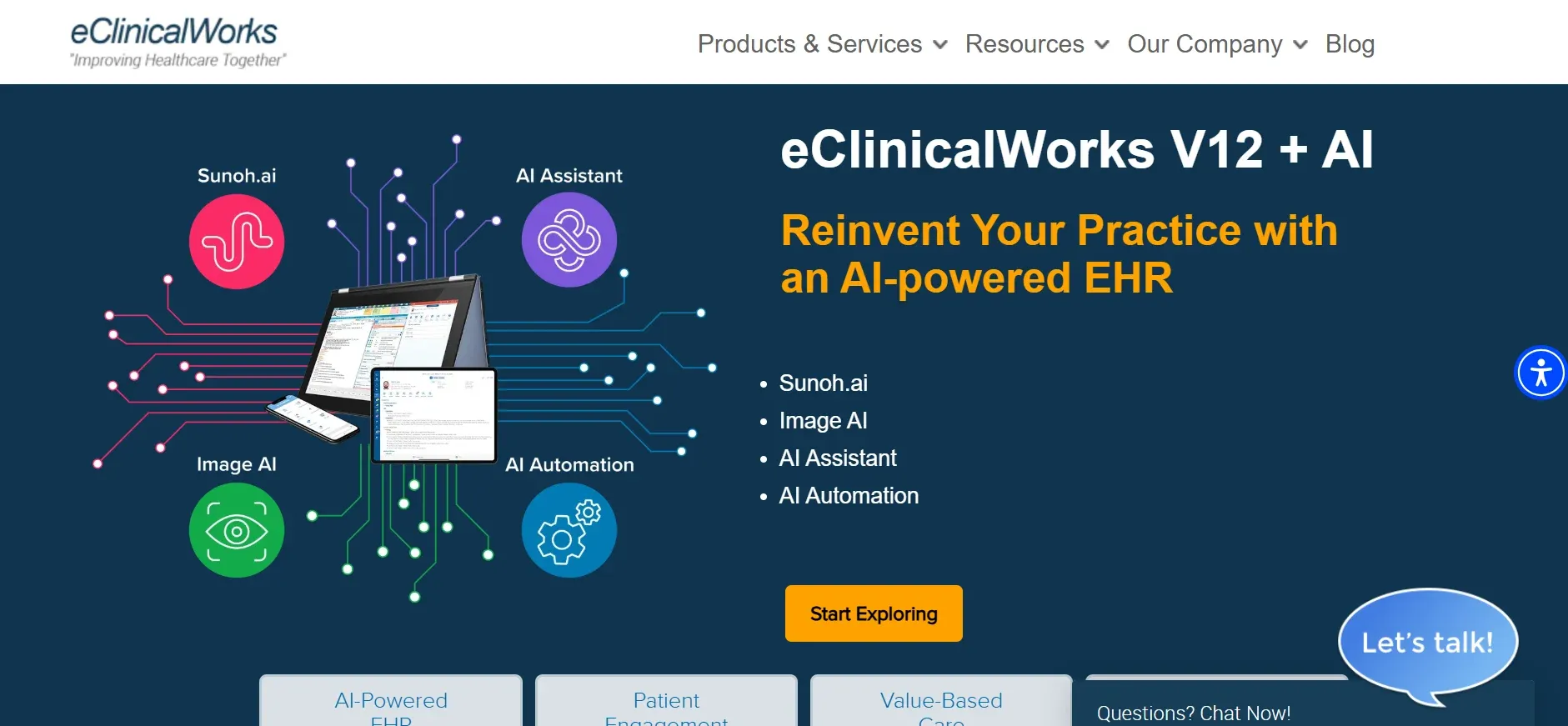
eClinicalWorks is a widely used cloud EHR and practice management suite, offering everything from scheduling to billing to patient engagement. Its flexibility and mobile apps make it popular with mid-size and multi-location clinics.
Pricing: Reported $449+/provider/month (confirm with vendor).
- Unified EHR, scheduling, and billing
- Mobile apps for providers and patients
- Large integration marketplace
- Per-provider pricing rises as you add staff
- Some users report slow support and clunky updates
- Custom reports and integrations may incur extra fees
8. NextGen (Best for multi-location urgent care)
NextGen is designed for complex clinics operating across multiple sites, with advanced scheduling, resource management, and documentation tools. Its urgent care modules are tailored for rapid patient intake and treatment.
Pricing: Reported $299+/provider/month (confirm with vendor).
- Multi-location scheduling and management
- Custom urgent care forms
- Advanced analytics and reporting
- Comprehensive feature set can be overwhelming for small teams
- Monthly costs rise as you scale
- Setup and integrations may require significant investment
9. Epic (Best for large organizations and hospital-owned clinics)
Epic is the leading EHR for large hospital systems and health networks. Its feature set is unmatched in scale, with interoperability, compliance, and analytics.
Pricing: Custom quote (enterprise scale).
- Comprehensive EHR for all specialties
- Industry-leading interoperability
- Deep analytics and compliance tools
- High cost and IT demands for independent clinics
- Implementation can take a year or more
- Customization requires Epic-certified developers
10. Devaims (Best for owning your urgent care platform)
Devaims builds custom urgent care platforms that you own outright. Unlike every other Athenahealth alternative, you keep the source code, pay no per-provider or per-location fees, and decide when and how to upgrade. You can integrate the labs, billing, and analytics you want, or build features no SaaS tool will ever prioritize for you. Devaims delivers EHR, practice management, check-in, scheduling, billing, and patient engagement, all tailored to your workflow and branding.
Pricing: $28,000 one-time build, then $180/month maintenance (flat, not per provider).
- Full ownership, no per-provider or per-location fees
- Custom features and integrations built to your needs
- Flat, predictable costs as you grow
Other Athenahealth alternatives worth knowing
- PrognoCIS: Good for specialty clinics, but less urgent care focus. Offers customizable templates and telemedicine, but per-provider pricing applies.
- Nuvolo: Strong for healthcare asset management and facilities, not a direct EHR replacement. May be useful for urgent care groups with multiple sites and complex physical operations.
- Practice Fusion: Popular cloud EHR for primary care; limited urgent care features and integrations, but low cost for solo or very small clinics.
- DrChrono: Focuses on mobile-friendly EHR and billing, with flexible APIs but per-provider subscription. Suitable for startups or clinics running on iPads.
If you’re running a niche or non-traditional urgent care, these may be worth a look, but always confirm they fit your real-world workflow and compliance needs. For deeper research, see resources from HIMSS and KFF.
How to choose the right Athenahealth alternative
- By budget: Calculate your total cost, including per-provider, per-location, integration, and support fees, over five years. Ask for detailed quotes and watch for “hidden” charges like data exports, upgrades, and custom reports. For most clinics, the real cost of SaaS can double or triple the sticker price.
- By workflow: Urgent care is unique: high patient volume, walk-ins, rapid documentation, and acute care protocols. Choose a tool (or custom build) that matches your flow out of the box, or can be tailored without endless consulting.
- By tech ownership: If you want to control your data, integrate with local partners, or avoid being locked into a vendor’s roadmap, SaaS is not your endgame. Ownership means you control upgrades, features, and compliance.
- By support and reporting: Some platforms charge for custom reports, complex billing setups, or priority support. Owned systems (like Devaims) can make these standard or custom to your needs.
- By growth: Plan for what happens when you add providers, new locations, or new service lines. Will your costs spike? Can your platform adapt, or will you need to migrate again?
If you’re tired of building someone else’s platform with your monthly fees, owning your software may be the next step.
Stop paying rent on software you could own
Every Athenahealth alternative above keeps you in the same cycle: per-provider fees, annual increases you cannot control, and features that are always “coming soon” unless you pay more. Even the best SaaS EHR is still rented. Five years from now, you will have paid out six figures, with nothing to show for it but another contract renewal.
That’s where Devaims comes in. Devaims builds urgent care platforms you own. You get the source code, your data, and the ability to add features whenever you need them, without waiting for a vendor’s roadmap or paying penalty fees. Clients keep full control: no user-based licenses, no forced upgrades, no lock-in ever.
- No per-provider price hikes: Add staff and locations without a bigger bill. Your costs remain flat as you grow, making budgeting predictable.
- Your data, your rules: Full ownership and compliance control. You decide where and how your data is stored, who accesses it, and how it’s backed up for HIPAA and local regulations.
- Custom fit: The forms, workflows, and analytics you need, built your way, not a generic vendor template. You can adapt quickly to new clinical protocols, regulatory changes, or service lines.
| Tool | Ownership | Cost model | Custom features? |
|---|---|---|---|
| Athenahealth | No | Per-provider/month + add-ons | Limited/custom dev extra |
| Experity | No | Per-provider/month, contract | Limited/custom dev extra |
| eClinicalWorks | No | Per-provider/month, contract | Limited/custom dev extra |
| Devaims (owned) | Yes | One-time build + flat maintenance | Anything you need |
| Year | Rented (Athenahealth) | Owned (Devaims) |
|---|---|---|
| 1 | $54,000 | $30,160 |
| 2 | $108,000 | $32,320 |
| 3 | $162,000 | $34,480 |
| 4 | $216,000 | $36,640 |
| 5 | $270,000 | $38,800 (break-even: year 1) |
How the math works: Assume 9 providers at $500/month each (a typical urgent care scale), plus a few add-ons for telehealth and analytics. That’s $4,500/month, or $54,000/year, just for the software rental. Over five years, you’ll have spent $270,000, and you still don’t own anything. By contrast, a Devaims build costs $28,000 one-time, plus $180/month for hosting and support. Your break-even point is just after year one, and every year after, you’re saving tens of thousands versus renting.
If your urgent care has more providers, or you want advanced custom features, the savings multiply. For multi-site clinics, there’s no additional fee for each location or user. We’ll run your real numbers for free, so you can see the exact break-even for your urgent care center.
How to switch from Athenahealth
- Export your data: Request a full export from Athenahealth, including EHR, billing, patient records, and attachments. Be prepared for possible export fees, and clarify supported data formats with your new vendor.
- Choose your new tool: Select the alternative that fits your workflow, compliance, and budget. For custom builds like Devaims, this involves mapping your ideal workflows and integrations before development starts.
- Migrate/import data: Map your exported data into the new EHR or custom system. This step often requires data validation, field mapping, and testing to ensure accuracy, especially for historical records and attachments.
- Reconnect payments and third-party integrations: Integrate with your payment processors, labs, imaging, and pharmacy partners. Custom systems can directly connect to any partner with an API or data feed.
- Train your staff: Run both systems in parallel for at least a week. Provide hands-on training for new workflows, forms, and reporting. With Devaims, training is customized to your implementation.
- Review and close out your Athenahealth contract: Ensure all data is transferred and validated. Confirm that no patient or billing records are left behind, and formally terminate your contract to avoid renewal fees.
With a custom Devaims build, the migration process is managed end-to-end, including data mapping, integration setup, and staff training. You get a single point of contact for the entire project.
Frequently asked questions
What is the best Athenahealth alternative for urgent care?
For most urgent care centers, Experity is a strong fit for urgent care-specific workflows, including queue management and rapid intake. However, you’re still renting and subject to per-provider pricing. If you want to own your platform, only Devaims delivers true ownership, unlimited customization, and flat costs as you grow.
Which Athenahealth alternative is the cheapest?
Kareo (Tebra) is often the lowest-cost SaaS for small clinics, starting at $125 per provider per month. However, once you factor in add-ons and growth, costs rise quickly. For long-term savings, a Devaims build costs more upfront, but is dramatically cheaper by year three, especially for clinics with more than 3-4 providers.
Is there a free Athenahealth alternative?
No free solution matches Athenahealth’s compliance, security, and urgent care features. While open source EHRs like OpenEMR exist, they require significant IT investment, custom development, and ongoing support. For real-world urgent care operations, a paid SaaS or owned system is the only practical path for compliance and reliability.
What’s the best Athenahealth alternative for multi-location clinics?
NextGen and eClinicalWorks both support multi-site urgent care, with advanced scheduling and analytics. However, their per-provider and per-location fees add up fast as you grow. A custom Devaims system lets you add locations and staff without increasing your monthly bill, and can be tailored to your unique operational structure.
How do I switch from Athenahealth to a custom system?
First, request a full data export from Athenahealth. Next, work with your new vendor (or Devaims) to map and import that data into your new platform. Run both systems in parallel while staff are trained on new workflows. With Devaims, migration is managed for you, including data mapping, integration setup, and validation. The process is designed to minimize downtime and risk.
Can I keep my existing patient data if I switch from Athenahealth?
Yes, you can retain your patient data. However, you must request a full export from Athenahealth and confirm the format is compatible with your new EHR. Most alternatives, and Devaims, can import structured historical data (demographics, visits, billing, attachments), but always confirm with your vendor about supported data types and any limitations.
When does it make sense to switch to an owned platform?
If your five-year total SaaS cost approaches the one-time build price (plus maintenance), and you want to control your workflows, data, and integrations, it’s time to consider owning. This is especially true for clinics planning to grow providers or locations, or those with unique compliance or workflow needs that off-the-shelf tools cannot address. Owned platforms also make sense if you want to build long-term equity in your technology and avoid vendor lock-in.
The bottom line
There’s no shortage of Athenahealth alternatives, but nearly all keep you on the subscription treadmill. The only way to break free is to own your platform outright, with a Devaims custom build tailored to your urgent care’s needs.
Here’s the test: Add up what Athenahealth (or any SaaS EHR) will cost you over five years. If that number could have built you something you own, with your branding, workflows, and integrations, you already have your answer. Ownership means flexibility, predictable costs, and the ability to adapt as your urgent care grows.
See more on the Devaims blog, or check out related guides: Kareo alternatives, eClinicalWorks alternatives, and Epic alternatives.