


Your catering business has outgrown spreadsheets and sticky notes. Spiffy looked like the fix, until the monthly fees started stacking, and every "upgrade" unlocked another charge. Suddenly, you’re renting software that costs as much as a delivery van, and you still don’t own a line of code, let alone the power to shape your workflow or scale without penalty.
If you’re searching for Spiffy alternatives, you’re not alone. Many catering owners start with SaaS, then hit a wall: per-user costs, locked features, forced annual contracts, and the realization that every new menu, truck, or team member means a bigger monthly bill. The truth? Caterease, Tripleseat, HoneyBook, and Event Temple all solve parts of the problem, but the only path to software you truly own is a custom build, like what Devaims delivers. Below, you’ll see how the top 9 options compare, and what it really costs to rent vs own.
Why catering companies look for Spiffy alternatives
Per-user pricing that explodes as you grow: Spiffy and most rivals charge for each extra team member, so your bill climbs with every new hire. What starts as an affordable tool for one or two people can double or triple as you add event managers, kitchen staff, or delivery drivers who need access. For growing caterers, this quickly becomes a major operations cost.
Setup fees and annual lock-in: Caterease, for example, wants $200 per user upfront and a year-long commitment, easy to miss until you’re signing. These setup and onboarding fees can make switching expensive, and annual contracts mean you’re locked in even if your needs change or the software falls short.
Features paywalled behind higher tiers: Need custom reports, accounting integrations, or automated workflows? With most SaaS, you’re forced into premium plans or add-ons. Often, headline pricing doesn’t include the features you actually need for a modern catering business, such as complex event logistics, custom branding, or integrations with tools like QuickBooks, Stripe, or Mailchimp.
Your data, but not your system: No matter how much you pay, you never get the source code. Switching vendors means starting over, rebuilding your menus, and sometimes losing historical event data or client notes. You are always at the mercy of the vendor’s roadmap and migration options.
Upgrades and changes on their timeline, not yours: Platform updates can break your workflow, and you have little say in the roadmap. New features may be added that you don’t want, while the reports or automations you need never arrive. These pain points drive the search for Spiffy alternatives, especially for caterers who want to own their technology future.
Quick comparison of the best Spiffy alternatives
| Tool | Best for | Starting price | You own it? |
|---|---|---|---|
| Caterease | Feature-rich, established caterers | $99/month + $200/user setup | No |
| Tripleseat | Multi-venue event management | ~$99/user/month | No |
| HoneyBook | Small teams, simple bookings | $29/month | No |
| Event Temple | Large venues, integrations | $249/month | No |
| 17hats | Solo and micro businesses | $13/month | No |
| Planning Pod | End-to-end event workflows | $39/month | No |
| CaterZen | Delivery-focused operations | $99/month | No |
| Better Cater | Simple quoting & orders | $69/month | No |
| Devaims | Owning your system, scale flexibility | One-time build, you own it | Yes |
Always confirm current pricing before you decide, as tiers, add-ons, and user counts can shift totals fast. Also consider the costs of onboarding, migration, and the potential for vendor lock-in if you ever want to leave.
The 9 best Spiffy alternatives
1. Caterease (best for feature-rich, established caterers)
Caterease is a heavyweight in catering management, with deep features for quoting, CRM, and event logistics. Compared to Spiffy, Caterease offers more advanced reporting, detailed menu management, and a comprehensive set of tools for event planning, billing, and kitchen production.
Caterease’s standout features include:
- Advanced menu and recipe management, including food costing and nutritional analysis
- Drag and drop event calendars and timeline management
- Customizable proposals, contracts, and invoices
- Client CRM, event history, and marketing tools
- Integrations with accounting software (QuickBooks), payment processors, and venue management tools
- Comprehensive reporting: sales, profitability, staff scheduling, and more
Pricing: $99/month (Express), $149/month (Standard), $199/month (Professional), plus $28/month per extra user and a $200/user setup fee, billed annually (Caterease pricing).
- Key limitations:
- Steep learning curve for new users
- High setup and per-user fees
- Customization limited to vendor options
- Strengths:
- Extensive feature set for established caterers
- Strong reporting and menu management
- Good accounting and CRM integrations
On a system you owned, adding a user would cost nothing after launch, and you’d have full control over features and data.
2. Tripleseat (best for multi-venue event management)
Tripleseat is known for handling complex events across multiple venues. If your business juggles catering at different locations, it's a strong contender. Its feature set is built for hospitality companies that need to coordinate events, menus, and staff across several properties.
- Key limitations:
- Per-user fees add up quickly
- Annual contracts limit flexibility
- Customization requires technical resources
- Strengths:
- Centralized dashboard for multi-location management
- Automated BEO and proposal generation
- Robust CRM and reporting
When per-user fees become a burden, Devaims lets you add unlimited users at no extra cost.
3. HoneyBook (best for small teams and simple bookings)
HoneyBook targets creative businesses and caterers who need easy client booking and invoicing. It’s more affordable than Spiffy but trades off customization for speed. Its interface is modern and mobile-friendly, making it ideal for caterers who want to get up and running fast without a lot of setup.
- Key limitations:
- Limited customization and automation
- Manual data import for large histories
- Advanced features require higher tiers
- Strengths:
- Easy onboarding and client portals
- Affordable for small teams
- Modern, mobile-friendly interface
When features are locked behind a higher tier, a custom platform just includes what you need from day one.
4. Event Temple (best for large venues and integrations)
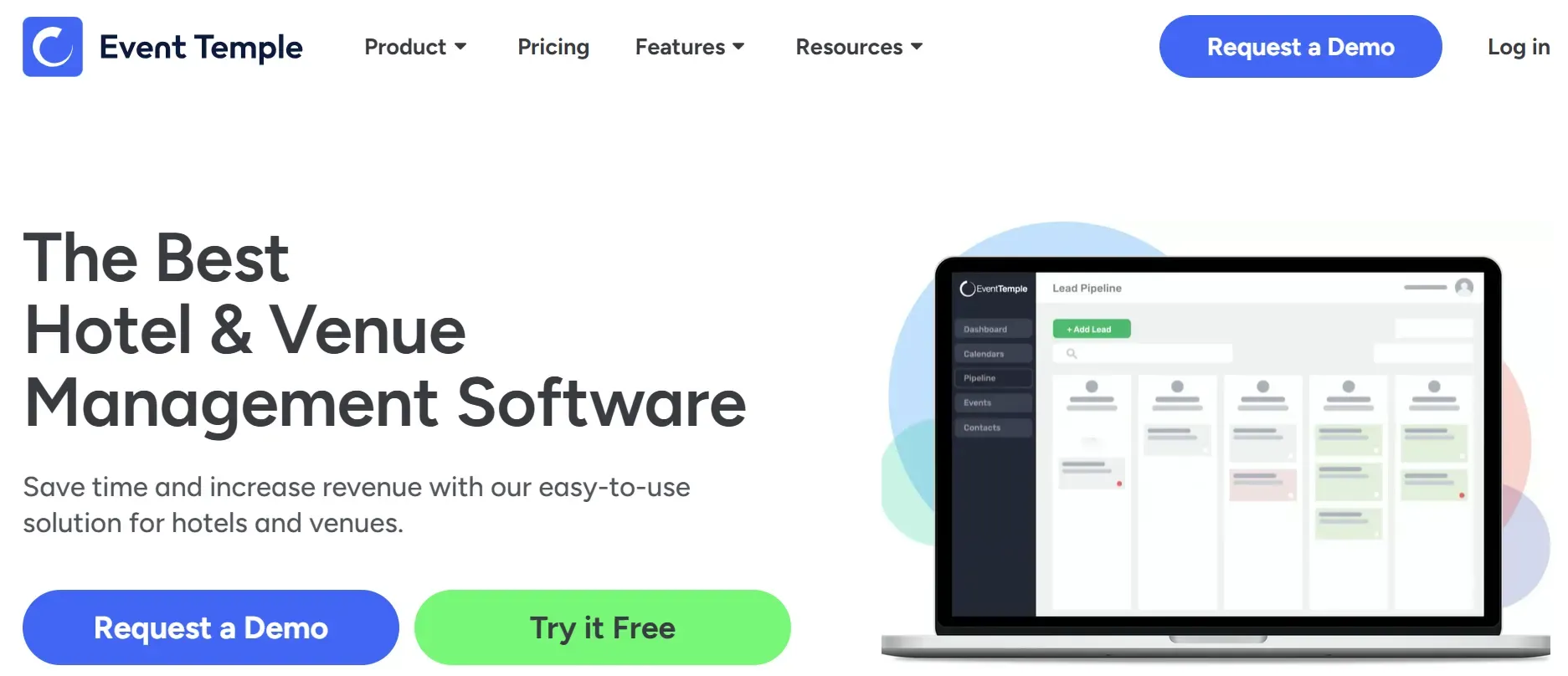
Event Temple is designed for hotels, conference centers, and venues with high event volume. It’s a step up from Spiffy on integrations, but the price reflects it. Event Temple emphasizes workflow automation, advanced reporting, and a growing ecosystem of integrations.
- Key limitations:
- Expensive for smaller teams
- Custom pricing complicates budgeting
- Interface can be overwhelming
- Strengths:
- Powerful integrations and automation
- Advanced analytics and reporting
- Multi-property management
5. 17hats (best for solos and micro businesses)
17hats fits solo caterers or very small teams who want simple project management, contracts, and payments in one place. Compared to Spiffy, it’s much cheaper, but you’ll outgrow it fast if your catering business expands.
- Key limitations:
- Not built for teams or complex workflows
- Basic reporting only
- Limited customization
- Strengths:
- Affordable entry pricing
- Easy to set up and use
- Good for solo operators
6. Planning Pod (best for end-to-end event workflows)
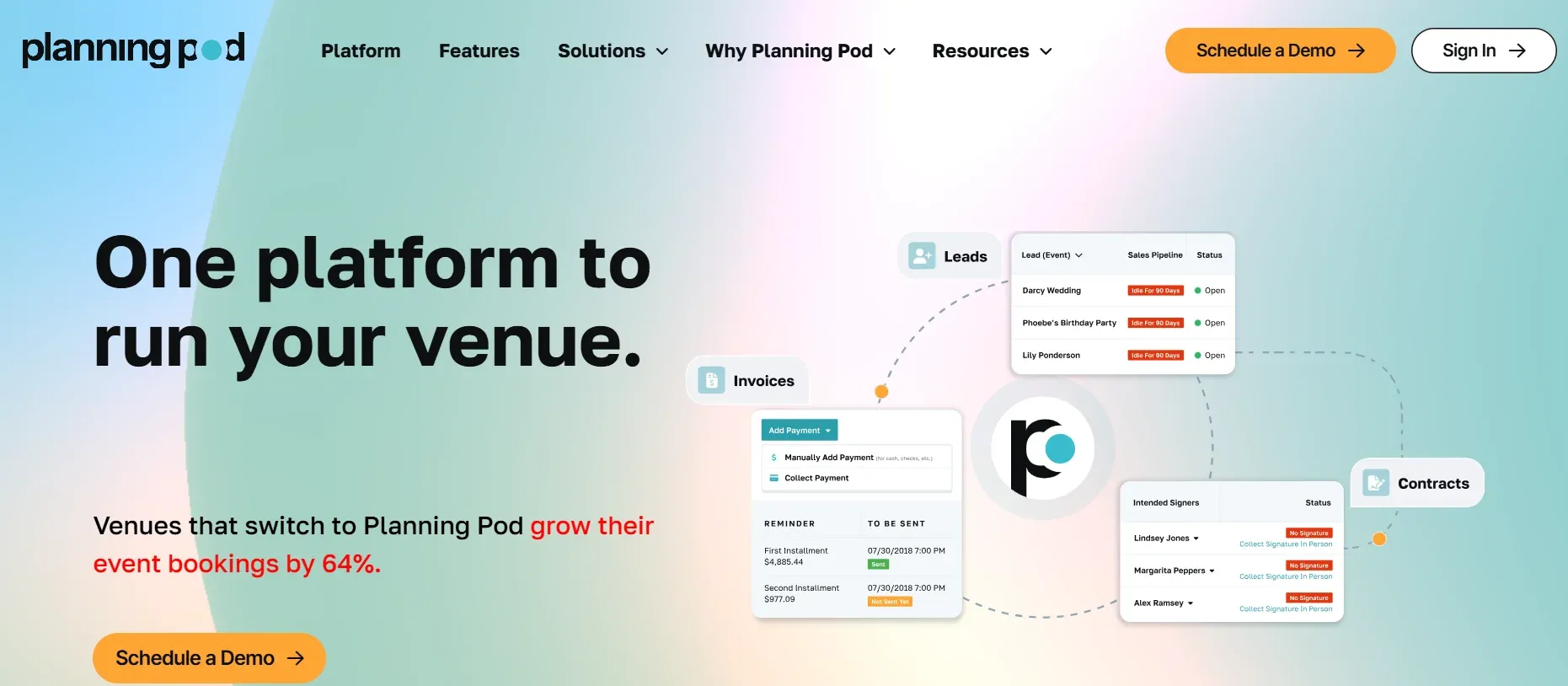
Planning Pod aims to cover everything: bookings, staff scheduling, floor plans, and catering logistics. It’s broader than Spiffy, but the interface can feel crowded for new users. Planning Pod is one of the few tools that offers collaboration features for both internal teams and external vendors.
- Key limitations:
- Interface can be overwhelming
- Advanced features require higher tiers
- Customization limited to platform options
- Strengths:
- Comprehensive event management tools
- Collaboration features for teams and vendors
- Good integrations for event workflows
7. CaterZen (best for delivery-focused catering)
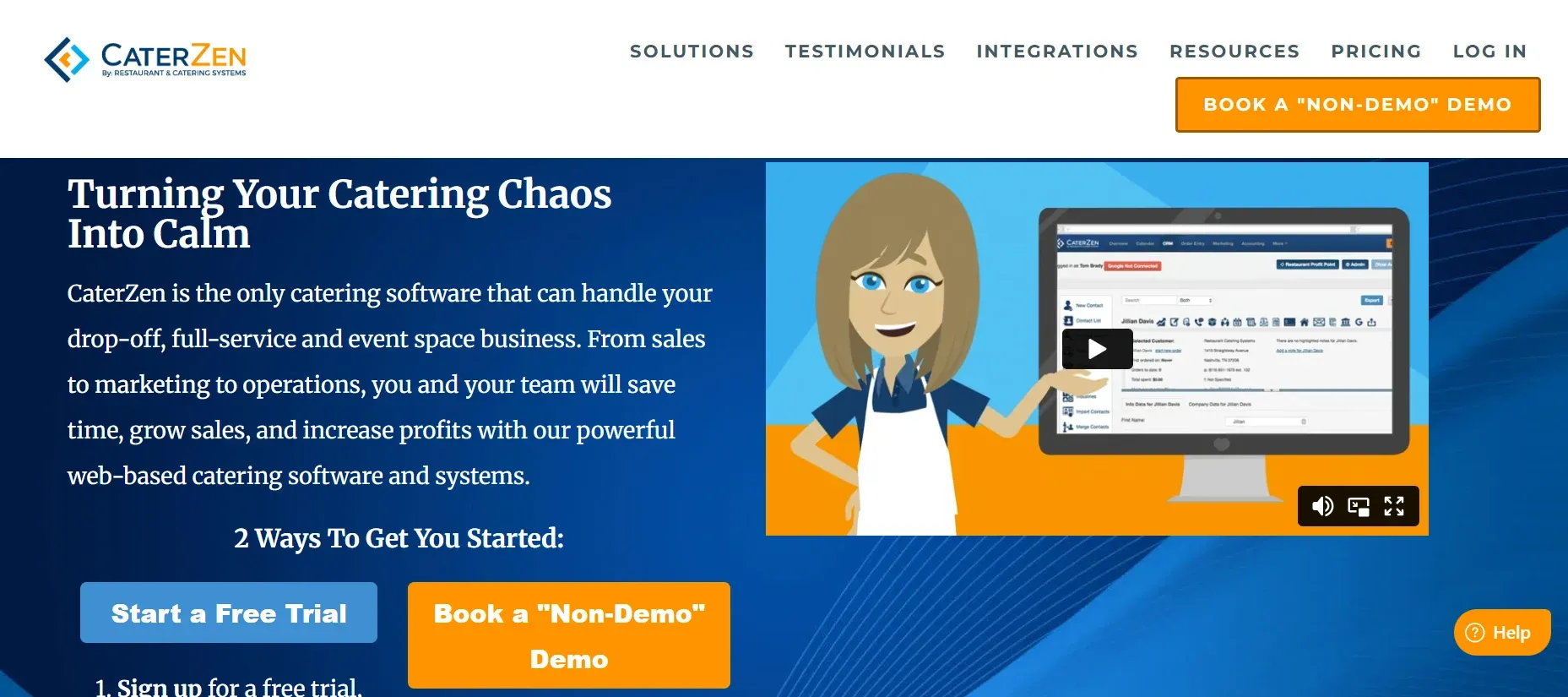
CaterZen is built for caterers who handle lots of deliveries, offering route planning and customer management. It’s more niche than Spiffy, but shines if delivery is the core of your business.
- Key limitations:
- Limited reporting and dated interface
- Not ideal for advanced event planning
- Custom workflows not supported
- Strengths:
- Strong delivery and logistics features
- Recurring order management
- Automated notifications for clients and drivers
8. Better Cater (best for simple quoting and orders)
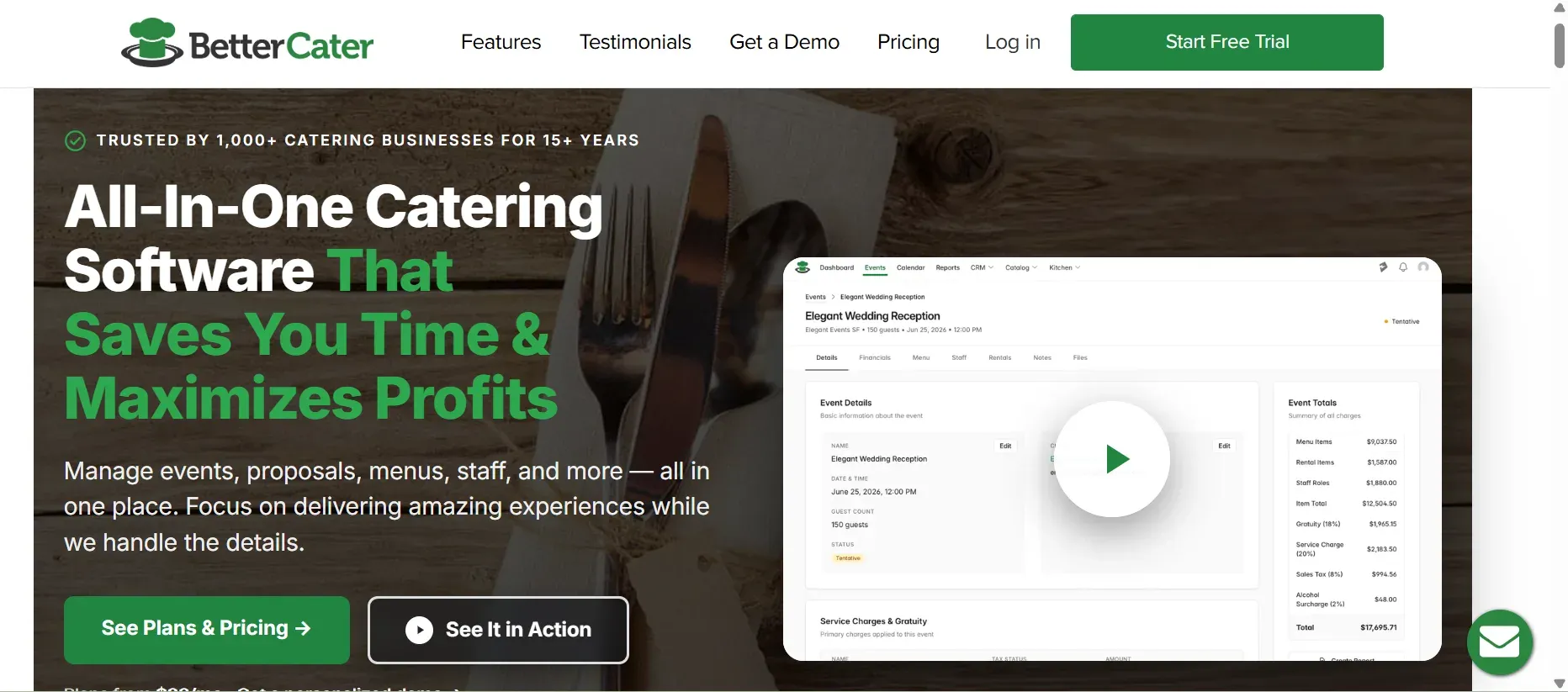
Better Cater is a streamlined tool for small caterers who want quick quoting and order entry, without the bells and whistles of Spiffy or Caterease. It’s intentionally simple, perfect for those who want to get in, get quotes out, and keep moving.
- Key limitations:
- Very limited customization and integrations
- Manual data import only
- Not suitable for scaling businesses
- Strengths:
- Quick to set up and use
- Affordable for small caterers
- Simple quoting and order management
A custom Devaims build means your quoting and order process matches your real workflow, not the other way around.
9. Devaims (the only owned alternative, best for control and scale)
Devaims is the path when you’re done renting. Devaims designs and builds custom catering management systems you own, source code and all. No per-user fees, no forced upgrades, and your data is always yours. It’s your platform, tailored to your trucks, menus, and reporting needs.
- Custom quoting, menu, and event management to fit your workflow exactlyOrder, delivery, and logistics modules designed around your operationIntegrations with any payment provider, accounting system, or third-party tool you useRole-based access and unlimited users, add staff as you grow, no extra feesAdvanced reporting and analytics, custom dashboards, and export optionsSource code ownership and full access to your dataChange requests handled on your timeline
- Custom quoting, menu, and event management to fit your workflow exactly
- Order, delivery, and logistics modules designed around your operation
- Integrations with any payment provider, accounting system, or third-party tool you use
- Role-based access and unlimited users, add staff as you grow, no extra fees
- Advanced reporting and analytics, custom dashboards, and export options
- Source code ownership and full access to your data
- Change requests handled on your timeline
With Devaims, the software works the way your shop runs, not the other way around.
Other Spiffy alternatives worth knowing
- Total Party Planner: Strong for event-heavy caterers, with menu costing and production tools. Pricing can rise quickly as you add users or require advanced features.
- Curate: Targets floral and event companies; less direct fit for catering, but some overlap for event planners who also offer food service.
- CaterXpert: Powerful, but best for enterprise-scale operations with highly complex needs and dedicated IT staff.
Some tools, like Curate, are more focused on event design than catering logistics. Be sure the tool matches your workflow before you commit. If food production, delivery, or kitchen management are central, pick a platform built for catering, not just event sales.
How to choose the right Spiffy alternative
- Budget: Solo operators can get by with 17hats or Better Cater; larger teams should check total costs with Caterease or Tripleseat. Factor in setup, migration, and training costs, not just monthly fees.
- Workflow needs: High-volume delivery? CaterZen. Deep event logistics? Planning Pod or Event Temple. Custom workflow? Devaims. Make a list of must-have features, like online ordering, delivery tracking, or production sheets, before you shop.
- Integration requirements: If you need payment, accounting, or custom reporting, make sure the tool, or your own system, supports it natively. Ask about API access and third-party integrations to avoid roadblocks later.
- Ownership preference: If you want to stop paying rent, owning with Devaims is the only path. Consider the long-term impact on your margins, data security, and ability to innovate as your business evolves.
If you want a system that won’t get more expensive as you grow, or features that fit your unique process, talk to Devaims about an owned solution.
Stop paying rent on software you could own
Every catering SaaS, Spiffy, Caterease, Tripleseat, solves a problem, but none put you in control. Your business grows, so do your per-user fees. You need a new feature? Wait for the vendor, or pay for the "Pro" tier. And in five years, you’ve spent enough to buy the system several times over, yet you still don’t own it.
Devaims changes that. As a custom software partner, Devaims builds catering management tools tailored to your workflow, menus, orders, deliveries, reporting, all as you want them. You get the source code, no contract lock-in, and flat, predictable support. Your data, your platform, your future.
- Sick of per-user pricing? With Devaims, you pay once, add as many users as you like forever.
- Frustrated by feature walls? If you need it, it’s built in, no more "upgrade for access".
- Worried about being stuck? You own the platform, so you decide when and how it grows.
| Platform | Ownership | Pricing Model | Contract Required? |
|---|---|---|---|
| Caterease | Rented | $99/mo + $200/user setup | Annual |
| Tripleseat | Rented | $99/user/mo | Annual |
| HoneyBook | Rented | $29/mo | Monthly |
| Devaims (owned) | You own it | One-time build + flat monthly maintenance | No |
| Year | Rented (annual) | Rented (cumulative) | Owned (Devaims annual) | Owned (cumulative) |
|---|---|---|---|---|
| 1 | $9,600 | $9,600 | $26,800 | $26,800 |
| 2 | $9,600 | $19,200 | $1,800 | $28,600 |
| 3 | $9,600 | $28,800 | $1,800 | $30,400 |
| 4 | $9,600 | $38,400 | $1,800 | $32,200 |
| 5 | $9,600 | $48,000 | $1,800 | $34,000 (now ahead) |
The cost math: For a 10-user catering shop, SaaS at $99/user/month = $990/month = $11,880/year. We used $9,600/year as a realistic blended figure with discounts. Devaims: $25,000 build, $150/month maintenance. Your numbers may differ, so ask us to run a custom calculation for your shop. The important thing is to model costs over 3-5 years, not just the first year, and to factor in what you get (or don’t get) for ongoing payments. Most caterers are surprised to see that after about three years, owning is less expensive than renting, and the savings compound every year after that.
The caterers who gain most from owning are those who plan to grow, want control over their data, or run unique workflows that rented tools can’t match.
How to switch from Spiffy
- Export all your data from Spiffy, including clients, events, menus, invoices. Most systems offer CSV or Excel export, but check for field mismatches.
- Choose your new platform: another SaaS, or a custom build from Devaims. Make sure you understand contract terms, onboarding process, and support.
- Import or migrate your data into the new system, map fields and verify accuracy. For custom builds, Devaims handles this step for you, ensuring all your historical data is preserved and correctly structured.
- Reconnect payment processors, email, and any third-party integrations. This may require API keys or setup with your new provider.
- Train your staff on the new workflows and features. Consider a short parallel run where both systems are live, so you can catch gaps or errors.
- Run both systems in parallel for a short period to catch gaps or errors. This minimizes downtime and ensures you don’t miss any critical events.
- Review your Spiffy contract and formally cancel when ready. Make sure there are no hidden termination fees or data deletion policies.
With a custom Devaims build, the migration is handled as part of the project, with dedicated support for training, integration, and data validation.
Frequently asked questions
What is the best Spiffy alternative for catering companies?
Caterease and Tripleseat are strong options for established caterers, while HoneyBook is great for small teams. For true ownership, Devaims stands alone as the custom solution you own outright. The best choice depends on your size, complexity, and desire for control. If you want to stop paying rent and have software that truly fits your business, Devaims is the only fully owned option.
Which Spiffy alternative is cheapest?
17hats and Better Cater offer the lowest monthly fees, but lack advanced features and scalability. When comparing total cost of ownership over several years, Devaims can save you the most in the long run, because there are no ongoing per-user or per-feature fees. The math favors owning if you plan to grow or stay in business for more than a couple of years.
Are there any free Spiffy alternatives for caterers?
Most professional tools charge monthly or annual fees. Some solo operators use spreadsheets, Google Forms, or basic CRM tools (like HubSpot Free), but these lack catering-specific features and cannot scale. Devaims does not offer free builds, but your system is yours, with no recurring SaaS rent and no surprise fees as you grow.
Which Spiffy alternative is best for delivery-heavy catering?
CaterZen is designed for catering businesses focused on delivery, providing route optimization, order tracking, and automated notifications for clients and drivers. Better Cater is also solid for logistics-heavy shops, especially those needing online ordering and ingredient tracking. For custom delivery workflows or integration with your own fleet tracking, Devaims can build exactly what you need.
Can I keep my Spiffy data if I switch?
Yes, you can export your client and event data from Spiffy, usually via CSV or Excel. Most alternatives, including a custom Devaims build, allow you to import your historical data for a smooth transition. Be aware that some data (like custom fields or attachments) may require special handling, so plan your migration carefully.
How does Devaims compare to Spiffy for ownership?
With Spiffy, you rent and never own the code or infrastructure. With Devaims, you get a custom-built platform, own the source code, and pay only flat maintenance, with no per-user or per-feature charges. You control the roadmap, integrations, and data. This is the biggest reason businesses switch to owned software: you’re never locked out, and you’re never forced to pay for features or users you don’t need.
When should I switch from Spiffy to an alternative?
If your costs are climbing, you’re hitting workflow walls, or you want to own your system, now is the time to explore Spiffy alternatives. Owning your software makes sense if you plan to stay in business and grow, want to protect your data, or need custom integrations that SaaS vendors won’t build. The earlier you switch, the sooner you stop paying rent and start building equity in your technology.
The bottom line
The best Spiffy alternatives all solve pieces of the puzzle, but every SaaS comes with a price that scales as you do. Here’s the test: add up what your rented platform will cost over the next five years. If that number could have built you something you own, you already know your answer.
Owning your catering software isn’t just a financial play. It’s about control, over your data, your workflow, and your future. When the time comes to make the switch, Devaims is ready to build it your way.
Keep learning at the Devaims blog, or compare other options with Tripleseat alternatives, HoneyBook alternatives, and Caterease alternatives.