



Every church leader has felt it: that moment you realize last year’s Pushpay bill was bigger than a staff raise. Or the day you discover the features you need are locked behind another contract tier. When every transaction shaves a few more dollars off your ministry goals, it’s enough to ask, why are we renting the tools we rely on?
If you’re searching for Pushpay alternatives, you’re not alone. The market is packed with platforms promising better rates, friendlier contracts, or a smoother donor experience. But here’s the catch: nearly every option is another rental. You pay, you use, you repeat, forever. That’s why more churches are considering custom, owned software from Devaims. In this guide, you’ll get the real numbers, the honest pros and cons of each alternative, and a look at what owning your platform truly delivers.
Ready to compare? The best alternatives in 2026 are Planning Center for flexibility, Breeze ChMS for flat pricing, Tithely for budget givers, and Devaims if you want to own your stack and stop paying rent for your own data.
Why churches look for Pushpay alternatives
Annual contracts mean you’re locked in. Pushpay requires a 12-month commitment, with no free tier, so switching isn’t easy if the fit is wrong. This lock-in can create annual stress for leadership teams as budget cycles approach, especially if you want to scale back features or find yourself dissatisfied with support or updates. If your church’s needs shift mid-contract, you’re often out of luck or must pay penalties to exit early.
Transaction fees eat into giving. Expect 2.9 percent plus 30 cents per credit/debit card transaction, and up to $0.75 to $1 per ACH, every single time a donation hits your account. These fees may seem small at first, but for a church raising $500,000 annually, that’s $14,500 or more gone before you see a dollar. Over five years, these fees alone can rival the salary of a part-time staffer or the cost of a major outreach initiative.
Pricing jumps as you grow. Annual costs often creep above $4,000 as your congregation expands or you add new features. Pushpay’s pricing tiers are tied to both member count and giving volume, so growing ministries can be penalized for success. Many churches report surprise “growth” charges or sudden jumps when adding campuses or ministries.
Limited flexibility for custom needs. Pushpay’s roadmap is set by the vendor, not by your ministry. Want a new report, a unique workflow, or an integration with local tools? You wait, submit a feature request, and hope it lands on the roadmap. If it does, it may be months or years before it’s released, often as a paid upgrade.
All your data is locked in their cloud. You don’t own the code or the database, so exporting everything if you leave is rarely smooth. Many users report that data exports are limited, with missing fields or non-standard formats, making migration to a new system tedious and error-prone. This lock-in is a major reason why so many leaders are searching for Pushpay alternatives.
Quick comparison of the best Pushpay alternatives
| Tool | Best for | Starting price | You own it? |
|---|---|---|---|
| Planning Center | Flexible, modular needs | $160/mo (typical mid-size church) | No, rented |
| Breeze ChMS | Simplicity, flat pricing | $72/mo | No, rented |
| Church Community Builder (CCB) | Large, multi-campus | $150 to $1,000/mo | No, rented |
| Tithely | Low-budget giving | Free to $19/mo | No, rented |
| Realm (ACS Technologies) | Integrated ChMS + giving | $29 to $209/mo | No, rented |
| Servant Keeper | Legacy on-premises users | Reported, varies | No, rented |
| FellowshipOne | Enterprise, complex reporting | Reported, varies | No, rented |
| ChurchSuite | UK/EU churches | Reported, varies | No, rented |
| Church Windows | Accounting-focused | Reported, varies | No, rented |
| Devaims | Churches that want to own | One-time build | One-time build, you own it |
Always confirm current pricing before you decide. Rates and features change fast in church tech. Also, note that setup fees, support tiers, and transaction costs can make a big difference in your total spend. Some tools offer discounts for annual payment or multi-campus bundles, but watch for hidden fees in the fine print.
The 10 best Pushpay alternatives
1. Planning Center (Best for modular flexibility)
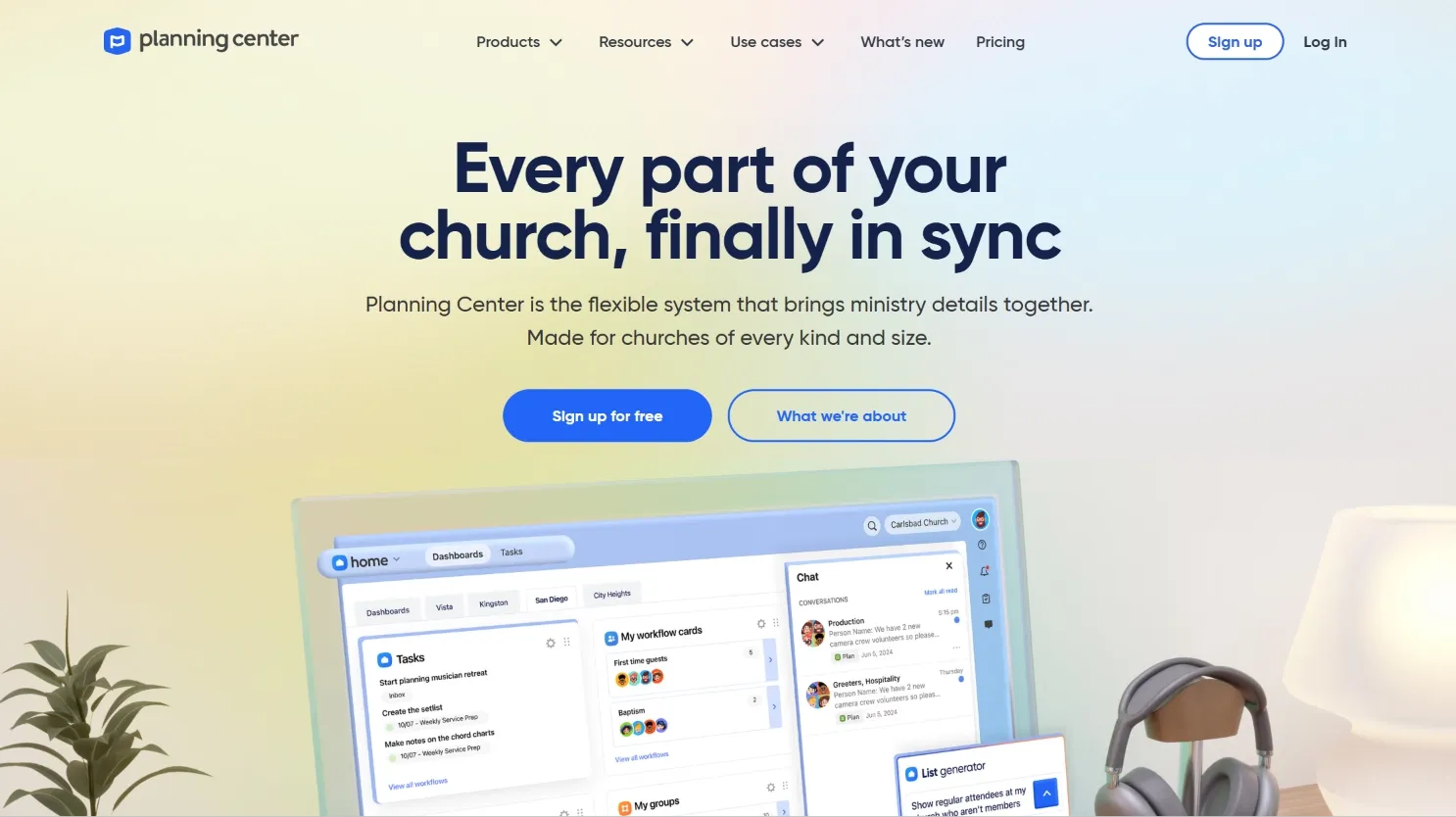
Planning Center is the “modular” leader in church software, letting you assemble exactly the tools your ministry needs. Its ecosystem covers Services (worship planning and volunteer scheduling), Groups (small group management), Giving (online/offline donations), Check-Ins (child safety and attendance), People (contact database), and more. Each module can be added or removed as your needs change, making it appealing for churches that want to avoid paying for unneeded features.
Pricing: $160/month for a typical mid-size church, with each module priced separately. No contracts or setup fees.
- Key limitations:
- Modular pricing can add up as you scale modules and users.
- Advanced customizations are limited to vendor roadmap.
- You do not own the code or backend data.
- Strengths:
- No contracts or setup fees, cancel anytime
- Modern UI, strong knowledge base, and active development
- Best for churches that want to evolve their tech stack gradually
On a Devaims-owned platform, every module is built exactly for your needs, with no piecemeal add-ons or surprise pricing shifts.
2. Breeze ChMS (Best for flat, simple pricing)
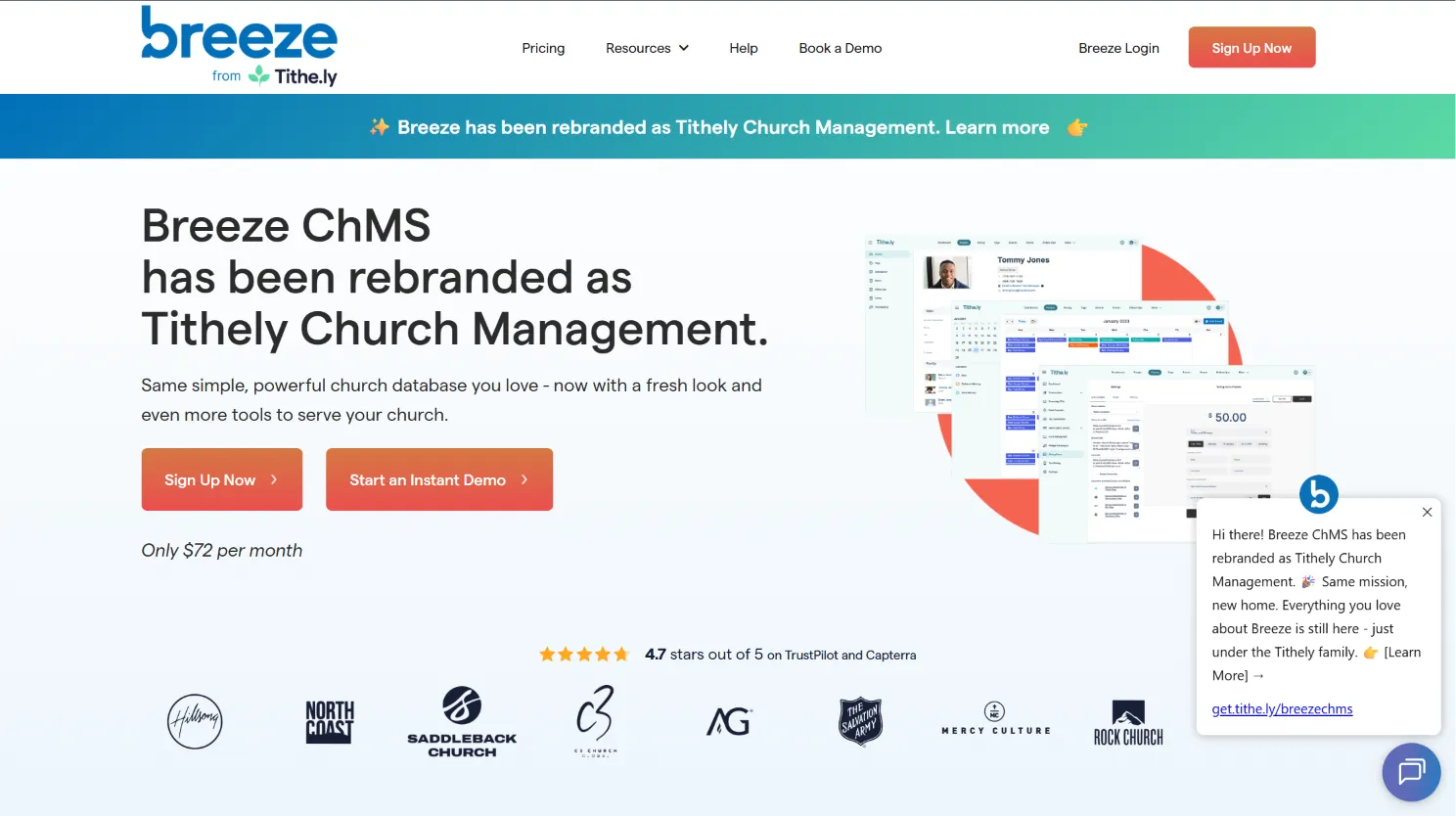
Breeze ChMS is popular with small and mid-sized churches for its one-price-fits-all approach: $72/month covers unlimited members, users, and features. The platform focuses on core church management: people, groups, calendar, basic giving, and communication. There are no contracts or setup fees, and support is known for being responsive and friendly.
Pricing: $72/month, flat rate. No contracts or setup fees.
- Key limitations:
- Feature set is intentionally simple and may not scale for complex needs.
- Integrations are limited compared to larger platforms.
- Advanced reporting and workflows are basic.
- Strengths:
- One price, no contracts or setup fees
- Easy to learn for non-technical staff and volunteers
- Fast, helpful customer support
With Devaims, your church could own every report, no more waiting for vendor priorities to align with your needs.
3. Church Community Builder (CCB) (Best for large, multi-site churches)
CCB is designed for large and complex churches, especially those with multiple campuses, diverse ministries, and dozens of staff users. The platform offers deep group management, event workflows, volunteer scheduling, assimilation pipelines, and advanced reporting. CCB also integrates with Pushpay for giving, but many churches use it as their ChMS backbone.
Pricing: $150 to $1,000/month depending on size and features. Setup fees may apply.
- Key limitations:
- Setup fees and contracts are standard for most plans.
- Interface can feel dated and has a learning curve.
- Advanced features may require higher pricing tiers.
- Strengths:
- Powerful for multi-campus administration and complex reporting
- Deep integrations with accounting, giving, and background checks
- Advanced permissions and workflow automation
With a Devaims build, you’d never get hit by a surprise storage or support charge, your platform, your terms.
4. Tithely (Best for budget-first online giving)
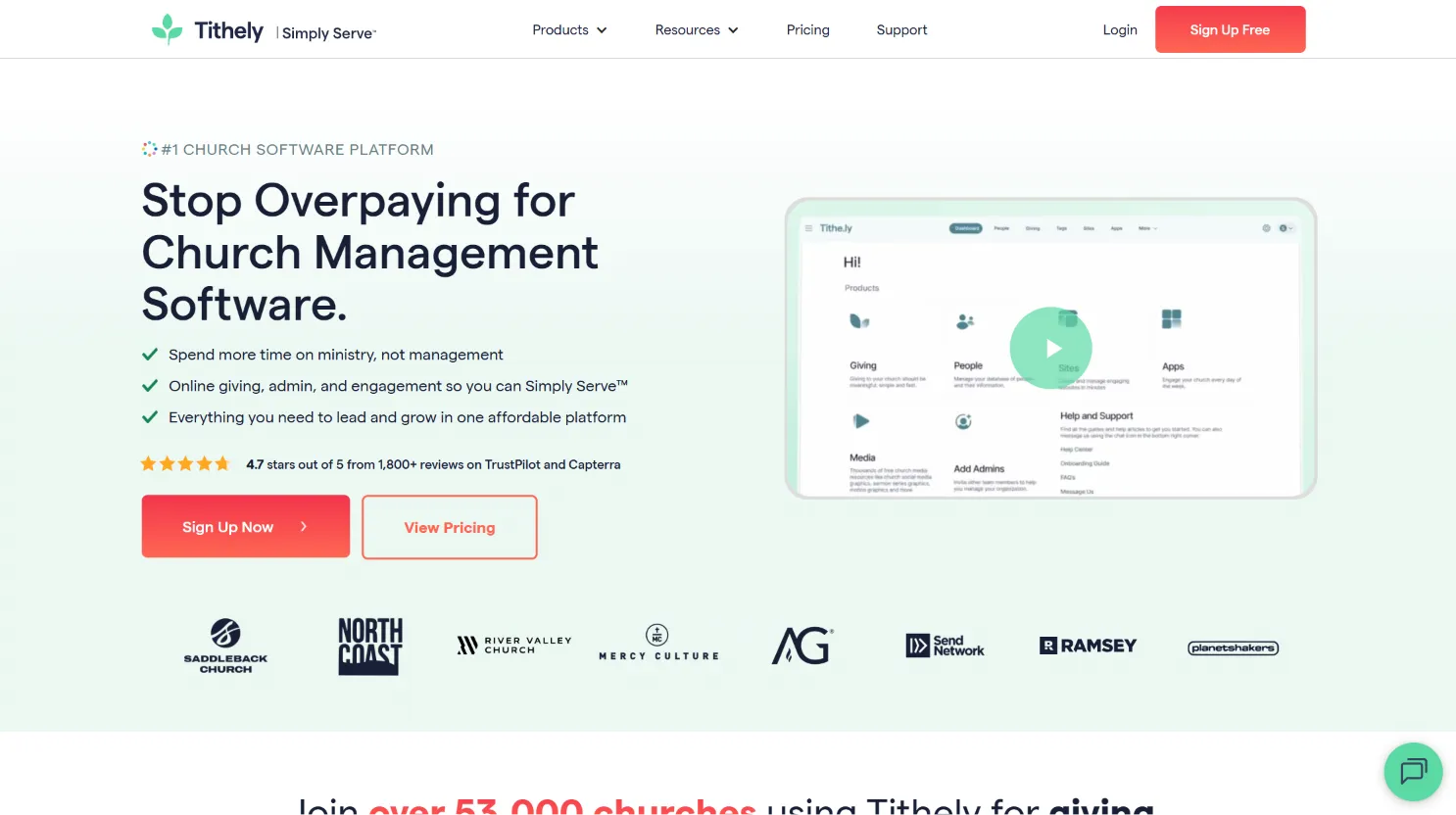
Tithely is best known for its lightning-fast setup and free entry point. The platform is focused on digital giving, web, text, kiosk, and mobile app, making it a favorite for church plants and small ministries. While it offers some basic ChMS features, giving is the core strength.
Pricing: Free to $19/month for core features. Transaction fees apply (2.9% + $0.30 per card, $0.30 per ACH).
- Key limitations:
- Transaction fees add up quickly as giving grows.
- ChMS features are basic and may not scale.
- Mobile app and advanced features cost extra.
- Strengths:
- Zero setup fees, no contracts, and rapid deployment
- Mobile-first donor experience and strong support for recurring giving
- Solid integrations for accounting and communications
5. Realm (ACS Technologies) (Best for all-in-one ChMS + giving)
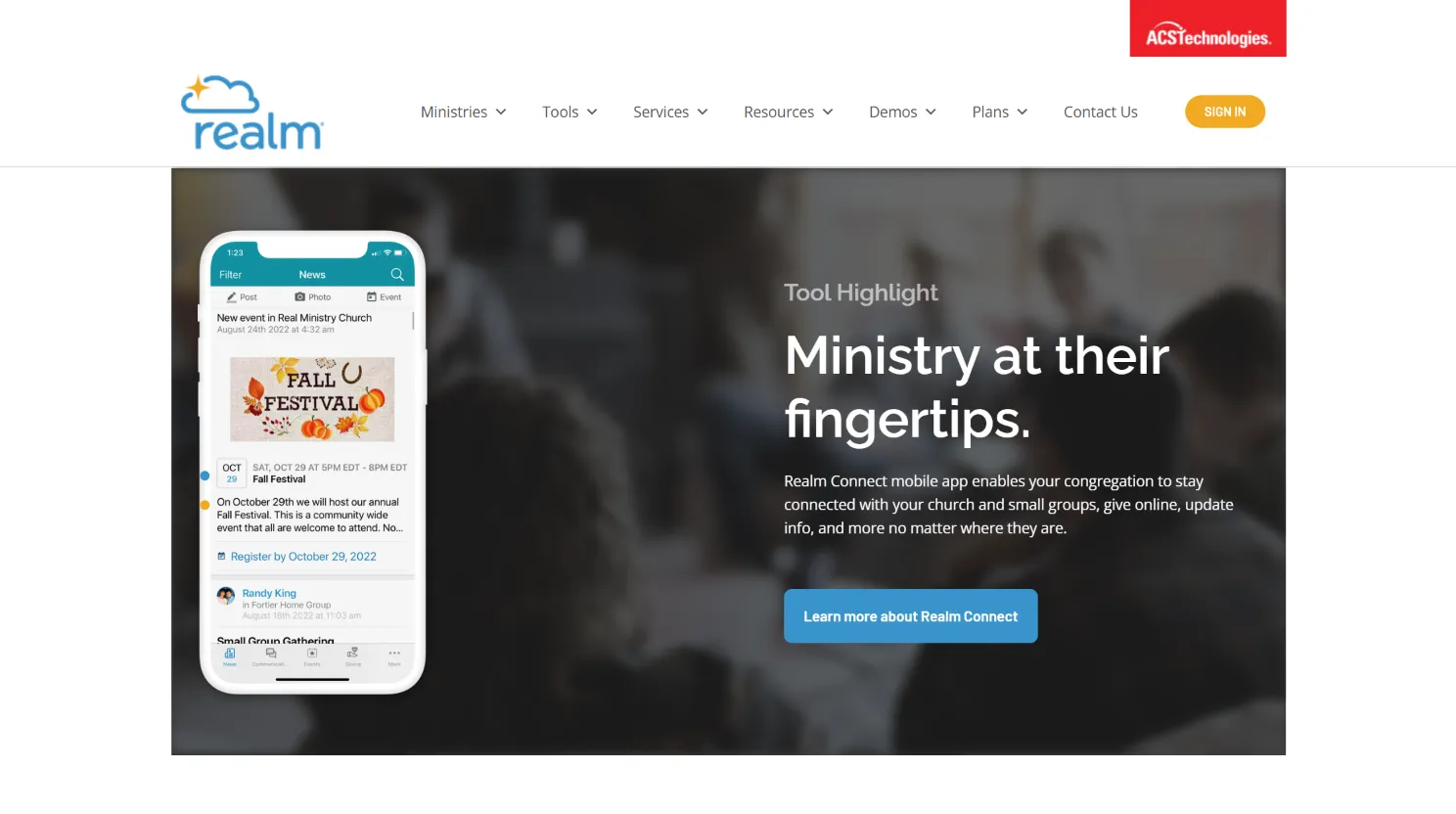
Realm is ACS Technologies’ cloud-based platform for managing members, giving, events, and communications in one place. It is a strong alternative for churches that want a single system for everything, from contributions to email groups to event RSVPs.
Pricing: $29 to $209/month depending on modules and size. Transaction fees apply.
- Key limitations:
- Pricing varies by module and member count.
- Learning curve for broad feature set.
- Some support responses can be slow.
- Strengths:
- Comprehensive suite for membership, giving, and events
- Active development and a large user community
- Flexible communication tools and reporting
With Devaims, your platform and training can be tailored for your team’s real workflows, not a generic template.
6. Servant Keeper (Best for legacy churches on Windows)
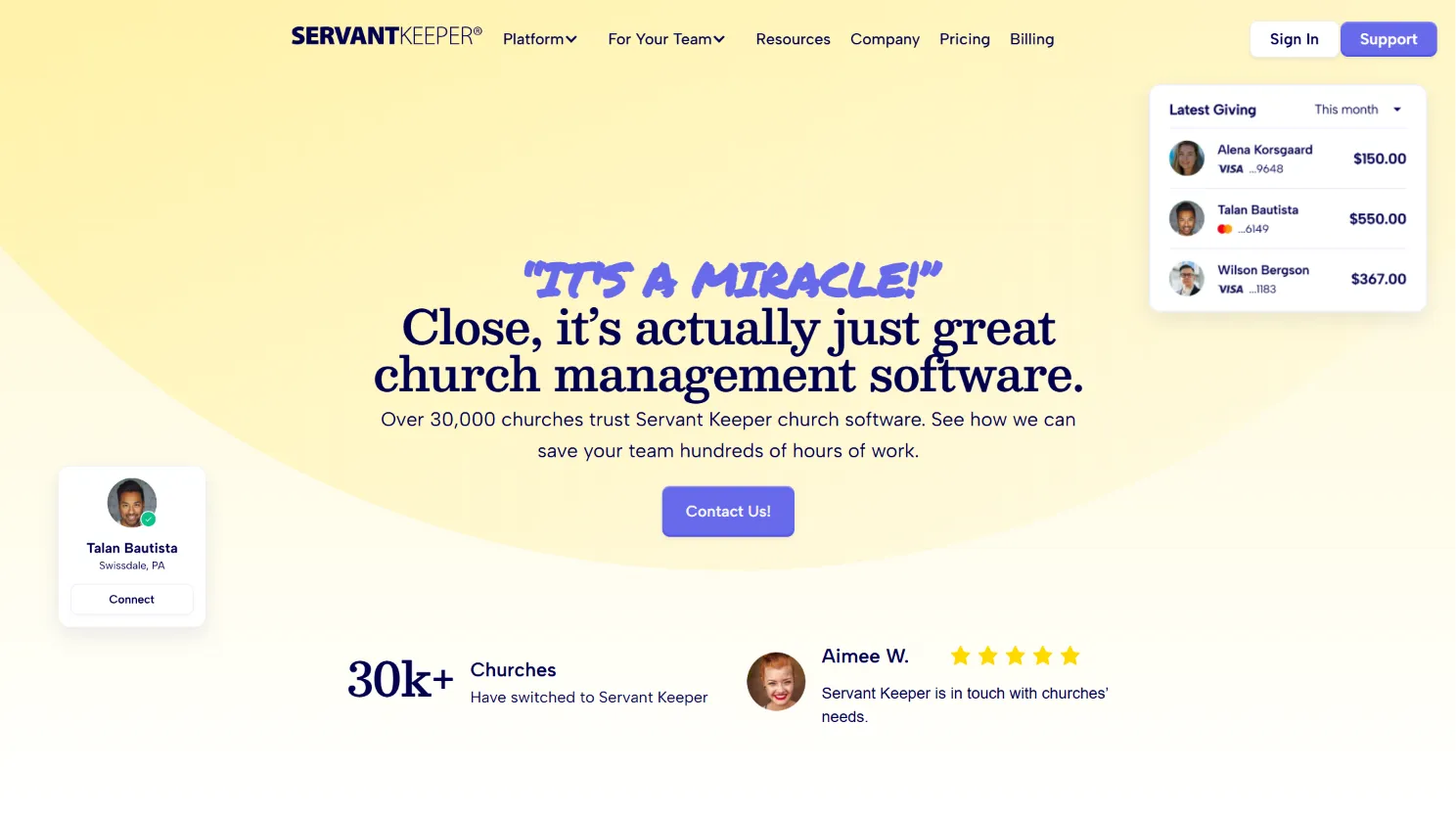
Servant Keeper has served churches since the 1990s, originally as an on-premises Windows application. Today, it offers both cloud and on-site options, making it a good fit for ministries with legacy infrastructure or limited internet access. While it has added web features, the experience is still rooted in traditional database management.
Pricing: Varies by deployment and features. Contact for quote. Subscription or perpetual license options.
- Key limitations:
- Interface is dated compared to modern cloud tools.
- Limited integrations and automation.
- On-premises installs require IT support.
- Strengths:
- Trusted for decades by traditional churches
- Flexible deployment (cloud or desktop)
- Strong reporting and offline access
7. FellowshipOne (Best for complex enterprise reporting)
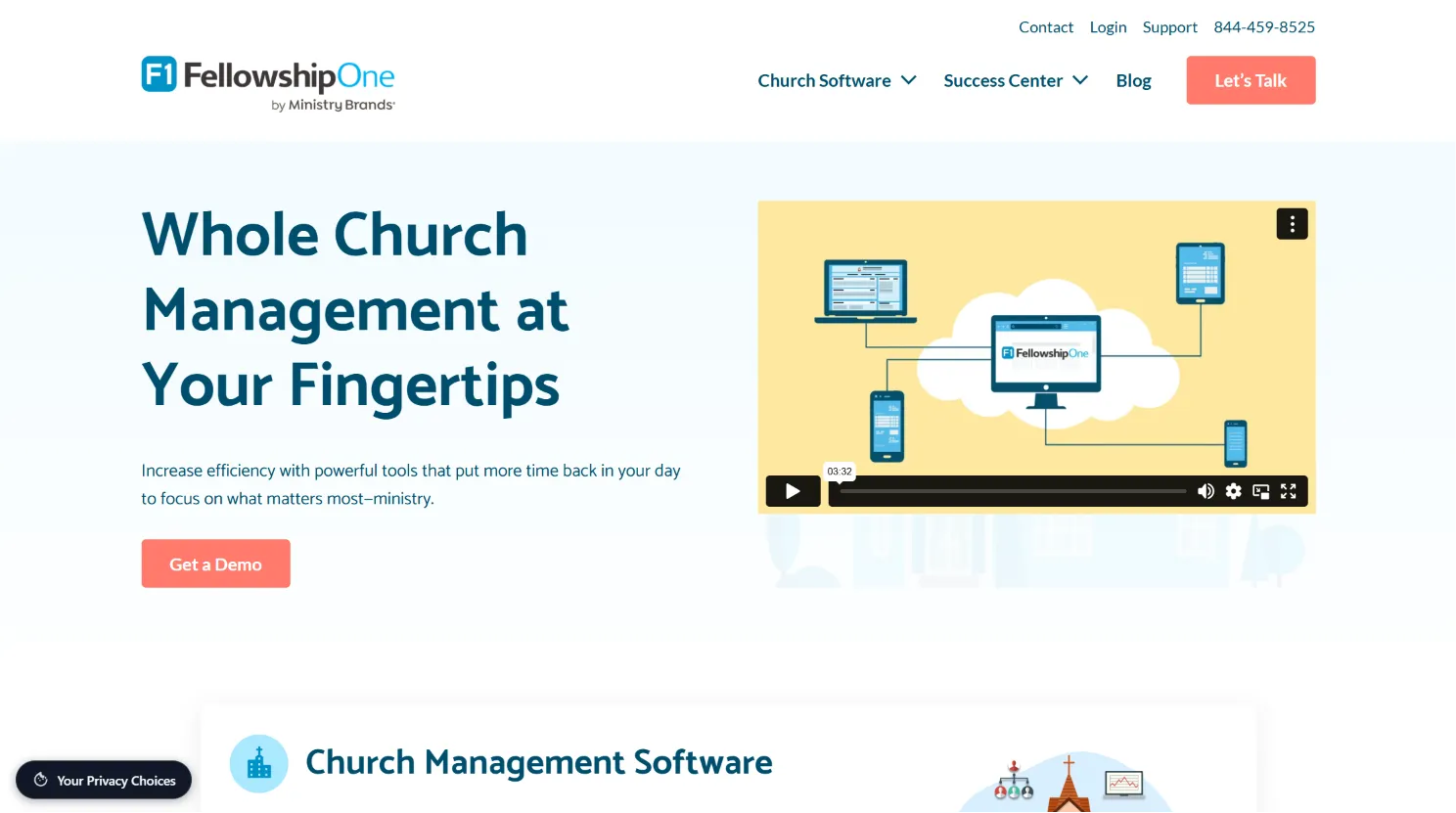
FellowshipOne is aimed at enterprise-level churches with complex needs for data, reporting, and ministry management. Its reporting engine is among the most flexible in church tech, with custom dashboards, data exports, and granular search capabilities. The platform is used by some of the largest churches in North America.
Pricing: Varies by size and features. Contact for quote. Setup fees and contracts may apply.
- Key limitations:
- Can be overwhelming for small teams.
- Setup and migration require significant planning.
- Pricing is not transparent.
- Strengths:
- Unmatched reporting and data flexibility
- Handles large, multi-campus organizations
- Rich ecosystem of integrations
8. ChurchSuite (Best for UK/EU churches)
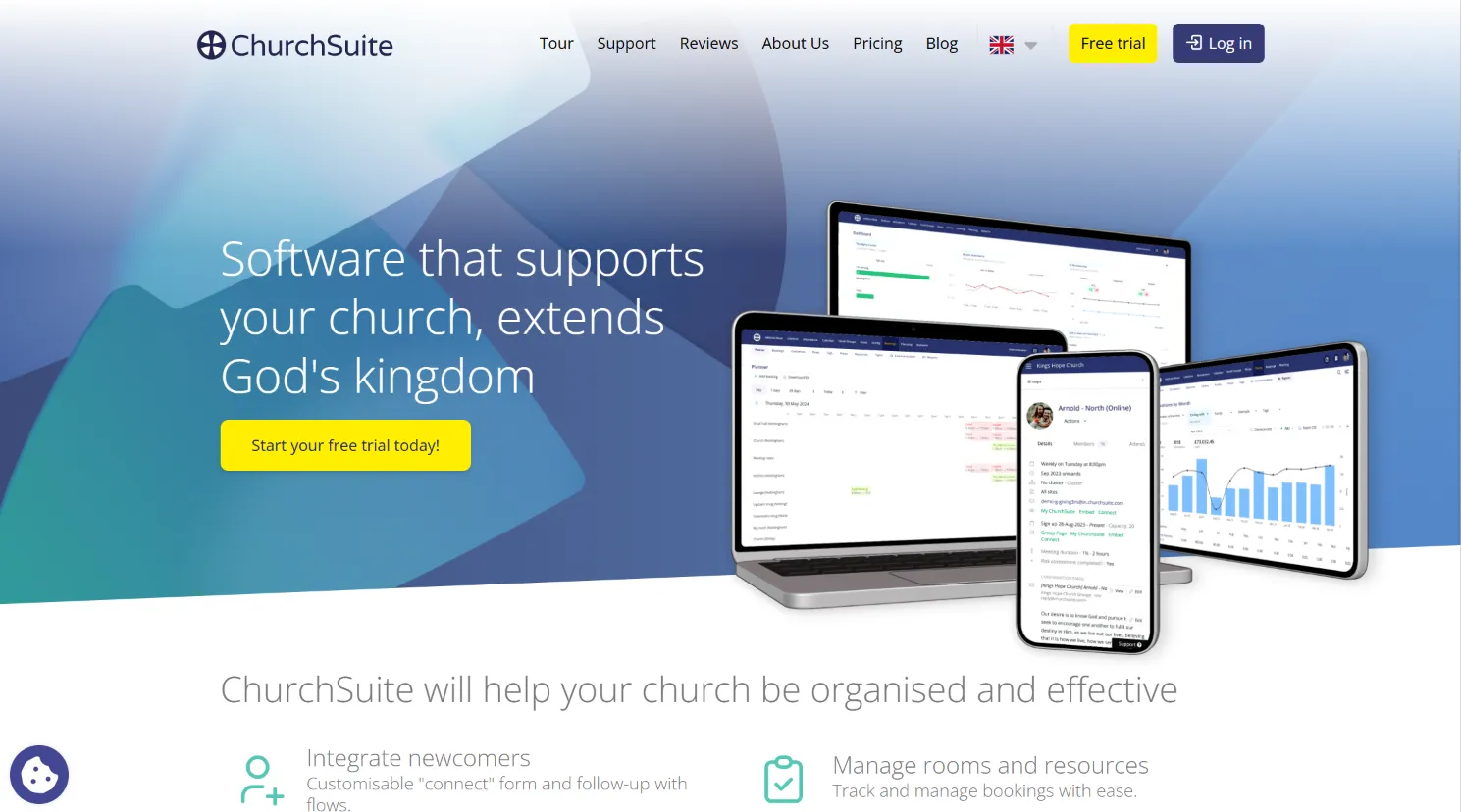
ChurchSuite is the leading choice for churches in the UK and EU, designed from the ground up for privacy, GDPR compliance, and local workflows. The platform covers people management, giving, events, and communications, all with a modern interface and strong localization.
Pricing: Varies by modules and church size. Priced in GBP/EUR. Contact for quote.
- Key limitations:
- North American payment integrations are limited.
- Pricing in GBP/EUR may complicate budgeting for non-EU churches.
- Less known outside Europe.
- Strengths:
- Best-in-class privacy and localization for EU/UK churches
- Modern, intuitive UI and strong support
- Flexible event and group management
9. Church Windows (Best for accounting-focused churches)
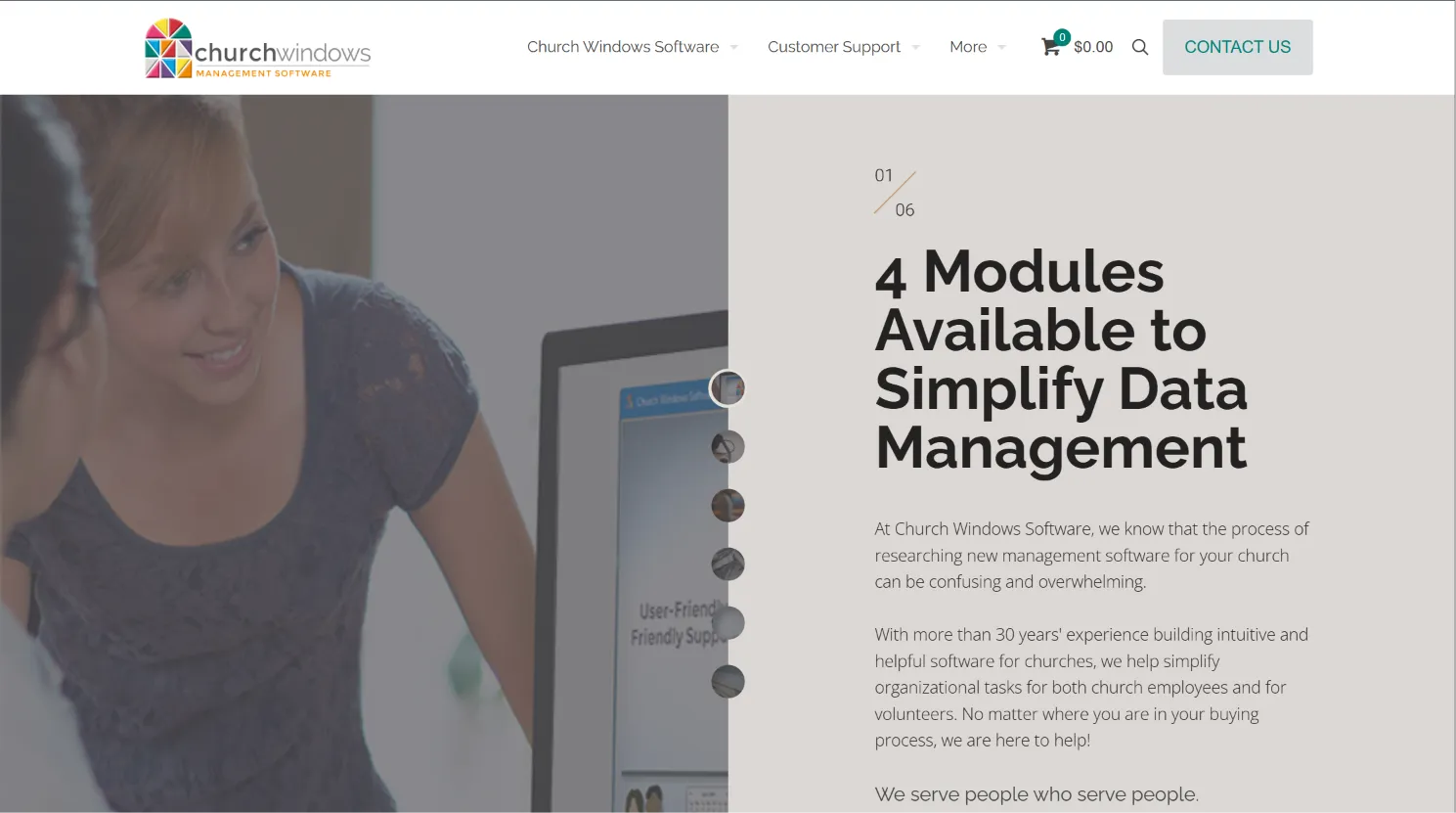
Church Windows is a legacy platform still favored by churches that prioritize strong finance, accounting, and payroll features. The software covers contributions, payroll, membership, and scheduling, with a focus on compliance and reporting for finance teams.
Pricing: Varies by modules and deployment. Subscription or perpetual license. Contact for quote.
- Key limitations:
- Interface is functional but dated.
- Digital giving features lag behind modern platforms.
- Customization is minimal.
- Strengths:
- Strong accounting and payroll modules
- Trusted by traditional and historic churches
- Flexible finance reporting and compliance
10. Devaims (Best for churches that want to own their tech)
Devaims builds custom church management and giving platforms your church owns outright. Unlike every other alternative, you get the source code, control your data, and never pay per-user or per-transaction rent again. Whether you need a single giving portal or a full-featured ChMS, every feature is built for your ministry’s unique needs. No more waiting on a vendor’s roadmap, and no more contract lock-in.
Pricing: One-time build fee, with optional flat maintenance. No per-user or per-transaction fees.
- One-time build, flat maintenance, and you keep the codeZero per-transaction or per-user fees, everCustom integrations and features built for your workflowsYou own your data, your platform, and your future upgrades
- One-time build, flat maintenance, and you keep the code
- Zero per-transaction or per-user fees, ever
- Custom integrations and features built for your workflows
- You own your data, your platform, and your future upgrades
Other Pushpay alternatives worth knowing
- Elvanto: A cloud ChMS popular in Australia, but with fewer US integrations and some recent changes after its acquisition by Tithely.
- EasyTithe: Focused on online giving, with simple forms and reporting, but limited church management features and basic integrations.
- Faithlife: Offers church websites and giving, but the company has shifted focus away from ChMS to Bible study and media tools in recent years.
- Subsplash: Strong for media and app building, with podcasting and livestream tools, but pricier for small churches and less focused on ChMS.
How to choose the right Pushpay alternative
- Budget: Know your real 5-year cost, including per-transaction and per-user fees. Calculate not just the monthly bill, but the total cost of ownership, including setup, migration, support, and payment processing. Ask for a full quote, with all fees itemized.
- Feature needs: If you want deep customization, rented tools will always come up short. Make a list of “must-have” and “wish-list” features. If you need unique workflows, custom reports, or integrations with local tools, only an owned or custom-built solution will truly deliver.
- Size and complexity: Multi-site churches should check for enterprise features and price jumps. Ask about support for multiple campuses, custom permissions, and consolidated reporting. Some tools charge per campus, per user, or for “premium” features.
- Ownership vs. rental: If you want control, look for an owned solution like Devaims. Consider who controls your data, who sets the roadmap, and how easily you can switch vendors or developers in the future.
- Data portability: Consider how easily you can export your data if you ever need to switch again. Ask about export formats, data completeness, and whether you can move to another tool or self-hosted platform without penalties or missing information.
If you want a system built for your ministry, with no more monthly rent or feature gatekeeping, it’s time to look at ownership.
Stop paying rent on software you could own
The dirty secret of church software? Every Pushpay alternative is still another rental. You pay monthly, you sign a new contract, and the platform’s roadmap is never truly in your hands. Over five years, you can easily spend $20,000 to $30,000, sometimes without getting the features your church actually needs. That’s why more ministries are asking: what if we just owned our tech?
The cost math is straightforward, but rarely explained by vendors. If your church pays $350/month for Pushpay, that’s $4,200 per year. Add in transaction fees, say, $14,500 annually on $500,000 in giving, and the five-year total can exceed $30,000, not including setup or support charges. Even “cheaper” platforms with $72/month pricing end up costing $4,320 over five years, plus per-transaction fees. And with every rented tool, you start over from zero if you ever switch.
Devaims builds custom giving, ChMS, and outreach platforms for churches that want control. You get the source code, your data is truly yours, and upgrades go at your pace, not a vendor’s. No per-user or per-transaction fees. No lock-in. No more watching costs climb just because your ministry is growing.
- No more contract surprises: You own the code, so renewals are your choice. Maintenance is flat or on-demand, and you decide when to upgrade.
- Every feature you want, nothing you don’t: We build your workflows, not a generic template. If you need a custom report, integration, or workflow, it’s part of the project, no waiting for a vendor’s roadmap.
- Your data, your terms: Full access, full export, any time. You can move to a new developer or platform whenever you choose, with no lock-in or hidden fees.
- No per-unit taxes on your growth: When you add a campus or ministry, costs don’t spike. Scaling is a technical question, not a billing trigger.
| Tool | Ownership | Typical monthly cost | Per-transaction/user fees? | Contract required? |
|---|---|---|---|---|
| Pushpay | Rented | $350 | Yes | Yes, annual |
| Planning Center | Rented | $180 | Some | No |
| Breeze ChMS | Rented | $72 | Some | No |
| CCB | Rented | $400 | Yes | Yes |
| Devaims | Owned | $0 (after build; $180/mo maint) | No | No |
| Year | Rented cost (Pushpay, CCB, etc.) | Owned cost (Devaims) |
|---|---|---|
| 1 | $4,200 | $27,160 |
| 2 | $8,400 | $29,320 |
| 3 | $12,600 | $31,480 |
| 4 | $16,800 | $33,640 |
| 5 | $21,000 | $35,800 |
These numbers are based on typical mid-sized church scenarios. For smaller churches, the break-even may take longer, but the long-term math is similar. Churches with stable giving and staff get the most from ownership, no surprises, no price hikes, and a platform that grows alongside your ministry, not against it.
How to switch from Pushpay
- Export all your donor, giving, and member data from Pushpay. Use Pushpay’s export tools to download CSV or Excel files for all records. Double-check for completeness, including custom fields, recurring donations, and historical transactions.
- Choose your new platform, whether it’s a rental or a custom Devaims build. Consider timing: avoid switching in the middle of a major campaign or event season if possible.
- Import records into the new system, mapping fields as needed. Most platforms have import wizards, but you may need to manually match custom data or fix formatting issues. For Devaims builds, this is handled as part of the project.
- Reconnect payment gateways and any integrations (text, email, CRM). Update donation forms, embed new giving widgets, and re-link integrations for communications and accounting.
- Train staff and volunteers on new workflows and tools. Provide documentation, run training sessions, and allow for questions. Devaims includes custom training based on your workflows.
- Test in parallel for 2 to 4 weeks to ensure nothing is missed. Run both systems side by side, process test donations, and verify reports before making a full cutover.
- Review your Pushpay contract for any final obligations or auto-renewals. Ensure you have met all notice requirements and have canceled recurring charges before your renewal date.
With a custom Devaims build, the migration is handled as part of the project, including data mapping, testing, and staff training.
Frequently asked questions
What is the best Pushpay alternative for small churches?
Breeze ChMS is a strong choice for small churches thanks to its flat, predictable pricing, easy setup, and responsive support. It covers the basics without overwhelming staff or volunteers. For those wanting to own their software, a smaller-scope Devaims build can be tailored to fit even leaner budgets, with only the features you need and no recurring rental fees.
Which Pushpay alternative is cheapest?
Tithely’s free plan is the cheapest entry point for basic giving, but transaction fees (2.9% + $0.30 per card, $0.30 per ACH) still apply. Over five years, even “free” options can cost thousands in fees, especially as your giving grows. For churches with stable giving, owning a simple Devaims portal can cost less than years of subscription and transaction fees, with the added benefit of true data ownership.
Is there a free Pushpay alternative?
Tithely offers a free basic plan for giving, but with limited features and transaction fees. Most full-featured ChMS and giving platforms are paid, with either monthly or annual contracts. A Devaims build requires upfront investment, but eliminates recurring rental fees and puts you in control of your data and features.
What is the best Pushpay alternative for large churches?
Church Community Builder (CCB) and FellowshipOne both target large, multi-campus ministries with advanced group management, reporting, and permissions. However, at scale, the per-user and per-feature charges grow quickly. A custom Devaims solution gives large churches true control, long-term savings, and the ability to build exactly what their ministries require.
When should a church switch from Pushpay?
If annual fees, transaction rates, or contract terms are limiting your ministry, or if you want features Pushpay won’t build, it’s time to look for Pushpay alternatives. Consider switching if you’re facing a contract renewal, experiencing support delays, or need deeper customization. If you’re tired of renting the same tools year after year, ownership may be the answer.
Can I keep my historical giving data when switching?
Yes, most platforms (including Devaims) support importing your historical giving, member, and donor data. Always export full records before leaving Pushpay, and verify that all fields (including custom data, recurring donations, and notes) are included. For complex migrations, professional assistance is recommended.
Does Devaims handle church accounting and payroll?
Yes, Devaims can build custom accounting, payroll, and donation modules to fit your church’s needs. Whether you want a full accounting suite, simple contributions tracking, or integration with QuickBooks or other finance tools, your platform is tailored to your workflows, not boxed into a template.
The bottom line
There are plenty of Pushpay alternatives, but almost all are just another rental. The real question is whether you want to keep paying for software you’ll never own, or invest in a platform that belongs to your church for good.
Here’s the test: add up what your next five years with Pushpay (or its rivals) will cost, including monthly fees, transaction charges, and upgrades. If that number could build you a platform you own, it might be time to stop renting and start owning. Devaims can run your numbers and show you the break-even, no pressure, just honest math, with every feature and integration you actually need.
See more at the Devaims blog, or get honest comparisons for other tools: Planning Center alternatives, Church Community Builder alternatives, Breeze ChMS alternatives.