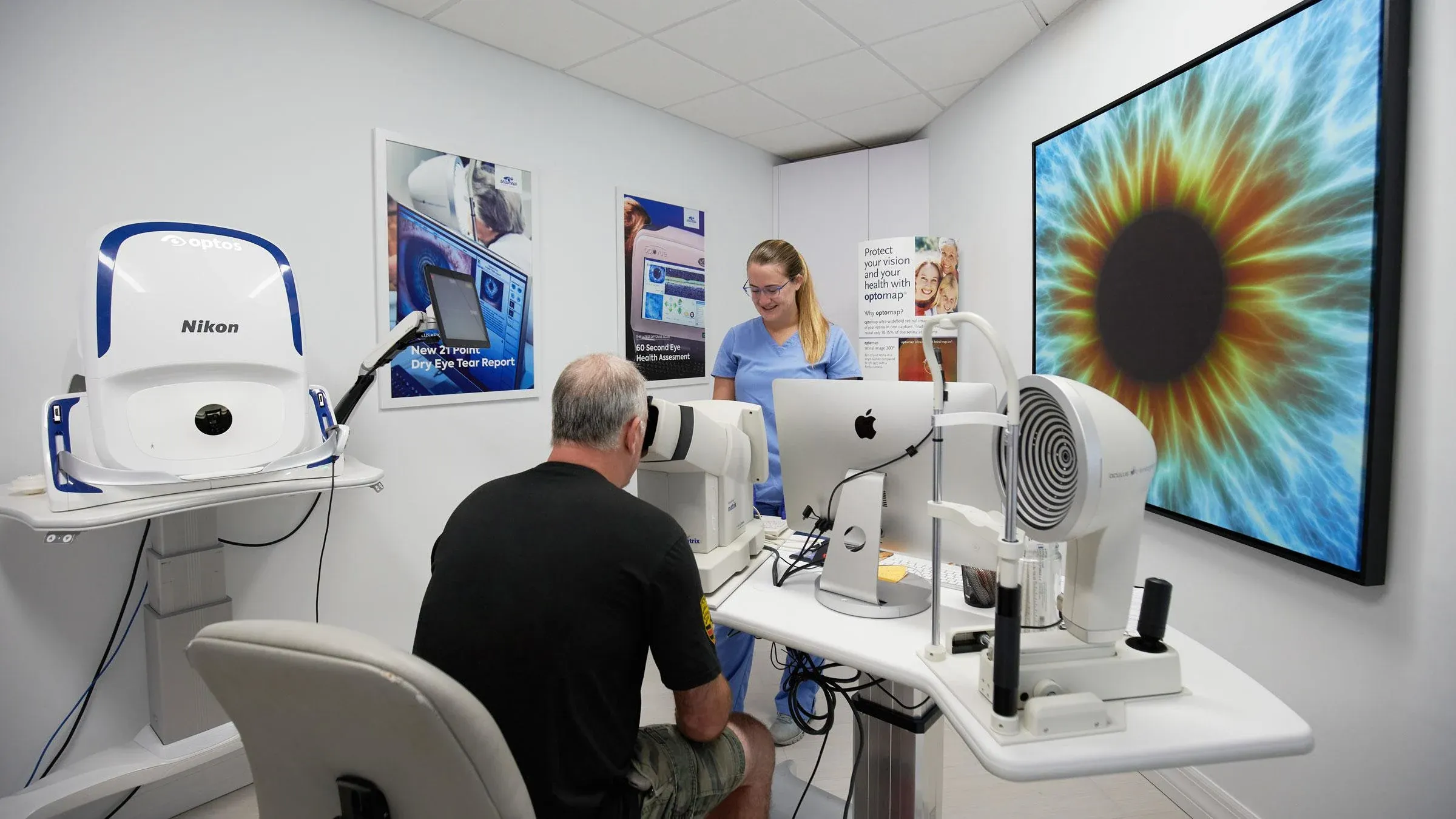



Ever felt like your optometry software is holding your practice hostage? You start for the features, stay for the records, and realize you’re paying more every year for the privilege of not owning a thing. The moment you want to switch, everything gets complicated, from data exports to surprise fees. And if you add a location or a provider, the monthly bill creeps higher. That’s the reality most optometry practices face.
The good news? There are more Optometry alternatives than ever in 2026, each with unique pros and gotchas. RevolutionEHR and Crystal PM have loyal fans. MaximEyes is a contender for practices focused on compliance. But every one of these tools keeps you on the rental treadmill, paying month after month for software you’ll never own. If you want out, you have one option: build your own, and Devaims is the team that makes it possible. Let’s break down the picks, and show you how owning changes the math.
Why eye care practices look for Optometry alternatives
Per-provider pricing gets expensive fast. Most platforms charge per doctor, per staff seat, or per location. Grow your team, watch your bill spike. For example, if you have two doctors and add a part-time provider, your monthly cost may jump by hundreds. This pricing model punishes growth and makes strategic planning harder, especially for practices looking to expand or bring on specialists.
Long-term contracts and lock-in. Many optometry EHRs require annual contracts, some even multi-year. Switching isn’t just technical, it’s contractual, with penalties looming. You may face auto-renewal clauses, early termination fees, or restrictions on data access if you try to leave before your contract is up. This can stifle agility and leave practices stuck with a system that no longer fits.
Data export headaches. Getting your records out can be a mess. Exports may be limited, incomplete, or come with extra fees. Some vendors provide only PDFs, not structured data, making migration to a new system time-consuming and error-prone. Your data, but you’re renting access, not true ownership.
Feature access tied to higher tiers. The reports you need, the integrations you want, they’re often locked behind pricier plans. That’s friction you feel every month. For example, advanced analytics, online scheduling, or imaging integrations might require premium subscriptions, doubling your expected spend.
Surprise fees and add-ons. Want texting, reminders, e-prescribing, or imaging? Prepare to pay more. The core price is rarely the total cost. Hidden costs show up when you need to integrate new equipment, add a telehealth module, or expand your service offerings. All these push owners to search for Optometry alternatives.
Quick comparison of the best Optometry alternatives
| Tool | Best for | Starting price | You own it? |
|---|---|---|---|
| Eyefinity | VSP integrated practices | Reported $399/mo | No |
| RevolutionEHR | Cloud-based, all-in-one | Reported $385/mo | No |
| Crystal PM | Customizable workflows | Around $349/mo | No |
| Compulink | Large practices, multi-specialty | Custom quote | No |
| MaximEyes | Compliance-focused | Reported $349/mo | No |
| OfficeMate | Legacy on-prem users | Reported $330/mo | No |
| Modernizing Medicine (Eyes) | Ophthalmology groups | Custom quote | No |
| Nextech | Ophthalmology, multi-site | Custom quote | No |
| Devaims | Practices that want to own | One-time build | One-time build, you own it |
Pricing changes fast, confirm current pricing before you decide. Also consider hidden costs like onboarding, training, and mandatory add-ons, which can make a big difference in your total spend.
The 9 best Optometry alternatives
1. Eyefinity (best for VSP integrated practices)
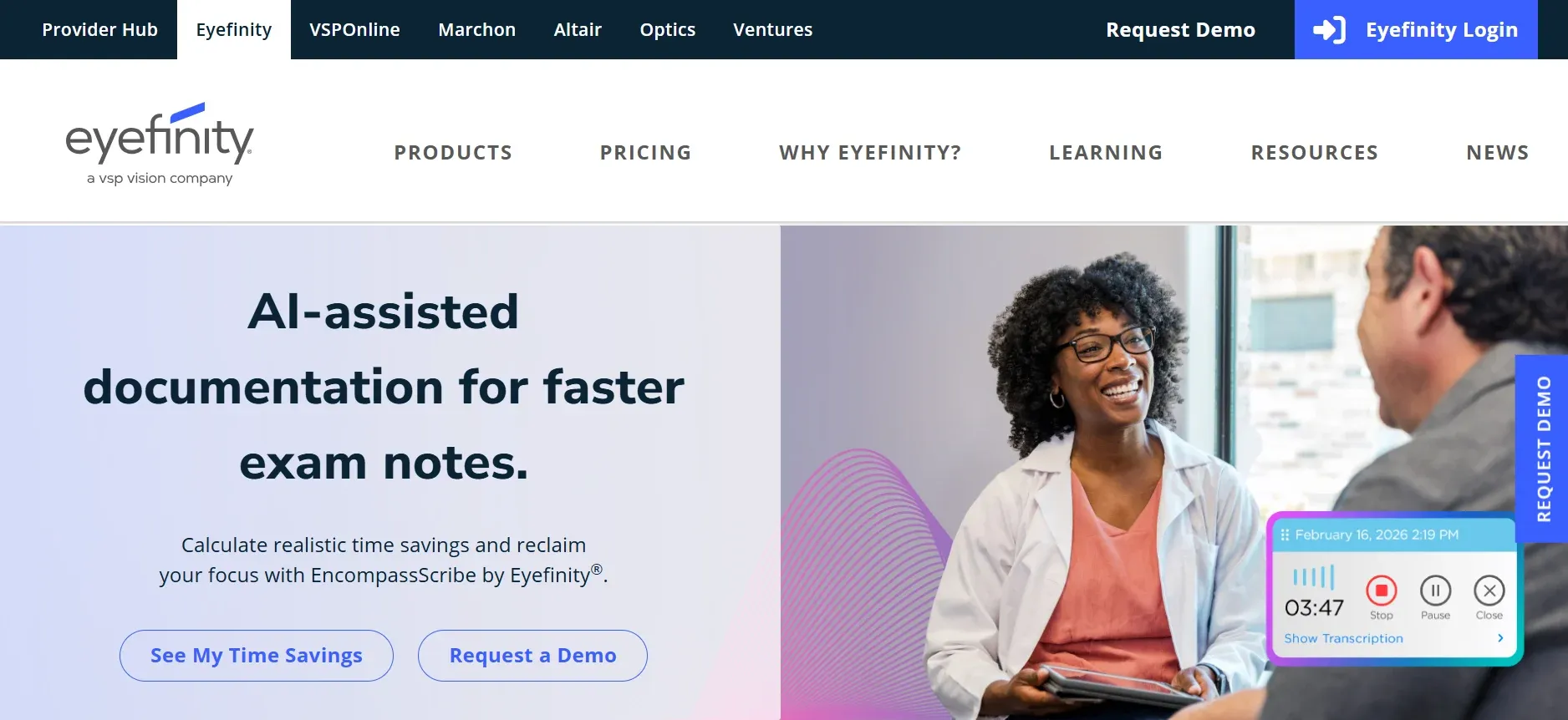
Eyefinity is the go-to for practices deeply tied to VSP and wanting an integrated workflow from scheduling to claims. It’s polished, familiar, and ticks boxes for insurance-linked shops, but you’re in their ecosystem for good.
Pricing: Reported $399/month plus add-ons for imaging, e-prescribing, and texting.
- Deep VSP integration for eligibility and claims
- Modern interface and strong training resources
- Retail optical and e-commerce tools included
- Locked into VSP ecosystem, limited flexibility for other insurers
- Data export is mostly PDFs, not structured records
- Add-on fees for many features
With a Devaims build, your insurance integrations aren’t locked to any one vendor, they are yours to maintain or change.
2. RevolutionEHR (best for cloud-based, all-in-one)
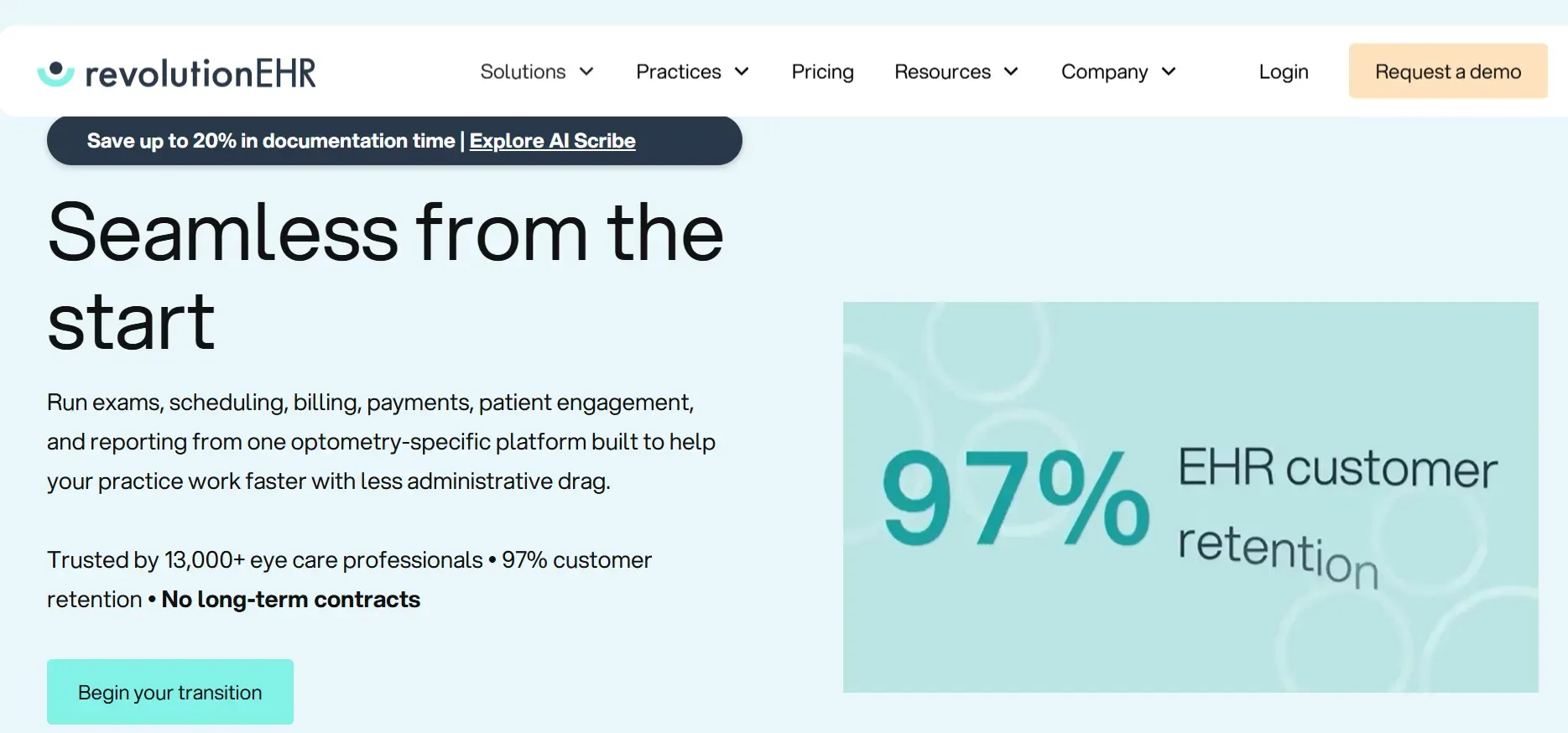
RevolutionEHR is a cloud-first platform popular among independent optometrists for its user-friendly interface and broad feature set. Its all-in-one approach covers EHR, billing, scheduling, patient communications, and inventory. RevolutionEHR’s clean dashboard and mobile accessibility make it a favorite for tech-savvy teams.
Pricing: Reported $385/month plus per-provider fees and add-ons.
- All-in-one platform with EHR, billing, and scheduling
- Mobile access and clean user interface
- Patient engagement tools available
- Per-provider and add-on pricing increases costs as you scale
- Limited data export, especially for clinical records
- Some analytics require higher-tier plans
On software you own, adding a provider is just a user permission, not a new monthly fee.
3. Crystal PM (best for customizable workflows)
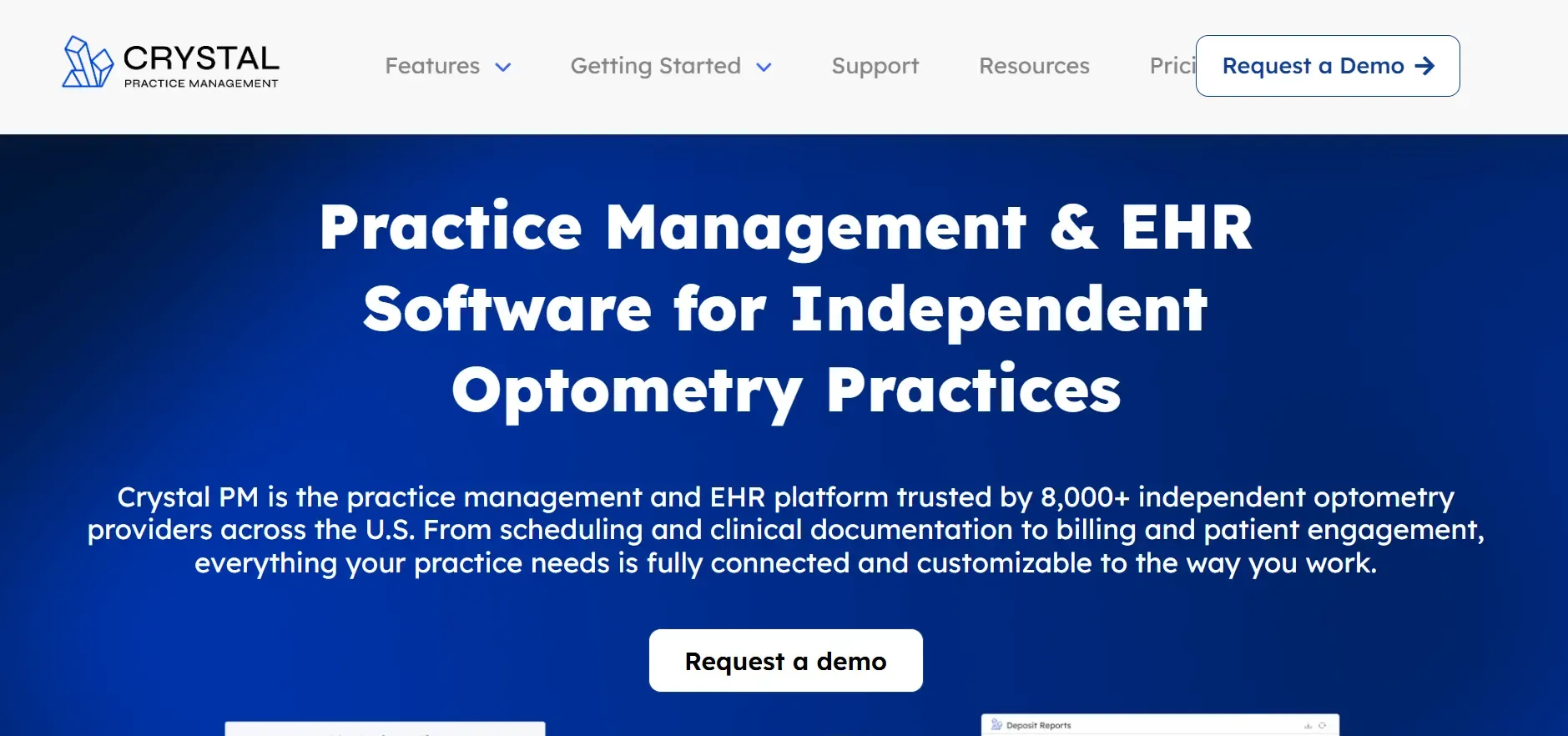
Crystal PM stands out for practices that want deep customization, especially for intake forms, exam templates, and workflow automation. It’s well-liked by practices with unique processes or specialty services.
Pricing: Around $349/month plus fees for some integrations.
- Highly customizable forms and workflows
- Wide range of device and clearinghouse integrations
- Document management is robust
- Dated interface can be clunky for new users
- Support response times can lag
- Migration to or from Crystal PM can be challenging
With Devaims, you can design workflows around your practice, not the other way around.
4. Compulink (best for large, multi-specialty practices)

Compulink is designed for large practices, multi-specialty clinics, and those with complex needs. It supports optometry, ophthalmology, surgery centers, and even behavioral health modules, making it a fit for large medical groups and eye care chains.
Pricing: Custom quote, typically higher for large groups and specialty modules.
- Specialty modules for ophthalmology and surgery
- Robust analytics and workflow automation
- Enterprise-level integrations and reporting
- High upfront costs for implementation and training
- Onboarding can take several months
- Vendor lock-in for updates and customizations
5. MaximEyes (best for compliance-driven practices)
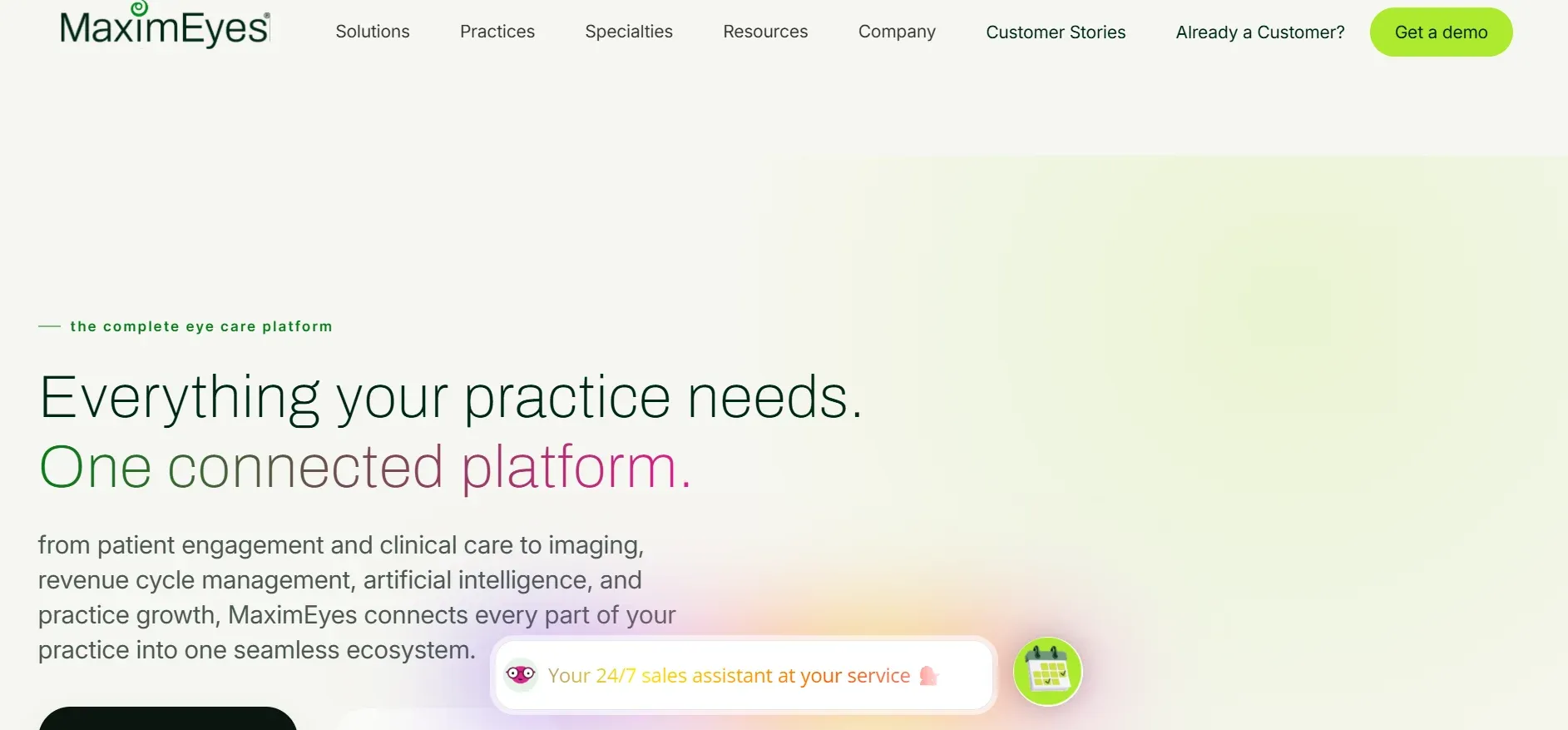
MaximEyes focuses on practices that must meet strict regulatory standards, such as those participating in government payer programs or subject to frequent audits. Its EHR and practice management solutions are built with compliance, security, and auditability in mind.
Pricing: Reported $349/month plus per-user fees and add-ons.
- Strong compliance and audit features
- Detailed logs and regulatory support
- Reliable for government payer programs
- Limited workflow customization
- Advanced features require premium plans
- Data export is manual and time-consuming
On a platform you own, compliance tools can be built for your exact needs, not just what fits the vendor’s mold.
6. OfficeMate (best for legacy on-premise users)
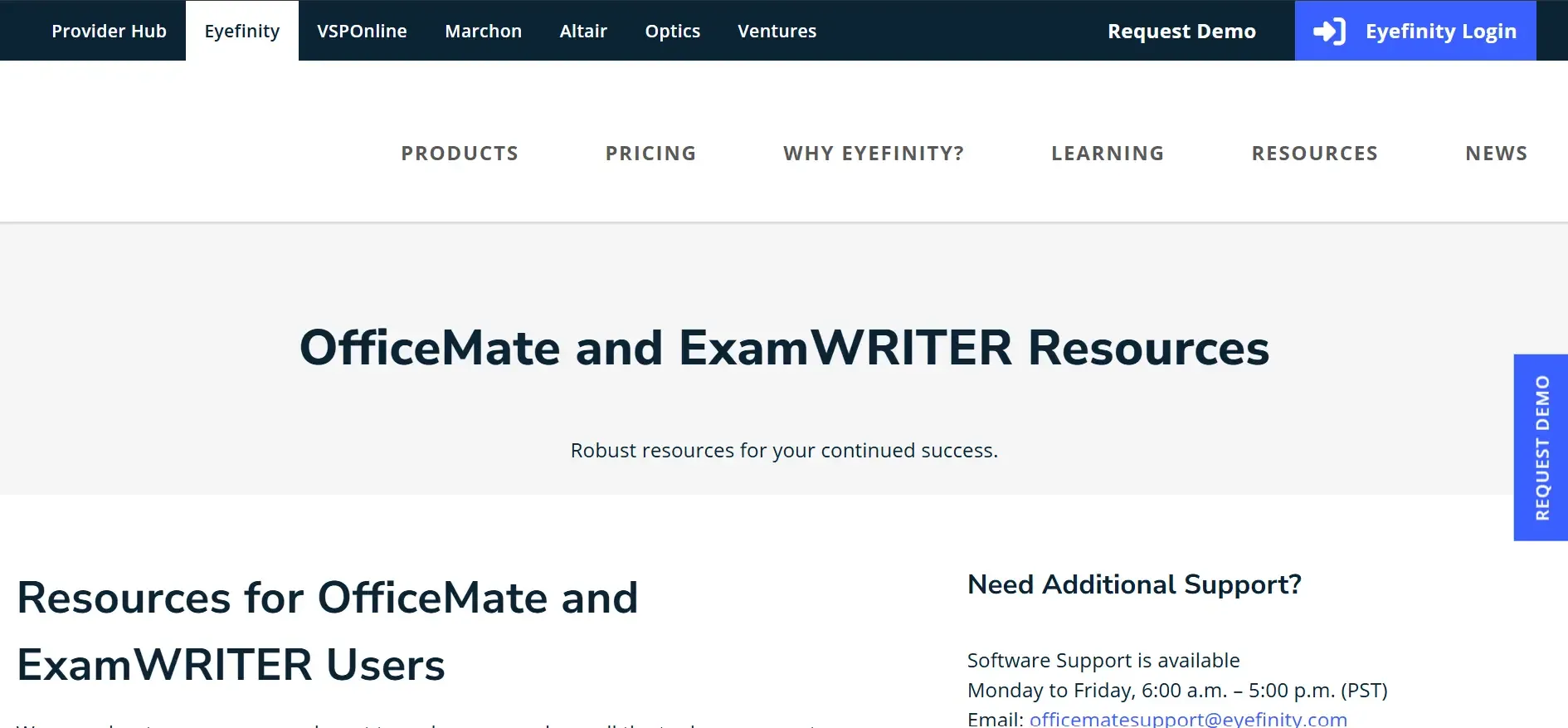
OfficeMate is one of the oldest optometry software brands. Originally on-premise, it now offers a cloud version. Many practices with decades of data or custom local setups still rely on OfficeMate for its familiarity and stability.
Pricing: Reported $330/month plus add-ons for imaging and integrations.
- Stable for legacy data and workflows
- Compatible with older hardware
- Cloud version adds remote access
- Slow pace of innovation and dated interface
- Limited support for new features
- Migration in or out can be laborious
7. Modernizing Medicine (Eyes) (best for ophthalmology groups)
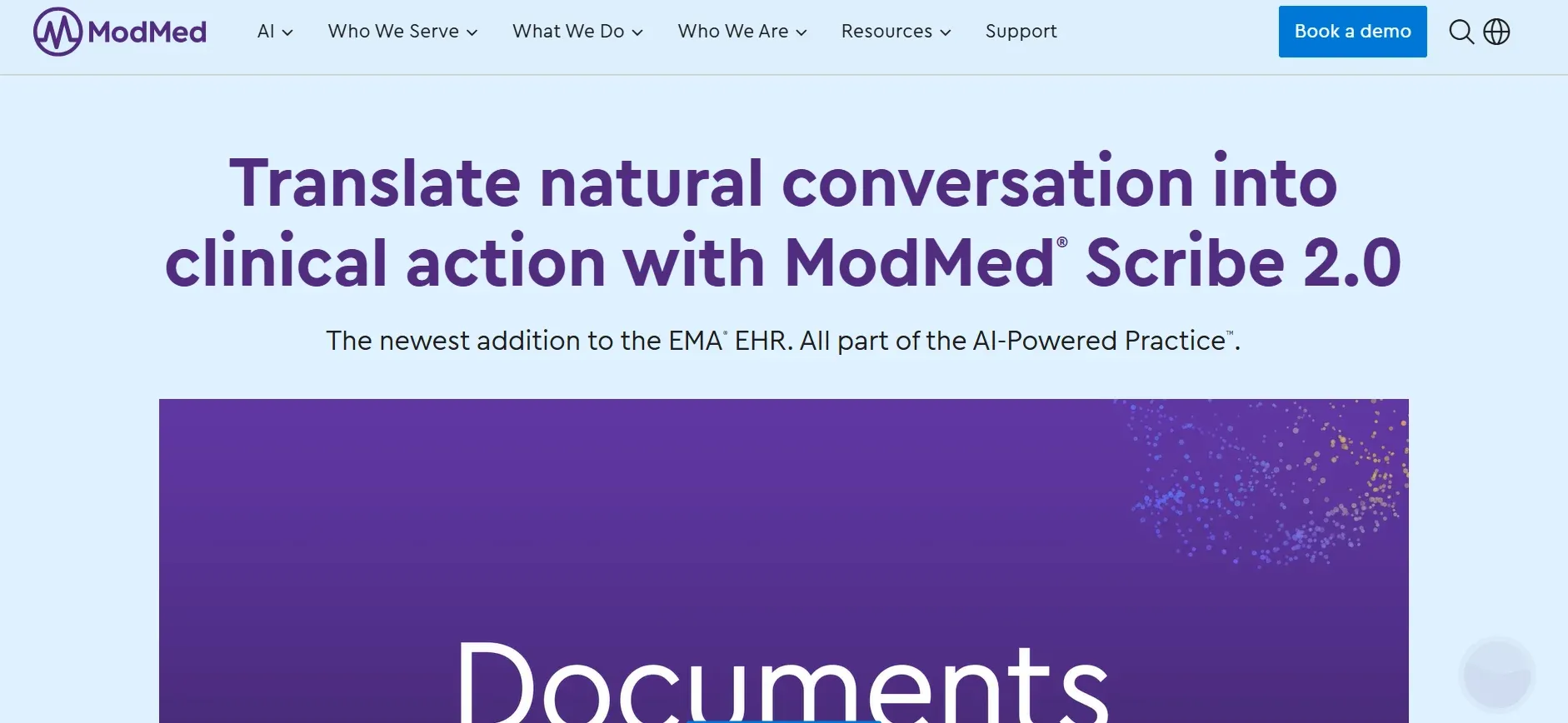
Modernizing Medicine (Eyes) is a specialty EHR designed for ophthalmology and large multi-location eye care groups. Its focus is on specialty workflows, imaging, and surgical scheduling.
Pricing: Custom quote, typically higher for specialty modules and large groups.
- Advanced imaging and specialty templates
- Mobile charting and AI-powered notes
- Strong integration with diagnostic devices
- Costly for small practices
- Steep learning curve
- Annual contracts required
8. Nextech (best for multi-site ophthalmology)
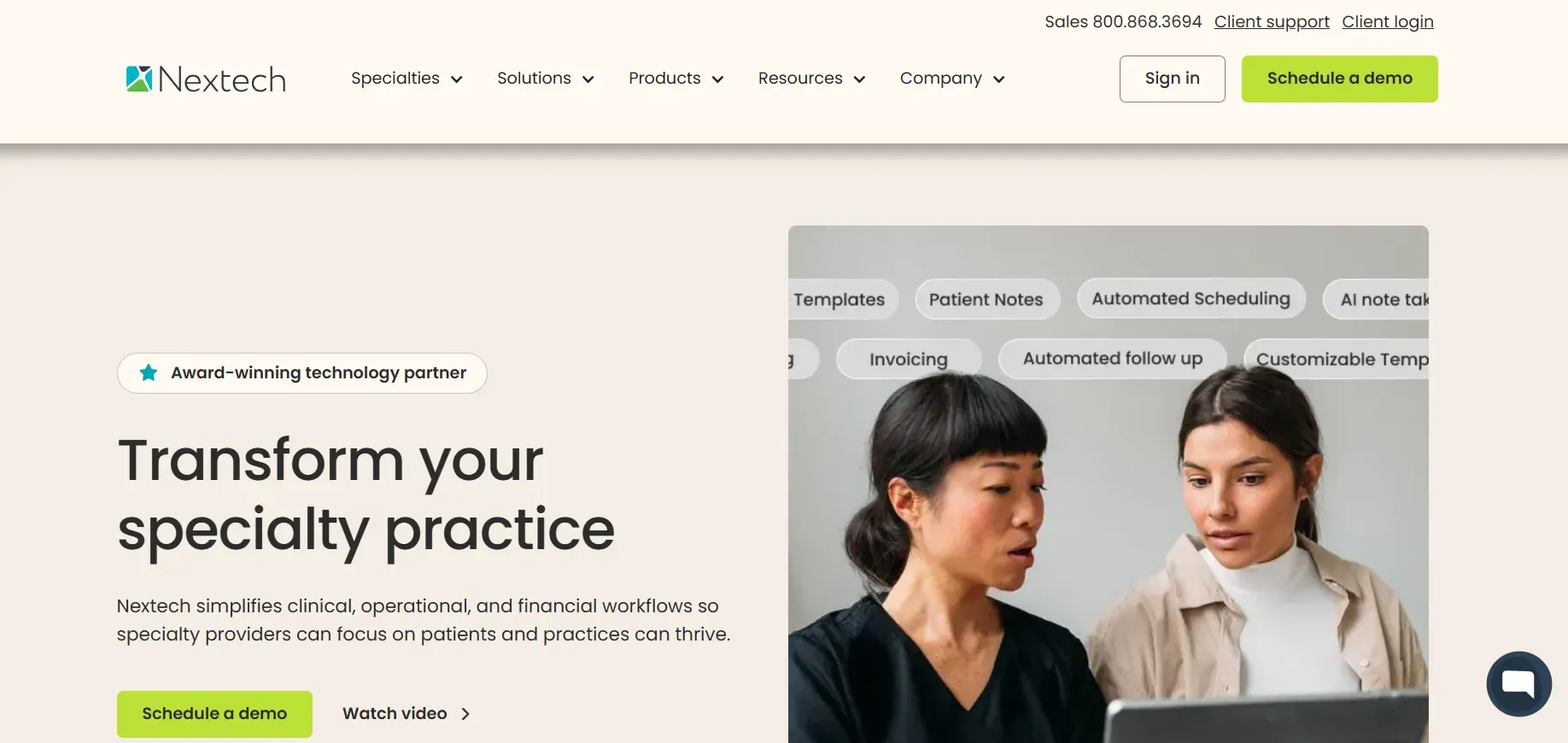
Nextech is a robust EHR and practice management solution for large, multi-site ophthalmology and optometry groups. Its modular architecture and enterprise features make it a top pick for organizations with complex needs.
Pricing: Custom quote, typically high for enterprise features and modules.
- Enterprise analytics and workflow automation
- Deep imaging and device integrations
- Customizable dashboards for large groups
- High total cost of ownership
- Lengthy onboarding and training
- Contract lock-in for key modules
9. Devaims (best for practices that want to own their platform)
Devaims builds custom optometry software that you own outright. You get every feature your practice needs, records, billing, scheduling, patient portal, imaging, and more, without paying per-user or per-location fees, and with source code that’s yours to keep. The only recurring cost is flat, predictable maintenance. Want a feature? It’s built for you. Want to add a provider or open a new location? There’s no additional fee, it’s your platform, end of story.
- Fully custom platform, built to your exact needs
- No per-user or per-location fees, ever
- Full data and code ownership, with open integrations
With Devaims, you can future-proof your practice and control every aspect of your software and data.
Other Optometry alternatives worth knowing
- Kareo, Known mainly for medical billing, not optometry-specific but used by some practices for its billing focus. Integrates with several EHRs and clearinghouses, but lacks eye care templates and device integrations.
- Practice Fusion, General EHR, not tailored to eye care but free for basic use; lacks optometry modules. Limited device integration and reporting.
- Practice Mate, A low-cost cloud EHR with basic scheduling and billing, but light on optometry features. Works for simple operations, but not for advanced eye care needs.
- Net Health Optometry, Focused on enterprise clinics, with pricing and complexity to match. Deep analytics and compliance, but overkill for small practices.
- athenahealth, A large EHR vendor with optometry modules, strong billing, and compliance, but less specialized in eye care workflows.
How to choose the right Optometry alternative
- Budget: Are you looking for the lowest monthly, or ready to invest in ownership? Consider not just the sticker price, but the long-term total cost, including add-ons and future growth.
- Practice size: Solo, group, or multi-location? Some tools scale better than others. Enterprise platforms (Compulink, Nextech) are overkill for solo practices, while small tools may not support complex needs.
- Specialty needs: Pure optometry, mixed medical, or surgery? The deeper your needs, the more you’ll want custom features. For example, pediatric optometry or low vision clinics often require unique exam templates and device integrations.
- Data control: Do you want easy export, or is owning your data a must? If you plan to grow, sell, or merge, full data ownership is invaluable for transitions and compliance.
- Contract flexibility: Will you bristle at lock-in, or are you comfortable with annual agreements? Consider your appetite for risk and desire for agility as your business evolves.
If you want to break free from renting and finally own your platform, here’s how Devaims changes the equation.
Stop paying rent on optometry software you could own
The real problem with nearly every Optometry alternative? You’re renting, forever. Fees stack up. Add-ons, per-user bumps, “integration” costs, and the constant threat of a price hike. Even if you switch, you’re still on someone else’s platform, and your data is never quite yours.
Devaims is different. We build optometry software tailored to your workflows, your team, your growth. You keep the code. You own the data. No contracts, no forced upgrades, no per-seat surprises. You pay once to build, then a flat monthly maintenance. Want to expand, tweak, or integrate? You call the shots, it’s yours.
Here’s how owning changes the pain points:
- No per-user or location fees: Add staff or clinics, your cost stays flat. You can bring on new providers, hire part-time optometrists, or open new locations without ever seeing your bill increase for each addition.
- No forced upgrades or feature gating: Every feature is built for your needs, not to push you up a tier. If you want new analytics, a telehealth module, or advanced imaging, it’s done on your timeline, not the vendor’s roadmap.
- Full data ownership and control: Export, migrate, or report however you want, no vendor holds your records hostage. This is critical for compliance, transitions, and future-proofing your practice.
- No contract lock-in: You’re not trapped year to year; you own the platform outright. If you want to change IT providers or bring development in-house, you have the freedom to do so.
| Tool | Ownership | Cost type | Contract? |
|---|---|---|---|
| Eyefinity | Rented | Monthly + add-ons | Yes |
| RevolutionEHR | Rented | Monthly + per-provider | Yes |
| MaximEyes | Rented | Monthly + per-user | Yes |
| Devaims | Owned | One-time build, flat maintenance | No |
Let’s do the five-year math. For a 4-provider practice, typical rented EHR bills run around $400/month plus $100/provider ($800/month total), with add-ons pushing that over $1,000/month. A custom Devaims build is $32,000 up front, with $200/month for maintenance.
| Year | Rented (cumulative) | Owned (cumulative) |
|---|---|---|
| 1 | $12,000 | $34,400 |
| 2 | $24,000 | $36,800 |
| 3 | $36,000 | $39,200 |
| 4 | $48,000 | $41,600 (now ahead) |
| 5 | $60,000 | $44,000 |
That’s a $16,000 savings by year four, plus the value of full ownership. And the math only gets better as you add providers, locations, or custom features. If you outgrow a rented platform or face a price hike, you’re back to square one. With Devaims, you have a permanent asset, not just another monthly bill.
How to switch from Optometry software
- Export all patient data, charts, and billing records from your current system. Request full structured exports if available, not just PDFs.
- Choose your new platform, whether it’s another vendor or a custom Devaims build. Evaluate migration support, feature compatibility, and training resources.
- Import your data, verify record completeness, and map key fields. Test clinical, billing, and scheduling modules for accuracy.
- Reconnect payment processing, e-prescribing, and third-party integrations. Ensure all devices and labs are properly linked.
- Train staff on new workflows and test the system in parallel with your current tool. Use sandbox environments for practice and troubleshooting.
- Review your old contract for auto-renewal or penalty clauses before canceling. Notify your vendor in writing and confirm the cancellation process is complete.
With a custom Devaims build, the migration is handled as part of the project. You get support for data mapping, device integration, and staff training, with a dedicated project manager guiding you through each step.
Frequently asked questions
What is the best Optometry alternative for small practices?
For small, independent practices, RevolutionEHR and Crystal PM are popular due to their ease of use and moderate pricing. RevolutionEHR is cloud-based, requires little IT infrastructure, and offers a gentle learning curve. Crystal PM’s customization is appealing if you have niche needs. However, both charge per user and may become expensive as you grow. If you want to avoid per-user fees and own your platform, Devaims is the only route to true ownership, letting you scale without worrying about your monthly bill.
Which Optometry alternative is the cheapest?
Practice Mate and Practice Fusion offer the lowest monthly costs, often under $100/month, but they lack optometry-specific features, device integrations, and compliance tools. For truly cost-conscious practices, these can work in the short term, but you’ll likely outgrow them. Over five years, a Devaims build can actually be cheaper than renting mainstream platforms once you factor in growth and add-ons.
Is there a free Optometry software option?
Practice Fusion has a free tier, but it’s limited and not built for eye care. You’ll miss out on features like imaging integration, optical inventory, and specialty exam templates. Most alternatives charge monthly or per-user fees. No free tool matches the full feature depth needed by a growing optometry practice.
How hard is it to migrate from my current Optometry software?
Migration can be challenging due to data export limits and contract lock-in. Most vendors make exporting data a manual and sometimes costly process. You may get only PDFs, not structured data, leading to information loss and manual re-entry. Devaims handles migration as part of every custom build, ensuring you get structured data, mapped fields, and staff training for a seamless transition.
Can I keep my data if I switch Optometry software?
This is a big pain point with most Optometry alternatives: you get partial exports, but rarely the full database. Vendors often cite privacy or technical limitations as reasons for restricting data access. With Devaims, you own the data and the code, so you control every export and migration. You can back up, export, or migrate your data however you want.
What’s the main reason practices switch to Devaims?
Owners switch to stop paying endless per-user fees, gain feature flexibility, and finally own their platform. If the five-year cost of renting is higher than building, ownership just makes sense. Other reasons include the need for custom features, integration with unique devices, or to gain full data control before a merger or sale.
Does Devaims support insurance and e-prescribing integrations?
Yes, Devaims can build out any integration your practice needs, including insurance clearinghouses, e-prescribing, and even niche optical labs. Unlike most platforms, you’re not locked into a specific vendor or workflow. Integrations can be updated or replaced as your needs change.
The bottom line
Most Optometry alternatives keep you on the rental treadmill, with hidden fees and limited control. The real unlock comes from changing the game: own your platform, control your data, and stop paying by the seat forever.
Here’s the test: add up what you’ll pay over five years. If that number could have bought you software you own, you already have your answer. The next move? Take control.
Want more insights? Explore the Devaims blog or see other vendor-neutral comparisons like Eyefinity alternatives, RevolutionEHR alternatives, and Compulink alternatives.