



Your EHR fees ate half your margin again last quarter, and you are not even getting the features you need. Or maybe you have outgrown the templates, and every workflow tweak means another ticket and another month of waiting. If you are searching for Netsmart alternatives, you are not alone, hundreds of mental health leaders are tired of renting software that runs their practice but never really feels like theirs.
There are plenty of Netsmart competitors, each with its own spin on scheduling, charting, or billing, but most keep you in the same rent-forever loop. After five years, all you have is a pile of receipts. In this guide, we will look at the top alternatives: SimplePractice, TherapyNotes, TheraNest, and more, so you can see where each one fits (and falls short). And we will show you the option that finally lets you own your system outright: a custom Devaims build.
Why mental health practices look for Netsmart alternatives
Recurring subscription fees stack up fast. Most EHR platforms, including Netsmart, operate on a monthly or annual subscription model, with pricing that increases for each additional user or feature. When you add in e-prescribing, telehealth, or advanced reporting, the total cost can easily double or triple your base subscription. Over time, especially as your team expands, this model becomes a major drain on margins. Many practices are surprised to discover they are paying far more than anticipated, with no asset to show for it.
Locked-in workflows limit flexibility. SaaS EHRs are designed to serve the widest possible audience, so they force practices to adapt to a standardized workflow, often at the expense of efficiency or clinical nuance. Customizing these workflows is either impossible or requires expensive, time-consuming development handled by the vendor. For organizations with unique intake, documentation, or billing needs, these restrictions create bottlenecks that impact both care quality and administrative efficiency.
Data ownership is murky. With most cloud EHRs, your practice data sits on the vendor's servers, and access is governed by their terms of service. Exporting data is possible, but often limited to specific formats or requires special requests. If you want to migrate, integrate deeply with other tools, or analyze data in advanced ways, you may hit roadblocks. True data ownership, where you hold and control your raw data, is rare in rental EHR models.
Feature gaps force upgrades. Many essential tools, such as advanced analytics, custom form builders, or integrations with third-party applications, are only available on higher pricing tiers or as paid add-ons. This means that as your practice grows or your needs evolve, you are pushed into more expensive plans or must pay extra for features that are critical to your workflow. You are often left choosing between paying more or accepting workarounds.
Support can be slow or costly. While most EHR vendors offer some level of support, response times can be inconsistent, and priority support may cost extra. For practices that rely on timely assistance, especially during onboarding or data migration, delays can be frustrating and disruptive. Some platforms offer only email-based support, while others charge for phone or live chat access.
These challenges are why so many mental health practices are actively considering alternatives to Netsmart, looking for better pricing, more flexibility, and, increasingly, true ownership.
Quick comparison of the best Netsmart alternatives
| Tool | Best for | Starting price | You own it? |
|---|---|---|---|
| SimplePractice | Solo & small practices | Reported $29/mo | No |
| TherapyNotes | Insurance billing | Reported $49/mo | No |
| TheraNest | Group practices | Reported $39/mo | No |
| Luminare Health | Integrated care | Contact for quote | No |
| Valant | Mid-sized clinics | Reported $140/mo | No |
| Procentive | Large orgs | Contact for quote | No |
| Kareo Behavioral (Tebra) | Billing & revenue | Reported $125/mo | No |
| Greenspace | Patient engagement | Contact for quote | No |
| BreezyNotes | Simplicity | Reported $39/mo | No |
| ICANotes | Psychiatry & documentation | Reported $75/mo | No |
| Devaims | Ownership & custom fit | One-time build | One-time build, you own it |
Always confirm current pricing before you decide. Rates and included features change often. Also, note that migration costs, onboarding fees, and additional modules can significantly impact the real total cost of ownership with any of these tools.
The 11 best Netsmart alternatives
1. SimplePractice (Best for solo & small practices)
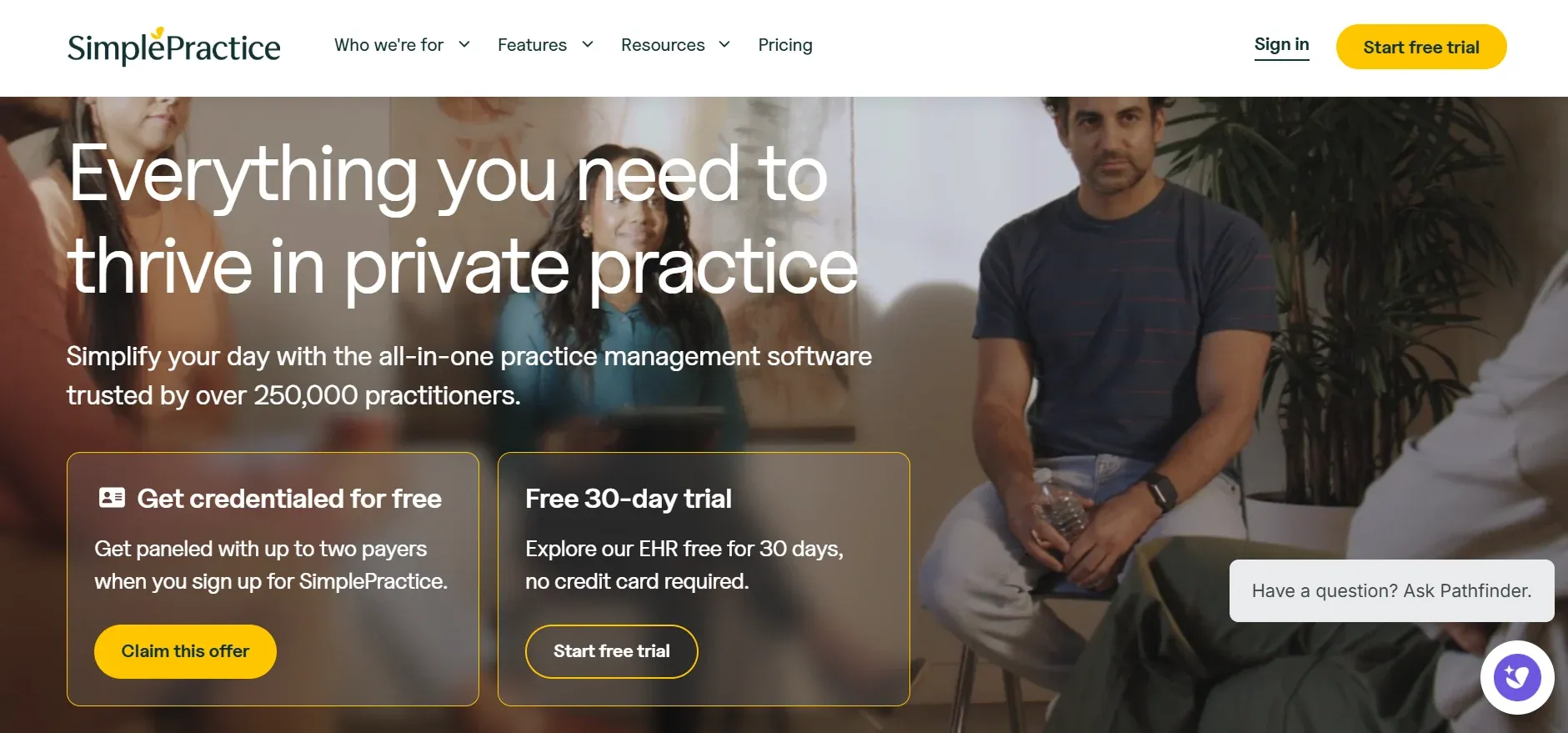
SimplePractice has become the go-to EHR for solo providers and small group practices in behavioral health. Its clean, modern interface is designed for ease of use, allowing new users to get started with minimal training. The platform offers core EHR features: scheduling, documentation, billing, telehealth, and a client portal in a single package.
Features and Integrations: SimplePractice supports appointment reminders, secure client messaging, online intake forms, payment processing (including Stripe and Square), and HIPAA-compliant telehealth. Integrations are available for accounting (QuickBooks), insurance clearinghouses, and some third-party apps, but deep customization is limited. SimplePractice also offers a mobile app for clinicians on the go.
Migration friction: Moving to SimplePractice from another EHR is relatively straightforward, with CSV import options for client data. However, complex data (like custom forms or historical billing records) may require manual entry or vendor-assisted migration, which can incur extra costs.
Use cases: SimplePractice is best for solo clinicians, small therapy groups, and practices that want to handle scheduling, notes, and billing in one place without heavy administrative overhead.
Pricing: Reported $29 per month for basic solo plan. See pricing.
- Very easy to use, with a gentle learning curve
- Client portal supports intake, document sharing, and payments
- Responsive mobile app for clinicians
- Per-user fees add up with extra clinicians
- Some key features require higher tiers
- Limited custom workflows and reporting
SimplePractice is a strong choice for new or small practices, but as you grow, the cost and customization limits become clear. On software you owned, adding new users would not trigger new fees every time your team grows.
2. TherapyNotes (Best for insurance billing)

TherapyNotes is widely respected for its insurance billing capabilities. The platform is built with mental health practices in mind and includes a comprehensive set of tools for clinical documentation, scheduling, and revenue cycle management. It is particularly well-suited to practices that bill insurance, manage multiple payers, or require detailed claims tracking.
Features and Integrations: TherapyNotes supports electronic claims submission, ERA/EDI integrations, and robust insurance payment reconciliation. It includes customizable note templates, appointment reminders, and a secure client portal. The system integrates with select clearinghouses and supports e-prescribing through DrFirst (at an additional cost). Reporting is functional but not highly customizable.
Migration friction: Data migration from other EHRs is possible via CSV or vendor-assisted processes, but mapping custom templates or historical insurance data may need extra setup. TherapyNotes offers onboarding support and training for new clients.
Use cases: Ideal for practices that handle complex insurance billing, need a reliable claims workflow, or want to minimize denials and payment delays. Also suitable for group practices that need standardized documentation and compliance.
Pricing: Reported $49 per month for the basic plan. See pricing.
- Best-in-class insurance claims management
- Reliable, responsive customer support
- Comprehensive documentation templates
- No ownership, always a subscription
- Reporting is functional but basic
- Customization is limited to templates
TherapyNotes is a smart choice for insurance-focused practices, but for those wanting control over workflows or deep integrations, building your own system is the only way to fully own your process.
3. TheraNest (Best for group practices)
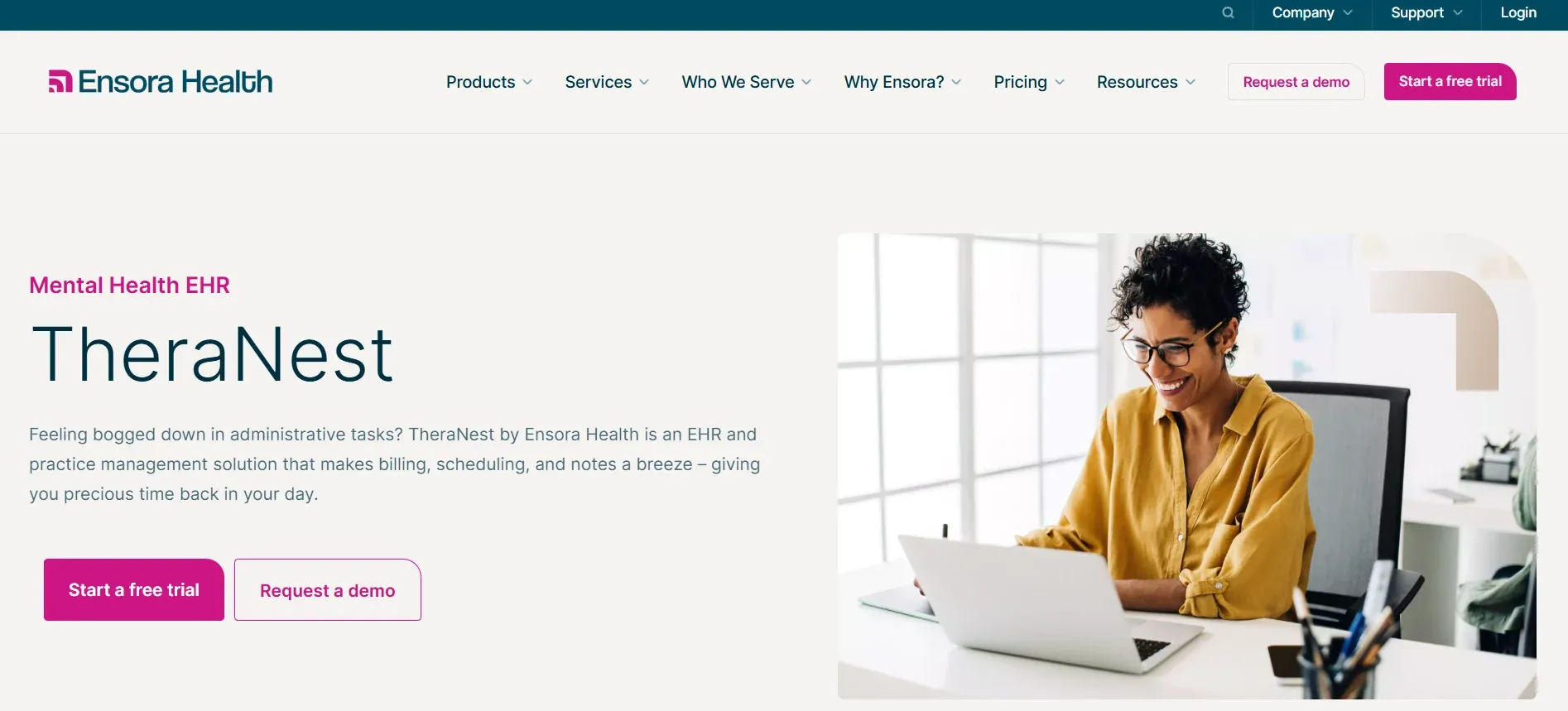
TheraNest targets group practices and organizations with growing teams. It offers a broad suite of features for scheduling, documentation, billing, and telehealth, plus collaboration tools for large or multidisciplinary teams.
Features and Integrations: TheraNest includes advanced scheduling (including group appointments), appointment reminders, telehealth, billing (insurance and self-pay), and a client portal. It integrates with clearinghouses, payment processors, and offers an API for limited custom integrations. TheraNest also supports outcome tracking and has built-in reporting tools, though custom analytics may require exporting data.
Migration friction: TheraNest offers import tools for client lists, notes, and billing data, but complex historical data or custom forms may require manual entry. Their onboarding team assists with setup and training, but larger practices may need more hands-on migration planning.
Use cases: Best for group practices, multi-provider clinics, or organizations that need collaborative scheduling, shared documentation, and team-based workflows. Also useful for practices that plan to expand and want a system that can grow with them.
Pricing: Reported $39 per month for solo; group pricing scales with size. See pricing.
- Rich scheduling and reminders
- Telehealth integration built-in
- Good for growing or collaborative teams
- Price jumps with more users
- Some reports require higher plans
- Limited deep customization
TheraNest is a flexible solution for group practices, but as with others, customization and ownership remain out of reach.
4. Luminare Health (Best for integrated care)

Luminare Health is designed for organizations seeking to integrate behavioral and physical health records, supporting coordinated care across disciplines. Its core value is interoperability, enabling providers to see a unified view of a patient’s health journey.
Features and Integrations: Luminare Health offers advanced care coordination, population health analytics, and strong interoperability via HL7/FHIR standards. It integrates with laboratories, pharmacies, and external EHRs, making it suitable for organizations that collaborate with primary care or hospital systems. The platform supports customizable dashboards and reporting, but workflow customization is limited to what is available in the Luminare ecosystem.
Migration friction: Implementation can be complex, especially for organizations with legacy systems or large data sets. Luminare Health provides onboarding support, but significant IT involvement is often required for setup, data mapping, and integration with existing systems.
Use cases: Best for large clinics, FQHCs, or behavioral health organizations that need to coordinate care with physical health providers, or participate in value-based care models. Also suitable for practices seeking deep data sharing across systems.
Pricing: Contact for quote; pricing varies by configuration.
- Unified patient health records across behavioral and physical health
- Strong interoperability and data-sharing capabilities
- Advanced care coordination tools
- Opaque pricing structure
- Tied to Luminare ecosystem
- Setup can be complex and IT-intensive
With a Devaims build, integrations and data flows are designed to fit your practice, not the vendor’s. You can select the exact interoperability standards you need and build workflows around your team's needs.
5. Valant (Best for mid-sized clinics)
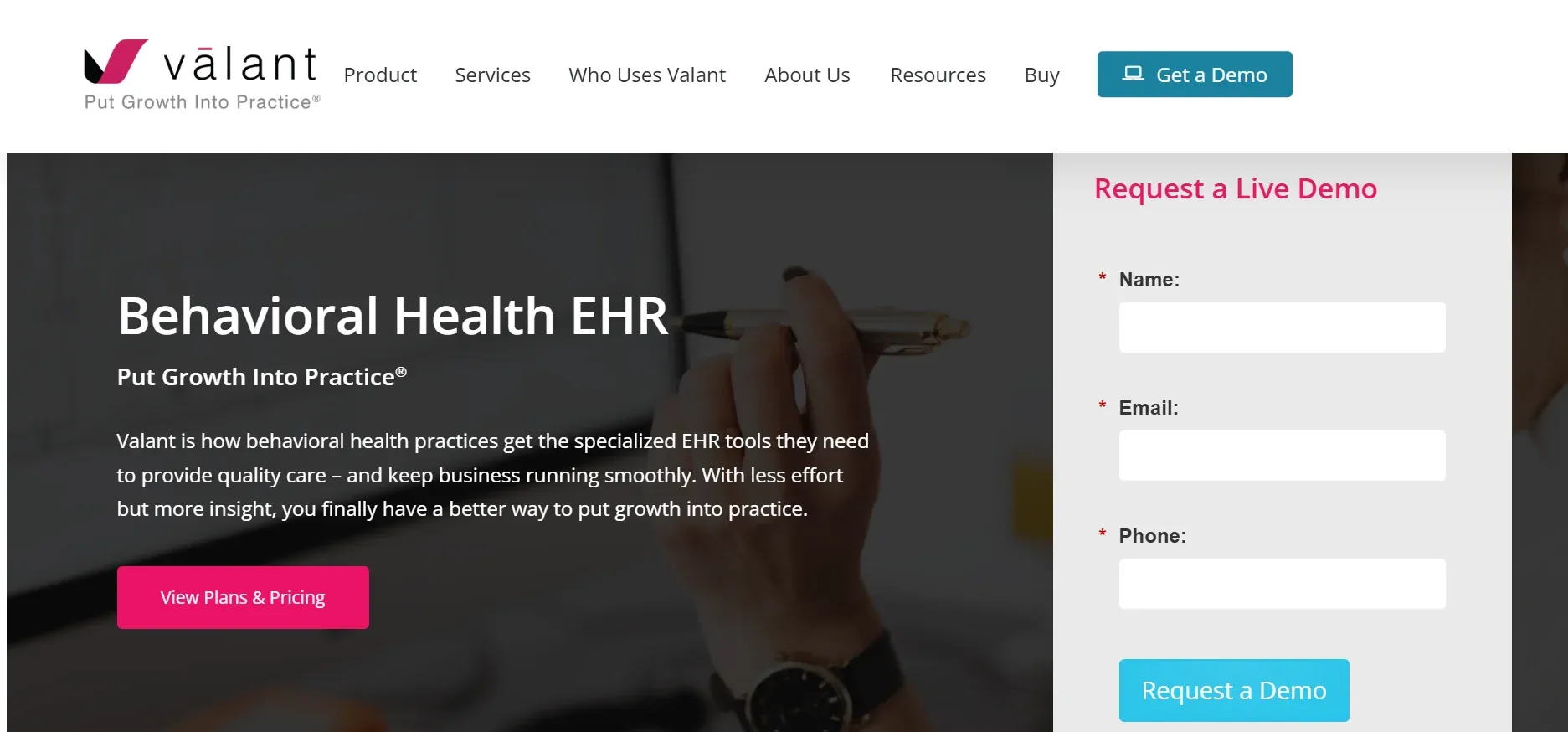
Valant is purpose-built for behavioral health organizations that need compliance, analytics, and scalability. The platform offers deep reporting, advanced billing, and robust clinical documentation, making it popular among mid-sized and larger clinics.
Features and Integrations: Valant includes custom note templates, outcome measurement tools, e-prescribing, telehealth, and secure patient communication. Its reporting suite enables practices to track productivity, clinical outcomes, and financial metrics. Integrations are available for labs, payers, and some third-party tools, but custom integrations may require vendor development. Valant is also ONC-certified for compliance.
Migration friction: Implementation cycles are longer than with lighter EHRs, with data migration requiring extensive planning, mapping, and validation. Valant provides onboarding teams, but practices should expect a transition period of several weeks to months, depending on complexity.
Use cases: Suited to clinics with 10+ providers, group practices with compliance reporting needs, or organizations that want to track detailed clinical and financial metrics. Also good for practices participating in quality programs or grants.
Pricing: Reported $140 per month; custom quotes for larger practices. See pricing.
- Advanced compliance and reporting tools
- Robust analytics for productivity and outcomes
- Scalable for mid-sized and larger organizations
- Relatively expensive for small teams
- Some features only in higher tiers
- Longer implementation cycles
Valant is a strong fit for organizations that need scale and compliance, but those seeking control over customization or long-term cost savings may want to explore ownership models.
6. Procentive (Best for large organizations)
Procentive is built for enterprise-level behavioral health agencies, offering a comprehensive EHR, billing suite, and documentation platform. It is often chosen by organizations that have outgrown smaller EHRs or need advanced compliance and integration capabilities.
Features and Integrations: Procentive supports complex billing (including Medicaid and Medicare), custom form builders, outcome tracking, and extensive reporting. It integrates with pharmacy systems, labs, payers, and other third-party tools, supporting HL7 and FHIR standards for data exchange. Role-based access, audit trails, and compliance modules are included for regulatory needs.
Migration friction: Onboarding is complex, often taking several months for large organizations. Procentive offers dedicated implementation teams and migration support, but practices should allocate significant time and resources for data mapping, training, and go-live support. Custom integrations may extend the timeline.
Use cases: Large behavioral health agencies, multi-site organizations, or clinics that require advanced billing, compliance, and data integration. Also suitable for organizations with high staff turnover or complex administrative hierarchies.
Pricing: Contact for quote; depends on organization size and needs.
- Highly scalable for large organizations
- Enterprise-level integrations and compliance
- Comprehensive billing and administrative tools
- Complex setup and onboarding
- Long-term contracts common
- Not ideal for smaller practices
Procentive is robust for large organizations but remains a subscription model, with limited ownership or deep customization options.
7. Kareo Behavioral (Tebra) (Best for billing & revenue)
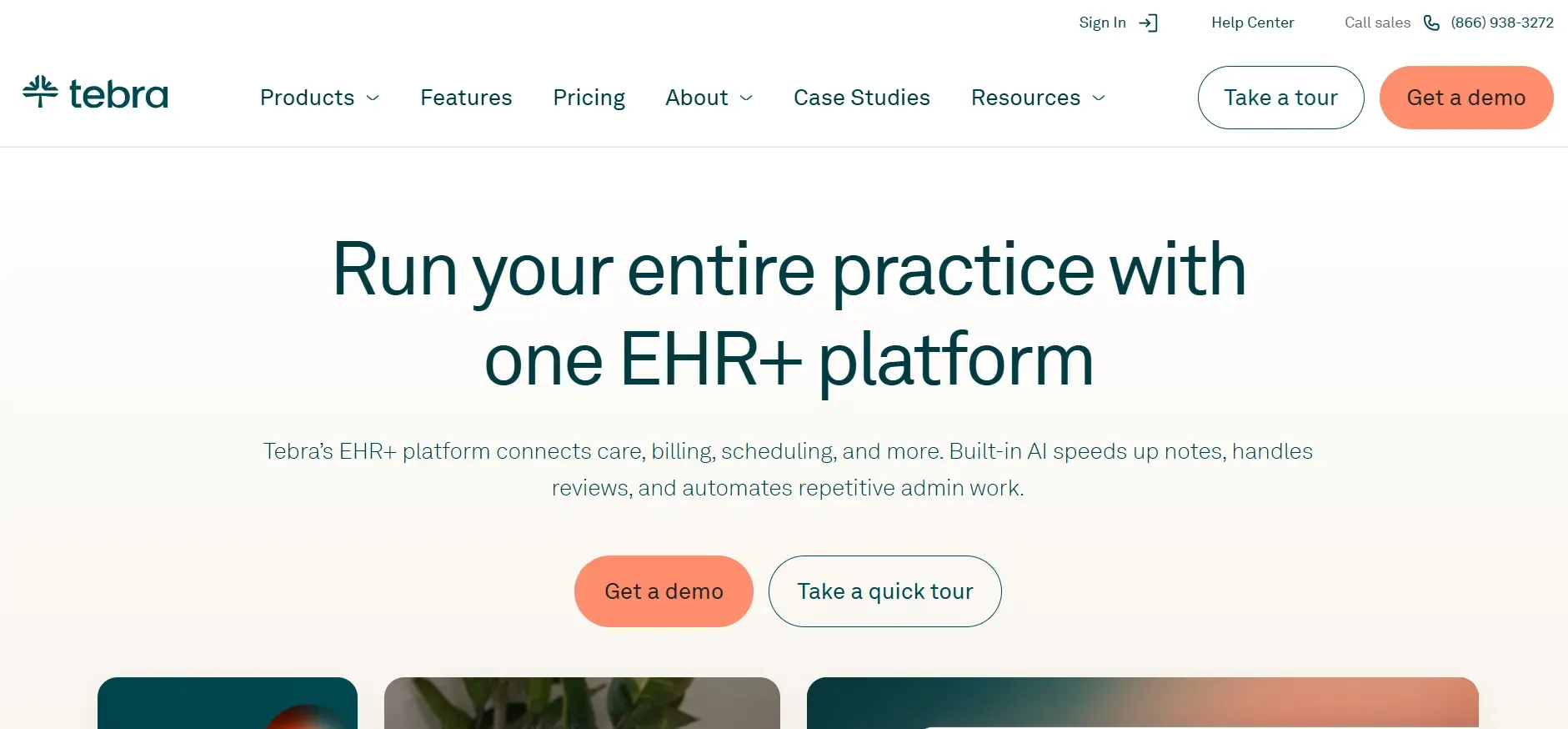
Kareo Behavioral (Tebra) is focused on streamlining billing and revenue cycle management for mental health providers. The platform combines EHR, practice management, and billing automation in one system.
Features and Integrations: Kareo offers automated claims submission, denial management, payment posting, and patient billing. The EHR component includes customizable templates, secure messaging, telehealth, and appointment reminders. Integrations are available with labs, pharmacies, and accounting tools. Kareo also supports real-time eligibility verification and ERA processing.
Migration friction: Kareo provides migration tools for importing patient data, schedules, and claims history, but complex customizations or legacy data may require manual adjustment. Training is provided, but onboarding can be challenging for teams without prior EHR experience.
Use cases: Ideal for practices that prioritize billing efficiency, want to reduce claim denials, or need robust revenue cycle management. Also suitable for clinics with mixed payer sources or those expanding telehealth offerings.
Pricing: Reported $125 per month. See pricing.
- Powerful billing automation and revenue tools
- Customizable patient reminders and telehealth
- Multi-specialty support
- Subscription fees rise with usage
- Learning curve for new users
- Limited to Tebra ecosystem
Kareo is a fit for billing-focused practices, but costs and customization limits can become barriers as you grow.
8. Greenspace (Best for patient engagement)

Greenspace is not a full EHR, but a platform designed to enhance patient engagement and measure outcomes in mental health care. It is commonly used alongside a core EHR to support measurement-based care and client progress tracking.
Features and Integrations: Greenspace offers digital assessments, outcome measurement tools, automated progress tracking, and real-time dashboards for clinicians and clients. It integrates with a growing list of EHRs, but depth of integration varies, some allow for embedded forms and data sync, others require manual data transfer. The platform also supports patient self-reporting and automated reminders.
Migration friction: Implementation is relatively easy, as Greenspace is usually layered on top of existing systems. However, if your EHR does not integrate natively, clinicians may need to manually enter or export data between systems.
Use cases: Practices focused on evidence-based care, those participating in research or grant programs, or clinics looking to boost client engagement and retention. Also valuable for organizations measuring treatment outcomes for payers or quality programs.
Pricing: Contact for quote; depends on organization size.
- Excellent outcomes tracking and analytics
- Patient engagement and self-reporting tools
- Supports measurement-based and evidence-based care
- Not a full EHR replacement
- Costs add up as usage grows
- Integration with some EHRs limited
If you want a single system with integrated engagement and outcomes, a custom build may be the only way to fully own the workflow and data.
9. BreezyNotes (Best for simplicity)
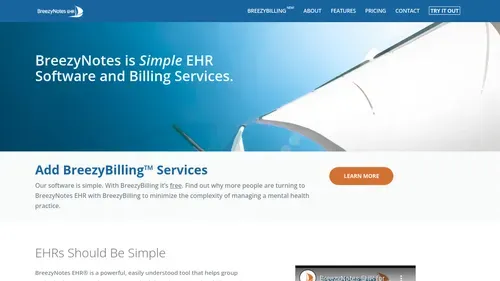
BreezyNotes is a streamlined, lightweight EHR built for solo and small group therapists who want to avoid complexity and high costs. The focus is on simplicity, speed, and user-friendliness.
Features and Integrations: BreezyNotes covers scheduling, progress notes, billing, and client management in a clean, intuitive interface. It offers limited integrations, primarily for payment processing and basic reporting. There is no telehealth or e-prescribing, and customization is minimal.
Migration friction: Getting started is easy, as the platform supports CSV imports for client data, but does not handle complex data types or custom forms. There are no onboarding fees, and support is responsive for new users.
Use cases: Best for solo practitioners or very small groups who want to get started quickly with minimal setup and training. Also suitable for clinicians who do not require advanced features or integrations.
Pricing: Reported $39 per month. See pricing.
- Simple, intuitive interface
- No setup or onboarding fees
- Responsive, personal support
- Fewer features than larger EHRs
- Not ideal for big teams or complex practices
- Limited customization
If you just want a system that fits you, Devaims can build exactly the workflow you need, no more, no less. This is the difference between a template-driven tool and a platform designed around your own process.
10. ICANotes (Best for psychiatry & documentation)
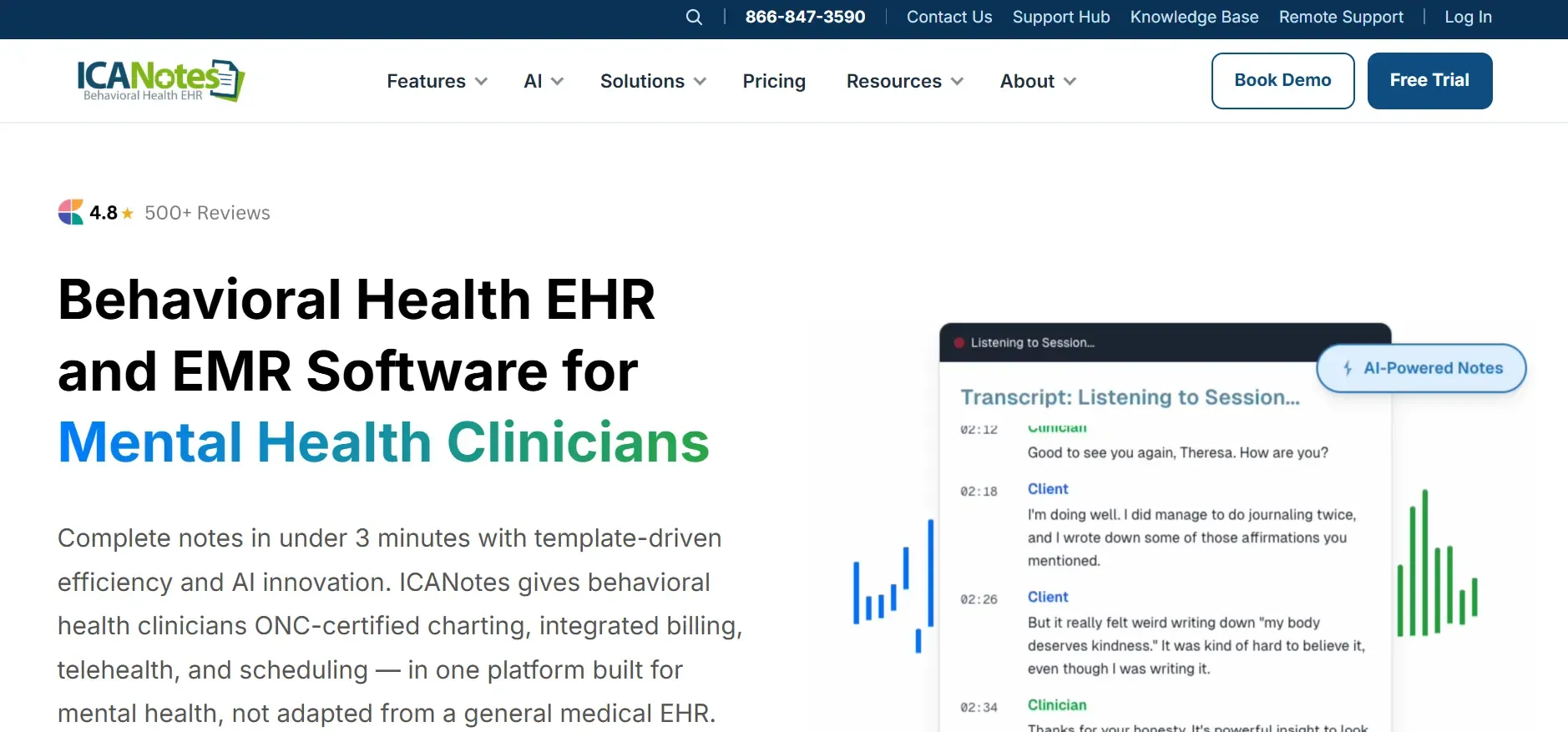
ICANotes is tailored for psychiatry and behavioral health, with a focus on clinical documentation and medication management. Its unique note generation tools help clinicians quickly create detailed, compliant records.
Features and Integrations: ICANotes offers specialized note templates, e-prescribing, and support for complex psychiatric workflows. It integrates with labs and some billing systems, and provides outcome tracking and reporting. The platform is ONC-certified and HIPAA-compliant.
Migration friction: Migration tools are available for client data and notes, but the interface can be challenging for new users. Onboarding support is provided, but training is recommended to get the most from the system.
Use cases: Best for psychiatrists, psychiatric nurse practitioners, and behavioral health clinics that require detailed documentation and medication management.
Pricing: Reported $75 per month per user. See pricing.
- Excellent for psychiatric documentation
- Robust medication management tools
- ONC-certified and HIPAA-compliant
- Interface is functional but dated
- Steep learning curve for new users
- Customization is limited
If you need workflows or documentation tailored to your practice, Devaims can build a system that matches your exact requirements, with no compromise on usability or compliance.
11. Devaims (Best for ownership & custom fit)
Devaims builds custom mental health software that you own outright, designed around your practice’s workflows and needs. Unlike every platform above, Devaims hands you the source code and full control, so you are never locked into monthly fees, forced upgrades, or data silos again.
Features and Integrations: With Devaims, you choose every feature: scheduling, documentation, billing, telehealth, e-prescribing, outcome tracking, custom reports, and any integration required (labs, payers, accounting, analytics). The platform is built to your specifications, and integrations can be tailored for HL7, FHIR, or any API your partners require. You decide how data flows, what the user interface looks like, and how workflows are structured.
- You own your platform and data, forever
- Custom features, workflows, and integrations from day one
- No per-user or per-feature fees, ever
- Full data control and no vendor lock-in
- Predictable, flat maintenance costs
Devaims is the only alternative here that gives you permanent ownership and full freedom to adapt, extend, or integrate your EHR as your practice evolves.
Other Netsmart alternatives worth knowing
- Qualifacts: Serves large behavioral health agencies with comprehensive EHR and analytics. Known for complex onboarding, high implementation costs, and enterprise pricing. Customization is possible but managed by the vendor, and contracts are typically long-term.
Some clinics consider open source EHRs (like OpenEMR), but support and compliance can be a challenge unless you have in-house technical talent. Open source can be a path to ownership, but requires significant IT investment and expertise to maintain HIPAA compliance and security.
How to choose the right Netsmart alternative
- Budget: Map out your monthly and five-year spend, including per-user and add-on costs. Consider onboarding, support, and migration fees. For larger practices, renting can end up costing more than building within five years.
- Practice size: Solo and small groups may want simplicity and low cost, while larger organizations need deep reporting, compliance, and integration capabilities.
- Customization: Decide if you can live with templates or need workflows, forms, and reports designed specifically for your team's needs. Consider future growth, will you outgrow the platform?
- Data control: Consider how much control you want over your data and integrations. Do you need to access raw data, build custom reports, or integrate with external systems?
- Support: Check if you need hands-on, local, or just email-based support. Review support SLAs, onboarding packages, and what is included in your plan.
If you want out of the rent-forever cycle, owning your own platform is one option worth running the math on. For many, the break-even point arrives sooner than expected.
Stop paying rent on software you could own
The single biggest frustration with Netsmart, and every alternative here, is that you are always renting your EHR. Subscription fees never stop, per-user rates creep up, and you are stuck with someone else's roadmap. With Devaims, you get a system built around you, and you keep the code. No contracts, no forced upgrades, no headaches.
Devaims is a custom software agency that builds EHR, practice management, billing, and client engagement platforms for mental health organizations. You own the source code, the data, and every workflow. No per-seat fees, no vendor lock-in, and no more paying for features you never use.
- No more per-user fees: Add as many clinicians or admins as you want. The cost does not change, and you avoid the compounding effect of per-seat pricing.
- Your features, your way: Reports, forms, integrations, if you need it, it is built for you. You are not limited by a vendor’s roadmap or forced upgrades.
- Full data control: Migrate, integrate, and analyze your practice’s data however you want, whenever you want. Build custom dashboards, run advanced analytics, or participate in research without restrictions.
- No contracts, ever: Once it is built, it is yours. Maintenance is flat and predictable, and you are never forced into upgrades or price hikes.
| Tool | Ownership | Customization | Per-user fees? |
|---|---|---|---|
| Netsmart | No | Limited | Yes |
| SimplePractice | No | Limited | Yes |
| TherapyNotes | No | Templates | Yes |
| Valant | No | Some | Yes |
| Devaims | Yes, you own it | Fully custom | No |
5-year cost comparison (for a 10-provider practice):
| Year | Rented (Netsmart, $250/mo) | Owned (Devaims: $30,000 build, $200/mo maint) |
|---|---|---|
| 1 | $3,000 | $32,400 |
| 2 | $6,000 | $34,800 |
| 3 | $9,000 | $37,200 |
| 4 | $12,000 | $39,600 |
| 5 | $15,000 | $42,000 |
After five years, owning your system saves you thousands, and you never lose control. If you have a large team or specific workflows, the math often favors building even sooner. For example, a 20-provider practice paying $250 per seat spends $5,000/month, or $60,000/year, enough to fund a custom build in the first year. Want a real quote? We will run your numbers (free of charge, no pushy sales).
How to switch from Netsmart
- Export your client data, documentation, and billing info from Netsmart. Review export options, most platforms provide CSV or XML exports, but some require special requests for complete records.
- Choose your new platform (subscription or custom-built). Evaluate migration support, onboarding processes, and data compatibility.
- Import data into the new system (mapping and validation step). This may involve manual data cleaning or working with the vendor to ensure all records are properly mapped.
- Reconnect payment processing and needed integrations. Ensure insurance clearinghouses, payment gateways, and labs are connected and tested.
- Train your staff on the new workflows and features. Allocate time for hands-on training, Q&A, and documentation updates.
- Test everything in parallel before going live. Run both systems side by side for a short period to catch any data or workflow issues.
- Review any outstanding contracts and cancel Netsmart when ready. Confirm all data has been migrated and that you have access to needed historical records.
With a custom Devaims build, the migration is handled as part of the project, with dedicated support for data mapping, validation, and staff training to minimize disruption.
Frequently asked questions
What is the best Netsmart alternative for solo providers?
For solo or small practices, SimplePractice and BreezyNotes are both straightforward and affordable. SimplePractice offers more features and integrations, while BreezyNotes is ideal for those who value simplicity and low cost. However, if you want a system tailored to your exact needs, with workflows, forms, and reports built for you, Devaims can build something you own from day one, no recurring fees, and your data stays yours.
Which Netsmart alternatives are strongest for insurance billing?
TherapyNotes and Kareo Behavioral (Tebra) offer advanced insurance and revenue management tools, including integrated claims, ERA/EDI, and denial management. Both platforms are used by practices with complex payer mixes and high claim volumes. If you want these workflows custom-fit to your process, a Devaims build can bake in exactly what you need, including custom rules, payer integrations, or specialized reporting.
Is there a free Netsmart alternative?
There are open source EHRs available, such as OpenEMR and OSCAR EMR, but most lack the support, compliance features, and user experience that mental health practices require. These platforms may work for tech-savvy organizations willing to invest in IT, but for most clinics, commercial alternatives to Netsmart start around $30 to $50 per month per user. Devaims is not free, but it is a one-time investment in ownership, with no ongoing per-user or per-feature fees.
What is the cheapest Netsmart alternative for a small team?
SimplePractice and BreezyNotes have lower per-user fees for small teams, especially for solo or two-person practices. However, as your team grows, per-user pricing can quickly surpass the cost of a custom Devaims build over a few years. For teams of five or more, it is worth running the five-year math to see if building makes more sense.
Can I keep my data if I switch from Netsmart?
Most platforms allow data exports, but the formats can be limited, and some data (like custom forms or historical billing) may not export cleanly. Always review your contract and request a full data export before switching. With Devaims, you own the database outright and can migrate, integrate, or extract data however you like, no more vendor lock-in or data access fees.
Which Netsmart alternative is best if I want to own my software?
Devaims is the only alternative in this list that builds a platform you own outright, with zero per-user or per-feature fees. You receive the source code, control hosting, and can adapt the system as your practice evolves. The rest remain rental models, no matter how long you use them.
When is it worth building my own EHR system?
If your organization has more than five clinicians, pays for multiple add-ons, or needs unique workflows or integrations, owning can pay off in as little as five years, sometimes sooner if you are paying high per-user rates. Devaims can help you calculate your break-even point based on your actual costs and requirements. Owning also makes sense if you need total data control, want to avoid forced upgrades, or plan to scale rapidly.
The bottom line
SimplePractice and TherapyNotes are solid for small teams, Valant and Procentive for larger clinics, but none let you break out of the rent cycle. If you are tired of recurring fees and want real control, owning your software is finally feasible for mental health practices, not just big hospital systems.
Here is the decision test: add up what you will pay in subscriptions over the next five years. If that number could have built you something you own, it is time to rethink your approach. Devaims is the only alternative here that hands you the keys. The opportunity to own and shape your EHR to your exact needs is now within reach for practices of all sizes.
See more on the Devaims blog or check other alternatives: SimplePractice alternatives, TherapyNotes alternatives, TheraNest alternatives.