



Ever get the invoice for MatrixCare and wonder how much longer you’ll have to keep renting your own records? You’re not alone. For many home care and elderly care agencies, the pain isn’t just the monthly fee. It’s the nickel and diming on add-ons, the contract renewal pressure, and the creeping realization that the longer you stay, the less you own.
If you’re searching for MatrixCare alternatives, you probably want more control, fewer surprise fees, and maybe, finally, to own your own core system. The top picks in 2026: AlayaCare, WellSky (ClearCare), Brightree, PointClickCare, and, for those who want to stop renting altogether, a custom Devaims build. Let’s break down the honest pros, the real costs, and the only option you’ll truly own.
Cut to the chase: if you’re tired of being billed for every new feature or user, there’s a way out. Read on for the MatrixCare alternatives that actually change the game, including the one where you keep the keys.
Why home care agencies look for MatrixCare alternatives
Surprise add-on fees: The base price rarely covers what you really need, critical modules and integrations are always extra. Many agencies find that what starts as an affordable monthly subscription rapidly balloons as they add must-have features like advanced reporting, family portals, or new compliance modules. The pain intensifies when features are released as paid upgrades, leaving you with the choice to pay more or fall behind competitors.
Per-user and per-client pricing: As you grow, MatrixCare can get punishingly expensive, with each new client or caregiver bumping up your bill. This model penalizes growth, making it hard to scale without worrying about runaway software costs. For agencies with seasonal fluctuations or those expanding into new markets, this unpredictability makes budgeting a headache.
Locked-in contracts: Multi-year agreements with steep early exit penalties keep you committed even if your needs change. This often means you’re stuck with a system that may no longer fit your workflows, and negotiating out of these contracts can be costly and time-consuming. Agencies have reported that contract terms can include automatic renewals with limited notice windows, making it easy to get trapped for another cycle.
Feature gating: Must-have reports or mobile features are often reserved for higher tiers, forcing expensive upgrades. Even if you start on an affordable plan, the features that matter most, custom reports, mobile charting, or real-time dashboards, may only be available at premium price points. This can stifle innovation and limit your ability to respond quickly to client or regulatory demands.
Limited data ownership: Exporting your own records isn’t as straightforward as it should be, and you’re never fully in control. Some agencies report difficulties accessing their full historical data, or discover that exports are incomplete or in proprietary formats. This can make transitions to new platforms challenging and puts your agency at risk of data lock-in.
If these pain points sound familiar, you’re not alone in hunting for MatrixCare alternatives. The market is shifting as agencies demand more flexibility, transparency, and ownership.
Quick comparison of the best MatrixCare alternatives
| Tool | Best for | Starting price | You own it? |
|---|---|---|---|
| AlayaCare | Cloud-based, global agencies | Reported: $7,000/year | Subscription |
| WellSky (ClearCare) | Large multi-site operations | Reported: $8 to $12 per client/month | Subscription |
| Brightree | Integrated billing | Custom quote | Subscription |
| PointClickCare | Senior care networks | Custom quote | Subscription |
| Caremerge | Engagement & communication | Reported: $8 per resident/month | Subscription |
| CareVoyant | All-in-one clinical + billing | Custom quote | Subscription |
| Sandata | EVV compliance | Custom quote | Subscription |
| HHAeXchange | Medicaid providers | Custom quote | Subscription |
| Devaims | Owning your core platform | One-time build, you own it | One-time build, you own it |
Always confirm current pricing before you decide. SaaS rates and terms change often, and hidden costs are common. Consider not just the starting price, but how costs will evolve as your agency grows or your needs change.
The 9 best MatrixCare alternatives
1. AlayaCare (Cloud-based, global agencies)
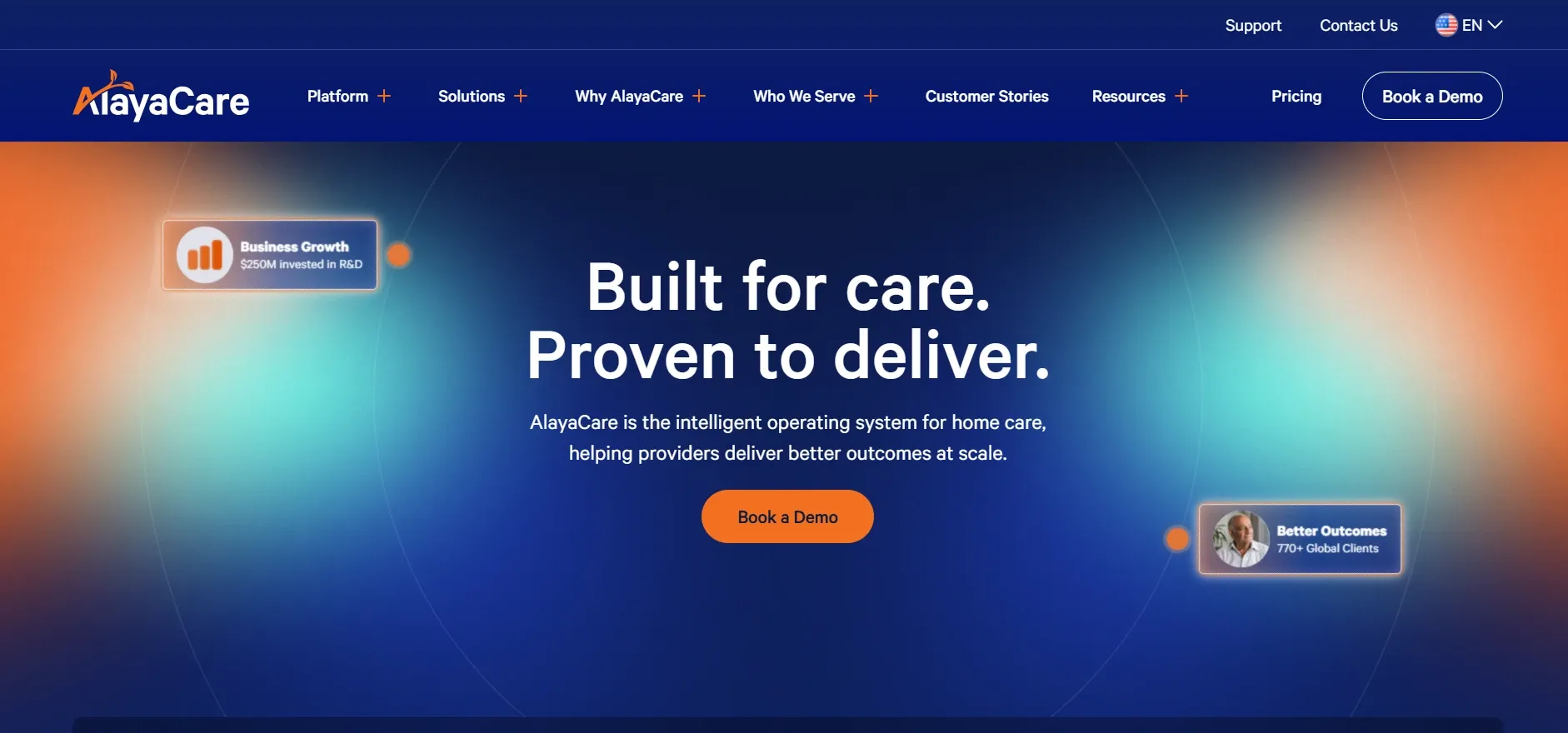
AlayaCare is a cloud-first platform built with modern home care in mind. Its core strengths are flexibility, mobile-first workflows, and a robust open API, making it popular among agencies operating in multiple regions or internationally. The platform offers a comprehensive suite of features: scheduling, clinical documentation, care planning, telehealth, billing, and family engagement. Its mobile app is particularly well-reviewed for ease of use and offline functionality, supporting field staff in real time.
Integrations: AlayaCare integrates with major payroll, HR, and EVV systems, and its open API allows agencies to connect with third-party analytics, telephony, and billing platforms. This flexibility is valuable for agencies with existing tech stacks or those seeking to automate data flows between systems.
Migration & Onboarding: AlayaCare provides dedicated migration support, including data mapping and training. However, agencies report that moving complex historical data (especially custom fields or notes) may require significant manual work. Expect a learning curve for staff used to legacy systems, but most users adapt quickly to the modern interface.
Use cases: Best for medium to large home care agencies with distributed teams, multi-site operations, or those requiring regulatory support in multiple countries. Agencies leveraging telehealth or needing to scale rapidly find AlayaCare’s architecture a good fit.
Pricing: Starts at around $7,000/year for smaller agencies, but costs can escalate with growth and feature upgrades. See pricing.
- Key limitations:
- Per-user and per-client pricing increases with growth
- Advanced modules gated behind premium tiers
- Customization beyond standard workflows requires vendor
- Strengths:
- Modern, mobile-first interface
- Open API for integrations
- Comprehensive feature set for global agencies
When you own your system, those per-user fees disappear for good.
2. WellSky (ClearCare) (Large multi-site operations)
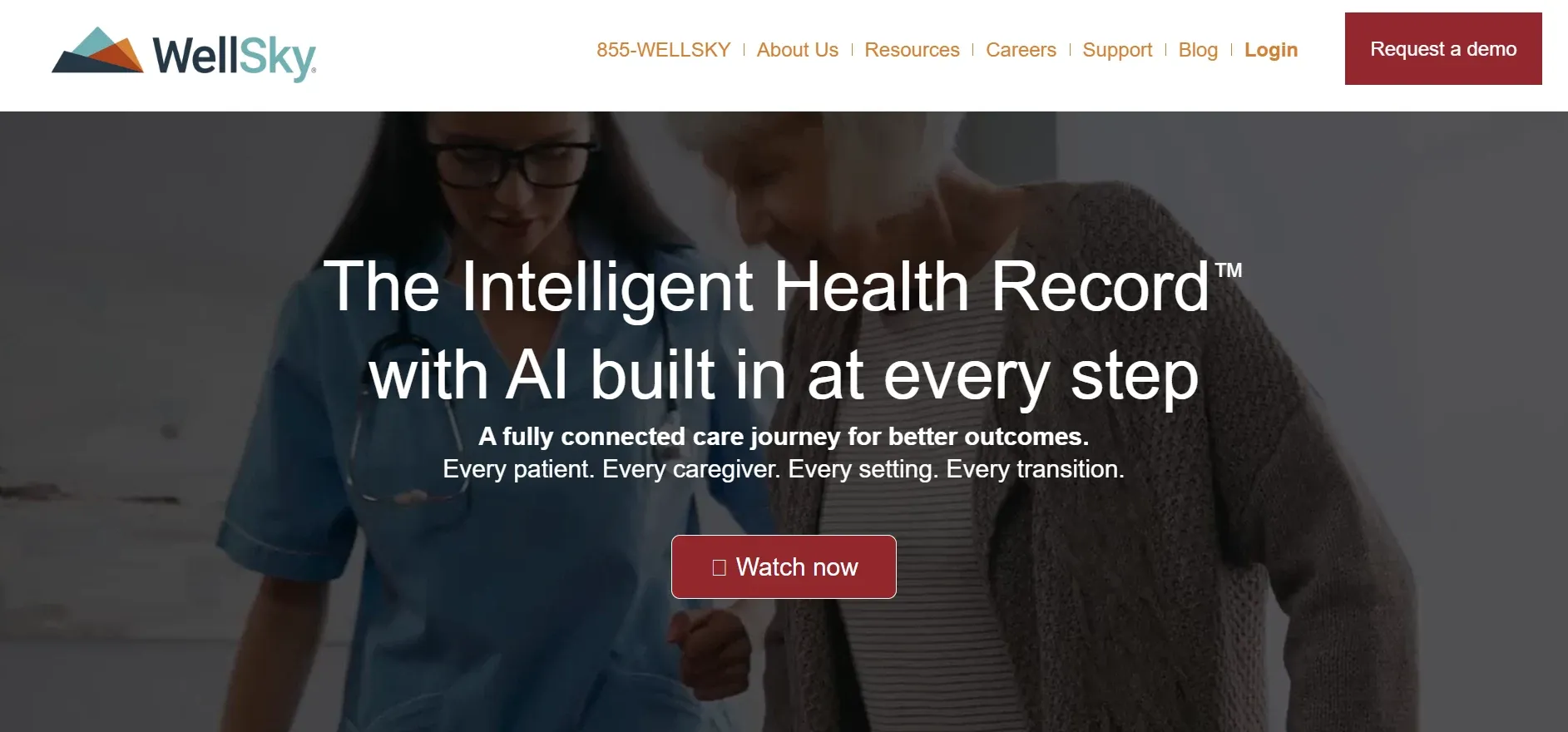
WellSky (formerly ClearCare) is a market leader for high-volume, multi-location home care agencies. Its core strengths are scalable scheduling, advanced EVV compliance, and integrated billing. WellSky’s API ecosystem allows for connections with background checks, payroll, accounting, and even other healthcare platforms. The platform’s interface is designed for agencies managing hundreds of caregivers and clients, with bulk scheduling, batch billing, and real-time dashboards.
Integrations: WellSky connects directly to many payroll processors (such as ADP, Paychex), popular accounting systems like QuickBooks, and state Medicaid EVV platforms. Agencies with complex requirements appreciate the ability to automate compliance and financial reporting.
Migration & Onboarding: WellSky offers migration support, but agencies moving from MatrixCare or other legacy platforms should expect to invest time in data mapping and verification. Some custom data fields or legacy workflows may not transfer seamlessly, and staff retraining is needed due to differences in terminology and navigation.
Use cases: Ideal for agencies operating across multiple states or with multiple lines of service (private pay, Medicaid, Medicare). The platform handles high transaction volumes and supports franchise models, making it a go-to for larger organizations or those planning rapid expansion.
Pricing: Typically $8 to $12 per client per month, with additional fees for integrations and premium modules. Get a quote.
- Key limitations:
- Per-client billing adds up quickly as census grows
- Advanced features require premium plans
- Customization limited to platform options
- Strengths:
- Scalable for large, multi-site agencies
- Strong EVV and compliance tools
- Robust integrations with payroll and accounting
With a custom Devaims build, every feature can be tailored to your workflows, not the other way around.
3. Brightree (Integrated billing)
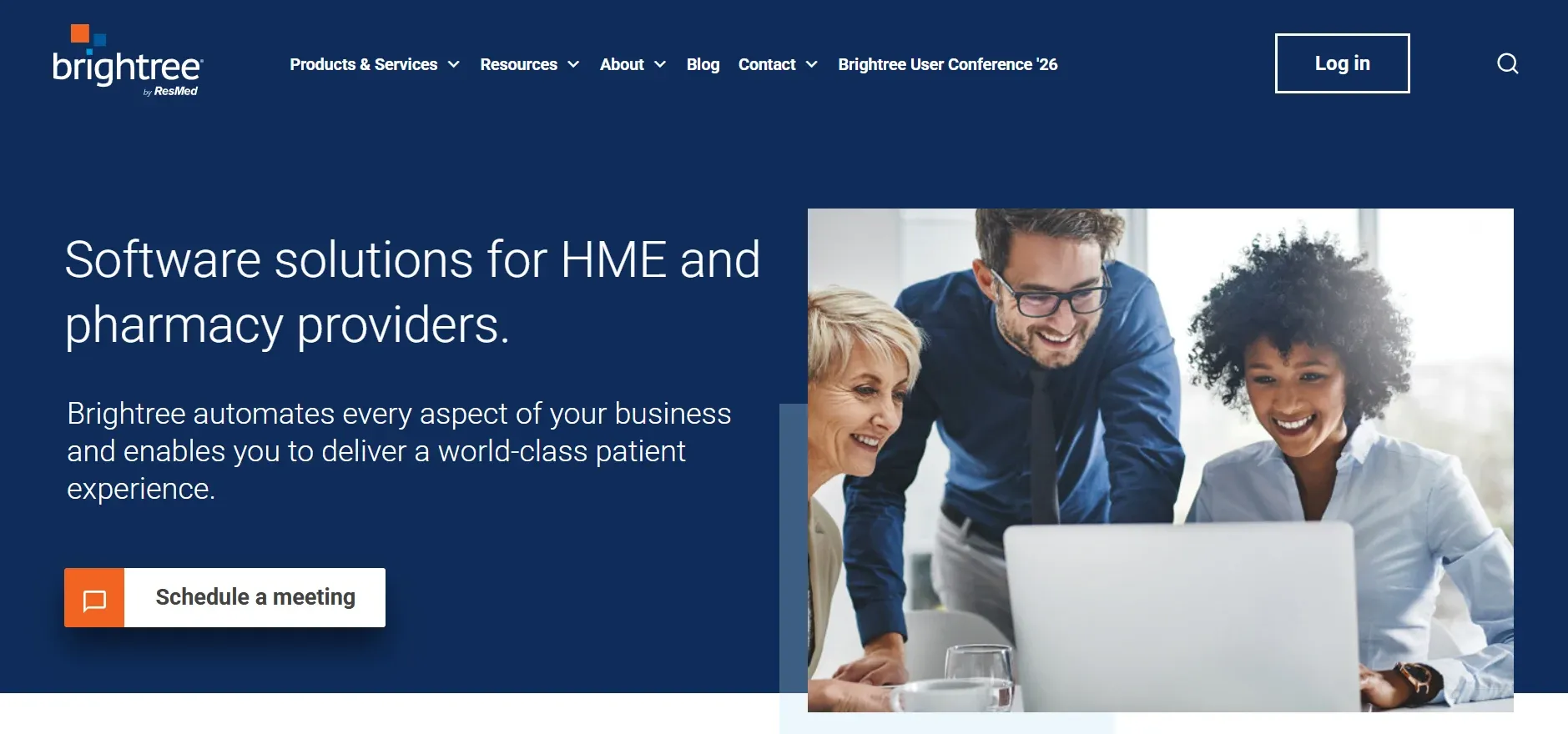
Brightree is a major player in the home health and hospice space, known for its sophisticated billing and claims management tools. Its platform offers clinical documentation, scheduling, revenue cycle management, and compliance tracking. Brightree’s billing engine is especially deep, supporting Medicare, Medicaid, private pay, and commercial insurance workflows. The system includes audit trails, automatic eligibility checks, and compliance alerts, making it well-suited for agencies with complex reimbursement needs.
Integrations: Brightree integrates with clearinghouses for claims submission, pharmacy management systems, and various medical device platforms. It also provides interfaces for labs and diagnostic reporting, which is valuable for agencies offering skilled nursing or therapy services.
Migration & Onboarding: Brightree provides onboarding teams and migration consultants, but the process can be lengthy for agencies with years of legacy data. Custom fields and non-standard workflows may not map directly, so agencies often need to clean and reformat data before migration. Staff training is provided, but the interface, while powerful, is not as modern or intuitive as newer competitors, leading to a steeper learning curve.
Use cases: Best for home health and hospice agencies needing deep billing and claims support, especially those billing multiple payers or managing a high volume of complex cases. Agencies that prioritize reimbursement accuracy and audit readiness will find Brightree’s compliance features valuable.
Pricing: Custom quote required. Request pricing.
- Key limitations:
- Interface can feel dated
- Customization limited to preset options
- Support quality can vary
- Strengths:
- Deep billing and claims management
- Strong compliance and audit tools
- Integrations with pharmacy and lab systems
4. PointClickCare (Senior care networks)
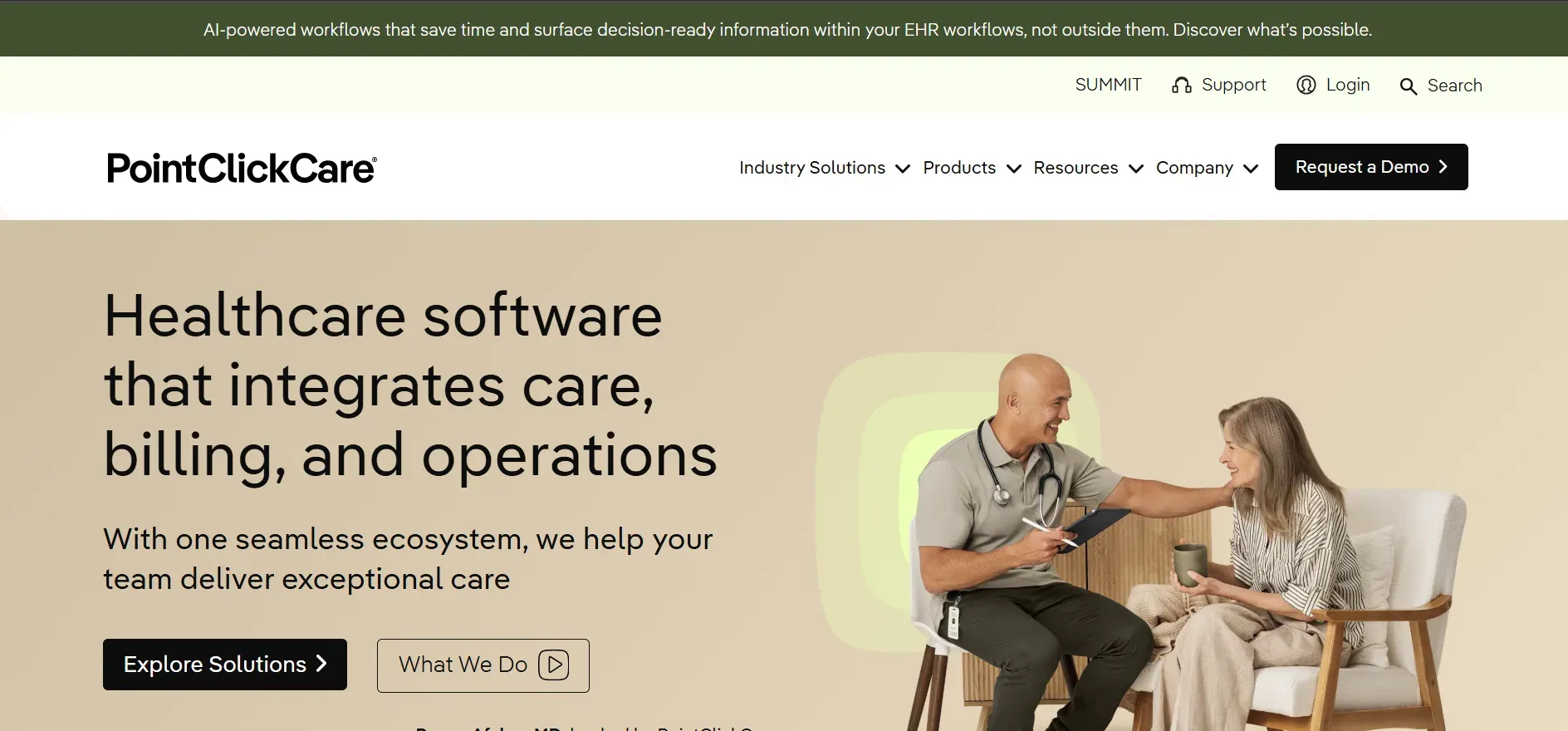
PointClickCare is an industry leader in senior care, providing a comprehensive EHR and care coordination platform. It is widely adopted by skilled nursing, assisted living, and senior living networks. The platform covers clinical workflows, medication management, care planning, family communication, and billing. Its reporting suite supports regulatory compliance and quality improvement initiatives.
Integrations: PointClickCare offers integrations with pharmacy systems, laboratory services, hospital EHRs, and analytics tools. The platform’s API allows for some interoperability, but most integrations are managed via vendor partnerships and may incur additional costs.
Migration & Onboarding: The company provides migration assistance, but agencies switching from MatrixCare should expect a careful review of data fields and mapping, particularly for custom assessments and historical care notes. Staff training is robust, but the interface can be complex for users new to EHRs or coming from more basic platforms.
Use cases: PointClickCare is ideal for senior living and post-acute care networks that need a unified platform for clinical, operational, and financial management. Its strengths are in regulatory reporting, quality metrics, and care coordination across multiple facilities.
Pricing: Custom quote only. Request a quote.
- Key limitations:
- Opaque, tiered pricing structure
- Customization limited to platform options
- Can be overwhelming for small teams
- Strengths:
- Comprehensive EHR for senior care
- Strong regulatory and quality reporting
- Wide adoption in post-acute networks
On an owned Devaims platform, integrations and reports are built for you, not for the average client.
5. Caremerge (Engagement & communication)
Caremerge focuses on resident and family engagement, providing tools for secure messaging, activity calendars, wellness tracking, and family portals. While it does not replace a full EHR or billing system, it excels at improving communication and transparency between staff, residents, and families. Agencies often use Caremerge alongside their core platform to fill gaps in engagement and satisfaction measurement.
Integrations: Caremerge integrates with select EHRs, calendar systems, and communication apps. Its open approach makes it a flexible add-on for agencies using MatrixCare, PointClickCare, or similar platforms.
Migration & Onboarding: Implementation is typically quick, as the platform is designed to overlay existing systems rather than replace them. Staff and families can be onboarded in a matter of days, and the mobile apps are praised for usability.
Use cases: Best for agencies and senior living communities prioritizing resident satisfaction, communication transparency, and family engagement. It is also used to boost participation in wellness activities and improve feedback collection.
Pricing: Around $8 per resident per month. Contact for quote.
- Key limitations:
- Does not offer core clinical or billing features
- Potential for data silos if not integrated
- Strengths:
- Excellent family and resident engagement tools
- Quick implementation and onboarding
- Flexible add-on to core platforms
6. CareVoyant (All-in-one clinical + billing)
CareVoyant is an all-in-one platform designed for agencies providing a mix of home health, private duty, and therapy services. It unifies clinical documentation, scheduling, billing, and compliance into one interface. The platform’s workflow engine supports customizable assessments, care plans, and billing rules, making it suitable for agencies with diverse service lines.
Integrations: CareVoyant connects with payroll, HR, pharmacy, and EVV systems. Its interoperability extends to HL7 interfaces for lab and hospital data, which is valuable for agencies managing transitions of care.
Migration & Onboarding: The onboarding process is thorough, with a focus on mapping complex workflows and billing requirements. Migration from MatrixCare or similar platforms may require detailed planning, especially for custom documentation templates or historical visit data. Staff training is essential, as the interface is dense and designed for power users.
Use cases: Agencies offering a combination of skilled and non-skilled services, or those requiring granular workflow customization, benefit most from CareVoyant. It is also suitable for organizations that need to manage compliance across multiple payers and regulatory environments.
Pricing: Custom quote. Request pricing.
- Key limitations:
- Steep learning curve for new users
- Customizations require vendor involvement
- Can be overkill for small providers
- Strengths:
- Unified clinical and billing platform
- Customizable workflows and billing rules
- Strong compliance support
7. Sandata (EVV compliance)
Sandata is the industry standard for Electronic Visit Verification (EVV), required for Medicaid-funded home care in most states. The platform’s core features are visit verification, compliance reporting, and seamless integration with state Medicaid systems. Sandata offers a user-friendly mobile app for caregivers to clock in and out, and supports voice, GPS, and biometric verification methods.
Integrations: Sandata integrates with a wide range of EHRs, payroll systems, and state Medicaid portals. Agencies can automate visit data transfer, billing, and compliance submissions, reducing manual paperwork and audit risk.
Migration & Onboarding: Implementation is typically straightforward, with Sandata providing state-specific onboarding guides. Agencies switching from MatrixCare may need to coordinate data flows and ensure that visit data, client records, and staff credentials are properly mapped. Training for caregivers is usually minimal due to the app’s simplicity.
Use cases: Essential for agencies serving Medicaid clients or operating in states with EVV mandates. Sandata is valued for its reliability, audit readiness, and state compliance certifications.
Pricing: Custom quote. Request pricing.
- Key limitations:
- Not a full EHR or scheduling platform
- Customization limited to compliance features
- Integration challenges with some platforms
- Strengths:
- Industry standard for EVV compliance
- Reliable, state-certified integrations
- User-friendly mobile app
8. HHAeXchange (Medicaid providers)
HHAeXchange is built for Medicaid-focused home care agencies, offering EVV, billing, authorization management, and compliance features in a unified platform. It automates the complexities of Medicaid billing, including prior authorizations, claims tracking, and eligibility checks. The system is widely used by large agencies and managed care organizations working with state Medicaid programs.
Integrations: HHAeXchange integrates with state Medicaid portals, payroll providers, and select EHRs. Its platform is designed for high-volume transaction processing and real-time data exchange with government systems.
Migration & Onboarding: HHAeXchange provides detailed migration support, but agencies with custom workflows or non-standard data fields may need manual intervention. The platform includes robust training resources, and support teams are familiar with Medicaid compliance nuances.
Use cases: Medicaid agencies, managed care organizations, and providers dealing with complex authorization and billing processes benefit most. The platform’s automation reduces administrative overhead and audit risk.
Pricing: Custom quote. Request pricing.
- Key limitations:
- Primarily focused on Medicaid workflows
- Customization is limited
- Long-term contracts and scaling fees
- Strengths:
- Automated Medicaid billing and EVV
- Strong compliance and audit support
- Real-time data exchange with state systems
9. Devaims (Owning your core platform)
Devaims builds custom web, mobile, and business software for home care agencies and then hands you the source code. Unlike SaaS vendors, Devaims delivers a platform you truly own: your records, your features, your integrations, your data, forever. There are no per-user fees, forced upgrades, or contract renewals. Agencies that want to break free from renting their platform find Devaims is the way to turn subscription spend into lasting ownership and control.
Integrations: Every integration is built to your requirements, payroll, EVV, training, analytics, and even legacy systems. You specify the workflows and data flows, and Devaims delivers custom connectors and dashboards.
Migration & Onboarding: Migration is handled as part of the project, with data mapping, quality checks, and staff training included. You decide what historical data to import, how to structure your records, and which features to prioritize. Support is ongoing, and updates are scheduled on your terms, not a vendor’s roadmap.
Use cases: Agencies of all sizes looking for complete ownership, maximum flexibility, and the ability to future-proof their operations. Especially valuable for organizations with unique workflows, multi-service lines, or those wanting to differentiate their client experience through technology.
- One-time build cost, then flat maintenance
- Full source code and data ownership
- Every feature, workflow, and report tailored to your agency
Other MatrixCare alternatives worth knowing
- eRSP, Home care scheduling and billing, focused on smaller agencies. eRSP provides a user-friendly interface, affordable entry pricing, and basic payroll and billing integrations. However, it lacks deep clinical modules and advanced analytics, and customization is limited.
- Rosemark, Affordable for small providers, with a strong reputation for customer support. Rosemark offers scheduling, billing, and simple compliance tools but is limited on enterprise features such as advanced reporting or multi-site management.
- AxisCare, Known for easy scheduling, mobile apps, and solid customer service. AxisCare is suitable for growing agencies but may lack deep clinical documentation or complex billing modules required by larger organizations.
- CareSmartz360, Another all-in-one SaaS for home care, subscription-based only. CareSmartz360 offers a broad feature set, including scheduling, billing, EVV, and training, but customization and ownership are limited by the SaaS model.
Some tools are great add-ons, not full replacements. Always check whether a platform truly covers your needs before switching. For a deeper dive, see Software Advice’s MatrixCare alternatives list.
How to choose the right MatrixCare alternative
- Budget: SaaS platforms charge per user, per client, or per feature, costs can snowball as you grow. Calculate not just year-one costs, but three- and five-year projections, factoring in likely staff and client growth, integration fees, and the cost of premium modules.
- Customization: If you want workflows built for you, only a custom or highly flexible tool will deliver. Most SaaS platforms offer limited customization, usually via custom fields or minor workflow tweaks. If your agency has unique processes, consider custom or open API platforms, or ownership models like Devaims.
- Ownership: Ask if you get the source code, or if you’re just renting access. True ownership means controlling your data, features, and integrations for the long term, and never facing a forced migration due to vendor business changes or acquisition.
- Vertical fit: Medicaid, private pay, and senior care all have different compliance and workflow needs. Choose a platform built for your primary payer mix and regulatory environment. Medicaid-focused agencies need strong EVV and claims; private pay agencies benefit from CRM and engagement modules.
- Integration: How easily can you connect payroll, EVV, and training modules? Check for pre-built integrations and the ability to add custom connectors. Consider future needs, such as analytics, telehealth, or third-party reporting.
If you’re ready to stop renting and start owning, there’s only one real path forward.
Stop paying rent on software you could own
Here’s the truth: every MatrixCare alternative above is still a rental. Whether it’s per-user, per-client, or per-feature, you’re paying for access, not ownership. If you want to control your costs, your data, and your future, owning your own platform is the only way out.
Devaims builds custom software for home care agencies. You get the web and mobile apps you need, the integrations you want, and the source code you own. No lock-in, no surprise hikes, and no waiting for your vendor to care about your roadmap.
- No per-user or per-client fees: Add staff and clients as you grow, no extra cost. This is especially powerful for agencies planning to expand or with unpredictable census fluctuations.
- Own your data and reports: Export, analyze, and audit on your terms. No more data silos or proprietary export formats; you control retention and compliance.
- Every feature built for you: If you need a custom workflow or integration, it’s yours, not a “maybe” down the roadmap. Your agency’s unique needs become the blueprint, not an afterthought.
| Platform | Ownership | Customization | Contract |
|---|---|---|---|
| MatrixCare | Rental (vendor-owned) | Preset modules only | Multi-year, auto-renewal |
| AlayaCare | Rental (vendor-owned) | API and some custom fields | Annual contract |
| PointClickCare | Rental (vendor-owned) | Limited customization | Annual contract |
| Devaims | You own 100% | Anything you need | No contract, one-time build |
Let’s do the 5-year math for a mid-sized agency with 80 clients and 40 staff. The average SaaS runs about $10 per client per month, plus $8 per staff per month, and $250/month for integrations and reporting. That’s:
| Year | Rented SaaS (cumulative) | Owned (Devaims, cumulative) |
|---|---|---|
| 1 | $19,200 | $32,000 |
| 2 | $38,400 | $34,760 |
| 3 | $57,600 | $37,520 |
| 4 | $76,800 | $40,280 |
| 5 | $96,000 | $43,040 (now ahead) |
In this scenario, the higher upfront investment for an owned platform is recouped within five years. If your agency is larger, growing, or requires custom workflows, the break-even point arrives even sooner. Owning your platform also protects you from vendor price hikes, acquisition risk, or forced migrations. For a personalized cost comparison, contact Devaims for a free analysis.
How to switch from MatrixCare
- Export your client, caregiver, and visit data from MatrixCare (CSV or API). Confirm with MatrixCare support what data can be exported and in what format. Some agencies report limitations on exporting historical notes or custom fields, plan accordingly.
- Choose your alternative platform and clarify migration support. Ask if the vendor provides hands-on migration services, data mapping, and quality assurance. For custom builds, ensure your migration plan covers all legacy data and workflows.
- Import or map your data into the new system. This may involve cleaning data, mapping fields, and testing for accuracy. For complex migrations, consider running parallel systems for a short period to validate data integrity.
- Reconnect payroll, billing, and EVV integrations. Ensure all third-party systems are connected and tested before going live. For custom platforms, this is handled during the build process.
- Train staff on new workflows and mobile tools. Comprehensive training reduces errors and increases adoption. Provide support resources and schedule follow-up sessions as staff adjust.
- Test side by side for at least one week to catch surprises. Use dual entry for critical workflows and compare outcomes to identify and resolve gaps.
- Review your MatrixCare contract for any exit terms or penalties. Plan your transition to avoid overlapping fees or contractual liabilities.
With a custom Devaims build, the migration is handled as part of the project, and you control the timeline and priorities.
Frequently asked questions
What is the best MatrixCare alternative for large agencies?
WellSky (ClearCare) and AlayaCare are both strong for large, multi-site home care operations. WellSky offers robust scheduling, billing, and compliance features at scale, while AlayaCare provides modern mobile tools and global support. However, both follow the SaaS rental model and can become expensive as you grow. If you want to own your platform and avoid per-user fees, a Devaims build is the only alternative with true ownership, unlimited customization, and flat ongoing costs. Large agencies with unique workflows or rapid expansion plans benefit most from ownership.
Which MatrixCare alternative is the cheapest?
Rosemark and eRSP cater to smaller agencies with lower entry costs and basic features. However, their per-user or per-client fees can add up quickly as you scale. Over five years, owning your platform with Devaims can be cheaper than any SaaS if you plan to grow, need custom features, or want to avoid recurring fees. Consider total cost of ownership, not just startup fees.
Is there a free MatrixCare alternative?
There are no fully free MatrixCare alternatives with the same feature set for home care. Some open-source EHR projects exist (such as OpenEMR), but they require significant IT resources for setup, customization, and maintenance, and may lack industry-specific features. Devaims can scope a build to your budget if you want to own your platform without sacrificing support or compliance.
Which MatrixCare alternative is best for Medicaid?
HHAeXchange and Sandata are strong choices for Medicaid agencies needing EVV, claims automation, and compliance. Both are widely adopted and have strong state integrations, but use a rental SaaS model with ongoing fees. For agencies wanting total cost control and ownership, Devaims can build a Medicaid-ready platform with custom EVV integrations and claims workflows, eliminating recurring rental costs.
When should I switch from MatrixCare?
Switch if you’re frustrated with per-user fees, surprise contract renewals, or feel boxed in by limited customization. Agencies planning to double in size, add new service lines, or modernize their workflows often find it’s the right time to move. The best time is before a contract auto-renewal or major price increase. Transitioning before a growth phase maximizes your cost savings and operational flexibility.
Can I keep my MatrixCare data when I switch?
You can export key records from MatrixCare, but some data may require manual migration or vendor assistance, especially custom fields or attachments. Plan for data validation and cleaning during migration. A Devaims build ensures you own your data from day one, no more data hostage scenarios, and you control retention and access policies.
Are MatrixCare alternatives hard to integrate with payroll and EVV?
Most SaaS alternatives offer standard payroll and EVV integrations, but full customization is rare and additional fees may apply. With Devaims, integrations are built to fit your stack, supporting any payroll, billing, or compliance system you use, and can be updated as your needs change. This flexibility is critical for agencies with unique reporting or state compliance requirements.
The bottom line
If the price of renting keeps you up at night, it’s time to rethink the math. The best MatrixCare alternatives each tackle a different piece of the puzzle, but only one puts you in the driver’s seat for the long term.
Here’s the test: add up what your current or next rented platform will cost you over the next five years. If that number could build you something you own, you already have your answer. Ownership means no more surprise hikes, no more waiting for a vendor’s roadmap, and no more paying rent on your own records.
For more insights, visit the Devaims blog or see our honest takes on Brightree alternatives, WellSky alternatives, and PointClickCare alternatives.