



You know the drill: you hit 'export' in LionDesk, and it tells you that's only available on the Pro plan. Or you want an integration, and it’s a paid add-on. The real kicker? That monthly fee never stops, and as your real estate team grows, so does the bill. If you’re here, you’ve already run the math. The cost of renting LionDesk for five years could have built you a system you own outright, and that’s before you add up all the nickel-and-dime fees for features you need to actually run your agency.
kvCORE and BoomTown are often the first stops for agencies wanting more automation or lead management muscle. But if you’re tired of paying for someone else’s roadmap, Devaims is the only alternative that lets you own the whole platform. Below, we’ll cut through the endless CRM list, highlight the honest reasons agencies outgrow LionDesk, and show how switching to something you own can change the economics of your business.
Why real estate agencies look for LionDesk alternatives
Per-user and per-lead pricing stacks up: Most real estate CRMs, LionDesk included, charge by the seat or by the number of leads. This model may look affordable at first, but as your agency grows, the cost can become a major burden. Adding agents, admins, or even marketing staff means your monthly bill rises, often unpredictably. Many agencies find themselves rationing access or features to keep costs down, which can hinder growth and collaboration.
Locked-in feature tiers: Essential tools, like bulk texting, advanced reporting, or workflow automations, are often locked behind higher-priced plans. This tiered approach means your team may outgrow your current subscription quickly, forcing you to pay more just to access core capabilities. Agencies often feel frustrated when a critical feature is available only as a paid add-on or requires upgrading the entire account.
Limited customization: Every real estate agency has its own way of working. LionDesk’s workflows cover basic needs, but if you want to automate a unique process or modify data fields to fit your business, you’ll likely run into hard limits. Customization options are usually restricted to what the vendor provides, and any changes often require support tickets or are simply not possible.
Integration headaches: Seamless integration with your website, lead sources, email marketing tools, and transaction management platforms is essential. With LionDesk, connecting to third-party tools can be challenging, sometimes requiring third-party middleware or extra fees. This can result in data silos, manual imports/exports, or missed opportunities for automation.
Unending rent, no ownership: After five years of subscription payments, you don’t own the platform or your customizations. If you leave, you risk losing access to your historical data and processes. Every SaaS CRM shares this issue: you’re always renting, never owning. This lack of ownership can become a strategic risk if your agency grows or your needs change.
These are the pains that send teams searching for LionDesk alternatives. Agencies want more control, flexibility, and a path to true ROI on their technology investment.
Quick comparison of the best LionDesk alternatives
| Tool | Best for | Starting price | You own it? |
|---|---|---|---|
| kvCORE | Large brokerages | Reported $499/mo | No |
| BoomTown | Lead gen power users | Reported $1,000+/mo | No |
| Follow Up Boss | Team collaboration | $69/user/mo | No |
| Chime CRM | AI-driven automation | Reported $499/mo | No |
| Real Geeks | IDX website integration | Reported $299/mo | No |
| Sierra Interactive | Customizable IDX | Reported $399/mo | No |
| Top Producer | Classic CRM workflows | Reported $99/mo | No |
| Devaims | Full ownership | One-time build | One-time build, you own it |
Pricing varies by region, size, and plan. Always confirm current pricing before deciding. SaaS rates do change, and discounts may be available for annual commitments or larger teams.
The 9 best LionDesk alternatives
1. kvCORE (Best for large brokerages)
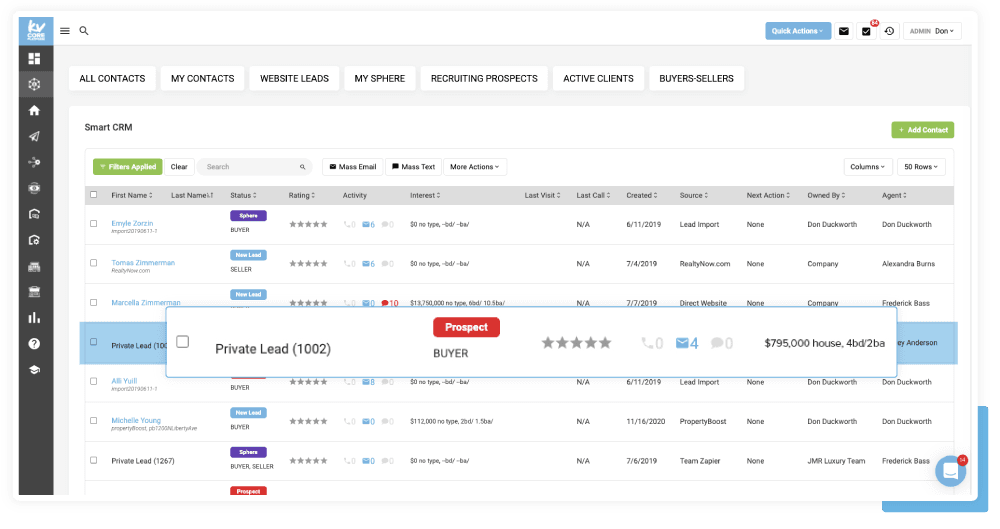
kvCORE is designed for large, multi-office teams that need advanced automation, lead routing, and marketing tools all in one place. It’s widely adopted by brokerages wanting to manage hundreds or thousands of agents from a single dashboard. Its core features include:
- Automated lead capture and nurturing: kvCORE offers built-in lead capture from IDX websites, landing pages, and integrations with lead sources like Zillow, Realtor.com, and Facebook. Leads can be automatically assigned and nurtured based on rules you set.
- Customizable workflow engine: kvCORE’s Smart Campaigns let you automate text, email, and task sequences. However, customization is limited to what’s available in their workflow builder. Truly unique processes may require workarounds.
- Integrated IDX websites: Each agent or team gets an IDX-enabled website with lead capture forms, property search, and marketing tools. The sites are mobile-friendly and SEO-optimized but offer limited design flexibility compared to a custom build.
Pricing: Reported $499/month base, with costs rising for larger teams and premium features.
-
Key limitations:
- Customization limited to vendor’s workflow builder
- Per-user and add-on fees increase total cost
- You never own the platform or data structure
-
Strengths:
- Powerful automation and lead routing
- Centralized management for large teams
- Strong integrations with real estate tools
With a custom Devaims build, automations and reporting are tailored to your team, not boxed into preset workflows.
2. BoomTown (Best for lead generation)
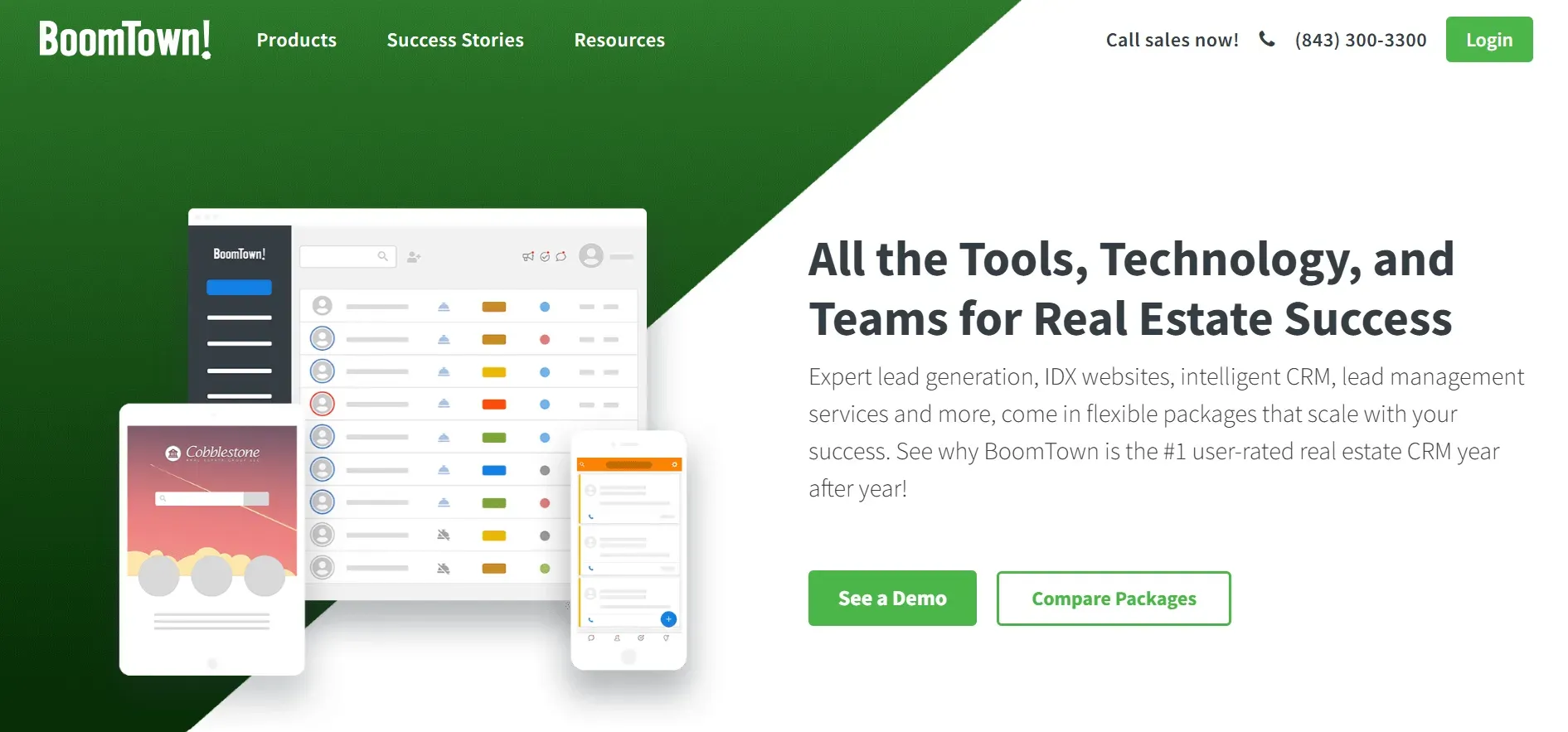
BoomTown is built for agencies focused on high-volume lead generation and conversion. Its platform combines a CRM, IDX website, marketing automation, and paid ad management. Key features include:
- Lead generation suite: BoomTown provides landing pages, IDX search, and strong PPC ad integration. They’ll even run Google and Facebook ad campaigns for you, with leads flowing directly into the CRM.
- Agent accountability tools: Advanced lead assignment, action plans, and automated reminders keep agents on track. Team leaders get dashboards to monitor engagement and follow-up rates.
- Automated marketing: Email and text drip campaigns, smart action plans, and behavioral follow-ups.
Pricing: Reported $1,000+/month minimum, plus required ad spend.
-
Key limitations:
- High base cost and required ad spend
- Customization limited to available modules
- Data export can be challenging if you leave
-
Strengths:
- Excellent lead generation and ad management
- Strong agent accountability features
- Integrated reporting and dashboards
With Devaims, you’d own your lead database and control exactly how campaigns are triggered, with no vendor roadmap in your way.
3. Follow Up Boss (Best for team collaboration)
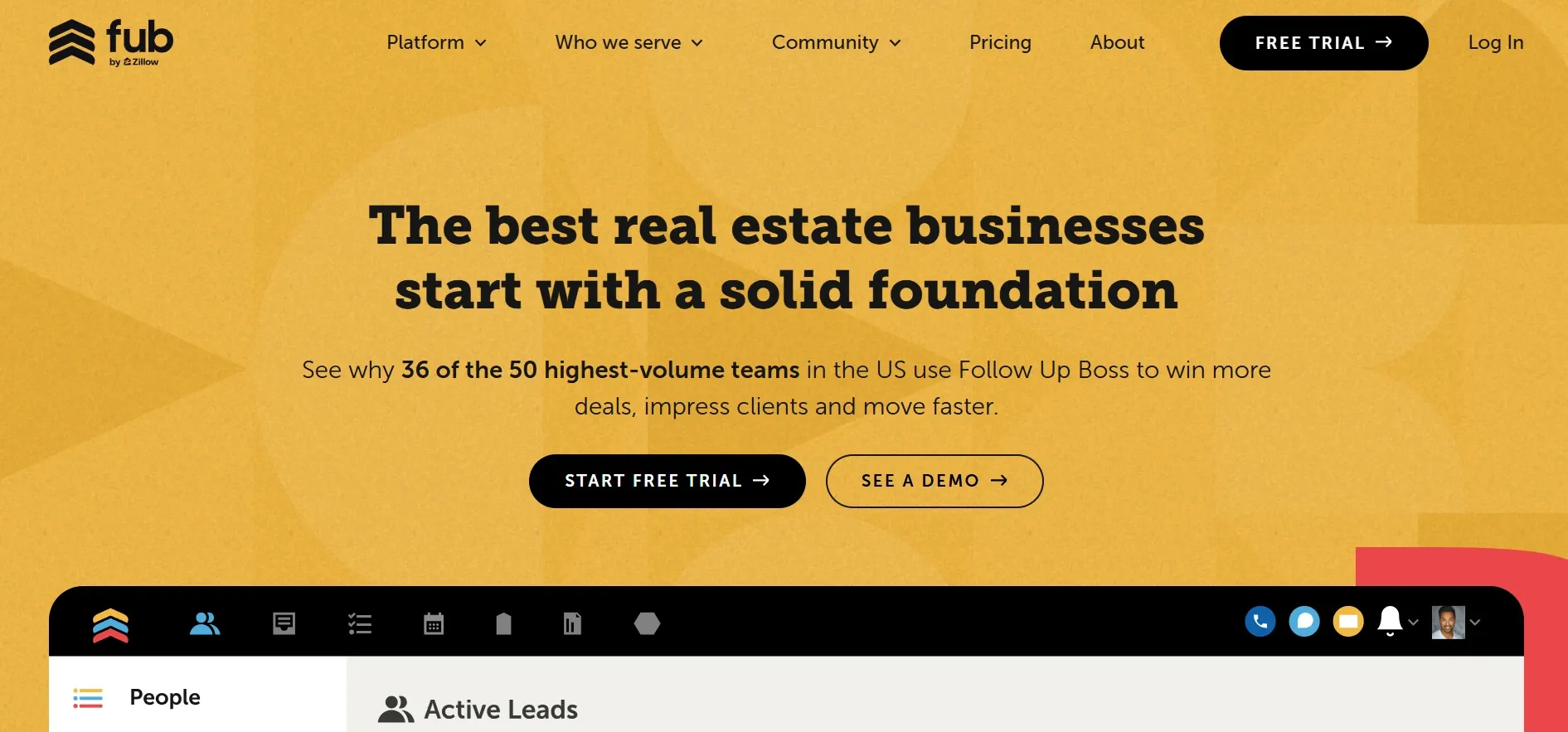
Follow Up Boss is popular for its simplicity and open integrations. It’s designed for teams that value collaboration, transparency, and a clean user experience. Features include:
- Unified inbox: View all communications, calls, texts, emails, from one screen. This makes team handoffs and collaboration easy.
- Open API & integrations: Connects with hundreds of lead sources, dialers, and marketing tools. Zapier and native integrations make it easy to expand functionality.
- Action plans: Automate follow-ups with customizable templates. Automation is less advanced than kvCORE or Chime, but workflows are easy to set up.
Pricing: $69/user/month.
-
Key limitations:
- Costs rise with each additional user
- Advanced automation requires outside tools
- You don’t own the platform or data model
-
Strengths:
- Easy onboarding and collaboration
- Open integrations and API
- User-friendly mobile app
4. Chime CRM (Best for AI-driven automation)
Chime CRM stands out for its AI-powered automation and predictive tools. It’s aimed at teams that want to use machine learning for smarter follow-ups, lead scoring, and workflow automation. Notable features include:
- AI assistant: Chime’s AI tools can automatically engage leads via text and email, qualify responses, and schedule appointments.
- Predictive lead scoring: Machine learning analyzes lead activity to prioritize outreach, helping agents focus on hot prospects.
- Integrated marketing: Chime offers email, text, and social media marketing tools, plus built-in ad management for Facebook and Google campaigns.
Pricing: Reported $499/month and up.
-
Key limitations:
- AI features are often add-ons
- Contracts may lock you in for a year
- Customization limited to available modules
-
Strengths:
- AI-driven automation and lead scoring
- Integrated marketing and IDX websites
- Visual dashboards and analytics
5. Real Geeks (Best for IDX website integration)
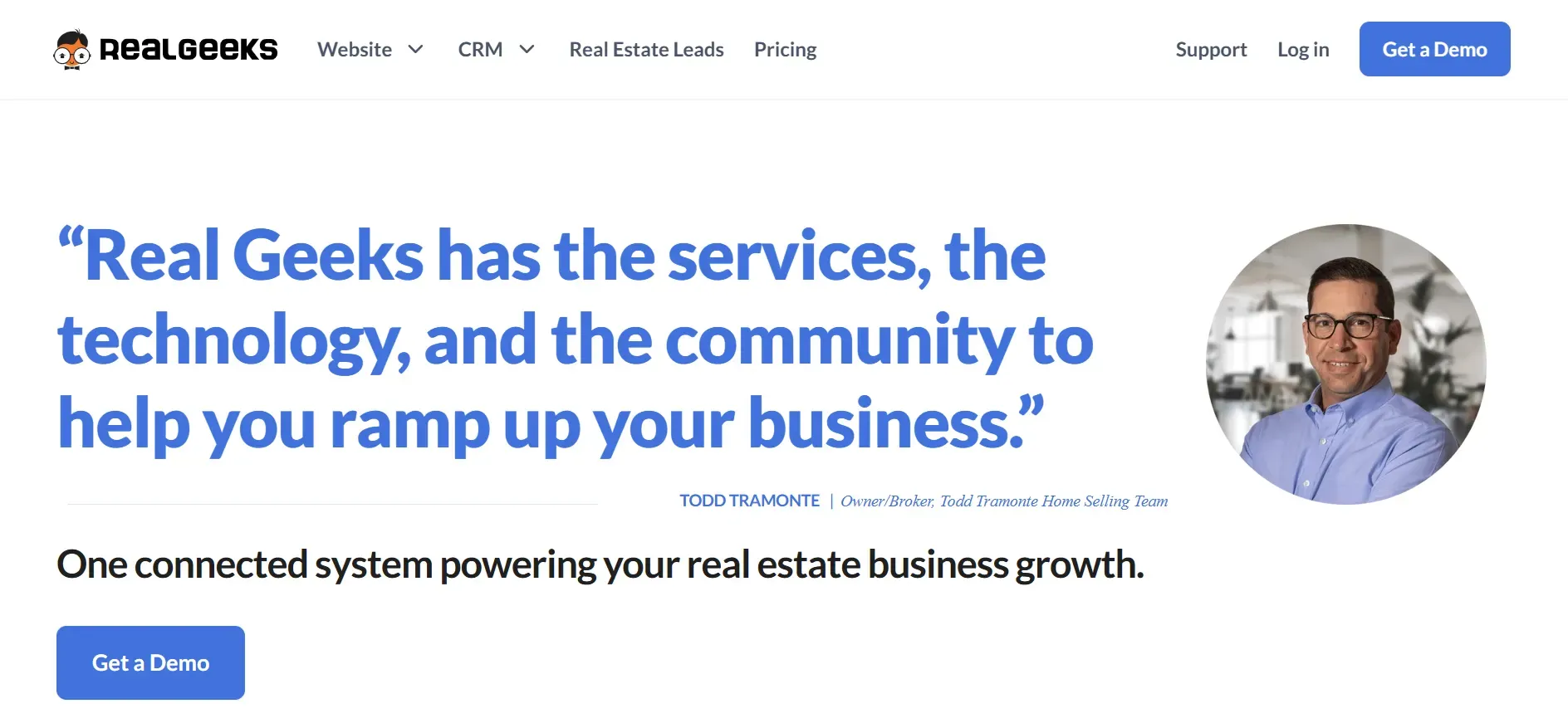
Real Geeks is known for its affordable, all-in-one approach, combining an IDX website with a built-in CRM. It’s a fit for agencies prioritizing lead capture from their website. Key features:
- IDX websites: Real Geeks provides attractive, SEO-friendly property search sites with customizable landing pages, lead capture forms, and market reports.
- Lead management: The built-in CRM offers contact management, basic follow-up plans, and automated text/email alerts.
- Lead routing: Assign leads to agents based on location, price range, or other criteria.
Pricing: Reported $299/month.
-
Key limitations:
- CRM features are basic compared to larger competitors
- Reporting and automation are limited
- Customization mainly focused on website, not backend workflows
-
Strengths:
- Affordable all-in-one package
- SEO-friendly IDX websites
- Simple lead routing and management
If you owned your CRM, you’d decide what’s included and never pay more for a needed report.
6. Sierra Interactive (Best for customizable IDX)
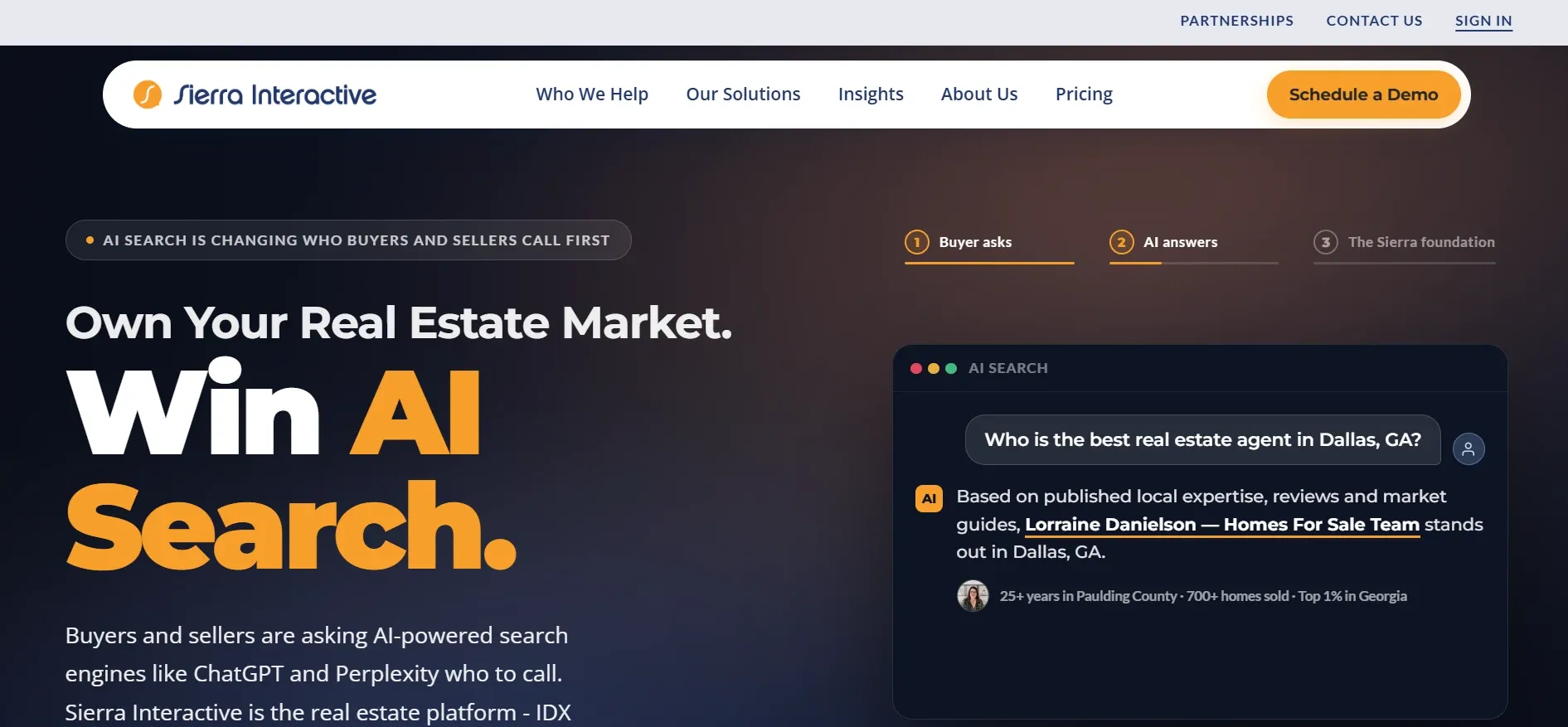
Sierra Interactive is a step up for agencies who want extensive control over their IDX website and lead routing logic. It’s built for brokerages ready to invest in a flexible, scalable platform. Features include:
- Highly customizable IDX websites: Sierra offers advanced design options, custom branding, and dynamic property search features.
- Flexible lead routing and pond management: Assign leads based on complex business rules. Lead “ponds” allow teams to share leads for fast response.
- Automation tools: Set up multi-step drip campaigns, task reminders, and follow-up plans.
Pricing: Base pricing starts at $399/month, with onboarding fees and per-user pricing for additional features.
-
Key limitations:
- Onboarding can involve significant setup fees and time
- Customization is strong on website, but backend workflow customization is limited
- Annual commitments are common
-
Strengths:
- Advanced IDX customization
- Flexible lead routing
- Detailed analytics and export options
7. Top Producer (Best for classic CRM workflows)
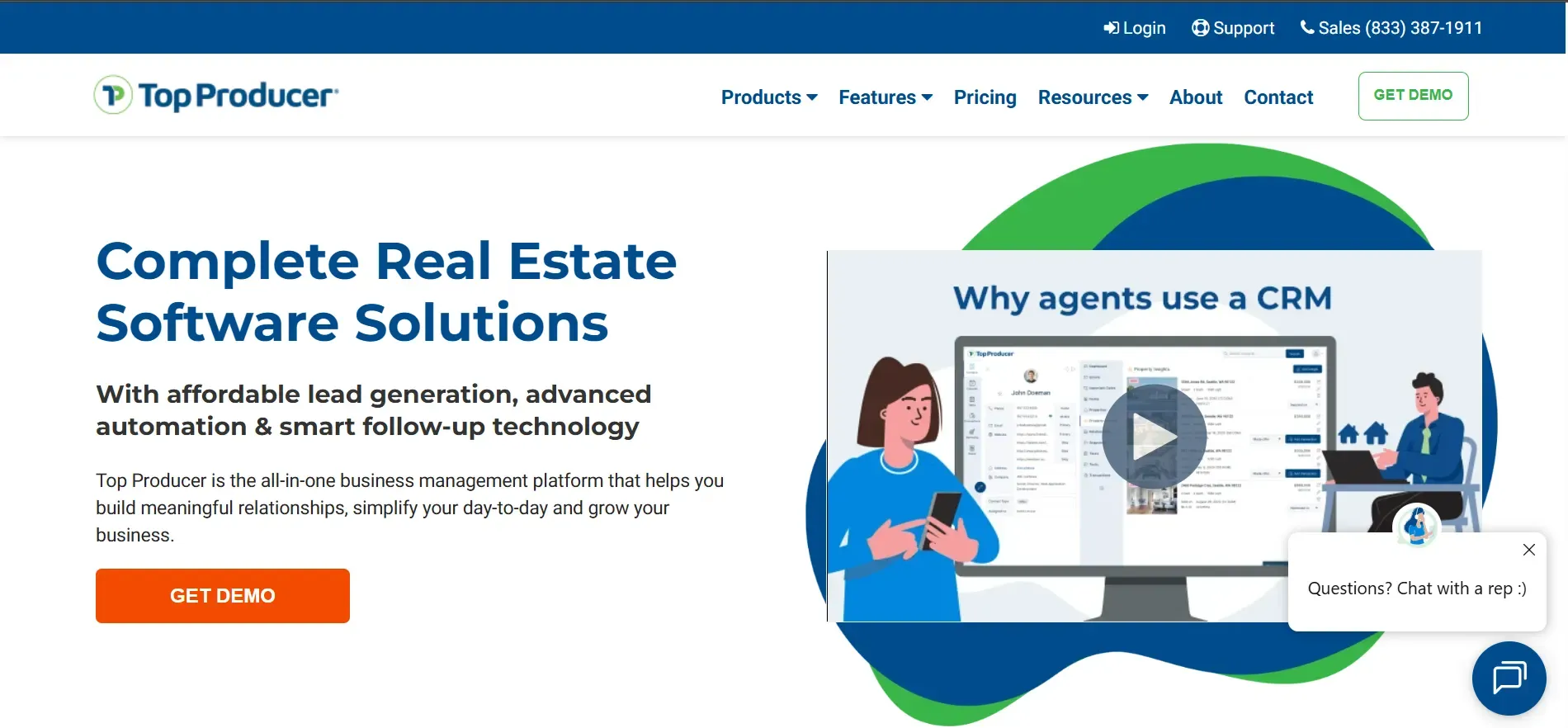
Top Producer is a longstanding CRM in real estate, known for stability and straightforward contact management. It’s ideal for agents who want familiar workflows and reliability. Features include:
- Contact and pipeline management: Organize contacts, deals, and follow-up tasks in a simple interface.
- Automated follow-up plans: Pre-built and customizable drip campaigns for buyers, sellers, and past clients.
- MLS and email integration: Syncs with major MLSs, Gmail, and Outlook for easy data entry and communication logging.
Pricing: $99/month.
-
Key limitations:
- Recurring fees add up over time
- Automation and customization lag behind newer competitors
- You never own the system or data model
-
Strengths:
- Stable, proven CRM
- Easy onboarding for solo agents and small teams
- Reliable contact and pipeline management
8. Dotloop (Best for transaction management)
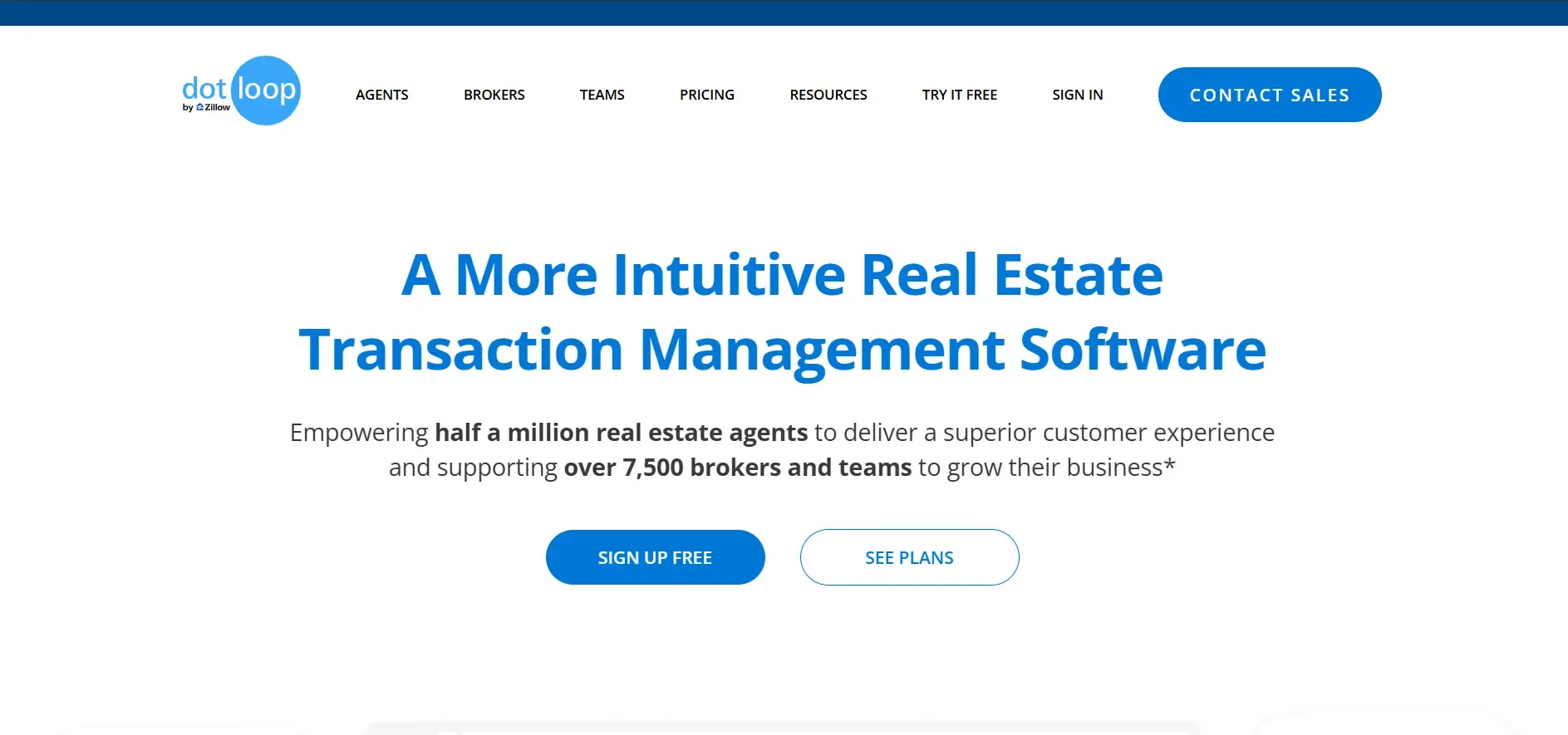
Dotloop isn’t a full CRM but is the standard for transaction management, e-signatures, and compliance in real estate. It’s often used alongside a CRM for streamlined deal closing. Features include:
- Transaction coordination: Manage deals from offer to close, track document status, and assign tasks to team members.
- E-signature and forms: Secure, legally compliant e-signatures on contracts and disclosures.
- Compliance and audit trails: Automatic activity logs, version control, and compliance checklists.
Pricing: $31.99/month per agent.
-
Key limitations:
- Additional cost on top of your CRM
- Data portability can be a challenge
- Not a CRM replacement, but a companion
-
Strengths:
- Industry-standard for transaction management
- Strong compliance and audit features
- Integrates with many real estate CRMs
9. Devaims (Best for owning your CRM and data)
Devaims builds custom web, mobile, and business software that you own outright, source code, database, and all. Unlike SaaS CRMs, you pay once for a platform tailored to your processes, integrations, and reporting needs. No per-user fees, no contracts, no feature upsells. Your system, your data, your rules.
- Full ownership: You receive the source code and database, giving you total control over your system, features, and integrations. No vendor lock-in.Custom workflows and reporting: Every automation, report, and dashboard is designed for your agency’s unique way of working. If your process changes, your platform can evolve with you.Unlimited users, no recurring rent: Add agents, admins, and partners as needed, no surprise fees. Maintenance is optional and flat, only if you want ongoing updates or support.Integration freedom: Connect to any website, lead source, or third-party tool. No waiting on a vendor’s roadmap, your development priorities come first.Data control and security: Your data stays on your servers (cloud or on-premise), and you define backup, retention, and access policies. No more paying to access your own customer history.
- Full ownership: You receive the source code and database, giving you total control over your system, features, and integrations. No vendor lock-in.
- Custom workflows and reporting: Every automation, report, and dashboard is designed for your agency’s unique way of working. If your process changes, your platform can evolve with you.
- Unlimited users, no recurring rent: Add agents, admins, and partners as needed, no surprise fees. Maintenance is optional and flat, only if you want ongoing updates or support.
- Integration freedom: Connect to any website, lead source, or third-party tool. No waiting on a vendor’s roadmap, your development priorities come first.
- Data control and security: Your data stays on your servers (cloud or on-premise), and you define backup, retention, and access policies. No more paying to access your own customer history.
With a custom Devaims build, the migration is handled as part of the project, including data cleanup, workflow recreation, and integration testing.
Other LionDesk alternatives worth knowing
- Skyslope for broker-focused transaction management. It’s not a full CRM, but is a strong add-on for compliance and audit trail needs.
- Lofty (formerly Easy Agent Pro) for agencies wanting a website-first approach with integrated lead capture and lightweight CRM features. Good for content marketing-driven teams.
- Contactually (now part of Compass), legacy users may still be on it, but it’s no longer available as a standalone product.
- Propertybase for Salesforce-powered CRM with brokerage-level customization. More expensive and complex, but highly flexible for large teams.
- CINC for teams focused on lead generation and paid ad campaigns, offering strong IDX and lead routing.
How to choose the right LionDesk alternative
- By budget: Run the five-year math, not just the first month. Per-user fees add up, especially as your team grows. Consider both upfront and hidden costs, onboarding, add-ons, and annual increases.
- By team size: Large brokerages need scalable automations, granular permission controls, and advanced reporting. Small teams often want simplicity, fast onboarding, and cost control.
- By workflow needs: If your agency can operate with standard processes, SaaS CRMs offer speed and convenience. If you have unique workflows, compliance, or integration needs, a custom build may be more sustainable.
- By ownership: Agencies concerned about data privacy, integration flexibility, or long-term costs should consider a platform they can own and control.
- By migration friction: Factor in the time and effort to move your data, retrain your team, and reconnect your tech stack. Some platforms offer full-service migration, while others leave you to DIY.
Once you know which pain points matter most, the right LionDesk alternative stands out. If you want to escape rent forever, here’s how the numbers work for Devaims.
Stop paying rent on software you could own
Every LionDesk alternative in this list, and LionDesk itself, shares a single problem: you’re always renting. Fees rise with every new agent, every new feature, and every year you stay. After five years, you’re thousands in without ever owning your tools. That’s where Devaims is different.
Devaims builds custom CRM and business software for real estate teams who are done with SaaS rent. You get the source code, full data access, and a platform built for how your agency actually works, not a generic set of features. No per-user fees, no contracts, no surprises. You pay for the build, then flat maintenance if you want upgrades or support. The system is yours, always.
- Per-user and per-lead fees? Gone. Add as many agents as you want, no extra cost.
- Feature lockouts? You decide what’s included and when it changes.
- Integration headaches? Your stack, your rules, no waiting on a vendor’s roadmap.
- Renting your own data? Not anymore. You keep it all, forever.
| Tool | Ownership | Recurring fees | Feature control | Data control |
|---|---|---|---|---|
| kvCORE | No | $499+/mo, per-user | Vendor roadmap | Export limited |
| BoomTown | No | $1,000+/mo, plus ads | Vendor roadmap | Export limited |
| Follow Up Boss | No | $69/user/mo | Vendor roadmap | Export limited |
| Devaims | Yes (your agency) | One-time build, flat maintenance | You decide | Full access |
Here’s what the five-year cost actually looks like for a 10-agent team starting at $499/month on a mainstream CRM (not counting upsells):
| Year | Rented CRM (Cumulative) | Owned (Devaims) (Cumulative) |
|---|---|---|
| 1 | $59,880 | $26,800 |
| 2 | $119,760 | $28,600 |
| 3 | $179,640 | $30,400 |
| 4 | $239,520 | $32,200 |
| 5 | $299,400 | $34,000 (now ahead) |
In this scenario, the crossover happens in year one, and the cost gap widens each year. Agencies with 15 or 20 users see even faster break-even. Remember, these numbers exclude additional costs like onboarding, training, or feature upsells, which can be significant. If you want to run your real numbers, Devaims will do the five-year math for free.
How to switch from LionDesk
- Export your data: Export contacts, deals, tasks, and communications from LionDesk. Depending on your plan, you may have access to CSV export, or you may need to use their API. For some data (like notes or message logs), you may need to request support or perform manual exports.
- Choose and set up your new platform: Select your new CRM or scope your custom build with Devaims. If you’re going SaaS, set up users, permissions, and integrations. For custom, you’ll define workflows, data fields, and reporting needs with your development partner.
- Import and map data: Import contacts, deals, and other data into your new system. Map fields (e.g., tags, custom properties) to ensure nothing is lost. Some platforms offer import wizards, while others require CSV formatting or manual entry.
- Reconnect integrations: Reconnect email accounts, lead sources (Zillow, Realtor.com, Facebook), IDX website, and transaction tools (dotloop, Skyslope, etc.). Test each integration for data flow and automation triggers.
- Train your team: Onboard your agents and admins with new workflows, automation rules, and reporting dashboards. Provide step-by-step guides or live training sessions to minimize disruption.
- Test in parallel: Run both LionDesk and your new CRM in parallel for at least a week. Validate that all leads, communications, and automations work as expected. Fix any issues before fully switching over.
- Review cancellation terms: Check your LionDesk agreement for contract terms, notice periods, or data retention policies. Cancel your subscription only after your data is fully migrated and verified.
With a custom Devaims build, the migration is handled as part of the project, including data cleanup, workflow recreation, and integration testing.
Frequently asked questions
What is the best LionDesk alternative for large teams?
kvCORE and BoomTown are strong LionDesk alternatives for large real estate teams needing automation, lead routing, and advanced reporting. Both offer out-of-the-box features for multi-office organizations but come with recurring per-user fees and limited customization. For agencies wanting to control their own roadmap, data, and costs, Devaims is the only real option for full ownership. With a custom build, you design workflows, reporting, and integrations to fit your business, and add unlimited users at no extra cost.
Which LionDesk alternative is cheapest?
Top Producer and Real Geeks start at lower monthly rates ($99-$299/month), making them affordable for small teams or solo agents. However, recurring fees add up over time, especially as your team grows or you need more features. Over five years, even low-cost SaaS CRMs can cost more than building a custom platform you own. Devaims is the only way to avoid monthly rent entirely after your upfront build, making it the most cost-effective for agencies planning to scale.
Are there any free LionDesk alternatives?
There are no free, full-featured CRMs designed for real estate agencies at this level. Some generic CRMs (like HubSpot or Zoho) offer free tiers, but critical features like automation, lead routing, and IDX integration are paywalled or missing. Real estate-specific SaaS CRMs typically offer free trials or demo accounts, but ongoing use always requires a paid plan. Devaims focuses on ownership and full customization, not free tiers.
What is the most customizable LionDesk alternative?
Sierra Interactive offers deep website and IDX customization, allowing agencies to design unique web experiences and advanced lead routing. Chime CRM brings AI-driven automation for lead scoring and follow-up. For total workflow, data, and integration control, including custom fields, automations, and reporting, only a custom Devaims platform is fully customizable from the ground up. With Devaims, you’re not limited by a vendor’s roadmap or feature set.
When should I switch from LionDesk?
You should consider switching if your monthly costs keep rising with team growth, you’re frustrated by feature lockouts or add-on fees, or you want to control your data and workflow. Agencies planning to expand, add new service lines, or integrate with unique tools often benefit from switching sooner. The earlier you move, the sooner you stop paying rent and start building equity in your technology.
Can I keep my LionDesk data if I switch?
You can export most contacts, deals, and basic fields from LionDesk, usually via CSV or their API. However, some data (like communication logs, notes, or custom fields) may require higher-tier plans or manual work to extract. Always audit your export to ensure nothing is lost. With Devaims, migration is handled for you, including data mapping, cleanup, and workflow recreation. You keep everything, forever, and can access your historical data at any time.
The bottom line
The right LionDesk alternative saves you more than money. It puts you in charge of your business, your data, and your future costs. The real question isn’t which SaaS CRM is best, but whether you want to keep renting forever or finally own your system.
Here’s the test: add up what your CRM will cost over five years. If that number would have built you something you own, you already have your answer. Agencies with vision and scale should run the math before signing another year’s contract.
Want more honest takes? Find deeper dives on the Devaims blog, or check out our guides to kvCORE alternatives, Follow Up Boss alternatives, and Chime CRM alternatives.