


That first eMoney Advisor invoice never feels too painful, but by year three, many financial advisors realize they’re handing over far more than the software’s worth. The costs ramp up: per-seat pricing, required add-ons, annual increases, and the subtle but real sense that your client data is locked away in someone else’s system. If you’re tired of renting your core tools and want more control, you’re not alone.
The market is crowded with eMoney Advisor alternatives. Redtail CRM, Orion Advisor, MoneyGuidePro, Wealthbox, and more each promise a better way. But almost every competitor is just another rental, with monthly fees, forced upgrades, and limited ownership. The only way out? Build and own your platform. That’s where a custom Devaims solution comes in: your workflows, your data, your code, no more SaaS treadmill.
Why financial advisors look for eMoney Advisor alternatives
Recurring fees stack up fast. What starts as $200 a month quickly grows to thousands per year, especially for multi-advisor firms or practices adding new features. Over time, these fees can easily reach $15,000 to $30,000 per advisor in five years. That is money that could fund your own technology.
Feature limits and forced upgrades. Many platforms gate the most useful features behind higher pricing tiers. Essential integrations, advanced reporting, or even client-facing tools are often locked unless you pay for the “Enterprise” package, regardless of whether you need every bell and whistle.
Data lock-in. Exporting a full history of client data, plans, and notes is rarely simple. Even when export options exist, the data can be incomplete, poorly structured, or in proprietary formats. This makes switching platforms a logistical headache and can risk losing valuable client history.
Workflow friction. Every financial practice is unique, but off-the-shelf tools force you into their standard workflows. Over time, workarounds, manual processes, or reliance on spreadsheets become the norm, undermining efficiency and accuracy.
Integration gaps. “All-in-one” platforms rarely deliver truly smooth integration with your custodians, billing, compliance, or marketing stack. Promised connections often require extra fees, custom development, or compromise on how your workflows function.
These pain points drive advisors to search for eMoney Advisor alternatives that better fit their needs and offer more control.
Quick comparison of the best eMoney Advisor alternatives
| Tool | Best for | Starting price | You own it? |
|---|---|---|---|
| Redtail CRM | CRM-centric practices | Reported $99/mo | No, SaaS |
| Wealthbox | User-friendly CRM | Reported $45/mo | No, SaaS |
| Salesforce Financial Services Cloud | Enterprise needs | Reported $225/mo | No, SaaS |
| MoneyGuidePro | Financial planning | Reported $1,200/yr | No, SaaS |
| Orion Advisor | All-in-one platform | Custom, reported $150+/mo | No, SaaS |
| Riskalyze (Nitrogen) | Risk assessment | Reported $245/mo | No, SaaS |
| Tamarac | Portfolio management | Custom, often $10k+/yr | No, SaaS |
| Advyzon | All-in-one for growing firms | Custom, reported $500+/mo | No, SaaS |
| Devaims (custom build) | Ownership, custom workflows | From $25,000 one-time | One-time build, you own it |
Pricing and tiers change frequently. Always confirm with vendors before making a decision.
The 9 best eMoney Advisor alternatives
1. Redtail CRM (CRM-centric shops)
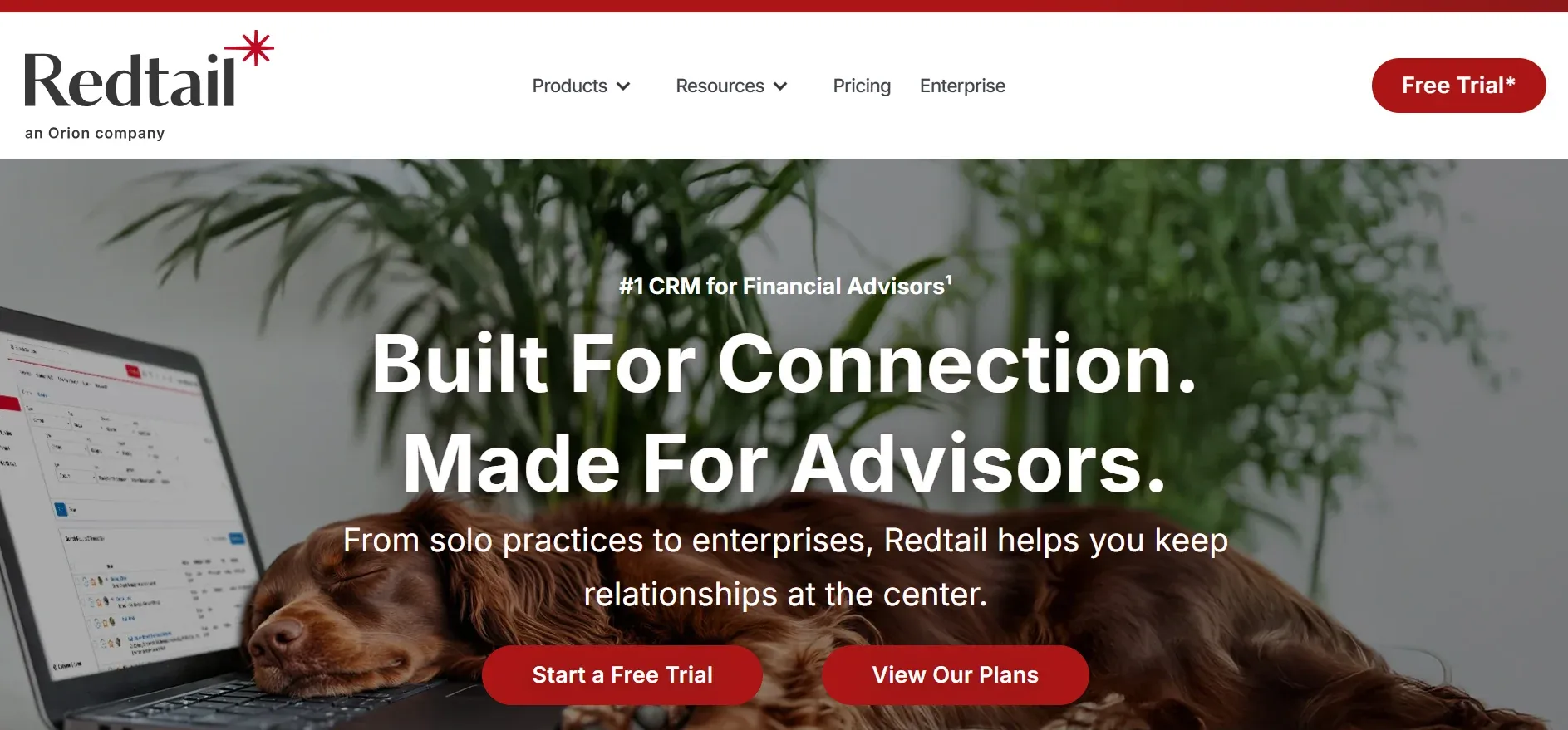
Redtail CRM is a favorite among advisors who prioritize client relationship management and workflow automation. Its industry-specific design makes it a strong fit for firms that want focused contact management, task tracking, and client communication tools without the steep learning curve of larger platforms.
Pricing: Starts at $99 per month per database, with add-ons for imaging and texting.
- Easy onboarding and advisor-focused workflows
- Strong integrations with leading planning and portfolio tools
- Affordable for solo and small teams
- Lacks in-depth financial planning and portfolio analytics
- Reporting is basic unless you invest in integrations
- Recurring fees and no platform ownership
Devaims can build a CRM module tailored to your exact workflow, so you never pay for features you do not use.
2. Wealthbox (User-friendly CRM)
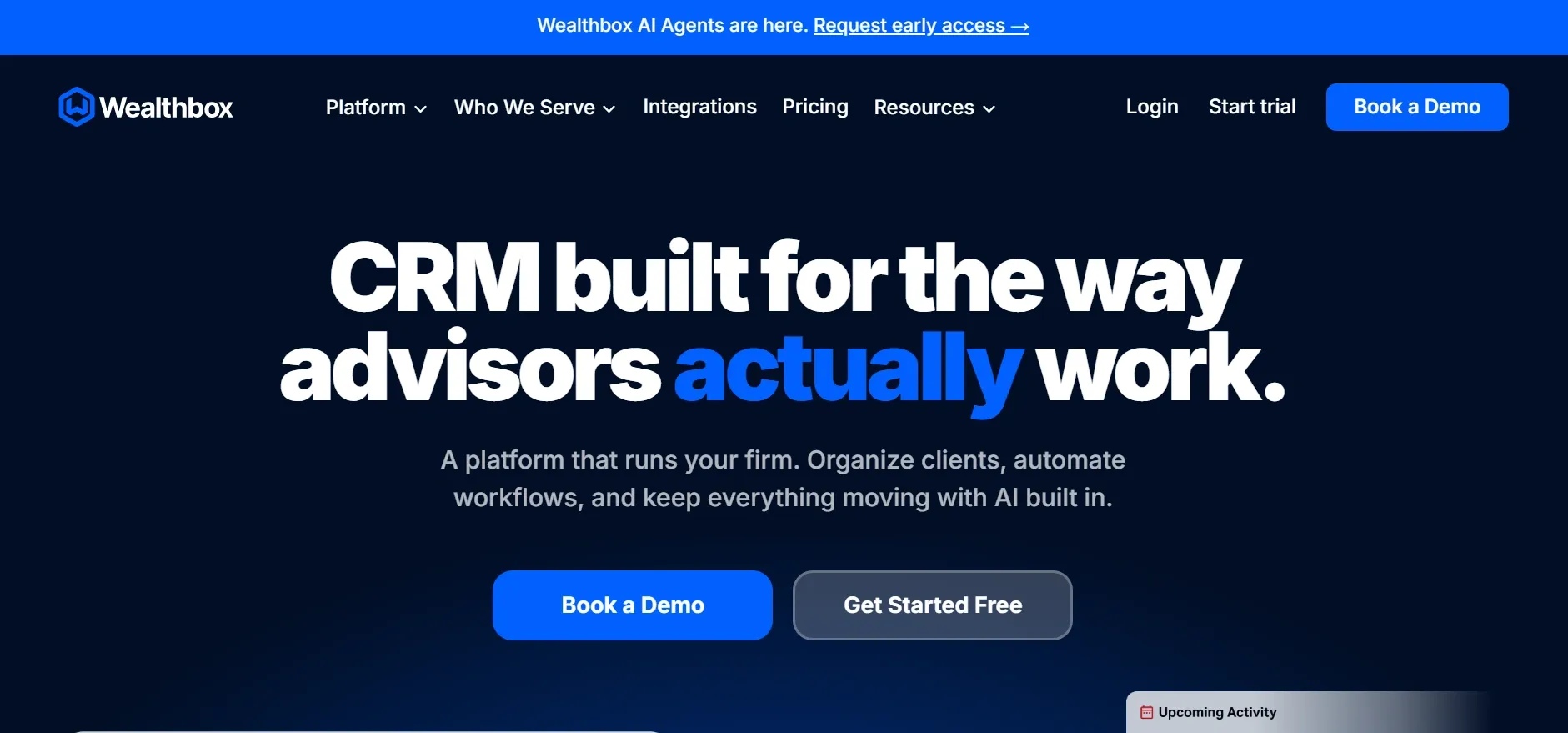
Wealthbox is designed for advisors who want a modern, intuitive CRM with minimal setup and training. Its clean interface and ease of use have made it a favorite for small to mid-sized practices looking to streamline client management without complexity.
Pricing: Starts at $45 per user per month, with higher tiers for advanced features.
- Very easy to use and quick to implement
- Strong integrations with popular advisor tools
- Mobile-friendly and ideal for small teams
- No built-in financial planning or portfolio management
- Customization limited to templates and workflows
- Per-user pricing can escalate as you grow
Devaims can deliver a CRM and planning portal in one platform, fully branded and owned by your firm.
3. Salesforce Financial Services Cloud (Enterprise needs)

Salesforce Financial Services Cloud is the heavyweight designed for large or rapidly growing wealth management firms. It brings the full power and flexibility of Salesforce’s ecosystem to the advisor space, offering deep customization, automation, and compliance capabilities.
Pricing: Starts at $225 per user per month, plus implementation and support costs.
- Highly customizable workflows and automation
- Extensive integrations and app marketplace
- Enterprise-grade compliance and reporting
- High complexity and cost for setup and ongoing use
- Customizations can create technical debt
- May be overkill for smaller firms
Devaims gives you enterprise-level customization, but you own the code and avoid per-user fees.
4. MoneyGuidePro (Financial planning focus)

MoneyGuidePro is a market leader for goal-based financial planning. It focuses on helping advisors and clients collaborate on scenario modeling, retirement projections, and plan tracking, making it a strong alternative for those who prioritize planning over CRM or portfolio management.
Pricing: Starts at $1,200 per advisor per year, with add-ons for advanced modules.
- Intuitive, client-friendly planning tools
- Strong integrations with advisor tech stack
- Widely adopted and trusted in the industry
- No built-in CRM or portfolio management
- Recurring per-advisor license fees
- Limited data portability and code ownership
5. Orion Advisor (All-in-one platform)

Orion Advisor offers a comprehensive suite: portfolio accounting, billing, trading, CRM, planning, and a client portal. Many advisors migrate to Orion to consolidate their tech stack and streamline operations.
Pricing: Custom pricing, often starting at $150 per user per month, with additional fees for modules.
- Deep portfolio management and reporting
- Unified client portal and digital experience
- Strong integrations with custodians and CRMs
- Complexity can overwhelm smaller teams
- Add-on costs accumulate quickly
- Platform is rented, not owned
6. Riskalyze (Nitrogen) (Risk assessment)
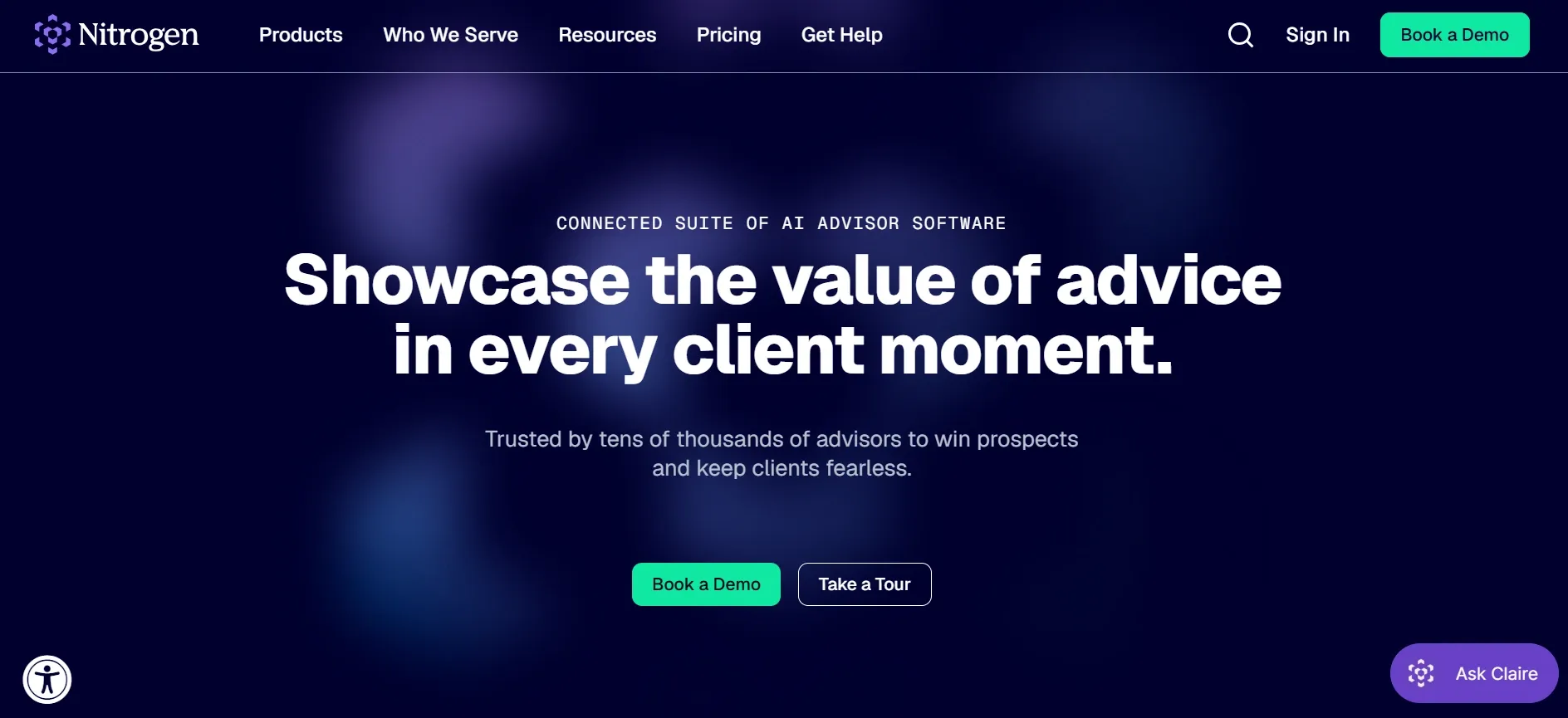
Riskalyze, now known as Nitrogen, focuses on quantifying and communicating investment risk. It is widely recognized for its client-friendly risk questionnaires and visualizations, making it a staple for compliance and suitability documentation.
Pricing: Starts at $245 per user per month, with higher tiers for advanced analytics.
- Best-in-class risk profiling and compliance tools
- Easy to use and client-friendly visuals
- Integrates with most advisor tech stacks
- High price for a single-feature platform
- No planning, CRM, or portfolio tools included
- Platform and data structure are not owned
7. Tamarac (Portfolio management)
Tamarac is a powerhouse for registered investment advisors focused on deep portfolio management, trading, and reporting. It is best suited for firms managing significant assets or with complex rebalancing needs.
Pricing: Custom, often $10,000 or more per year, plus implementation fees.
- Advanced portfolio rebalancing and reporting
- Multi-custodian support and integrations
- Customizable client portals
- Expensive for small or solo practices
- Steep learning curve and ongoing support required
- Multi-year contracts and no platform ownership
8. Advyzon (All-in-one for growing firms)
Advyzon is a unified platform that combines CRM, portfolio management, document storage, billing, and a client portal. It is designed for growing RIAs who want an integrated stack without the hassle of managing multiple vendors.
Pricing: Custom, typically starting around $500 per month, with add-ons for advanced features.
- Unified CRM, portfolio, and billing in one platform
- Customizable reports and client portal
- Migration support for onboarding
- Pricing increases with client and user count
- Some advanced integrations may be limited
- Platform is rented, not owned
9. Devaims (Custom build you own)
Devaims is not another SaaS subscription. It is a custom software development partner for advisors who want to own their technology. Rather than renting, you get a platform built for your workflows, planning, CRM, portfolio, billing, client portal, and any integration you need, delivered with full source code and documentation.
Pricing: One-time build from $25,000, plus flat, predictable maintenance.
- Full ownership of code, data, and workflows
- Custom integrations and modules to fit your firm
- No recurring per-user or per-seat fees
With Devaims, you control your technology and roadmap, and never face forced upgrades or vendor lock-in.
Other eMoney Advisor alternatives worth knowing
- Black Diamond: Enterprise-grade portfolio reporting and client portal, best for large RIAs or multi-office practices. High cost and significant implementation requirements, but strong for firms with complex reporting or alternative asset needs.
- Junxure: A long-established CRM for financial advisors, now owned by AdvisorEngine. Best for shops with legacy workflows or deep customization needs, but the interface is less modern compared to newer options.
- AdvisorEngine: Aimed at digital-first firms, offering a client portal, digital onboarding, and basic planning. Less depth in cash flow or scenario modeling than eMoney Advisor, but strong for automating onboarding and digital engagement.
- RightCapital: Popular for cash flow-based planning and client-friendly visuals. Quick to implement, but less customizable than MoneyGuidePro or a custom build. Integrates with most major CRMs and custodians.
How to choose the right eMoney Advisor alternative
- By budget: Solo advisors or small teams may lean toward Wealthbox, Redtail CRM, or MoneyGuidePro for lower monthly fees. Larger firms or those needing more modules may justify Orion, Tamarac, or Salesforce.
- By need: If planning is your core value, focus on MoneyGuidePro, RightCapital, or Advyzon. For CRM-centric shops, Redtail or Wealthbox are strong. For risk assessment, Riskalyze is the leader. For all-in-one consolidation, look at Orion, Advyzon, or Salesforce Financial Services Cloud.
- By size: Enterprise platforms like Salesforce and Tamarac are best for larger or fast-growing RIAs, while Advyzon and Orion serve growing firms. Smaller practices may prefer the simplicity and price point of Wealthbox or Redtail.
- By workflow: If you want workflows, reports, or integrations that perfectly match your process, owning with Devaims is the only real path. Custom builds can adapt to evolving needs and give you a true technology asset.
When the math of monthly fees, forced upgrades, and integration headaches starts to outweigh the convenience, it’s time to seriously consider an owned, custom platform.
Stop paying rent on software you could own
Every eMoney Advisor alternative above is another subscription, with monthly fees, per-seat pricing, and the risk that your data and workflows can be disrupted or lost if you ever stop paying. Even the best-in-class tools share this core problem: you’re renting access to your own client experience, not building equity in a technology asset.
Devaims builds custom software for advisors who are ready to own their stack. You get a solution built to your exact process, planning, CRM, portfolio, billing, client portal, compliance, or any combination you need. The source code and data are yours, with no vendor lock-in or forced upgrade cycles. Maintenance is flat and predictable, and you decide when and how to invest in new features.
- Recurring fees eliminated: One-time build, then only low, predictable maintenance.
- All your workflows, your way: No more workarounds, missing features, or paying for modules you never use.
- True data ownership: You keep the codebase and client history, forever, with no export headaches or lost detail.
- Integrations tailored to you: Direct connections to your custodians, planning engines, compliance systems, or marketing stack, no waiting on a vendor’s roadmap.
| Tool | Pricing model | Data ownership | Custom workflows? |
|---|---|---|---|
| eMoney Advisor | Subscription, per user, add-ons | No, rented | Limited, templated |
| Orion Advisor | Subscription, per user + modules | No, rented | Partial, via configuration |
| MoneyGuidePro | Subscription, per advisor | No, rented | Limited |
| Devaims (owned) | One-time build, flat maintenance | Yes, you own it | Fully custom |
Here’s what the long-term cost really looks like for a mid-sized RIA (5 advisors, 3 admin, typical add-ons):
| Year | Rented (eMoney/Orion, $1,500/mo) | Owned (Devaims, $30,000 build + $200/mo maint) |
|---|---|---|
| 1 | $18,000 | $32,400 |
| 2 | $36,000 | $34,800 |
| 3 | $54,000 | $37,200 |
| 4 | $72,000 | $39,600 |
| 5 | $90,000 | $42,000 (now ahead) |
For most practices, owning breaks even by year three. After that, every dollar stays in your business. If you’re running more users, higher-value add-ons, or need frequent upgrades, the math tilts even sooner in favor of ownership. We can run your exact numbers on a call, so you see the break-even point for your firm’s unique needs.
How to switch from eMoney Advisor
- Export all client data, reports, and plan histories from eMoney Advisor. Use built-in export features where possible. Take care to export in open formats (CSV, PDF, XML) and check for completeness.
- Choose your new platform, weighing features, workflow fit, and ownership. Consider not just current needs but future growth, integrations, and the cost of switching again in a few years.
- Map and import client records and assets into the new system. Clean your data, standardize formats, and use vendor or custom import tools. For custom builds, you can define exactly how data is structured and mapped.
- Reconnect integrations, custodians, and payment systems. Test all connections and ensure data flows as expected. Custom platforms like Devaims can build direct integrations to reduce manual work.
- Train your team on the new workflows and reports. Provide documentation, run live training sessions, and collect feedback. Custom builds can include onboarding support tailored to your team’s needs.
- Test in parallel for a month, ensuring nothing is missed. Run both old and new systems side by side, checking for missing data, broken workflows, or integration gaps.
- Review your eMoney Advisor contract for cancellation terms. Watch for auto-renewal clauses and plan your transition to avoid extra fees.
With a custom Devaims build, migration, including mapping, import, and quality assurance, is handled as part of the project, minimizing disruption and ensuring all your data comes with you.
Frequently asked questions
What’s the best eMoney Advisor alternative for financial planning?
MoneyGuidePro is the most widely adopted for interactive, goal-based planning. RightCapital is strong for cash flow and tax planning, while Advyzon and Orion offer integrated planning as part of larger suites. For firms that want to tailor every aspect of the planning experience, custom scenario modeling, unique plan types, or white-label reporting, a custom Devaims build is the only way to own the planning logic and UI, eliminating recurring SaaS costs forever.
What’s the cheapest eMoney Advisor alternative for solo advisors?
Wealthbox and Redtail CRM offer entry-level pricing under $100 per month, making them attractive for solo or startup advisors. However, over a five-year horizon, even these “affordable” options reach $3,000 to $6,000, with no asset or code to show for it. For advisors who want to invest in a long-term solution and avoid recurring fees, a Devaims custom build can be scoped to fit a solo practice’s needs and budget.
Can I get a free eMoney Advisor alternative?
There are no truly free replacements with the same capabilities and compliance. Some solo advisors use spreadsheets or general-purpose CRMs like HubSpot or Zoho in their free tiers, but these lack industry-specific features, compliance, integrations, and support. Free software often comes with data limits or advertising, and may put you at risk with regulators. Serious practices will need to invest in a professional, secure solution, either rented or owned.
Which eMoney Advisor alternative is best for integration with custodians?
Orion Advisor and Tamarac have deep integrations with major custodians, supporting automated data feeds, trading, and reconciliation. Advyzon also offers strong custodian connectivity. With a Devaims custom build, you can request direct, API-based integrations with any custodian or data provider you use, and maintain control over update schedules and data flows, removing reliance on a third-party roadmap or support queue.
When should a firm switch from eMoney Advisor?
Firms typically switch when recurring costs outpace perceived value, when feature gaps force workarounds or manual processes, or when workflow friction starts to impact client service and growth. If you are already searching for alternatives, you are likely at the tipping point where the pain of staying exceeds the pain of change. Ownership becomes especially attractive when you want to build equity in your technology and future-proof your operations.
Can I keep my client data when I switch?
Most platforms provide some export functionality, but the completeness and usability of the data varies widely. Some will export contacts and account data but not notes, plan histories, or document attachments. Proprietary formats can make re-import difficult. With Devaims, you own the entire database and have full access to every client record, attachment, and history, forever, with no dependency on a vendor’s goodwill or export tools.
How long does a custom Devaims build take?
Most Devaims custom builds launch in three to six months, depending on scope, integrations, and complexity. The process includes requirements gathering, design, iterative development, data migration, team training, and go-live support. You get a dedicated project team and a platform that fits your workflows on day one, with the ability to iterate or expand features over time.
The bottom line
The top eMoney Advisor alternatives each offer unique strengths. Some excel at planning, others at CRM, portfolio management, or risk. But every SaaS solution rents you a platform, and the costs add up. The decision rule: add up your five-year cost, factor in migration friction and lost productivity from workarounds, and ask, would owning pay off? For many firms, especially those with growth plans or unique workflows, the answer is yes. By year three, ownership often puts you ahead, and every dollar after that stays in your business, not a vendor’s pocket.
If you’re ready to stop renting your workflow and start owning your platform, it’s time to talk to Devaims.
Check out more expert takes on the Devaims blog, plus compare other alternatives at Salesforce Financial Services Cloud alternatives, Orion Advisor alternatives, and Wealthbox alternatives.