


Ever had your sales manager lose an entire day to a vAuto glitch, or watched your DMS bill climb with every new rooftop? You are not alone. Car dealers everywhere know the pain: slow responses, surprise fees, and the feeling that your own data is being held hostage. The promise of "all-in-one" fades fast when the UI is stuck in 2014 and you need a workaround just to run last month’s numbers.
If you are hunting for real vAuto alternatives, you want more than just a different logo. You want transparent pricing, no multi-year contract traps, and the freedom to run your dealership your way. DealerCenter is the most cost-transparent, and eLead CRM and VinSolutions are solid, but every rental platform eventually runs the same bill: monthly, forever. If you want to keep your code and own the platform, only a custom build, like from Devaims, lets you do that.
Let’s get into the 9 best vAuto alternatives for dealerships in 2026 and show you the math on owning vs renting.
Why car dealerships look for vAuto alternatives
Dealerships are increasingly seeking vAuto alternatives because the legacy vendor model does not fit the pace or transparency required today. Here is a deeper look at the core reasons:
- Locked-in contracts: Major DMS and inventory platforms often require three to five year contracts. This means you are stuck if the tool stops meeting your needs, or if better technology comes along. Early termination fees and complex offboarding make switching costly and time-consuming. Many dealers have cited feeling “trapped” as their needs evolve or as mergers and acquisitions shift their tech stack.
- Escalating fees: Most platforms start with a seemingly fair monthly rate, but the cost rises rapidly as you add rooftops, users, or new modules (such as CRM, F&I, or advanced reporting). For example, adding a new rooftop may double your bill, and “integration fees” for connecting to third-party vendors can be several hundred dollars per month. Annual price increases are common and rarely negotiable.
- Data access headaches: Many SaaS platforms restrict data exports or charge extra for API access. Dealers often struggle to extract their own customer, deal, or inventory data, especially when migrating. Some vendors use proprietary formats or only allow partial exports, making it hard to switch or integrate with other tools.
- Outdated user experience: Legacy systems tend to have interfaces and user flows that haven’t seen meaningful updates in years. This slows onboarding of new staff, increases training costs, and leads to more mistakes. Frustrated users may resort to spreadsheets or manual workarounds, reducing the ROI of the platform.
- Poor support and slow fixes: When issues arise, support tickets can languish for days, especially during peak sales periods or holidays. Updates and bug fixes are often scheduled at the vendor’s convenience, not yours, and critical requests may fall into a backlog. Dealers report feeling like “just another number” as support teams are stretched thin.
These issues are not just annoyances, they impact sales velocity, compliance, and your ability to pivot quickly in a volatile market. That is why more dealers are seeking platforms that fit their workflow, budget, and growth plans, not the other way around.
Quick comparison of the best vAuto alternatives
| Tool | Best for | Starting price | You own it? |
|---|---|---|---|
| Reynolds & Reynolds | Large multi-rooftop dealers | Not disclosed | No |
| DealerSocket | Integrated CRM/DMS | Not disclosed | No |
| VinSolutions (Cox) | Dealer groups needing CRM | Not disclosed | No |
| CDK Global | Franchise dealerships | Not disclosed | No |
| AutoSoft | Independent dealers | Not disclosed | No |
| DealerCenter | Budget-conscious, small lots | $60/mo (basic) | No |
| eLead CRM | Sales-driven teams | Not disclosed | No |
| DealerBuilt | Customizable DMS | Not disclosed | No |
| Devaims | Dealers who want to own | One-time build | One-time build, you own it |
Always confirm current pricing before you decide. Hidden add-ons and contract terms can make a big difference over time. Most vendors will require a demo or a call before revealing the true cost, so push for a complete quote including all users, rooftops, modules, support, and integration fees. This is crucial for accurate long-term budgeting.
The 9 best vAuto alternatives
1. Reynolds & Reynolds (best for large multi-rooftop dealers)
Reynolds & Reynolds is one of the industry’s oldest and most entrenched DMS providers, serving thousands of franchise dealerships across North America. Its suite covers everything from accounting and F&I to inventory management, CRM, and service scheduling. Reynolds is best known for its compliance tools and deep integrations with OEMs and third-party vendors. For large groups managing multiple rooftops, it provides the scale and reliability needed to handle high sales volumes and complex operations.
Features: Reynolds offers a modular platform, with add-ons for digital retailing, service lane, document management, and more. The reporting suite is extensive, allowing for granular analysis of sales, inventory turnover, F&I penetration, and service performance. Integration with manufacturers is a major strength, as Reynolds is certified with nearly every major OEM and can automate warranty submissions, recalls, and parts ordering.
Integrations: Reynolds integrates with most major OEMs, parts suppliers, and third-party marketing and F&I vendors. However, API access is tightly controlled, and custom integrations often require significant fees and vendor involvement. Many dealers report that getting data out for external analytics or third-party marketing is cumbersome.
Migration Friction: Moving to or from Reynolds is a high-friction process. Contracts are multi-year and often include steep penalties for early exit. Data export is possible but requires coordination with their support and may come in proprietary formats that need cleaning before import elsewhere.
Use Cases: Reynolds excels for large dealer groups with complex compliance needs, multiple rooftops, and a need for standardized workflows. It is common among top 150 dealer groups and those with manufacturer-mandated DMS requirements.
Pricing: Not disclosed. Pricing is customized per dealership and typically requires a sales call.
-
Key limitations:
- Multi-year contracts with steep exit penalties
- Limited customization and slow feature rollout
- High total cost of ownership over time
-
Strengths:
- Deep OEM integrations and compliance tools
- Scalable for large, multi-rooftop groups
- Comprehensive reporting and analytics
With a custom Devaims build, you own your data and keep the code, not just lease a login.
2. DealerSocket (best for integrated CRM/DMS)
DealerSocket has carved out a strong position as a unified DMS and CRM platform, favored by mid-sized and large independent and franchise dealerships. It brings together inventory management, desking, digital retailing, and customer relationship management in a single interface. This “all-in-one” approach is meant to reduce the headaches of integrating multiple vendors, but it comes with its own set of trade-offs.
Features: DealerSocket’s CRM is highly regarded for its lead tracking, automated follow-up, and internet lead integration. The DMS side includes inventory management, F&I, accounting, and service modules. The platform offers mobile apps for sales and service staff, and a customer-facing portal for digital retailing. Reporting is customizable, with dashboards for managers and owners.
Integrations: Strong connections exist to most major OEMs, digital marketing vendors, and F&I providers. API access is available but may require extra fees and setup. DealerSocket is also known for its integration with DealerFire (websites) and Inventory+ (acquired through Solera).
Migration Friction: Migrating to DealerSocket involves data mapping and import, often supported by their onboarding team. However, getting your data out if you leave can be challenging, and some dealers report incomplete data exports or additional charges for full access. Contracts are usually annual or multi-year, and early termination can be costly.
Use Cases: Best for dealerships that want to centralize CRM and DMS in one place, and who value sales process automation. Especially popular with growing dealer groups and independents scaling up.
Pricing: Not disclosed. Pricing varies by modules and dealership size.
-
Key limitations:
- Per-rooftop pricing can escalate quickly
- Support can be slow during busy periods
- Customization limited compared to custom builds
-
Strengths:
- Unified CRM and DMS platform
- Strong integrations with OEMs and marketing tools
- Customizable reporting and dashboards
If per-rooftop pricing frustrates you, with Devaims you pay one flat build and own it.
3. VinSolutions (Cox Automotive) (best for dealer groups needing CRM)
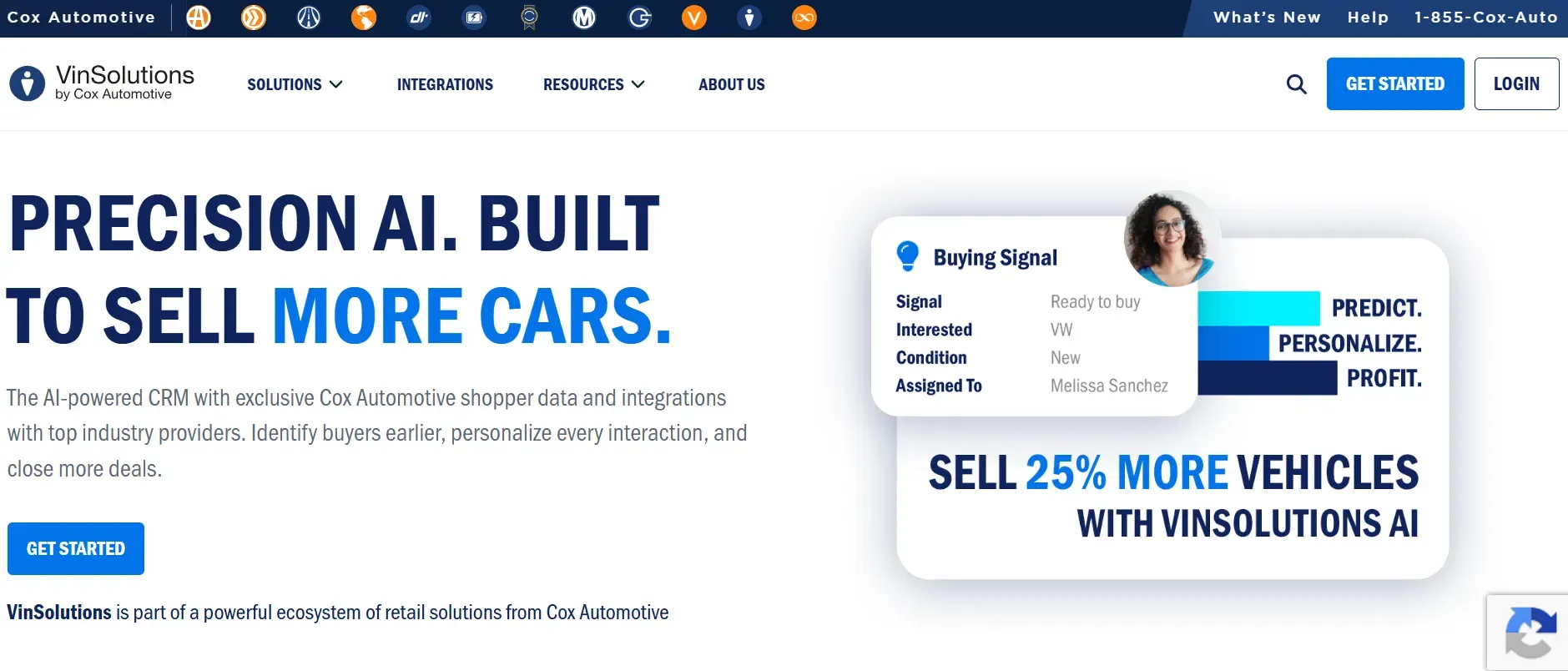
VinSolutions, part of Cox Automotive, is a leading CRM and inventory tool built for dealer groups that want to unify sales, marketing, and customer engagement. Its integration with other Cox products (Dealer.com, Kelley Blue Book, Autotrader) makes it a strong choice for dealers invested in that ecosystem. VinSolutions is especially popular for managing internet leads and multi-channel marketing.
Features: VinSolutions Connect CRM provides lead management, appointment scheduling, automation for follow-ups, and texting/email campaigns. Its inventory module tracks vehicles from acquisition to sale, including price optimization and appraisal tools. The reporting suite covers everything from lead conversion to salesperson performance and marketing ROI.
Integrations: Deep integration with Cox Automotive products is the standout feature. VinSolutions also connects to most major DMS, website providers, and third-party marketing tools, but API access for custom integrations is limited unless you’re part of the Cox network. Data can be exported, but with some friction.
Migration Friction: Onboarding is streamlined for those already using Cox products, but for others, data mapping and import can be a lengthy process. Exporting data on exit may require support involvement, and historical data may not always transfer cleanly.
Use Cases: Ideal for dealer groups with multiple rooftops who prioritize CRM and marketing automation. Also favored by stores with high internet lead volume and those who want integration with their digital marketing stack.
Pricing: Not disclosed. Pricing is customized and typically requires a sales call.
-
Key limitations:
- UI feels dated compared to newer SaaS
- Pricing per rooftop adds up quickly
- Limited control over product roadmap
-
Strengths:
- Deep Cox ecosystem integrations
- Strong CRM and marketing automation
- Comprehensive reporting tools
When your team needs a workflow that just works, owning the code is the only way to guarantee no forced UI changes.
4. CDK Global (best for franchise dealerships)

CDK Global is a powerhouse in the DMS world, serving over 15,000 dealerships globally. Most major automotive brands certify CDK, making it a go-to for franchise dealers who need reliability, compliance, and standardized processes. CDK is often compared directly with Reynolds & Reynolds in RFPs for large groups.
Features: CDK covers the full dealership workflow: sales, F&I, service, accounting, inventory, and parts. CDK’s Drive platform is the flagship, offering dashboards, compliance tools, and workflow automation. CDK also offers a digital retailing suite, mobile apps, and analytics for enterprise groups.
Integrations: CDK boasts integrations with most OEMs, parts suppliers, and third-party vendors in the automotive space. They provide an API (Fortellis) for custom integrations, but access is controlled and often comes at additional cost. CDK is also working on open integrations but progress is slow.
Migration Friction: Implementation of CDK is a significant project, often requiring months of planning, data cleansing, and staff training. Exiting CDK is equally complex, with data export requiring coordination with their team. Dealers report that getting complete datasets is possible but not always straightforward.
Use Cases: Best for large or multi-franchise dealerships that must meet strict OEM requirements and want a stable platform with enterprise support.
Pricing: Not disclosed. Pricing is customized per dealership.
-
Key limitations:
- Interface is functional but outdated
- Upgrades and customizations are slow
- Pricing escalates with added features or rooftops
-
Strengths:
- OEM-certified and widely adopted
- Enterprise-level support and compliance
- Comprehensive workflow coverage
With Devaims, you can finally have a DMS that fits your workflow, not the other way around.
5. AutoSoft (best for independent dealers)
AutoSoft is a lighter DMS solution aimed primarily at independent and small franchise dealers. It distinguishes itself with a simpler user experience and a lower starting price, making it attractive for dealers with modest needs or those just starting out.
Features: AutoSoft covers core DMS needs: inventory management, accounting, F&I, and service. It includes basic CRM features, but lacks the depth of larger platforms. Reporting is straightforward, focusing on the essentials. The interface is more approachable than legacy DMS, but still far from modern SaaS standards.
Integrations: AutoSoft integrates with select OEMs, parts vendors, and some third-party F&I and website providers. API access is limited and may not support all custom use cases. For dealers with more advanced marketing or analytics needs, integration options may be insufficient.
Migration Friction: Onboarding is relatively fast compared to enterprise DMS, but data migration from legacy platforms still requires careful mapping. Exporting data is possible, but not always in a format that can be easily imported elsewhere.
Use Cases: Best for smaller independent dealers, BHPH operations, or those seeking a low-cost, no-frills DMS. Also suitable as a “starter” DMS for new stores.
Pricing: Not disclosed. Pricing is typically lower than enterprise DMS.
-
Key limitations:
- Limited feature set for growing dealers
- Minimal customization options
- Support for advanced integrations is limited
-
Strengths:
- Simple user experience
- Lower starting price
- Quick onboarding for small dealers
6. DealerCenter (best for budget-conscious, small lots)
DealerCenter is unique in this list for its transparent, published pricing and modular approach. It is engineered for small independent lots, BHPH operations, and startups looking for an affordable entry into dealership management software. DealerCenter’s web-based platform covers DMS, CRM, inventory, and digital retailing in a single package.
Features: The basic plan ($60/month) covers inventory management, deal structuring, and basic reporting. CRM Plus ($99/month) adds lead management, texting, and appointment scheduling, while CRM Pro ($199/month) unlocks automation, marketing tools, and credit pulls. Additional modules for F&I, BHPH, service, and accounting are available as paid add-ons. Mobile apps allow for on-the-go inventory checks and deal updates.
Integrations: DealerCenter integrates with major website providers, credit bureaus, F&I vendors, and digital marketing platforms. API access is limited, but DealerCenter’s marketplace offers pre-built connections to many common vendors. Some integrations (like QuickBooks or custom web services) may cost extra.
Migration Friction: Onboarding is fast, with import tools for inventory and customer data. For dealers switching from Excel or a basic DMS, the process is smooth. For those migrating from enterprise DMS, data mapping is more involved, and some historical data may require manual reformatting. Exporting your data is possible but not always seamless for large datasets.
Use Cases: Ideal for small independents, BHPH lots, and start-ups. Also works as a secondary platform for specialty inventory or pop-up locations. Many dealers use DealerCenter as a bridge before moving to a full enterprise DMS.
Pricing: Starts at $60/month (basic), higher with add-ons.
-
Key limitations:
- Costs rise quickly with add-ons and users
- Advanced features require higher-tier plans
- Support can be slow during peak periods
-
Strengths:
- Transparent, published pricing
- Fast onboarding for small dealers
- Modular, scalable platform
On software you owned, every new rooftop or user would cost you nothing extra, your system, your rules.
7. eLead CRM (best for sales-driven teams)
eLead CRM, now part of CDK Global, is a sales-focused customer relationship management tool used by thousands of franchise and independent dealerships. It is built for high-volume sales environments that demand lead management, follow-up automation, and detailed reporting.
Features: eLead’s core strengths are in internet lead capture, automated lead routing, outbound call tracking, and appointment scheduling. The platform includes texting, email campaigns, and integration with digital retailing tools. Customizable dashboards allow sales managers to monitor performance in real time. eLead also offers desking tools and basic F&I integration.
Integrations: eLead integrates with most major DMS (including CDK, Reynolds, and DealerSocket), website providers, and digital marketing platforms. Data flows can be automated for inventory, leads, and customer records. However, deeper API access for custom reporting or analytics may require additional negotiation and fees.
Migration Friction: Implementation is managed by eLead’s onboarding team, with data import tools for leads, customers, and past deals. Exporting your data on exit is possible but may require support intervention, and some historical information may not transfer in full fidelity.
Use Cases: Ideal for dealerships with high web lead volume and a sales-first culture. Especially useful for stores where internet sales, BDCs, and outbound call campaigns are central to the operation.
Pricing: Not disclosed. Pricing is per module and dealership size.
-
Key limitations:
- Interface is functional but not modern
- Technical bugs and slowdowns after updates
- Multi-year contracts and per-module pricing
-
Strengths:
- Strong lead management and automation
- Customizable dashboards for sales teams
- Integrates with most DMS and marketing tools
That’s the kind of sales dashboard you would just have if the platform were built for you.
8. DealerBuilt (best for customizable DMS)
DealerBuilt positions itself as a flexible, people-driven DMS designed for mid-sized dealerships that want more control than legacy platforms allow. Its open architecture and customer-focused culture have earned it a loyal following among dealers who want a say in their workflow and integrations.
Features: DealerBuilt’s “LightYear” platform includes inventory management, sales, F&I, accounting, service, and payroll modules. Users can configure workflows, dashboards, and reporting to match their processes. DealerBuilt is known for its willingness to build custom modules or integrations as part of the onboarding process.
Integrations: The platform is more open than most legacy DMS, with support for custom integrations to third-party vendors, marketing tools, and analytics platforms. However, not all integrations are plug-and-play, some require consulting or development fees.
Migration Friction: Onboarding is more complex than with out-of-the-box SaaS, but DealerBuilt’s team is hands-on during migration. Data import is thorough, and historical data can be brought in with proper mapping. Exporting data on exit is possible, but as with all SaaS, you do not own the underlying system.
Use Cases: Ideal for mid-sized dealers who want to customize workflows or integrate with niche vendors. Also popular among groups outgrowing “starter” DMS and needing more flexibility without the overhead of CDK or Reynolds.
Pricing: Not disclosed. Pricing is customized and may include fees for custom work.
-
Key limitations:
- Still a rental platform, not owned
- Pricing can escalate with custom work
- Support may slow down during busy periods
-
Strengths:
- Flexible, open architecture
- Customizable workflows and integrations
- Hands-on onboarding and support
9. Devaims (best for owning your dealership platform)
Devaims is fundamentally different from every other option on this list. Instead of renting a SaaS platform, Devaims builds a custom dealership platform that you own outright, source code, database, and all. This approach gives you total control over features, integrations, data, and future development, with no ongoing per-unit or per-module fees.
Features: Devaims builds exactly what you need, inventory management, CRM, F&I, accounting, reporting, digital retailing, service scheduling, and even mobile apps. Workflows and dashboards are tailored to your processes, not the vendor’s template. Custom reporting, API integrations, and automation are built for your operation, not retrofitted from a generic SaaS.
Integrations: Any third-party vendor, OEM, marketing tool, or analytics platform can be integrated via API or custom connectors. You decide what to connect and how. Popular integrations include RouteOne, Dealertrack, QuickBooks, OEM data feeds, marketing automation, and more. You are never limited by vendor politics or proprietary formats.
Migration Friction: Devaims handles full migration as part of the project. All customer, vehicle, deal, and historical data is mapped and imported. Because you own the database, you will never face export restrictions or data loss if you switch in the future.
Use Cases: Best for dealerships (especially groups) who want to end recurring software rent, control their tech stack, and future-proof their operation. Also ideal for stores with unique workflows, compliance needs, or integration requirements that off-the-shelf SaaS cannot handle.
Pricing: One-time build, then flat monthly for support.
- You own the code and database, no more rentingCustom workflows, reports, and integrationsNo monthly per-unit or per-module feesSupport and updates on your termsNo contract lock-in, your system, your data
- You own the code and database, no more renting
- Custom workflows, reports, and integrations
- No monthly per-unit or per-module fees
- Support and updates on your terms
- No contract lock-in, your system, your data
Other vAuto alternatives worth knowing
- Frazer DMS: A budget DMS for small used car lots; limited for larger stores. Simple to use and affordable, but lacks advanced CRM or multi-rooftop support.
- Autostar: Focused on independent BHPH dealers, with payment collection tools and compliance features. Not full-featured enough for franchise groups or high-volume operations.
- AutoManager DeskManager: Good for small independents, with inventory and sales tools, but lacks full CRM depth and advanced reporting.
- Wayne Reaves: Niche for buy-here-pay-here shops; not a fit for most franchise dealers. Focused on payment collection and simple inventory management.
How to choose the right vAuto alternative
- Budget: Know your true all-in cost, monthly, add-ons, per-unit fees, setup, and support. Ask for a five-year projection, not just year one. Many dealers are surprised by how quickly SaaS rent adds up compared to a custom build.
- Contract terms: Avoid multi-year lock-in unless the platform is proven at your scale. Pay attention to auto-renewal clauses, early termination fees, and hidden costs for data export or integration.
- Custom needs: If you need a report, workflow, or integration that off-the-shelf tools do not offer, consider owning. SaaS is rarely flexible enough for unique processes, compliance needs, or regional requirements.
- Dealership size: Small independents may be fine with DealerCenter or Frazer, but multi-rooftop groups quickly outgrow "starter" DMS tools. Large groups and franchises need scalability, integrations, and reliable support.
- Data ownership: If exporting or integrating your data matters, rental SaaS options limit what you can do. Ask vendors about their export formats, API access, and data retention policies before you sign anything.
If you are tired of contracts and recurring fees, owning your system with Devaims might be the only way to future-proof your operation. For more guidance, see NIADA and Automotive News for industry insights on DMS trends and technology shifts.
Stop paying rent on software you could own
The single biggest pain in the dealership tech stack is rent: monthly fees that never stop, contracts that trap you, and the creeping realization that you’re just a tenant in your own digital shop. Every vAuto alternative, Reynolds, DealerSocket, CDK Global, changes the logo, not the math. You still rent. You still lose leverage. Owning is different.
Devaims builds custom dealership platforms, inventory, CRM, reporting, even mobile apps, so you own the source code and the whole stack. No one can hike your price, hold your data, or block new features because you hold the keys. Your platform, your rules, your equity.
- No per-unit or per-module fees: Add rooftops, users, or features with no extra charge. You control your own scaling, and your cost does not balloon as you grow.
- No contract lock-in: Pay once to build, then a flat monthly for support. Cancel anytime, you keep the code. No more worrying about auto-renewals or early termination penalties.
- Custom workflows: The exact dashboards, reports, and integrations you need, no more workarounds. Your system adapts to your business, not the other way around.
- Your data, your way: Export, integrate, analyze, no friction, no hidden charges. Full API access and direct database control mean you can connect any tool, anytime.
| Tool | Ownership | Contract term | Per-unit fees? |
|---|---|---|---|
| Reynolds & Reynolds | Vendor-owned | 3 to 5 years | Yes |
| DealerSocket | Vendor-owned | 1 to 3 years | Yes |
| DealerCenter | Vendor-owned | Month to month | Yes, for add-ons |
| Devaims (custom build) | You own it | No contract | No |
Here’s the five-year math for a scaled dealer group with 5 rooftops and 40 users. Assume a typical SaaS DMS/CRM runs $180 per user per month after add-ons, or $7,200 per month total. Devaims build is $32,000 one-time and $200 per month for updates/support.
| Year | Rent (cumulative) | Own (cumulative) |
|---|---|---|
| 1 | $86,400 | $34,400 |
| 2 | $172,800 | $36,800 |
| 3 | $259,200 | $39,200 |
| 4 | $345,600 | $41,600 |
| 5 | $432,000 | $44,000 (now ahead) |
This math holds for almost any dealership group with more than a handful of users or rooftops. The longer you rent, the further ahead you fall. Owning your platform not only saves you six figures over five years, it also gives you leverage: no more forced upgrades, price hikes, or feature removals. Your system is an asset, not a liability.
We’ll run your numbers for free, just ask. For more on the cost math, see Digital Dealer’s annual DMS cost surveys.
How to switch from vAuto
- Export all customer, inventory, and deal data from vAuto (CSV or API). If you hit roadblocks, insist on full data export and ask for documentation on proprietary fields.
- Choose your new platform and map out required integrations. List all vendors, websites, lenders, and marketing tools you need to connect.
- Import your data into the new system, checking for format mismatches. Plan for some manual data cleaning, no two DMS export exactly the same way.
- Reconnect payments, F&I vendors, and website integrations. Test each connection thoroughly before going live.
- Train your staff on the new workflows and dashboards. Schedule multiple sessions and provide cheat sheets to minimize downtime.
- Run both systems in parallel for at least one closing cycle. This helps catch any data gaps or workflow issues before final cutover.
- Review contract end dates and submit cancellation for vAuto. Get written confirmation of cancellation and final data handoff.
With a custom Devaims build, the migration is handled as part of the project. The team will work with you to ensure every field, report, and integration is mapped and tested, reducing risk and downtime.
Frequently asked questions
What is the best vAuto alternative for independent dealers?
DealerCenter is the most accessible for small independents, with transparent pricing and modular add-ons. Frazer DMS is also worth a look for very small lots or BHPH operations. For larger shops or those who want total ownership, Devaims is the only option where you keep the code, database, and all integrations. This means you can scale, customize, and export your data at any time, no strings attached.
Which vAuto alternative is cheapest?
DealerCenter starts at $60 per month for the basic DMS, but add-ons for CRM, F&I, and reporting quickly increase costs, often to $300 per month or more per rooftop. Frazer DMS and DeskManager are also low-cost for small operations. Over five years, owning a Devaims platform can become much more affordable for growing dealerships, since you avoid all per-user, per-module, and per-rooftop fees. For any dealership with more than a handful of users, the math favors ownership after the second or third year.
Is there a free vAuto alternative?
There is no truly free DMS or CRM for car dealerships with the features needed at scale. Some tools (like DealerCenter or Frazer) offer free trials or demo accounts, but all charge monthly after onboarding. Open-source projects exist but lack the support, compliance, and integrations required for real-world operations. Owning with Devaims means no monthly rental at all, just a one-time build and optional support.
Which vAuto alternatives have the best support?
Reynolds & Reynolds and CDK Global have large support teams but are known for slow ticket times and bureaucratic escalation processes. DealerCenter offers phone and chat support but can be slow during peak hours. DealerBuilt is praised for hands-on onboarding but can slow down as you scale. Devaims gives you direct access to the team that built your platform, with no ticket queue or call center runaround. Support is tailored to your actual system, not a generic knowledge base.
When should I switch from vAuto?
If you are frustrated by contract lock-in, yearly price hikes, or limited data access, it is time to look at vAuto alternatives. Other signs include: needing features not on the vendor’s roadmap, expanding to more rooftops, or integrating with new marketing and F&I tools. The sooner you switch, the sooner you start saving on recurring fees and gain control over your operation.
Can I keep my historical data if I switch?
Most platforms let you export key data with some effort, but you may need to clean or reformat it. Some vendors charge extra for full historical exports or limit the number of fields. With Devaims, all your data is yours from day one, with no export restrictions ever. You have full access to the raw database and can build custom reports or integrations anytime.
Which vAuto alternative gives me full ownership?
Only a custom Devaims build lets you own your dealership software outright. All other vAuto alternatives are rented SaaS platforms with recurring fees, contracts, and limits on data access and customization. With Devaims, you decide what gets built, how it works, and who can access your data, forever.
The bottom line
The best vAuto alternatives all remove some pain, but none fix the core problem: you are always renting, never owning. Here is the real test, add up what your DMS and CRM stack will cost over five years. If that number could have bought you a system you own, it is time to make the switch. Ownership means no more price hikes, no more waiting for feature requests, and no more barriers to your own data.
Owning your dealership platform with Devaims is not just about saving money; it’s about control, leverage, and never being locked out of your own data again.
Want more insights? Read the Devaims blog, or check out our guides to CDK Global alternatives, DealerSocket alternatives, and VinSolutions alternatives.