



You spend thousands a year for software you don’t even own. Mitchell 1’s subscription, setup fees, and contracts add up fast, and by year five, you’ve paid more than the cost of building your own platform from scratch. Tired of price hikes, limitations, or just feeling like your data is held hostage?
If you’re searching for Mitchell 1 alternatives, you’re not alone. Shop owners want modern features, flexibility, and control over what they’re paying for. The top picks: Tekmetric for flexible contracts, Shop-Ware for modern enterprise workflows, PartsTech for integrated parts ordering, and a custom Devaims build if you’re ready to stop renting and actually own your system. The freedom you want is possible if you know where to look.
Below we’ll break down the real pros, cons, and costs, and show where the rent to own math finally tips in your favor.
Why tire shops look for Mitchell 1 alternatives
Legacy interface slows you down: Mitchell 1’s UI feels stuck in another decade. The interface, while familiar to some, is not intuitive for new staff and can be a drag on productivity. Navigating between work order creation, invoicing, and inventory management often requires multiple clicks and windows. This slows down customer check-in, billing, and even simple lookups, especially during peak hours. For busy tire shops, these small inefficiencies add up, eating into margins and causing frustration among staff who expect the same speed and usability they get from modern software in other areas of their lives.
Long-term contracts and setup fees: Mitchell 1 typically requires a non-refundable activation fee and binds shops into 12 or 24 month contracts, often with automatic renewals. These contracts are easy to overlook, leading to unexpected renewals and penalties for early termination. Setup fees ($500 to $1,500) can be a significant upfront cost, and since they’re non-refundable, even if you decide the system isn’t right for you after a few months, you’re still out that money. This inflexibility is out of step with the way many modern businesses want to operate.
Add-on pricing stacks up: The base subscription rarely covers everything a tire shop needs. Common features like tire inventory management, marketing automation, or advanced reporting are locked behind additional fees. Over time, as you add more users, locations, or features, your monthly bill can double or triple from the advertised price. This makes long-term budgeting difficult and can lead to unpleasant surprises when reviewing your annual software costs.
No source code, no control: With Mitchell 1 and most competitors, you’re essentially renting access to the software. You have no access to the source code, which means little ability to customize or control how your workflows are built. If you need a unique report, integration, or workflow, you’re reliant on the vendor’s roadmap or forced to devise awkward workarounds. This lack of control can be especially painful for shops with unique sales processes, inventory needs, or reporting requirements.
Limited transparency on pricing: Many shop management vendors, including Mitchell 1, do not publish clear pricing online. This lack of transparency makes it difficult to compare options or plan your budget. You often have to go through a lengthy sales process just to get a quote, and the final contract may include hidden fees, required support packages, or automatic increases after the first year.
For many, these pain points drive the search for Mitchell 1 alternatives that offer more flexibility and real ownership.
Quick comparison of the best Mitchell 1 alternatives
| Tool | Best for | Starting price | You own it? |
|---|---|---|---|
| Tekmetric | Flexible contracts | $179/mo (+ add-ons) | No, always rented |
| NAPA TRACS | Integrated NAPA parts | Contact sales | No, always rented |
| PartsTech | Integrated parts ordering | Free (1 user), $79/mo+ | No, always rented |
| Shop-Ware | Enterprise features | $249 to $399/mo (+ setup fees) | No, always rented |
| AutoLeap | All-in-one shops | Contact sales | No, always rented |
| TireShop | Tire-specific shops | Contact sales | No, always rented |
| Omnique | Small to mid shops | Contact sales | No, always rented |
| Devaims | Full ownership | One-time build, you own it | Yes, fully owned |
Always confirm current pricing before you decide. Add-ons and contract terms can change quickly. Ask for written quotes, not just verbal estimates.
The 9 best Mitchell 1 alternatives
1. Tekmetric (Best for flexible contracts)
Tekmetric is a cloud-based shop management platform designed for modern auto and tire shops. Unlike legacy systems, Tekmetric’s interface is clean, mobile-friendly, and built for speed. Shops can manage appointments, digital vehicle inspections (DVIs), customer communications, and payment processing from a single dashboard. Tekmetric stands out for its month to month contracts, with no required long-term lock-in, and you can cancel at any time with no penalty.
Pricing: Starts at $179/month per shop (billed annually). Add-ons: Multi-Shop $70/month, Tire Suite $39/month, Marketing $345/month. See current pricing.
-
Key limitations:
- Most tire features require paid add-ons
- No source code ownership or deep customization
- Monthly costs can rise quickly with growth
-
Strengths:
- Modern, easy-to-use interface
- Month to month contracts, no long-term lock-in
- Integrated parts ordering and marketing tools
Tekmetric’s modular pricing can add up, but it’s a good fit if you want to avoid long contracts and need a modern interface. If you want to avoid per-user fees entirely, Devaims lets you own your platform outright.
2. NAPA TRACS (Best for integrated NAPA parts)
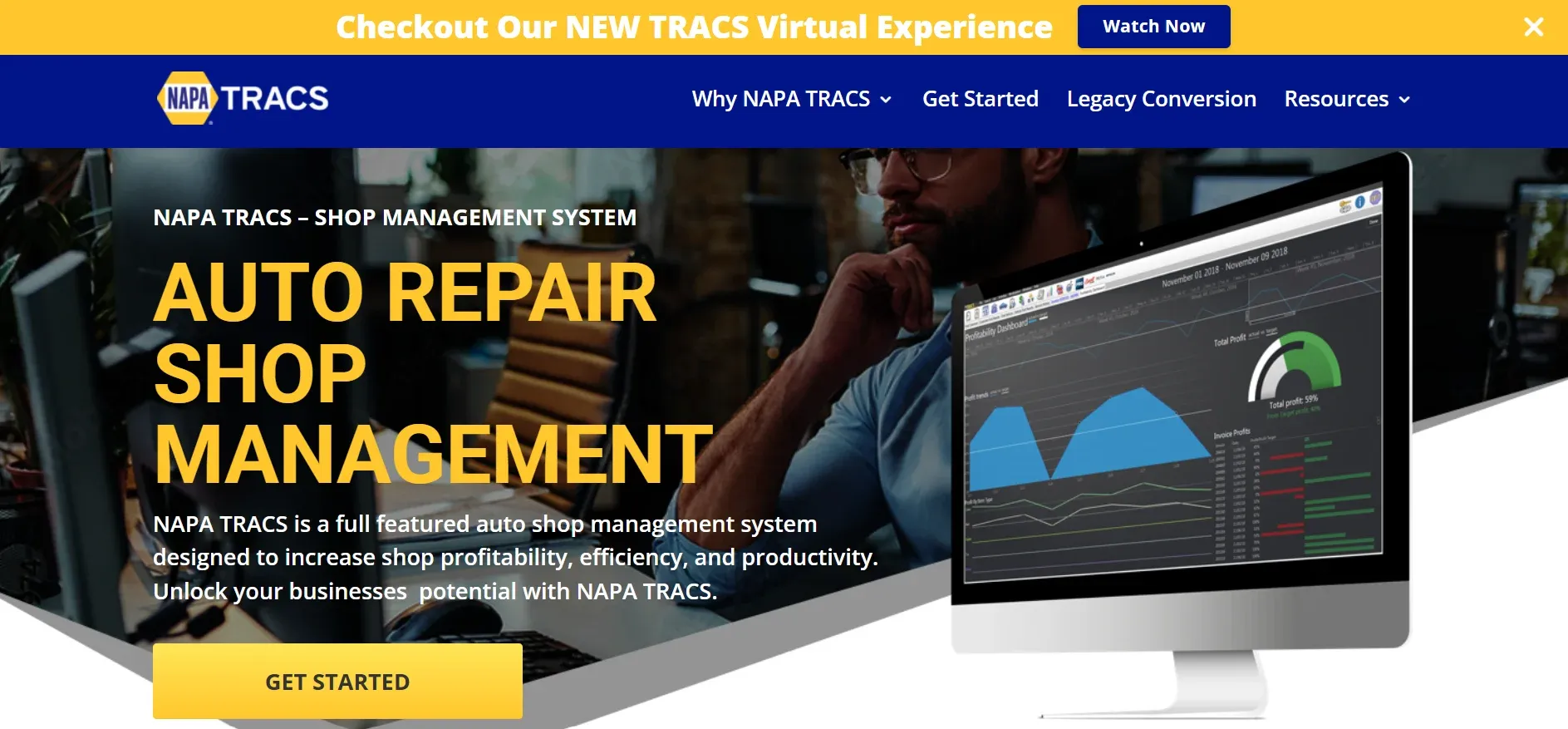
NAPA TRACS is a legacy shop management solution built by and for NAPA Auto Parts. Its main strength is tight integration with the NAPA parts catalog, enabling quick lookups, real-time pricing, and automated order placement directly from the work order screen. NAPA TRACS features modules for inventory, invoicing, service history, and customer management, all designed to work smoothly with NAPA’s supply chain.
Pricing: Sales-led, not publicly disclosed. Contact NAPA TRACS for details.
-
Key limitations:
- Best for shops sourcing mainly from NAPA
- Interface is less modern than cloud competitors
- Limited third-party integrations
-
Strengths:
- Direct NAPA e-catalog integration
- Solid inventory and service history tracking
- Reliable support for NAPA-focused shops
If you want to break free from vendor lock-in and own your system, Devaims can build direct integrations with NAPA and any other supplier you use.
3. PartsTech (Best for integrated parts ordering)
PartsTech is a specialized platform for parts sourcing and procurement, connecting tire shops to a network of over 30,000 parts distributors, including NAPA, Advance Auto Parts, and Worldpac. Its main value is in eliminating phone calls and manual price-checks, letting you compare prices and availability across suppliers in a single interface.
Pricing: Free for one user; paid plans start at $79/month. See details.
-
Key limitations:
- Not a full shop management system
- Free plan limited to one user
- Advanced integrations may require technical support
-
Strengths:
- Real-time parts lookup across suppliers
- Easy to add alongside existing systems
- Integrates with leading shop management tools
PartsTech is great for procurement, but if you want a single system for everything, Devaims can build a platform with integrated parts ordering and full shop management.
4. Shop-Ware (Best for enterprise features)
Shop-Ware is built for high-volume, multi-location tire shops that require advanced workflows, granular reporting, and deep integrations. Its modern, cloud-based interface brings enterprise-level power to independent shops and regional chains.
Pricing: $249 to $399/month base, but many shops pay $400 to $600/month with add-ons. Setup fees: $500 to $2,500. See pricing.
-
Key limitations:
- Setup fees and add-ons increase total cost
- No code ownership or custom roadmap
- Learning curve for legacy users
-
Strengths:
- Enterprise-grade reporting and analytics
- Multi-location management
- Open API for integrations
Shop-Ware is powerful for chains, but if you want to avoid per-location fees and own your platform, Devaims is the only true alternative.
5. AutoLeap (Best for all-in-one shops)
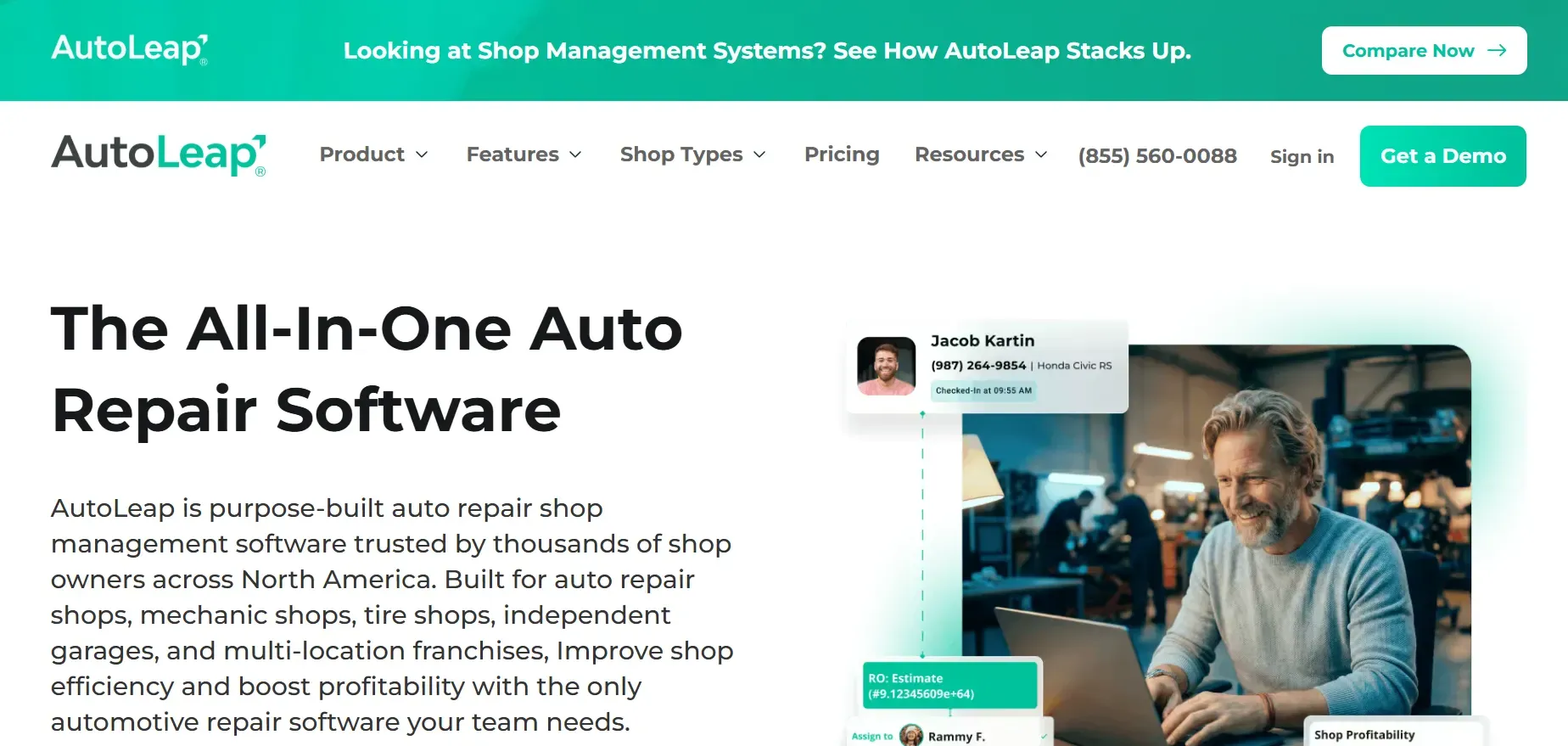
AutoLeap is a unified platform that aims to replace multiple tools in a tire shop’s stack: work order management, CRM, inventory, digital inspections, and payment processing are all included. AutoLeap is cloud-based and offers a modern interface, with a focus on automating repetitive tasks.
Pricing: Not publicly disclosed. Setup fee may be refunded after training completion.
-
Key limitations:
- Some features less advanced than dedicated tools
- Opaque pricing, must contact sales
- No ownership or control over code
-
Strengths:
- All-in-one platform for shop management
- Modern interface and automation
- Onboarding and migration support
If you want every feature tailored to your workflow, Devaims can build an all-in-one system that you own and control.
6. TireShop (Best for tire-specific shops)
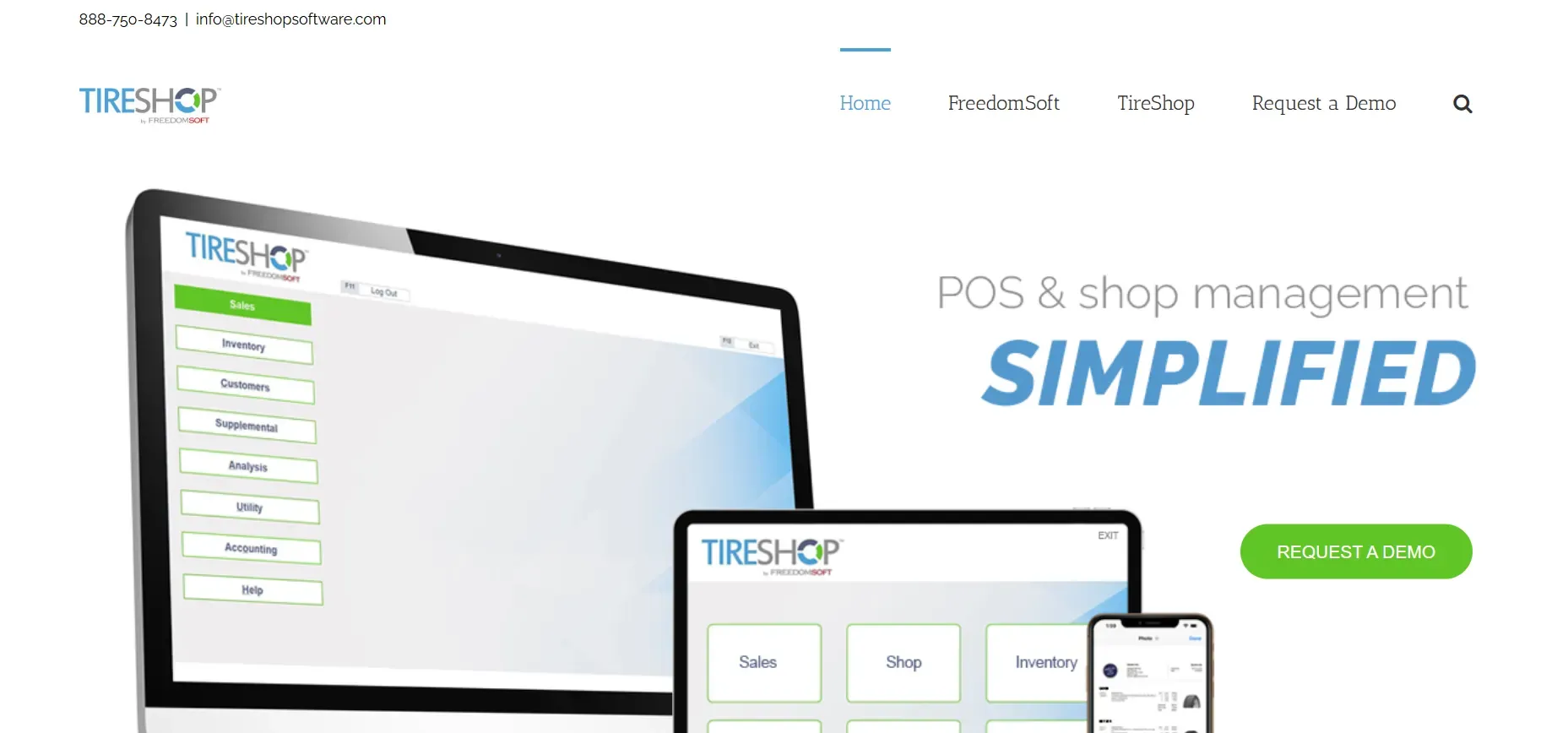
TireShop is a legacy desktop and cloud solution that caters specifically to tire dealers and automotive service centers. It includes modules for tire inventory, sales, work orders, and point-of-sale, all tailored for the tire industry’s unique needs.
Pricing: Not publicly disclosed; contact TireShop for details.
-
Key limitations:
- Limited integration options
- Dated interface compared to cloud tools
- No ownership or custom features
-
Strengths:
- Tire-specific workflows
- Barcode inventory tracking
- Simple onboarding for tire dealers
For tire shops wanting modern features and ownership, Devaims can build a system with tire-specific workflows and full control.
7. Omnique (Best for small to mid-size shops)
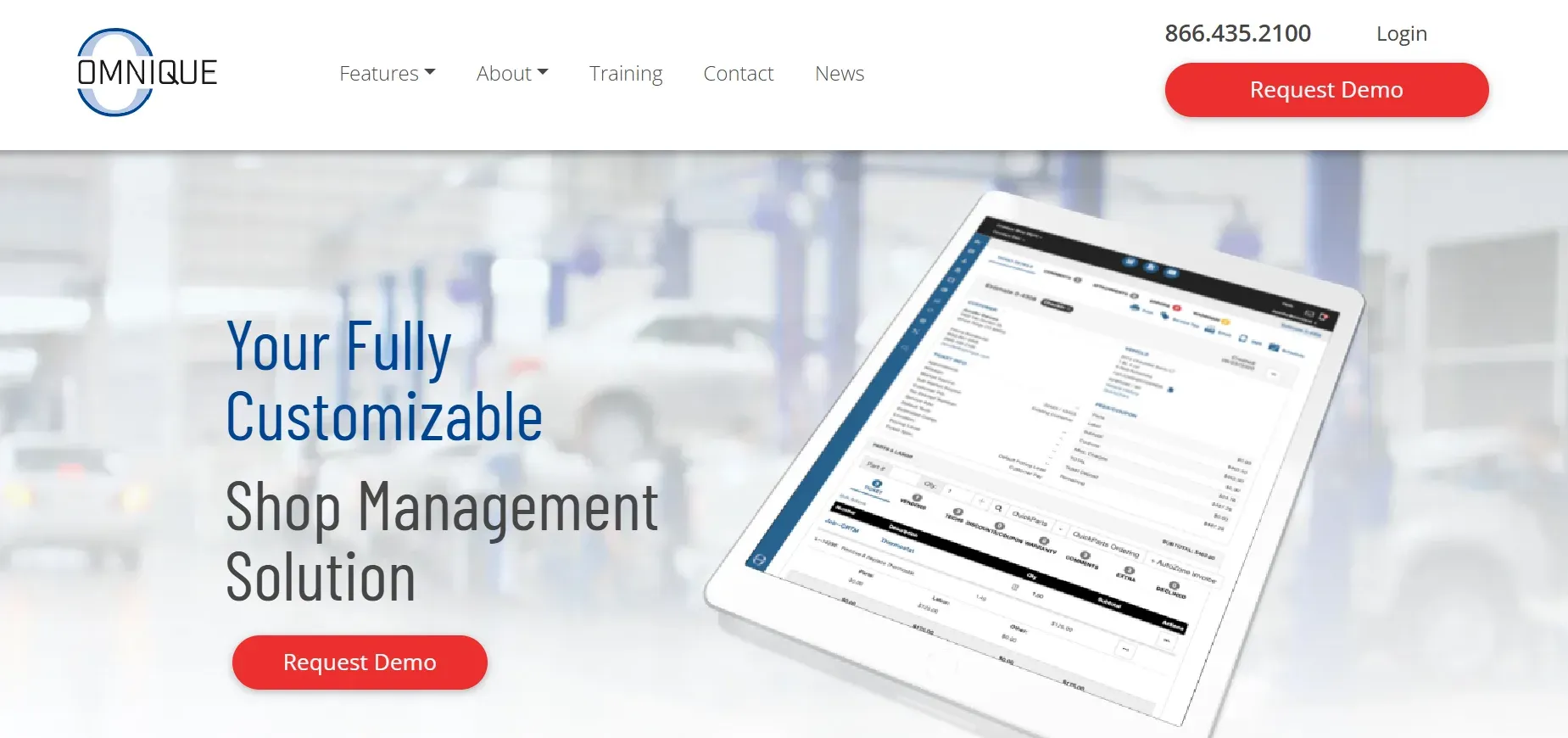
Omnique offers a cloud-based platform focused on small and mid-sized auto and tire shops. Its interface is modern, and it covers essential workflows: work orders, inventory, scheduling, and customer management.
Pricing: Not publicly disclosed; contact Omnique for current rates.
-
Key limitations:
- Advanced features require add-ons
- No code ownership
- Limited customization for unique workflows
-
Strengths:
- Modern, cloud-based access
- Easy onboarding and support
- Integrates with major suppliers
Omnique is a solid choice for growing shops, but if you want to avoid monthly fees and own your platform, Devaims is the way forward.
8. Protractor (Best for multi-location operators)
Protractor is a cloud-based platform designed for multi-location tire and auto repair shops. Its strengths are workflow standardization, centralized reporting, and scalable management across locations.
Pricing: Not publicly disclosed; contact Protractor for rates.
-
Key limitations:
- Pricing can escalate with growth
- Customization limited to platform options
- No ownership or export of code
-
Strengths:
- Centralized control for multiple locations
- Customizable workflow templates
- Strong reporting and analytics
Protractor is strong for chains, but Devaims lets you scale without per-location fees and gives you full control.
9. Devaims (The only platform you own)
Devaims builds custom shop management systems that you own outright. Unlike every other Mitchell 1 alternative, you keep the source code, control your data, and never worry about price hikes or losing access. Devaims is ideal for tire shops that are tired of renting the same features year after year and want a platform that fits their process exactly.
- One-time build cost, then flat maintenance
- You own the code and the data, no lock-in
- Custom features and workflows, built for your shop
- No per-user or per-location fees
- Scales as you scale, with total flexibility
Other Mitchell 1 alternatives worth knowing
- MaxTraq: More focused on fleet tracking than shop management; best for tire shops with large commercial/fleet contracts, not general retail.
- TireConnect: Excellent for tire e-commerce and B2B sales, but not a substitute for full shop management (no work order or POS modules).
How to choose the right Mitchell 1 alternative
- Budget: Calculate your true monthly and yearly spend, factoring in all add-ons, setup fees, and per-user or per-location charges. Look beyond the base price to the real cost over 3 to 5 years.
- Shop size: Multi-location and high-volume tire shops need tools that don’t penalize growth with per-location or per-user fees. Custom ownership is especially valuable here.
- Feature fit: Some platforms are built around parts ordering; others focus on workflow automation or tire sales. Make a list of your must-have features (e.g., tire barcode scanning, digital inspections, marketing automation) and check how each platform delivers them.
- Ownership: Decide if you want to control your data and system, or if renting is enough for your needs. Full ownership means you decide the roadmap, integrations, and data access.
- Contract terms: If you value flexibility, avoid platforms with long lock-in periods, automatic renewals, or hidden clauses. Month to month contracts or outright ownership offer the most freedom.
If you’re leaning toward true ownership, keep reading, there is a real alternative.
Stop paying rent on software you could own
Every Mitchell 1 alternative above is still a rental, with monthly or annual fees, surprise add-ons, and contracts that stretch as long as you stay in business. You pay forever, but never own the system or your data. That’s where Devaims is different: we build custom tire shop management software that you own, with your features and your workflows, and you keep the source code.
Devaims builds your system to match the way your shop actually runs, not how a SaaS vendor thinks you should operate. No per-user fees, no forced upgrades, no "feature locked to a higher tier" headaches. When you want a new report or workflow, we build it for you, once, not as another monthly charge. You own the code, the data, and the future of your platform.
- Every dollar goes toward building your asset, not renting someone else’s
- Your features and reports are built for your business, not generalized
- No more surprise bills, add-on fees, or losing data when you switch
- Your data, your process, your system, no lock-in
| Platform | Ownership | Monthly Fee | Setup/Build Cost | Contract |
|---|---|---|---|---|
| Mitchell 1 | Rented | $350 to $450 (est. with add-ons) | $500 to $1,500 activation | 12 to 24 month, auto-renewal |
| Tekmetric | Rented | $179 to $400+ (with add-ons) | None | Month to month |
| Shop-Ware | Rented | $249 to $600 (multi-location) | $500 to $2,500 setup | Month to month |
| Devaims | Owned | $0 (one-time build, then flat maint.) | $28,000 (typical) | No contract, you own it |
| Year | Rented (cumulative) | Owned (cumulative) |
|---|---|---|
| 1 | $36,000 | $30,600 |
| 2 | $72,000 | $32,400 |
| 3 | $108,000 | $34,200 |
| 4 | $144,000 | $36,000 |
| 5 | $180,000 | $37,800 (now ahead) |
Let’s look at the math: If you have five bays and pay $600 a month for your shop management, that’s $7,200 a year, or $36,000 in five years, and you still own nothing. Add-on fees for more users, locations, or features can push your total higher, especially if you grow. With Devaims, you could own your system outright in less than five years, and every new bay or user costs you nothing extra. The longer you stay in business, the more you save, and you build equity with every dollar invested.
Devaims is the right move for tire shops who want to build their business, not their vendor’s recurring revenue.
How to switch from Mitchell 1
- Export all customer, inventory, and work order data from Mitchell 1. This may require assistance from Mitchell 1 support, especially for historical or custom fields. Always request data in a portable format (CSV, Excel, or SQL export).
- Choose your new platform and confirm contract terms. Pay close attention to onboarding fees, data migration support, and integration options.
- Import data into the new system (or work with your vendor to do it). With SaaS platforms, you may need to map fields or clean up data before import. With a Devaims build, this is handled for you.
- Reconnect payment processing and any core integrations. Ensure your new system is connected to payment gateways, parts suppliers, and accounting tools before going live.
- Train staff on new workflows and test live transactions in parallel. Run the new system alongside the old one for a week or two to catch any issues.
- Review and cancel your Mitchell 1 contract, watching for auto-renewal terms. Make sure you’ve exported all your data before closing your account.
With a custom Devaims build, the migration is handled as part of the project, including data transformation, integration setup, and staff training.
Frequently asked questions
What’s the best Mitchell 1 alternative for tire shops in 2026?
Tekmetric stands out for flexible contracts and a modern interface. Shop-Ware is a strong choice for enterprise features and multi-location management. PartsTech is a top parts ordering add-on if procurement is your bottleneck. For full ownership and control, where you keep the code and decide your features, Devaims is the only true alternative. If you want to stop paying rent and start building an asset, Devaims is the answer.
Which Mitchell 1 alternative is cheapest for small shops?
PartsTech offers a free plan for a single user, but it is limited to parts ordering and not full shop management. For comprehensive management, Tekmetric’s base plan is the most affordable among major players, but add-ons (tire suite, marketing, extra users) can increase costs quickly. For small shops on a budget, start with Tekmetric or Omnique, but review your five-year costs, Devaims may be more cost-effective if you plan to grow or want to own your system.
Is there a free alternative to Mitchell 1?
PartsTech’s free tier covers only one user and is limited to parts lookup and ordering. There are no free, full-featured shop management platforms that cover everything (work orders, invoicing, inventory, marketing) without ongoing fees. Open-source options exist but require significant technical skill to deploy and maintain. Devaims is not free, but is the only model where you own the code and avoid forever-rental fees.
Which alternative is best for multi-location or growing tire shops?
Shop-Ware and Protractor are strong for multi-location management, offering centralized reporting and standardized workflows. However, both use per-location or per-user pricing, which can become expensive as you add shops or staff. With Devaims, every new shop or user is just part of your owned system, no extra monthly fees, and features are tailored to your unique workflow.
How long does it take to switch from Mitchell 1 to a new platform?
Most tire shops can switch in 2 to 4 weeks, depending on the complexity of their data and the amount of staff training needed. The process involves data export, transformation, and import, as well as integration setup and workflow testing. With Devaims, the switch is managed for you, including custom migration scripts and hands-on support for onboarding your team.
Can I keep my data when switching from Mitchell 1?
You can export core customer, inventory, and transaction data, but some custom fields, historical attachments, or proprietary formats may require manual extraction or conversion. Always back up your data before canceling Mitchell 1. With Devaims, you own and control your data from day one, with full access to your database and export tools.
When should I switch from Mitchell 1?
If you’re frustrated by contracts, rising costs, or limitations on features and reporting, it’s time to consider Mitchell 1 alternatives. The five-year rent to own math is compelling: if your projected rental costs exceed the price of a custom build, or if you need features that your vendor will not provide, it’s time to explore ownership. Switching is also wise if you want to integrate with new suppliers or tools not supported by your current system.
The bottom line
Here’s the hard truth: every Mitchell 1 alternative in this space is a rental, except Devaims. If you want to stop paying for the same features year after year and actually own your shop management platform, it’s time to look hard at the numbers.
Add up your real five-year spend. If the total would have built you a system you own, you already have your answer. That’s the moment to stop paying rent and start building equity in your business software.
Want more? Explore the Devaims blog or see related reads: Tekmetric alternatives, Shop-Ware alternatives, and PartsTech alternatives.