

11 Best Restaurant POS Platforms in 2026
Running a restaurant in 2026 means renting a stack of software, not one tool. A POS like Toast or Square. A reservation platform like OpenTable or SevenRooms. An inventory tool like MarketMan. Loyalty, online ordering, and marketing modules on top. Each one bills monthly, most take a cut of every transaction, and none of it belongs to you.
It is not surprising that restaurants are rethinking their software choices. The restaurant software market is worth roughly $18.96 billion in 2026 and continues to grow as operators look for better ways to control costs and protect margins. The real question is whether the platform you choose helps your business run more profitably or simply becomes another monthly bill.
This guide lists the 11 Best Restaurant Software Platforms in 2026, comparing the inventory, food-costing, and back-of-house platforms that restaurants really consider when they need more flexibility, better value, or a system that can grow with them.
Why Restaurants Are Looking for a POS Alternative in 2026
The Hidden Costs of a Rented POS
The pricing page makes a rented POS look cheap. The real bill is based on four things the page tends to downplay. First, payment processing is the single largest line item for most restaurants. It’s baked in on platforms like Toast and Square, so you don’t get to shop for a better rate, and it can go up in the middle of a contract. Second, proprietary hardware: Toast terminals run $799 to $1,500+ and only work with Toast, so leaving means re-buying everything. Third, the add-on stack: online ordering, loyalty, KDS, marketing, and reservation per-cover fees each add to the total. Fourth, the contract: two-to-three-year terms with early-termination fees in the thousands.
Put together, a full-service restaurant usually pays $1,500 to $3,500 a month, all-in, roughly half of it for processing, on a system it will never own and whose data, including its guest relationships, lives inside the vendor's brand. That structure is fine for a simple single location. It starts to cost real money and real control the moment you scale.
Quick Comparison of the Top Restaurant Platforms
| Platform | Best For | Pricing | Processing / Lock-In | You Own It |
| Toast POS | Full-service depth | $0 to $165+/mo | Forced processing, 2-3 yr contract | No |
| Square for Restaurants | Small & quick-service | Free to ~$60/mo | Locked to Square, no contract | No |
| Lightspeed Restaurant | Inventory-heavy concepts | ~$59 to $319/mo | Lightspeed Payments + add-ons | No |
| TouchBistro | Full-service, restaurant-first | ~$69/mo per location | TouchBistro Payments (Chase) | No |
| Aloha POS (NCR) | Large & enterprise | Enterprise quote | Enterprise contract | No |
| Revel Systems | iPad-based, processor choice | ~$99/mo+ per terminal | Supports third-party processors | No |
| Clover | Bank/reseller availability | Reseller pricing | Tied to reselling bank | No |
| OpenTable | Reservation discovery | $149 to $499/mo | Per-cover network fees | No |
| SevenRooms | Guest CRM & reservations | ~$499/mo per venue | Subscription, no per-cover | No |
| Upserve (Lightspeed) | Legacy users | Folded into Lightspeed | Discontinued standalone | No |
| CAKE POS | Simple quick-service | Quote-based | Subscription | No |
The Hidden Costs That Don't Appear on the Sticker
Before you sign any POS contract, look for these five cost traps. They're the items that turn a "$69 a month" POS into a four-figure monthly bill, and they're the questions worth asking every vendor on your shortlist:
- Forced processing. Are you required to use the vendor's payment processing, and can they raise the rate mid-contract? (Toast can, with 30 days' notice.)
- Proprietary hardware. Does the hardware work only with this vendor, becoming worthless if you switch?
- Plug-in modules: What features (online ordering, loyalty, KDS, marketing etc.) cost extra monthly fees above the base plan?
- Per-cover and per-terminal fees. Do reservations cost per cover, and does each terminal add to the bill?
- Contract and exit terms. How long is the commitment, what's the early-termination fee, and can you export your data on the way out?
All five are answered the same way: no forced processor, standard hardware, all in the build, no per-everything fees, and no contract to get out of because the code is yours.
What to Look for in POS Alternatives
When evaluating alternatives to POS and other back-of-house platforms, prioritize these four factors:
Feature completeness - Are the features that actually control cost (recipe costing, COGS, variance, waste) included, or gated to a higher tier?
Pricing transparency - Is pricing published and predictable, or quote-based and prone to annual increases, and does it scale per location?
Data ownership - Can you export your recipes, vendor history, and cost data freely, or is it locked in a proprietary format with API access behind a paywall?
Fit for complex operations - Does it handle central kitchens, semi-finished production, internal transfers, and traceability, or only a simple single-site setup?
The systems below are measured against all four, and the differences explain why some suit a simple single location while others, or owning your own platform, fit a serious, scaled operation.
The 11 Best Restaurant POS Systems
1. Toast POS: Best for Full-Service Depth
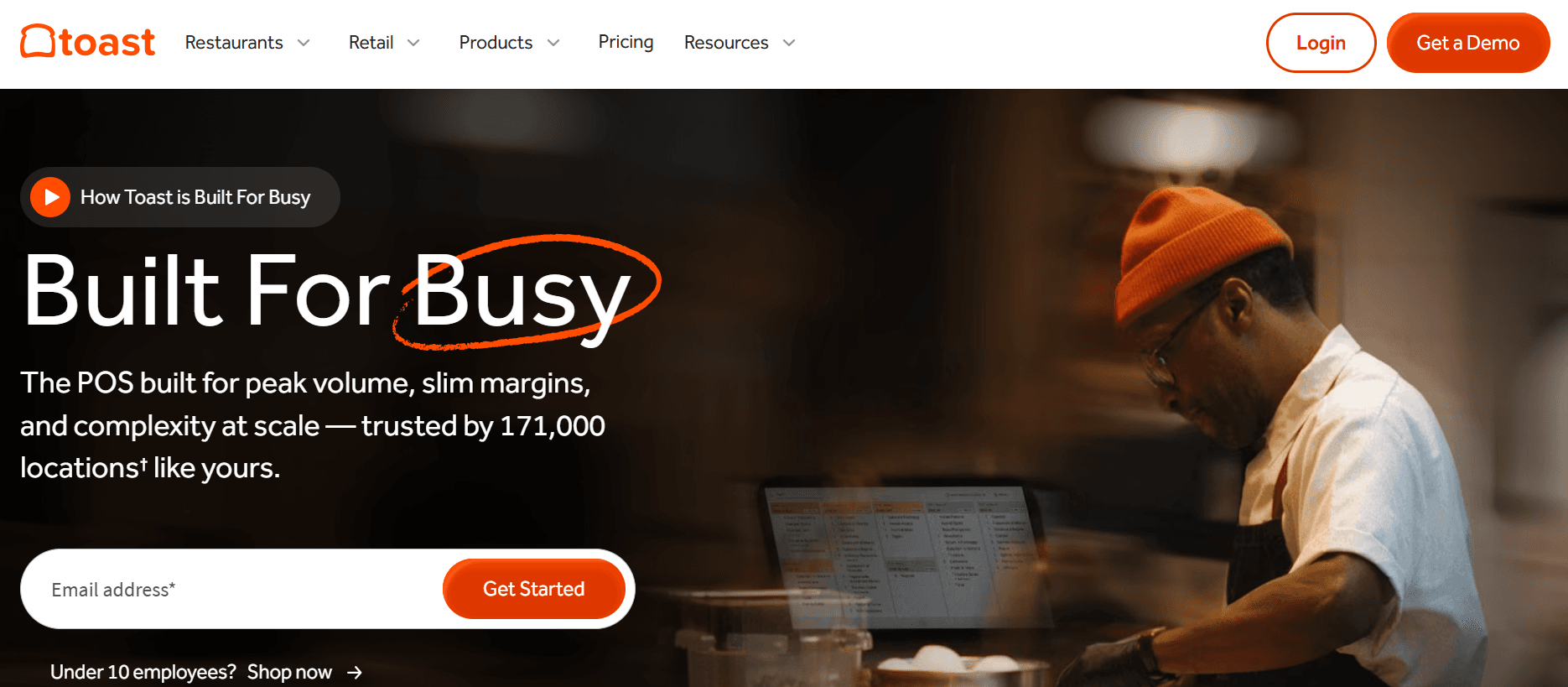
Best for: Full-service and multi-location restaurants that want the deepest restaurant-specific feature set and will accept the cost and lock-in to get it.
Toast is the most-used restaurant POS in the US, with over 112,000 businesses, and its feature depth, offline reliability, and restaurant-grade hardware are genuinely strong. Software runs $0 for the Starter Kit up to $69 and $165+ for higher tiers, but you're required to use Toast's payment processing, and that processing is usually the largest line on the bill.
Limitations:
- Forced payment processing you can't shop, with rate increases allowed mid-contract
- 2-to-3-year contracts with early-termination fees in the thousands
- Proprietary hardware ($799 to $1,500+) that only works with Toast
- Add-on modules at $50 to $165 a month each
2. Square for Restaurants: Best Free Tier
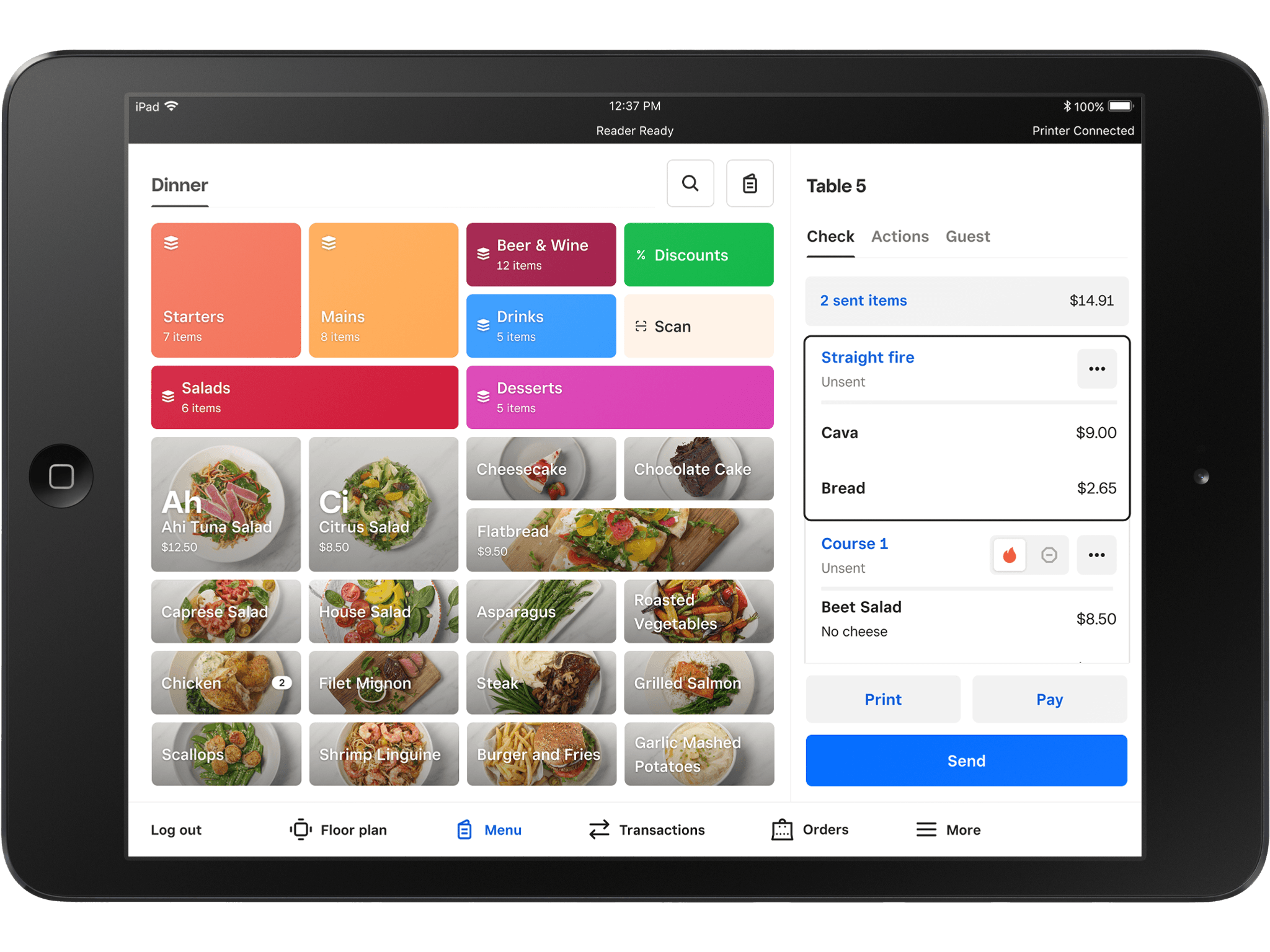
Best for: Small restaurants, cafes, food trucks, and quick-service spots that want a free start and no contract.
Square is the easiest on-ramp in the category. The free tier is genuinely free, setup takes minutes, and there's no contract, with a Plus plan around $60 a month for multi-location and advanced features. For a small operation it's hard to beat.
Limitations:
- Payment processing locked to Square, no third-party processor
- Basic inventory compared to Lightspeed or Revel
- No built-in reservations; you integrate OpenTable separately
- Reporting and front-of-house depth trail restaurant-specific rivals
3. Lightspeed Restaurant: Best for Inventory-Heavy Concepts
Best for: Inventory-heavy and hybrid retail-plus-restaurant concepts that need deep stock control.
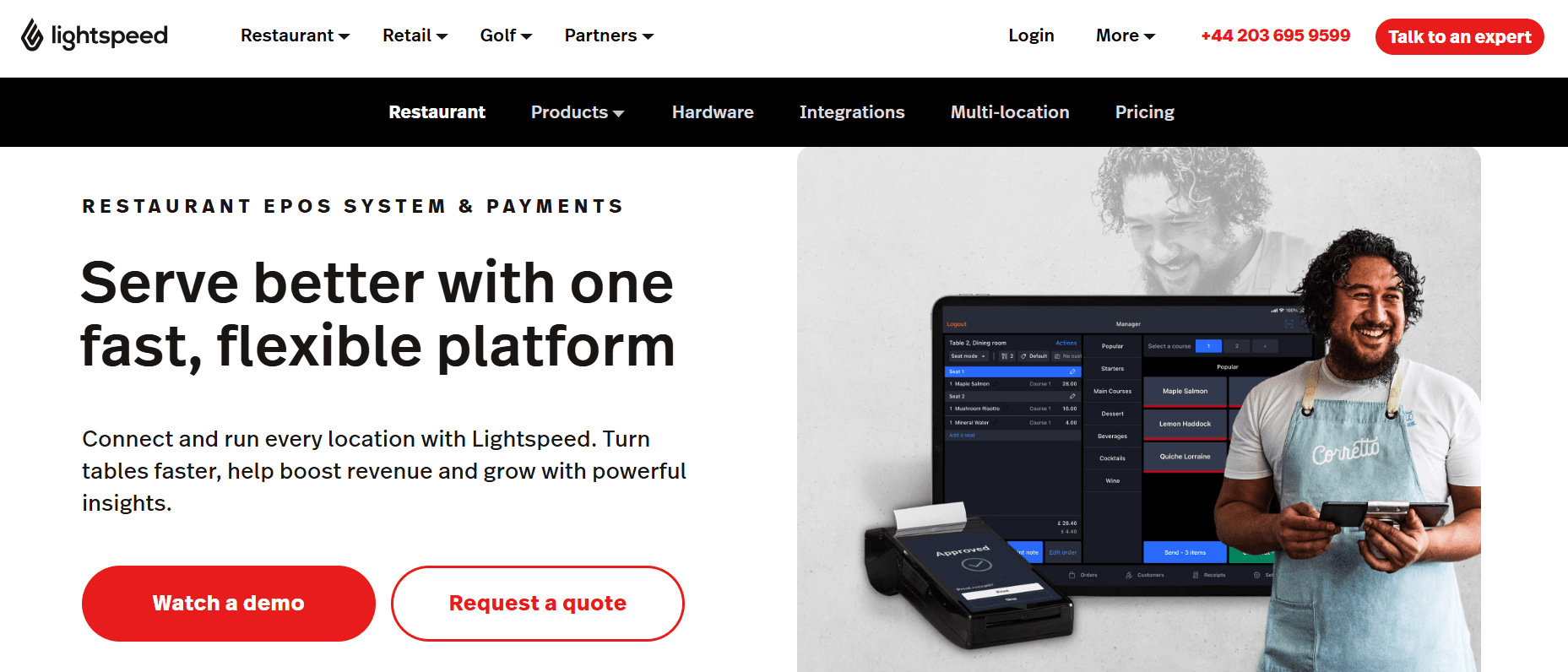
Lightspeed brings strong inventory and reporting, with tiers from about $59 to $319 a month and payments powered by Stripe. Its retail heritage suits concepts that sell product alongside food, though sit-down development can feel secondary to its retail roots.
Limitations:
- Pricing ramps quickly, with loyalty and analytics on premium tiers
- KDS and other add-ons cost extra (around $40 a month per screen)
- Restaurant-specific development trails its retail focus
- First-year TCO can reach $2,500 to $5,000
4. TouchBistro: Best Restaurant-First Design
Best for: Full-service and fine-dining restaurants that want restaurant-first design with built-in reservations.
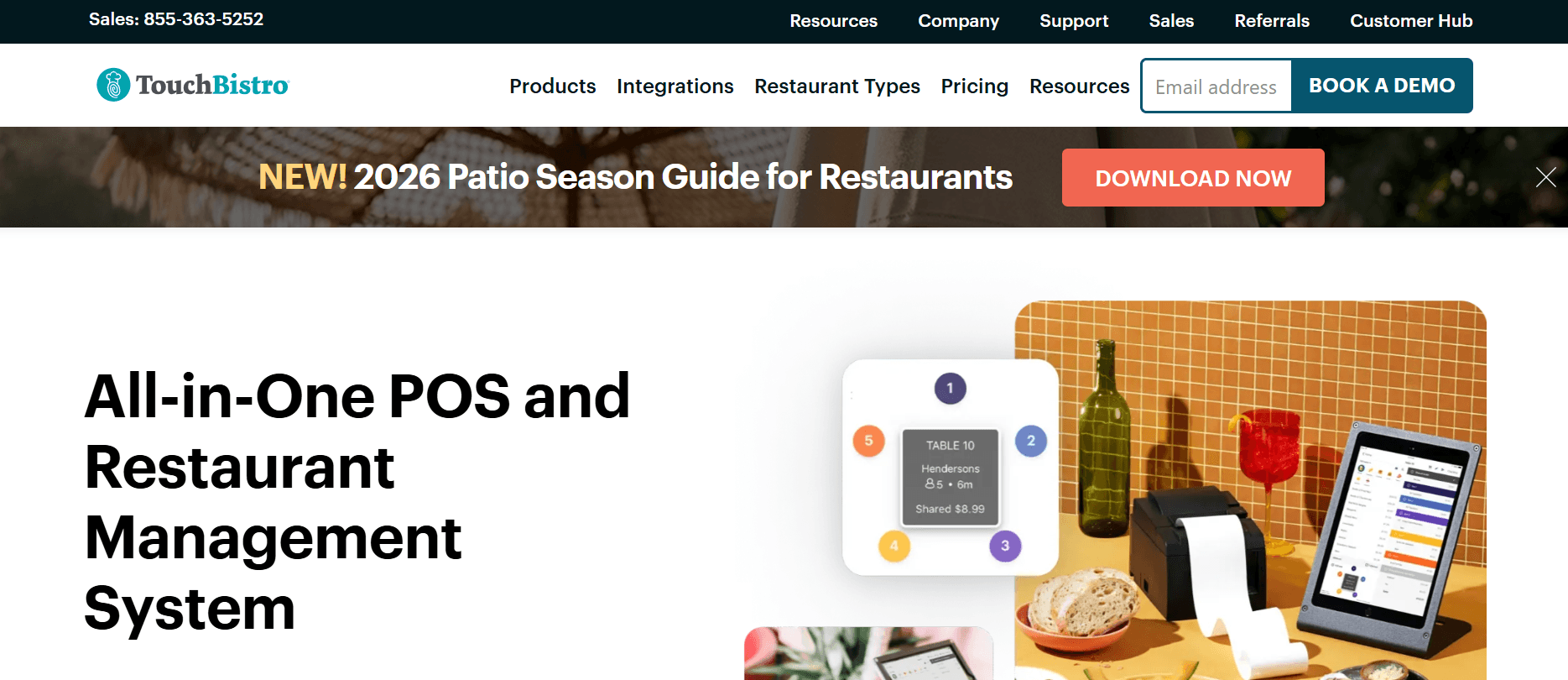
TouchBistro was built by restaurant people, with reservations included and a clean tableside experience. Pricing starts around $69 a month per location with unlimited users, and payments run through TouchBistro Payments powered by Chase.
Limitations:
- Some features that are standard elsewhere are chargeable extras
- Reporting and back-office depth trail Toast and Lightspeed
- Per-location pricing adds up across a group
- Online ordering and loyalty are add-ons
5. Aloha POS (NCR): Best for Enterprise Operations
Best for: Large and enterprise restaurants that want a long-established, heavy-duty platform with deep back-office tooling.
Aloha, from NCR Voyix, is a legacy enterprise POS with a long track record in high-volume and chain environments. Its depth and reliability are proven, but it's enterprise software: pricing is quote-based, and contracts and hardware commitments are significant, with the complexity that comes with legacy enterprise systems.
Limitations:
- Quote-based enterprise pricing, not transparent.
- Significant hardware and contract commitments.
- Heavier and less modern than cloud-native rivals.
- Overkill for independents and small groups.
6. Revel Systems: Best for Processor Flexibility
Best for: Larger and quick-service operations that want an iPad-based platform with the flexibility to choose their own processor.
Revel is a scalable, iPad-based POS aimed at higher-volume and multi-location operators, starting around $99 a month per terminal. Unlike Toast, it supports third-party payment processors, a real advantage if you want to control processing.
Limitations:
- Per-terminal pricing climbs with size
- Implementation and onboarding can be involved
- Often requires annual commitments
- Heavier setup than a simple QSR tool
7. Clover: Best for Bank/Reseller Availability
Best for: Restaurants that want a flexible POS available through their existing bank or merchant-services provider.
Clover is widely available because it's sold through banks and resellers, with a large app marketplace for extending it. That channel is its main strength and its main risk, because pricing and contract terms vary heavily by who you buy from.
Limitations:
- Pricing and contracts vary by reseller, often bundled into a merchant agreement
- Processing usually tied to the reselling bank
- App-marketplace add-ons stack up in cost
- 36-month TCO commonly $6,000 to $18,000
8. OpenTable: Best for Reservation Discovery
Best for: Restaurants that need the discovery and booking volume of the largest diner marketplace.
OpenTable's diner network is its real product, driving discovery a standalone system can't. Plans run $149 (Basic), $299 (Core), and $499 (Pro) a month, plus $1 to $1.50 per cover on network bookings, and those cover fees add up fast for a busy venue.
Limitations:
- Per-cover fees that scale with volume, potentially thousands a year on top of the subscription
- OpenTable's brand sits on guest-facing communications, not yours
- A system-of-record requirement that can limit other booking channels
- Variable monthly cost that's hard to forecast
9. SevenRooms: Best for Owning the Guest Relationship
Best for: Upscale and multi-property operators who want to own the guest relationship with deep CRM and marketing.
SevenRooms is a reservation and guest CRM platform for operators who want to own their guest data rather than rent reach. It charges no per-cover fees and builds a detailed profile on every booking, with pricing around $499 per venue per month, roughly $6,000 a year.
Limitations:
- Higher flat monthly cost per venue
- No consumer marketplace, so it won't drive new-diner discovery
- Aimed at enterprise and upscale operators
- Quote-based, less transparent pricing
10. Upserve (Lightspeed): A Cautionary Tale
Best for: Existing Upserve users, who are now effectively on Lightspeed.
Upserve (formerly Breadcrumb) was a well-regarded restaurant POS and management platform that Lightspeed acquired in 2020 and folded into its restaurant offering. As a standalone product it has effectively been retired, with its capabilities and customers migrated into Lightspeed Restaurant.
Limitations:
- No longer sold as a standalone product
- Existing users are pushed onto Lightspeed Restaurant
- Migration and rebranding disruption for legacy accounts
- Its fate is itself a lesson in vendor risk
11. CAKE POS: Best for Simple Quick-Service
Best for: Small to mid-size quick-service and casual restaurants that want a straightforward, easy-to-run POS.
CAKE is a simpler POS aimed at quick-service and casual dining, with an emphasis on ease of use and fast counter service. Pricing is quote-based, and it's a reasonable fit for operators who want something uncomplicated without the depth or cost of an enterprise platform.
Limitations:
- Quote-based pricing
- Fewer advanced features than Toast or Lightspeed
- Smaller integration ecosystem
- Best suited to simpler operations
Why Restaurants Are Rethinking Their POS in 2026
A rented POS is genuinely useful out of the box. Operators start looking elsewhere when they hit the model's structural limits.
The processing is forced, and it's the real cost. Toast and Square require their own processing, so you can't shop for a better rate, and on real volume that cut is the largest line on the bill, larger than the software itself.
The hardware and contracts lock you in. Proprietary terminals, multi-year contracts, and early-termination fees mean leaving is expensive by design. The hardware you paid for only works with the vendor you're trying to leave.
The add-ons and per-cover fees stack. Online ordering, loyalty, KDS, marketing, and reservation cover fees each add to the bill, so two restaurants on the same POS plan pay very different totals.
Your guest data isn't yours. Reservation platforms put their brand on your guests' confirmations and increasingly want to be your system of record, so the relationship you're paying to build reinforces someone else's brand.
You own none of it. After years across the stack you walk away with renewal invoices, and exporting your own sales and guest history is often deliberately difficult.
Beyond the Alternatives: Own Your Restaurant Platform Instead
Best for: Established restaurants and multi-location groups that want their POS, online ordering, reservations, and reporting built around their operation, with their own payment processor and no per-everything fees.
Devaims isn't a restaurant POS you subscribe to; it's a custom software development partner. Instead of renting one vendor's product, you hire Devaims' engineers to build the platform your operation actually needs, POS, online ordering, reservations, inventory, loyalty, and reporting, in one system, and you own the source code at the end. You don't climb tiers to unlock features, you don't pay a forced processor a cut of every sale, and your guest data never sits in someone else's brand.
The difference between Devaims and the systems below that you rent is that you own it, you have your own payment processor at a rate you control, and a platform built for how you operate, not the average restaurant. That eliminates the most expensive parts of the rented model: the processing markup, the per-everything fees, and the lock-in. At a restaurant doing $100,000 a month in card sales, shaving a half a percent off processing alone is $6,000 a year, and it’s all yours.
Devaims vs the Rented POS Model
The best way to understand why owning beats renting is to look at the exact places the rented POS model costs you control, the same pressures that send growing operators looking, and ask what a platform built for your restaurant would do instead.
Payment processing: a forced, marked-up rate vs. your own
Processing is the single biggest line in most restaurants' software costs, and the rented model is built around controlling it. Toast requires its own processing and can raise the rate mid-contract on 30 days' notice; Square locks you to Square. You can't shop, you can't negotiate past a point, and the markup applies to every dollar you take. An owned platform lets you bring any processor and pay near interchange-plus, so the markup, the most expensive part of the whole stack, simply disappears.
Hardware: proprietary and stranded vs. standard and yours
Toast terminals are custom made, and not transferable, so when a unit goes out of warranty and dies, you have to buy another toast terminal at toast's price. And if you want to change systems, the hardware is a paperweight. Your hardware isn’t a leash, thanks to a custom platform that runs on standard tablets, printers and card readers you can source and replace anywhere.
Fees: billed per everything vs. flat and owned
Growth is measured by the rented model: per terminal, per cover on bookings, and per add-on module. Every new location, busy Friday, or feature you turn on adds to the bill. There are no meters in an owned platform. Add a fourth location or a fifth terminal, and the software cost stays flat.
Guest data: the platform's asset vs. yours
When a guest books through OpenTable, the confirmation, the reminder, and the data promote OpenTable’s brand, not yours, and reservation platforms increasingly want to be your system of record. When you have an owned reservation layer, every booking creates a guest profile that is yours, ready to serve and market without a per-cover fee or a third party in the middle.
Contracts and support: a queue and a lock-in vs. the code and a partner
Rented POS contracts often run two to three years with early-termination fees in the thousands, and when something breaks, you're in a vendor's support queue. Owning changes that: there's no contract to escape, and a needed change is a task you prioritize with a development partner who knows your system. The honest trade-off, and it's a real one, is that ownership means you carry maintenance rather than handing it off, which is why this suits operations with the scale to justify it, not a single location that wants someone else to keep the lights on.
Best for the right stage: A custom build costs more up front than a subscription and takes weeks to deliver. Payments, PCI compliance, and hardware are genuinely hard, so a single small location is better served by renting one of the systems below. For an operation with the volume and stability to justify it, ownership is the move that ends the renting.
How to Choose the Right POS for Your Operation
Selecting a POS comes down to three things: the scale and complexity of your operation, your card volume, and how much you value owning versus renting.
For a single location or a new concept, an off-the-shelf system is the smart, low-friction choice, and Square's free tier or Toast's Starter Kit gets you running today with no build effort.
For full-service depth or enterprise scale, Toast, Aloha, and MICROS-class systems bring the feature depth and reliability that large operations need, with the cost and lock-in that come with them.
For an operation where card volume is high and the rented stack has crossed a few thousand dollars a month, the question stops being which system to rent and becomes whether to own. That's where Devaims fits: a platform built around your operation, with your own payment processor, every feature included, and full ownership of the system and the data, at a total cost that, over a few years, comes in below a rented stack plus a forced-processor markup.
Frequently Asked Questions
What's the most expensive part of a restaurant POS?
Usually the payment processing, not the monthly software fee. Systems like Toast require their own processing at 2.49% to 3.50% plus 15 cents per transaction, and on real volume that cut is typically the largest line on the bill.
Can I use my own payment processor?
Not with Toast or Square, which need their own processing. Revel and Lightspeed have third party processors. A custom built platform allows you to bring any processor and pay close to true cost.
Which option lets me own my software instead of renting it?
Devaims. Every other system here is a subscription or license you pay indefinitely. With Devaims you commission a custom platform once and own the source code and your data outright, with your own processor and no per-everything fees.
What happened to Upserve?
Upserve was acquired by Lightspeed in 2020 and folded into Lightspeed Restaurant. It's no longer sold standalone, a reminder that a rented platform can be discontinued out from under you.
Conclusion
The restaurant POS market in 2026 offers plenty of robust systems, and there's no single one that fits every operation. Balancing feature depth against cost, convenience against control, and renting against owning is what separates a smart choice from an expensive trap.
If you run a simple, single-location business, Square or Toast Starter serves that purpose well. But if your card volume is high, if you're running multiple locations, and if you're tired of a forced processor taking a cut of every sale on a system you'll never own, you need more than another subscription. You need a platform built for your operation that you actually hold.
Devaims combines the depth of the enterprise systems, your own payment processor at a rate you control, and full ownership with no per-everything fees. Don't keep renting your restaurant's nervous system by the terminal and the cover. Book a free consultation with Devaims and own the platform your restaurant runs on