


Ever had a donor management "demo" end with a price that tripled because you needed actual reporting? Or signed up excited, only to hit a feature wall unless you upgraded tiers? If you have used Network for Good, you know the drill: the price is hidden until a call, fees add up, and you never really own your own system.
The truth: every major Network for Good alternative in 2026 still rents you access, often with add-ons and contracts. Bloomerang is trusted for fundraising, DonorPerfect for donor tracking, and Little Green Light for small shops. But none of them hand you the keys. Only Devaims lets you own your CRM outright, your data, your workflows, your code, no ongoing rent. Let’s get into the real numbers, real pain points, and the one honest path to ownership.
Why nonprofits look for Network for Good alternatives
Hidden pricing and sales calls. Network for Good (now Bonterra) stopped publishing prices in 2026. You need a call for a quote, and the real cost depends on your size and needs. This lack of transparency makes budgeting and board approvals harder, and often leads to sticker shock after a demo. Many competitors have adopted similar tactics, making it difficult to compare options directly or anticipate true costs before beginning migration planning.
Annual contracts and limited flexibility. Many alternatives require annual or multi-year contracts, which lock you in if your needs change mid-year. Month-to-month is rare. This can be especially restrictive for nonprofits with seasonal fundraising cycles or those that need to pivot strategy quickly. The inability to downsize or change plans mid-contract often leads to wasted budget if your constituent base shrinks or campaign needs shift.
Feature gating and upcharges. Essential features like grant management or advanced reporting often mean buying add-ons or moving to a higher tier. For example, many platforms advertise low entry prices, but core nonprofit needs, such as recurring gifts, pledge tracking, or multi-channel communication, are only available in premium tiers. This results in a never-ending upgrade cycle where your monthly spend creeps up as your organization grows or your campaigns become more sophisticated.
Limited grant and fund tracking. Network for Good lacks grant lifecycle management and restricted fund compliance, forcing workarounds or manual tracking. For organizations managing multiple funding streams, this can lead to compliance risks, audit headaches, and extra hours spent reconciling gifts to specific programs. Many alternatives offer only basic fund tracking, requiring separate tools or spreadsheets for grant management, defeating the purpose of a central CRM.
Never owning your system. After years of payments, you own nothing, just recurring fees and data export headaches if you want to leave. Every major Network for Good alternative shares this rent-vs-own dilemma. Customization is often limited to superficial branding or workflow tweaks, and when you leave, you often lose access to historical engagement data, automations, and even your own custom fields. True ownership means you can adapt, integrate, and scale your system as your mission evolves, without negotiating with a vendor for every change.
Quick comparison of the best Network for Good alternatives
| Tool | Best for | Starting price | You own it? |
|---|---|---|---|
| Bloomerang | Fundraising CRM | $40/mo | No, subscription |
| DonorPerfect | Donor management | $99/mo | No, subscription |
| Salesforce NPSP | Enterprise, complex orgs | $60/user/mo | No, subscription |
| Raiser's Edge NXT | Large nonprofits | ~$5,000/yr | No, subscription |
| Neon CRM | Automation, integrations | $99/mo | No, subscription |
| Little Green Light | Small nonprofits | $45/mo | No, subscription |
| Kindful | Donor engagement | $119/mo | No, subscription |
| Virtuous | Relationship fundraising | $350/mo | No, subscription |
| Devaims | Owning your system | One-time build | One-time build, you own it |
Always confirm current pricing and contract terms before you decide, many tools adjust fees or feature tiers without notice. Consider not just the sticker price but the full cost of ownership, including setup fees, required add-ons, and the cost of exporting your data if you ever need to leave.
The 9 best Network for Good alternatives
1. Bloomerang (Fundraising CRM)
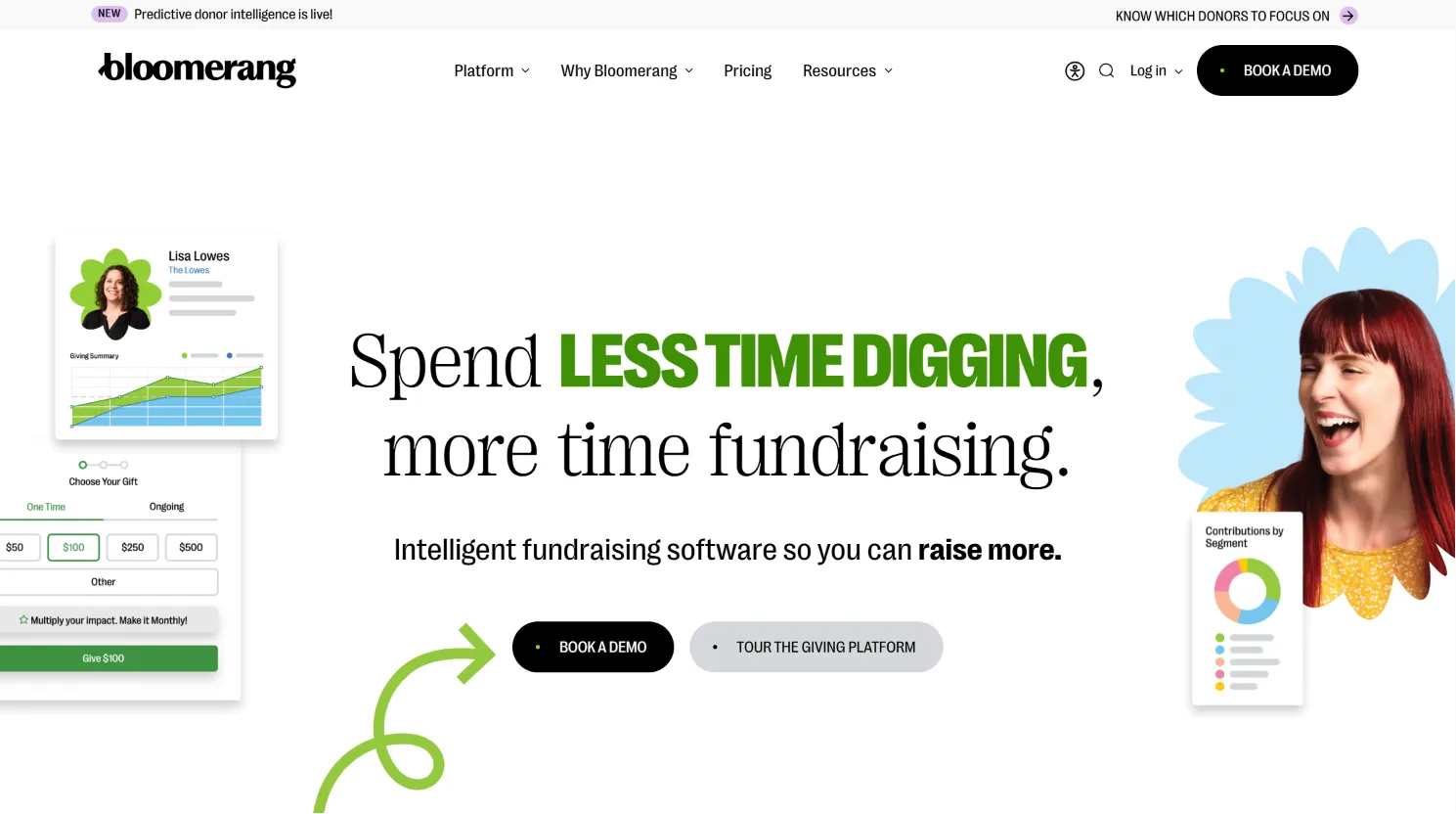
Bloomerang is designed to make fundraising and donor engagement easier for nonprofits of all sizes, but especially for those with annual budgets over $200,000. Its standout features are built around donor retention, its dashboard shows at-a-glance retention rates, recent activity, and donor engagement scoring. The interface is modern, with a focus on usability and quick training for new staff. It offers online donation forms, event registration, email marketing, and volunteer tracking.
Pricing: Starts at $40/month, with annual contracts and add-ons for advanced features.
- Modern, user-friendly interface with fast onboarding
- Strong donor retention tools and built-in email marketing
- Integrates with major accounting and fundraising platforms
- Advanced reporting and analytics require higher tiers or add-ons
- Annual contracts, no true month-to-month option
- Custom workflows and automations are limited
On a Devaims build, you could have donor workflows tailored to your exact campaigns, not just the ones the vendor offers.
2. DonorPerfect (Donor management)
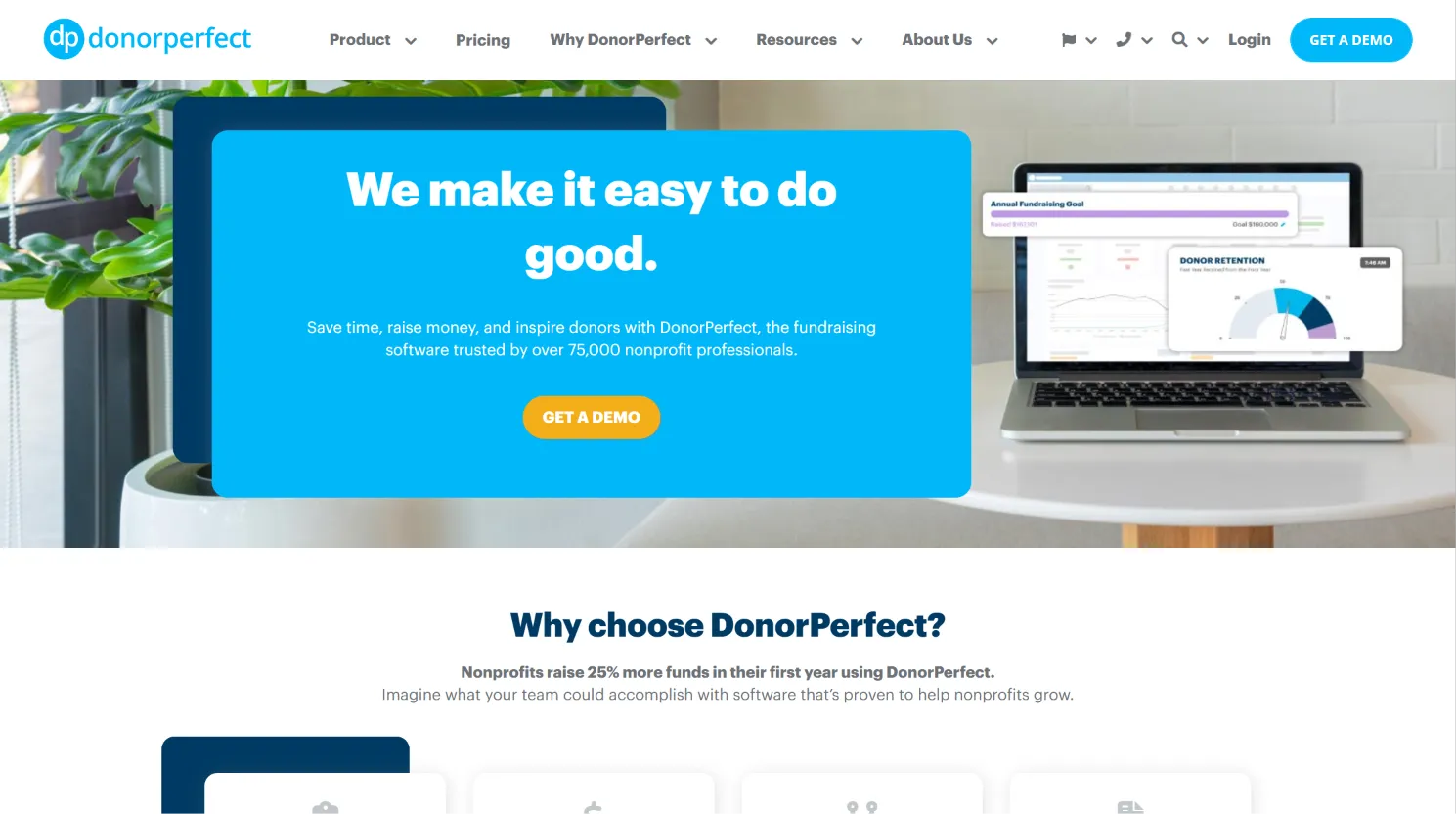
DonorPerfect is a legacy CRM trusted by thousands of nonprofits. Its core strength is robust donor tracking, with highly customizable fields and filters. The platform supports pledges, recurring gifts, event management, and grant tracking, though the grant module is basic compared to dedicated grant management tools. DonorPerfect offers built-in email, text messaging, and online giving forms, plus a mobile app for on-the-go access.
Pricing: Starts at $99/month, with discounts for annual contracts and extra fees for add-ons.
- Highly customizable donor tracking and segmentation
- Strong support for multi-channel fundraising
- Reliable onboarding and migration assistance
- Interface is less modern than newer tools
- Advanced features often require paid add-ons
- Learning curve for deep reporting and automation
With a Devaims platform, core features like custom reporting would be built in, not an upcharge.
3. Salesforce Nonprofit Success Pack (NPSP) (Enterprise, complex orgs)
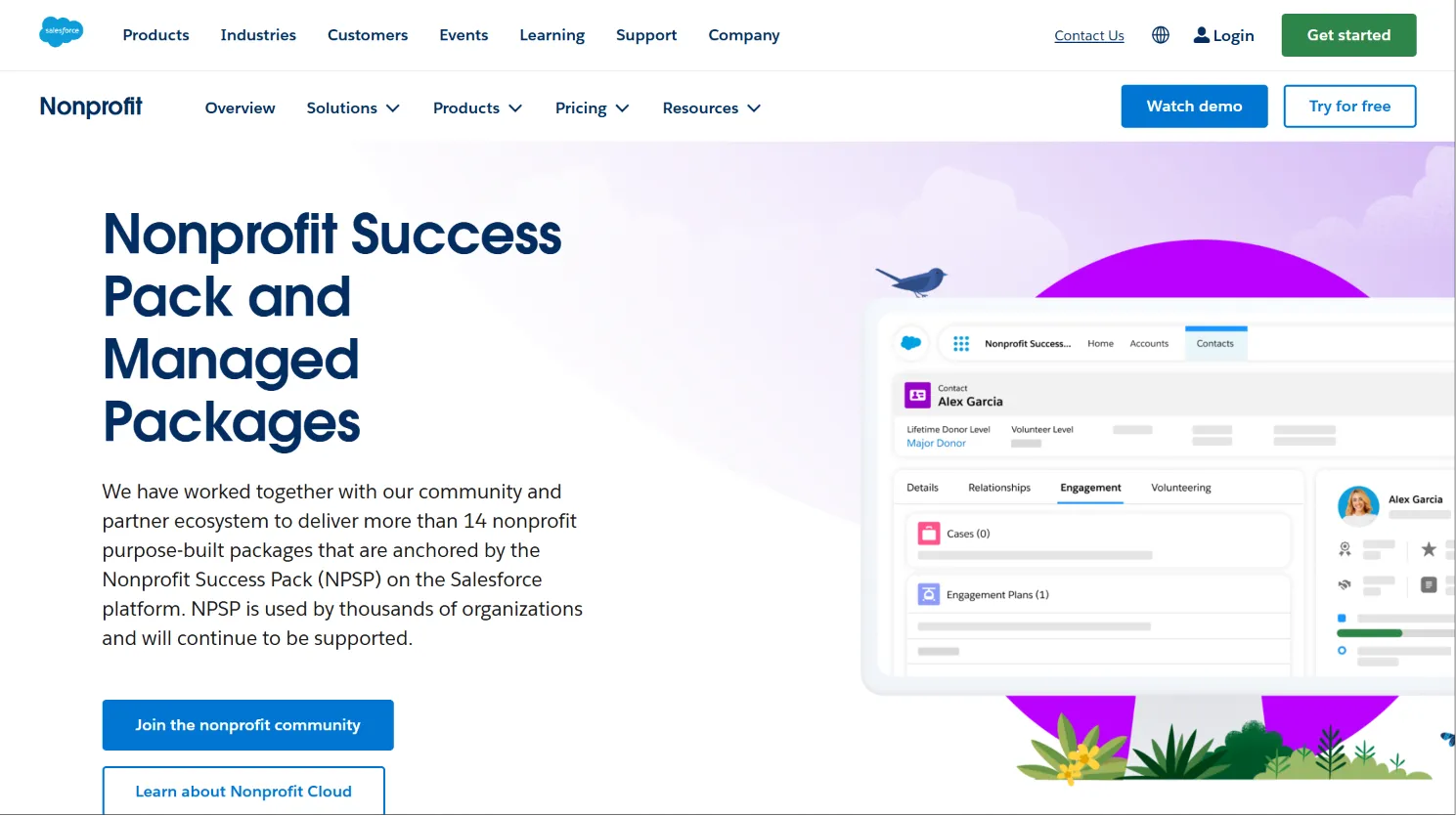
Salesforce NPSP is the nonprofit-tailored version of the world’s leading CRM. It is an ecosystem more than a single software product, built to handle complex program, donor, volunteer, and grant management at scale. Its customization is unparalleled, custom objects, fields, automations, and integrations can be built to fit nearly any workflow or reporting requirement. The platform supports detailed relationship mapping, major gift cultivation, and integrated marketing automation (via Pardot or Marketing Cloud).
Pricing: Starts at $60/user/month, with additional costs for add-ons and consulting.
- Unmatched customization and integration options
- Powerful relationship and program management
- Large ecosystem of nonprofit-focused add-ons
- High implementation and ongoing admin costs
- Complex setup requires technical expertise
- Can be overkill for smaller nonprofits
For organizations with unique reporting or workflow needs, a Devaims build delivers only what you need, no bloat, no per-seat fees.
4. Blackbaud Raiser's Edge NXT (Large nonprofits)
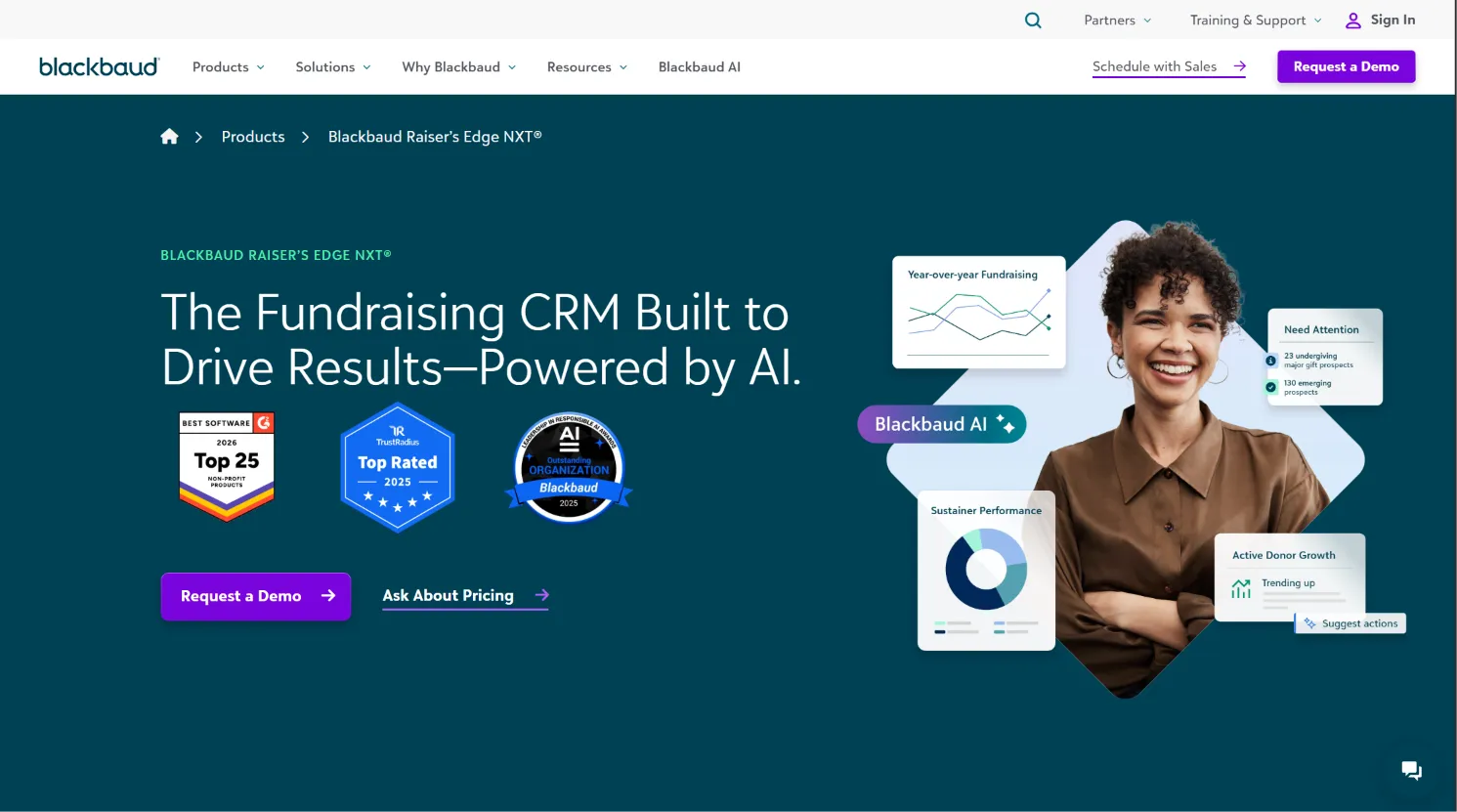
Raiser’s Edge NXT is the flagship fundraising and donor management platform from Blackbaud. It is built for established organizations with large donor bases and complex reporting requirements. Features include constituent management, event and volunteer tracking, grant management, and powerful analytics. The cloud-based NXT version adds modern UI and mobile access, but the underlying database structure is inherited from legacy Blackbaud products.
Pricing: Starts around $5,000/year, with additional fees for modules and support.
- Comprehensive donor and fundraising management
- Strong analytics and reporting for large orgs
- Deep integration with Blackbaud suite and partners
- High cost of ownership and support
- Complex system can be overwhelming for new users
- Customizations and integrations often require consulting
5. Neon CRM (Automation, integrations)
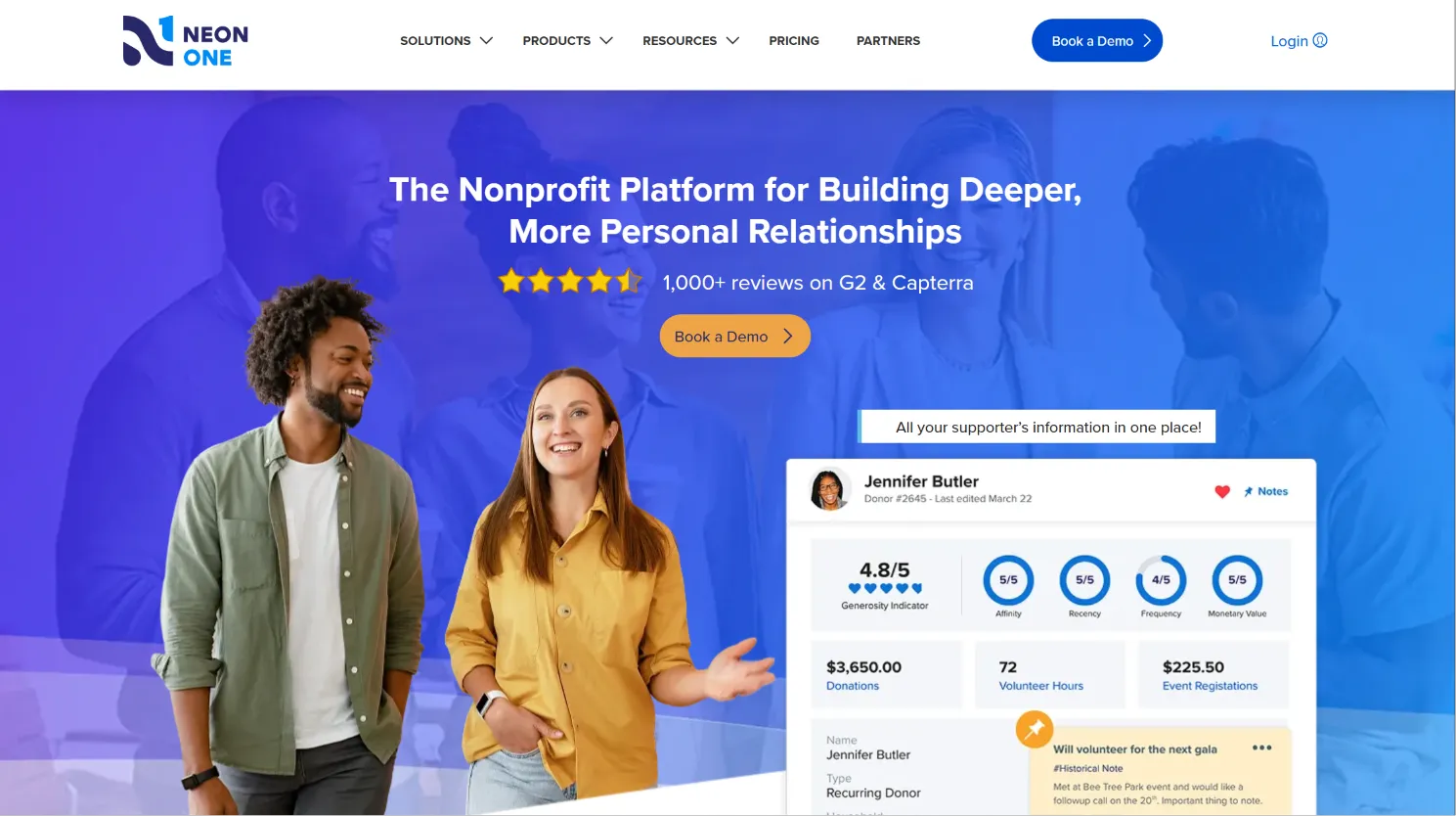
Neon CRM is built for nonprofits that want strong automation and a wide array of integrations. The platform covers donor management, events, peer-to-peer fundraising, membership, and email marketing. Its automation tools allow for custom workflows, such as triggered emails or recurring gift reminders, without needing developer support. Neon CRM also includes volunteer management and grant tracking, though these modules are less advanced than some dedicated tools.
Pricing: Starts at $99/month, with setup fees and costs rising as you add records or modules.
- Powerful automation and workflow tools
- Wide range of integrations via API and Zapier
- Supports membership, events, and peer-to-peer fundraising
- Annual contracts limit flexibility
- Interface can be cluttered for small teams
- Advanced automations may require technical help
With Devaims, your onboarding is a project milestone, not a fee, training and migration are built in.
6. Little Green Light (Small nonprofits)
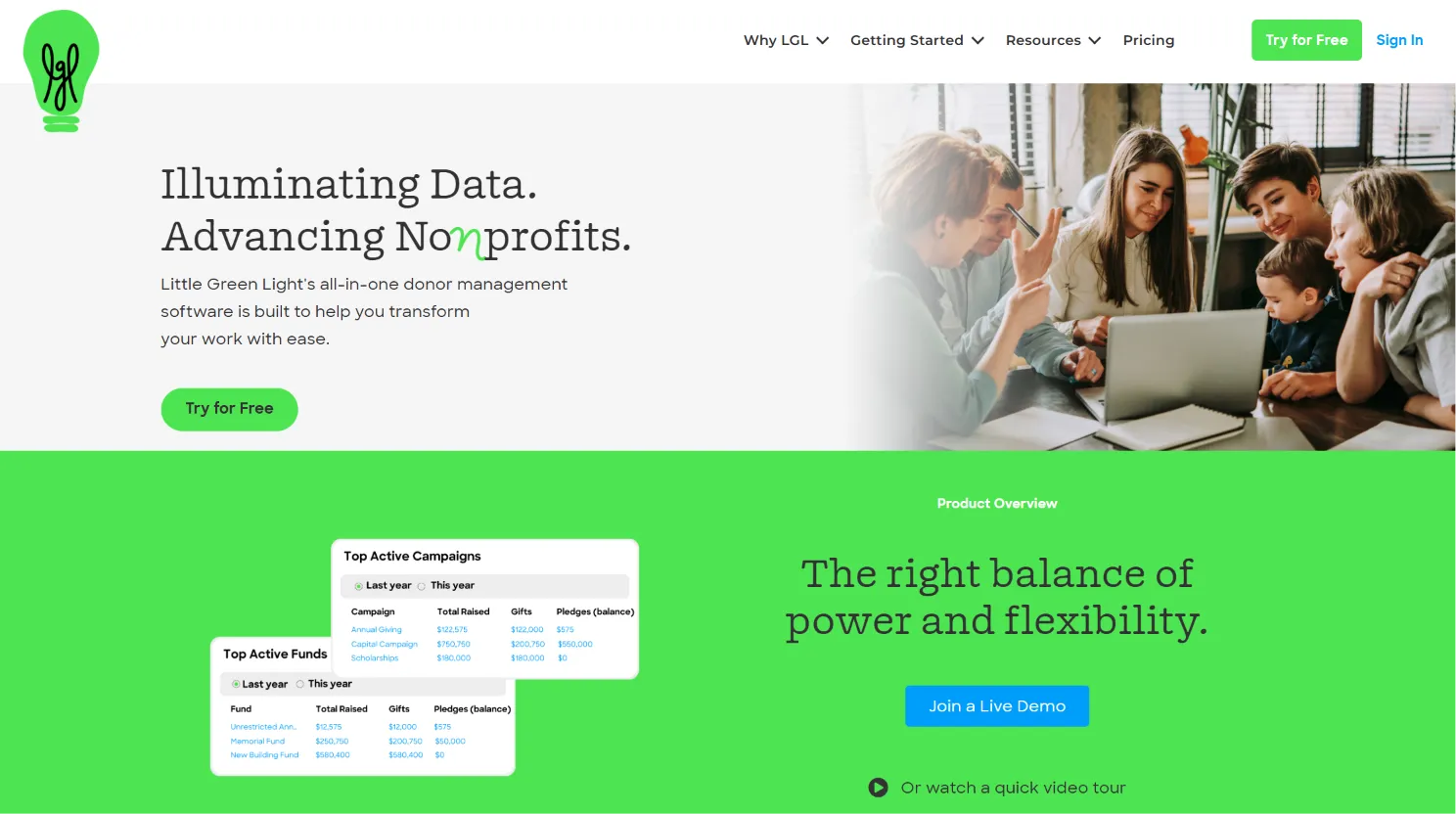
Little Green Light (LGL) is a favorite for small nonprofits and schools. Its focus is on simplicity and affordability, offering core donor management, basic reporting, and online donation forms. The platform is cloud-based, with an interface designed to get new users up and running quickly and with minimal training. LGL includes support for tribute gifts, event management, and simple mail-merge letters.
Pricing: Starts at $45/month, no setup fee, flexible contracts.
- Affordable and easy to use for small teams
- Responsive support and clear documentation
- Quick setup and import tools for standard data
- Lacks advanced analytics and automation
- No dedicated grant management
- Limited integrations beyond basics
7. Kindful (Donor engagement)
Kindful, now part of Bloomerang, is known for its clean interface and strong focus on donor engagement. Its feature set includes online giving, donor profiles, communication tracking, and basic automation. Kindful excels at making it easy to segment donors and track touchpoints over time, with a timeline view for each supporter. Email marketing and event registration are built in, but deeper grant or fund accounting requires external tools.
Pricing: Starts at $119/month, with costs rising as your database grows.
- Clean, intuitive interface for donor engagement
- Easy segmentation and communication tracking
- Integrates with major accounting and event tools
- Standalone future is uncertain as it merges with Bloomerang
- Limited grant and fund management features
- Pricing increases quickly with more records
8. Virtuous (Relationship fundraising)
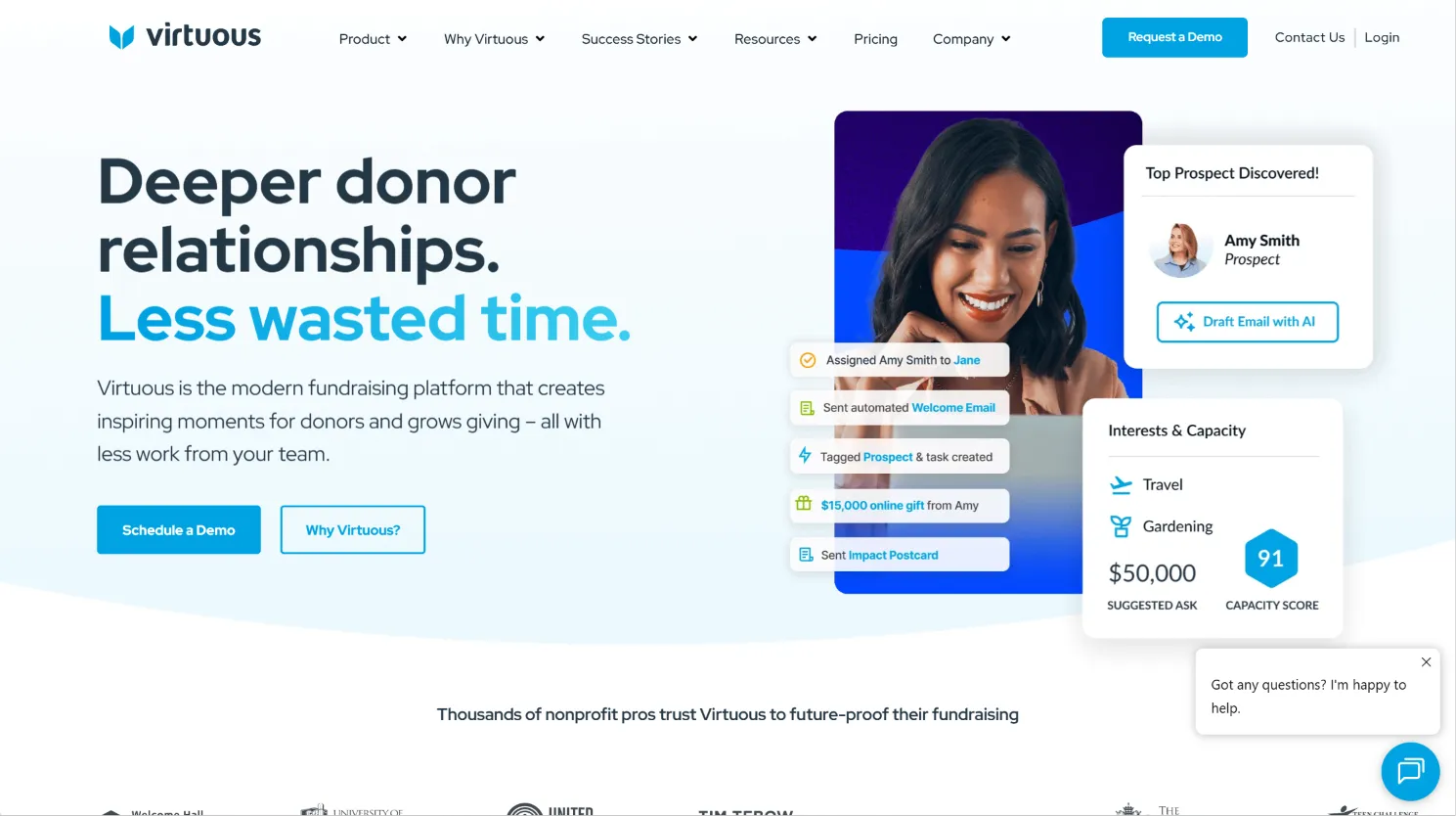
Virtuous is designed for nonprofits that want to move beyond transactional fundraising and focus on personalized donor journeys. Its platform combines donor management with advanced automation, multi-channel marketing, volunteer tracking, and project management. Virtuous’s donor-centric approach helps organizations automate personalized emails, direct mail, and call reminders based on donor behavior and giving history.
Pricing: Starts at $350/month, annual contracts required.
- Advanced automation for donor journeys
- Multi-channel marketing and volunteer tracking
- Strong integrations and API access
- High minimum monthly cost
- Feature set can be overwhelming for small teams
- Requires disciplined data management and training
With a Devaims build, you could run unlimited campaigns and never pay a platform fee again.
9. Devaims (Owning your system)
Devaims builds custom nonprofit CRMs, fundraising platforms, and grant management tools that you own outright. You get the source code, full data access, and workflows designed for your team, not a generic "average" nonprofit. No subscription, no surprise fees, no lock-in. You pay once for the build, then a flat maintenance fee, and the system is yours.
- One-time build, then flat maintenance
- All features and integrations you actually need, not just what comes in a tier
- You keep the code and your data, no vendor rent, ever
- Migration and training included as part of the project
- Unlimited users, records, and custom fields, no per-seat or per-record fees
Integrations: Devaims can integrate with any external system (QuickBooks, Mailchimp, Stripe, Salesforce, or your accounting, email, and reporting tools) as part of your build. Integrations are tailored to your workflows, not just what a SaaS vendor supports out of the box.
Migration friction: The Devaims process includes a deep requirements analysis, full data migration (including custom fields, historical giving, soft credits, and engagement data), and hands-on training. You do not pay extra for onboarding or support during the transition. After launch, you own your data and code, so future migrations (if ever needed) are straightforward.
Concrete use cases: Nonprofits with unique workflows, multi-entity reporting, complex grant management, or those outgrowing SaaS platforms are ideal candidates. For example, a national advocacy group needing custom compliance reporting and multi-lingual donor engagement uses a Devaims build to centralize all operations, automate workflows, and avoid per-user fees.
Other Network for Good alternatives worth knowing
- Apricot (Bonterra): Focused on case management, not a donor CRM. Useful for social services, but not a full fundraising suite.
- Bonterra Impact Management: More for impact reporting and program management than donor relations.
- DonorDock: A rising CRM for small shops, but not as feature-rich as the top picks above.
- CiviCRM: Open-source CRM for nonprofits, highly customizable but requires in-house technical expertise to deploy and maintain.
- Funraise: Modern interface and strong peer-to-peer tools, but advanced features are gated behind higher pricing tiers.
How to choose the right Network for Good alternative
- Sort by budget: Can you handle $99 to $350+ per month, or do you prefer a one-time investment?
- Match to your team’s size: Some tools are overkill for small shops, others too basic for complex orgs.
- Do you need advanced grant management or just fundraising?
- How important is owning your data, workflows, and integrations?
- Can you live with platform lock-in, or do you want to keep your system forever?
Beyond price and features, consider your internal IT capacity, staff turnover, and growth plans. Some platforms are easier to use but harder to customize as you scale. If never paying per-user or per-feature again sounds appealing, it is time to look at what owning your system with Devaims can do for you.
Stop paying rent on donor management: Own your nonprofit CRM
Here’s the rub: every alternative to Network for Good is still rented. You pay month after month, features live behind paywalls, and contract terms can change overnight. Five years later, you have paid tens of thousands and still do not own your donor database or workflows. With Devaims, you get a system built for your nonprofit, delivered with the code and data in your hands, no recurring software rent, no "export nightmare" if you outgrow it.
Devaims is a custom software agency specializing in nonprofit CRMs, fundraising platforms, and grant management systems. You own the code, the database, and every workflow. No one can lock you out, hike your price, or force you to upgrade tiers just to get a feature you need. We do the migration, training, and support, and you keep everything forever.
- Per-user and per-constituent fees disappear: one price, all features.
- Custom reporting, grant tracking, and donor journeys, designed for your team.
- Zero lock-in: Your nonprofit owns the system, data, and codebase for good.
- Maintenance is flat and predictable; no surprise "feature hikes" ever.
| Tool | Ownership | Contract | Export fees |
|---|---|---|---|
| Network for Good | Rented | Monthly or annual | Possible data fees |
| Bloomerang | Rented | Annual | Standard export tools |
| DonorPerfect | Rented | Monthly or annual | Standard export tools |
| Devaims | Owned (your code) | No contract, you own it | No fees, you keep everything |
| Year | Rent (avg SaaS) | Devaims (owned) |
|---|---|---|
| 1 | $6,000 | $32,000 |
| 2 | $12,000 | $33,800 |
| 3 | $18,000 | $35,600 |
| 4 | $24,000 | $37,400 (now ahead) |
| 5 | $30,000 | $39,200 |
If you are paying $500/month for donor management and fundraising, that is $6,000/year, $30,000 over five years for something you never own. With Devaims, the break-even often comes in year 4, and every year after that your system just keeps saving you money. Let us run your real numbers and show you the math. For larger organizations, the five-year savings can reach six figures and eliminate the risk of being forced to migrate again when your SaaS vendor changes direction or pricing.
How to switch from Network for Good
- Export your donor, campaign, and transaction data from Network for Good (CSV or database export recommended). Pay special attention to custom fields, recurring gifts, and soft credits, these often require manual mapping.
- Choose your new platform (SaaS or a Devaims custom build). Evaluate migration tools, support, and the ability to import historical engagement data.
- Import historical data into the new system, test for field mapping, duplicates, and data integrity. Run sample reports to ensure accuracy.
- Reconnect payment processors, integrations, and email systems. Test each integration to ensure gifts, acknowledgments, and communications flow correctly.
- Train your staff on the new workflows and reporting tools. Provide documentation and schedule follow-up support sessions.
- Test parallel for two to four weeks to verify accuracy and uncover issues. Run side-by-side gift processing and reporting to catch discrepancies before going live.
- Review your old contract for cancellation terms, then go live on your new platform. Notify stakeholders of the transition and update any public-facing donation forms or links.
With a custom Devaims build, the migration is handled as part of the project. We help map every field, validate integrity, and provide hands-on support through launch.
Frequently asked questions
What is the best alternative to Network for Good for small nonprofits?
Little Green Light is a top choice for small nonprofits due to its month-to-month flexibility, low starting price, and minimal training requirements. It covers basic donor management, event tracking, and mail merges. For organizations that want to own their system and avoid recurring fees, a Devaims build is the only true own-it option, especially for those with unique workflows or compliance needs.
Which Network for Good alternative is the cheapest?
Givebutter is free to start, but charges a 1.5 percent fee on every donation, which adds up quickly for larger campaigns. Little Green Light starts at $45/month with no setup fee. Over a five-year period, Devaims is the cheapest for organizations with stable or growing donor bases, since you pay once, own the system, and avoid ongoing rent or per-user fees. This is especially true for nonprofits with more than 5,000 records or multiple staff users.
Are there any free Network for Good alternatives?
Givebutter offers a free plan, but platform and processing fees are deducted from every donation. There are open-source tools like CiviCRM, but they often require significant IT resources for setup, hosting, and maintenance. Devaims offers a one-time build so you only pay for what you need and can skip recurring rent entirely, with the added benefit of professional support and no technical headaches.
What is the most customizable Network for Good alternative?
Salesforce NPSP and Devaims are the most customizable. Salesforce offers deep configuration, custom objects, and integrations, but with high costs and complexity. Devaims delivers a platform built for your nonprofit from the ground up, in your preferred language or tech stack, with full ownership of the code and data, no limits on customization, no forced upgrades, and no vendor lock-in.
When should a nonprofit switch from Network for Good?
If you are frustrated by limited reporting, annual price hikes, feature gating, or export headaches, it is time to evaluate Network for Good alternatives. Other triggers include: your team is outgrowing the platform, you need advanced grant or fund tracking, you are tired of paying for features you do not use, or you want to future-proof your operations with true ownership. Owning your CRM with Devaims pays off for organizations planning to grow, those with unique workflows, or those seeking long-term cost stability.
Can I keep my historical data if I leave Network for Good?
Yes, but you may face export limitations or formatting challenges. Some platforms restrict the number of records you can export at once, or require you to pay for full data exports. Custom fields, engagement histories, and soft credits may not map cleanly to your new system. With a Devaims build, your data is always yours, accessible in standard formats (CSV, SQL, or API), and you can export or migrate at any time without penalty.
Is Devaims really different from SaaS alternatives?
Yes. All SaaS tools rent you access and can change pricing or features, sometimes with little notice. Devaims builds a platform you own outright, with no ongoing rent, no forced upgrades, and no lock-in. You have full control over your data, integrations, and future development, your system, your rules.
The bottom line
Every Network for Good alternative in 2026 brings something new, better automation, fresher design, lower fees for a while. But the only way to escape the rent cycle is to own your system. Here is the single decision rule: if your five-year total SaaS spend could have bought you a custom platform, stop renting.
Owning your CRM means your data, your rules, and no more price hikes or feature drama. If you are ready to see what ownership looks like for your nonprofit, talk to Devaims for a free roadmap and side-by-side cost math.
Explore more insights on the Devaims blog. You might also find these useful: Bloomerang alternatives, DonorPerfect alternatives, and Little Green Light alternatives.