



Ever feel like you’re running your pharmacy for your software vendor, not your patients? When a single McKesson EnterpriseRx update breaks your workflow or another fee appears on your invoice, it’s enough to make any owner question what they’re really paying for. Pharmacy software is mission-critical. But as the years go by, monthly bills keep rising and you still don’t own a line of code.
A growing number of pharmacies are looking for McKesson EnterpriseRx alternatives that won’t box them in. The leading options, PioneerRx, Liberty Software, QS/1 NRx, Rx30, Winpharm, Scriptpro, RxSafe, PharmaServ, and BestRx, each bring something new to the table, but most still rent you the same core features on a subscription. The one way out? Owning your own platform, with a custom build from Devaims that’s yours to keep.
Why pharmacies look for McKesson EnterpriseRx alternatives
Pharmacy management systems are the backbone of daily operations, and as the business grows, so do frustrations with legacy or rigid SaaS solutions. Here’s why pharmacy owners and managers are actively seeking alternatives to McKesson EnterpriseRx in 2026:
- Per-script fees add up fast: What starts as a seemingly manageable per-prescription fee can snowball. For a pharmacy processing 5,000 scripts monthly at $0.20 per script, that’s $1,000/month, before any base fee. As your business scales, so does the “rent,” with no equity gained.
- Feature gates and forced upgrades: Many essential tools, like advanced analytics, clinical modules, or inventory automation, are only available in premium tiers. Even basic reporting or e-prescribing may require add-ons, and annual price increases are common. This “feature gating” means your costs can double over time if your needs evolve.
- Locked-in workflows: Most SaaS vendors design their systems for the average, not the outlier. If your pharmacy specializes in compounding, LTC, or unique clinical services, you’re often forced to adapt your workflow to their template. Customization is either unavailable or charged at a steep premium, and changes are subject to vendor timelines.
- Data belongs to them, not you: While vendors tout “easy migration,” in practice, exporting your data, patients, prescriptions, inventory, logs, can be slow, incomplete, and require expensive professional services. Some systems export in proprietary or nonstandard formats, making a clean break difficult or costly. Data portability is rarely a top vendor priority.
- Surprise charges and contract creep: Compliance modules, e-prescribing, texting, telepharmacy, and integration with third-party services can all incur additional fees. The base subscription rarely reflects your true monthly spend. Long-term contracts with auto-renewal clauses are pervasive, locking you in even as your needs change.
If these pain points sound familiar, you’re not alone. Hundreds of pharmacies are re-evaluating their dependence on rented systems and looking for alternatives that offer more control, flexibility, and value.
Quick comparison of the best McKesson EnterpriseRx alternatives
| Tool | Best for | Starting price | You own it? |
|---|---|---|---|
| PioneerRx | Independent pharmacies | Reported around $500/mo | No, monthly subscription |
| Liberty Software | Retail & specialty | Reported around $400/mo | No, monthly subscription |
| QS/1 NRx | Chain & hospital pharmacies | Reported from $450/mo | No, monthly subscription |
| Rx30 | Multi-location | Reported from $500/mo | No, monthly subscription |
| Winpharm | Independent & LTC | Reported from $350/mo | No, monthly subscription |
| Scriptpro | Automation-focused | Custom, often $600+/mo | No, monthly subscription |
| RxSafe | Inventory automation | Custom, often $500+/mo | No, monthly subscription |
| PharmaServ | Retail & closed-door | Reported from $400/mo | No, monthly subscription |
| BestRx | Community pharmacies | Reported from $325/mo | No, monthly subscription |
| Devaims | Pharmacies wanting ownership | One-time build, then $150-230/mo | One-time build, you own it |
Always confirm current pricing and terms with the vendor before you decide. Vendors update pricing and packaging frequently, often with little notice.
The 10 best McKesson EnterpriseRx alternatives
1. PioneerRx (independent pharmacies)
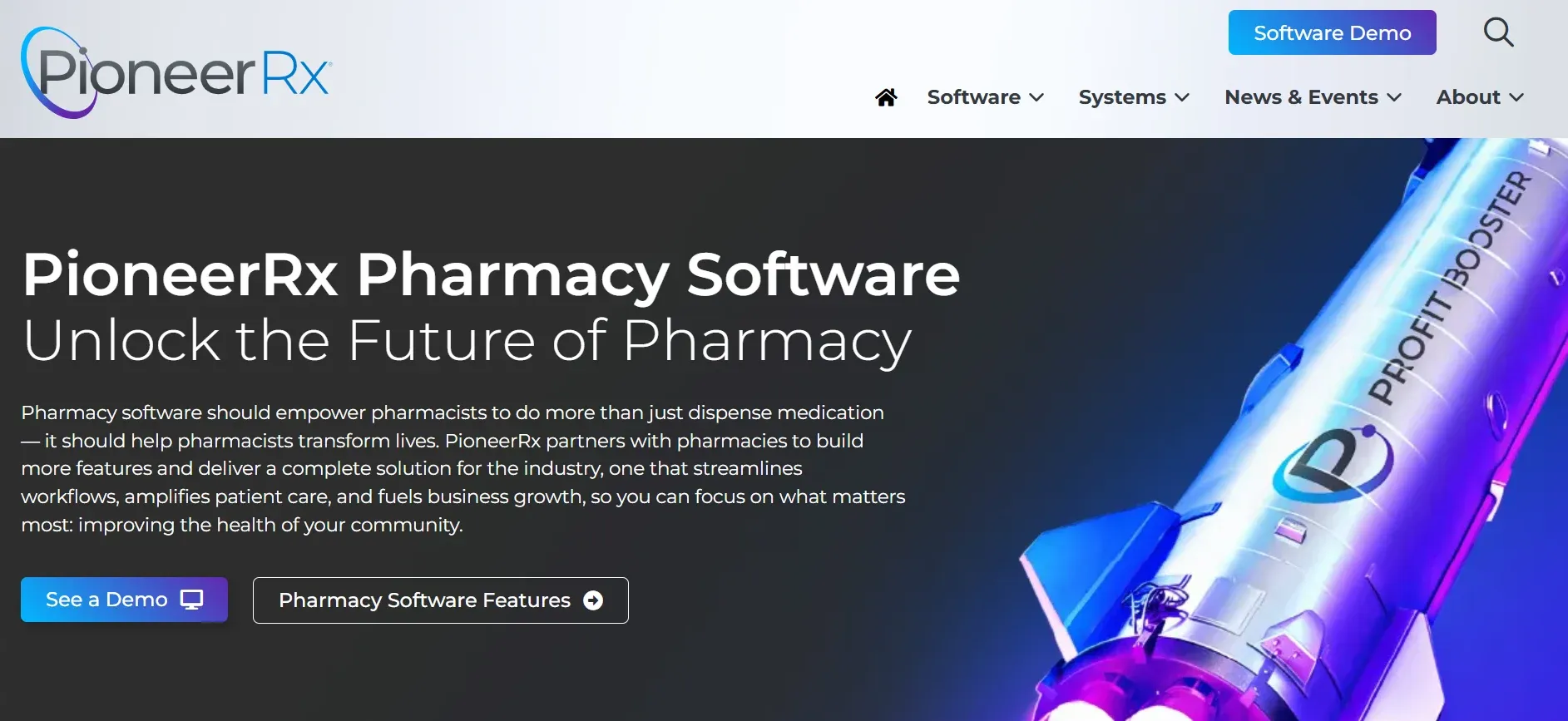
PioneerRx is widely regarded as the “go-to” for independent and small-chain pharmacies seeking a modern, cloud-based experience. Its interface is clean and fast, and the company is known for rapid deployment of new features. Their focus on innovation shows in tools like mobile patient engagement apps, adherence tracking, and integrated clinical services modules.
Integration support is broad: PioneerRx connects with national wholesalers, major robotic dispensing solutions, and a variety of compliance and reporting tools. They also offer integrations for point-of-sale (POS), immunization reporting, and third-party billing. The marketplace of add-ons is extensive, but each addition can increase your monthly spend.
Migration from McKesson EnterpriseRx to PioneerRx is usually smooth, with dedicated onboarding teams, but data mapping for custom fields may require manual review. The biggest sticking point is the cost structure: per-store, per-feature, and occasional per-user fees. As your pharmacy grows, so does your bill, and you never gain any ownership.
Pricing: Starts around $500/month, plus add-ons and per-user fees.
- Modern, user-friendly interface
- Broad integration support
- Strong community and frequent updates
- Recurring subscription with no ownership path
- Feature access tied to plan or add-ons
- Custom integrations require vendor approval
With Devaims, you can own your platform and avoid per-store fees entirely.
2. Liberty Software (retail and specialty)
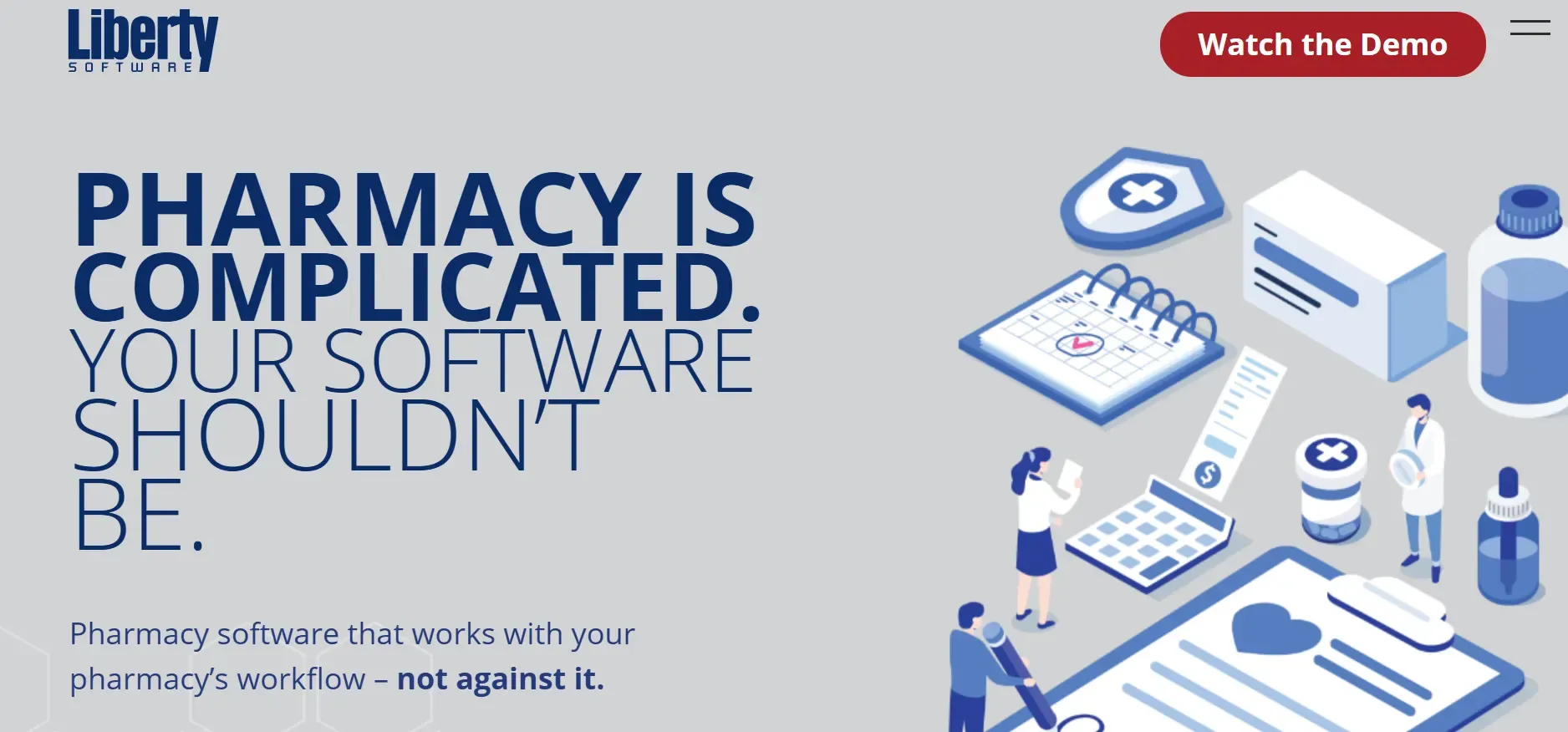
Liberty Software is favored by both retail and specialty pharmacies, especially those seeking a balance between regulatory compliance and ease of use. The platform is HIPAA compliant and offers e-prescribing, inventory management, and strong reporting tools. Their interface is praised for being intuitive, with minimal training required for new hires.
Liberty’s integrations cover most major wholesalers, e-Prescribe (SureScripts), immunization reporting, and a variety of third-party billing systems. Their reporting suite is extensive, with customizable dashboards and export options to Excel or PDF. However, exporting full historical data for migration can be time-consuming, and some fields may not map perfectly.
Liberty’s pricing is tiered: the base system covers essentials, but advanced modules (like clinical services, compounding, or telepharmacy) are add-ons. This model can be cost-effective for smaller operations, but larger or more complex pharmacies will see expenses rise as needs evolve.
Pricing: Starts around $400/month, plus add-ons for advanced modules.
- Intuitive interface and easy onboarding
- Comprehensive compliance features
- Responsive support team
- Customization limited to built-in options
- Advanced features require add-ons
- Data export for migration can be slow
Devaims builds custom reporting and compliance tools to your exact needs.
3. QS/1 NRx (chain and hospital pharmacies)
QS/1 NRx is a staple in the chain and hospital pharmacy world, built for scale and heavy compliance. Its legacy is reliability. NRx handles high script volumes, supports multi-site operations, and offers detailed audit trails for regulatory scrutiny. The platform is also known for its support of complex billing scenarios, including 340B, Medicaid, and multi-payer environments.
QS/1 NRx features deep integrations with automation hardware (ScriptPro, Parata, Kirby Lester), EHRs, and major wholesalers. The platform’s API allows for some custom integrations, but these often require professional services and incur additional charges. Migration from McKesson EnterpriseRx can be challenging if you have custom data fields or legacy workflows, and NRx’s interface, while powerful, is less modern compared to newer options.
QS/1 contracts are typically annual or multi-year, with pricing based on store count, feature set, and support level. Custom development is possible, but at significant cost and with long lead times.
Pricing: Starts from $450/month, with additional fees for modules and integrations.
- Highly reliable and scalable
- Strong compliance and audit features
- Supports complex billing environments
- Annual or multi-year contracts
- Interface less modern than some competitors
- Custom work is costly and slow
4. Rx30 (multi-location pharmacies)
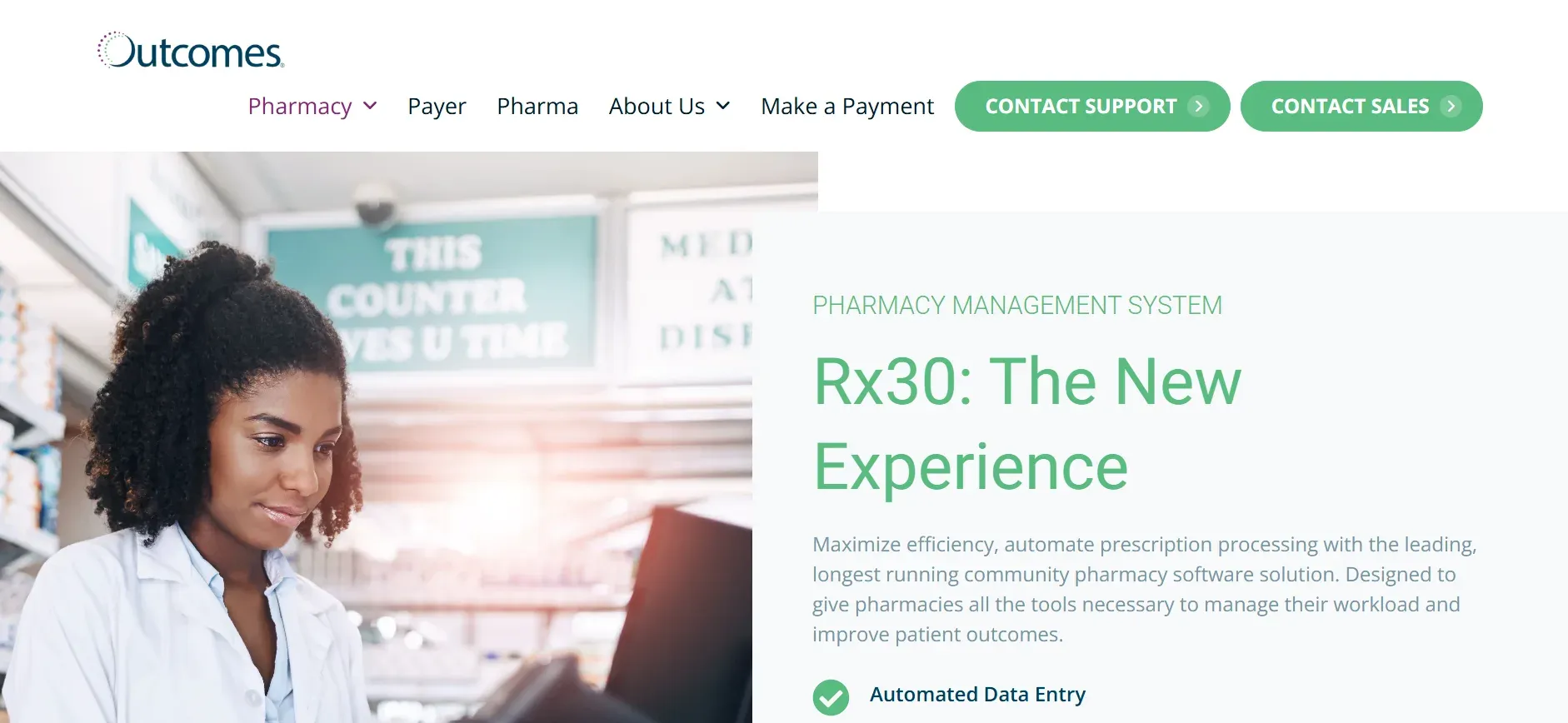
Rx30 focuses on multi-location pharmacies seeking workflow automation, detailed reporting, and electronic claims processing. Rx30’s user interface is straightforward, and the platform is known for its stability and uptime. For pharmacies growing beyond a single location, Rx30 offers centralized management of inventory, reporting, and staff permissions.
Integrations are a strong suit. Rx30 connects with a wide range of POS systems, robotic dispensing units, and patient engagement tools. Their cloud-based option makes remote access and multi-site support easier. Migration from McKesson EnterpriseRx is supported, but data mapping for nonstandard fields can be time-intensive.
Pricing is modular: the base fee covers standard workflows, but automation, clinical modules, and specialty integrations come at a premium. Over five years, the cost can surpass initial estimates, especially as your script volume and number of locations grow.
Pricing: Starts from $500/month, plus fees for automation and specialty modules.
- Centralized multi-site management
- Stable and reliable platform
- Wide integration support
- Customization is limited
- Costs rise with locations and modules
- Data ownership remains with vendor
5. Winpharm (independent and LTC pharmacies)
Winpharm is a budget-friendly option for independent and long-term care (LTC) pharmacies wanting a straightforward solution. Its interface is simpler than some competitors, which can be a plus for smaller operations with limited IT staff. The platform covers core needs: prescription processing, inventory, and reporting.
Winpharm offers integrations with major wholesalers, basic e-prescribing, and some LTC-specific features (such as medication pass and MARs). However, advanced automation, clinical modules, and third-party integrations are limited. Migration from McKesson EnterpriseRx is possible, but data mapping for LTC-specific fields can be a manual process.
Pricing is attractive for new or smaller pharmacies, but as you add users, modules, or require compliance features, costs can rise. You remain on a subscription, with no path to ownership or full customization.
Pricing: Starts from $350/month, with add-ons for advanced features.
- Simple, easy-to-use interface
- Affordable for small pharmacies
- LTC-specific features included
- Limited scalability for larger operations
- Few advanced automation options
- No ownership or deep customization
6. Scriptpro (automation-focused pharmacies)
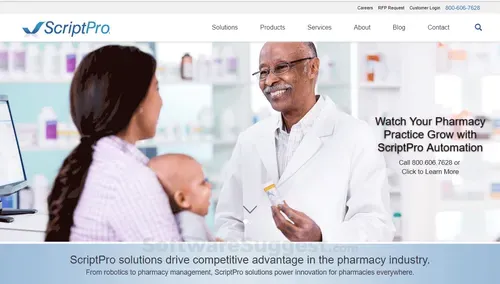
Scriptpro is synonymous with pharmacy robotics and automation. If your pharmacy processes thousands of scripts per day or prioritizes operational efficiency, Scriptpro’s hardware/software bundles can be transformative. Their systems automate pill counting, labeling, and dispensing, reducing labor costs and minimizing errors.
Scriptpro’s software integrates tightly with their robotics as well as many third-party PMR systems, including McKesson EnterpriseRx, QS/1, and Rx30. Their solution also offers workflow management, inventory control, and analytics. However, the full automation suite is a significant investment, often requiring both hardware purchase/lease and a recurring software fee.
Migration from other systems is supported, but the process is complex due to the combination of hardware and software. Training and on-site setup are included in most packages, but ongoing support is required for maintenance and updates.
Pricing: Custom, often $600+/month, plus hardware costs.
- Industry leader in automation
- Reduces labor and errors
- Strong integration with robotics
- High up-front and ongoing costs
- Locked into hardware ecosystem
- Customization of automation logic is limited
7. RxSafe (inventory automation)
RxSafe specializes in inventory automation and high-density storage solutions. Their core product is an automated storage and retrieval system that integrates with most pharmacy management platforms, allowing for fast, secure, and accurate inventory handling.
RxSafe’s software tracks inventory movement in real-time, provides analytics on usage and shrinkage, and helps improve compliance with DEA and state regulations. The system integrates with leading PMR vendors (PioneerRx, QS/1, Rx30, Liberty, and others), but is not a full PMR replacement, you’ll still need a separate software system for prescription processing.
Migration from McKesson EnterpriseRx involves connecting RxSafe to your new PMR; RxSafe provides implementation support, but you’ll coordinate integration with both vendors. Hardware investment is significant, and monthly service fees apply for software updates and support.
Pricing: Custom, often $500+/month, plus hardware investment.
- Excellent for inventory automation
- Improves security and compliance
- Integrates with top PMR vendors
- Requires separate PMR system
- Significant hardware investment
- Ongoing service fees
8. PharmaServ (retail and closed-door pharmacies)
PharmaServ is designed for retail and closed-door pharmacies needing configurable workflows and strong compliance features. The platform includes prescription processing, inventory management, e-prescribing, and robust reporting. It’s particularly popular among pharmacies serving long-term care facilities and group homes.
PharmaServ integrates with a range of third-party platforms: wholesaler ordering, eMARs, billing, and even custom reporting tools. Their support team is known for responsiveness, and they offer tailored onboarding for complex migrations from systems like McKesson EnterpriseRx. However, deep customization of workflows or interfaces is limited to what PharmaServ’s development team will support.
Pricing is modular, with a base fee covering most needs and additional charges for specialty modules (e.g., compounding, telepharmacy, advanced analytics). Migration can be challenging if you have unique data structures, but PharmaServ assists with mapping and data validation.
Pricing: Starts from $400/month, plus fees for specialty modules.
- Strong compliance and reporting
- Responsive support team
- Popular for LTC and closed-door pharmacies
- Customization limited to vendor-supported options
- Subscription model, no ownership
- Migration can be complex for unique data
9. BestRx (community pharmacies)
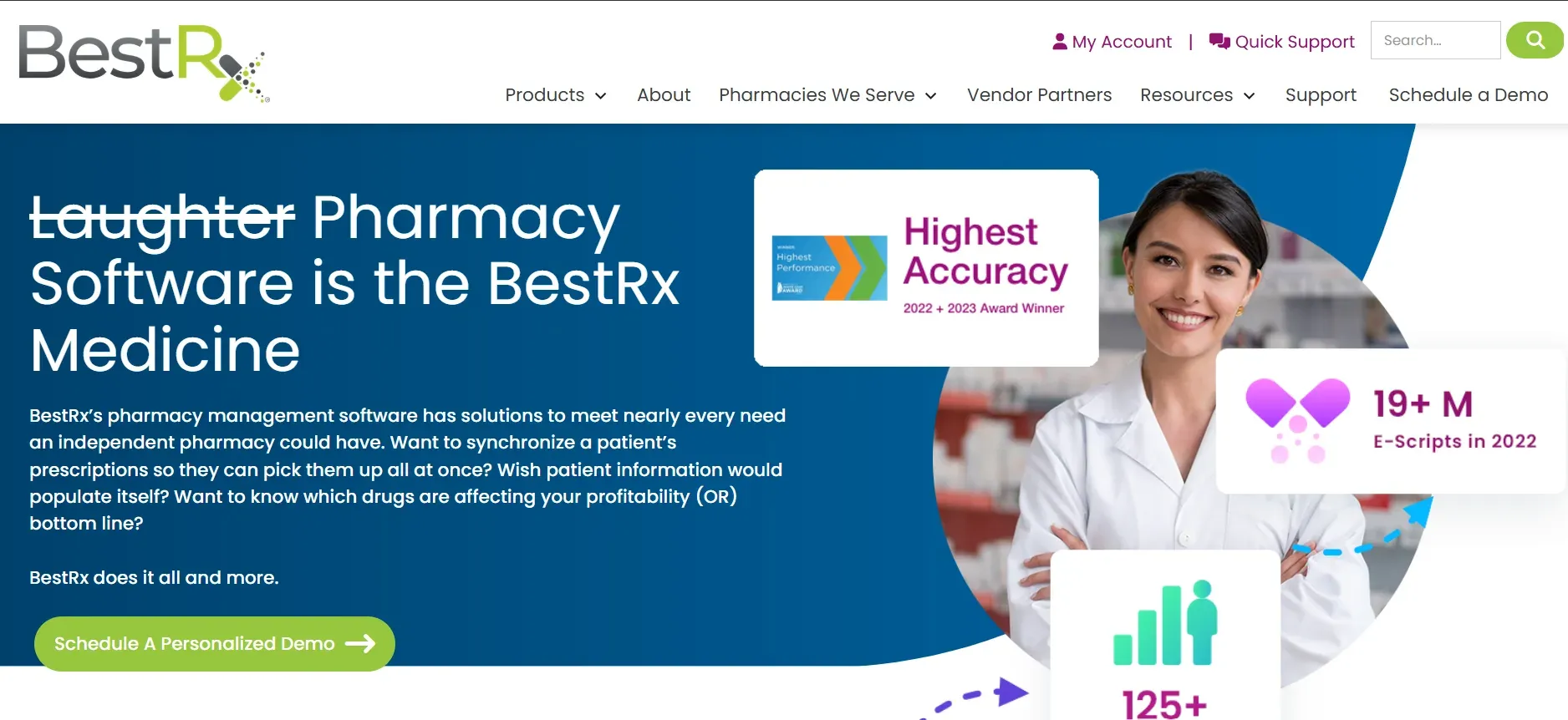
BestRx is a favorite among independent and community pharmacies for its simplicity, affordability, and reliable support. The platform provides prescription processing, inventory, e-prescribing, and basic clinical services. BestRx emphasizes ease of onboarding, with many customers reporting quick training and minimal disruption during migration.
BestRx supports integrations with major wholesalers, SureScripts, and select third-party vendors for compliance and reporting. The system is cloud-based, enabling remote access and multi-location support (at an additional cost). Data migration from McKesson EnterpriseRx is supported, but exporting full historical data can be slow and may require manual cleanup.
Pricing is among the lowest in the industry, but advanced features, such as clinical modules, advanced analytics, or telepharmacy, are add-ons. Over time, total cost of ownership can rise as your needs expand.
Pricing: Starts from $325/month, with add-ons for advanced features.
- Affordable entry pricing
- Easy onboarding and training
- Reliable support for independents
- Minimal customization options
- Advanced features require add-ons
- Data export for migration can be slow
With a Devaims build, you only pay for features you actually use, and you keep them for good.
10. Devaims (pharmacies wanting ownership)
Devaims stands apart by building custom pharmacy management platforms designed for your exact workflow, retail, LTC, specialty, or any mix. The difference is ownership: you receive the source code, full data access, and the freedom to evolve your system as your business grows. There are no per-script, per-user, or per-store fees. Maintenance is a flat, predictable cost, and you’re never forced into upgrades or feature gates.
Devaims handles the entire migration process, including data mapping, integration setup, and staff training, ensuring a smooth transition from McKesson EnterpriseRx or any other platform. Integrations are tailored to your needs: choose any wholesaler, robotic dispensing, compliance reporting, or billing service. If you need a unique workflow, reporting dashboard, or patient engagement tool, it’s built for you from day one.
- Full ownership of code and data
- Custom features and integrations
- No recurring SaaS rent or feature gates
With Devaims, you own the code, the data, and the roadmap, forever.
Other McKesson EnterpriseRx alternatives worth knowing
- Datascan, Focuses on specialty and compounding, with advanced workflow tools for nonstandard dispensing. Pricing and interface may not fit every retail pharmacy, and migration can be complex if you have deep data history.
- Computer-Rx, Good for smaller operations and clinics, with a reputation for strong customer service. Now part of Transaction Data Systems, so product direction and support may change as the company integrates with its parent’s ecosystem.
- SuiteRx, Well-suited for specialty and compounding pharmacies, offering tailored modules for nontraditional workflows. Less common in retail chains, and the learning curve can be steep for teams used to retail-focused systems.
- Micro Merchant Systems, A niche option with a focus on specialty, closed-door, and mail-order pharmacies. Their PrimeRx platform offers advanced features but is less widely adopted, so peer support and third-party integrations may be limited.
How to choose the right McKesson EnterpriseRx alternative
- Budget: Go beyond the sticker price, calculate your all-in monthly cost, including add-ons, per-user or per-script fees, and projected growth. For example, a $400/month base fee plus $0.20/prescription for 5,000 scripts equals $1,400/month. Multiply by the number of stores and years to see your true spend.
- Feature set: List your must-haves: advanced reporting, automation, compliance, telepharmacy, clinical modules, or specialty workflows. Confirm which are included in the base package and which are add-ons. Some vendors only offer certain features in higher-priced tiers.
- Customization vs. out-of-the-box: If your pharmacy has unique needs, compounding, LTC, clinical services, or multi-site operations, consider whether a rented system will support your workflow or force you into workarounds. Ownership lets you build what you need, when you need it.
- Data ownership and migration: Ask vendors how easily you can export all your data, in usable formats, and whether they provide migration assistance. Consider future integrations, will you be able to connect new services, or are you locked down?
- Support and roadmap: Evaluate vendor responsiveness, support hours, and escalation processes. Will your requests be prioritized, or will you wait in line? With custom ownership (like Devaims), you set the roadmap.
If you’re tired of workarounds and want to own your path forward, a custom build might be your exit from SaaS rent.
Stop paying rent on software you could own
The single biggest pain point with McKesson EnterpriseRx, and most alternatives, is that you’re always renting. Add a store, pay more. Want a new feature, pay more. Five years down the road, you own nothing but a stack of receipts. Every system on this list, except Devaims, keeps you in this loop.
Devaims builds pharmacy software tailored to your exact workflow, retail, LTC, specialty, or any mix. You get the full source code, unlimited users, and integrations you choose. No per-script, per-user, or per-store fees. No forced upgrades. You keep your data, and your platform evolves as your business does. Maintenance is flat, predictable, and you’re never stuck waiting for a vendor’s next sprint.
- Per-script fees? Gone. Your system, your logic.
- Feature gates? If you want it, it’s built in from day one.
- Migration headaches? Devaims handles the migration, so you start fresh with your data and team trained.
- Outgrowing your vendor? You own the stack, scale how you want, when you want.
| Vendor | Ownership | Monthly cost (scaled) | Feature access | Contract |
|---|---|---|---|---|
| McKesson EnterpriseRx | Vendor-owned | $600-900+ | Tied to tier | Annual/2-year typical |
| PioneerRx | Vendor-owned | $500-850+ | Locked to plan | Annual |
| QS/1 NRx | Vendor-owned | $450-900+ | Locked to plan | Annual |
| BestRx | Vendor-owned | $325-600 | Add-ons priced separately | Annual |
| Devaims (owned) | You own it | $0 rent, $150-230/mo maint | All built-in features | No contract, yours for good |
| Year 1 | Year 2 | Year 3 | Year 4 | Year 5 | |
|---|---|---|---|---|---|
| Rented (avg. $700/mo) | $8,400 | $16,800 | $25,200 | $33,600 | $42,000 |
| Owned (Devaims: $30,000 build + $200/mo maint) | $32,400 | $34,800 | $37,200 (now ahead) | $39,600 | $42,000 |
For most pharmacies, owning pulls ahead by year 4. After that, it’s all savings and total control. If you want to see the math for your pharmacy’s script volume and locations, talk to us. We’ll run the numbers, no strings attached.
How to switch from McKesson EnterpriseRx
- Export your data: Request a full export of patient, prescription, and inventory data from McKesson EnterpriseRx. Clarify the format (CSV, XML, proprietary) and ask for data dictionaries to aid mapping. Be aware that some custom fields or historical logs may require special handling.
- Select and plan your new platform: Evaluate alternatives based on your workflow, budget, and integration needs. For custom builds (Devaims), scoping includes workflow mapping, compliance requirements, and third-party integrations.
- Data mapping and import: Work with your new vendor (or Devaims) to align data fields, resolve mismatches, and validate records. Test imports with sample data to ensure accuracy before full migration.
- Reconnect integrations: Set up e-prescribing (SureScripts, state PDMPs), billing, wholesaler ordering, POS, and any third-party services. Devaims and top SaaS vendors handle this as part of onboarding.
- Staff training: Schedule hands-on training for all team members. For custom systems, training is tailored to your workflows; for SaaS, it follows the vendor’s standard approach.
- Parallel run and validation: Operate both systems in tandem for a short window, typically 1 to 2 weeks, to catch discrepancies, ensure all scripts and inventory reconcile, and confirm integrations are live.
- Finalize and decommission: Review your old contract, provide proper notice, and ensure all outstanding data or compliance requirements are met before fully decommissioning McKesson EnterpriseRx.
With a custom Devaims build, the migration and training are fully managed as part of the project, minimizing downtime and risk.
Frequently asked questions
What’s the best McKesson EnterpriseRx alternative for independent pharmacies?
PioneerRx is the most frequently chosen for independents wanting a modern, cloud-based system with frequent updates and a strong support community. Liberty Software and BestRx are also strong options, especially for pharmacies focused on compliance or seeking lower entry costs. For pharmacies with unique workflows or those wanting to break the cycle of SaaS rent, Devaims is the only true ownership option, offering custom features and full control.
Which McKesson EnterpriseRx alternative is the cheapest?
BestRx and Winpharm generally offer the lowest starting prices, often $325 to $350 per month. However, it’s important to factor in the cost of add-ons, per-user fees, and growth over time. What appears cheapest up front can become costly if you need advanced features, automation, or multi-site support. Over a five-year period, the “cheap” option may end up costing as much as, or more than, higher-end systems, especially when you factor in lost flexibility and recurring rent.
Is there a free pharmacy management system alternative?
No leading pharmacy management system in the US is truly free due to the complexity of compliance (HIPAA, DEA, state regulations), e-prescribing, and integration needs. Some open-source projects exist globally (like OpenEMR or OpenMRS), but they lack pharmacy-specific features and require significant IT investment, including custom development, hosting, and compliance validation. For most pharmacies, a “free” solution is impractical. Devaims offers transparent, one-time pricing for ownership without ongoing SaaS rent.
When should a pharmacy switch from McKesson EnterpriseRx?
Signs it’s time to switch include: rising monthly fees, frequent price increases, inability to customize workflows, slow vendor support, or the need for features not on the vendor’s roadmap. Plan your migration during a slower business period, and allocate time for staff training and dual-system validation. If you’re opening new locations or adding clinical services, that’s also an ideal moment to re-evaluate your platform.
Can I keep my data when switching to a new pharmacy system?
Yes, you have the right to export your data from McKesson EnterpriseRx, but the process can be involved. Be proactive: request exports well in advance, clarify formats, and ensure all historical data (including custom fields and logs) is included. With Devaims, migration is managed for you, with data validation and mapping included in the project scope.
What if I want a feature that’s not in any off-the-shelf system?
Most SaaS platforms offer limited customization, and custom features are often subject to vendor approval and long development cycles. If you require something unique, such as a custom clinical workflow, niche billing integration, or advanced analytics, Devaims ensures you get exactly what you need, built to your specifications. No waiting for a vendor’s roadmap or submitting feature requests that may never be prioritized.
How do monthly fees for alternatives compare to McKesson EnterpriseRx?
Most alternatives fall between $325 and $900 per month, depending on features, number of stores, and add-ons. However, these fees are recurring and typically increase over time. Devaims is different: after a one-time build fee, you pay only a flat maintenance fee ($150 to $230/month), with no per-user, per-script, or per-store charges. Over three to five years, ownership is often less expensive than renting.
The bottom line
The right McKesson EnterpriseRx alternative depends on your pharmacy’s workflow, size, feature needs, and appetite for ongoing fees. Here’s the real test: add up what you’ll pay over five years, including all add-ons, per-script charges, and support. If that total could have built you a platform you own, it’s time to break the rent cycle. Ownership is not just an IT decision, it’s a strategic move for control, flexibility, and long-term savings.
Explore more pharmacy tech insights on the Devaims blog, or check out other alternatives: PioneerRx alternatives, BestRx alternatives, QS/1 NRx alternatives.