

That donor CRM you rent? In five years, you’ll have paid for it twice over, and still not own a thing. Kindful’s gone, rolled into Bloomerang, and most of its rivals are just new ways to lease your own data, one monthly invoice at a time. If you’ve ever stared at an annual renewal and wondered where the money actually goes, you’re not alone.
The real question in 2026 isn’t "Which SaaS is nicest?" It’s, "Should I keep renting, or is it time to own?" Below, I’ll walk you through the 9 best Kindful alternatives, including Bloomerang, DonorPerfect, and Salesforce Nonprofit. You’ll see the real numbers, the gotchas, and, if you’re ready to stop paying rent, a look at what it takes to have your own platform built by Devaims. The Kindful alternatives list ends where ownership begins. Let’s get you the facts.
Why non-profits look for Kindful alternatives
Opaque pricing and hidden fees: Many donor CRMs, including Kindful (before its sunset), kept actual costs behind sales calls. Setup can run $1,000 to $5,000 or more, and customizations are extra. Even after rollout, recurring charges for “premium” integrations, reporting modules, or additional users can surprise you. This lack of transparency makes planning and budgeting challenging, especially for smaller non-profits with tight margins.
Locked-in contracts: Annual agreements are standard and often auto-renew. If a tool fails to fit, you’re still stuck paying until the renewal window, which can be a major pain point if your needs shift or you discover a critical feature is missing. Early exit fees and data export restrictions also create friction for non-profits looking to switch.
Scaling costs that sneak up: Manage more donors, pay more money. SaaS CRMs almost always use tiered pricing, so the cost rises as your supporter base grows. Some vendors charge per record, others per user or feature, and some combine all three. A tool that fits at 500 donors may become unaffordable at 5,000, without offering more value.
Reporting limitations: Many non-profits hit a wall when it comes to custom reports or integrations, often finding the feature they need is reserved for a higher-priced plan or just not possible at all. Workarounds can become complex and unreliable, especially when boards or funders demand unique metrics.
Ownership and control: After five years of payments, you still don’t control your data or the code. If a vendor sunsets a feature, changes terms, or is acquired, your processes can break overnight. This is the root frustration driving the search for Kindful alternatives: non-profits want true ownership over the systems that power their fundraising and relationships.
Quick comparison of the best Kindful alternatives
| Tool | Best for | Starting price | You own it? |
|---|---|---|---|
| Bloomerang | Kindful users, all-in-one donor CRM | $1,188/year | No |
| DonorPerfect | Growing non-profits | $99/month | No |
| Salesforce NPSP | Large teams, heavy customization | First 10 users free | No |
| Blackbaud Raiser's Edge NXT | Enterprise-level fundraising | Custom quote | No |
| Neon CRM | Small to mid-sized non-profits | $50/month | No |
| Little Green Light | Budget-conscious teams | $45/month | No |
| Network for Good | Smaller organizations | Free plan available | No |
| Virtuous | Advanced automation | Custom quote | No |
| Devaims | Non-profits ready to own | One-time build | One-time build, you own it |
Always confirm current pricing before you decide, the real cost is often in the fine print, including potential add-on fees, support tiers, and integration charges.
The 9 best Kindful alternatives
1. Bloomerang (best for Kindful users wanting continuity)
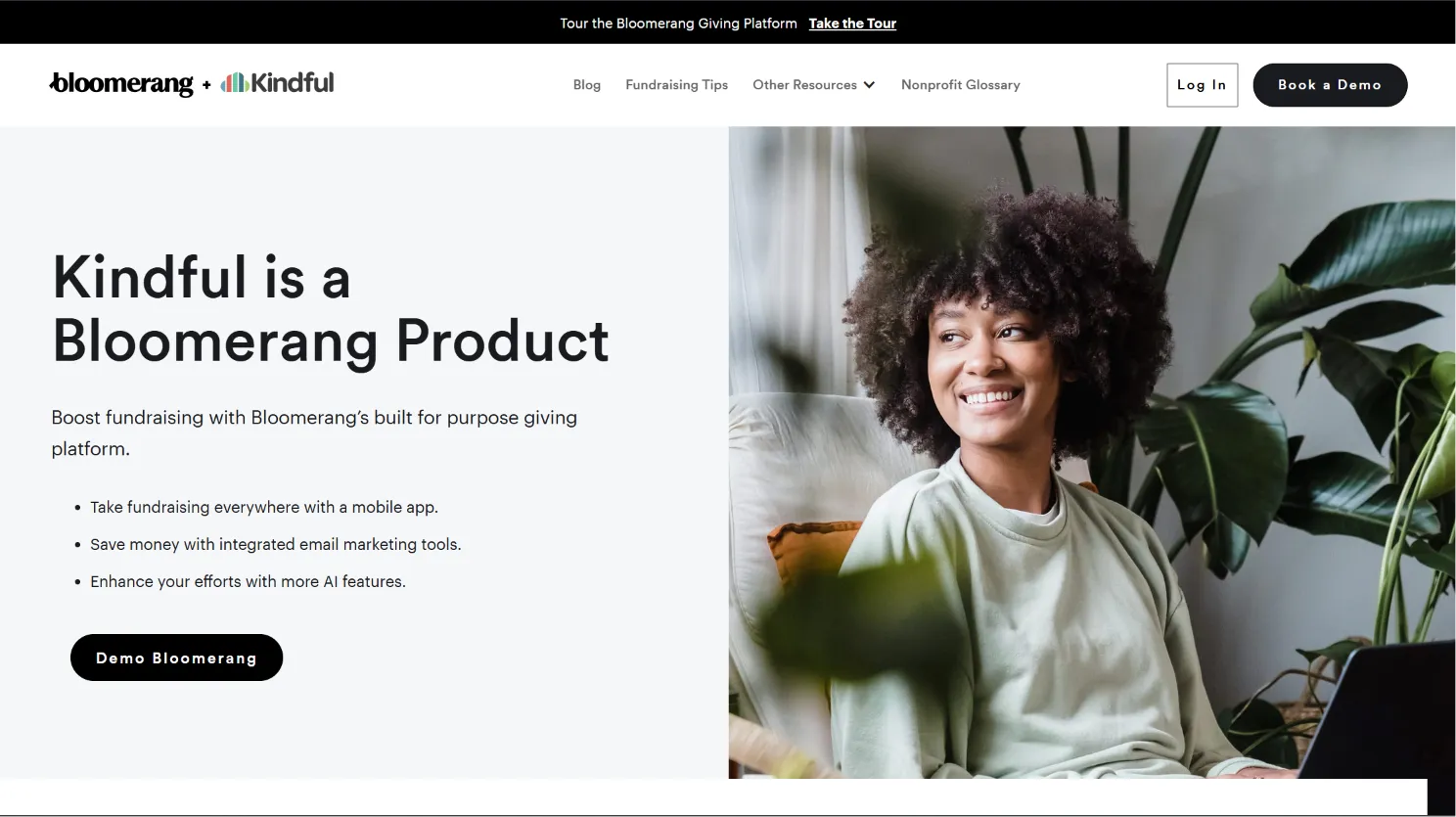
Bloomerang is now the direct successor to Kindful, inheriting its donor management features and adding its own. This makes it the most familiar transition for current Kindful users, and Bloomerang has prioritized migration tools and support to ease the switch. Expect a similar interface, donor profiles, online giving forms, and built-in communications tools. Bloomerang stands out for its focus on donor retention, offering features such as engagement scoring, constituent timelines, and automated thank-you workflows.
Features: Bloomerang provides donor management, online giving pages, email marketing, event registration, volunteer tracking, and reporting dashboards. Its integrations include QuickBooks, Mailchimp, Constant Contact, Zapier, and event tools like Eventbrite. The platform is designed to be user-friendly, with a clean interface and strong onboarding resources.
Migrating from Kindful: Bloomerang offers migration support for Kindful data, but some fields or customizations may not transfer perfectly. Expect some manual cleanup, especially if you used Kindful’s custom fields or workflows extensively.
- Seamless for Kindful users (with migration support)
- Donor engagement scoring and communication tools
- Active user community and responsive support
- Annual contracts, no ownership
- Customization capped at what is on the roadmap
- Some reports and integrations require premium plans
If you ever find yourself wishing for a feature that just can't be added, that's the kind of flexibility you'd get with an owned platform from Devaims.
2. DonorPerfect (best for scaling non-profits)
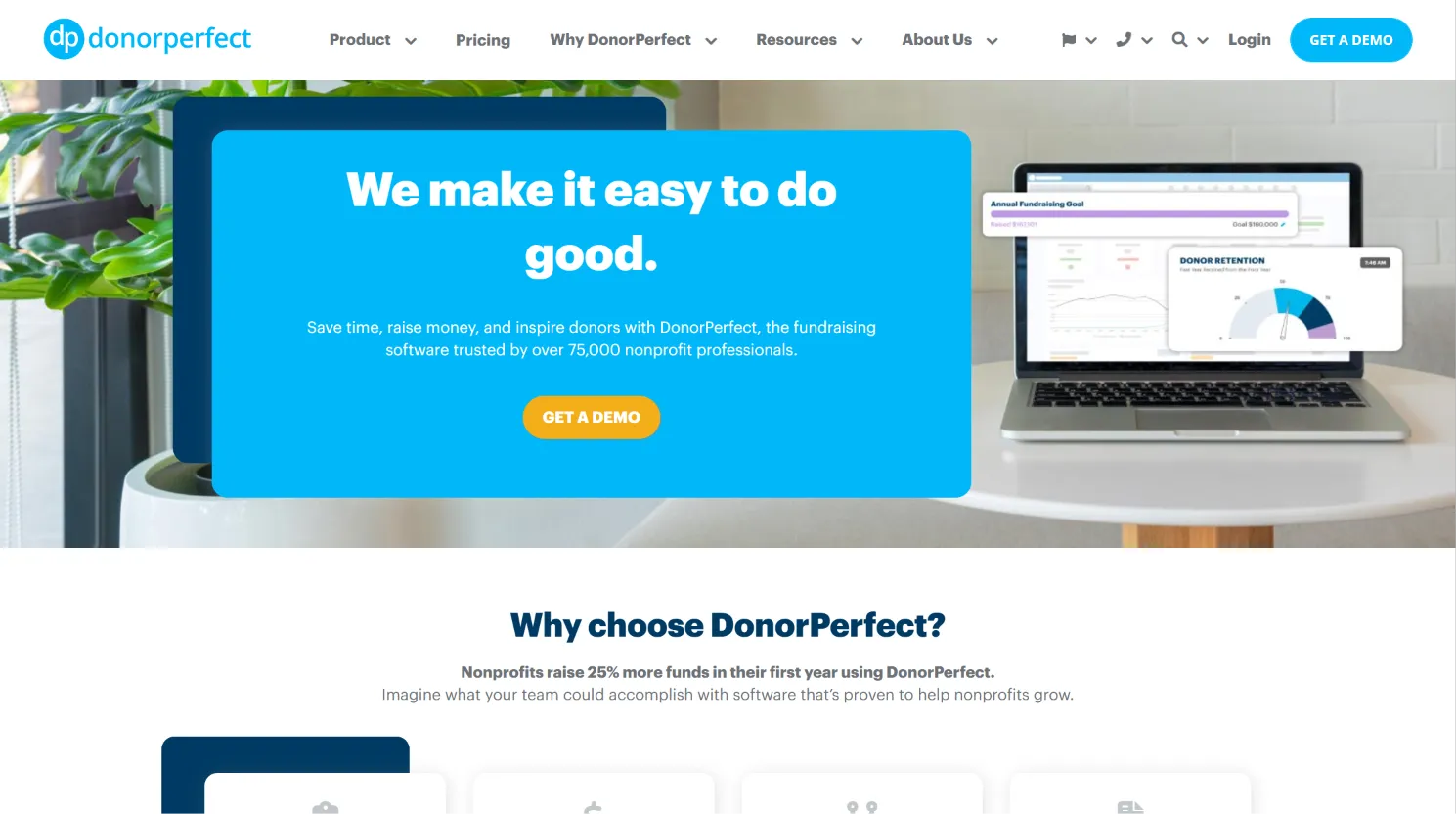
DonorPerfect is a long-standing name in the donor CRM space, popular with mid-sized and growing non-profits. Its tiered pricing and modular add-ons let organizations start small and scale up. DonorPerfect’s interface is functional but can feel dated, and some users find the learning curve steep, especially for complex reporting or workflow automations.
Features: DonorPerfect covers donor and gift management, recurring donations, automated acknowledgments, pledge tracking, and campaigns. Its reporting engine is powerful but not always intuitive. The platform integrates with popular tools like QuickBooks, Double the Donation, Constant Contact, Mailchimp, and Zapier, making it easy to connect with fundraising and marketing apps. The built-in forms and event tools are serviceable, though not as slick as more modern competitors.
Migrating from Kindful: DonorPerfect offers data migration services, but custom fields and notes may require manual mapping. Some users report a period of adjustment as staff learn the new workflow.
- Comprehensive donor management and reporting
- Strong integration support
- Flexible pricing as you grow
- Annual contract lock-in
- User interface can feel outdated
- Setup and training can be time-consuming
On a Devaims build, your interface is designed for your team, not the average user.
3. Salesforce Nonprofit Success Pack (NPSP) (best for customization at scale)
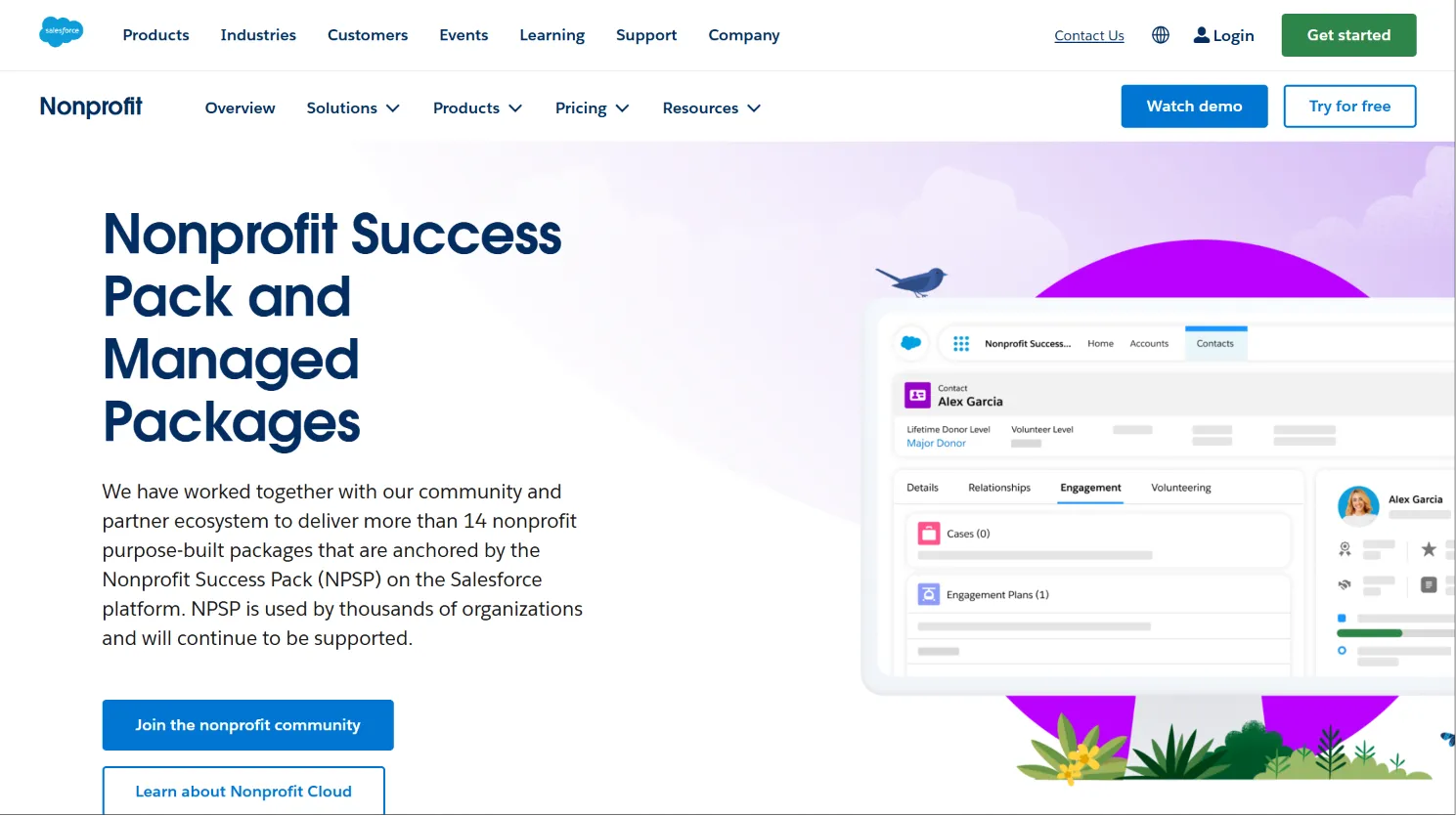
Salesforce NPSP is the most customizable and extensible donor CRM in the SaaS world, with a global ecosystem of consultants and apps. The base NPSP is free for the first 10 users for most non-profits, but the true cost comes in setup, customization, and ongoing consulting. NPSP is built on the commercial Salesforce platform, so you get world-class security, APIs, and workflow tools, but also the complexity of an enterprise system.
Features: NPSP offers contact and donation management, householding, grant tracking, volunteer management, personalized communications, and deep reporting via Salesforce’s dashboard builder. It integrates with a vast range of tools: accounting, marketing automation, payment processors, and custom apps from the Salesforce AppExchange. You can automate complex donor journeys, trigger actions based on giving behavior, and build custom fields and objects for any need.
Migrating from Kindful: Migration is possible but can be complex. You may need a Salesforce partner to map and import data, especially if you have custom workflows or need to maintain historical donation records. Training is a must, as Salesforce’s interface and terminology differ from typical donor CRMs.
- Unmatched flexibility and scalability
- Huge integration ecosystem
- Free for small teams (with caveats)
- Complex setup and ongoing costs
- Requires technical skill or outside help
- No ownership, annual contracts
The cost of customization here is ongoing. With Devaims, what you build is yours forever.
4. Blackbaud Raiser's Edge NXT (best for enterprise fundraising)
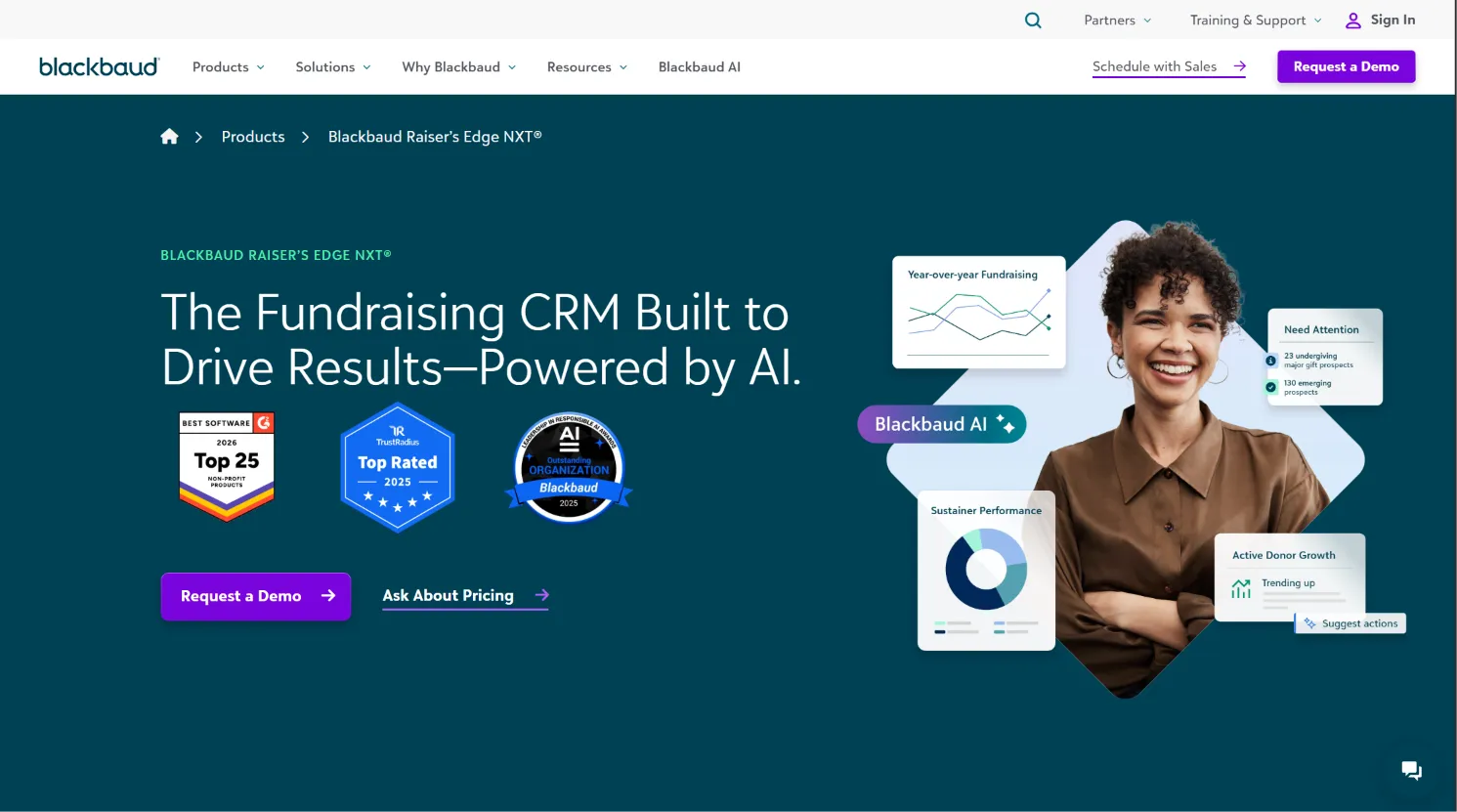
Raiser's Edge NXT is the heavyweight in the non-profit CRM market, trusted by major universities, hospitals, and large non-profits. Its feature set is deep: donor and gift management, major gifts pipeline, grant tracking, volunteer management, and advanced analytics. Blackbaud’s platform is cloud-based but can integrate with legacy on-premise systems for large institutions.
Features: Raiser’s Edge NXT covers every aspect of donor engagement, from segmentation and wealth screening to planned giving and stewardship. The platform supports complex organizational structures, custom roles and permissions, and integrations with Blackbaud’s broader suite (e.g., Financial Edge for accounting, Luminate Online for digital fundraising). The reporting and dashboard tools are enterprise-grade, supporting custom KPIs and board-ready export formats.
Migrating from Kindful: Blackbaud provides migration services, but expect a significant investment of time and money. Staff training is essential due to the system’s complexity. Data mapping, especially for custom fields or legacy data, may require manual intervention.
- Feature depth for large organizations
- Trusted by enterprise non-profits
- Handles complex structures and reporting
- High cost, custom contracts
- Requires significant training
- No ownership, data export can be complex
For teams who want full control, Devaims delivers custom enterprise features without user-based pricing.
5. Neon CRM (best for small to mid-sized non-profits)
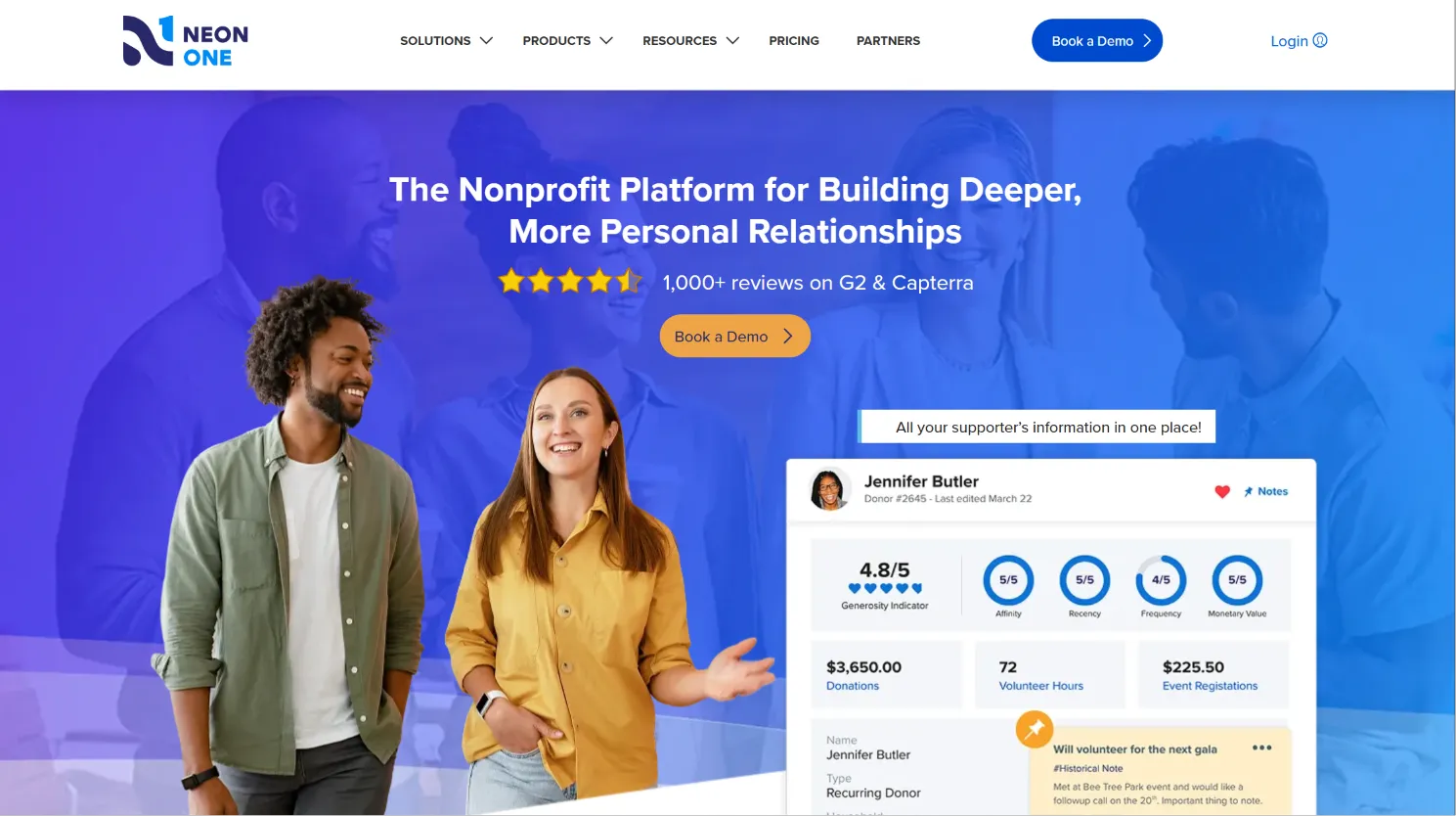
Neon CRM is a modern cloud-based donor management platform designed for small to mid-sized organizations. Its clean interface and affordable pricing make it accessible, while its feature set covers the essentials: donor profiles, online giving, event registration, membership management, and basic communications.
Features: Neon CRM provides customizable donation forms, peer-to-peer fundraising, email marketing, and a mobile app for on-the-go access. Integrations include QuickBooks, Mailchimp, Constant Contact, Zapier, and payment processors like Stripe and PayPal. Neon also offers workflow automation for tasks such as thank-you emails and donor segmentation.
Migrating from Kindful: Neon offers migration support and will help map most core fields. However, highly customized data (e.g., unique custom fields, notes, or legacy segmentation) may require manual adjustment. Their support team is known for responsiveness during onboarding.
- Affordable for small teams
- Modern, user-friendly interface
- Quick onboarding and responsive support
- Limited advanced reporting
- Integration gaps for niche needs
- Annual contracts, no ownership
On a custom Devaims system, your reporting is exactly what your board wants, no workarounds needed.
6. Little Green Light (best for tight budgets)
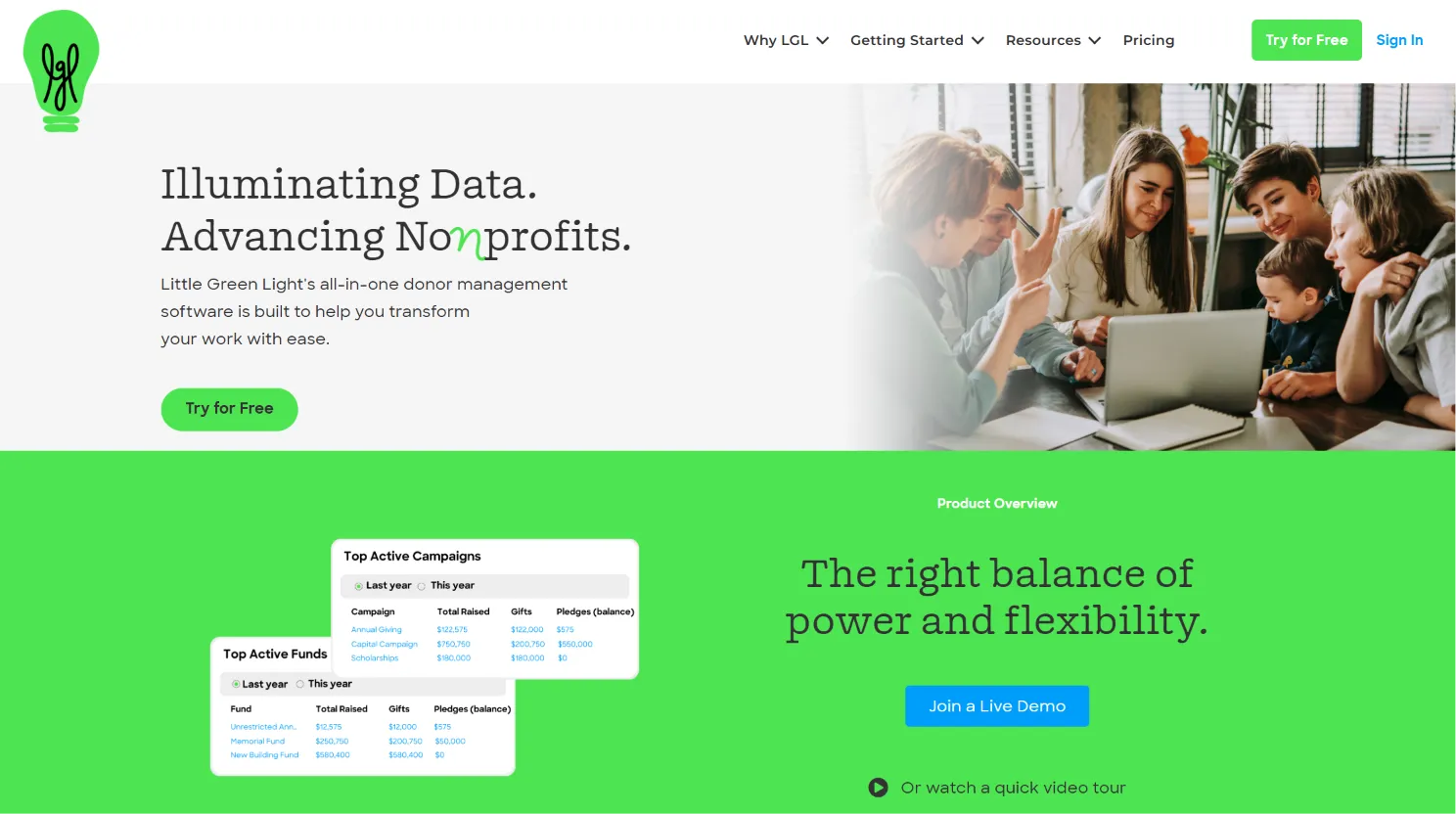
Little Green Light is the budget-friendly choice for non-profits looking for donor management basics at a transparent price. Its simplicity is its biggest asset: you get core CRM functionality, basic event tracking, and online giving, all for a flat monthly fee with no setup charges.
Features: Little Green Light supports donor and gift management, online forms, event tracking, simple mail merges, and pledge management. Integrations include QuickBooks, Mailchimp, Constant Contact, Zapier, and Google Sheets. The reporting is straightforward, with canned reports and some customization via export to Excel or Google Sheets.
Migrating from Kindful: Little Green Light provides import templates and guides, but data mapping is manual. If you have clean CSV exports from Kindful, migration is feasible; custom fields or legacy notes may need adjustment. The support team is known for being hands-on during this process.
- Transparent, affordable pricing
- Month-to-month flexibility
- No setup fees
- Limited custom reporting and integrations
- Not designed for large or complex teams
- No ownership or advanced features
When you outgrow basic features, Devaims can build the next step, custom, but still yours to keep.
7. Network for Good (best for starter non-profits)
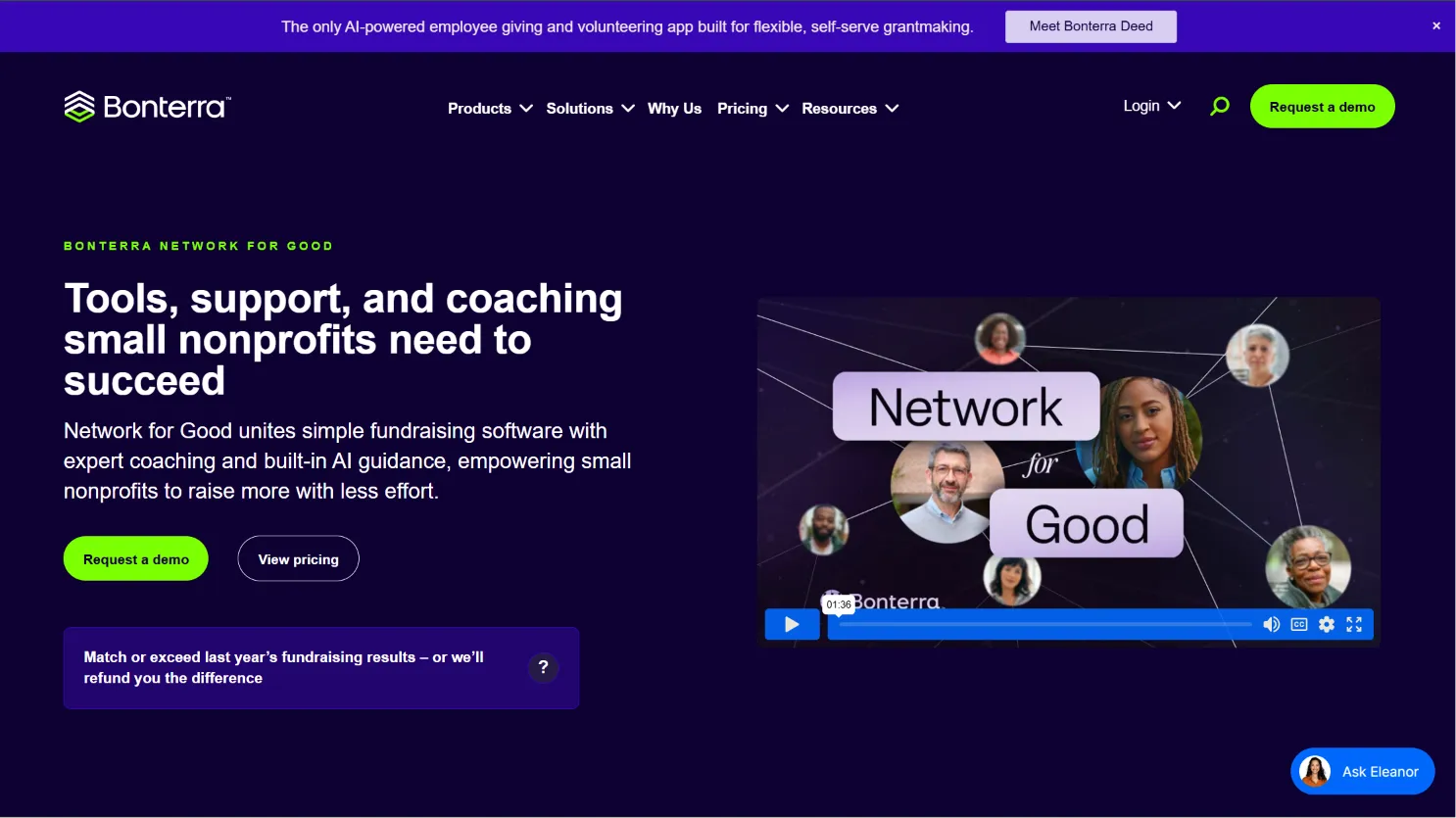
Network for Good provides donor management, fundraising pages, and basic CRM for free or low cost. Its focus is on simplicity and accessibility, making it a top choice for new or very small non-profits. Paid plans unlock features like text-to-give, peer-to-peer fundraising, and more advanced reporting.
Features: Network for Good includes donor database, email marketing, online donation forms, event ticketing, and basic reporting. Integrations are limited but include QuickBooks and Mailchimp. The platform is designed for ease of use, with minimal setup and simple navigation.
Migrating from Kindful: Data import is possible via CSV, but custom mapping and field alignment are manual. The free plan is limited in capacity and features, so most organizations outgrow it as their needs develop.
- Free entry-level plan
- Very simple setup and onboarding
- Good for small campaigns and basic donor tracking
- Limited customization and scalability
- Minimal integrations
- Basic reporting only
As your needs grow, a Devaims build lets you keep all your data, no matter how large your list gets.
8. Virtuous (best for automation and donor journeys)
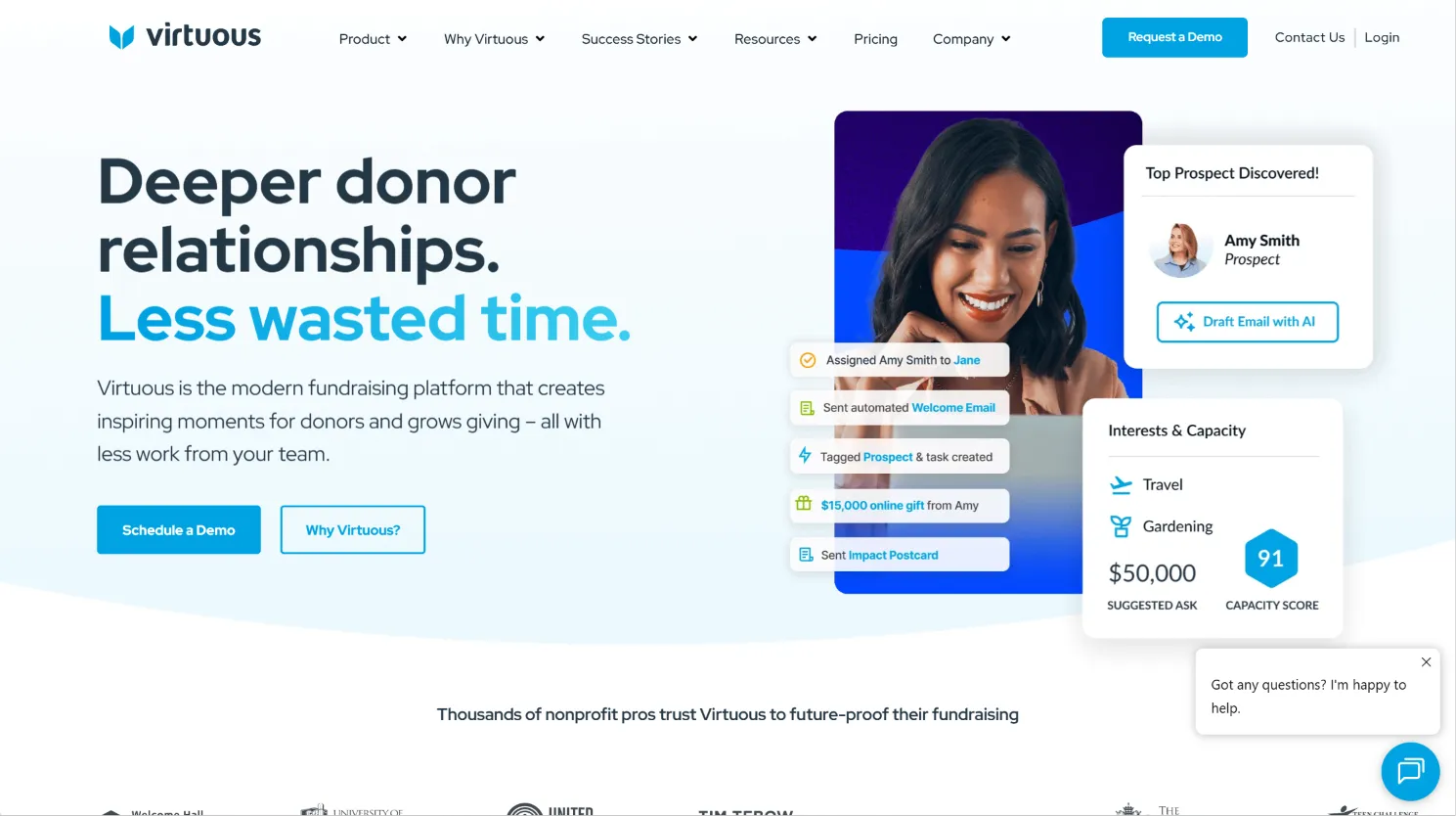
Virtuous is built for non-profits that want to automate donor journeys and personalize engagement at scale. Its standout feature is an automation engine, allowing you to trigger emails, tasks, and reminders based on donor actions. Virtuous also supports segmentation and campaign management, making it ideal for sophisticated fundraising teams.
Features: Virtuous offers donor management, online giving, marketing automation, major gift pipelines, volunteer tracking, and event management. It integrates with QuickBooks, Mailchimp, Zapier, and other fundraising tools. Automation sequences can be built visually, enabling donor journeys and stewardship workflows.
Migrating from Kindful: Virtuous offers migration support, but as with other advanced platforms, mapping custom fields and workflows can take time. Training is important to get the most out of the automation tools.
- Automation and segmentation
- Comprehensive donor and campaign management
- Customer support and onboarding
- High cost, annual contracts
- Learning curve
- Ownership and flexibility limited
9. Devaims (best for non-profits ready to own their CRM)
Devaims is the alternative for organizations tired of renting their donor platform. You get a custom donor CRM, built to your specs, with the source code delivered. No per-user fees, no lock-in, and no surprises. Your data, your platform, your rules. If you’ve ever lost sleep over a price hike or an integration breaking, this is what owning feels like.
Features: Devaims builds are entirely custom: donor management, online giving, event tools, volunteer coordination, grant tracking, reporting dashboards, and any feature your organization needs. Integrations are implemented to match your existing systems, accounting, email, payment processors, even legacy databases. Reporting and analytics are tailored to your board, funder, or compliance requirements. Security and data privacy controls are built to your standards, not a vendor’s.
Migrating from Kindful: Devaims handles the entire migration as part of the build. Your historical data, custom fields, and workflows are mapped and tested, minimizing downtime and manual cleanup. Training is personalized, and documentation is provided for your processes, not generic SaaS features.
- One-time build cost, then flat maintenance
- You own the code, data, and roadmap
- Fully custom features, reporting, and integrations
- No contract lock-in; always portable
- Direct support from the team who built it
On Devaims, there are no limitations, your platform is built for your needs and you own it outright.
Other Kindful alternatives worth knowing
- Givebutter: Excellent for peer-to-peer fundraising and events; less robust for traditional donor CRM. 0 percent platform fee, but relies on donor tips. Good for campaigns and crowdfunding.
- Donorbox: Simple donation forms, but not a full donor CRM. Good for small teams needing just the basics and integrates easily with most websites.
- Wild Apricot: Popular for member management and events, but less focused on donor CRM features. Useful for associations and clubs.
How to choose the right Kindful alternative
- Budget: Be honest about your annual and five-year spend. Factor in setup fees, per-record pricing, and the cost of add-ons or integrations. Don’t forget training and potential migration costs.
- Customization needs: If you want unique workflows, custom reports, or non-standard integrations, look past basic SaaS tiers and consider how much flexibility you’ll need in the future.
- Team size and tech skills: Salesforce NPSP is powerful but needs tech time; Little Green Light is plug-and-play. Consider how much time your staff can dedicate to setup, learning, and ongoing admin.
- Integration requirements: Make a list of the tools you need to connect, email, accounting, event management, payment processors. Not all platforms integrate equally, and some charge extra.
- Ownership appetite: If you want to keep your code and control your data, Devaims is the only option here that delivers true ownership. Think about the risks of vendor lock-in and what happens if your provider changes terms or sunsets your favorite feature.
Ready to stop renting and start owning? Here’s how Devaims changes the equation.
Stop paying rent on software you could own
Every Kindful alternative above rents you access. Whether it’s $99 or $1,200 a month, the math is the same: as your donor list grows, so do your fees. Add a few users, want a custom report, or need an integration? That’s extra. And after five years, you still don’t own a thing. With Devaims, you invest once, pay a flat maintenance fee, and the system is yours, forever.
Who is Devaims? Devaims builds donor CRMs, fundraising platforms, and business software for non-profits. You get the source code, the full platform, and full control. No per-seat pricing, no forced upgrades, and no contract lock-in. If you ever want to move your data or host elsewhere, you can, because you own it.
- No per-record or per-user taxes: Your growth is never penalized.
- Feature set is yours to define: Every report, dashboard, or integration can be built to fit your real process.
- No surprise contract renewals: Maintenance is transparent and predictable.
- Direct support: The team who built your platform is the team who supports it.
Here’s how Devaims stacks up versus the big names:
| Tool | Ownership | Pricing Model | Custom Features | Lock-in? |
|---|---|---|---|---|
| Bloomerang | No | Annual, per-record | Limited | Yes |
| Salesforce NPSP | No | Per user + consulting | High (with cost) | Yes |
| Raiser's Edge NXT | No | Annual, custom quote | High (with cost) | Yes |
| Devaims | Yes | One-time build, flat maintenance | As custom as you want | No |
Now, see how the costs really add up over five years:
| Year | Rented SaaS (Bloomerang/DonorPerfect typical) | Owned (Devaims custom build) |
|---|---|---|
| 1 | $4,800 | $30,000 (build) + $2,400 (maintenance) = $32,400 |
| 2 | $9,600 | $32,400 + $2,400 = $34,800 |
| 3 | $14,400 | $34,800 + $2,400 = $37,200 |
| 4 | $19,200 | $37,200 + $2,400 = $39,600 |
| 5 | $24,000 | $39,600 + $2,400 = $42,000 |
Break-even arrives by year 5 for mid-sized teams. Sooner if you’re scaling fast, or paying more for records, users, or integrations. Want your own numbers? We’ll run them for you.
Non-profits with complex reporting, strict compliance, or a large (and growing) donor base see the most value from owning. But even smaller teams save in the long run when they want real control and no surprises.
How to switch from Kindful
- Export your donor data and reports from Kindful (or Bloomerang, if already migrated). Use the vendor’s export tools to pull all contact, donation, communication, and custom field data into CSV or Excel files. Document any custom fields, workflows, and integrations you rely on.
- Shortlist your Kindful alternatives and select the right fit. Consider the features, costs, and migration support offered by each vendor. Request demos and, if possible, trial access to see how your data and workflows would look in each system.
- Import data into the new system, mapping fields carefully. Many vendors offer import templates or migration services. Pay special attention to historical gifts, recurring donations, and custom fields, these often need manual mapping or cleanup.
- Reconnect payment processors and integrations. Update your donation forms, event registrations, and email tools to sync with your new CRM. Test all integrations to ensure data flows correctly between systems.
- Train your team on the new interface and workflows. Schedule training sessions, create documentation, and assign a point person for questions. Early investment in training saves time and frustration later.
- Test run all donation flows and reporting in parallel before going live. Run a sample campaign, process test donations, and generate key reports. Compare results to your historical data to spot discrepancies.
- Review and finalize any remaining contract or data retention obligations. Ensure you meet data privacy and compliance requirements, and formally close out your old Kindful or Bloomerang account once migration is complete.
With a custom Devaims build, the migration is handled as part of the project, often with a higher degree of data fidelity and workflow matching than typical SaaS migrations.
Frequently asked questions
What is the best Kindful alternative for non-profits?
Bloomerang is the direct successor to Kindful and is the smoothest transition for current users who want to keep a similar workflow. However, if your organization values deep customization, full data ownership, or has unique reporting and process needs, Devaims is the route for true ownership. Devaims lets you define every aspect of your platform and own the code, making it ideal for non-profits planning for the long haul and wanting to break free from SaaS lock-in.
Which Kindful alternative is cheapest?
Little Green Light and Neon CRM start at $45 to $50 per month for basic plans with no setup fees. Network for Good offers a free entry-level plan, although it is limited in features and capacity. These are good for small teams with basic needs. For organizations that want to own outright, a Devaims build is a larger upfront investment but pays off as your team and database grow, especially when you compare five-year costs and factor in the value of ownership.
Is there a free Kindful alternative?
Network for Good offers a free plan for basic donor management and online giving, though you may encounter donation processing fees. Salesforce NPSP is free for the first 10 users for eligible non-profits, but setup and ongoing support may require paid consultants. For organizations that need full-featured CRM, most alternatives are paid. Free options are best for very small or new organizations with limited needs.
Which Kindful alternative is best for large non-profits?
Blackbaud Raiser's Edge NXT and Salesforce NPSP are both popular with enterprise-scale non-profits because they support complex structures, multi-location teams, and advanced reporting. Both require significant investment in setup, training, and ongoing support. If your organization needs deep customization, tight compliance, or wants to avoid user-based pricing, Devaims can develop a platform to fit any scale, and you keep the source code, making it the only option for true ownership at enterprise level.
When should I switch from Kindful or Bloomerang?
If your organization is facing rising costs, needs features only available on higher tiers, is frustrated by limited integrations, or wants to control its data, it’s time to consider Kindful alternatives. The switch is also worth considering if you’re planning rapid growth, expect reporting or compliance requirements to increase, or want to future-proof your donor CRM investment, including the ownership route with Devaims.
Can I keep my old Kindful data?
Yes, your donor data can be exported and mapped into any of the Kindful alternatives listed here, including a Devaims custom build. Data migration is a standard part of the switch. Be prepared to review and clean up custom fields, notes, and historical records. With Devaims, the migration is managed for you, ensuring maximum data fidelity and minimal disruption.
How does Devaims compare to other Kindful alternatives?
Devaims is the only option on this list where you own the software, data, and roadmap outright. All other Kindful alternatives are rented SaaS, with ongoing fees, contract lock-in, and limited flexibility. With Devaims, you define every feature, integration, and report, and you never risk losing access to your data or being forced into a price hike or feature sunset.
The bottom line
Most Kindful alternatives will rent you the same donor CRM features, just under a new logo and contract. The single most useful decision filter? Add up your five-year cost. If that number could have paid for a custom platform you own, it’s time to stop renting.
Owning your donor CRM isn’t just about saving money, it’s about controlling your mission-critical data and never being surprised by a price hike or a feature being "sunset." Want to see what you could build for the same money you’ve spent on SaaS? Let’s talk.
For more insights, visit the Devaims blog or check out related posts like Bloomerang alternatives, DonorPerfect alternatives, and Salesforce Nonprofit alternatives. For additional non-profit tech reviews, see Idealware and TechSoup.