


Ever looked at your Atlas Chiropractic System invoice and wondered how you got here? Another surprise add-on, another fee, and you still do not own a line of the code your practice runs on. That sinking feeling is familiar. Every time a patient signs in, you are reminded the platform is rented, not yours.
If you are eyeing Atlas Chiropractic System alternatives, you are not alone. Many clinics move to ChiroTouch, Jane App, or ChiroFusion for deeper EHRs, cleaner billing, or better scheduling. A few want something custom, a system that serves their processes and belongs to them, end to end. The real question: keep renting or finally own? Let’s break down the honest trade-offs and see if Devaims is the route for your clinic to stop paying rent on software you could own.
Why chiropractic clinics look for Atlas Chiropractic System alternatives
Recurring subscription fees add up quickly. Even basic tiers come with monthly charges per provider or location, which scale as your practice grows. For clinics with more than one provider, these costs can balloon rapidly. If you expand to multiple locations or bring on associates, you are often required to pay for each additional user or site, sometimes at a premium. This model can significantly eat into profit margins and make long-term budgeting unpredictable.
Locked features in higher-priced plans. Many platforms lure you in with a low monthly fee, but as soon as you need advanced reporting, integrations (like with QuickBooks or advanced clearinghouses), or even basic automation, those features are gated behind premium plans. This can force clinics into more expensive contracts just to access tools that become essential as they grow. For example, some platforms restrict access to key analytics, segmenting them into enterprise tiers, which can be frustrating for data-driven clinics.
Long-term contracts and vendor lock-in. Most cloud-based chiropractic EHRs require at least an annual contract, and some lock you in for multiple years. This makes it difficult to switch if your clinic’s needs change or if you become dissatisfied with the level of support or feature development. Early termination fees can be steep, and exporting your data is not always as simple as clicking a button.
Limited customization and workflow control. Off-the-shelf tools often do not match the unique flow of your clinic, leading to workarounds and manual processes. For example, if your intake process or SOAP note requirements differ from the norm, you may be forced to use generic templates, which can slow down care and frustrate staff. Some systems offer limited template customization, but rarely allow deep changes to core workflows or business logic.
Data ownership concerns. With most alternatives, your data sits on someone else’s servers, governed by their terms, not yours. This presents risks for data privacy, compliance, and future migration. In some cases, exporting data for a move incurs fees or significant delays, and you may not get your information in a format that imports cleanly elsewhere. These issues drive practices to consider Atlas Chiropractic System alternatives that give back control.
Quick comparison of the best Atlas Chiropractic System alternatives
| Tool | Best for | Starting price | You own it? |
|---|---|---|---|
| ChiroTouch | All-in-one chiropractic practices | Reported $259/month | No, subscription |
| ChiroFusion | Solo and multi-provider clinics | Reported $99/month | No, subscription |
| Jane App | Multi-specialty and integrative clinics | Starts at $79/month | No, subscription |
| Platinum System | High-volume chiropractic offices | Contact for pricing | No, subscription |
| DrChrono | Integrated EHR and billing | Contact for pricing | No, subscription |
| Kareo (Tebra) | Insurance-heavy practices | Reported $125/provider/month | No, subscription |
| Practice Perfect | Rehab and multidisciplinary clinics | Starts at $69/month | No, subscription |
| Genesis Chiropractic | Automated workflow clinics | Contact for pricing | No, subscription |
| Devaims | Clinics wanting ownership | One-time build, then $150 to $230/month maint | One-time build, you own it |
Always confirm current pricing before you decide, as rates and terms change frequently. Make sure to account for all potential fees: onboarding, data migration, support, and any necessary integrations.
The 9 best Atlas Chiropractic System alternatives
1. ChiroTouch (All-in-one chiropractic practices)
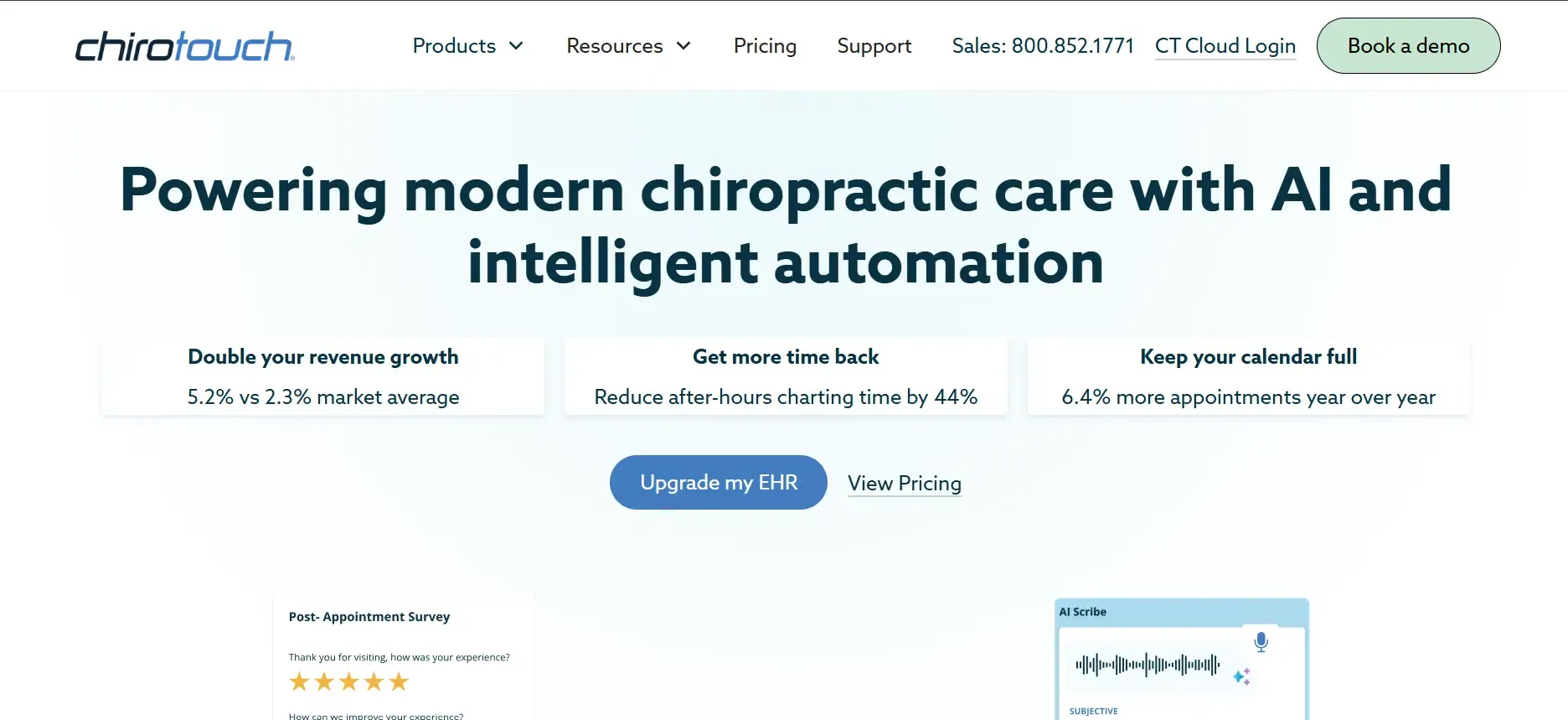
ChiroTouch is one of the most widely adopted chiropractic EHRs, trusted by thousands of clinics in the US. Its comprehensive toolset covers SOAP notes, customizable intake forms, robust billing (including integrated clearinghouse), scheduling, and a patient portal. ChiroTouch has invested heavily in compliance, including HIPAA and Medicare reporting requirements, making it suitable for clinics needing to meet strict regulatory standards.
ChiroTouch’s interface is mature and relatively intuitive, though it can feel complex for new staff. It integrates with major payment processors and clearinghouses, and offers add-ons for telehealth and advanced analytics. The company provides strong US-based support, with onboarding assistance and ongoing training resources.
Pricing: Reported $259/month for standard plan. See details.
- Comprehensive suite for EHR, billing, scheduling, and patient engagement.
- Strong compliance features for insurance-heavy and Medicare clinics.
- Frequent updates and large support community.
- Pricing is per provider, so costs increase linearly as you add staff. For clinics with multiple chiropractors, this can quickly exceed $1,000/month.
- Integrations with certain third-party apps (like advanced analytics or marketing tools) and custom reports may require higher-tier subscriptions or incur extra fees.
- Exporting your full dataset for migration to another platform is possible, but typically requires a support request and may be limited to specific formats, which can complicate moving to a new system.
Who chooses ChiroTouch? Clinics needing a proven, all-in-one solution with little tolerance for risk or downtime. If your practice is insurance-based with complex billing, ChiroTouch may be a fit. However, the per-provider fee structure can be a major drawback for growing practices.
Migration friction: Moving from Atlas or another system to ChiroTouch usually involves data mapping and staff retraining. ChiroTouch’s onboarding team can help, but expect a few weeks of adjustment and the need to audit imported data.
If you want to avoid per-provider fees, Devaims offers a flat-cost, own-it alternative with no user-based pricing.
2. ChiroFusion (Solo and multi-provider clinics)
ChiroFusion is a cloud-based platform designed for smaller clinics that want essential EHR and billing features without the complexity or cost of enterprise software. Its interface is modern and clean, with a focus on quick access to SOAP notes, appointment scheduling, and billing.
ChiroFusion supports basic insurance claim submission, patient texting/email reminders, and simple reporting. It is popular among solo practitioners and small groups who need a reliable, affordable solution. While it integrates with clearinghouses and major payment processors, it lacks the depth of customization found in more expensive systems.
Pricing: Reported $99/month for standard plan. See details.
- Affordable entry price, making it attractive for new clinics.
- Onboarding is fast and straightforward; most clinics are up and running in days.
- Patient communication tools (text/email) are included in all plans.
- Customization is limited mostly to templates; building unique workflows or reports is not supported without developer intervention.
- Advanced billing features, such as in-depth analytics or automated appeals, are locked to higher-tier plans.
- No true offline mode, so a reliable internet connection is required at all times.
Migration friction: ChiroFusion offers data import tools, but some manual mapping may be needed for complex records. Training is relatively easy due to the simple interface, though power users may notice the lack of advanced options.
Trade-offs: You save on upfront costs but may outgrow the platform as your clinic expands or diversifies services. If your workflows are unique or you want deep reporting, you may hit the ceiling quickly.
When you want a system that grows with you and is fully customizable, Devaims lets you own the platform and adapt it as your clinic evolves.
3. Jane App (Multi-specialty and integrative clinics)
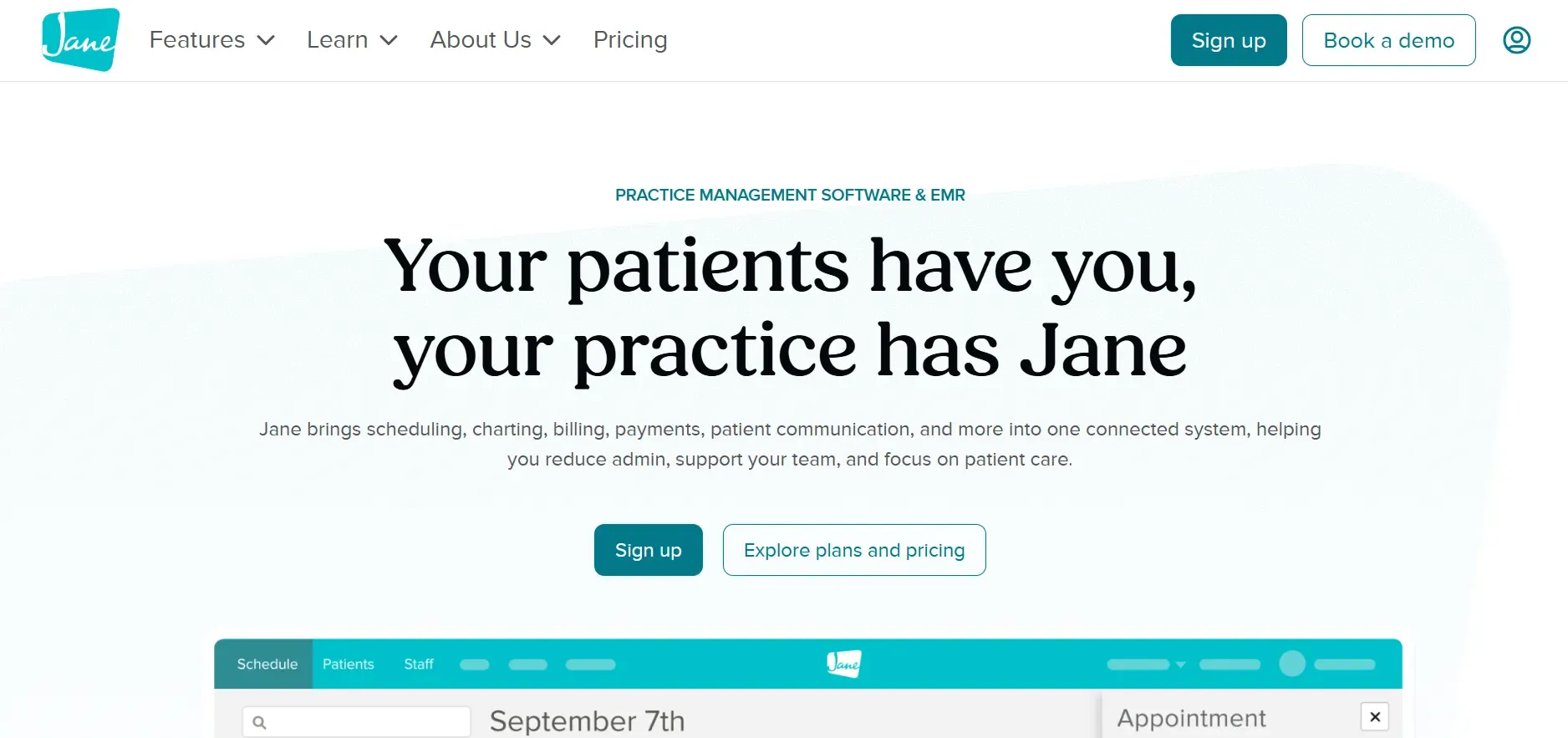
Jane App is widely recognized for its modern, user-friendly design and its flexibility across multiple healthcare disciplines. It works well for chiropractic, physiotherapy, massage, and other allied health services, making it a favorite for integrative or multidisciplinary clinics.
Jane’s scheduling tools are highly visual, with drag-and-drop calendar management and automated reminders. The intake process supports digital forms and e-signatures, and the patient portal is intuitive for both staff and patients. Jane offers basic billing and insurance support, though it is not as full-featured as larger medical EHRs. Integrations include Stripe for payments and Mailchimp for marketing.
Pricing: Starts at $79/month per practitioner. See details.
- Modern, easy-to-learn user experience.
- Excellent online booking and automated reminders.
- Supports a wide range of disciplines and appointment types.
- Every additional provider is a separate monthly charge, which can escalate costs for multi-practitioner clinics.
- Advanced reporting, custom branding, and integration options are only available on higher-priced plans.
- Jane is not fully EHR-certified for insurance-centric clinics; some insurance workflows may require manual workarounds.
Migration friction: Jane’s support team assists with data imports, but migrating complex SOAP notes or billing histories may require additional cleanup. Training is generally fast due to the system’s intuitive design.
Trade-offs: Jane is ideal for clinics prioritizing ease of use and patient engagement over deep insurance billing or heavy customization. For large teams or clinics with complex insurance needs, the cost and limitations can be a barrier.
For clinics wanting to avoid per-provider fees and own their platform, Devaims delivers a custom solution with no recurring user charges.
4. Platinum System (High-volume chiropractic offices)
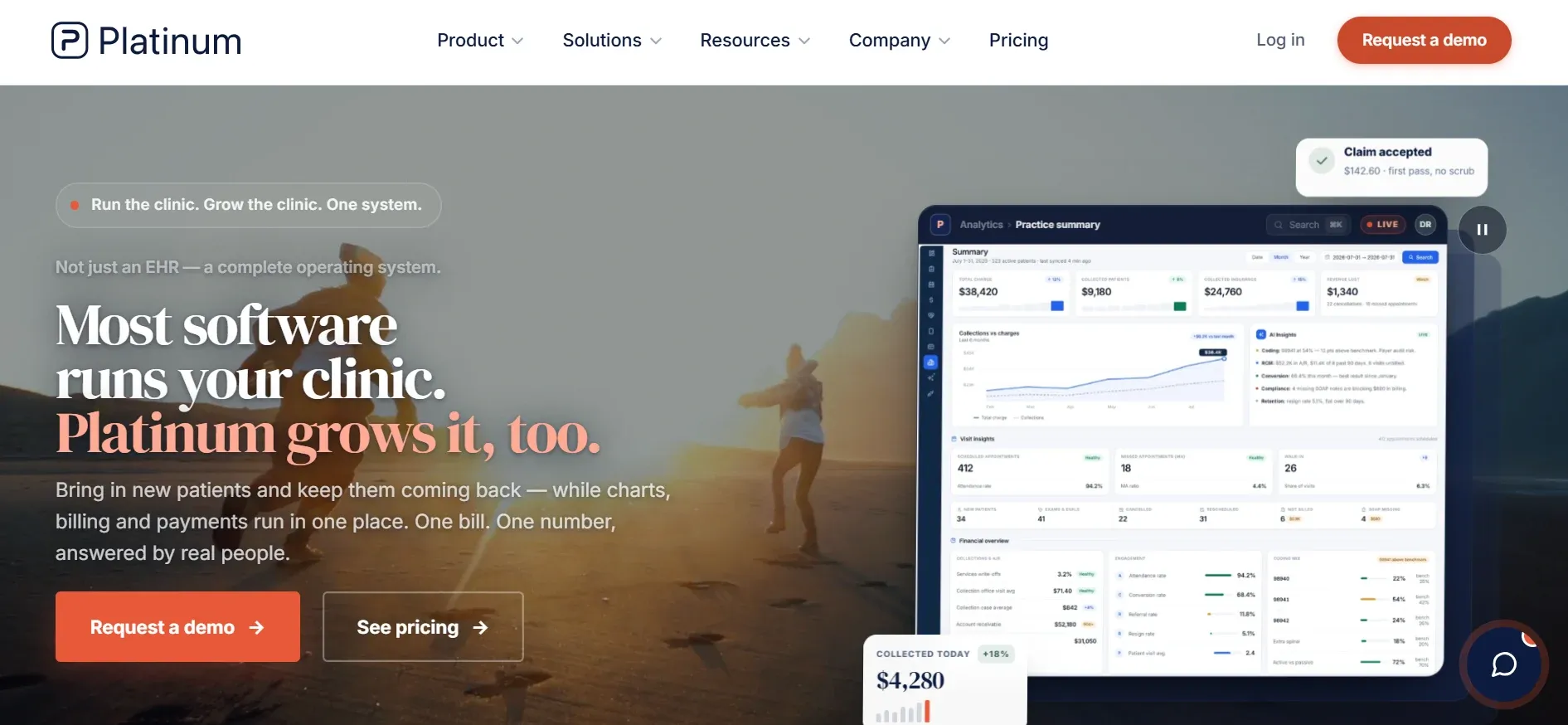
Platinum System is tailored for clinics that need to handle high patient volume with speed and efficiency. Its reputation is built on lightning-fast check-in and appointment management, making it a favorite for high-throughput, walk-in-heavy practices.
The system includes basic EHR, scheduling, and billing features, but its interface is dated compared to modern web-based alternatives. Platinum System is installed locally or hosted on the cloud, depending on your needs. Integrations are limited, and many clinics supplement it with third-party tools for analytics or marketing.
Pricing: Contact for current pricing. Subscription model. Some clinics report onboarding fees and annual contracts.
- Extremely fast check-in, scheduling, and patient throughput.
- Proven reliability for busy, high-volume clinics.
- Long track record in the chiropractic industry.
- Interface and workflows have not kept pace with newer systems, which can impact staff satisfaction.
- Customization for reporting, intake, or integrations is limited and may require vendor intervention.
- Data resides on Platinum’s infrastructure; full exports may be subject to delays or fees.
Migration friction: Local installations may require IT support for migration. Data export/import can be cumbersome, especially if moving to a cloud-based alternative.
Trade-offs: Platinum System’s speed is unmatched for certain workflows, but the lack of modern features and customization can frustrate clinics seeking innovation or improved patient engagement.
When you want a modern interface and full control, Devaims builds your platform to your exact workflow and branding.
5. DrChrono (Integrated EHR and billing)
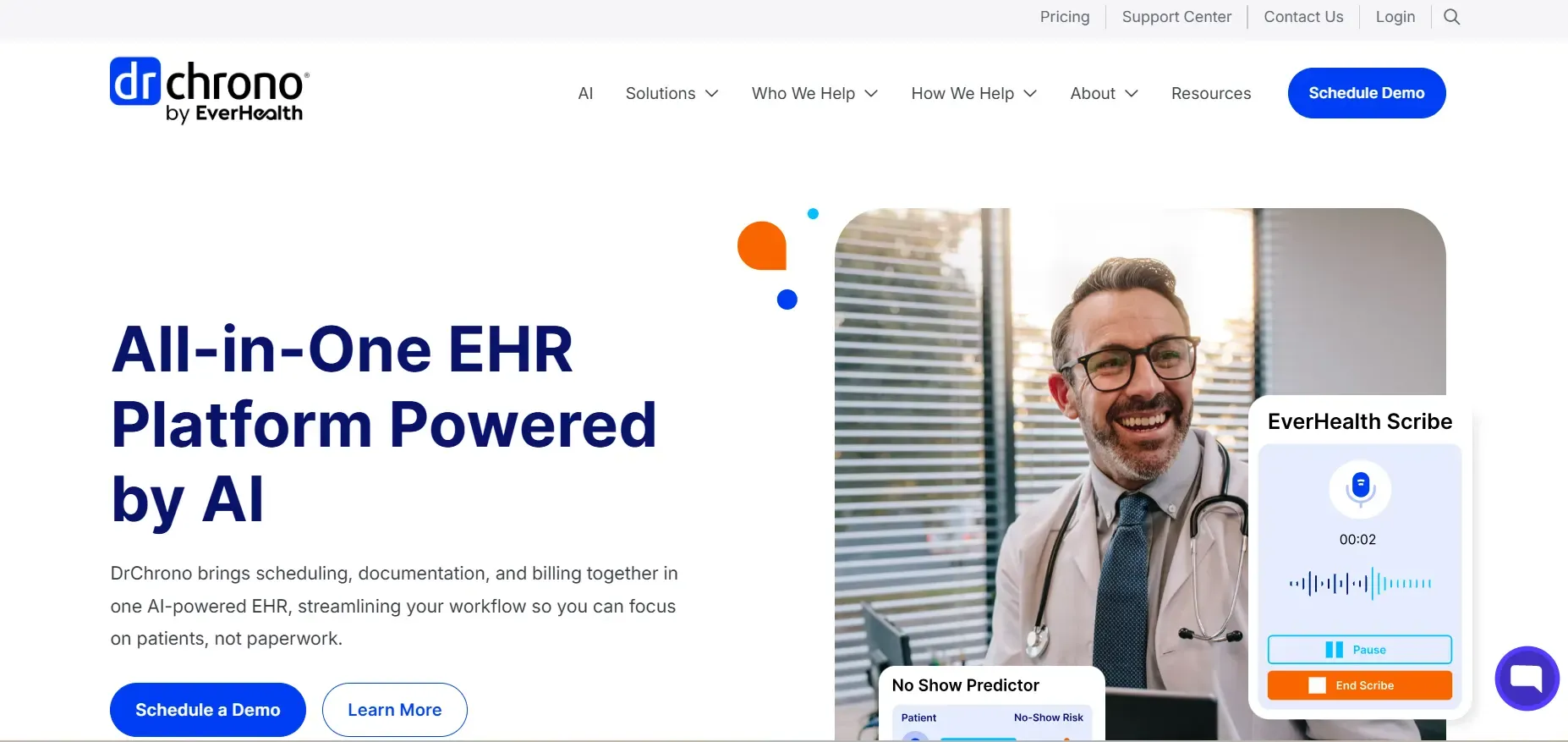
DrChrono is a well-known medical EHR platform with integrated billing and claims management. It is used by a range of medical specialties, including some chiropractic offices, and is especially popular with clinics wanting a single platform for charting, billing, scheduling, and telehealth.
DrChrono offers a mobile-friendly interface, with apps for iPad and iPhone, making it attractive for clinics on the go. The EHR is customizable, though the templates are built for medical doctors, so chiropractic-specific workflows require adaptation. Billing is robust, supporting insurance claims, patient statements, and detailed analytics.
Pricing: Contact for pricing. Subscription tiers based on features and users. Expect add-on fees for telehealth, e-prescribing, or advanced analytics.
- Comprehensive scheduling, billing, and claims management.
- Telehealth and e-prescription capabilities built in.
- Mobile access from anywhere.
- Pricing escalates quickly with add-ons and as you add providers.
- Learning curve is steeper for non-MD clinics, as workflows are not chiropractic-specific.
- Template customization is limited to what DrChrono supports; unique chiropractic needs may not be fully addressed.
Migration friction: Moving data to DrChrono requires careful mapping, especially if coming from a chiropractic-focused system. Staff may need additional training to adapt to the medical-centric interface.
Trade-offs: DrChrono works best for clinics that want medical-grade features and are willing to adapt their processes. For chiropractic-specific workflows, it may feel like a compromise.
Devaims lets you build chiropractic-specific workflows from the start, so you never have to adapt your practice to generic medical templates.
6. Kareo (Tebra) (Insurance-heavy practices)
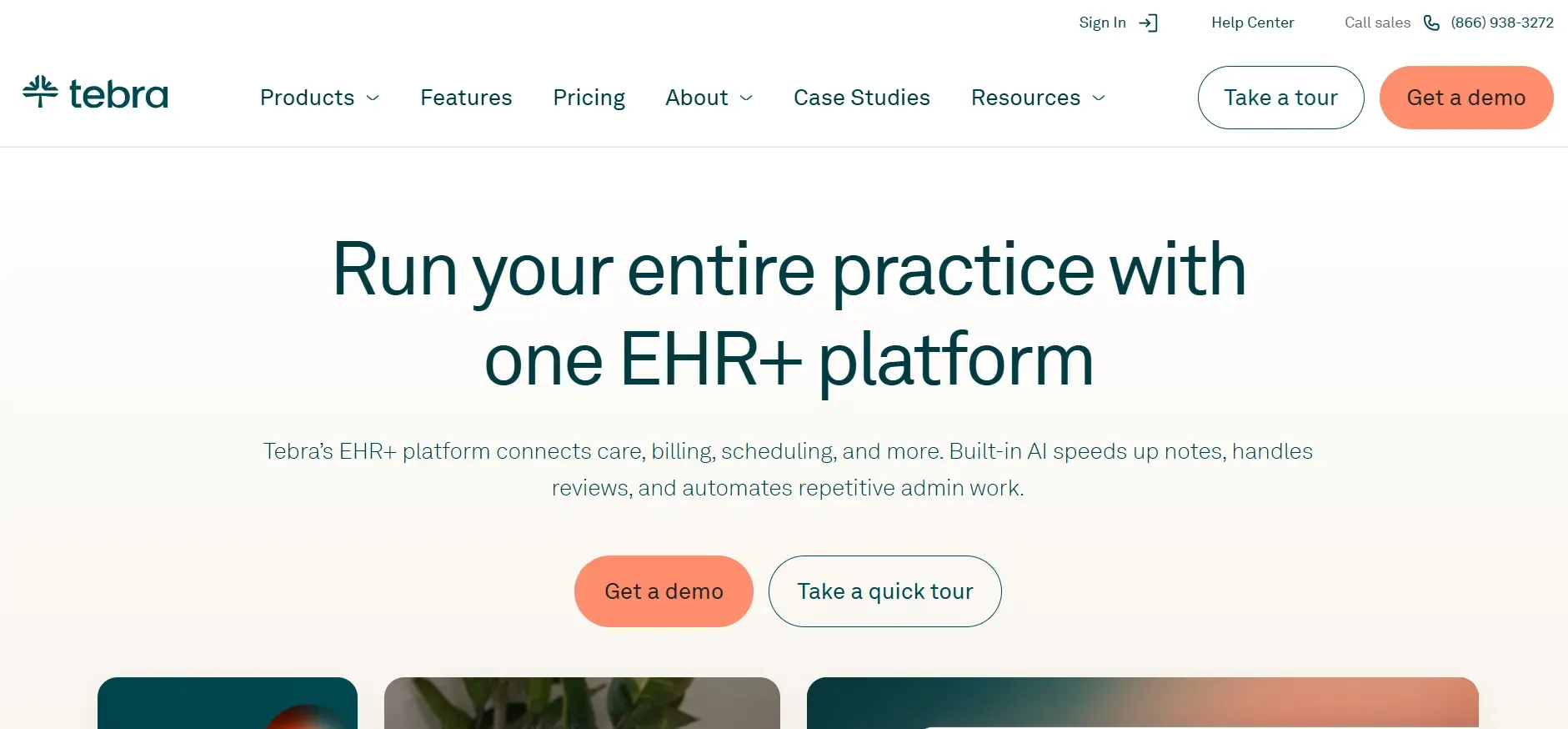
Kareo (now part of Tebra) is a cloud-based EHR and billing system focused on insurance-heavy and multi-provider clinics. Kareo’s strengths are in claims management, electronic remittance, and reporting. Its interface is designed for medical practices, but chiropractic templates and workflows can be set up during onboarding.
Kareo integrates with many clearinghouses and offers a patient portal, appointment reminders, and telehealth (via Tebra). Its reporting engine is strong, allowing detailed tracking of claims, denials, and AR.
Pricing: Reported $125/provider/month. See details. Additional fees may apply for certain integrations or modules.
- Excellent insurance billing and claims management tools.
- Flexible, detailed reporting for financial and clinical data.
- Cloud-based, accessible from anywhere.
- Costs increase with each provider you add, making it less affordable for growing practices.
- Chiropractic-specific templates and workflows require setup and may not be as deep as dedicated chiropractic EHRs.
- Some users report slow support response times or challenges with complex claims.
Migration friction: Data import is possible, but mapping for chiropractic-specific fields can require manual work. Staff training is needed to adapt to the medical-oriented interface.
Trade-offs: Kareo works well for insurance-focused clinics, but the per-provider pricing and less chiropractic-centric workflows can be drawbacks for some practices.
With Devaims, you can integrate insurance billing and claims management into your own system, with no per-provider fees.
7. Practice Perfect (Rehab and multidisciplinary clinics)
Practice Perfect is an EHR and practice management system built for rehab, physiotherapy, and multidisciplinary clinics. It supports scheduling, documentation, billing, and patient engagement, with strong document management and flexible note templates.
Practice Perfect allows for some customization of workflows, and supports multiple provider types within a single clinic. Its interface, while functional, is less modern than competitors, and some users report that reporting and analytics are limited unless you upgrade to premium plans.
Pricing: Starts at $69/month. See details. Pricing scales with users and features.
- Supports a range of provider types and disciplines.
- Flexible document management and customizable note templates.
- Affordable for smaller clinics and solo practitioners.
- User interface can feel dated, especially for clinics used to modern web apps.
- Advanced reports and analytics are only available on higher-tier plans.
- Integrations with third-party apps are limited; you may need workarounds for marketing or analytics.
Migration friction: Data import is supported, but may require vendor assistance for complex records. Training is straightforward, though new users may need time to adjust to the UI.
Trade-offs: Practice Perfect is a solid value for multidisciplinary clinics, but may feel limiting for tech-forward practices or those seeking deep automation.
Devaims can build a multidisciplinary platform tailored to your clinic, supporting all provider types and workflows you need.
8. Genesis Chiropractic (Automated workflow clinics)
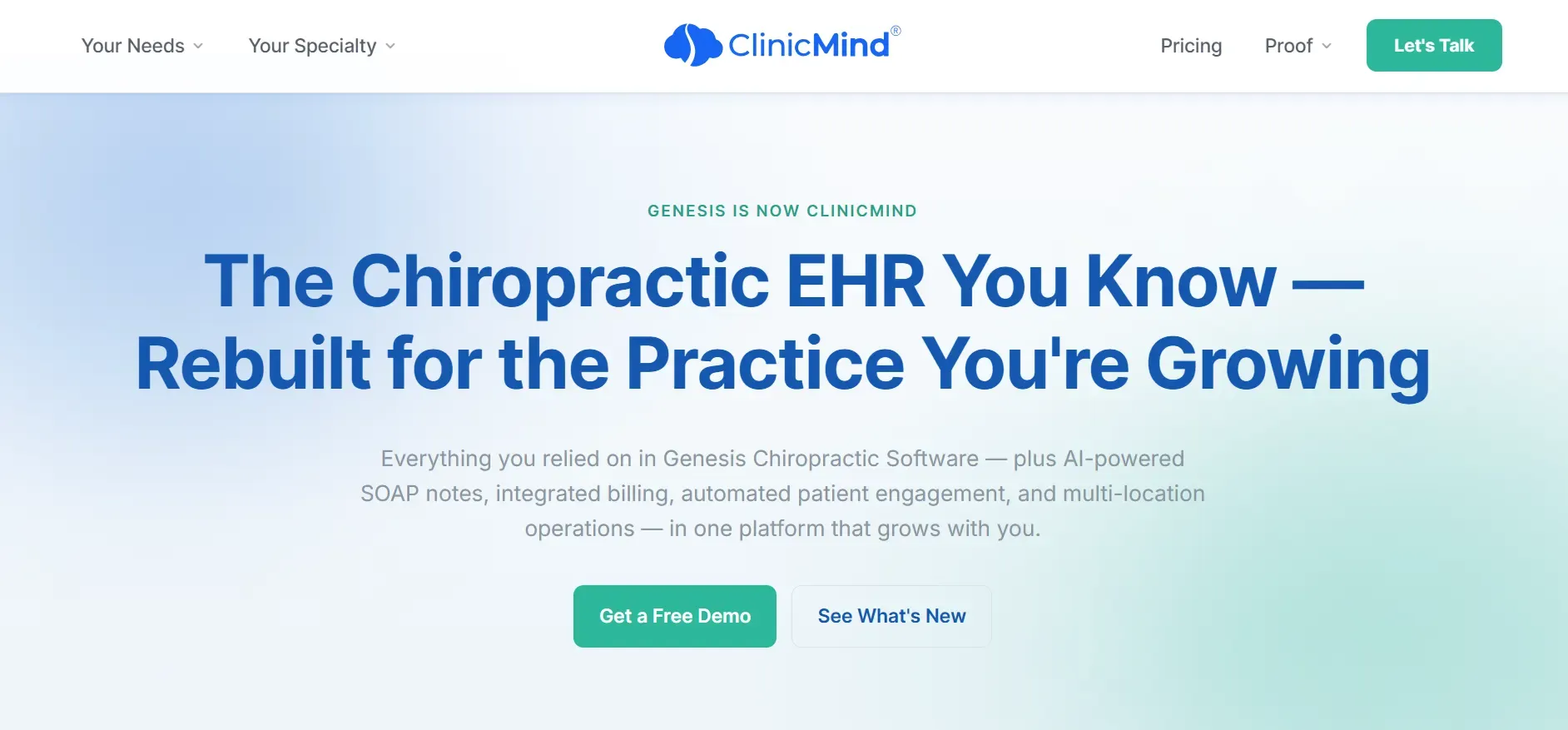
Genesis Chiropractic is a cloud-based EHR built to automate common clinic workflows, from patient reminders to care plan management and insurance follow-ups. Its automation engine is a key differentiator, helping clinics reduce manual tasks and improve compliance.
Genesis offers robust patient communication tools, care plan tracking, and insurance billing. It integrates with clearinghouses and supports custom care plans, making it popular with clinics focused on retention and patient engagement. However, customization is limited to what the system supports, and updates are controlled by the vendor’s roadmap.
Pricing: Contact for pricing. Subscription-based. Pricing is typically based on features and provider count.
- Automates reminders, follow-ups, and care plan tasks.
- Strong tools for insurance billing and AR management.
- Cloud-based, with mobile access for providers.
- Pricing is not transparent and can vary widely based on clinic size and features.
- Customization beyond built-in automation requires vendor involvement.
- New features and updates are only available as Genesis develops them, not on your schedule.
Migration friction: Genesis offers onboarding support, but data migration can be complex if coming from non-standard systems. Training is necessary to fully leverage automation features.
Trade-offs: Genesis is ideal for clinics that value automation and are willing to work within the system’s framework. If you want control over feature development or customization, it may not be the best fit.
Devaims gives you full control over automation and feature development, so you are never limited by a vendor’s roadmap.
9. Devaims (Clinics wanting ownership)
Devaims is the alternative that lets you stop renting and start owning. Instead of paying per provider, location, or feature, you get a system built to your exact workflow, with the source code in your hands. No more feature lock, no more surprise add-ons, and no waiting for someone else’s roadmap. You keep everything: the code, the data, the control.
Devaims’ process begins with a discovery phase, mapping your clinic’s workflows, reporting needs, and integration requirements. From there, Devaims builds a fully custom web-based platform that can include EHR, scheduling, billing, patient engagement, telehealth, and any other modules you need. The platform is designed to integrate with your existing systems, whether that’s a clearinghouse, payment processor, or marketing CRM.
- One-time build, then flat maintenance. No per-user or per-location fees, ever. You can add unlimited providers or locations without extra cost.
- Fully tailored to your workflow, branding, and data requirements. Every feature is built to your clinic’s specifications, not a generic template.
- You own the source code and database, so you control updates, integrations, and exports. No more vendor lock-in.
- Integrates with your existing systems, including clearinghouses, payment processors, and marketing tools. If it has an API, it can be integrated.
- Long-term cost savings: By year five, most clinics find they have spent less than they would have on a subscription-based system, and they own their platform.
Migration is handled as part of the build, including data mapping, import, and staff training. You get a dedicated project manager to ensure a smooth transition from Atlas or any other platform.
Other Atlas Chiropractic System alternatives worth knowing
- Kroll: More common in pharmacy management, not focused on chiropractic. Limited support for chiropractic workflows, and integrations may not fit most practices.
- ProChiropractic: Niche player with limited adoption, may lack support for multi-location clinics and advanced reporting.
- Check industry review sites such as Capterra and Software Advice for emerging EHR platforms, but most will follow the same rent-it model unless you build your own.
How to choose the right Atlas Chiropractic System alternative
- Budget: Weigh full EHR features against per-provider or per-location costs. Consider the five-year total, not just the monthly fee.
- Specific needs: Do you need robust insurance billing, patient engagement tools, multi-specialty support, or advanced reporting? Prioritize platforms that excel in your clinic’s core workflows.
- Clinic size: Small clinics can tolerate per-user fees better, but for growing or multi-location practices, these can be a major expense.
- Workflow fit: Off-the-shelf systems offer convenience but may force you into workarounds. Custom builds let you design every step, but require more planning upfront.
- Data control: Decide if you need to own your data and platform, or if renting is sufficient. Consider compliance, privacy, and future migration when making this decision.
If you are ready to explore what owning your practice software could look like, Devaims is your next move.
Stop paying rent on software you could own
Every alternative to Atlas Chiropractic System shares a core problem: you are always renting. Subscription fees, per-user surcharges, and feature-gated upgrades mean you are locked into someone else’s roadmap and pricing. In five years, you may have paid enough to have built your own system. That is where Devaims makes the math work for you.
Devaims builds custom web, mobile, and business software for chiropractic clinics. You keep the source code, own the data, and control every workflow. No per-unit or per-location fees, no feature locked behind a paywall, and no contract that outlives its value. You get a system designed for your clinic, not a generic template.
- Per-user fees? Gone. Add as many providers as you want, the cost is the same.
- Feature limits? You define what gets built, and you own every feature.
- Locked data? You keep the database and control exports and integrations.
- Evergreen costs? After the build, only flat, transparent maintenance.
| Platform | Ownership | Pricing model | Who controls features? |
|---|---|---|---|
| Atlas Chiropractic System | Rented | Subscription, per-provider/location | Vendor |
| ChiroTouch | Rented | $259/month, per-provider | Vendor |
| Jane App | Rented | $79/month per practitioner | Vendor |
| Devaims | Owned | One-time build, then flat maintenance | You |
Let’s do the five-year cost math for a growing clinic:
| Year | Rented (subscription, $259/mo x 3 providers) | Owned (Devaims, $30,000 build + $200/mo maint) |
|---|---|---|
| 1 | $9,324 | $32,400 |
| 2 | $18,648 | $34,800 |
| 3 | $27,972 | $37,200 |
| 4 | $37,296 | $39,600 |
| 5 | $46,620 | $42,000 (now ahead) |
By year five, owning pulls ahead. For clinics with more providers, the math turns even faster. If you want a system that is yours, not rented, Devaims is the only honest alternative.
How to switch from Atlas Chiropractic System
- Export all patient and financial data from Atlas (request CSV or similar files). Some vendors may charge for this or require a support ticket. Be sure to request all custom fields, attachments, and historical billing records.
- Evaluate and choose your next platform from the Atlas Chiropractic System alternatives above. Consider doing a demo or trial run to test workflows and integrations.
- Import your records into the new system, mapping fields as needed. For custom fields or legacy notes, you may need to work with the new vendor’s support team.
- Reconnect payment processors, clearinghouses, and integrations. Verify that all connections are secure and compliant.
- Train staff on new workflows and test parallel runs for at least a week. This ensures no data is lost and that everyone is confident before going live.
- Review your Atlas contract for cancellation terms to avoid extra fees. Some contracts require 30 days’ notice or have early termination penalties.
With a custom Devaims build, the migration is handled as part of the project. You get a migration plan, data audit, and hands-on support to ensure nothing is lost in the transition.
Frequently asked questions
What is the best Atlas Chiropractic System alternative for clinics needing full EHR and billing?
ChiroTouch and Jane App are the most popular for clinics seeking all-in-one EHR and billing with a proven track record. ChiroTouch is more insurance- and compliance-focused, while Jane App excels at patient engagement and ease of use. Both, however, are subscription-based and limit long-term control. Devaims is the only alternative that gives you full ownership: EHR, billing, scheduling, and patient engagement tailored to your needs, with no per-user fees and no feature lock-in.
Which Atlas Chiropractic System alternative is the cheapest?
Practice Perfect and ChiroFusion offer affordable monthly pricing for smaller clinics, but as you add providers, costs rise quickly. Over five years, an owned Devaims build can be cheaper for growing teams, especially if you plan to expand or add locations.
Are there any free Atlas Chiropractic System alternatives?
OfficeAlly’s basic claims tool is free, but it lacks clinical and scheduling features. There are no truly free, full-featured chiropractic EHRs in the market. Open-source EHRs exist (like OpenEMR), but they require significant IT expertise and are not tailored for chiropractic. Devaims is a build-to-own approach: not free upfront, but no ongoing per-user fees or feature upgrades to buy.
When should a clinic switch from Atlas Chiropractic System?
Switch if you are frustrated by rising fees, locked features, poor support, or if you have outgrown Atlas’s workflow limitations. Many clinics make the move when the five-year cost of renting surpasses the cost to own a custom system. If your clinic is expanding, adding services, or facing compliance requirements that Atlas cannot meet, it is time to consider alternatives.
Can I keep my patient data when moving to another platform?
Yes, but the process can range from simple to complex. Most platforms allow data export, though some require a support request or charge a fee. Make sure to check what formats are available (CSV, XML, etc.), and whether attachments, images, or custom fields are included. Devaims builds in data export/import tools, so you always control your data, no hidden fees or delays.
Which Atlas Chiropractic System alternative works best for multidisciplinary clinics?
Jane App and Practice Perfect support multi-specialty workflows and can manage multiple provider types under one roof. However, both are subscription-based. Devaims can build a cross-discipline platform tailored to your exact needs, with no subscription lock-in, supporting chiropractic, rehab, physiotherapy, and any other modalities you offer.
How do Atlas Chiropractic System alternatives compare on data ownership?
Almost all alternatives keep your data on their servers and control how you access it. Even if they allow exports, the formats may not be easily imported elsewhere, and you may face delays or fees. Devaims is the only owned option, giving you the database and code. If data control and future-proofing your practice matter, that is the deciding factor.
The bottom line
No matter which Atlas Chiropractic System alternative you choose, you are picking between renting and owning. Most clinics do not realize that by year five, the subscription model costs more than a custom build. The rule: add up the five-year total. If it buys you ownership, you are already paying too much to rent.
Owning your software with Devaims means total control, flat costs, and no more feature lock or per-user fees. For growing clinics, that is the path to real independence.
See more at the Devaims blog, or compare other systems in our ChiroTouch alternatives, Jane App alternatives, and ChiroFusion alternatives guides.