



Your nonprofit just got a quote for Apricot (Bonterra) and the numbers made your eyes water. Or maybe you are already on Apricot, and the new AI assistant sounds nice, until you realize it is another upcharge layered onto a contract you can’t escape. The real sticker shock comes at the five-year mark: add up the monthly fee, per-seat licensing, and every new integration, and you are renting your own data at a premium.
If you are searching for Apricot (Bonterra) alternatives, you are not alone. Bloomerang, DonorPerfect, and Salesforce NPSP all pop up as contenders, but each brings its own flavor of recurring fees, tiered features, and the ever-present threat of price hikes. Below, I’ll break down the top alternatives, who they fit, and the one path that lets you stop renting altogether. Yes, you can actually own your nonprofit’s software with Devaims.
Why non-profits look for Apricot (Bonterra) alternatives
Escalating costs: Monthly or annual plans quickly climb as you add contacts, users, or modules, often with little warning. Many nonprofits find that the original quoted price is only the beginning. As your organization grows or your needs evolve, you may discover that essential features such as advanced reporting, automation, or integrations with accounting systems are locked behind higher pricing tiers or require additional per-user or per-contact fees. Over several years, these incremental costs can double or triple your original budget.
Opaque pricing: Getting a straight answer on total cost, setup, support, and add-ons can feel like pulling teeth. Vendors often require a sales call just to reveal the actual costs, and you may not discover mandatory onboarding, support, or implementation fees until you are deep in the process. With Apricot (Bonterra), for example, implementation and consulting are often required, adding thousands to your first-year bill. Some features, like workflow automation or custom dashboards, may only be available as paid add-ons, making it hard to forecast your true annual spend.
Contract lock-in: Multi-year contracts and required consulting fees make switching painful, even if you are unhappy a year in. It is common for nonprofit CRMs to require 2- or 3-year commitments, with stiff penalties for early exit. If your needs change, or if the software fails to deliver as promised, you are stuck until the renewal window opens or face steep buyout fees. This lock-in stifles flexibility and can force organizations to continue paying for a system that no longer fits.
Feature gating: The tools you actually need, such as custom fields, better reporting, and integrations, are locked to higher tiers or require more per-user fees. This means your team might be forced to upgrade to a more expensive plan just to access a single feature, or you might be nickel-and-dimed for each new user. Some platforms even cap the number of custom fields or reports you can create on lower plans.
Ownership and data portability: At the end of the day, you don’t own the platform or even have an easy way to take your data elsewhere. Most SaaS nonprofit CRMs, including Apricot (Bonterra), make it cumbersome to fully export your data with all customizations, notes, and attachments. Some even restrict API access or charge extra for bulk exports. Every Apricot (Bonterra) alternative in this list is a rental, except one.
If any of these pain points sound familiar, you are in the right place to compare Apricot (Bonterra) alternatives honestly.
Quick comparison of the best Apricot (Bonterra) alternatives
| Tool | Best for | Starting price | You own it? |
|---|---|---|---|
| Bloomerang | Small to mid-sized nonprofits | $40/month | No |
| DonorPerfect | Growing organizations | $99/month | No |
| Salesforce NPSP | Large, complex orgs | $60/user/month | No |
| Blackbaud Raiser's Edge NXT | Enterprise fundraising | Quoted, ~$5k/year | No |
| Neon CRM | Flexible donor management | $99/month | No |
| Little Green Light | Simple donor tracking | $45/month | No |
| Kindful | Integrating with QuickBooks | $119/month | No |
| Network for Good | All-in-one giving | $200/month | No |
| Givebutter | Campaign fundraising | Free (with tips), $29/month+ | No |
| Devaims | Custom, owned solution | One-time build, you own it | Yes |
Always confirm current pricing before you decide. Fees and tiers change fast in this space. For the most accurate and up-to-date information, check each vendor’s website or reach out for a quote, especially if your nonprofit is growing or has specialized needs.
The 10 best Apricot (Bonterra) alternatives for non-profits
1. Bloomerang (best for small to mid-sized nonprofits)
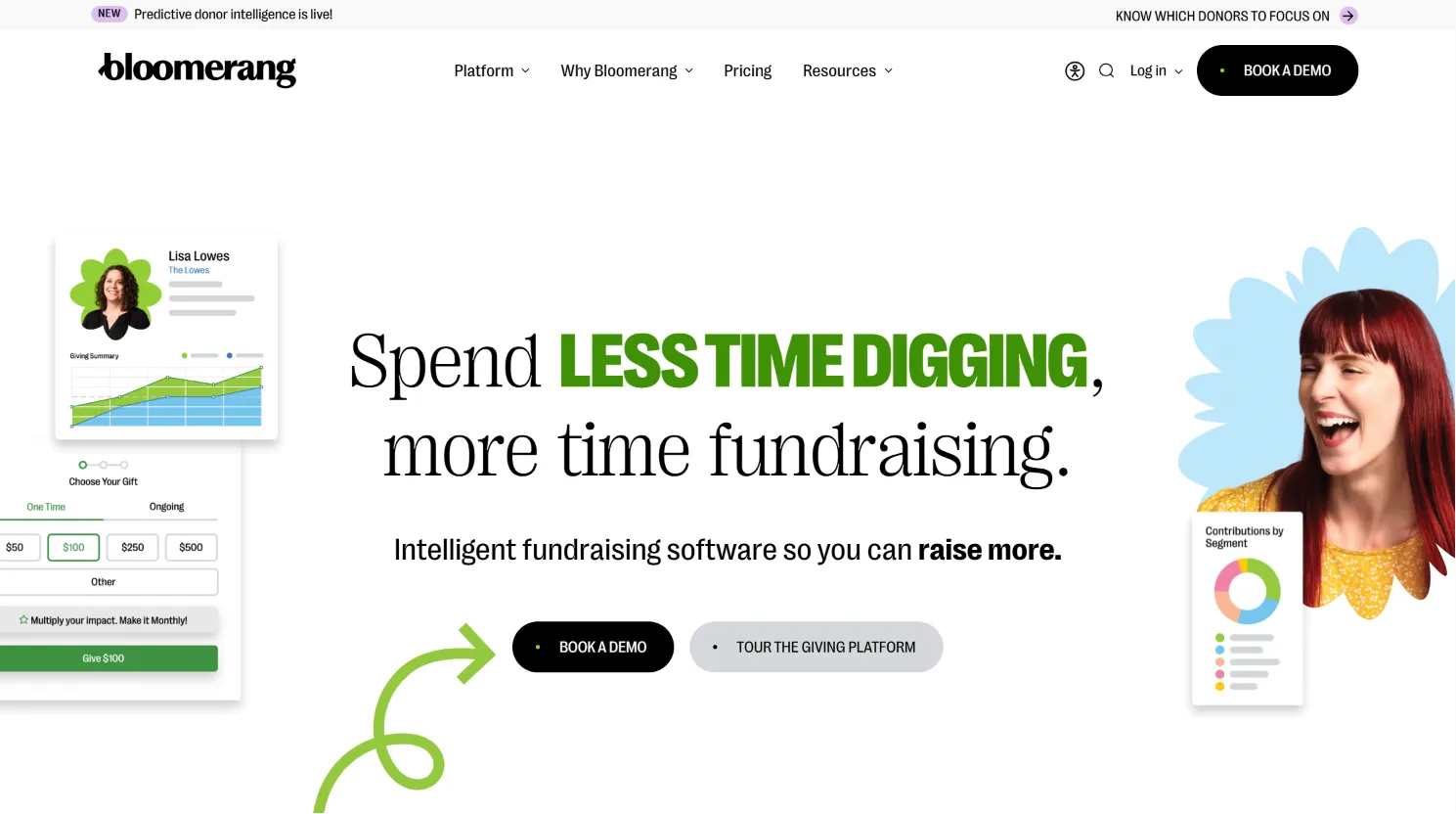
Bloomerang is designed to simplify donor management and fundraising for organizations with limited staff or technical resources. Its intuitive interface, quick setup, and clear focus on donor retention make it one of the most popular Apricot (Bonterra) alternatives for smaller nonprofits. The platform offers donor profiles, timeline-based interaction tracking, and built-in email marketing. You can segment donors, automate thank-yous, and use analytics to track retention rates.
Pricing: Starts at $40/month, up to $125/month (see Costbench).
- Easy onboarding and user-friendly interface
- Strong donor retention tools
- Solid integrations for core nonprofit needs
- Advanced features require higher plans
- Reporting module is less flexible than some competitors
- Custom data exports are limited
On a custom Devaims build, you get only the features you need, no upsell, and avoid the risk of outgrowing your platform and facing a disruptive migration down the line.
2. DonorPerfect (best for growing organizations)
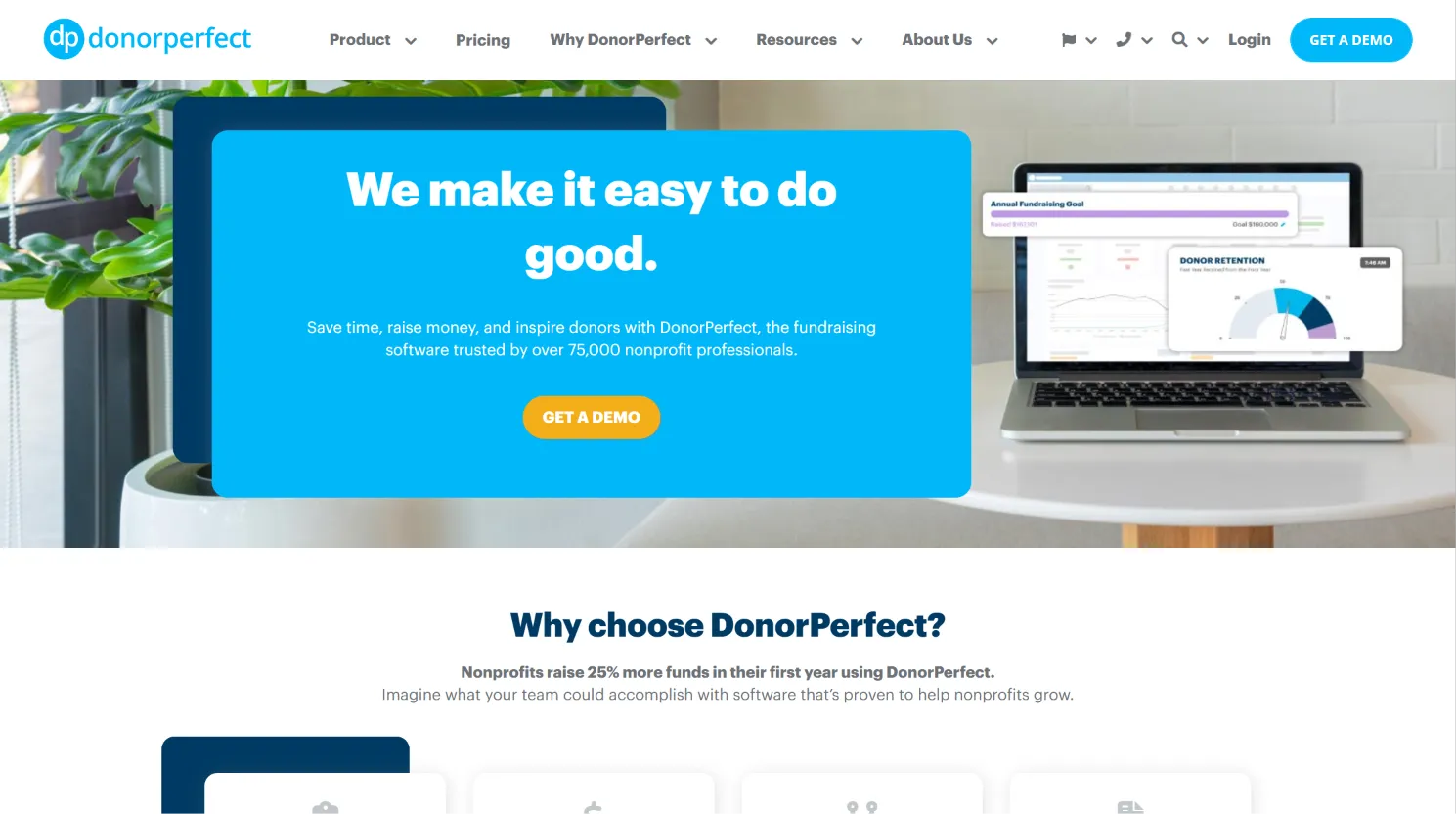
DonorPerfect is a long-established nonprofit CRM with a reputation for reliability and breadth. It offers comprehensive donor and fundraising management, supporting online giving, event registration, volunteer tracking, and grant management. DonorPerfect’s modular approach allows organizations to start small and add features as they grow, which is both a strength and a source of hidden costs.
Pricing: $99/month, $199/month, $649/month tiers (see DonorDock).
- Scalable for growing organizations
- Comprehensive donor and fundraising management
- Responsive support and active user community
- Interface is dated compared to newer tools
- Advanced modules add up in cost
- Customization can be time-consuming
When you own your software, every integration is built for your real workflows, not gated by a vendor’s roadmap or modular upsell model.
3. Salesforce Nonprofit Success Pack (NPSP) (best for large, complex nonprofits)
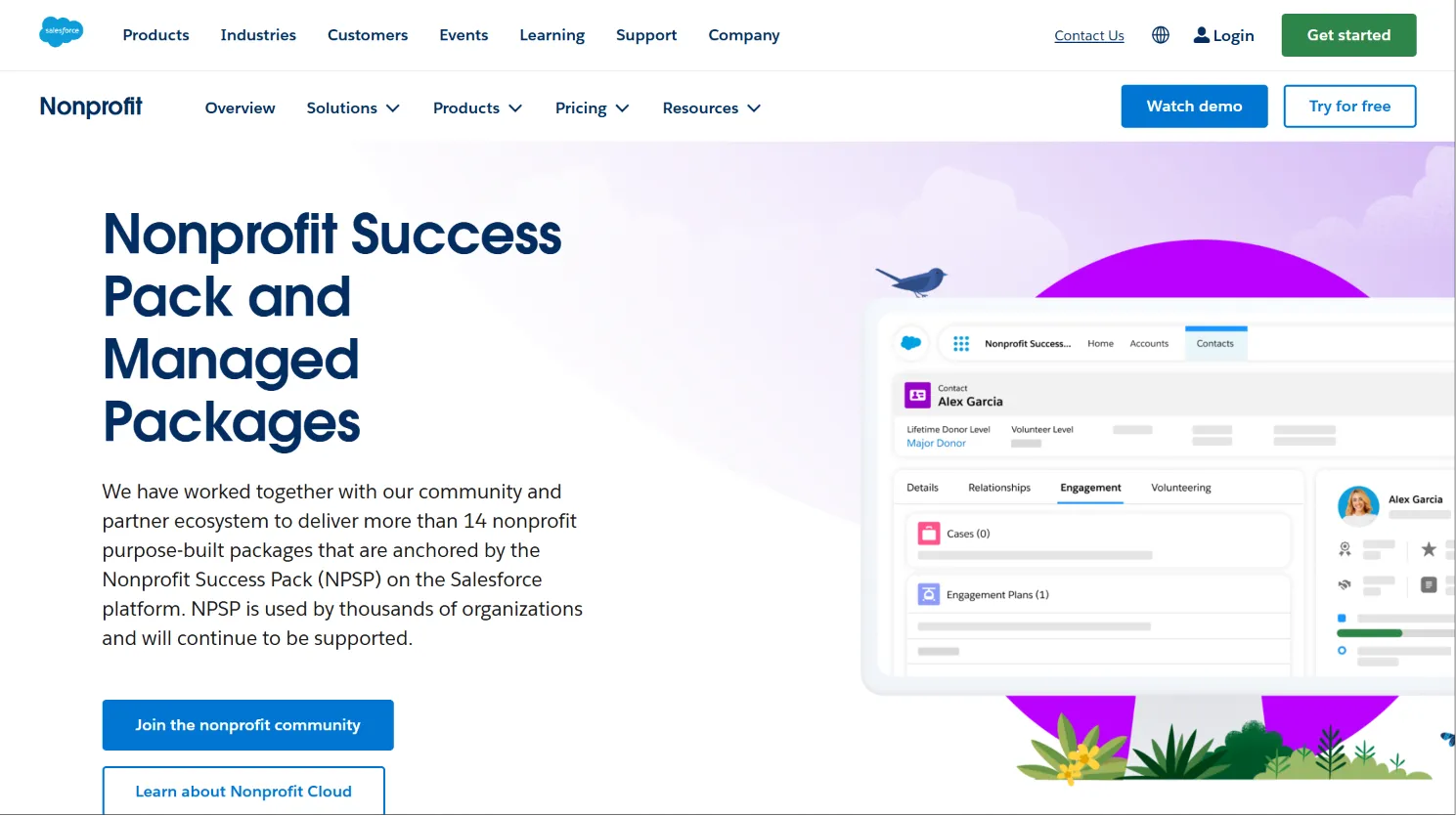
Salesforce NPSP is a CRM platform built for scale, flexibility, and deep customization. It is the only tool in this list that can truly rival enterprise resource planning systems in complexity. NPSP is free for the first 10 users for nonprofits, but real-world use usually requires paid add-ons, consulting, and ongoing admin support.
Pricing: $60 to $165 per user per month; implementation from $30,000 to $100,000+ (see Grantpipe).
- Highly customizable and scalable
- Extensive integrations and automation
- Strong reporting and analytics
- Steep learning curve and ongoing admin needs
- Costs can rise quickly with add-ons
- Complexity can slow down simple tasks
With a Devaims build, you get custom features without the perpetual consultant bill or per-seat pricing, and your system evolves with your needs, not a vendor’s release cycle.
4. Blackbaud Raiser's Edge NXT (best for enterprise fundraising)
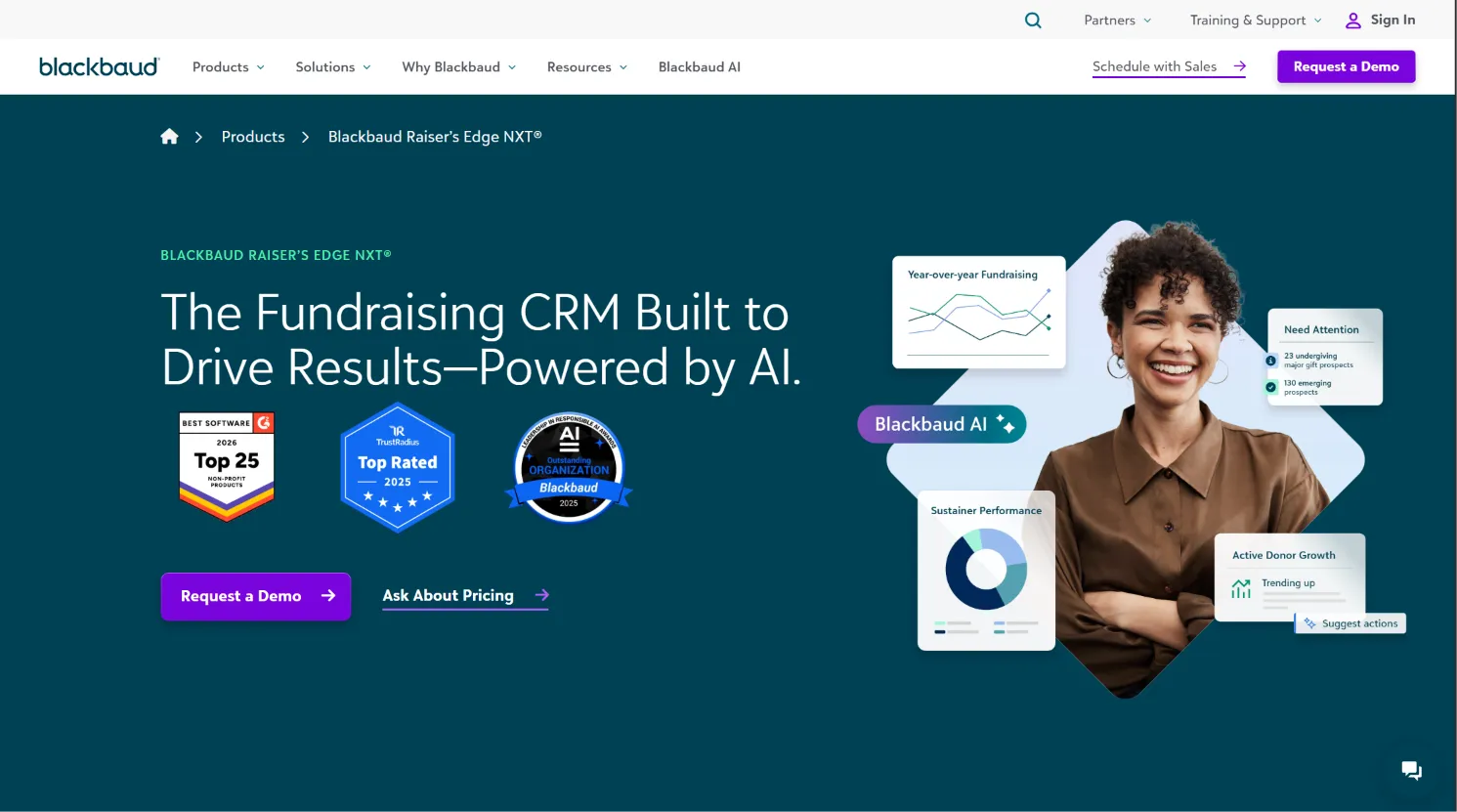
Blackbaud Raiser's Edge NXT is a SaaS CRM focused on large fundraising operations, higher education, and healthcare nonprofits. It is known for its deep donor profiles, powerful segmentation, and sophisticated campaign management. Blackbaud is often chosen by organizations with multi-million-dollar annual fundraising and large development teams.
Pricing: Quote-based, typically $5,000 to $15,000+ per year (see Grantpipe).
- Advanced donor analytics and segmentation
- Strong for large fundraising teams
- Integrates with major accounting and marketing tools
- Opaque pricing and multi-year contracts
- Customizations often require paid development
- Switching away can be costly and time-consuming
Switching to owned software means you are never trapped by a vendor contract, your data, your rules, and no surprise price hikes.
5. Neon CRM (best for flexible donor management)
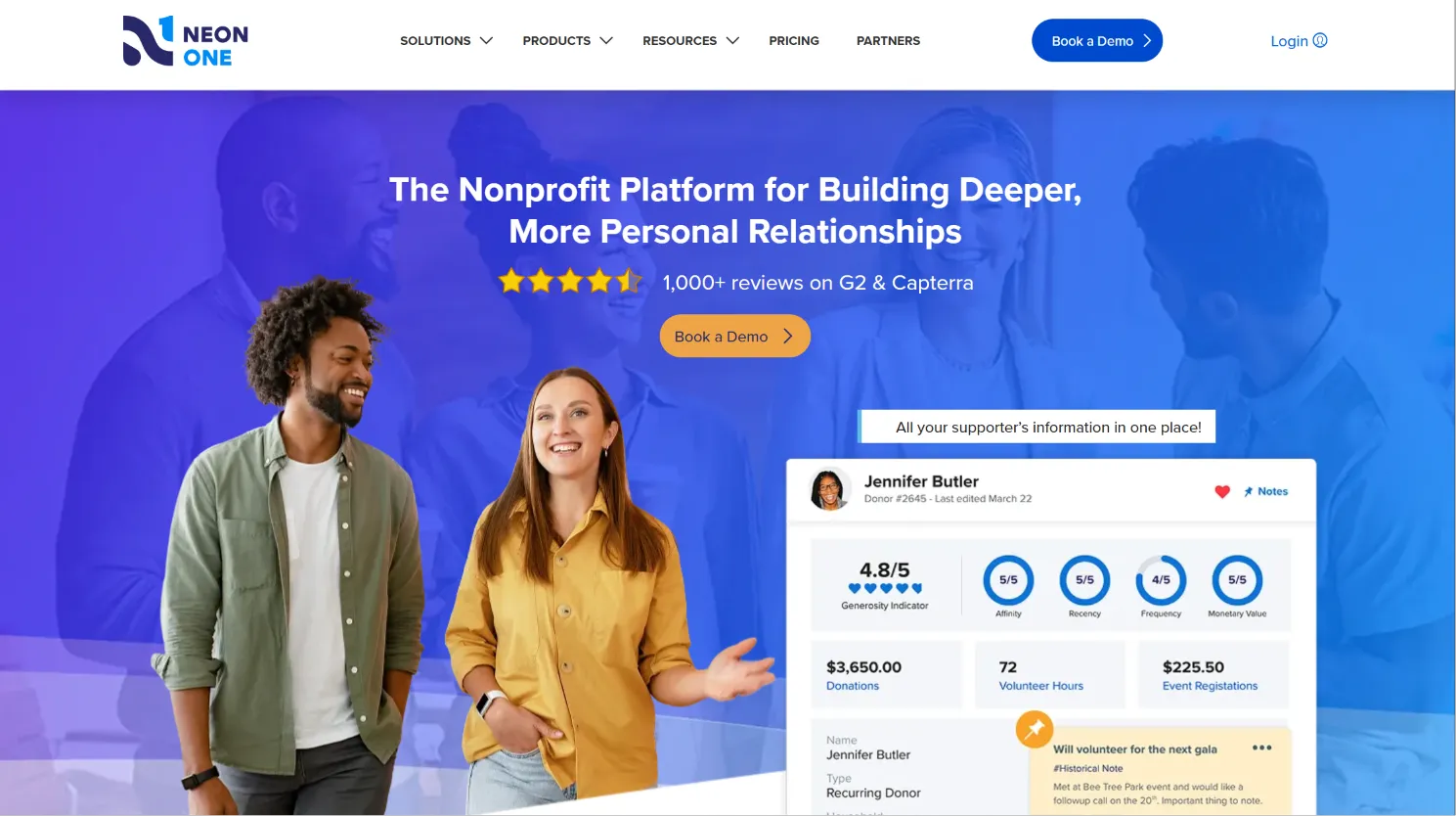
Neon CRM is a cloud-based solution that blends donor management, events, memberships, and email marketing in a single platform. Its flexibility and breadth appeal to nonprofits that need more than just a donor database, but do not want the cost or complexity of Salesforce or Blackbaud.
Pricing: $99/month (Essentials), $209/month (Impact), $409/month (Empower) (see DonorDock).
- Flexible for events, memberships, and donor management
- Customizable reporting and dashboards
- Wide range of integrations
- User interface is less intuitive for new users
- Feature bloat for simple needs
- Advanced automation requires higher plans
6. Little Green Light (best for simple donor tracking)
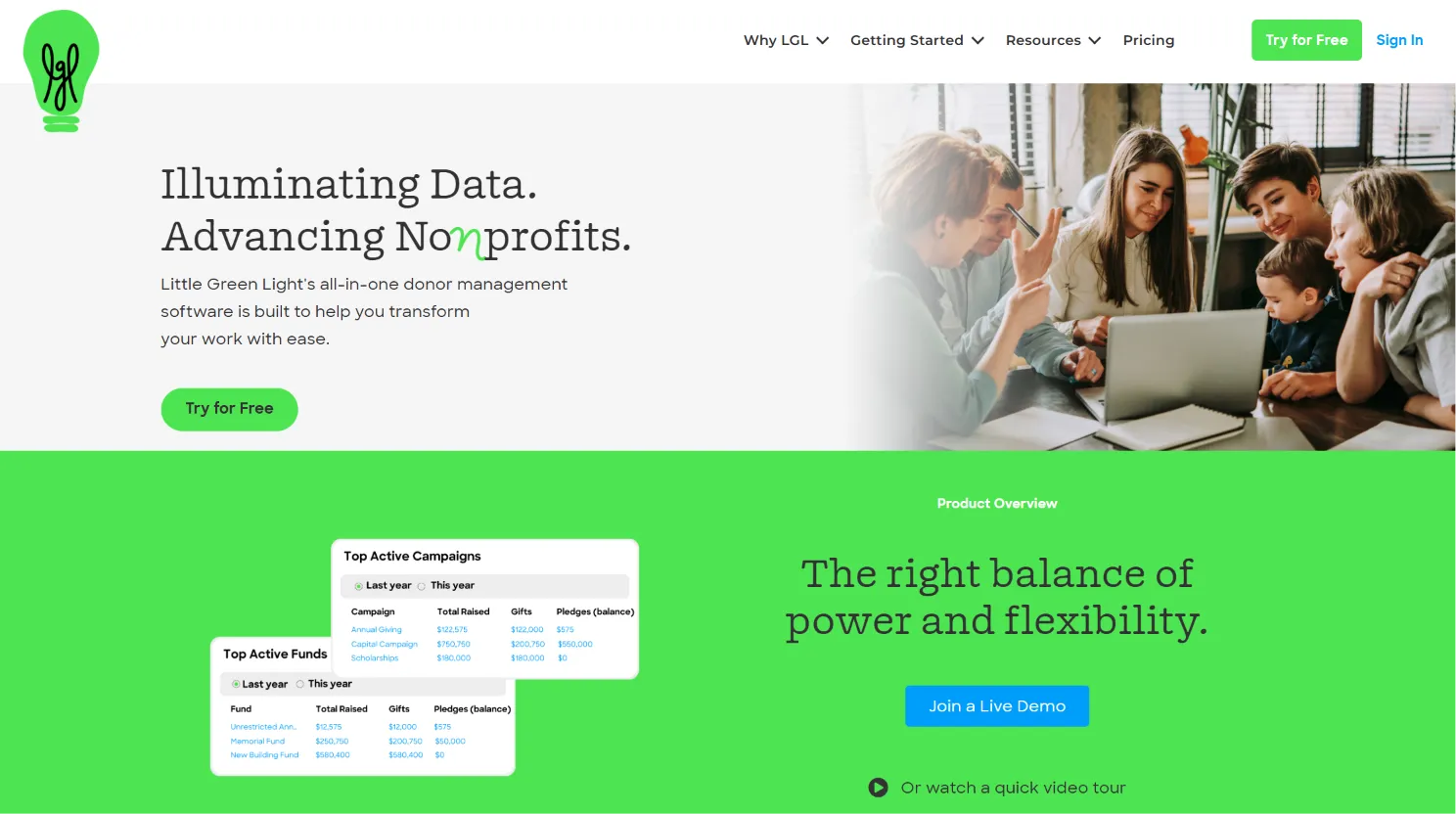
Little Green Light (LGL) is a streamlined platform designed for small nonprofits that need to track donors, gifts, and basic fundraising activities without the complexity of larger systems. Its user-friendly interface and affordable pricing make it a go-to for organizations just getting started with CRM software.
Pricing: $45/month for 2,500 contacts, up to $135/month for 50,000 contacts (see CheckThat.ai).
- Affordable and easy to use
- Good for basic donor tracking
- Simple onboarding and support
- Limited advanced automation and analytics
- May not scale for larger organizations
- Complex migrations require manual adjustment
7. Kindful (best for QuickBooks integration)
Kindful specializes in donor management with a modern UI and a strong focus on integrating with QuickBooks and other accounting tools. It is built for organizations that want to streamline their financial reconciliation and donor data in one place.
Pricing: Starts at $119/month; scales with database size (see Kindful pricing page).
- Excellent QuickBooks integration
- Modern, user-friendly interface
- Solid donor segmentation tools
- Pricing increases as database grows
- Advanced automation requires higher plans
- Reporting options less customizable than some competitors
8. Network for Good (best for all-in-one giving)
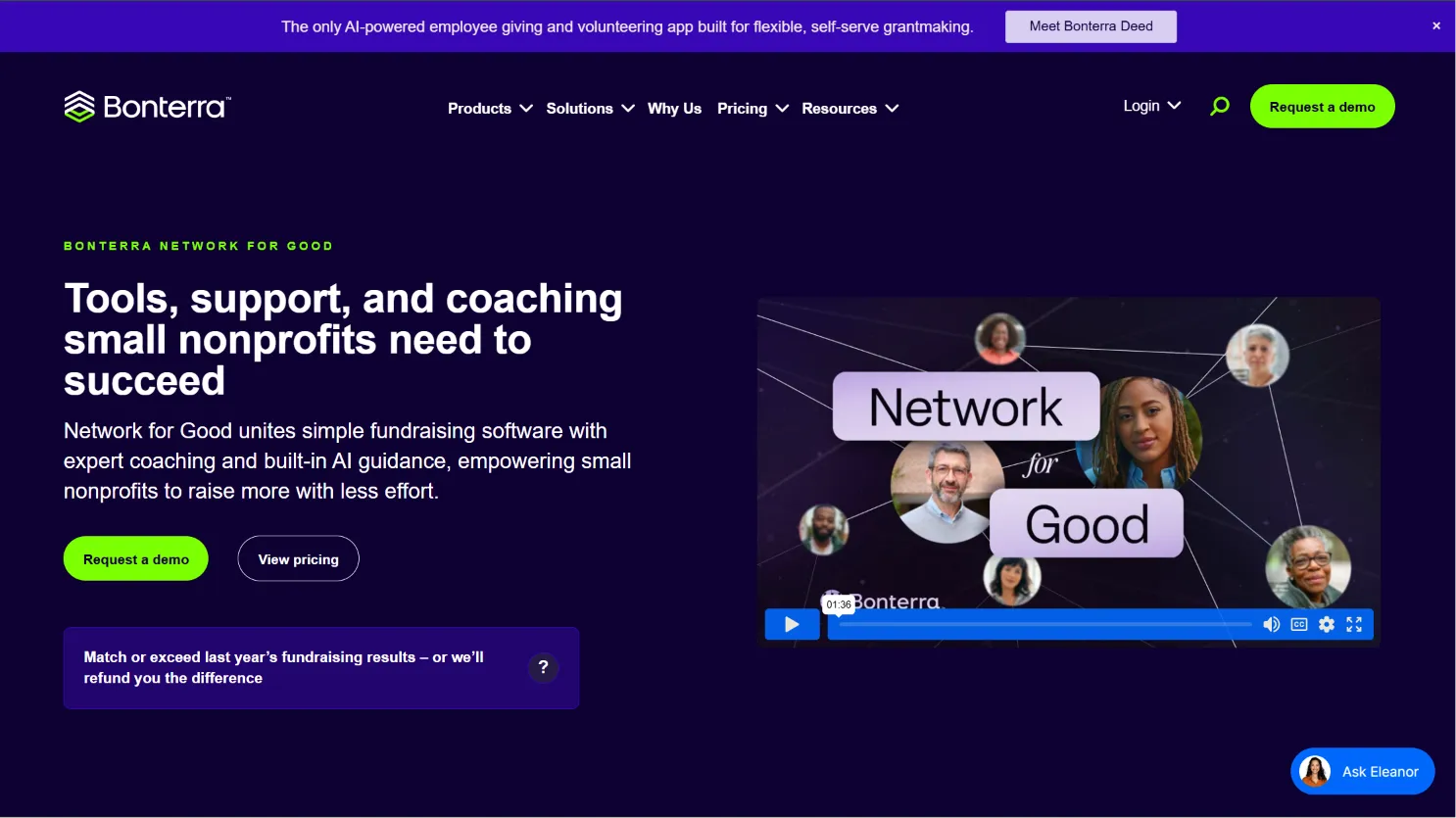
Network for Good is an all-in-one platform that combines donor management, fundraising pages, event ticketing, and communications. It is designed for organizations that want to centralize online giving and donor engagement without managing multiple tools.
Pricing: Starts at $200/month (see Network for Good pricing page).
- All-in-one fundraising and donor management
- Strong coaching and training resources
- Easy-to-use donation pages
- Higher starting price than many competitors
- Customization options are limited
- Integrations are fewer than larger CRMs
9. Givebutter (best for campaign fundraising)
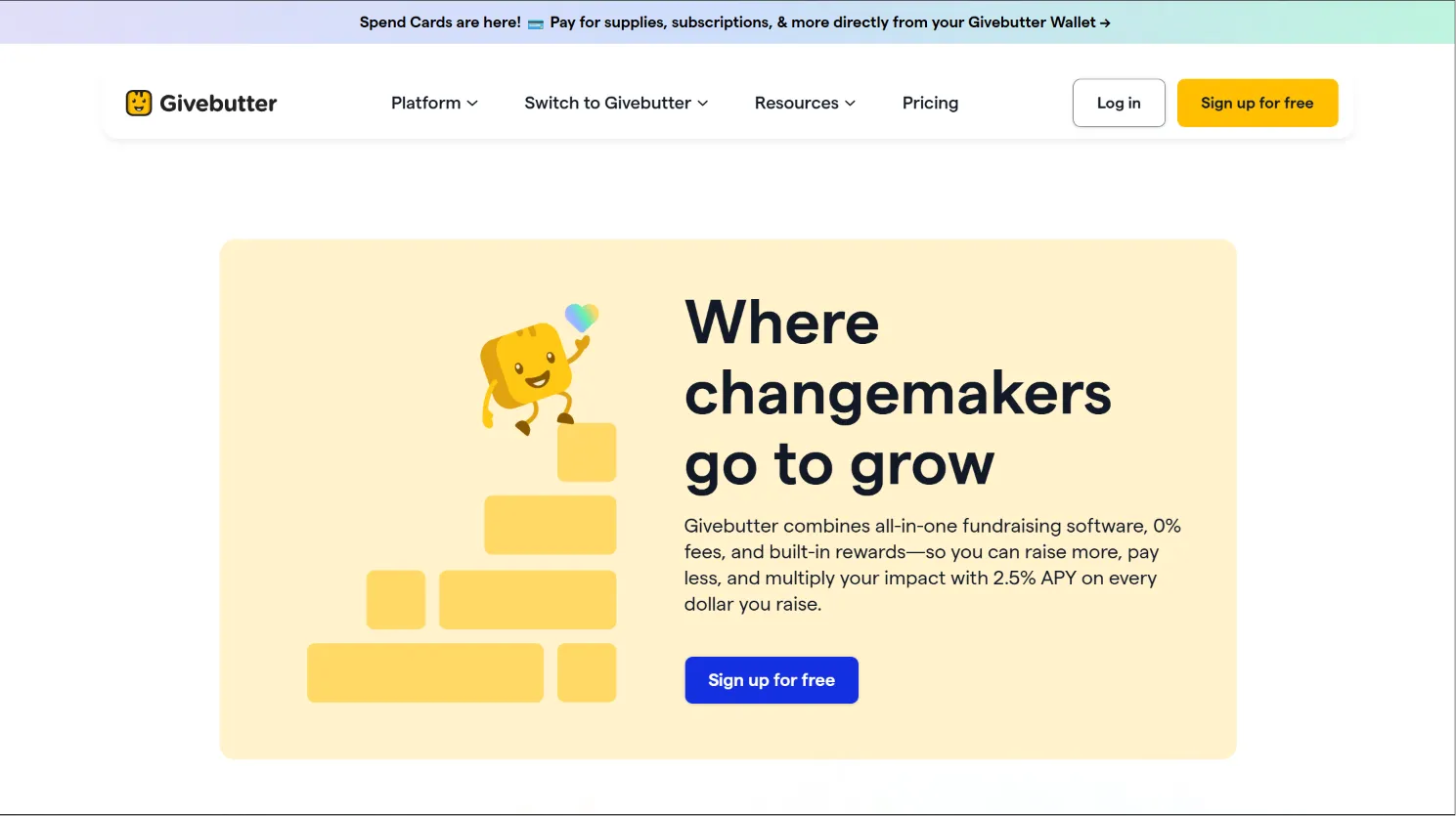
Givebutter is a fundraising platform focused on peer-to-peer, event, and campaign fundraising. It stands out for its modern, social-media-friendly approach and its tip-based pricing model, which can make it free for organizations willing to let donors cover platform costs.
Pricing: Free with tips enabled, otherwise 3% platform fee; Givebutter Plus from $29/month (see DonorDock).
- Modern fundraising pages and campaign tools
- Social sharing and live event features
- Low or no upfront cost for campaigns
- Donor management is basic
- Some features require paid upgrade
- Free plans include Givebutter branding
On software you own, your campaigns look and feel like your brand, not a third-party platform.
10. Devaims (the only option you own outright)
Devaims is the only Apricot (Bonterra) alternative in this list that gives you full ownership of your nonprofit’s software. Instead of renting a platform, Devaims builds a custom CRM tailored to your workflows, data structures, and reporting needs. You pay once for the build, keep the source code, and only cover flat maintenance, no per-user fees, no contract lock-in, and no forced upgrades. Devaims can integrate with your existing tools and migrate all your historical data, including custom fields and attachments.
- One-time build, you keep the code
- Fully custom workflows, fields, and reports
- No recurring license or per-user fees
- Flat, predictable maintenance costs
- Direct support from the team that built it
Other Apricot (Bonterra) alternatives worth knowing
- Virtuous: A CRM focused on mid-sized to large nonprofits with strong marketing automation, journey mapping, and multi-channel donor engagement. Pricing starts higher and is best for organizations ready to invest in growth.
- DonorDock: Lightweight, affordable donor management for micro-nonprofits; simple interface, but not as feature-rich as others here.
- CharityEngine: Powerful but complex, suited to enterprise and direct mail-heavy organizations. Includes integrated payment processing and advanced campaign tools, but requires more training and setup.
How to choose the right Apricot (Bonterra) alternative
- Budget: Are you willing to pay per seat, per contact, or do you want a fixed cost you can plan for? Calculate the five-year total cost, including add-ons and support. Custom ownership (like Devaims) can be cheaper in the long run if you are growing quickly.
- Scale: Do you expect to double your donor base in the next year or need a solution for 500,000 contacts? Some platforms scale gracefully; others become cost-prohibitive or slow as your data grows.
- Reporting and integrations: Are you running complex grants and need custom reporting, or will out-of-the-box templates suffice? If you have specialized reporting needs, make sure your platform supports custom dashboards and exports, or consider custom software.
- Ownership: Is it important that you own your data, workflows, and platform or is renting acceptable? True ownership gives you control over data, features, and future integrations.
- Support and training: Will you need hands-on onboarding, or does your team have the technical chops to handle a more complex system? Factor in the cost and time for staff training, and look for platforms with strong support communities or dedicated account managers.
If you are outgrowing SaaS pricing or want to stop paying for features you never use, owning with Devaims could be your best next move.
Stop paying rent on software you could own
Every SaaS CRM, including Apricot (Bonterra) and its top competitors, locks you into a cycle of monthly fees, surprise add-ons, and contract renewal stress. The more your nonprofit grows, the more you pay, and the more disruptive it feels to switch. Even the newest AI features (like Apricot’s Que assistant) only deepen the lock-in. Over time, the cost of renting can easily eclipse the price of owning, especially for organizations with large contact lists or complex workflows.
Devaims builds custom nonprofit platforms that you own outright, source code, database, integrations, the lot. No per-seat fees, no forced upgrades, and no vendor holding your data hostage. You get exactly the features you need, with the freedom to adapt as your mission evolves.
- Per-unit fees disappear: Add as many users or donors as you want, your costs stay flat.
- No contract lock-in: You own the code, so you decide when or if to change.
- Custom everything: Reports, dashboards, workflows, and integrations built for your real needs, not what fits a vendor’s template.
- Predictable costs: Flat maintenance, no surprise hikes, and no paying for features you never use.
| Tool | Ownership | Recurring fees | Contract lock-in |
|---|---|---|---|
| Apricot (Bonterra) | No | Yes, monthly/annual | Yes, multi-year typical |
| Bloomerang | No | Yes, monthly/annual | No/Yes, depends |
| Salesforce NPSP | No | Yes, per-user | Yes, consultant lock-in |
| Devaims | Yes | Flat, predictable maintenance | No contract, you keep the code |
| Year | Rented (SaaS, cumulative) | Owned (Devaims, cumulative) |
|---|---|---|
| 1 | $12,000 | $27,400 |
| 2 | $24,000 | $29,800 |
| 3 | $36,000 | $32,200 |
| 4 | $48,000 | $34,600 |
| 5 | $60,000 | $37,000 (now ahead) |
For a typical mid-size nonprofit (5,000-10,000 contacts, 10+ users, a couple of integrations), renting a SaaS CRM averages $1,000/month with add-ons. A Devaims custom build runs around $25,000 to $27,400 one-time, plus flat maintenance (here shown as $200/month). By year four, you are saving money, and every year after widens the gap.
Nonprofits with recurring data exports, costly add-ons, or rapid growth see the biggest benefit from owning. If you are ready to run your numbers, let’s talk.
How to switch from Apricot (Bonterra)
- Export your full donor and program data from Apricot (CSV or API export). Review what data you can export, contacts, donations, notes, custom fields, and attachments. Some fields may not export cleanly and will need special handling.
- Choose your new platform and map database fields to avoid data loss. Carefully match each field from Apricot to the new system. For custom workflows or unique data structures, work with your new provider (or Devaims) to create equivalent functionality.
- Import donor, contact, and transactional data into the new CRM. Test imports with sample data to ensure accuracy. For complex migrations, consider a phased approach, import core data first, then add historical or custom data.
- Reconnect donation processors, email services, and integrations. This step often requires updating API keys or credentials and testing to ensure all transactions and communications are flowing properly.
- Train your staff and volunteers on the new system, using sandbox/test environments where possible. Provide documentation and hands-on sessions to minimize disruption. Encourage feedback and adjust workflows as needed.
- Run both systems in parallel for a few weeks to ensure continuity, then cut over and review your contract obligations. This overlap period allows you to catch any missing data or process gaps. Once confident, complete the transition and formally exit your Apricot contract, ensuring you have all necessary data backups.
With a custom Devaims build, the migration is handled as part of the project, with full support for custom data mapping, testing, and staff training.
Frequently asked questions
What is the best Apricot (Bonterra) alternative for small nonprofits?
Bloomerang and Little Green Light are popular Apricot (Bonterra) alternatives for small nonprofits thanks to low starting prices, easy onboarding, and strong support for basic donor management. They are ideal for organizations with limited staff or technical resources. For organizations tired of monthly fees and wanting to own their system, a custom Devaims build is a unique option. With Devaims, even small nonprofits can get a tailored solution that fits their exact workflows and eliminates recurring costs.
Which Apricot (Bonterra) alternative is most affordable?
Givebutter can be used for free if you enable donor tips, making it the lowest-cost option for campaign-based fundraising or events. Little Green Light and Bloomerang offer affordable entry points for ongoing donor management, but costs rise as you add contacts or need more advanced features. Over several years, recurring fees can surpass the cost of a custom solution, especially for growing organizations. If you want to minimize total cost of ownership, consider how long you plan to use the system and whether your database will grow.
Is there a free Apricot (Bonterra) alternative?
Givebutter offers a free tier (with donor tipping), suitable for fundraising campaigns and events rather than comprehensive donor management. Salesforce NPSP is heavily discounted for nonprofits, with the first 10 user licenses free, but real-world use typically incurs costs for implementation, customizations, and ongoing administration. Owning your platform with Devaims means no monthly license fees, but there is a one-time build cost that pays off over time for organizations who plan to stick with the same system for several years or more.
What is the best Apricot (Bonterra) alternative for large organizations?
Salesforce NPSP and Blackbaud Raiser's Edge NXT are leading choices for large, complex nonprofits, offering deep customization, advanced analytics, and scalability. Both require significant investment in setup, training, and ongoing support, and often involve long-term contracts or consultant dependencies. If your organization has unique needs or wants to avoid vendor lock-in, a custom Devaims build offers an alternative: full ownership, custom features, and predictable costs as you grow.
How easy is it to switch from Apricot (Bonterra) to another platform?
Switching can take a few weeks to several months, depending on the complexity of your data and workflows. The process involves exporting your data, mapping fields to the new system, importing and validating records, reconnecting integrations, and training staff. Some data, like custom fields, attachments, or workflow automations, may not transfer directly and require manual recreation. With Devaims, migration is handled by the build team, ensuring all your data (including custom structures) is preserved and your team is trained on the new system.
Can I keep my data if I leave Apricot (Bonterra)?
You can export your data from Apricot (Bonterra), but custom fields, workflows, and attachments may require manual extraction or special handling. Some SaaS platforms limit the completeness of exports or charge extra for comprehensive data dumps. With Devaims, you own all code and data, making future transitions simple and fully in your control. You can export your full database at any time, and custom workflows or reports are yours to keep and modify.
Why would a nonprofit choose to own software instead of rent?
Over five years, SaaS fees can surpass the cost of owning custom software, especially for large or growing nonprofits. Owning means no surprise increases, flat support, and full control over your data and features. It also eliminates contract lock-in and dependency on a vendor’s roadmap. You gain the freedom to adapt your system as your mission evolves, integrate with any tools you choose, and avoid forced migrations or price hikes. Devaims is the only Apricot (Bonterra) alternative in this list that offers true ownership, making it a compelling choice for organizations thinking long-term.
The bottom line
Bloomerang, DonorPerfect, and Salesforce NPSP all compete with Apricot (Bonterra), but every SaaS CRM is a rental, fees never stop, and you are always one renewal away from a budget surprise. Here is the real test: add up what you will pay over five years, including all users, contacts, and add-ons. If that number could have bought you a system you own, you may be ready to stop renting. Owning with Devaims is not just about cost, it is about control, flexibility, and future-proofing your nonprofit’s mission-critical systems. If you want a roadmap to owning (and saving) instead of renting, let’s talk.
See more on the Devaims blog, or read our take on Bloomerang alternatives, DonorPerfect alternatives, and Salesforce NPSP alternatives.